brake fluid AUDI A8 2011 User Guide
[x] Cancel search | Manufacturer: AUDI, Model Year: 2011, Model line: A8, Model: AUDI A8 2011Pages: 302, PDF Size: 76.07 MB
Page 234 of 302
232 Checking and filling
Brake fluid
Checking brake fluid level
The brake fluid level can be checked with a
quick glance .
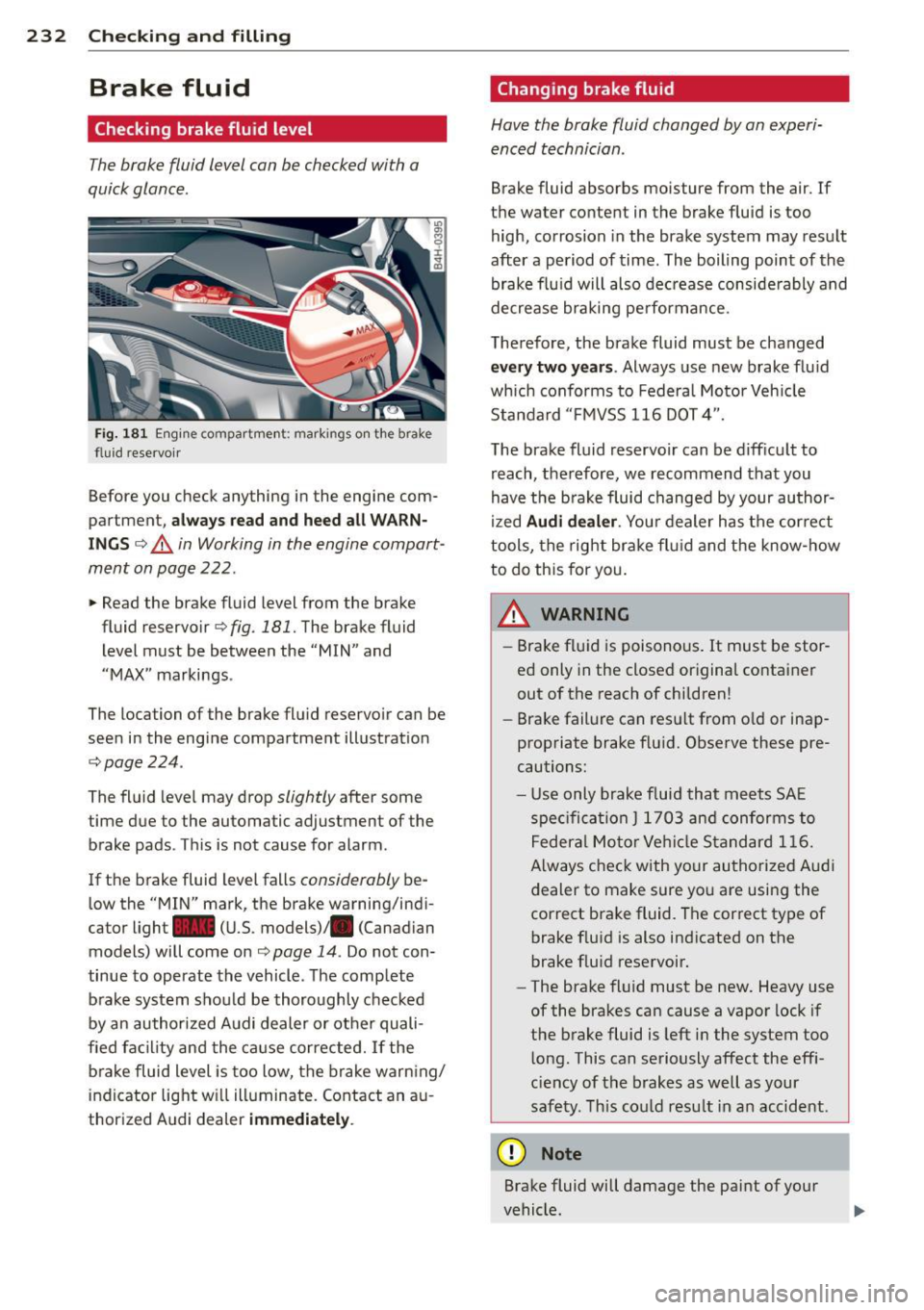
Fig. 181 Engine compartme nt: markings on the brake
flu id reservoir
Before you check anything in the engine com
partment,
always read and heed all WARN
INGS ¢ .&._ in Working in the engine compart
ment on page 222.
.. Read the brake fluid level from the brake
fluid reservoir ¢
fig. 181. The brake fluid
level must be between the "MIN" and
" MAX " markings .
The location of the brake fluid reservoir can be
seen in the engine compartment illustration
c:::,page224 .
The fluid level may drop slightly after some
time due to the automatic adjustment of the
brake pads . T hi s is not cause for alarm.
If the brake fluid level falls
considerably be
low the "MIN" mark, the brake warning/indi
cator light. (U.S. models)/ . (Canadian
models) will come on ¢
page 14. Do not con
tinue to operate the vehicle . The complete
brake system should be thoroughly checked
by an authorized Audi dealer or other quali
fied facility and the cause corrected.
If the
brake fluid level is too low, the brake warning/
indicator light will illuminate. Contact an au
thorized Audi dealer
immediately .
Changing brake fluid
Have the brake fluid changed by an experi
enced technician .
Brake fluid absorbs moisture from the air. If
t he water content in the brake fluid is too
high, corrosion in the brake system may result
after a period of time . The boiling point of the
brake fluid will also decrease considerably and
decrease braking performance.
Therefore, the brake fluid must be changed
every two years . Always use new brake fluid
which conforms to Federal Motor Vehicle
Standard "FMVSS 116 DOT 4".
The brake fluid reservoir can be difficult to reach, therefore, we recommend that you
have the brake fluid changed by your author
ized
Audi dealer. Your dealer has the correct
tools, the right brake fluid and the know-how
to do this for you .
A WARNING
-Brake fluid is poisonous. It must be stor
ed only in the closed original container
out of the reach of children!
- Brake failure can result from old or inap
propriate brake fluid. Observe these pre
cautions:
- Use only brake fluid that meets SAE
specification
J 1703 and conforms to
Federal Motor Vehicle Standard 116.
Always check with your authorized Audi
dealer to make sure you are using the
correct brake fluid. The correct type of brake fluid is also indicated on the
brake fluid reservoir.
- The brake fluid must be new. Heavy use
of the brakes can cause a vapor lock if
the brake fluid is left in the system too
long . This can seriously affect the effi
ciency of the brakes as well as your
safety. This could result in an accident.
(D Note
Brake fluid will damage the paint of your
vehicle.
Page 235 of 302
@ For the sake of the environment
Because of the problem of proper disposa l
of brake fl uid as we ll as the special tools
requ ired and the necessary expert ise, we
recommend that you have t he brake fluid
changed by your author ized Audi dealer .
Battery
General information
Under normal operating conditions, the bat
tery in your Audi does not need any mainte
nance. With
high outside temperatures or
long daily dr ive s we recommend that you have
the electro lyte level checked by a service fa
cility . The electrolyte level shou ld a lso be
checked each time the battery is charged
¢ page 235.
Have the battery checked when you take your
ve hicle in for service . Yo u are well adv ised to
replace a battery that is older than 5 yea rs .
W ith certa in types of a irbag deployment, t he
b attery is d isconnected from the vehicle elec
tr ica l system for safety reasons¢.&.
in Re
pair, care and disposal of the airbags on
page 159.
Disconnecting the battery terminals
Some vehicle functions (power w indow regu
lators , for example) are lost if the battery ter
m inals a re d isconnected. These func tions have
to be re lea rned after the batte ry term inals a re
connected agai n. T o prevent this , the bat tery
should only be d isconnec ted from the vehicle
e lec tric al system when absolu tely necessa ry
for repairs .
Vehicles not driven for long periods
If you do not drive you r vehicle over a period
of severa l days or weeks, elec trical compo
nen ts are gr adually cut b ack o r swi tched off .
This redu ces energy cons umption and main
tains starting capab ility over a longer per io d
¢ page 195.
Be aw are tha t when you unlock yo ur vehicle ,
some of the conven ien ce f unct ions may no t
Checkin g and fillin g 233
opera te , such as the Conven ience key*, the re
mote control or the power seat adjustment .
T he convenience functions will be ava ilab le
again when you switch on the ign ition and
start the eng ine.
Winter operat ion
D uring the w inte r mon ths, bat tery capacity
tends to dec rease as temperatures drop . This
is beca use more power is a lso consumed wh ile
starting, and the headlights, rear window de
fogger, etc., are used more often.
Avoid unnecessary powe r consum ptio n, pa r
ticu lar ly in city traffic or when traveling only
short distances. Let your autho riz ed Audi
dealer check the capacity of the vehicle bat
te ry before w inter sets in¢
page 235 . A well
c h arged battery will not on ly prevent s tarti ng
problems w hen the weather is cold, but wi ll
also last longer.
(D Tips
If you r vehicle is left s tandi ng for seve ral
weeks at extremely low temperatures, the
vehicle ba ttery s hould be removed an d
s to red w here i t w ill not fr eeze . T his w ill
p revent it from be in g damaged and having
to be replaced.
Working on the battery
Be especially careful when working on or near
the bat tery.
T he battery is lo cated in the l uggage compa rt
ment unde r the floo r. B efo re you che ck a ny
thi ng in the luggage com partmen t,
read and
heed all WARNINGS
¢ .&, .
Alw ays heed t he safety warning s, when work
ing on the vehicle b atte ry or the vehicle e lec -
t rical system to prevent i njury. .,..
•
•
Page 248 of 302
246 Tires and wheels
valve stem caps on all wheels are secure ly
mounted on the valve .
@ For the sake of the environment
Underinflated tires will also increase the
fue l consumption.
Tires and vehicle load limits
There are limits to the amount of load or
weight that any vehicle and any tire can carry.
A vehicle that is overloaded will not handle
well and is more difficult to stop. Overloading
can not only lead to loss of vehicle control, but can also damage important parts of the
vehicle and can lead to sudden tire failure, in
cluding a blowout and sudden deflation that
can cause the vehicle to crash.
Your safety and that of your passengers also
depends on making sure that load limits are
not exceeded. Vehicle load includes everybody
and everyth ing in and on the vehicle. These
l oad limits are techn ica lly referred to as the
vehicle's
Gross Vehicle Weight Rating
("GVWR").
The "GVWR" includes the we ight of the basic
vehicle, all factory installed accessories, a full
tank of fuel , oil, coo lant and other fluids plus
maximum load. The maximum load includes
the number of passengers that the vehicle is
intended to carry ("seating capacity") with an
assumed weight of 150 lbs (68 kg) for each
passenger at a des ignated seat ing pos ition
and the tota l we ight of any luggage in the ve
hicle. If you tow a trailer, the weight of the
trailer hitch and the tongue weight of the
l oaded trailer must be included as part of the
vehicle load.
The
Gross Axle Weight Rating ("GAWR") is
the maximum load that can be applied at each
of the vehicle's two axles.
The G ross Vehicle Weight Rating and the
Gross Axle Weight Rating are listed on the
safety compliance sticker labe l located on the
driver's side B-p illar. You r A udi has 5 seat ing
positions, 2 in the front and 3 in the rear for
total seating capacity of 5. Vehicles with pow- er individual rear seats* have
4 seating posi
tions,
2 in the front and 2 in the rear for total
seat ing capac ity of
4. Each seating position
has a safety belt¢
page 137, Safety belts.
The fact that there is an upper limit to your
vehicle's Gross Vehicle Weight Rating means
that the total weight of whatever is being car
ried in the vehicle (including the weight of a
trailer hitch and the tongue weight of the
loaded trailer) is lim ited . The more passen
gers in the vehicle or passengers who are
heavier than the standard we ights assumed
mean that less we ight can be carried as lug
gage.
The tire pressure label on your Audi also lists
the max imum combined weight of a ll of the
occupants and luggage or other cargo that
the vehicle can carry. For the location of the
label¢
page 242, fig. 184.
A WARNING ,___
Overloading a vehicle can cause loss of ve
h icl e contro l, a crash or other accident, se
rious personal injury, and even death.
- Carrying more weight than your vehicle
was designed to carry will prevent the
vehicle from handling properly and in
crease the risk of the loss of vehicle con
trol.
- The brakes on a vehicle that has been
overloaded may not be able to stop the
veh icle with in a safe distance.
- Tires on a vehicle that has been overload
ed can fail suddenly, including a blowout
and sudden deflation, causing loss of
control and a crash.
- Always make sure that the total load be
ing transported -including the weight of
a trailer hitch and the tongue we ight of a
loaded trailer -does not make the vehi
cle heavier than the vehicle's G ross Vehi
cle Weight Rating.
Page 251 of 302
A WARNING
Sudden tire failure can lead to loss of con
trol, a crash and serious personal injury!
- Never drive a vehicle when the tread on
any tire is worn down to the wear indica
tors.
- Worn tires are a safety hazard, they do
not grip well on wet roads and increase
your risk of "hydroplaning" and loss of
control.
- Always keep chemicals that can cause
tire damage, such as grease, oil, gasoline
and brake fluid away from t ires.
- Tires age even if they are not be ing used
and can fail suddenly, especially at high
speeds . Tir es that are more than 6 years
old can only be used in an emergency
and then with special care and at lower
speeds.
- Never mount used tires on your vehicle if
you are not sure of their" previous histo
ry ." Old used tires may have been dam
aged even though the damage cannot be
seen that can lead to sudden tire failure
and loss of vehicle control.
Tires and wheels 249
New tires and replacing tires and wheels
New tires and wheels have to be broken in .
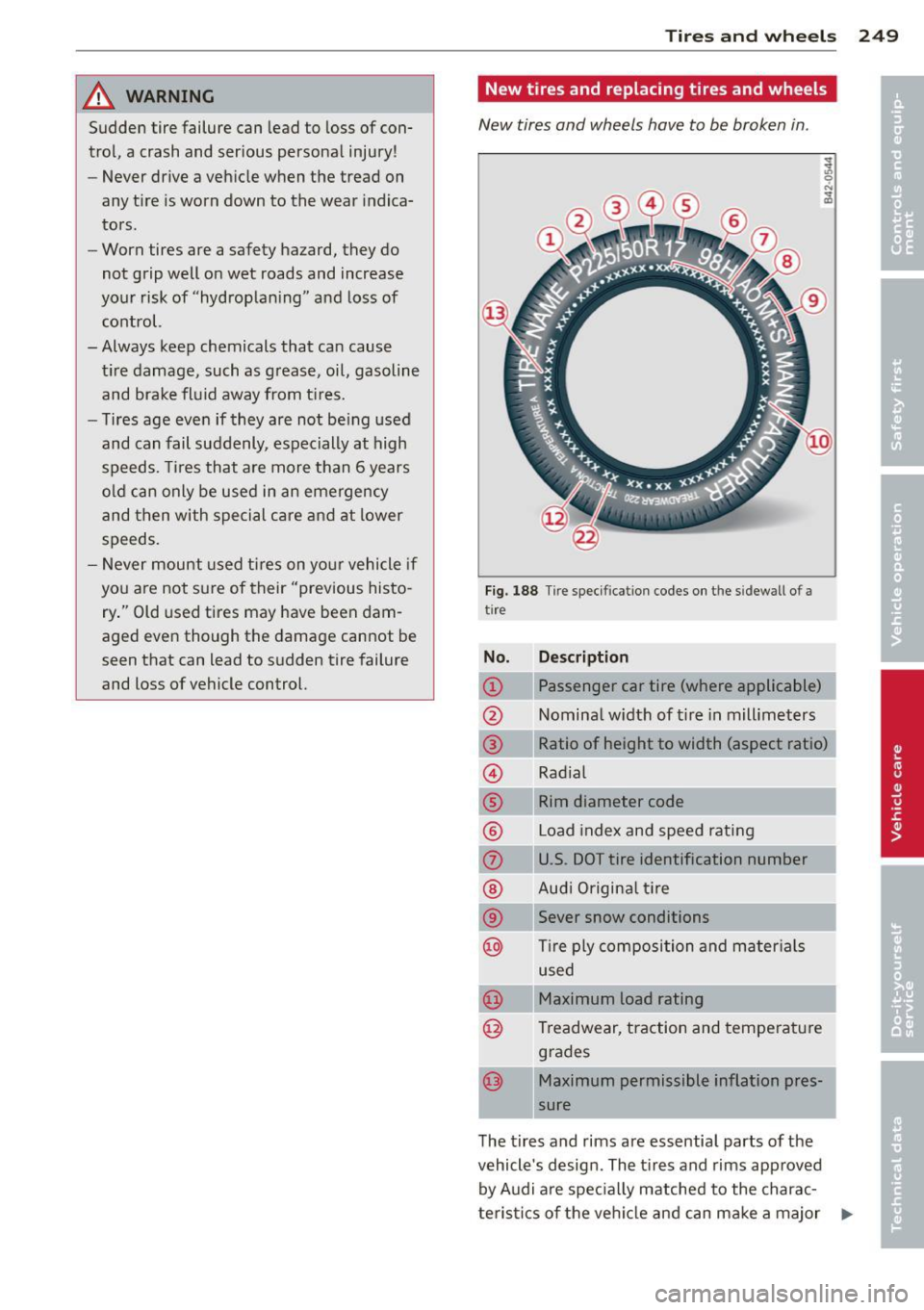
Fig. 188 Tir e specificat ion codes on t he s idewall o f a
tire
No. Description
CD Passenger car tire (where applicable)
@ Nominal w idth of tire in millimeters
® Ratio of height to width (aspect ratio)
© Radial
® Rim diameter code
® Load index and speed rating
(f) U.S. DOT tire identification number
® Audi Origina l tire
® Sever snow conditions
@ T ire ply composition and materials
used
@ Maximum load rating
@ Treadwear, traction and temperature
grades
@ Maximum permissible inflation pres-
sure
The tires and rims are essential parts of the
vehicle's design . The tires and rims approved
by Audi are spec ially matched to the charac
teristics of the vehicle and can make a major .,.
•
Page 272 of 302
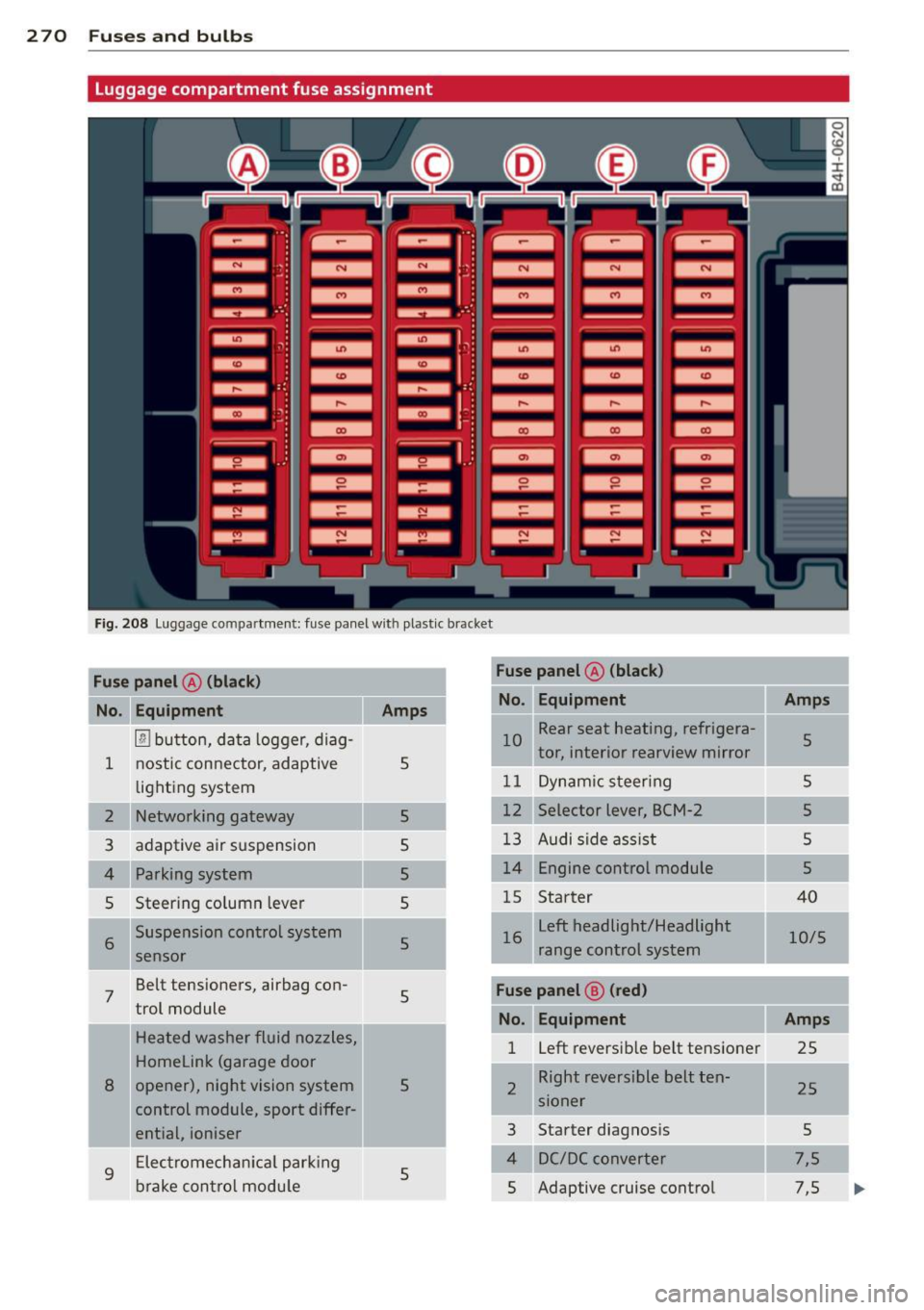
2 70 Fu ses and bulb s
Luggage compartment fuse assignment
Fig. 208 Luggage co mpar tment: fuse panel with plastic b racket
Fu se pan el A (black ) Fuse panel
@ (b lac k)
I
No.
Equ ipment Amps No
. Equipment
Amps .
l!l button, data logger, diag-
1 nostic con
nector, adaptive
5 10
Rear seat heating, refrigera-
5 j tor, interior rearview mirror
lighting system 11 Dynam
ic steer ing 5
2 Networking gateway
5 12
Selector lever, BCM-2
5
3 adaptive air suspension
5 13 Audi side ass
ist 5
4 Parking system 5 14 Engine control module
5
5 Steering column
lever
5 1
5 Starter 40
I 6 Suspension control system
5
sensor left headlight/Headlight
'
16
10/5
range control system
.
7 Belt tensioners, airbag con-
5
trol module Fuse pan el@ (red)
No. Equipment Amps
Heated washer fluid nozzles,
Homelink (garage door
8 opener), night vision system
5
control module, sport differ- 1
left reversib
le be lt tens ioner
25
2 II
R_ight reversible belt ten-
25
s1oner
ential, ioniser 3
Starter diagnos
is
5
9
Electromechan ica l park ing
5
brake con tro l module 4 DC/DC converter
7,5
5 Adaptive cruise control 7,5
Page 287 of 302
-Always make sure the transm ission se
lector lever (automatic transmiss ion) is
in "P" (Park position) and the park brake
is firm ly app lied .
@) For the sake of the environment
-Changing the eng ine settings w ill ad
versely affect em ission levels. This is det
rimental to the environment and increas
es fue l consumption .
- Always observe env ironmental regula
tions when d ispos ing of old engine oil,
used b rake fluid , dirty engine coola nt,
s p ent batter ies or wo rn o ut t ires.
- Undeployed airbag modules and preten
s ioners mig ht be classified as Perchlo
r ate Mate rial -spec ia l hand ling may ap
ply, see www.dts c.ca .gov/ha za rdous
w aste/perch lor ate. W hen the veh icle or
par ts of the res traint system in cl udi ng
a irbag modules safety be lts wit h preten
s ioners are scra pped, all app lica ble laws
and regulations must be observed. Your
a uth orized Audi dea ler is familiar w ith
t h ese req uirements and we recommend
that you have your dea le r perfo rm this
se rv ice for you .
Additional accessories,
modifications and
parts replacement
Additional accessories and parts
replacement
Always consult an authori zed Audi dealer be
fore purchasing acce ssories.
Your veh icle inco rporates the lates t safety de
sig n featu res e nsu ring a high standard of ac
t ive and passive safe ty .
This safety could be comp romised by non-ap
p roved changes to t he ve hicle. For this reason ,
if pa rts have to be replaced, please observe
t he following points when ins tall ing addition
a l accessories:
Con sumer In formation 285
Approved Audi accesso ries and genuine Aud i
parts are available from authorized A udi deal
ers .
T hese de alers a lso have the necessary facili
ties, tools and tra ined spec ialists to ins tall the
parts and accessories p roper ly .
A WARNING
Using the wrong spare pa rts or using non
approved accessories can cause damage to
the vehicle and ser ious persona l injury.
- Use on ly accessories express ly approved
by Audi and ge nuine Audi spare parts
- These parts and accessories have been
specially designed to be used on yo ur ve
h icle .
- Never install accessor ies such as tele
phone crad les or beverage ho lders o n ai r
bag covers or withi n the airbag deploy
ment zones . Do ing so w ill increase t he
ris k of injury if a irbags are triggered in an
accident!
- Before you check anything in the engine
compa rtme nt, always r ead an d heed a ll
W ARNI NGS
<::;>page 216 .
(D Note
-If items other than genu ine A udi spare
par ts, add-on equipmen t and accessory
items are used o r if repair wo rk is not
performed a ccord ing to spe cified met h
od s, this ca n resu lt in s evere da mage to
yo ur vehicle's engine and bo d y (s uch as
co rrosi on) and adve rsely affect yo ur vehi
cle's warranty .
- The innovat ive a luminium con cep t of
yo ur Audi AS means t hat all se rvicin g, re
pairs or other work on the vehicle body
must be carr ied out exclusive ly by an Au
di workshop .
- If emergency repa irs must be performed
elsewhere, have the veh icle examined by
an authorized Audi dealer as soon as
possible .
- The manufacturer cannot be held liable
for damage wh ic h occurs due to failure
t o comply with these stipu lations .
•
•
Page 290 of 302

288 Index
Average consumption ........ ... .... .. 24
Average speed . . . . . . . . . . . . . . . . . . . . . . . 24
Avoid damaging the vehicle .. .. .. .. .. . 198
B
Battery 233
Charging ................... ..... . 235
Important warnings ...... .. .. .. .. . 233
Location . ................. .. .... . 233
low . .. .... .......... ...... ... .. . 195
Replacing the battery ...... ..... .. . 236
State of charge ............... .. ... 195
W inter operation ....... .. .. .. .. .. . 233
Working on the battery .... .. .. .... . 233
Before driving .. ... .... .... .. .. .. .. . 127
Blended gasoline .................. . 218
Blower (automatic climate control) . . . . . . 76
Body cavity sealing ......... .. .. .... . 211
Booster seats
Brake fluid 177
Changing the brake fluid ....... .. .. . 232
Check ing the brake fluid level . .. .. .. . 232
What is the cor rect brake flu id level? . . 232
What should I do if the brake fluid warn-
ing light comes on?
........ .... ... . 232
Brake system Anti-lock braking system . . . . . . . . . . . . . 19
Brake assist system ....... .. .. .... . 190
Brake booster ............ .. .. .. .. . 193
Brake fluid ............... ... .... . 232
Brake fluid specifications for refill and re-
placement ............... ... .... . 232
Brake light defective ...... .. .. .. .. .. 21
Brake pads ... ........... .. .. .... . 197
Electromechanical park ing brake .. .. . . 81
Fluid reservoir ............... .. ... 232
H ow does moisture or road salt affect the
brakes? .. ............... .. .. .... . 192
Warn ing/ indicator lights ... .. .. .... . . 14
Worn brake pads symbol ... .. .. .. .. . . 19
braking guard Messages
Sett ings
. .. ... .......... .. .. .. .. ..
86
93
93
Break-in period . ........... .. .. .... . 197
Brake pads . ... ....... ... .. .. .. .. . 197
Tires 197
Bulbs ..... .. ................ ..... . 272
C
California Proposition 65 Warning ... .. 223
Battery specific . ................. . 235
Capacities .. .. .. .. .... ...... ... .. . .
Engine oil ... .. . .. ............ .. . .
Car care .... .... .................. . 282
224
206
Exterior ....... .. .......... ...... . 206
Interior ..... .. .. ....... ...... .. .. 212
Car carrier Transporting your vehicle ....... .. .. 277
Catalytic converter .............. ... . 198
Center armrest Cockpit ....... .. ..... ........... .. 57
Rear . .. .. .. .. .. ............. .. .. . 63
Central locking . . . . . . . . . . . . . . . . . . . . . . 31
Emergency locking ............. .... . 35
Certification . . . . . . . . . . . . . . . . . . . . . . . 286
Changing a wheel .. ................ . 262
Changing engine oil ............. .... 228
Chassis (undercoat ing) ........... .. . .
Check ing
Engine coolant level ...... ...... .. . -
Tire pressure . .. .. ............. .. . .
Child restraints Danger of using child restraints in the
front seat ..... .. .......... ...... .
Where can I get additional information
about child restraints and their use? ..
Child restraint system anchors .... .. . .
Child safety ... .. .. ................ .
Convertible locking retractor ........ .
Guidance fixtures for lower anchorages
I mportant safety instructions for using
child safety seats .............. ... .
Important things to know when driving
with children . ... ....... .... --. - . - 212
229
244
14
7
187
181
169
178
183
172
169
Tether anchors . .. .......... ...... . 185
Tether straps .. .. ... .. ..... ... .. .. 185
Child safety lock Rear doors (mechanical) ........ .... . 38
Rear doors (power) ...... ...... .. . - - 38
Child safety seats . . . . . . . . . . . . . . . . . . . 17 4
Booster seats . . . . . . . . . . . . . . . . . . . . . 177
Convertible child seats ......... .... 175
Convertible locking retractor ..... .... 178
Page 293 of 302

Pressure malfunction ................ 16
Recomm end ed oil check int ervals .. .. . 227
Senso r defective . . . . . . . . . . . . . . . . . . . . 20
Spe cificat ion and visco sity .. .. .. .. .. . 224
En gin e speed limitat ion ..... .. .. .. .. .. 20
Eng ine start system (indicator lights) .... 17
Entry assistance . . . . . . . . . . . . . . . . . . . . . 60
Environm ent
Break-in period ......... .. .... .. .. . 197
Cata lytic converter .......... .. .... . 198
Disposing of your vehicle battery .... . 236
Driving at high speeds ........... .. . 200
Driving to minimize pollution and noise 199
Fuel ... .. .. .. .. ........... .. .. .. . 220
Fuel economy ............ .... .. .. . 199
Leaks under your veh icle ...... .. .... 222
Lettin g the vehicle stand and warm up. 200
Proper disposal of drained brake fluid . 232
Proper disposal of drained engine cool-
ant ... .. .. .... ............. .. .. . 230
Proper disposal of drained engine
oil . . . . . . . . . . . . . . . . . . . . . . . . . 227, 228
Recycling used engine oil ... .. .. .. .. . 227
Unleaded fuel ............ .... .. ... 218
What should I do with an old battery? . 236
ESP (Electronic stabilization program)
Warning/indicator lights ... .. .. .. .. .. 18
Event Data Recorder (EDR) ...... .. .... 190
Exhaust tail pip es .......... .... .. .. . 212
Expa nsion tank ............ .. .. .. .. . 229
Exterior lighting .............. ... ... . 43
Exterior mirrors
Ad justing .. .. ........... .. .. .. .... 51
Dimming . .. ............. .... .. .... 51
H eating .. .. ............. .... .. .... 51
Exterior temperature display ... .. .. .. .. 23
F
Fast ening
Booster seats .. .......... .. .. .. .. . 17 7
Convertible child safety seats ..... .. . 175
Infant seats . ............ .. .. .. ... 174
Floor mats . .. ............. .... .. .. . 133
Foot pedals .. .... ......... .... .. .. . 132
Index 291
For the sake of the environment
Gasoline fumes and the environment .. 220
Reducing engine noise by early upshift-
ing ......... .. .. .................. 10
Refueling ... .. .. .... ............. 220
Saving fuel by early upsh ifting ...... .. 10
Four zone automatic climate control .. ... 75
Front airbags Description . . . . . . . . . . . . . . . . . . . . . . . 149
How they work ... .. . .......... .... 1S4
Frontal coll is ion s and the laws of physics 138
Front passenger seat adjustment . . . . . . . 60
Front seats . . . . . . . . . . . . . . . . . . . . . . . . . S4
Adjus ting ... .. .. .. .. ........... .. 129
Child restraints in the front seat ...... 147
Fuel Additives ........ .. ............... 218
Blended gasoline .................. 218
Current consumpti on ........... .. .. . 24
Economy messages (efficiency program) 25
Fuel filler flap emergency release ... .. 221
Fuel filler neck ...... .... ...... .. .. 219
Fuel gauge . . . . . . . . . . . . . . . . . . . . . . . . 11
Gasoline .. .. .. .. .. .. ........... .. 218
Gasoline addit ives ................. 219
Low fuel level symbol . . . . . . . . . . . . . . . 20
Octane rating .. .. .. . .. .. ...... .. .. 218
Recommendation ................. . 218
Refuelling ... .. .. .... ............. 220
Reserve ..... .. .. ................. . 11
Ta nk capacity . . . . . . . . . . . . . . . . . 11, 282
Fuses Ass ignment ...... ............... . 268
Replacing ... .. .. ... ............ .. 268
G
Garage door opener (Homelink ®) .. ... . 124
Garment hooks .. .. ................. . 71
Gas discharge lamps .... ............. 272
Gauges Engine coolant temperature . . . . . . . . . . 10
Fuel gauge . . . . . . . . . . . . . . . . . . . . . . . . 11
Speedometer . . . . . . . . . . . . . . . . . . . . . . 26
Tachom eter ... .. ................. . 11
T rip odometer . .. .... ........... .. . 26
General illustration . . . . . . . . . . . . . . . . . . . 8
Generator (warning/indicator lights) ... . 16
•
•