seats AUDI A8 2011 User Guide
[x] Cancel search | Manufacturer: AUDI, Model Year: 2011, Model line: A8, Model: AUDI A8 2011Pages: 302, PDF Size: 76.07 MB
Page 65 of 302
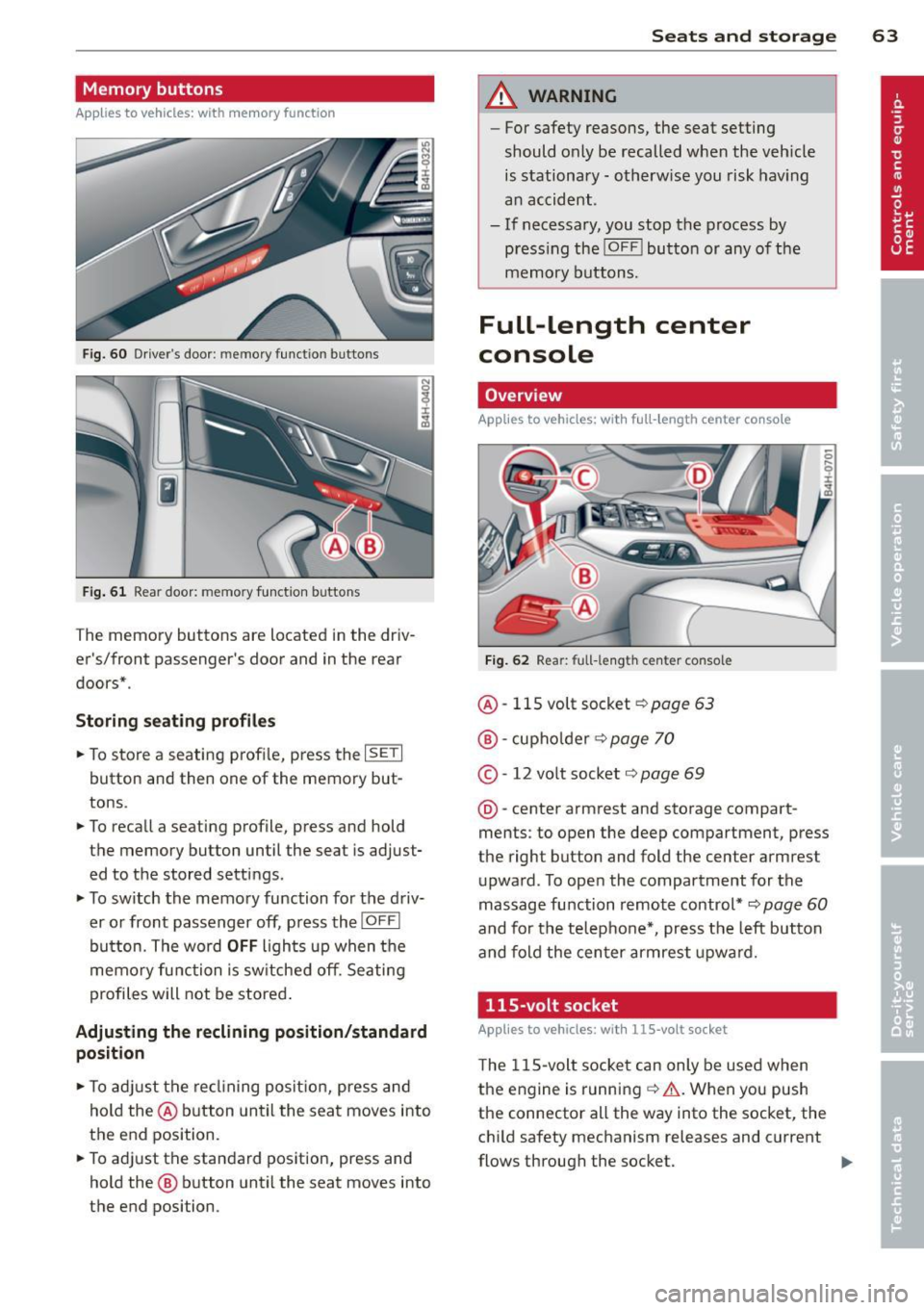
Memory buttons
Applies to vehicles: with memory function
Fig. 60 Driver's door: memory function buttons
Fig. 61 Rear door: memory function buttons
The memory buttons are located in the driv
er's/front passenger's door and in the rear
doors* .
Storing seating profiles
.. To store a seating profi le, press the ISETI
button and then one of the memory but
tons .
.. To recall a seating profile, press and hold
the memory button until the seat is adjust
ed to the stored settings.
.. To switch the memory function for the driv
er or front passenger off, press the
IOFFI
button. The word OFF lights up when the
memory function is sw itched off. Seating
profiles will not be stored .
Adjusting the reclining position/standard
position
.. To adjust the reclining position, press and
hold the@ button until the seat moves into
the end position .
.. To adjust the standard position, press and
hold the @ button until the seat moves into
the end position.
Seats and storage 63
A WARNING
-For safety reasons, the seat setting
should only be recalled when the veh icle
is stationary -otherwise you risk having
an accident.
- If necessary, you stop the process by
press ing the
!OF F! button or any of the
memory buttons.
Full-length center
console
Overview
Applies to vehicles: with full-length center console
Fig. 62 Rear: full-le ngth center console
@ -115 volt socket Q page 63
@-cupho lder ¢ page 70
©-12 volt socket ¢ page 69
@-center armrest and storage compart
ments : to open the deep compartment, press
the right button and fold the center armrest
upward. To open the compartment for the
massage function remote control*
Q page 60
and for the telephone*, press the left button
and fold the center armrest upward.
115-volt socket
Applies to vehicles: wit h 115-volt socket
The 115-volt socket can only be used when
the engine is running ¢.&. .When you push
the connector all the way into the socket, the
child safety mechanism releases and current
flows through the socket. ""
Page 67 of 302

Luggage compartment
Tie-downs and luggage compartment net
The Luggage compartment net prevents small
objects from sliding .
Fig. 63 Location of the fastening eyes in the luggage
compartment
Fig. 64 Luggage compartment net unhooked
~ To secure objects with the luggage compart
ment net*, fold the tie-down bracket up
ward ¢
fig. 63 .
~ Insert the hooks on the luggage compart
ment net* into the tie-downs ¢
fig. 64.
~ Read and heed all WARNINGS¢ page 133,
Stowing Luggage.
In a coll is ion, the laws of phys ics mean that
even smaller items that are loose in the vehi
cle will turn into heavy missiles that can cause
serious injury . Items in the vehicle pick up ki
netic energy which varies with the vehicle and
the weight of the item. Vehicle speed is the
most significant factor.
F or example, in a frontal collis ion at a speed
of 30 mph (48 km/h), the forces acting on a
10-lb (4.5 kg) object are about
20 times the
normal weight of the item. This means that
the we ight of the item would suddenly be the
Seats and storage 65
equivalent of about 200 lbs (90 kg). One can
easily imagine the injuries that an item of that
weight flying freely through the passenger
compartment can cause in a collision at a
speed considered relatively low.
A WARNING
Weak, damaged or improper straps used
to secure items to tie-downs can fail dur ing hard braking or in a collision and cause
serious personal injury.
-Al ways use su itable retaining straps and
properly secure items to the tie-downs in
the luggage compartment to help pre
vent items from shifting or flying for
ward.
- Never attach a child seat tether strap to
a tie-down.
- For strength-related reasons, the mount
ing hooks can only be used to secure ob
jects weighing up to 10 lb. (5 kg) . Heavi
er objects will not be adequately secured
- there is a risk of injury.
Page 68 of 302

66 Seats and storage
Pass-through with ski
sack
Preparing the pass -through
Appl ies to vehicles: with pass-through and ski sack
Long objects such as skis con be transported
in the ski sock.
Fig. 65 Rear bench seat: re m oving t he protect ive cove r
Fig. 66 Rear cente r armres t: attaching the p ro tect ive
cover
.. Fold the rear center armrest and the cover
located beh ind it down .
.,. Press the button to remove the protective
cover
¢fig. 65.
.. To p rotec t the front area of the center arm
r est, position the cover as illustrated
~ fig. 66 and press the suction cups down so
they adhere.
.. Remove the ski sack and unfold it.
Loading and securing the ski sack
Applies to vehicles: with pass -through and ski sack
--~ --
--· ---
Fig. 67 Luggage compart men t: pass -through in t he
backres t
Fig. 68 Rear benc h seat: secur ing the sk i sack
Loading
.,. Fold the pass -through cover in the luggage
compartment down¢
fig. 67.
.,. Slide the pointed end of the skis into the ski
sack first¢ &. The front part of the bind
ings must be directly under the secu ring
strap on the ski sack@¢
fig. 68.
Securing
.,. Insert the securing strap ® on the ski sack
into the center safety belt latch©¢
fig. 68.
.,. Tig hten the secur ing strap @.
Securing (vehicles with full-length center
console)
In the pass-through, two securing straps are
in the hooks located in the luggage compart
ment .
.,. Hook the hooks into the front tie-downs in
the luggage compartment .
.,. Tighten the securing strap@ in the rear .
Page 70 of 302
68 Seats and storage
-When not in use, to reduce fuel consump
tion, wind noise and to guard against theft.
A WARNING
- Use of an unapproved roof rack or incor
rect mounting of an approved roof rack
can cause the roof rack or the items at
tached to it to fall off the roof onto the
road .
- Objects falling from the roof of a vehicle
can cause a crash and personal injury .
- Only mount the roof rack on the desig
nated locations on the roof
c::> fig. 69.
-The roof rack system must be installed
exactly according to the instructions pro
vided.
- When driving with a roof rack system,
changes to the center of gravity and wind
resistance can change the vehicle han
dling and lead to a collision . Always
adapt your driving and your speed to the
current conditions.
- Your vehicle warranty does not cover any
damages to the vehicle caused by using
roof racks or mounting structures not
approved by Audi for your vehicle. The
same applies to damage resulting from
incorrect roof rack installation.
- Always check the roof rack mountings
and hardware before each trip and dur
ing a trip to make sure everything is se
curely tightened. If necessary, retighten
the mountings and check the entire sys
tem from time to time.
- After mounting a roof rack system, or
when you transport objects on the roof
of your vehicle, the height of the vehicle
is naturally increased. Be careful when
driving under low bridges or in parking
garages for example . This could cause
damage to the load and even the vehicle itself.
- Make sure the open rear lid and the sun
roof* do not come into contact with the
roof rack.
Loading the roof rack
Always distribute loads evenly. Make sure
anything on the roof rack is securely tied
down.
.. Always distribute the loads on the roof rack
evenly.
.. Always attach items to the roof rack securely
before you drive off.
The maximum permissible roof weight is
220
lb (100 kg).
The roof weight is the total of
the weight of the roof rack, the attachments
and the cargo you are carrying. You must also
not exceed the maximum load weight for the
roof rack you are using.
When using a roof rack system which has a lower load carrying capacity, you must not use
up the total maximum permissible load carry
ing capacity specified above. Instead, you
should load the roof rack system only to the
maximum capacity specified by the manufac
turer of the roof rack system .
A WARNING ,_
Weak, damaged or improper straps used
to secure items to the roof rack can fail
during hard braking or in a collision and
cause serious personal injury .
- Make sure the roof rack is installed exact
ly as specified above
c::> page 67.
- Always use suitable mounting straps for
securing items to the roof rack to help
prevent items from shifting or flying for
ward .
- Items on the roof rack must always be securely mounted .
- The use of a roof rack can negatively af
fect the way a vehicle handles . Cargo
that is large, heavy, bulky, long or flat
will have a greater negative influence on
the vehicle's aerodynamics, center of
gravity and overall handling. Always
drive slowly, avoid sudden braking and
maneuvers when transporting cargo on
the roof of your vehicle .
Page 72 of 302

70 Seats and st o ra ge
Storage
(upholder
Fig . 72 Center conso le: front cupholder
Fig. 73 Section of the rear bench seat: rear cupholder
Fr ont cuphold er
., To open the cupholder, tap the cover
¢ fig. 72, ~ &_ .
Rear cupholder
., To open the cupholder, tap the front strip
¢fig. 73, ~ &_.
In vehicles with a full-length center console in
the rear, the cupholder is located at @
~page 63, fig. 62.
A WARNING
Spilled hot liquid can cause an accident
and personal inj ury .
- Never carry any beverage containers with hot liquids, s uch as hot coffee or hot tea,
in the veh icle while it is mov ing. In case
of an accident, sudden braking or other
vehicle movement, hot liquid could spill,
causing scalding burns. Spilled hot liquid
can also cause an accident and personal injury. -
Use on ly soft cups in the cupholder. Hard
cups and glasses can cause injury in an
accident.
(D Note
Only drink containers with lids should be
carried in the cupholder. Liquid could spill
out and damage your vehicle's electronic
equipment or stain the upholstery, etc.
Cooled glove compartment
The cooled glove compartment only functions
when the AIC system is switched on.
Fig. 74 Glove compartme nt: sw itching cool ing mode
on/off
., Turn the knob@ counterclockwise to sw itch
cooling on. The symbols on the knob indi
cate the correct pos ition
q fig. 74 .
., Turn the knob @clockwise to switch cooling
off.
The glove compartment cooling mode only
funct ions when the vehicle A/C system is
switched on. If the heat ing is sw itched on,
switching the glove compartment cooling mode off is recommended.
(@ Tips
The glove compartment can be locked us
i ng t he mechanical key
¢page 30.
Storage area behind the rear seat
You can place light art icles of clothing on the
rear w indow shelf behind the backrest.
Page 74 of 302
7 2 Seats and st o ra ge
Cooler
Introduction
Applies to vehicles: with cooler
Please clean the cooler before using it for the
first time~
page 216.
You can only switch on the cooler if
- the temperature in the luggage compart
ment is below 131 °F (55 °C). The cooler
switches off automatically if the tempera
ture in the luggage compartment exceeds 131 °F (55 °C) . Once the temperature falls
below 131 °F (55 °C) again, the cooler
swit ches on aga in automatically.
- the battery is adequately charged. The cool
er switches off automatically if the vehicle
ba ttery voltage fal ls below a minimum lev
el. This prevents the battery from d ischarg
i ng. The cooler switches back on again auto
matically when the battery voltage increases
again (e.g. after starting the engine).
The cooler coo ls to 42 .8
° F ( + 6 °c) and the
freezer cools to 2 1.2 °F (- 6 °C) in optimum
cooling cond itions. The cooling performance
is affected by the temperature in the luggage
compartment. The temperature inside the
cooler will be higher if the luggage compart
ment is hot.
.,&. WARNING
To avoid putting the occupa nts at any r isk,
please observe the following safety ru les:
- The maximum capacity is 2.5 kg (5 .5
lbs.).
- Never overload the cooler. This could cause injury in the event of a co llision o r
s u dden bra king.
- The coo le r li d must always be kept closed
wh ile you are driv ing. Make sure the re
taining catch is sec urely engaged . The
c o ntents of the coo le r could be thrown
forwar d into the passe nger comp art
ment in the event of a collision or u nder
s udden braking -risk of inj ury!
- Inflammable liq uids, g as canisters, etc.
must not be store d in the cooler -risk of explos
ion! This also includes any prod
ucts that might em it volati le or inflam
mable gases.
- Liquids w ill freeze at temperatures at or
be low 32 °F (0 °C) and may cause glass
bottles to burst!
(D Note
- The venti lation openings for the cooler
are located on the back pane l trim in the
luggage compartment and
must be kept
clear at a ll times.
- If the coo ler is not functioning properly,
switch it off to prevent furt her damage.
Have it checked by a qualified works hop.
Operation
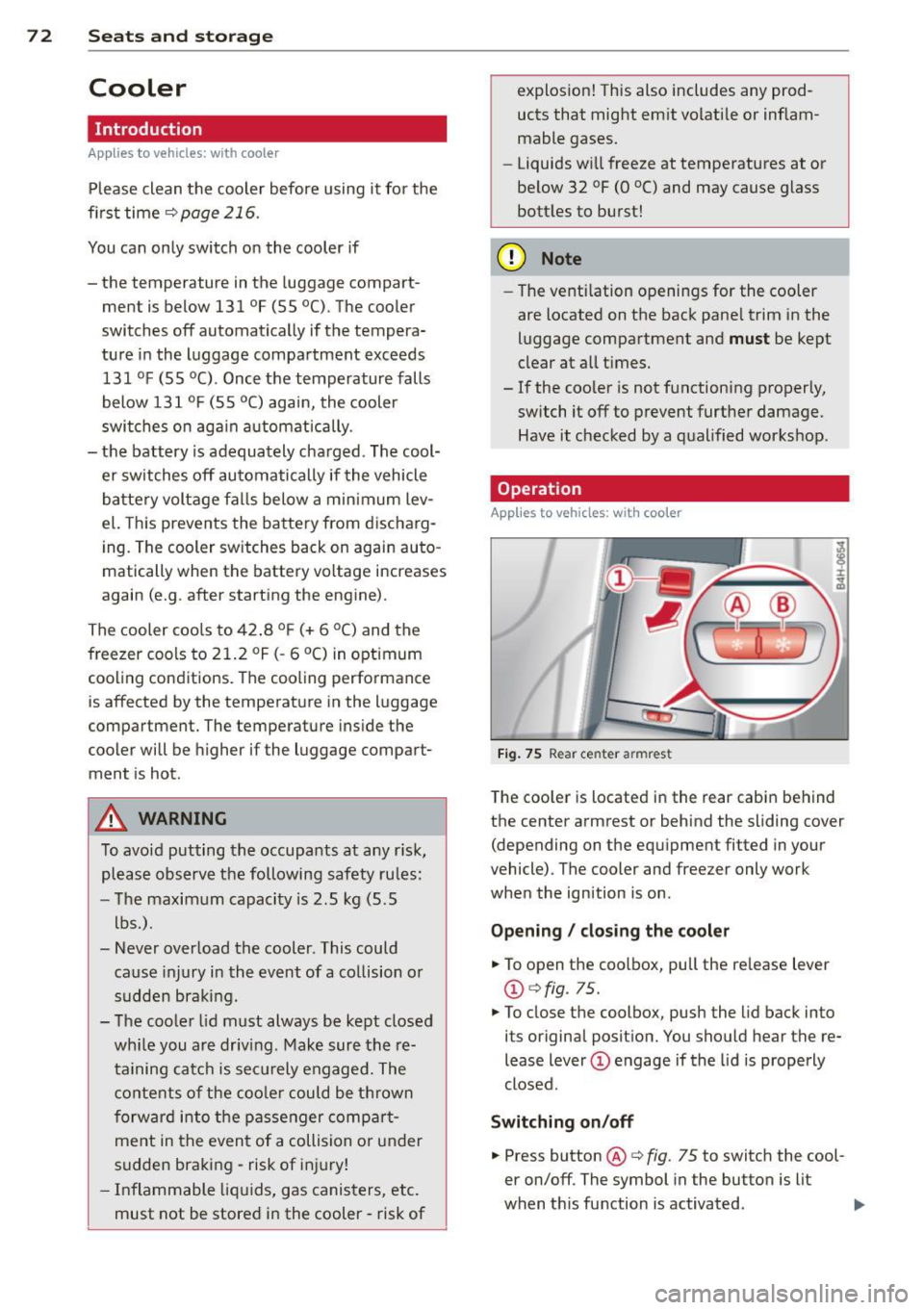
Applies to vehicles: with coo ler
Fig. 75 Rear center armrest
The cooler is located in the rear cabi n behind
the center armrest or behind the sliding cover
(depending on the equipment fitted in your
vehicle). The cooler and freezer only work
when the ignition is on .
Opening / clos ing the co oler
.,. To open the coolbox, pull the re lease lever
@ qfig. 75.
.,. To close the coolbox, push the lid back into
its original position. You should hear the re
lease lever
(D engage if the lid is properly
closed.
Switching on /off
.,. Press button @ q fig. 75 to switch the cool
er on/off. The symbol in the button is lit
when t his function is activated. .,,_
Page 75 of 302

~ Press button ® to switch the freezer on/off .
The symbo l in the b utton is lit when this
function is act ivated .
(Di Tips
-Always try to leave the lid open for as
short a time as poss ible to prevent con
densation b uildup.
- Do not put hot food o r drinks in the cool
er.
Seats and storage 73
Page 78 of 302

76 Warm and cold
airflow and air distribution are controlled au
tomatically.
Adjusting the temperature
Temperatures between 60 °F (+16 °() and
84 °F (+28 °C) can be set. Outside of this
range,
lo or hi wi ll appear in the climate con
trol system disp lay. At both of these settings,
the climate control system runs continuously
at maximum cooling or heating power. There
is no temperature regu lation.
~ Adjusting the airflow
You can adjust the airflow manually to suit
your needs. To have the airf low regulated au
tomatically, press the
! AUTO ! button.
~ Adjusting the air distribution
You can manually se lect the vents where the
air will flow. To have the air distribution regu
lated automatically, press the
IAUTOI button .
~ I lil* Adjusting Seat heating/
ventilation*
Pressing the button switches the seat heat
ing/ventilation on at the highest setting ( level
3). The L EDs indicate the temperature leve l.
To reduce the temperature, press the button
again. To switch the seat heating/ventilation
off, press the button repeatedly until the LED
turns off.
After 10 minutes, the seat heating/venti lation
automatically switches from level 3 to level 2.
I n vehicles without the four zone automatic
climate conrol *, buttons in the rear center
console control the seat heating for both out
er rear seats*.
~ Switch the defroster on/off
The winds hield and s ide windows are defrost
ed or cleared o f condensation as quickly as
possible. The maximum amo unt of air flows
mainly from the vents below the windshield.
Recirculation mode switches off. The tempera
ture is controlled automat ically.
The
IAUTOI button switches the defroster off.
~ Switching rear window heater on/off
T he rear window heater only operates when
the engine is running. It switches off auto
matically after 10 to 20 minutes, depending
on the outside temperature.
T o prevent the rear window heater from
switching off automatically , press and hold
the~ button for more than 3 seconds. This
r ema ins stored until the ignition is switched
off.
I SYNCI Synchronization*
When synchronization is switched on, the
same settings are applied to both the driver
and front passenger, except for the seat heat
ing/ventilation*. The rear seat is a lso
synchronized in vehicles with the four zone
automat ic climate conro l*. Synchron ization
switches off when the settings for the front
passenger side or rear* are adjusted.
You can also switch synchronization on by pressing and holding a dial. For example, if
you press and hold the dial on the front pas
senger side, the settings for that s ide are
transferred to the driver side. The same ap
plies to the rea r*.
Air vents
You can open or close the center and rear
vents in the cockpit and the vents in the rear
center console and door pillars using the
ridged thumbwheels. The levers adjust the di
rection of the airflow from the vents.
,&. WARNING
Do not use this setting for extended peri
ods of time. The windows could fog up
since no fresh air can enter the vehicle. If
the windows fog up, press the air recircula
tion button aga in immediately to switch
off the a ir recirculation function or select
defrost.
(D Note
To avoid damage to the heating elements
in the seats, do not kneel on the seats or
-
Page 80 of 302
78 On the road
On the road
Steering
Adjusting steering wheel position
The steering wheel position can be adjusted
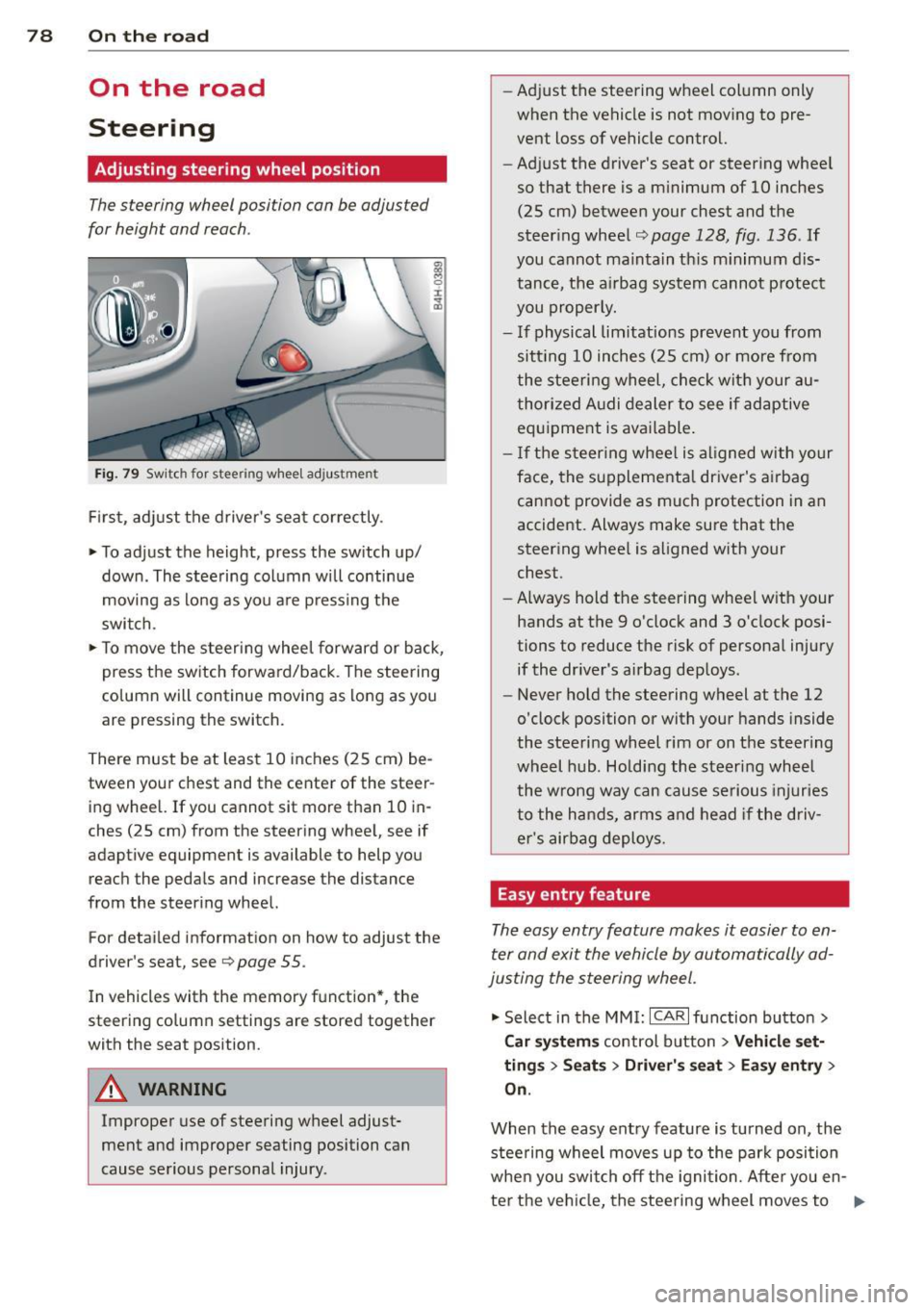
for height and reach .
Fig. 79 Switch for steer ing wheel adjustment
First , adjust the driver's seat correctly .
• To adjust the height, press the switch up/
down. The steering column will continue
moving as long as you are pressing the
switch.
• To move the steering wheel forward or back,
press the switch forward/back . The steering
column will continue moving as long as you
are pressing the switch.
There must be at least 10 inches (25 cm) be
tween your chest and the center of the steer ing wheel. If you cannot sit more than 10 in
ches (25 cm) from the steering wheel, see if
adaptive equipment is available to help you
reach the pedals and increase the distance
from the steering wheel.
For detailed information on how to adjust the
driver's seat, see
Q page 55.
In vehicles with the memory function* , the
steering column settings are stored together
with the seat position.
A WARNING
Improper use of steering wheel adjust
ment and improper seating position can
cause serious personal injury. -
Adjust the steering wheel column only
when the vehicle is not moving to pre
vent loss of vehicle control.
- Adjust the driver's seat or steering wheel
so that there is a minimum of 10 inches
(25 cm) between your chest and the
steering wheel
Q page 128, fig . 136 . If
you cannot maintain this minimum dis
tance, the airbag system cannot protect
you properly.
- If physical limitations prevent you from
sitt ing 10 inches (25 cm) or more from
the steering wheel, check with your au
thorized Audi dealer to see if adaptive equipment is available.
- If the steering wheel is aligned with your
face, the supplemental driver's airbag
cannot provide as much protection in an
accident. Always make sure that the
steering wheel is aligned with your
chest.
- Always hold the steering wheel with your
hands at the 9 o'clock and 3 o'clock posi
tions to reduce the risk of personal injury
if the driver's airbag deploys.
- Never hold the steering wheel at the 12
o'clock position or with your hands inside
the steering wheel rim or on the steering
wheel hub. Holding the steering wheel
the wrong way can cause serious injuries
to the hands, arms and head if the driv
er's airbag deploys.
Easy entry feature
The easy entry feature makes it easier to en
ter and exit the vehicle by automatically ad
justing the steering wheel.
• Select in the MMI: ICARlfunction button>
Car systems control button > Vehicle set·
tings > Seats > Driver's seat> Easy entry >
On.
When the easy entry feature is turned on, the
steering wheel moves up to the park position
when you switch off the ignition. After you en-
ter the vehicle, the steering wheel moves to .,..
Page 129 of 302
Driving Safely
General notes
Safe driving habits
Please remember -safety first!
This chapter contains important information,
tips, instructions and warnings that you need
to read and observe for your own safety, the
safety of your passengers and others . We have
summarized here what you need to know
about safety belts, airbags, ch ild restra ints as
well as child safety. You r safety is for us
priori
ty number 1.
Always observe t he information
a nd warn ings in th is sect ion - for yo ur own
safety as well as that of your passengers .
The information in this se ction applies to all
model ve rsions of your veh icle . Some of the
feat ures descr ibed in this sec tions may be
standa rd equipment on some models, or may
be optional equipment on others. If you are
not sure, ask yo ur authorized Audi dealer.
A WARNING
- Always make sure that you follow the in
st ruct ions and heed the WARNINGS i n
this Manual. It is in your interest and in
the inte rest of you r passengers.
- Always keep the complete Owner's Liter
at ure in your Audi when you lend or sell
yo ur vehicle so that this important info r
mation will always be ava ilable to the
dr iver and passenge rs.
- Always keep the Owner's lit erature handy
so that you can find i t eas ily if you have
ques tion s.
Safety equipment
The safety features are part of the occupant
restraint system and work together to help
redu ce the risk of injury in a wide variety of
accident situations .
Your safety and the safety of your passenge rs
should not be left to chance. Advances in
t echnology have made a var iety of fea tures
avai lable to he lp red uce the risk of in jury in an
Dr iving Safel y 127
accident . The following is a list of just a few of
the safety features in yo ur Audi :
- sophis ticated s afety be lts fo r drive r and a ll
passenger sea ting posit ions,
- s afety bel t prete nsio ners ,
- safety belt force lim ite rs fo r the front seats,
- safety belt he ight adjustment systems for
the front seats ,
- head restra ints
- front airbags,
- knee airbags for th e front seats
- side airbags in the front seats and outer rear
seats,
- side c urtain ai rbags,
- s pecia l LATCH an cho rages for child re-
s t raints,
- head restra ints for each sea ting pos it ion,
- adj ustab le steer ing colum n.
These ind iv idual safety features, can work to
gether as a system to help protect you and
your passengers in a wide range of accide nts .
These features cannot work as a system if
they are not always correctly adjusted and cor
r e ct ly u sed .
Safety is everybody's r esponsibility!
Important things to do before driving
Safety is everybody's job! Vehicle and occu
pant safety always depends on the informed and careful driver .
For your safety and the safety of your passen
gers,
before driv ing always:
.,. Ma ke su re that all lig hts and signa ls a re op
erating correctly .
.,. Make su re that the tire pressure is correct.
.,. Make sure that all windows are clean and af
ford good vis ibility to the outs ide .
.,. Secur e all luggage and other items caref ully
~ page 65, ~ page 70 .
.,. Ma ke s ure that nothing can in te rfere wi th
t he ped als .
.,. Adj ust front seat, head res traint and mirrors
correctly for your height.
.,. Inst ruct passengers to adjust the head re -
straints according to their height. ..,. •
•