seats AUDI A8 2011 Workshop Manual
[x] Cancel search | Manufacturer: AUDI, Model Year: 2011, Model line: A8, Model: AUDI A8 2011Pages: 302, PDF Size: 76.07 MB
Page 186 of 302
184 Child Safet y
• Push down on the seat cushion so that the
lower anchorages are visib le.
• Pull
off the guidance fixtures from the lower
anchorages.
• Always remove the guidance fixtures and
keep them in a safe place when not in use.
You may find it easier to install child re
straints equipped with hooks attached to
straps without the guidance fixtures in place.
If this is the case, remove the guidance fix
tures by pull ing them
off the anchorages .
H oweve r, the guidance fixtu res can he lp you
to locate the
LATCH ancho rages.
.&_ WARNING
Imprope r use of tether anchorages or low
er anchorages ca n cause serious persona l
injury in a crash .
- Always carefully fo llow the child re
straint manufacturer 's instructions for
proper insta llation and use of child re
straint systems .
- Never use the
LATCH or tethe r anchorag
es to attach safety belts or other kinds of
occupant restraints.
- Child restraint tether attachments and
lower attachments are only des igned to
secure a child restraint t hat has been
equipped to use these anchorages.
- Tether anchorages and lower anchorages
are designed to withstand only those
loads imposed by correctly fitted ch ild
restraints. Under no circumsta nces can
they be used safely for adu lt or chi ld
safety belts o r harnesses.
- Never mou nt more than one ch ild re
stra in t to a sing le tether or to a low er an
c ho rage poin t. Attac hing two chi ld re
st rain ts to a sing le anchor age poi nt can
cause the anchorage to fail and cause se
rious persona l injury in a crash .
0 Note
- Remove the guidan ce fixt ures before
fo ld ing t he rear sea tba ck t o preven t
dam aging the seat c ushion . -
To attach the ch ild restraint sec urely, the
seat must be moved to the farthest rear
posit ion, the seat height set to the low
est position and t he head restraint must
be adjusted to the vertical position
¢page 57.
-If you leave the guidance f ixtures instal
led for several days , they could leave a
mark on the upholstery on the seat cush
ion and back rest in the area that the
guidance fixtures were installed . T he up
holste ry wou ld al so be pe rmanen tly
stretched aro und the gui dance fix tures.
Th is ap plies especia lly to lea ther seats .
Installing a child restraint with LATCH
lower anchorages
Whenever you install a child restraint always
follow the child restraint manufacturer's in
structions.
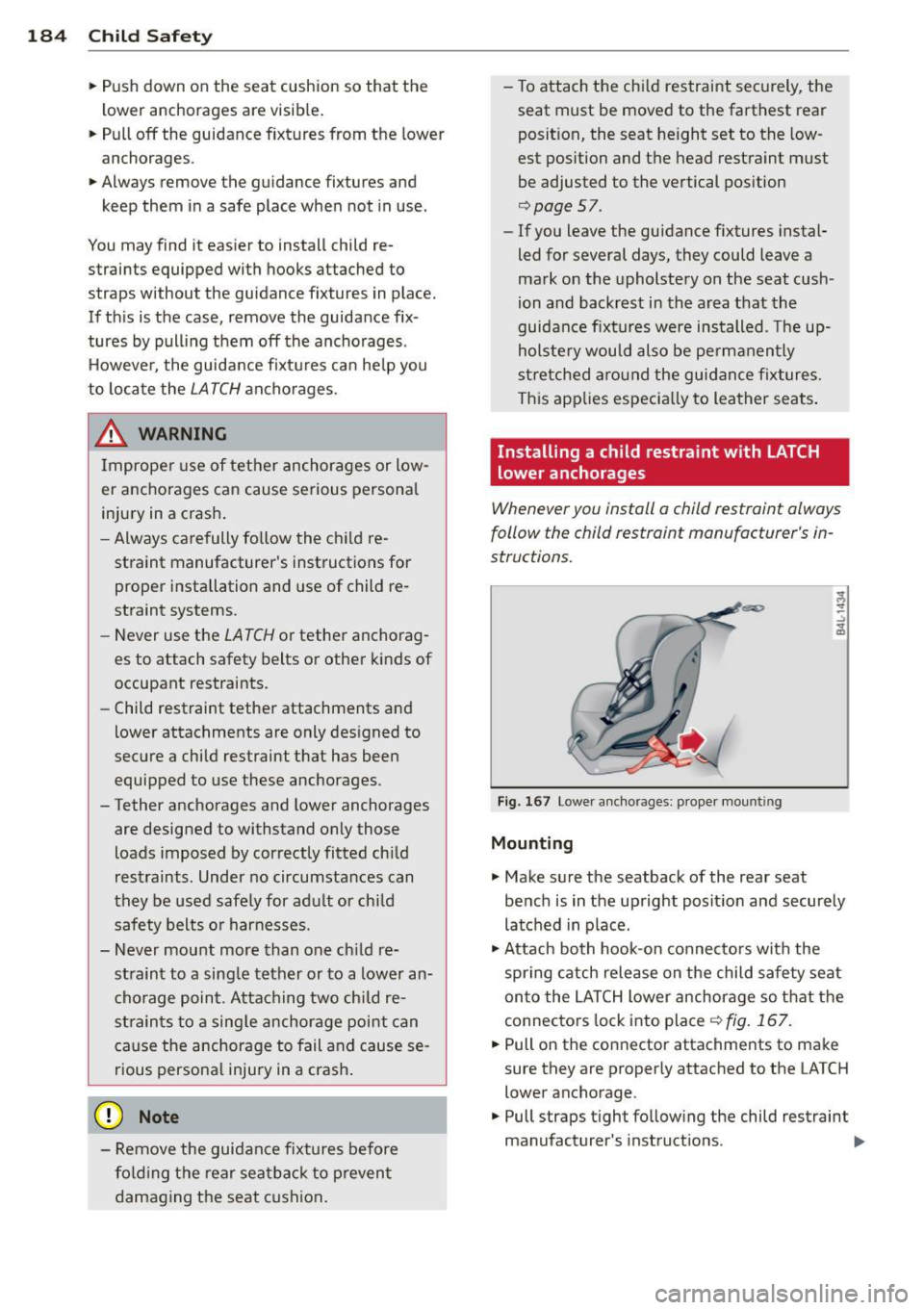
F ig. 167 Lowe r a nchorages: proper mount ing
Mounting
• Make sure the seatback of the rear seat
bench is in the upright posit ion and securely
latched in place .
• Attach bo th hook-on connectors with the
spring catch release on the child safety seat
on to the LATCH lower anchorage so that the
connecto rs lock into place
¢ fig. 167.
•Pullon the connector attachments to make
sure they are proper ly attached to the LATCH
lower anchorage .
• Pull straps tight following the child restraint
manufacturer's instruct io ns. .,,.
Page 187 of 302
Releasin g
• Loosen the tension on the straps following
the chi ld restraint manufacturer's instruc
tions .
• Depress the spring catches to release the
anchorage hooks from the lower anchorag
es.
Remember: Use tether straps to help keep the
child restraint firmly in p lace.
A WARNING
Improper use of the LATCH system can in
crease the risk of serious personal injury
and death in an acc ident.
- These anchors were developed only for
child safety seats us ing the "LATCH" sys
tem .
- Never attach other child safety seats,
belts or other objects to these anchors .
- Always make sure that you hear a click
when latching the seat in place. If you do
not hear a click the seat is not secure and
cou ld fly forward and h it the interior of
the vehicle, or be ejected from the vehi cl e.
A WARNING
Imprope r insta llation of chi ld restr aint s
w ill increase the risk of inju ry in an acc i
dent.
- Always fol low the child rest raint sys tem
man ufacturer's instr uctions for proper
installation of the child restraint system
and proper use of tethe r straps as we ll as
the lower anchorages or safety belts in
your vehicle.
- Always read and heed the important in
format ion and WARNINGS about child
safety and the installation of child re
straint systems
q page 169, Child Safe
ty .
(D Note
On veh icles with power adjustable rear
seats* some criter ia must be observed
Child S afety 185
when attaching the ch ild restraint using
the
LATCH system:
- T o attach the chi ld restraint securely, the
seat must be moved to the farthest rear
position, the seat height set to the low
est position and the head restraint must
be adjusted to the vertical pos ition
9page57.
- If a child safety seat is attached to one of
the rear seats, this seat must not be ad
justed using the power controls under
any c ircumstances. The
Entry assistanc e
for this seat must also be deactivated in
the MM I
9 page 60. The child safe ty seat
as well as the rear seat can be damage d
by t he a dju stmen t process.
Tether anchors and tether straps
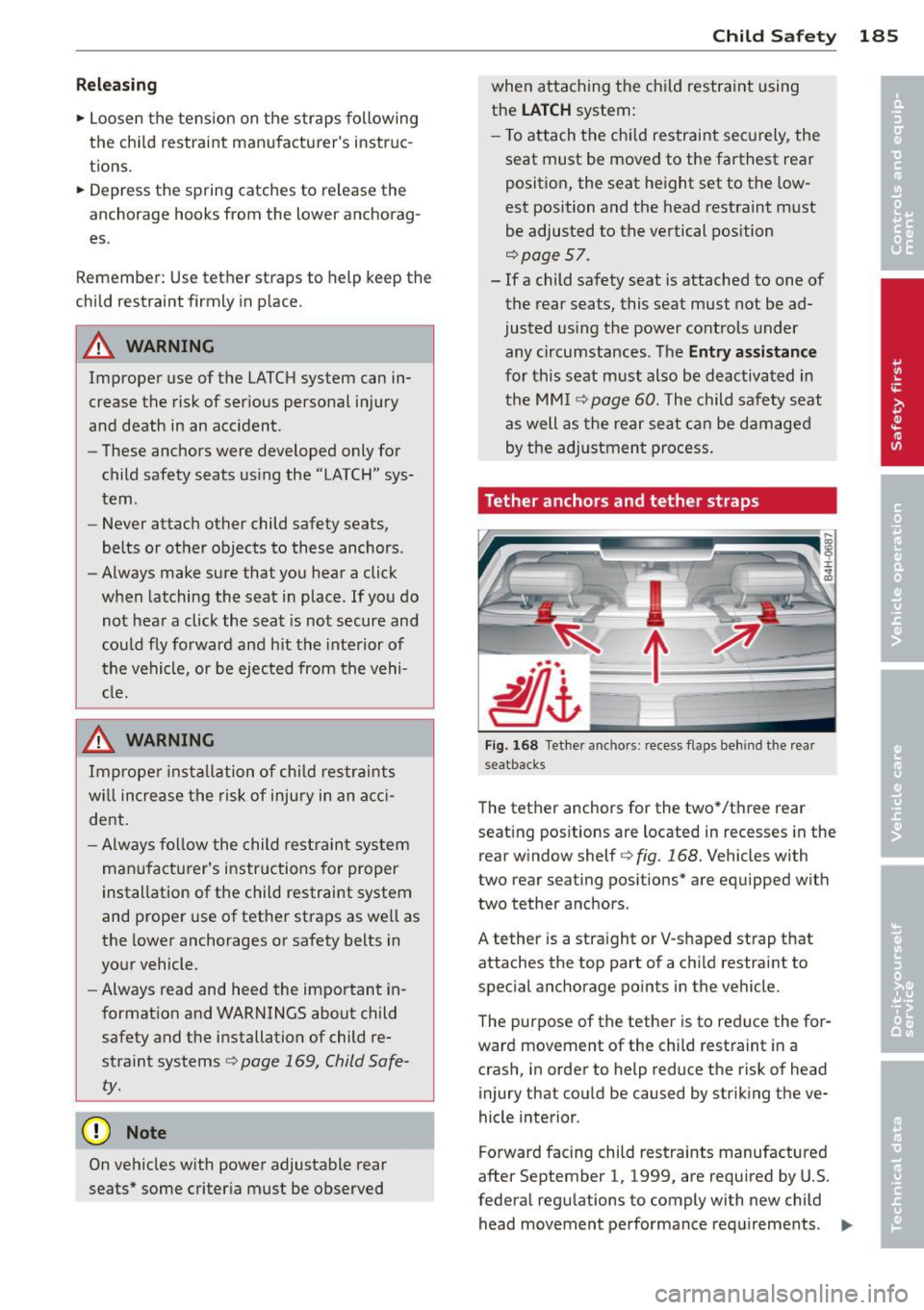
Fig. 168 Tet her anc hor s: recess flaps beh ind t he rea r
seatbacks
The tether anchors for the two * /t hree rear
seat ing pos itions are located in recesses in the
rear window shelf
q fig . 168. Vehicles with
two rear seating positions* are equipped w ith
two tether anchors .
A tether is a stra ight or V-s haped strap that
attaches the top part of a ch ild restraint to
special anchorage points in the vehicle.
The purpose of the tether is to reduce the for
ward movement of the child restraint in a
crash , in order to help reduce the risk of head
injury that could be caused by striking the ve
hicle interior .
Forward facing child restraints manufactured
after September 1, 1999, are requ ired by U.S.
federal regulations to comply with new child head movement performa nce requ irements .
II-
Page 188 of 302
186 Child Safet y
These new performance requirements make a
tether necessary on most new child safety
seats.
.&_ WARNING
Improper insta llation of child restraints
wi ll increase the risk of injury and death in
a crash.
- Always follow the instructions prov ided
by the manufacturer of the ch ild re
straint you intend to install in your Audi .
- Improper use of child restra int anchors
(including tether anchors) can lead to in
jury in a collision. The anchors are de
signed to withstand on ly those loads im
posed by cor rect ly fitted ch ild restraints.
- Never mou nt two ch ild restraint systems
on one LA T CH lower ancho r po int.
- Never attach two child restraint systems
to one tethe r strap or tether anchorage.
- Never attach a tether strap to a tie-down hook in the luggage compartment.
- Never use c hild restraint tether ancho
rages to secure safety belts o r other
k inds of occ upant restra ints.
- Never secure or attach any luggage or other items to the LATC H lowe r ancho
rages or to the tethe r anchors.
- If a tether or othe r strap is used to at
tac h a child rest raint to the front passen
ger seat, make sure that it is not so
t ight, that it causes the we ight-sensi ng
mat to measure more weight than is ac
t u a lly on t he seat.
- T he heav ier we ight reg iste red can make
t he Advanced Airbag Sys tem work as
though an adult were on the seat and de
ploy the Advanced Airbag when it must
be s uppressed causing serious or even
fatal injury to the child.
- If you must install a rearward facing
child safety seat on the front passenger
seat beca use of exceptional circ umstan
ces and the
PASSENGER AIR BAG OFF
light does no t come on and stay on, im
med iately install the rea r-facing child
safety seat in a rear seating position a nd
-
have the airbag system inspected by your
Aud i dea ler.
Installing the upper tether strap on the
anchorage
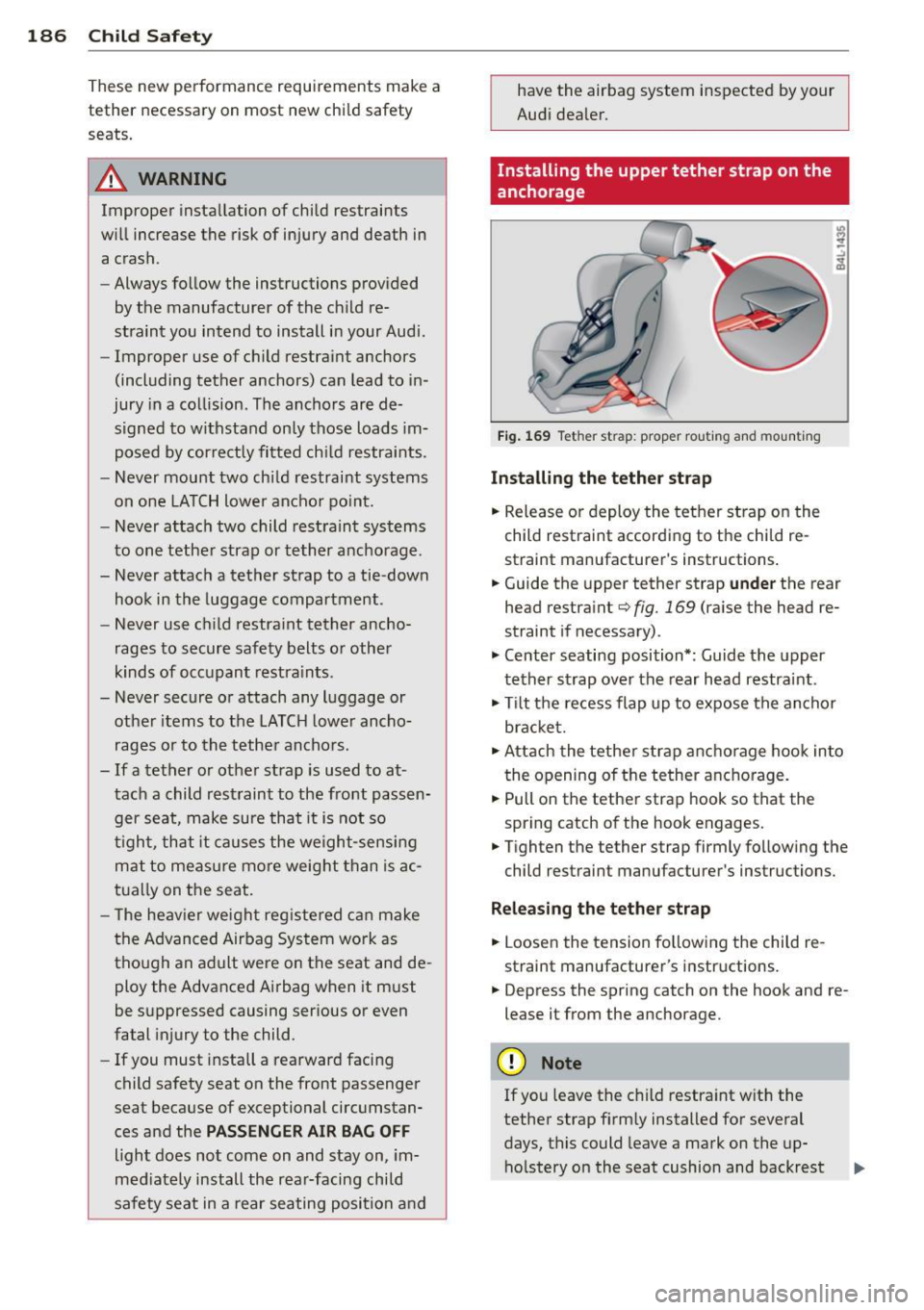
F ig . 1 69 Tether strap: proper ro uting and mount ing
Installing the tether strap
"' Release or deploy the tether st rap on the
child restraint according to the child re
straint manufacturer's instructions .
"' Guide the upper tether strap
under the rear
head restra int¢
fig. 169 (ra ise the head re
straint if necessary) .
"' Center seating position*: Guide the upper
tether strap over the rear head restra int.
"' Tilt the recess flap up to expose the an chor
b racket.
"' Att ach the tether strap ancho rage hook in to
the opening of the tethe r ancho rage.
"' Pull on the tether strap hook so that the
spring catch o f the hook engages.
"' Tighten the tether strap firmly fo llow ing the
child restraint manufacturer's instructions.
Releasing the tether strap
"'Loosen the tension fo llow ing the child re
straint manufacture r's in str uctions.
"' Depress the spring catch on the hook and re
lease it from the anchorage.
(D Note
If yo u leave the c hild restra int w it h the
tether strap firm ly installed for seve ral
days, this could leave a mark on the up
ho lstery on the seat cushion and backrest
Page 189 of 302
in the area where the tether strap was in
stalled. The upholstery wo uld a lso be per
manently stretched around the tether
strap. This applies especially to leather
seats.
Using tether straps on rearward-facing
child restraints
Curren tly , few rear-facing child res traint sys
tems come with a tethe r. P lease re ad an d
heed the child res traint system manufactur
er's instructions carefully to determine how to
properly insta ll the tethe r.
A WARNING
A child in a rearward-facing child safety
seat installed on the front passenger seat
w ill be seriously injured and can be k illed if
the front a irbag inflates -even with an Ad
vanced Airbag System.
- The inflating a irbag w ill hit the child
safety seat or infant carrier w ith g reat
force and w ill smash the ch ild safety seat
and child against the backrest, ce nte r
armrest, or door.
- A tight tether or other st rap on a rear
wa rd-fa cing child restra int attached to
the fro nt p assenger se at can put too
much pressure on the weight -ma t in the
seat and register a heavier we ight in the
Advanced Airbag System. The heavier
we ight registered can make the system
work as though an ad ult were on the seat
and dep loy the Advanced Airbag when it
must be suppressed caus ing se rious or
ev en fatal injury to the child.
- If you must install a rearward facing child safety seat o n the front passenger
seat because of exceptional circumstan ces a nd the
PASSENGER AIR BAG OFF
ligh t d oes no t come on and stay on, im
med iately install the rear-facing child
safety seat in a rear seating position and
have t he a irbag system inspected by you r
Audi dealer.
Child Sa fet y 187
Additional Information
Sources of information about child
restraints and their use
There are a number o f sources of additiona l
information abo ut child restraint se lection, in
stallation and use :
N HT SA advises t hat the bes t ch ild safety seat
is the one that fi ts your chi ld and fits in your
vehicle, and that yo u will use correct ly and
consistently.
T ry before yo u buy!
U.S National Highway Traffic Safety Admin
istration
Tel.: 1 -888 -3 27-42 36 (TIY: 1-800-4 24-9153)
www. n hts a .gov
National SAFE KIDS Campaign
Tel.: (202) 66 2-0600
www.safe kids.o rg
Safety BeltSafe U .S .A
Tel.: (800) 7 45-SAFE (English)
Te l.: (800) 7 47-SANO (Span ish)
www.carseat .org
Transpo rt Canada Information Centre
Tel.: 1 (800) 333-037 1 or call
1 (613) 998-8616 if you are in the Ottawa
area
www.tc.gc. ca/ ro ad safe ty
Audi Cu stomer CARE
T el.: (800) 82 2-2834 •
•
Page 190 of 302
188 Audi pre sense
Audi pre sense
Preventative passenger
protection
A pp lies to veh icles: with Audi pre se nse
Aud i pre sense can ini tia te steps to help pro
t ect veh icle occupants in certain situa tions.
The funct ions described depend on equ ipment
installed in your vehicle:
Audi pre sense basic
The following functions can be triggered in
certain driv ing situations :
- Tightening of the safety belts (for examp le,
during heavy braking) : the front safety belts
have reversible belt pretensioners. If a colli
sion does not occur, the safety belts loosen
s lightly and are ready to be tightened again .
- Closing the w indows and the sunroof* : the
windows and the sunroof* close leaving a
small open gap .
Audi pre sense basic functions can be trig
gered at speeds above 20 mph (30 km/h).
Vehicles with Aud i drive select*: the dep loy
ment time is adapted in dynamic mode.
Audi pre sense front (vehicles with
adaptive cruise control*)
Audi pre sense front includes the functions in
Audi pre sense basic. In addition, within the
limits of the system, the likelihood of a colli
sion with the vehicle immediately ahead is al
so ca lculated . If the system senses an immi
nent collision the follow ing functions can be
tr iggered :
-Audi braking guard
c::> page 92
- Tightening the safety be lts
- Closing the windows and the sunroof* (leav -
ing a small open gap)
Audi pre sense rear (vehicles with Audi
side assist*)
Audi p re sense rear includes the functions in
Audi pre sense basic. In addition, the likeli
hood of a rear -end collis ion with the vehicle
coming from behind is also calc ulated.
If the risk
of a co llision is detected, the following
functions can be triggered :
- Tig htening the safety belts
- Closing the windows and the sunroof* (leav-
ing a small open gap)
- Adjusting the seats : the settings for the
power head restrains, the upper sections of
t he backrests and the pneumatic side bol
s ters* are optim ized for the front seats and
the outboard rea r seats*. If a collision does
not occur, the previo us seat settings are re
stored.
Audi pre sense plus
Audi pre sense plus includes the funct ions in
A udi pre sense front and Audi pre sense rea r.
Error message
Audi pre sense: not available
Preventative passenger protection is not avail
able. See your authorized Audi dealer immedi
ately to have the malfunction corrected .
A WARNING
-Audi pre sense cannot overcome the laws
of physics.
It cannot prevent a collision. Do
not let the increased safety provided
tempt you to take risks. This will increase
the r isk o f a coll is ion and serio us personal
injuries.
- The sensors cannot always detect all ob
jects . This increases the risk of a colli
sion.
- Aud i p re sense does not detect peop le or
animals or objects that are crossing the
vehicle's path
c::> page 86.
-The radar sensor's vis ion can be reduced
by heavy rain, ice, snow, heavy road spray
and reflections from guard rails, tunnel
entrances, etc. These and similar condi
tions can prevent vehicles from be ing ac
curately detected and in some cases they
may not be detected at all.
Ill>
Page 198 of 302
196 Intelligent technology
What you should know
The highest priority is given to maintaining
starting capability.
The battery is severely taxed in short-distance
driving, in city traffic and during the cold time
of year. Abundant electr ical energy is re
qu ired, but only a little is generated. It is also
cr itical if the e ngine is not run ning and elect ri
cal components a re turned on. In th is in
stance energy is being consumed but none is be ing generated .
I t is in precisely these situations that you w ill
notice energy managemen t actively regulat
ing the distrib ution of energy.
Vehicle stands for an ext ended period
If you do not drive your vehicle over a period
of severa l days or weeks, elect rical compo
nents are grad ually cu t back o r switched off .
This reduces energy co nsu mption and main
tains starting cap abili ty
over a longer period.
Be aware that when you unlock you r vehicle,
some of the conve nience funct ions may not
ope rate, such as the Convenience key , the re
mote cont ro l or the power seat adjustment .
The convenience functions will be availab le
aga in when you switch on the ignition and
start the engine .
With the engine turned off
If yo u lis ten to the radio, for example, with
the eng ine turned off or use othe r MM I fu nc
tions, the battery is being discharged .
I f sta rting capability is jeopa rdized due to e n
e rgy consumpt ion, the fo llow ing warning ap
pears in the MMI disp lay :
Please start th e engine soon or th e syst em
will be turned off .
The warning ind icates that the system will be
turned off automatically after 3 m inu tes .
If
you wish to cont inu e us ing the functions , you
have to start the engine.
With the engine running
Although e lec trical energy is generated when
the vehicle is being driven, the battery can be
come discharged. This happens mostly when
li ttle energy is being generated and a g reat
deal consumed and the battery's state of
charge is not optimal.
To b ring the energy ba lance back into equili
brium, consumers which req uire especially
l arge amounts of energy are temporar ily cut
back or sw itched off. Heat ing systems i n par
ticular require a great deal of energy. If you
notice , for example, that the heated seats* o r
the heated rear window are not heating, they have been temporarily cut back or sw itched
off . These systems w ill be available again as
soon as the ene rgy balance has been restored.
You w ill also notice that engi ne idle speed has
been increased slightly . Thi s is normal and not
a cause for con ce rn. By inc reas ing eng ine id le
speed the addi tional energy requ ired is gener
ated and the battery is charged.
Page 214 of 302
212 Cleaning and protection
tem pera ture is high, it can be removed with a
p lastic scraper and a suitable solvent.
A WARNING
So lvents can be dangerous.
- Benzine is flammable and toxic. If you
use benzine for removing the wax, keep
sparks, f lame and lighted cigarettes
away. Never dump benzine on the
ground, into ope n streams or down sew
age drains .
- Be sure to observe all safety and env iron
menta l regulations. Follow all instruc
t ions on the container.
- Always read and heed all WARNINGS and
ot her information ¢
page 206.
Chassis
Have the undercoating checked for damage
from time to time.
The lower body shell of your Audi is a lso thor
ough ly protected against corrosion.
Any damage to the under coating caused by
road hazards shou ld be repaired promptly.
A WARNING
Too much undercoating in the wrong pla
ces can cause a f ire.
- Do not apply additional undercoating or
rustproofing on o r near the exha ust
man ifold, exhaust p ipes, catalytic con
verter or heat shie lds. W hile driving, the
substance used for undercoating cou ld
over heat and cause a fire .
- Always read and heed all WARNINGS and
ot her information ¢
page 206.
Exhaust tail pipes
Road salt and other cor ros ive ma ter ials wi ll
damage th e material in the exha ust ta il p ipes
if they are no t cleaned reg ula rly. Do no t clean
the tail p ipes with whee l cleaner, p aint po lish ,
ch rome polish or ot her abrasive cleaners .
C lean the tail p ipes with car care prod ucts
that are s uita ble for stain less stee l. Your a
uthorized Audi dea ler can provide clean
ing products that have been tested and ap
proved for yo ur vehicle.
Care of interior
Infotainment components
T he M MI/RS E* display may be cleaned wit h a
soft clot h and commerci ally-available " LCD
cl eaner". The clot h should be co ated lightly
whe n the cleaning solution when clea ning t he
display.
T he M MI/RS E* con trols m ust be cleaned first
with a b rush so tha t d irt does not en ter the
u nit or enter between the buttons and the
ho using. T hen wiping the cont ro ls with a cloth
dampened with dish detergent and water is
recommended.
(D Note
To prevent scratches, only clean the dis
p lay when it is dry.
- To prevent damage, make sure fluids do
not enter the contro ls .
· Aluminum trim
U se only neutral -pH products to remove spots
and deposits from a luminum surfaces.
Chrome care products and a lkaline cleaners
will attack a luminum surfaces and can dam
age t hem over t ime.
A WARNING
A lways rea d and heed all WAR NIN GS an d
o ther in fo rmation
¢page 206 .
Fabrics and fabric coverings
Fabr ics and fab ric cover ings (e.g . seats, door
trim pa ne ls, etc.) sho uld be cleaned at regular
intervals wit h a vacuum cleaner . This removes
s ur face dirt particles which cou ld become em
bedded in the fabric throug h use. Steam
cleaners should not be used, because the
steam tends to push the dir t deeper into the
fabric a nd lock it the re . ..,_
Page 248 of 302
246 Tires and wheels
valve stem caps on all wheels are secure ly
mounted on the valve .
@ For the sake of the environment
Underinflated tires will also increase the
fue l consumption.
Tires and vehicle load limits
There are limits to the amount of load or
weight that any vehicle and any tire can carry.
A vehicle that is overloaded will not handle
well and is more difficult to stop. Overloading
can not only lead to loss of vehicle control, but can also damage important parts of the
vehicle and can lead to sudden tire failure, in
cluding a blowout and sudden deflation that
can cause the vehicle to crash.
Your safety and that of your passengers also
depends on making sure that load limits are
not exceeded. Vehicle load includes everybody
and everyth ing in and on the vehicle. These
l oad limits are techn ica lly referred to as the
vehicle's
Gross Vehicle Weight Rating
("GVWR").
The "GVWR" includes the we ight of the basic
vehicle, all factory installed accessories, a full
tank of fuel , oil, coo lant and other fluids plus
maximum load. The maximum load includes
the number of passengers that the vehicle is
intended to carry ("seating capacity") with an
assumed weight of 150 lbs (68 kg) for each
passenger at a des ignated seat ing pos ition
and the tota l we ight of any luggage in the ve
hicle. If you tow a trailer, the weight of the
trailer hitch and the tongue weight of the
l oaded trailer must be included as part of the
vehicle load.
The
Gross Axle Weight Rating ("GAWR") is
the maximum load that can be applied at each
of the vehicle's two axles.
The G ross Vehicle Weight Rating and the
Gross Axle Weight Rating are listed on the
safety compliance sticker labe l located on the
driver's side B-p illar. You r A udi has 5 seat ing
positions, 2 in the front and 3 in the rear for
total seating capacity of 5. Vehicles with pow- er individual rear seats* have
4 seating posi
tions,
2 in the front and 2 in the rear for total
seat ing capac ity of
4. Each seating position
has a safety belt¢
page 137, Safety belts.
The fact that there is an upper limit to your
vehicle's Gross Vehicle Weight Rating means
that the total weight of whatever is being car
ried in the vehicle (including the weight of a
trailer hitch and the tongue weight of the
loaded trailer) is lim ited . The more passen
gers in the vehicle or passengers who are
heavier than the standard we ights assumed
mean that less we ight can be carried as lug
gage.
The tire pressure label on your Audi also lists
the max imum combined weight of a ll of the
occupants and luggage or other cargo that
the vehicle can carry. For the location of the
label¢
page 242, fig. 184.
A WARNING ,___
Overloading a vehicle can cause loss of ve
h icl e contro l, a crash or other accident, se
rious personal injury, and even death.
- Carrying more weight than your vehicle
was designed to carry will prevent the
vehicle from handling properly and in
crease the risk of the loss of vehicle con
trol.
- The brakes on a vehicle that has been
overloaded may not be able to stop the
veh icle with in a safe distance.
- Tires on a vehicle that has been overload
ed can fail suddenly, including a blowout
and sudden deflation, causing loss of
control and a crash.
- Always make sure that the total load be
ing transported -including the weight of
a trailer hitch and the tongue we ight of a
loaded trailer -does not make the vehi
cle heavier than the vehicle's G ross Vehi
cle Weight Rating.
Page 289 of 302

A
A/C (automatic climate control) .... .. .. 75
Accessories .. ... .. .. ..... ... .. .. .. . 285
Adaptive a ir suspension/sport .. .. .. .. . 106
adaptive cruise control Stop-and-go traffic . . . . . . . . . . . . . . . . . 89
Adapt ive cruise control ................ 86
C lean ing sensors/cameras ........... 208
Messages . . . . . . . . . . . . . . . . . . . . . . . . . 93
Request for drive r in tervention .. .. .. .. 90
Adapt ive Light (defective) ... .. .. .. ... . 21
Adding Engine coolant ........ ... ... ... ... 230
Eng ine oi l .. .. ........... .. .. .. ... 227
W indshield washer fluid ... .. .. .. .. . 236
Addit ives
Engine oi l .. .... .. .... ... .. .. .. ... 227
Adjustab le steer ing colum n ............ 78
Ad justing
A ir distribution (automatic climate con-
trol) . . . . . . . . . . . . . . . . . . . . . . . . . . . . . . 76
Front seats . . . . . . . . . . . . . . . . . . . . . . . . 54
I nstrument illum inat ion . ..... .... ... 47
S teer ing colum n .......... .. .. .. .. .. 78
Temperatu re (automat ic climate co ntrol) 76
Airbag system . . . . . . . . . . . . . . . . . 145, 164
Advanced A irbag System ............ 149
Advanced Airbag System components . 152
Ca re . .... .. ................. .. ... 158
C hi ldren . .. .. ........... .. .. .. ... 170
Ch ild restra ints .................... 171
Components (front airbags) . ... .. .. . 152
Danger of fitting a child seat on the front
passenger seat . . . . . . . . . . . . . . . . . . . . 147
Disposal . . . . . . . . . . . . . . . . . . . . . . . . . 158
Front airbags . . . . . . . . . . . . . . . . 149, 150
H ow do the front airbags work? ... .. . 154
H ow many airbags does my vehicle
have? ... ..... ........... ...... .. 152
H ow the Advanced Airbag System com -
po nents work together ............. 153
I mportan t safety instructions on the
knee airbag system .... ... .. .. .. .. . 162
Important things to know .... .. .. .. . 145
Knee airbags ............. .... .. ... 161
Mon itoring . . . . . . . . . . . . . . . . . . . . . . . 156
PASSENGER AIR BAG OFF light .. .. .. . 156
Inde x 287
Repairs ... .. .... ... .. .. ..... ... .. 158
Safety instructions . .. ... .... ... .. .. 158
S ide a irbags ... .. .. . .. ... .... ... .. 163
S ide curtain airbags ................ 166
Warning/ind icator lights ............ . 18
Warning/Indicator lights ........... 156
We ight-sensing mat ... .. ..... ... .. 170
When must the system be inspected? 156
Aircraft Transporting your vehicle ........... 277
A lloy wheels . . . . . . . . . . . . . . . . . . . . . . . 211
All Wheel Drive . . . . . . . . . . . . . . . . . . . . . 194
Winter tires . .. .. .... ........... .. 253
Ambience lighting ..... ............. . 46
Anti-freeze
refer to Engine coolan t ...... ... .. .. 229
Anti- lock b raking system ............ . 190
Warning/ind icator lights .......... .. . 19
Anti-slip regulation ............. .... 190
Anti -theft systems
E lectronic immob ilizer .. .. ..... ... .. . 30
Audi braking guard
refer to b ra ki ng g uard .............. . 86
Audi drive select
refer to drive select 106
Audi Service Repair Manuals and Litera-
ture .............................. 283
A UTO
A utomat ic climate control ............ 75
A utomatic head lights .. .. ..... ... .. . 43
Auto Lock . . . . . . . . . . . . . . . . . . . . . . . . . . 31
Automat ic belt retractor . . . . . . . . . . . . . 140
A utomat ic car wash .... ........... .. 207
Automat ic climate control
Air vents . . . . . . . . . . . . . . . . . . . . . . . . . . 76
Automat ic recircu lation .............. 77
Operation . .. .. .. .... ............. . 75
Setup ............................ 77
synchronizing . . . . . . . . . . . . . . . . . . . . . . 76
Automat ic transm iss ion (t iptro nic) . .... 112
Emergency mode . .. ............... 115
K ick-down . .. .. .. ... ............ .. 115
Manua l shift ing . . . . . . . . . . . . . . . . . . . 115
Parking lock eme rgency release .. .. .. 116
Se lector lever positions . .. ..... ... .. 112
Automat ic w ipers ......... ........... 48
Auto Safety Hotline ................. 135
•
•
Page 290 of 302

288 Index
Average consumption ........ ... .... .. 24
Average speed . . . . . . . . . . . . . . . . . . . . . . . 24
Avoid damaging the vehicle .. .. .. .. .. . 198
B
Battery 233
Charging ................... ..... . 235
Important warnings ...... .. .. .. .. . 233
Location . ................. .. .... . 233
low . .. .... .......... ...... ... .. . 195
Replacing the battery ...... ..... .. . 236
State of charge ............... .. ... 195
W inter operation ....... .. .. .. .. .. . 233
Working on the battery .... .. .. .... . 233
Before driving .. ... .... .... .. .. .. .. . 127
Blended gasoline .................. . 218
Blower (automatic climate control) . . . . . . 76
Body cavity sealing ......... .. .. .... . 211
Booster seats
Brake fluid 177
Changing the brake fluid ....... .. .. . 232
Check ing the brake fluid level . .. .. .. . 232
What is the cor rect brake flu id level? . . 232
What should I do if the brake fluid warn-
ing light comes on?
........ .... ... . 232
Brake system Anti-lock braking system . . . . . . . . . . . . . 19
Brake assist system ....... .. .. .... . 190
Brake booster ............ .. .. .. .. . 193
Brake fluid ............... ... .... . 232
Brake fluid specifications for refill and re-
placement ............... ... .... . 232
Brake light defective ...... .. .. .. .. .. 21
Brake pads ... ........... .. .. .... . 197
Electromechanical park ing brake .. .. . . 81
Fluid reservoir ............... .. ... 232
H ow does moisture or road salt affect the
brakes? .. ............... .. .. .... . 192
Warn ing/ indicator lights ... .. .. .... . . 14
Worn brake pads symbol ... .. .. .. .. . . 19
braking guard Messages
Sett ings
. .. ... .......... .. .. .. .. ..
86
93
93
Break-in period . ........... .. .. .... . 197
Brake pads . ... ....... ... .. .. .. .. . 197
Tires 197
Bulbs ..... .. ................ ..... . 272
C
California Proposition 65 Warning ... .. 223
Battery specific . ................. . 235
Capacities .. .. .. .. .... ...... ... .. . .
Engine oil ... .. . .. ............ .. . .
Car care .... .... .................. . 282
224
206
Exterior ....... .. .......... ...... . 206
Interior ..... .. .. ....... ...... .. .. 212
Car carrier Transporting your vehicle ....... .. .. 277
Catalytic converter .............. ... . 198
Center armrest Cockpit ....... .. ..... ........... .. 57
Rear . .. .. .. .. .. ............. .. .. . 63
Central locking . . . . . . . . . . . . . . . . . . . . . . 31
Emergency locking ............. .... . 35
Certification . . . . . . . . . . . . . . . . . . . . . . . 286
Changing a wheel .. ................ . 262
Changing engine oil ............. .... 228
Chassis (undercoat ing) ........... .. . .
Check ing
Engine coolant level ...... ...... .. . -
Tire pressure . .. .. ............. .. . .
Child restraints Danger of using child restraints in the
front seat ..... .. .......... ...... .
Where can I get additional information
about child restraints and their use? ..
Child restraint system anchors .... .. . .
Child safety ... .. .. ................ .
Convertible locking retractor ........ .
Guidance fixtures for lower anchorages
I mportant safety instructions for using
child safety seats .............. ... .
Important things to know when driving
with children . ... ....... .... --. - . - 212
229
244
14
7
187
181
169
178
183
172
169
Tether anchors . .. .......... ...... . 185
Tether straps .. .. ... .. ..... ... .. .. 185
Child safety lock Rear doors (mechanical) ........ .... . 38
Rear doors (power) ...... ...... .. . - - 38
Child safety seats . . . . . . . . . . . . . . . . . . . 17 4
Booster seats . . . . . . . . . . . . . . . . . . . . . 177
Convertible child seats ......... .... 175
Convertible locking retractor ..... .... 178