tires AUDI A8 2011 Owner's Guide
[x] Cancel search | Manufacturer: AUDI, Model Year: 2011, Model line: A8, Model: AUDI A8 2011Pages: 302, PDF Size: 76.07 MB
Page 257 of 302
chains because t he vehicle will be ex
tremely low. If you do drive with snow
chains on while the vehicle is at this lev
el, the snow chains might severe ly dam
age the wheelhouse and other parts of
the veh icle.
@ Tips
Where snow cha ins are mandatory oncer
tain roads, this normally also applies to ve
hicles with All Wheel Drive.
Wheel bolts
Wheel bolts must always be tightened to the
correct torque .
The design of whee l bolts is matched to the
factory installed r ims. If different rims are fit
ted, the correct wheel bolts with the right length and correctly shaped bolt heads must
be used . This ensures that wheels are fitted
secure ly and that the brake system f unctions
correctly .
In certain circumstances, you may not use
wheel bolts from a d iffe rent vehicle -even if it
i s the same mode l
¢page 285.
A WARNING
Imprope rly tig hte ned or maintained whee l
bolts can be come loose causing loss of
contro l, a co llision and serious persona l in
jury .
- Alw ays keep the w heel bolts and the
th reads in the wheel hubs clea n so the
wheel bolts can turn easily and be prop
er ly tightened .
- Never grease or oil the wheel bo lts and
the threads in the w heel h ubs. They can
become loose wh ile driving if greased or
o iled, even if tightened to the specif ied
torque.
- Only use wheel bolts that belong to the
rim being installed.
- Never use different whee ls bolts on your
vehicle.
- Always maintai n the co rrect tightening
torq ue for the wheel bo lts to reduce the
Tire s an d wheel s 255
risk of a wheel loss. If the tightening tor
que of t he wheel bolts is too low, they
can loosen and come out when the vehi
cle is mov ing. If the tighte ning torque is
too h igh, the wheel bol ts and threads
can be damaged and the whee l can be
come loose.
(I) Note
The specified torque for the whee l bolts is
90 ft lb ( 120 Nm) wi th a tole rance of± 7,4
ft lb(± 10 Nm). Torq ue whee l bolts diago
nally. Afte r cha nging a whee l, the torq ue
must be checked as soon as possible wi th a
torque w rench -prefe rably by an au thor
ized Audi dealer or qualif ied workshop .
Low aspect ratio tires
Your Audi is facto ry-eq uipped with low aspect
ratio tires. These tires have been thoro ughly
tested and been se lected specifically for your
model for their superb performance, road fee l
and handling u nder a variety of driving cond i
tions . Ask your authorized Audi dealer for
more details.
The low aspect ratio of these t ires is ind icated
by a numeral of
55 or less in the tire's size
designation . The numeral rep resents the ratio
of the t ire's sidewall height in relation to its
t read width ex pressed in pe rce ntage. Conven
tiona l tires have a he igh t/w idth ratio of 60 or
more.
The performance of low-aspe ct-ratio tire s is
particularly sensitiv e to improper infla tion
pres sure. It is therefore important that low
a spect ratio tires are inflated to the specified
pre ssure and that the inflation pressure i s
regularly checked and maintained. Tire pre s·
sures should be checked at least once a
month and always befo re a long trip
¢ page 244, Checking tire pressure.
What you can d o to avoid tire and rim
damage
Low aspect ratio tires can be damaged more
easily by impact w it h potholes , curbs, gul lies ..,.
•
•
Page 258 of 302
256 Tires and wheels
or ridges on the road, particularly if the tire is
underinflated.
I n o rder to minim ize the occurrence of impact
damage to the tires of your vehicle, we recom
mend that you observe the following precau
tions:
- Always maintain recommended inflation
pressures. Check your tire pressure every
2,000 miles (3,000
km) and add air if neces
sary.
- Drive carefully on roads with potholes, deep
gullies or ridges. The impact from driving
through or over such obstacles can damage
your tires. Impact with a curb may also cause damage to your tires.
- After any impact, immediately inspect your
tires or have them inspected by the nearest
authorized Audi dealer. Replace a damaged
tire as soon as possible .
- Inspect your tires every 2,000 miles (3,000
km) for damage and wear . Damage is not al
ways easy to see. Damage can lead to loss of
air and underinflation, wh ich could eventu
ally cause tire failure . If you be lieve that a
t ir e may have been damaged, replace the
t ir e as soon as possible.
- T hese tires may wear mo re quick ly than oth
ers.
- Please also remember that, while these t ires
deliver respons ive handling, they may ride
less comfortably and make more no ise than
other choices.
Reduced performance in winter/cold
season conditions
All tires are designed for certain purposes.
The low aspect ratio, ultra high performance
tires originally installed on your vehicle are in
tended for maximum dry and wet road per
formance and handling. They are not suitable
for cold, snowy or icy weather condit ions. If
you drive under those circumstances, you should equip your vehicle with all -season or
winter tires, which offer better traction under
those cond it ions. We suggest you use the rec
ommended snow or all-season tires specified
for your vehicle, or their equivalent. Refer
to
q page 253 for more detailed infor
mation regarding winter tires.
Tire pressure monitoring system
(D General notes
Applies to veh icles: w ith tire pressure monitoring system
Each tire, including the spare ( if provided),
shou ld be checked monthly when co ld and in
flated to the inflation pressure recommended
by the veh icle manufacturer on the vehicle
placard or tire inflation pressure label. (If your
vehicle has tires of a different size than the
s ize indicated on the vehicle placard or tire in
flation pressure label, you should dete rmine
the proper tire inflation p ressure fo r those
t i res).
As an added safety feature, your veh icle has
been equipped with a tire pressure mon itoring
system (TPMS) that illuminates a low tire
pressure tel ltale when one or more of your
tires is significant ly under-inflated. According
ly, when the low tire pressure telltale illumi
nates, you should stop and check your tires as
soon as possible, and inflate them to the
proper pressure. Driving on a sign ificantly un
der-inflated t ire causes the tire to overheat
and can lead to tire failure . Under-inflation al
so reduces fuel efficiency and tire tread life,
and may affect the vehicle 's handling and
stopp ing ability.
Please note that the TPMS is not a substitute
for proper tire ma intenance, and it is the driv
er's respons ibility to maintain correct tire
pressure, even if under-inflation has not
reached the level to trigger illuminat ion of the
TPMS low tire pressu re tellta le .
Your vehicle has also been equipped with a
TPMS malfunction indicator to indicate when
the system is not operating properly. The
T PMS ma lfunction indicator is combined with
the low tire pressure telltale. When the sys
tem detects a malfunction, the telltale will
flash for approximately one minute and then ..,_
Page 259 of 302

remain continuously illuminated. This se
quence will continue upon subsequent vehicle
start-ups as long as the malfunction exists.
When the malfunction indicator is illuminat
ed, the system may not be able to detect or
signal low tire pressure as intended . TPMS
malfunct ions may occur for a variety of rea
sons, including the installation of replace ment or alternate tires or wheels on the vehi
cle that prevent the TPMS from functioning
properly . Always check the TPMS malfunct ion
tellta le after replacing one or more t ires or
wheels on your vehicle to ensure that the re
placement or alternate tires and wheels allow
the TPMS to continue to function properly.
Tire pressure indicator appears
Applies to vehicles: with tire pressure monitoring system
The tire pressure indicator in the instrument
cluster informs you if the tire pressure is too
low or if there is a system malfunction.
Fig. 189 Display : underinflatio n warning
Fig. 190 Display: System malfu nctio n
Using the ABS sensors, the tire pressure moni
toring system compares the tire tread circum
ference and vibration characteristics of the in
dividual tires . If the pressure decreases in one
or more tires, this is indicated in the instru-
Tires and wheels 257
ment cluster with a warning symbol [I) and a
message
r::!) fig. 189.
The tire pressure monitoring system must be
reset via MMI each t ime the pressures are ad
justed (e.g. when switching between partial
and full load pressure) or after changing or re
placing a tire on your vehicle
r::!) page 258. You
can find the recommended tire pressures for
your vehicle on the label on driver's side 8-pil
lar
r::!) page 242 .
Tire tread circumference and vibration charac
teristics can change and cause a tire pressure
warning if:
- the tire pressure in one or more tires is too
low,
- the tire has structural damage,
- the tir e pressure was changed, wheels rotat-
ed or replaced but the TPMS was not reset
r::!) page 258 .
Warning symbols
[I) Loss of pressure in at least one tire co& .
Check the tire or tires and replace or repa ir if
necessary. The indicator light
[I) in the instru
ment cluster also illuminates
r::!) page 11.
Check/correct the pressures of all four tires
and resetTPMS via MMI.
lli§ffl (Tire Pressure Monitoring System) Tire
pressure! System malfunction.
If llilffl appears after switching the ignition
on or while driving co
fig. 190 and the indica
tor light
[I) in the instrument cluster blinks
for approximately one minute and then stays
on, there is a system malfunction . See your
authorized Audi dea ler as soon as possible .
A WARNING
-If the tire pressure indicator appears in
the instrument cluster display , one or
more of your tires is significant ly under
inflated . Reduce your speed immediately
and avoid any hard steering or braking
maneuvers. Stop as soon as possible and
check the tires and their pressures . In
flate the tire pressure to the proper pres-
sure as indicated on the vehicle's tire .,.
Page 260 of 302

258 Tires and wheels
pressure label~ page 242 . Driving on a
significantly under-inflated tire causes
the tire to overheat and can lead to tire
failure. Under-inflation also is likely to
impair the vehicle's handling and stop
ping ability.
- The driver is responsible for maintaining
the correct tire pressures. You must
check the tire pressures regularly.
- Under certain cond itions (such as a spor
ty driving style, winter condit ions or un
paved roads), the pressure monitor indi
cator may be delayed.
- Ask your author ized Audi dealer if run
flat tires may be used on your veh icle.
Your vehicle registration becomes invalid
if you use these tires when not permit
ted. Damage to your vehicle or accidents
cou ld also result.
(D Tips
- The tire pressure monitoring system
stops working when there is an ESP/ABS
malfunction.
- Using snow chains may result in a system
malfunction.
- To ensure a proper TPMS function use
AUDI Original Tires which are marked
with "AO" or "RO" on the tire sidewall.
~p age 249.
- The tire pressure monitoring system on
your Audi was syntonized using tires with
the "AO" or "RO" identification. We rec
ommend using these tires.
Reset tire pressure monitoring system
App lies to vehicles: with tire pressure monitoring system
If the tire pressure is adjusted, wheels are ro
tated or changed, the TPMS must be reset via
MMI .
.. Switch on the ignition .
.. Se lect in the MMI: !CAR !function button>
Car systems contro l button > Servicing &
checks > Tire pressure monitoring > Store
tire pressures > Yes, store now.
(D Tips
Before resetting the TPMS, the current
pressures of all four tires must correspond
to the specif ied values. Adjust the tire
pressure and reset the pressure in the tire
pressure monitoring system according to
the load you are carrying~ page 242.
- Do not store the tire pressures if you are
dr iving with snow chains. Otherwise, a
system malfunction may occur.
Page 269 of 302

and the hub. R emove a ll dirt from these
su rfaces before remo unt ing the wheel.
Tires with unidirectional tread design
Tires with unidirectional tread de sign must be
mounted with their tread pattern pointed in
the right direction.
Using a spare tire with a tread pattern
intended for use in a specific direction
When using a spa re tire w ith a tread patte rn
inte nded for use in a specific direction, please
note t he following:
- T he direction o f rotation is marked by an a r
r ow on the side of the tire.
- If the spare tire has to be install ed in the in
correct di rection, use the sp are tire only
temporar ily since the t ire will not be a ble to
achieve its optimum pe rformance character
ist ics with regard to aquaplaning, noise and
wear.
- We recommend that you pay particular at
tent ion to this fact during wet weat he r and
t h at you adjust your speed to matc h road
condit ions .
- Replace the flat tire w ith a new one and
have it installed on your ve hicle as soon as
poss ib le to restore the hand ling advantages
of a uni direct io na l ti re .
Notes on wheel changing
Pl ease rea d the information ¢ page 2 49, New
t ires and repl acing tires and wheels
if you are
goi ng to use a s pare t ire which is differen t
from the tires on your ve hicle.
Afte r you cha nge a tire:
- Check the tire pressure on the spare imme
diately after installation .
- Have the wheel bolt tightening torque
checked with a torque wrench as soon as
possible by your authorized Audi dealer or
a qualified service station .
- With steel and alloy wheel rims, the wheel
bolts are correctly tightened at a torque of
90 ft lb (120 Nm). What do I do now? 267
-
If you notice that the wheel bolts are cor
roded and difficult to turn while changing
a tire , they should be replaced before you
check the t ightening torque.
- Replace the flat ti re with a new one and
have it installed on your vehicle as soon as
possible. Remount the wheel cover.
Until then , drive with extra care and at re
duced speeds.
A WARNING
- I f you are g oing to eq uip your vehicle
wit h tires o r rims which differ from those
which were factory installed, then be sure to read the information
¢ pag e 249,
N ew tires and replacing tires and
w heels.
- Always ma ke sure t he damag ed wheel o r
e ven a fla t tire an d the jack a nd tool ki t
a re prope rly se cu red in t he luggage co m
p art me nt and a re not loo se in the pas
senger compartment .
- I n an a ccide nt or sudde n maneuver they
could fly forward, injuring anyone in the
veh icle.
- Always s tore da mage d wheel, j ack and
t oo ls se curely in the lugg age comp art
men t. Othe rwise, in an accident o r su d
den maneuver they co uld f ly forwa rd,
causing inju ry to passengers in the veh i
cle.
- Do not use commerc ia lly available t ire
sealants. Othe rwise, the electrical com
ponents of the tire pressure mon itor ing
system * will no lo nger work p roperly and
the sensor for the tire p ress ure monito r
i n g sys tem * will have to be re placed by a
qua lified wor kshop. •
•
Page 279 of 302
@ Tips
Check carefully to make sure the hook-up
is secure be fore moving the ca r up the flat
bed tr uck ramp .
Vehicle transport
Whenever you hove your vehicle transported,
be sure to note the following:
(D Note
Mount the tie-down chains/cab les over the
r u nning surface (ci rcumference) o f the
tires. Never secure the vehicle by the axle,
the suspensi on struts or the front or rear
towline eye . For tec hnical reaso ns, the
pressure i n the s uspension struts may
change du ring th e transport and this will
adve rsely affect vehicle handling.
Lifting vehicle
Lifting with workshop hoist and with
floor jack
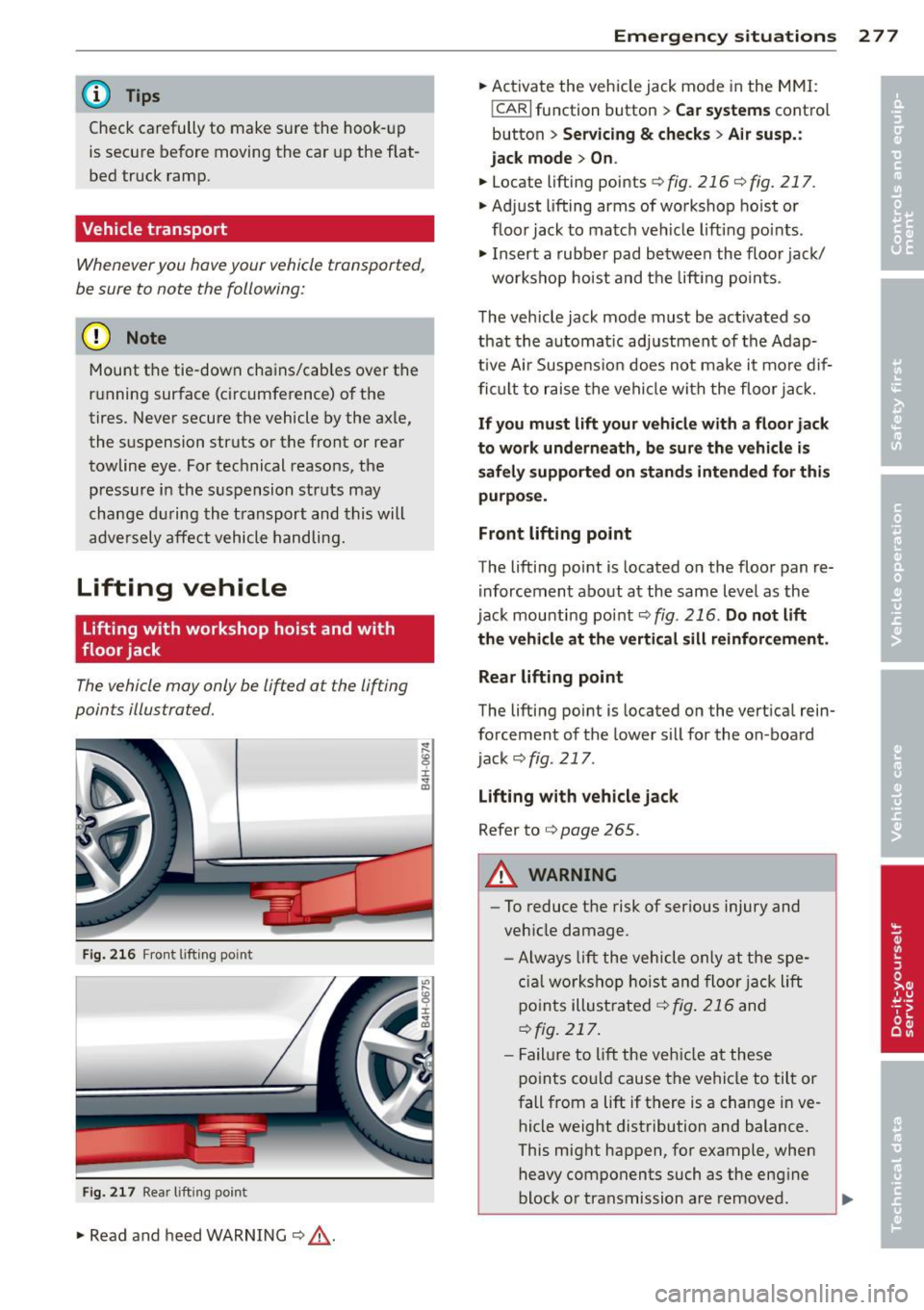
The vehicle may only be li~ed at the lif ting
points illu stra ted.
Fi g. 2 16 Front l ift in g po int
Fi g. 217 Rea r lifti ng point
.. Read and heed WARNING r:::;, ,&. .
Emergency s itu ations 2 7 7
.. Ac tivate the vehicle jack mode in the M MI:
!CAR I fu nction button > Car systems contro l
button>
Servicing & checks > Air susp.:
jack mode > On .
.. Locate lifting points r:::;, fig . 216 r:::;, fig. 217 .
.. Adjust lifting arms of workshop ho ist o r
floor jack to matc h ve hicle lift ing po ints .
.. Insert a rubbe r pad b etween the floo r jac k/
works hop hoist and the li fting po in ts .
The vehicle jack mode must be activated so
that the a utomat ic adjustment of the Adap
tive Ai r Suspe nsio n does not make it mo re dif
fi cu lt to raise the vehicle wit h the floor j ack.
If you must l ift your vehicle with a floor jack
to work und erneath, be sure the vehicle is
safely supported on stand s intended for this
purpo se.
Front lifting point
The lifti ng point is located o n the floor pan re
inforcement a bout at the same level as the
jack mount ing point
r:::;, fig . 216. Do not lift
the vehicle at th e verti cal sill reinforcem ent .
Rear lifting point
The lifti ng point is located o n the vert ica l rein
forcement of the lower sill for the on -board
jack
r:::;, fig . 217 .
Lifting with vehicle jack
Refer tor:::;, page 265 .
A WARNING ~
-To reduce the risk of ser ious injury and
ve hicle damage.
- Alway s lift the vehicle only at th e spe
cial worksho p hois t and floor jack lift
po ints illust rate d
r:::;, fig. 216 and
¢ fig. 217 .
- Fail u re t o lift the ve hicle at these
po ints co uld cause t he vehicle to til t or
fall from a lift if there is a change in ve
hicle weight distribution and balance.
This mig ht happen, fo r example, when
heavy components such as the eng ine
block o r transmissi on are removed .
-
Page 289 of 302

A
A/C (automatic climate control) .... .. .. 75
Accessories .. ... .. .. ..... ... .. .. .. . 285
Adaptive a ir suspension/sport .. .. .. .. . 106
adaptive cruise control Stop-and-go traffic . . . . . . . . . . . . . . . . . 89
Adapt ive cruise control ................ 86
C lean ing sensors/cameras ........... 208
Messages . . . . . . . . . . . . . . . . . . . . . . . . . 93
Request for drive r in tervention .. .. .. .. 90
Adapt ive Light (defective) ... .. .. .. ... . 21
Adding Engine coolant ........ ... ... ... ... 230
Eng ine oi l .. .. ........... .. .. .. ... 227
W indshield washer fluid ... .. .. .. .. . 236
Addit ives
Engine oi l .. .... .. .... ... .. .. .. ... 227
Adjustab le steer ing colum n ............ 78
Ad justing
A ir distribution (automatic climate con-
trol) . . . . . . . . . . . . . . . . . . . . . . . . . . . . . . 76
Front seats . . . . . . . . . . . . . . . . . . . . . . . . 54
I nstrument illum inat ion . ..... .... ... 47
S teer ing colum n .......... .. .. .. .. .. 78
Temperatu re (automat ic climate co ntrol) 76
Airbag system . . . . . . . . . . . . . . . . . 145, 164
Advanced A irbag System ............ 149
Advanced Airbag System components . 152
Ca re . .... .. ................. .. ... 158
C hi ldren . .. .. ........... .. .. .. ... 170
Ch ild restra ints .................... 171
Components (front airbags) . ... .. .. . 152
Danger of fitting a child seat on the front
passenger seat . . . . . . . . . . . . . . . . . . . . 147
Disposal . . . . . . . . . . . . . . . . . . . . . . . . . 158
Front airbags . . . . . . . . . . . . . . . . 149, 150
H ow do the front airbags work? ... .. . 154
H ow many airbags does my vehicle
have? ... ..... ........... ...... .. 152
H ow the Advanced Airbag System com -
po nents work together ............. 153
I mportan t safety instructions on the
knee airbag system .... ... .. .. .. .. . 162
Important things to know .... .. .. .. . 145
Knee airbags ............. .... .. ... 161
Mon itoring . . . . . . . . . . . . . . . . . . . . . . . 156
PASSENGER AIR BAG OFF light .. .. .. . 156
Inde x 287
Repairs ... .. .... ... .. .. ..... ... .. 158
Safety instructions . .. ... .... ... .. .. 158
S ide a irbags ... .. .. . .. ... .... ... .. 163
S ide curtain airbags ................ 166
Warning/ind icator lights ............ . 18
Warning/Indicator lights ........... 156
We ight-sensing mat ... .. ..... ... .. 170
When must the system be inspected? 156
Aircraft Transporting your vehicle ........... 277
A lloy wheels . . . . . . . . . . . . . . . . . . . . . . . 211
All Wheel Drive . . . . . . . . . . . . . . . . . . . . . 194
Winter tires . .. .. .... ........... .. 253
Ambience lighting ..... ............. . 46
Anti-freeze
refer to Engine coolan t ...... ... .. .. 229
Anti- lock b raking system ............ . 190
Warning/ind icator lights .......... .. . 19
Anti-slip regulation ............. .... 190
Anti -theft systems
E lectronic immob ilizer .. .. ..... ... .. . 30
Audi braking guard
refer to b ra ki ng g uard .............. . 86
Audi drive select
refer to drive select 106
Audi Service Repair Manuals and Litera-
ture .............................. 283
A UTO
A utomat ic climate control ............ 75
A utomatic head lights .. .. ..... ... .. . 43
Auto Lock . . . . . . . . . . . . . . . . . . . . . . . . . . 31
Automat ic belt retractor . . . . . . . . . . . . . 140
A utomat ic car wash .... ........... .. 207
Automat ic climate control
Air vents . . . . . . . . . . . . . . . . . . . . . . . . . . 76
Automat ic recircu lation .............. 77
Operation . .. .. .. .... ............. . 75
Setup ............................ 77
synchronizing . . . . . . . . . . . . . . . . . . . . . . 76
Automat ic transm iss ion (t iptro nic) . .... 112
Emergency mode . .. ............... 115
K ick-down . .. .. .. ... ............ .. 115
Manua l shift ing . . . . . . . . . . . . . . . . . . . 115
Parking lock eme rgency release .. .. .. 116
Se lector lever positions . .. ..... ... .. 112
Automat ic w ipers ......... ........... 48
Auto Safety Hotline ................. 135
•
•
Page 290 of 302

288 Index
Average consumption ........ ... .... .. 24
Average speed . . . . . . . . . . . . . . . . . . . . . . . 24
Avoid damaging the vehicle .. .. .. .. .. . 198
B
Battery 233
Charging ................... ..... . 235
Important warnings ...... .. .. .. .. . 233
Location . ................. .. .... . 233
low . .. .... .......... ...... ... .. . 195
Replacing the battery ...... ..... .. . 236
State of charge ............... .. ... 195
W inter operation ....... .. .. .. .. .. . 233
Working on the battery .... .. .. .... . 233
Before driving .. ... .... .... .. .. .. .. . 127
Blended gasoline .................. . 218
Blower (automatic climate control) . . . . . . 76
Body cavity sealing ......... .. .. .... . 211
Booster seats
Brake fluid 177
Changing the brake fluid ....... .. .. . 232
Check ing the brake fluid level . .. .. .. . 232
What is the cor rect brake flu id level? . . 232
What should I do if the brake fluid warn-
ing light comes on?
........ .... ... . 232
Brake system Anti-lock braking system . . . . . . . . . . . . . 19
Brake assist system ....... .. .. .... . 190
Brake booster ............ .. .. .. .. . 193
Brake fluid ............... ... .... . 232
Brake fluid specifications for refill and re-
placement ............... ... .... . 232
Brake light defective ...... .. .. .. .. .. 21
Brake pads ... ........... .. .. .... . 197
Electromechanical park ing brake .. .. . . 81
Fluid reservoir ............... .. ... 232
H ow does moisture or road salt affect the
brakes? .. ............... .. .. .... . 192
Warn ing/ indicator lights ... .. .. .... . . 14
Worn brake pads symbol ... .. .. .. .. . . 19
braking guard Messages
Sett ings
. .. ... .......... .. .. .. .. ..
86
93
93
Break-in period . ........... .. .. .... . 197
Brake pads . ... ....... ... .. .. .. .. . 197
Tires 197
Bulbs ..... .. ................ ..... . 272
C
California Proposition 65 Warning ... .. 223
Battery specific . ................. . 235
Capacities .. .. .. .. .... ...... ... .. . .
Engine oil ... .. . .. ............ .. . .
Car care .... .... .................. . 282
224
206
Exterior ....... .. .......... ...... . 206
Interior ..... .. .. ....... ...... .. .. 212
Car carrier Transporting your vehicle ....... .. .. 277
Catalytic converter .............. ... . 198
Center armrest Cockpit ....... .. ..... ........... .. 57
Rear . .. .. .. .. .. ............. .. .. . 63
Central locking . . . . . . . . . . . . . . . . . . . . . . 31
Emergency locking ............. .... . 35
Certification . . . . . . . . . . . . . . . . . . . . . . . 286
Changing a wheel .. ................ . 262
Changing engine oil ............. .... 228
Chassis (undercoat ing) ........... .. . .
Check ing
Engine coolant level ...... ...... .. . -
Tire pressure . .. .. ............. .. . .
Child restraints Danger of using child restraints in the
front seat ..... .. .......... ...... .
Where can I get additional information
about child restraints and their use? ..
Child restraint system anchors .... .. . .
Child safety ... .. .. ................ .
Convertible locking retractor ........ .
Guidance fixtures for lower anchorages
I mportant safety instructions for using
child safety seats .............. ... .
Important things to know when driving
with children . ... ....... .... --. - . - 212
229
244
14
7
187
181
169
178
183
172
169
Tether anchors . .. .......... ...... . 185
Tether straps .. .. ... .. ..... ... .. .. 185
Child safety lock Rear doors (mechanical) ........ .... . 38
Rear doors (power) ...... ...... .. . - - 38
Child safety seats . . . . . . . . . . . . . . . . . . . 17 4
Booster seats . . . . . . . . . . . . . . . . . . . . . 177
Convertible child seats ......... .... 175
Convertible locking retractor ..... .... 178
Page 297 of 302
Remote control Garag e door open er (Homelink ®) .. .. . 124
Massage funct ion . . . . . . . . . . . . . . . . . . . 60
Unlock ing and locking ........... .. .. 32
Remote rear lid release ............... 35
Repair manuals ................... .. 283
Repairs Airbag system .................... 158
Replacing Fu ses . ..... .. .. ... ..... ... .. .. ... 268
Light bulbs ... ... ..... ... .. .. .. ... 272
Tires and whee ls . ..... ... .. .. .. .. . 250
Windshield wiper blades ... .. .. .. .. .. 50
Report ing Safety Defects .......... .. . 135
Reset button . . . . . . . . . . . . . . . . . . . . . . . . 26
Retractor . . . . . . . . . . . . . . . . . . . . . . . . . . 140
Reverse . .. .. ........ ......... .. .. . 112
R ims (cleaning) ..................... 211
Roof rack .... .... ...... ... .. .. .. .... 67
L oading .... .. .... .... ... .. .. .. .... 68
Roof weight . . . . . . . . . . . . . . . . . . . . . . . 68
s
SAFE . .. .. .. ... .. .. ..... ... .. .. .... 26
Safe driving hab its ...... ... .. .. .. .. . 127
Safety belt position ........ .. .. .. .. . 141
Safety belts worn by pregnant women . 142
Safety belt pretens ioner . . . . . . . . . . . . . . 143
Service and disposal . . . . . . . . . . . . . . . 1 44
Safety belt pretens ioners
P re sense . . . . . . . . . . . . . . . . . . . . . . . . 188
Safety belts . . . . . . . . . . . . . . . . . . . . . . . . 140
Adjusting .. .. .. ............ ... .. . 142
cleaning ......................... 216
D anger to passengers who do not wea r a
safety be lt . .. .. ......... .. .. .. .. . 138
F asten ing .. ............. .... .. ... 1 40
I mproperly wor n .................. 14 3
N ot wo rn . .... .. ..... ... .. .. .. ... 138
Safety belt position .... ... .. .. .. .. . 14 1
Safety instructions ..... ... .. .. .. .. . 140
Secur ing child safety seats . .. .. .. .. . 178
Special considerations for pregnant
women .. ... ............. ... ... .. 142
Unfasten ing .... ............ ... ... 142
War ning/ indicato r light .. .. .. .. .. .. . 137
Inde x 295
Warning light . ...... .. .. ..... ... .. . 16
Why YOU MUST wea r them ...... .. .. 137
Worn properly ... .. . .. ..... ... .. .. 139
Safety be lt tens ioner
drive selec t .. .. .. ................. 106
Safety be lt warning light ............ . 137
Safety compliance sticker ..... ... .. .. 279
Safe ty eq uipme nt .. ............. .... 12 7
Safety features for occupant restraint and
protection . . . . . . . . . . . . . . . . . . . . . . . . . 12 7
Safety gui delines
Seat adjustment . . . . . . . . . . . . . . . . . . . . 54
Safety instr uctions
E ngine compar tment ........... .... 2 22
f or side cu rtain airbags . ..... ... .. .. 167
for using child safety seats ... ... .. .. 172
for using safety belts . . . . . . . . . . . . . . . 140
Monito ring the Advanced Airbag Sys-
tem ............................. 158
Safety sys tems
Warning/ind icator lights ..... ... .. .. . 18
Seat adjustment Co ntrols (front seats) . . . . . . . . . . . . . . . . 55
C o ntrols (re ar seats) ........... .. .. . 57
Drive r's sea t . . . . . . . . . . . . . . . . . . . . . . . 54
F ront passenger's seat . . . . . . . . . . . . . . . 55
Front seats . . . . . . . . . . . . . . . . . . . . . . . . 54
Head restraints . . . . . . . . . . . . . . . 61, 131
Reclining rear seat .... ............. . 58
Safety gu idelines . ... ... .... ... .. .. . 54
Seat belts Why YOU MUST wea r them ... ... .. .. 137
Seat heating/ventila tion . . . . . . . . . . . . . . 76
Seating position Driver ....... .... ........... ..... 128
Front passenger ... ........... .... . 129
How to ad just the front seats ........ 129
Incor re ct sea t position .......... .. .. 131
Oc cupan ts . .. .. .. .. . .. .......... .. 128
Rear passengers .. .. .. ...... ... .. .. 130
Seat memory . . . . . . . . . . . . . . . . . . . . . . . 62
Seats (n umber) . ... .. .. ... ..... ... .. 137
Se lective unlo ck feature . . . . . . . . . . . . . . . 32
Se lector lever . . . . . . . . . . . . . . . . . . . . . . 112
Service and disposa l
Safety be lt pretensioner . . . . . . . . . . . . 144
Se rv ice interval display .. ......... .. .. . 26
•
•
Page 298 of 302
296 Index
Servotronic (power steering system) ... . 194
Shiftpaddles . ... ... ...... ... .. .. .. . 115
Ship (transporting your vehicle) . .. ..... 277
Side airbags
Description ............... ... .... . 163
How they work ............ ... .... . 164
Side assist Activating and deactivating . . . . . . . . . . . 98
C leaning sensors ....... .... .. .. .. . 208
Description ............... ... .... .. 98
Informational and alert stage signals . 100
Messages in instrument cluster display 104
MMI settings ................ ..... 103
Operation . . . . . . . . . . . . . . . . . . . . . . . . . 99
Safety tips ................ .. .. .. . 104
Sensor detection area . . . . . . . . . . . . . . . 99
Side curtain airbags ................. 166
Descript ion ................ .. .... . 166
How they work ........... .... ..... 167
Safety instructions ........ .... .... . 167
Ski sack
refer to Pass-through with ski sack ... .. 66
Sliding/tilting sunroof Emergency closing .......... .. .. .. .. 41
Emergency operation ...... .... .. .. .. 42
Opening and closing ....... ... .. ... . 40
Panoramic sunroof ............ .... .. 41
Snow chains ... ........... .. .. .. .. . 254
Sockets . . . . . . . . . . . . . . . . . . . . . . . . 63, 69
Solar operation (automatic climate con-
trol) . . . . . . . . . . . . . . . . . . . . . . . . . . . . . . . 77
Sources of information about child re-
straints and their use ......... .. .... . 187
Space-saving spare tire ........ .. .... . 261
Spare wheel ............... ... .... . 262
Speedometer . . . . . . . . . . . . . . . . . . . . . . . 26
Speed rating letter code ....... .. .... . 250
Speed warn ing system ...... .. .. ...... 83
Sport differential . .......... ... .. .. . 106
Ind icator light . . . . . . . . . . . . . . . . . . . . . 22
START ENGINE STOP button ....... .. .. 79
Starting from rest . . . . . . . . . . . . . . . . . . . . 82
Starting off with a trailer .. .. .... .. .. . . 82
Starting the engine .................. 79 Steering wheel
Adjusting steering column ....... ... . 78
Easy entry feature . . . . . . . . . . . . . . . . . . 78
Indicator light . . . . . . . . . . . . . . . . . 17, 22
Shift paddles .... ............. .... llS
Steering wheel heating ............ .. 77
Steps for determining correct load limit . 247
Stopping the eng ine ... .......... .. .. . 80
Storage .. .. .. .. .. ............. .. .. . 70
Sunroof ........ .. .. .............. .. 40
Sun shades Emergency closing (roof) ......... ... . 42
Panoramic sunroof ............. .. .. . 42
Rear window ... .. ... .......... .. .. . 47
Side doors ..... .. .. .............. .. 47
Sun visors .. .. .. .. .. ..... ...... .. .. . 47
Symbols
refer to Warning/Indicator lights . .. .. . 11
T
Tachometer ..... .. .. ............ 11, 23
Technical modifications .......... .. .. 286
Temperature di splay .................. 23
T ether anchors .... ................ . 18S
Tether strap .. .. .. .. ..... ...... .. .. 185
The first 1,000 miles (1,500 km) and after-
wards ...... .. .. .. .. ........... .... 197
Tie-downs . . . . . . . . . . . . . . . . . . . . . 65, 134
Tips for the environment Sav ing fuel .. .. .. .. ... ....... ... .. . 68
tiptronic (automatic transmission) . .... 112
T ire pressure .... .. ............. .... 244
Tire pressure monitoring system ....... 256
Loss of air pressure ............. ... 25 7
Malfunction ..... ................ . 257
Resetting tire pressures ......... .. .. 258
Tires ..... .. .. .. .. .. ............. .. 238
Serv ice life . . . . . . . . . . . . . . . . . . . . . . . 248
speed rating letter code ......... ... 250
Tire manufacturing date ......... ... 250
T ire specifications ... .......... .. .. 250
T read depth . .. .. ............. .. .. 248
Uniform tire quality grading ......... 252
Winter tires ..... ................ . 253
Tires and veh icle load limits ........... 246