brake AUDI A8 2011 Workshop Manual
[x] Cancel search | Manufacturer: AUDI, Model Year: 2011, Model line: A8, Model: AUDI A8 2011Pages: 302, PDF Size: 76.07 MB
Page 224 of 302
222 Checking and filling
Checking and filling Engine hood
Releasing the engine hood
The engine hood is released from inside the
vehicle .
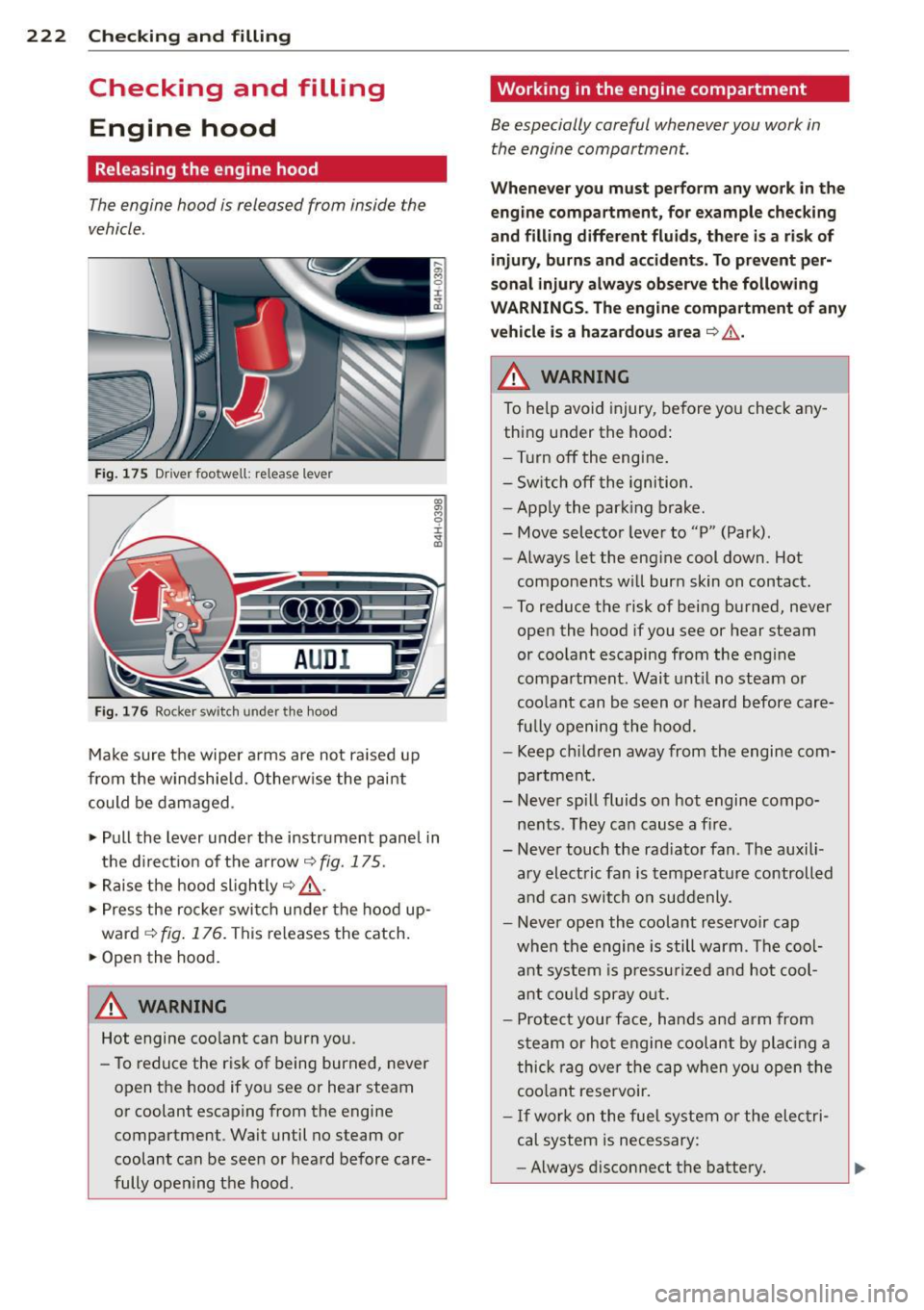
Fig. 175 Driver foo twell: release lever
AUD I
Fig. 176 Rocker switch un der the hood
Make sure the wiper arms are not raised up
from the windshield. Otherwise the paint
could be damaged.
.,. Pull the lever under the instrument panel in
the direction of the arrow
¢ fig. 175.
.,. Raise the hood slightly¢,&. .
... Press the rocker switch under the hood up
ward ~
fig. 176. This releases the catch.
... Open the hood.
&_ WARNING
Hot engine coolant can burn you.
- To reduce the risk of being burned, never
open the hood if you see or hear steam
or coolant escaping from the engine compartment . Wait until no steam or
coolant can be seen or heard before care
fully opening the hood .
' Working in the engine compartment
Be especially careful whenever you work in
the engine compartment.
Whenever you must perform any work in the
engine compartment, for example checking
and filling different fluids, there is a risk of injury, burns and accidents. To prevent per
sonal injury always observe the following
WARNINGS. The engine compartment of any
vehicle is a hazardous area
¢ ,&. .
/n.. WARNING
To help avoid injury, before you check any
thing under the hood:
- Turn off the engine.
- Switch off the ignition .
- Apply the parking brake.
- Move selector lever to "P" (Park) .
- Always let the engine cool down. Hot
components will burn skin on contact.
- To reduce the risk of being burned, never
open the hood if you see or hear steam
or coolant escaping from the engine
compartment. Wait until no steam or
coolant can be seen or heard before care
fully opening the hood.
- Keep children away from the engine com
partment.
- Never spill fluids on hot engine compo
nents . They can cause a fire .
- Never touch the radiator fan. The auxili
ary electric fan is temperature controlled
and can switch on suddenly .
- Never open the coolant reservoir cap
when the engine is still warm . The cool
ant system is pressurized and hot cool
ant could spray out.
- Protect your face, hands and arm from
steam or hot engine coolant by placing a
thick rag over the cap when you open the
coolant reservoir.
- If work on the fuel system or the electri
cal system is necessary:
- Always disconnect the battery.
Page 225 of 302

-Never smoke or work near heate rs or
open flames. Fluids in the engine com
partment could start a fire.
- Keep an approved fire extinguisher im
mediately ava ilable.
- To avoid elect rical shock and persona l in
jury while the engine is running or be ing
started, never touch:
- I gnition cables
- Othe r components of the high voltage
e lectronic ignition system.
- If you must pe rform a check or repair
with the engine running:
- F irst, fully apply the pa rking brake,
move selector lever to "P" (Park) .
- Always use extreme caution to prevent
clothing, jewelry, or long hai r from get
ting caught in the radiator fan, V-belts
or other moving parts, or from contact ing hot parts. T ie back hair before
starting, and do not wear cloth ing that
will ha ng or droop into the eng ine.
- Min imize exposure to emission and
c h emical hazards
c:> &,.
A WARNING
California Propos ition 65 Warning:
- Engine exhaust, some of its constituents,
and certai n veh icle components co nta in
or em it chemicals known to the State of
Californ ia to cause cancer a nd b irth d e
fects a nd rep roduct ive ha rm. In addi tion,
c e rta in fluids cont ained in vehicle s and
c ertain p rod ucts of component wear con
tain or emit chemicals known to the
State of Ca lifo rnia to cause cancer and
birth defects or other reproductive harm.
- Battery posts, terminals and related ac
cessories contain lead and lead com-
Checkin g and fillin g 223
poun ds, c hemicals known to the State of
California to cause cancer and reproduc
tive harms. Wash hands after handling.
([) Note
When adding fluids, always make su re that
they are poured into the p roper conta iner
or fi ller opening, otherwise serious dam
age to vehicle systems w ill occur .
@ For the sake of the environment
To detect lea ks in time, inspect the vehicle
floor pan from underneath regular ly. If
you see spots from oil or other veh icle flu
i ds, have you r vehicle inspected by an au
thorized Audi dea ler.
Closing the engine hood
.. Pull the hood down until the pressure from
t he st ruts is reduced.
.. Let the hood
drop down a nd l atc h in pla ce.
Do not try to push it shut; it may fail to en
gage ~ A_.
A WARNING
-
A hood that is not completely latched
could fly up and block your view while dr iv
i ng.
- When you close the engine hood, chec k it
to make sure t he safety catch has prope r
ly engaged. The hood shou ld be flush
with the surround ing vehicle body parts .
- If you notice while driv ing that the hood
is not secured prope rly, stop at once and
close it. •
•
Page 234 of 302
232 Checking and filling
Brake fluid
Checking brake fluid level
The brake fluid level can be checked with a
quick glance .
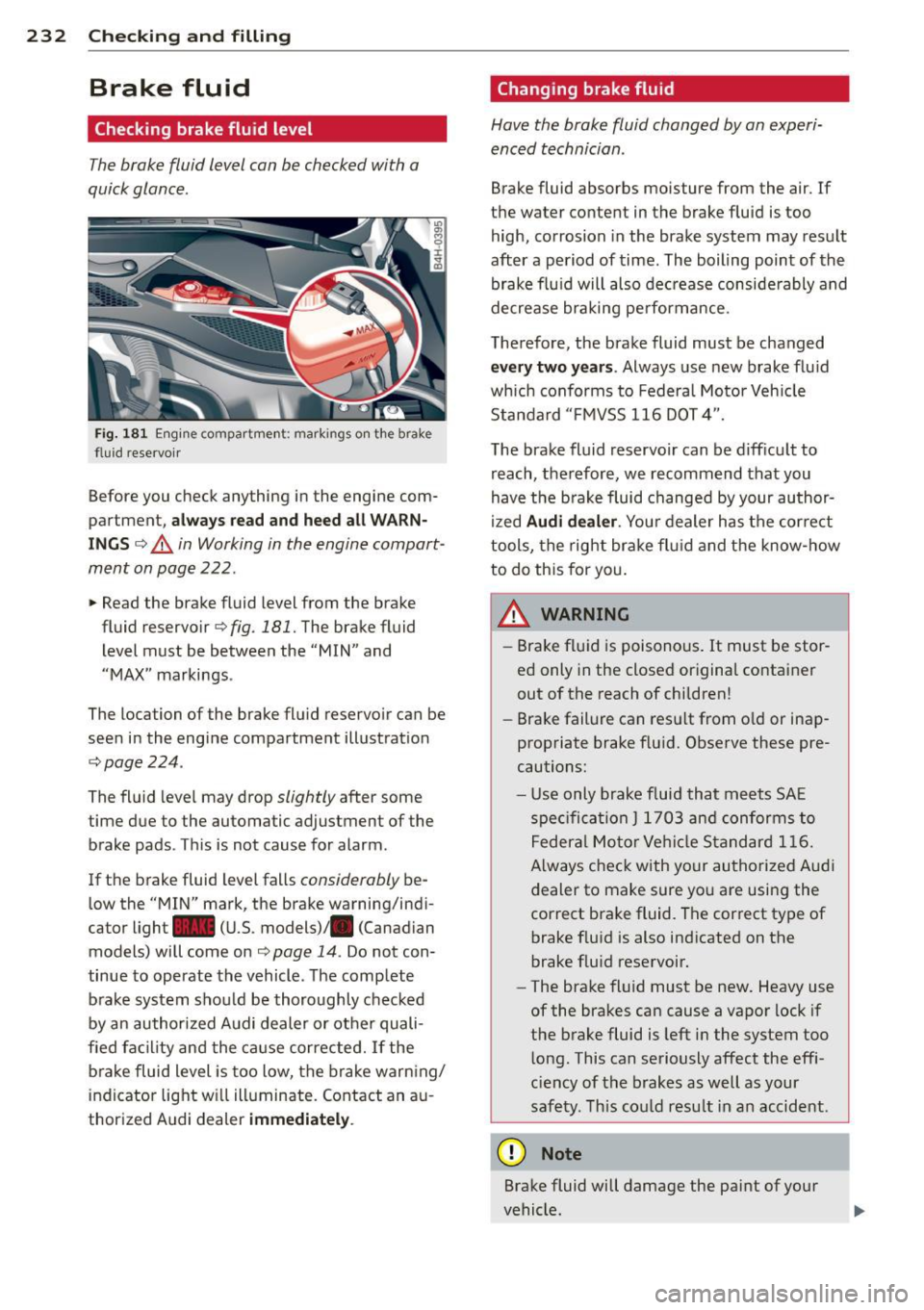
Fig. 181 Engine compartme nt: markings on the brake
flu id reservoir
Before you check anything in the engine com
partment,
always read and heed all WARN
INGS ¢ .&._ in Working in the engine compart
ment on page 222.
.. Read the brake fluid level from the brake
fluid reservoir ¢
fig. 181. The brake fluid
level must be between the "MIN" and
" MAX " markings .
The location of the brake fluid reservoir can be
seen in the engine compartment illustration
c:::,page224 .
The fluid level may drop slightly after some
time due to the automatic adjustment of the
brake pads . T hi s is not cause for alarm.
If the brake fluid level falls
considerably be
low the "MIN" mark, the brake warning/indi
cator light. (U.S. models)/ . (Canadian
models) will come on ¢
page 14. Do not con
tinue to operate the vehicle . The complete
brake system should be thoroughly checked
by an authorized Audi dealer or other quali
fied facility and the cause corrected.
If the
brake fluid level is too low, the brake warning/
indicator light will illuminate. Contact an au
thorized Audi dealer
immediately .
Changing brake fluid
Have the brake fluid changed by an experi
enced technician .
Brake fluid absorbs moisture from the air. If
t he water content in the brake fluid is too
high, corrosion in the brake system may result
after a period of time . The boiling point of the
brake fluid will also decrease considerably and
decrease braking performance.
Therefore, the brake fluid must be changed
every two years . Always use new brake fluid
which conforms to Federal Motor Vehicle
Standard "FMVSS 116 DOT 4".
The brake fluid reservoir can be difficult to reach, therefore, we recommend that you
have the brake fluid changed by your author
ized
Audi dealer. Your dealer has the correct
tools, the right brake fluid and the know-how
to do this for you .
A WARNING
-Brake fluid is poisonous. It must be stor
ed only in the closed original container
out of the reach of children!
- Brake failure can result from old or inap
propriate brake fluid. Observe these pre
cautions:
- Use only brake fluid that meets SAE
specification
J 1703 and conforms to
Federal Motor Vehicle Standard 116.
Always check with your authorized Audi
dealer to make sure you are using the
correct brake fluid. The correct type of brake fluid is also indicated on the
brake fluid reservoir.
- The brake fluid must be new. Heavy use
of the brakes can cause a vapor lock if
the brake fluid is left in the system too
long . This can seriously affect the effi
ciency of the brakes as well as your
safety. This could result in an accident.
(D Note
Brake fluid will damage the paint of your
vehicle.
Page 235 of 302
@ For the sake of the environment
Because of the problem of proper disposa l
of brake fl uid as we ll as the special tools
requ ired and the necessary expert ise, we
recommend that you have t he brake fluid
changed by your author ized Audi dealer .
Battery
General information
Under normal operating conditions, the bat
tery in your Audi does not need any mainte
nance. With
high outside temperatures or
long daily dr ive s we recommend that you have
the electro lyte level checked by a service fa
cility . The electrolyte level shou ld a lso be
checked each time the battery is charged
¢ page 235.
Have the battery checked when you take your
ve hicle in for service . Yo u are well adv ised to
replace a battery that is older than 5 yea rs .
W ith certa in types of a irbag deployment, t he
b attery is d isconnected from the vehicle elec
tr ica l system for safety reasons¢.&.
in Re
pair, care and disposal of the airbags on
page 159.
Disconnecting the battery terminals
Some vehicle functions (power w indow regu
lators , for example) are lost if the battery ter
m inals a re d isconnected. These func tions have
to be re lea rned after the batte ry term inals a re
connected agai n. T o prevent this , the bat tery
should only be d isconnec ted from the vehicle
e lec tric al system when absolu tely necessa ry
for repairs .
Vehicles not driven for long periods
If you do not drive you r vehicle over a period
of severa l days or weeks, elec trical compo
nen ts are gr adually cut b ack o r swi tched off .
This redu ces energy cons umption and main
tains starting capab ility over a longer per io d
¢ page 195.
Be aw are tha t when you unlock yo ur vehicle ,
some of the conven ien ce f unct ions may no t
Checkin g and fillin g 233
opera te , such as the Conven ience key*, the re
mote control or the power seat adjustment .
T he convenience functions will be ava ilab le
again when you switch on the ign ition and
start the eng ine.
Winter operat ion
D uring the w inte r mon ths, bat tery capacity
tends to dec rease as temperatures drop . This
is beca use more power is a lso consumed wh ile
starting, and the headlights, rear window de
fogger, etc., are used more often.
Avoid unnecessary powe r consum ptio n, pa r
ticu lar ly in city traffic or when traveling only
short distances. Let your autho riz ed Audi
dealer check the capacity of the vehicle bat
te ry before w inter sets in¢
page 235 . A well
c h arged battery will not on ly prevent s tarti ng
problems w hen the weather is cold, but wi ll
also last longer.
(D Tips
If you r vehicle is left s tandi ng for seve ral
weeks at extremely low temperatures, the
vehicle ba ttery s hould be removed an d
s to red w here i t w ill not fr eeze . T his w ill
p revent it from be in g damaged and having
to be replaced.
Working on the battery
Be especially careful when working on or near
the bat tery.
T he battery is lo cated in the l uggage compa rt
ment unde r the floo r. B efo re you che ck a ny
thi ng in the luggage com partmen t,
read and
heed all WARNINGS
¢ .&, .
Alw ays heed t he safety warning s, when work
ing on the vehicle b atte ry or the vehicle e lec -
t rical system to prevent i njury. .,..
•
•
Page 242 of 302
240 Tires and wheels
Maximum loaded vehicle weight
means t he sum of:
(a) Curb weight
(b) Accessory weight
(c) Vehicle capacity we ight, and
(d) P rod uction options weight
Maximum (permissible) inflation pressure
me ans t he max imum co ld inflation pressu re
to which a tire may be in flate d. Also called
"maxim um inflation p ress ure."
Normal occupant weight
means 150 lbs. (68 kilog rams) times the
nu mbe r of o ccupants seated in t he vehicle up
to the tota l sea ting capaci ty of yo ur vehicle .
Occupant distribution means dist ribution of occupants in a veh icle .
Outer diameter means t he overa ll diameter of a n in flated new
tire.
Overall width
means t he linear dis tan ce between the ex ter i
ors o f th e sidewalls of an inflated tire, in cl ud
ing e levations due to labeling, decorations, or
p rotective bands o r ribs.
Ply
means a laye r of r ubber-co ate d parall el c ords.
Production options weight
means t he comb ined we ight of those installed
regular produc tion options weigh ing ove r 5
l bs . (2 .3 kg) in excess of t hose standard items
which they repla ce, no t previously considered
in cur b weight o r acc essory weig ht, incl uding
h eavy duty brakes, r ide leve le rs, roof ra ck,
h eavy duty ba tte ry, a nd specia l trim .
Radial ply tire
means a pneumatic t ire in which the p ly co rds
t ha t ex tend to the beads are laid a t sub stan
ti ally 9 0 degrees to the ce nt erline o f the
trea d. Recommended inflation pressure
see
<=>
page 239, C old tire infl atio n pressure.
Reinforced tire
means a tire design to operate a t higher loads
and at h igher inflation pressures than t he cor
r espondi ng stan da rd tire. Reinforced tires
may be identifie d as "X L", "xl" , "EX TRA LOAD",
o r "RF " on t he sidewa ll.
Rim
means a metal su ppo rt for a tire or a t ire and
tube assembly upon which the tire beads are
seated.
Rim diameter
means nom inal d iameter of the bead seat. If
you change your wheel s ize, you w ill have to
purchase new tires to match th e new r im di
ameter .
Rim size designation
means r im diameter and width.
Rim width
means nom inal dista nce between rim flan ges .
Sidewall
means tha t port ion of a t ire betw ee n t he
t read a nd bead.
Speed rating (letter code)
means the speed at which a tire is designed to
be driven for extended periods of time. The
r a ti ngs range from 93 mph ( 150 km/h) to
186 mph (298 km/h)
~ page 250. Yo u may
not fi nd this information o n all ti res because
it is no t re quir ed by law.
T he speed rating letter code, wh ere applica
ble , is molde d on the tire sidewall a nd indi
c ates the max imum pe rmissibl e road speeds
<=> A in Winter tire s on page 2 54.
Tire pressure monitoring system*
mea ns a system that detects when o ne or
more of a veh icle 's tires are unde rinf lated an d
ill uminat es a low tir e pr es sure wa rning t ell
t a le.
Page 246 of 302
24 4 T ir es and whe els
- The brakes on a vehicle that has been
overloaded may not be able to stop the
vehicle within a safe distance.
- Tires on a vehicle that has been overload
ed can fail suddenly causing loss of con
trol and a crash.
- Always make sure that the tota l load be
ing transported -including the we ight of
a trailer hitch and the tongue weight of a
loaded trailer - does not make the veh i
cle heav ier than the veh icle's Gross Vehi
cle Weight Rating.
A WARNING
- Incorrect tire pressures and/or underin
flation can lead to a serious or fatal acci
dent.
- Incorrect tire pressures and/or underin
flation cause increased tire wear and can affect the handling of the vehicle .
- Incorrect tire pressures and/or underin
flation can also lead to sudden tire fa il
ure, including a blowo ut and sudden de
flation, causing loss of vehicle control.
Checking tire pressure
.
The correct tire pressure for the tires original
ly installed on your vehicle is listed on the tire
pressure label located on driver's side 8-pil
lar.
The recommended t ire pressures are on the
tire pressure labe l and in the tab le
r::;, page 242, Cold tire inflation pressure.This
means that the pressure must be checked and
adjusted when the tire has not been driven for
more than a couple of m iles (kilometers) at
low speeds during the previous three hours .
A ir in the tires expands when the tire heats up
as a result of internal fr iction as it flexes in
use. The ti re p ressu re is higher w hen the tire
has warmed up than when it is "cold ."
It is the inflat ion pressure in a "cold" tire that
counts. Therefo re, you shou ld never let air out
of a warm t ire to match "Cold tire inflation
p ressure" recommendations
¢page 242. T he tires wou
ld then be unde rinf lated and co uld
fail suddenly.
T he tire pressure label on your Audi lists the
re commended co ld tire inflation pressures at
maximum capacity for the new, original
equipment tires that were on your vehicle at
t h e time it was man ufactured. For the loca
t ion of the labe l
r::;, page 242, fig. 184 .
Most tires lose air natura lly over time. They
can a lso lose some air if you drive over a pot
ho le or hit a curb while park ing. It is usually
not possible to see whether the rad ia l tires
used today are underinflated just by looking
at them .
Therefore, be sure to check t ire press ures at
l east once a month and a lways before going
on a long trip. Make sure to take the number
of peop le and the amount of luggage into ac
count when adjust ing tire pressure for a trip -
even one that you wo uld not consider to be
"long." See
r::;, page 246, Tires and vehicle
load limits
for more important information .
Always use an accurate ti re pressu re gauge
when checking and ad justing inflat ion pres
su res. Check all of the tires and be sure not to
forget the spare tire.
If the pressure in any t ire
is too high when the ti re is "cold," let air o ut
of the ti re s low ly with the edge o f the tire
gauge and keep checking the pressure until
you reach the pressure that is correct for the load (passengers and luggage) and k ind of
driv ing you plan to do.
If the pressure in any tire is too low, note the
difference between the pressure in the co ld
tire and the pressure you need and add the air
that you need to reach the correct pressure for
the ve hicle load (passengers and luggage) for
the tires on your vehicle as listed on the o n
your vehicle and in th is manual and the kind
of d riving you plan to do .
Never e xce ed the max imum inflation pres
sure list ed on the tire sidewall for any rea
s on .
Page 248 of 302
246 Tires and wheels
valve stem caps on all wheels are secure ly
mounted on the valve .
@ For the sake of the environment
Underinflated tires will also increase the
fue l consumption.
Tires and vehicle load limits
There are limits to the amount of load or
weight that any vehicle and any tire can carry.
A vehicle that is overloaded will not handle
well and is more difficult to stop. Overloading
can not only lead to loss of vehicle control, but can also damage important parts of the
vehicle and can lead to sudden tire failure, in
cluding a blowout and sudden deflation that
can cause the vehicle to crash.
Your safety and that of your passengers also
depends on making sure that load limits are
not exceeded. Vehicle load includes everybody
and everyth ing in and on the vehicle. These
l oad limits are techn ica lly referred to as the
vehicle's
Gross Vehicle Weight Rating
("GVWR").
The "GVWR" includes the we ight of the basic
vehicle, all factory installed accessories, a full
tank of fuel , oil, coo lant and other fluids plus
maximum load. The maximum load includes
the number of passengers that the vehicle is
intended to carry ("seating capacity") with an
assumed weight of 150 lbs (68 kg) for each
passenger at a des ignated seat ing pos ition
and the tota l we ight of any luggage in the ve
hicle. If you tow a trailer, the weight of the
trailer hitch and the tongue weight of the
l oaded trailer must be included as part of the
vehicle load.
The
Gross Axle Weight Rating ("GAWR") is
the maximum load that can be applied at each
of the vehicle's two axles.
The G ross Vehicle Weight Rating and the
Gross Axle Weight Rating are listed on the
safety compliance sticker labe l located on the
driver's side B-p illar. You r A udi has 5 seat ing
positions, 2 in the front and 3 in the rear for
total seating capacity of 5. Vehicles with pow- er individual rear seats* have
4 seating posi
tions,
2 in the front and 2 in the rear for total
seat ing capac ity of
4. Each seating position
has a safety belt¢
page 137, Safety belts.
The fact that there is an upper limit to your
vehicle's Gross Vehicle Weight Rating means
that the total weight of whatever is being car
ried in the vehicle (including the weight of a
trailer hitch and the tongue weight of the
loaded trailer) is lim ited . The more passen
gers in the vehicle or passengers who are
heavier than the standard we ights assumed
mean that less we ight can be carried as lug
gage.
The tire pressure label on your Audi also lists
the max imum combined weight of a ll of the
occupants and luggage or other cargo that
the vehicle can carry. For the location of the
label¢
page 242, fig. 184.
A WARNING ,___
Overloading a vehicle can cause loss of ve
h icl e contro l, a crash or other accident, se
rious personal injury, and even death.
- Carrying more weight than your vehicle
was designed to carry will prevent the
vehicle from handling properly and in
crease the risk of the loss of vehicle con
trol.
- The brakes on a vehicle that has been
overloaded may not be able to stop the
veh icle with in a safe distance.
- Tires on a vehicle that has been overload
ed can fail suddenly, including a blowout
and sudden deflation, causing loss of
control and a crash.
- Always make sure that the total load be
ing transported -including the weight of
a trailer hitch and the tongue we ight of a
loaded trailer -does not make the vehi
cle heavier than the vehicle's G ross Vehi
cle Weight Rating.
Page 251 of 302
A WARNING
Sudden tire failure can lead to loss of con
trol, a crash and serious personal injury!
- Never drive a vehicle when the tread on
any tire is worn down to the wear indica
tors.
- Worn tires are a safety hazard, they do
not grip well on wet roads and increase
your risk of "hydroplaning" and loss of
control.
- Always keep chemicals that can cause
tire damage, such as grease, oil, gasoline
and brake fluid away from t ires.
- Tires age even if they are not be ing used
and can fail suddenly, especially at high
speeds . Tir es that are more than 6 years
old can only be used in an emergency
and then with special care and at lower
speeds.
- Never mount used tires on your vehicle if
you are not sure of their" previous histo
ry ." Old used tires may have been dam
aged even though the damage cannot be
seen that can lead to sudden tire failure
and loss of vehicle control.
Tires and wheels 249
New tires and replacing tires and wheels
New tires and wheels have to be broken in .
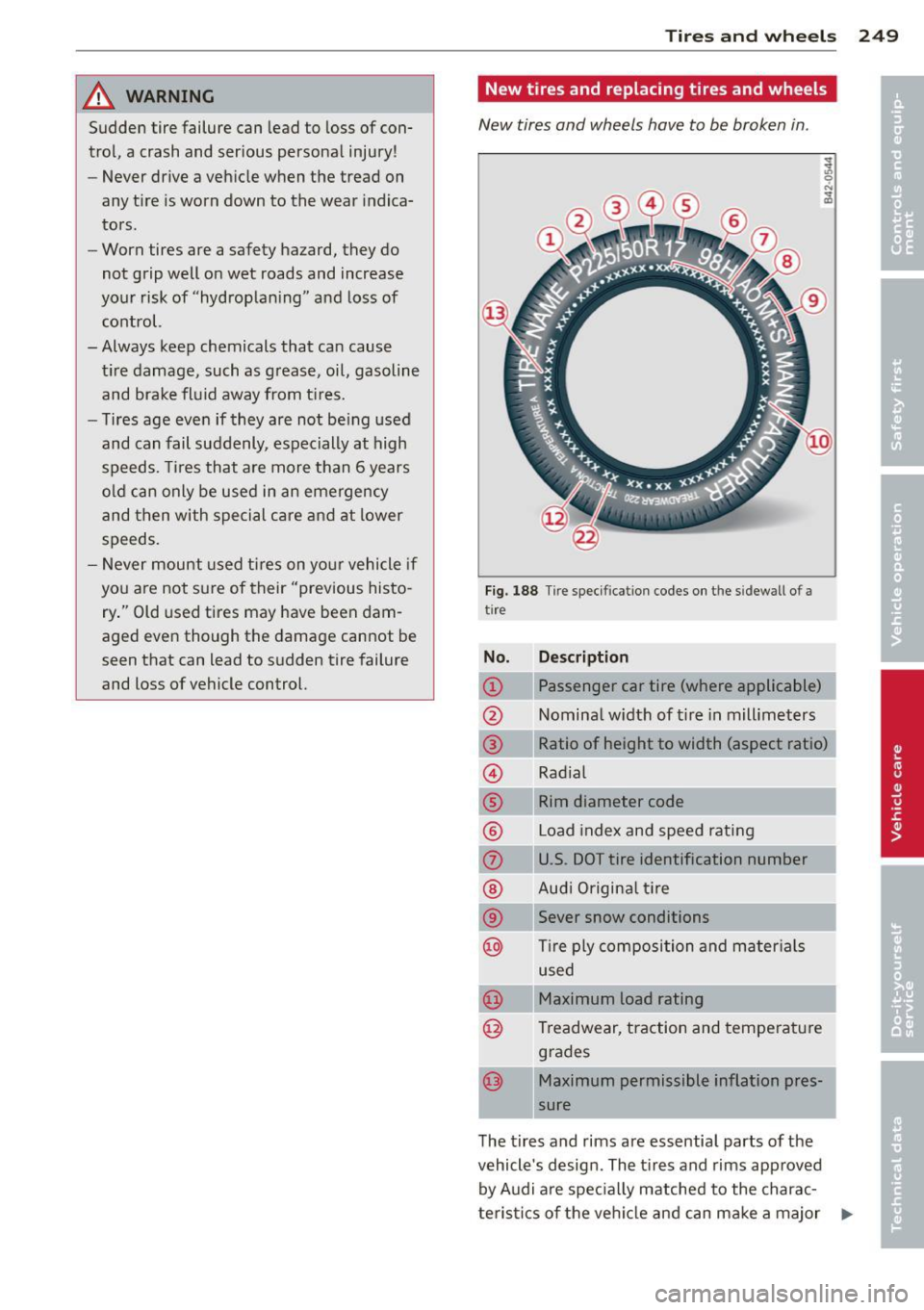
Fig. 188 Tir e specificat ion codes on t he s idewall o f a
tire
No. Description
CD Passenger car tire (where applicable)
@ Nominal w idth of tire in millimeters
® Ratio of height to width (aspect ratio)
© Radial
® Rim diameter code
® Load index and speed rating
(f) U.S. DOT tire identification number
® Audi Origina l tire
® Sever snow conditions
@ T ire ply composition and materials
used
@ Maximum load rating
@ Treadwear, traction and temperature
grades
@ Maximum permissible inflation pres-
sure
The tires and rims are essential parts of the
vehicle's design . The tires and rims approved
by Audi are spec ially matched to the charac
teristics of the vehicle and can make a major .,.
•
Page 254 of 302
252 Tir es and whe els
Driving with different tires reduces vehi
cle handling and can lead to a loss of
control.
- If the spare tire is not the same as the
tires that are mounted on the veh icle -
for example with winter tires - only use
the spare tire for a short period of time
and dr ive with extra care . Refit the nor
ma l road wheel as soon as safely possi
ble.
- Never drive faster than the maximum
speed for which the tires on your veh icle
are rated because ti res that a re driven
faster than their rated speed can fail
sudden ly .
- Overloading t ires cause heat build- up,
sudden tire failure, including a blowout
and sudden deflation and loss of control.
- T emperature grades app ly to tires that
are properly inflated and not over o r un
derinflated .
- For technical reasons it is not a lways
possible to use wheels from other vehi
cles -in some cases not even whee ls
from the same vehicle model.
- If you install wheel trim discs on the ve
hicle whee ls, make sure that the air f low
to the brakes is not blocked. Reduced air
flow to the brakes can them to overheat, increasing stopping distances and caus
ing a collision .
- Run flat t ires may only be used on vehi
cles that were equipped with them at the
factory . The vehicle must have a chassis
designed for run flat tires . Incorrect use
of run flat tires can lead to vehicle dam
age or acc idents. Check with an a uthor
ized Audi dea le r or tire specialist to see if
yo ur vehicle can be equipped with run
flat tires. If run f lat tires are used, they
must be insta lled on all four wheels. Mix
ing t ire types is not permitted .
- Fo r technical reasons , it is not genera lly
possib le to use the whee l rims from oth
er vehicles. This can ho ld true for wheels
of the same veh icle type. - If the spare tire is different from the
tires that yo u have mounted on your ve
hicle (for example winter tires or wide
profile tires), then use the spare tire for a
short period of time only and drive w ith
extra care. Replace the flat tire w ith the
tire matching the others on your vehicle
as soon as possib le .
- Never drive without the valve stern cap .
The valves cou ld get damaged .
@) For the sake of the environment
Dispose of o ld tires in accordance with the
local requirements .
Uniform tire quality grading
-Tread wear
- Traction AA AB C
- Tempe ra tu re ABC
Quality grades can be found whe re applicab le
on the tire sid e wall betw een tr ead shou ld er
a nd maximum section width
c> page 249,
fig. 188 .
For ex ample: Tread wear 200 , Tract ion AA ,
Temperatur e A.
All passenger car t ires must conform to Feder
al Safety Requirements in add ition to these
grades.
Tread wear
T he tread wear grade is a comparative rating
based on the wear rate of the t ire when tes ted
u nder contro lled cond itions on a specified
government test course .
For example, a tire graded 150 would wear
one and one ha lf (11/2) times as well on the
government course as a tire graded 100.
T he relative performance of tires depends
upon the actual conditions of thei r use, how
ever, and may depa rt s ignificantly from the
norm due to va riations in driving hab its, se rv
ice practices and differences in road character -
istics and cl imat e. ..,.
Page 257 of 302
chains because t he vehicle will be ex
tremely low. If you do drive with snow
chains on while the vehicle is at this lev
el, the snow chains might severe ly dam
age the wheelhouse and other parts of
the veh icle.
@ Tips
Where snow cha ins are mandatory oncer
tain roads, this normally also applies to ve
hicles with All Wheel Drive.
Wheel bolts
Wheel bolts must always be tightened to the
correct torque .
The design of whee l bolts is matched to the
factory installed r ims. If different rims are fit
ted, the correct wheel bolts with the right length and correctly shaped bolt heads must
be used . This ensures that wheels are fitted
secure ly and that the brake system f unctions
correctly .
In certain circumstances, you may not use
wheel bolts from a d iffe rent vehicle -even if it
i s the same mode l
¢page 285.
A WARNING
Imprope rly tig hte ned or maintained whee l
bolts can be come loose causing loss of
contro l, a co llision and serious persona l in
jury .
- Alw ays keep the w heel bolts and the
th reads in the wheel hubs clea n so the
wheel bolts can turn easily and be prop
er ly tightened .
- Never grease or oil the wheel bo lts and
the threads in the w heel h ubs. They can
become loose wh ile driving if greased or
o iled, even if tightened to the specif ied
torque.
- Only use wheel bolts that belong to the
rim being installed.
- Never use different whee ls bolts on your
vehicle.
- Always maintai n the co rrect tightening
torq ue for the wheel bo lts to reduce the
Tire s an d wheel s 255
risk of a wheel loss. If the tightening tor
que of t he wheel bolts is too low, they
can loosen and come out when the vehi
cle is mov ing. If the tighte ning torque is
too h igh, the wheel bol ts and threads
can be damaged and the whee l can be
come loose.
(I) Note
The specified torque for the whee l bolts is
90 ft lb ( 120 Nm) wi th a tole rance of± 7,4
ft lb(± 10 Nm). Torq ue whee l bolts diago
nally. Afte r cha nging a whee l, the torq ue
must be checked as soon as possible wi th a
torque w rench -prefe rably by an au thor
ized Audi dealer or qualif ied workshop .
Low aspect ratio tires
Your Audi is facto ry-eq uipped with low aspect
ratio tires. These tires have been thoro ughly
tested and been se lected specifically for your
model for their superb performance, road fee l
and handling u nder a variety of driving cond i
tions . Ask your authorized Audi dealer for
more details.
The low aspect ratio of these t ires is ind icated
by a numeral of
55 or less in the tire's size
designation . The numeral rep resents the ratio
of the t ire's sidewall height in relation to its
t read width ex pressed in pe rce ntage. Conven
tiona l tires have a he igh t/w idth ratio of 60 or
more.
The performance of low-aspe ct-ratio tire s is
particularly sensitiv e to improper infla tion
pres sure. It is therefore important that low
a spect ratio tires are inflated to the specified
pre ssure and that the inflation pressure i s
regularly checked and maintained. Tire pre s·
sures should be checked at least once a
month and always befo re a long trip
¢ page 244, Checking tire pressure.
What you can d o to avoid tire and rim
damage
Low aspect ratio tires can be damaged more
easily by impact w it h potholes , curbs, gul lies ..,.
•
•