Head AUDI A8 2014 Repair Manual
[x] Cancel search | Manufacturer: AUDI, Model Year: 2014, Model line: A8, Model: AUDI A8 2014Pages: 314, PDF Size: 78.47 MB
Page 197 of 314
be su ppressed causing serious o r even
fatal injury to the child.
- If you must i nstall a rearward facing
child safety seat on the front passenger
seat because of exceptional circumstan
ces and the
PASS ENGER AIR BA G OFF
light does not come on an d stay on, im
med iately install the rear-facing child
safety seat in a rear seating position and
have the a irbag system inspected by you r
Audi dealer.
Installing the upper tether strap on the
anchorage
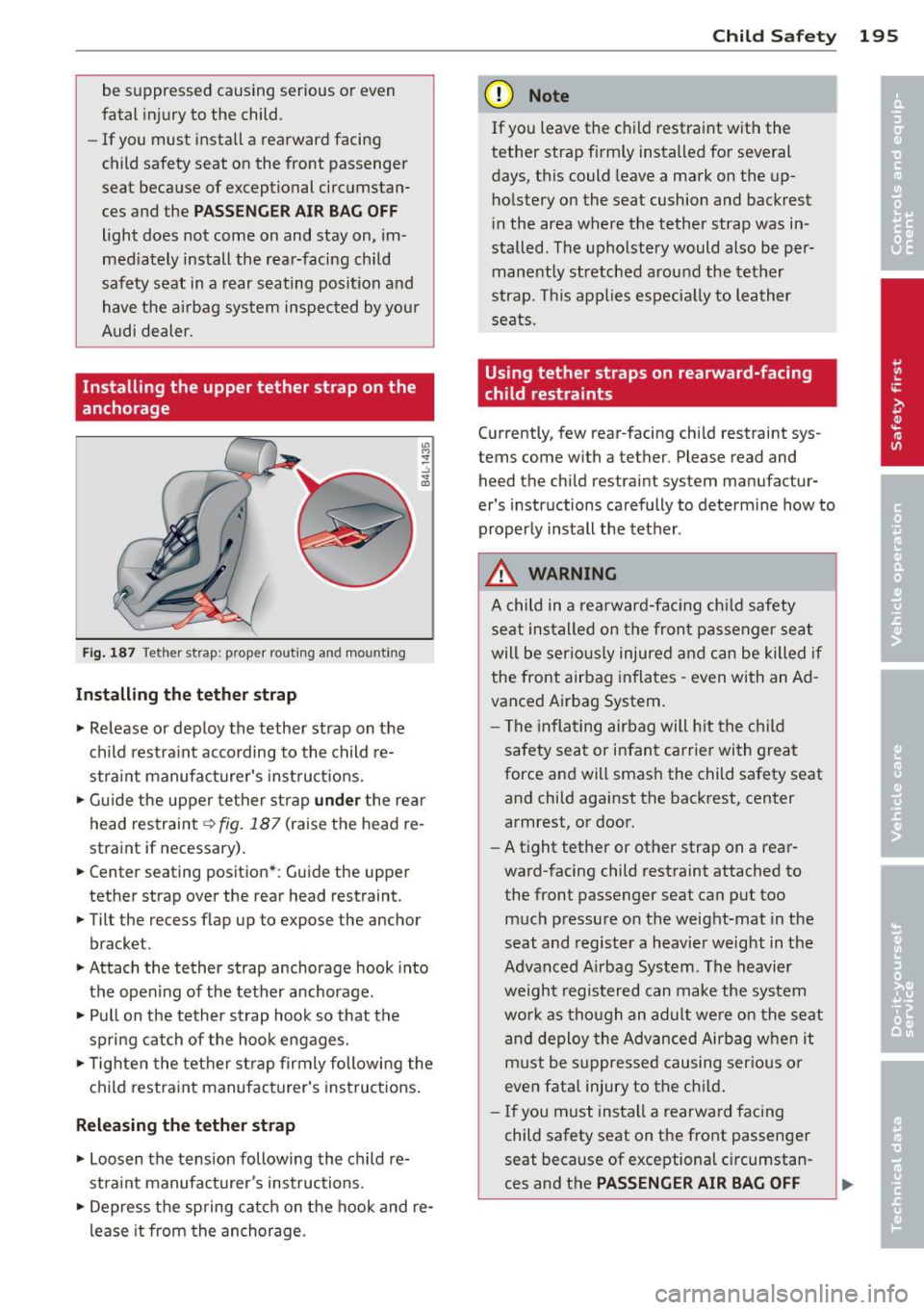
Fig. 187 Tether strap: prope r rout ing and mounting
Installing th e tether strap
• Release or dep loy the tether strap on the
child restra int according to the child re
stra int manufacturer's inst ruct ions .
• Gui de the upper tether strap
under the rear
head restraint
r=> fig. 187 (raise the head re
straint if necessary) .
• Center seating position* : Guide the upper
tether strap over the rear head restraint.
• Tilt the recess flap up to expose the anchor
bracket.
• Attach the tether strap anchorage hook into
the open ing of the tether anchorage .
• Pull on the tether strap hook so that the
spri ng catch of the hoo k engages.
• Tighte n the tet her st rap firmly following the
child restraint manufacturer's inst ruct ions .
Releasing the tether strap
• Loosen the tension following the ch ild re
stra int manufacturer's instructions.
• Depress the sp ring catch on the hook and re
l ease it from the anchorage.
Child S afety 195
(D Note
If you leave the c hild restraint with the
tether strap firmly installed for several
days, th is could leave a mark on the up
holstery on the seat cushion and backrest
i n the area where the tether strap was in
stalled. The upholstery would also be per manently stretched around the tether
strap. This app lies especia lly to leather
seats.
Using tether straps on rearward-facing
child restraints
Currently, few rear-facing child restraint sys
tems come with a tether. Please read and
heed the child restraint system manufactur
er's instructions carefully to determine how to
properly install the tether .
A WARNING ,.;; -
A child in a rearward-facing ch ild safety
seat installed on the fron t passenger seat
will be ser io usly injured and ca n be killed if
the front airbag inflates -even with an Ad
vanced Airbag System.
- The infla ting air bag will h it the ch ild
safety seat or i nfant carrier with great
force a nd will smas h the child safety seat
and child against the backrest, center
armrest, or door.
- A tight tether or other strap on a rear
ward-facing child restraint attached to
the front passenger seat can put too
muc h pressure on the weight-mat in the
seat and register a heavier weight in the
Advanced A irbag System. The heavier
weight regis tered can make the system
wo rk as tho ugh an adult we re on the seat
an d deploy the Advanced Airbag when it
m ust be s uppressed causing ser ious or
eve n fata l injury to the chi ld .
- If you must insta ll a rearward fac ing
child safety seat on the front passenger
seat because of exceptiona l circumstan
ces and the
PASSENGER AIR BAG OFF
Page 199 of 314
Audi pre sense Preventative passenger
protection
App lies to veh icles: with Audi p re se nse
Audi pre sen se can ini tiate steps to help pro
t ect vehicle occupants in certain situations.
The funct ions descr ibed depend on equipment
installed in your vehicle:
Audi pre sense basic
The following functions can be triggered in
cert ain driving situations :
- Tightening of the safety belts (for example,
during heavy braking) : the front safety belts
have reversible belt pretensioners. If a colli
sion does not occur, the safety belts loosen
slightly and are ready to be tightened again .
- Closing the windows and the sunroof* : the
windows and the sunroof" close leaving a
small open gap .
Audi pre sense basic functions can be trig
gered at speeds above 20 mph (30 km/h) .
Vehicles with Audi drive select*: the deploy
ment time is adapted in dynamic mode.
Audi pre sense front (vehicles with
adaptive cruise control*)
Audi pre sense front includes the functions in
Audi pre sense basic. In addition, within the
limits of the system, the likelihood of a colli
sion with the vehicle immediately ahead is al
so calculated . If the system senses an immi
nent collision the following functions can be
tr iggered:
- Braking guard
¢ page 100
-Tightening the safety belts
- Closing the windows and the sunroof* ( leav-
ing a small open gap)
Audi pre sense rear (vehicles with Audi
side assist*)
Audi pre sense rear includes the functions in
Audi pre sense basic. In addition, the likeli
hood of a rear-end col lision with the vehicle
coming from behind is also calculated. If the
Audi pre sense 197
risk of a collision is detected, the following
functions can be triggered :
- Tightening the safety belts
- Closing the windows and the sunroof* (leav-
ing a small open gap)
- Adjusting the seats: the settings for the
power head restrains, the upper sections of
the backrests and the pneumatic side bol
sters* are optim ized for the front seats and
the outboard rear seats*. If a collision does
not occur, the previous seat settings are re
stored.
Audi pre sense plus
Audi pre sense plus includes the funct ions in
Audi pre sense front and Audi pre sense rear.
Error message
Audi pre sense: not available
Preventative passenger protection is not avail
able. See your authorized Audi dealer immedi
ately to have the malfunction corrected .
A WARNING
Audi pre sense cannot overcome the laws
of physics.
It cannot prevent a collision. Do
not let the increased safety provided
tempt you to take risks. This will increase
the risk of a collision and serious personal
injuries.
- The sensors cannot always detect all ob
jects . This increases the risk of a colli
sion.
-Audi pre sense does not detect people or
animals or objects that are crossing the
veh icle's path ¢
page 94.
- The radar sensor's vision can be reduced
by heavy rain, ice, snow, heavy road spray
and reflections from guard rails, tunnel
entrances, etc. These and similar condi
tions can prevent vehicles from be ing ac
curately detected and in some cases they
may not be detected at all.
Ill-
•
•
Page 202 of 314
200 Intellig ent technol ogy
ESC includes and/or works together with the
anti-lock braking system (ABS), brake assist
system, anti-slip regulat ion (ASR), electronic
d ifferential lock (EDL), dynamic steering* and
electronic interaxle differential lock*. ESC is
switched on all the time. In certain situations
when you need less tract ion, you ca n sw itch
off ASR by pressing the button above
~ page 201, fig. 188 the se lector lever. Be
sure to sw itch ASR on aga in when you no lon
ger need less traction.
Anti -lock braking system (ABS )
ABS prevents the wheels from locking up
when braking. The vehicle can still be steered
even du ring ha rd b raking . Apply steady pres
sure to the brake pedal. Do not pump the ped
a l. A pulsing in the brake peda l indicates that
the system is he lping you to brake the vehicle.
Br ake assist system
The brake assist system can decrease brak ing
d istance. It increases braking power when the
d river p resses the brake pedal q uick ly in emer
gency situations. You must press and hold the brake peda l until the situation is over. In
vehicles with adaptive cruise control*, the brake assist system is more sensitive if the
d istance detected to the vehicle ahead is too
small.
Anti- slip regulati on (ASR )
ASR reduces engine power when the drive
wheels begin to spin and adapts the force to
the road condit ions. This makes it easier to
start, accelerate and drive up hills.
El ectronic diff erential lo ck (EDL )
The ED L brakes wheels that are spinning and
transfers the drive power to the other drive
wheel or whee ls if the vehicle is equipped with
all whee l drive*. This funct ion is available up
to about 7S mph (120 km/h).
In extreme cases, EDL a utomatica lly switches
off to help keep the brake on the braked whee l
from overheating. EDL will switch on again au
tomatically when conditions have returned to normal.
Dynamic ste ering *
On vehicles with dynamic s teering, ES C helps
stabilize the steering in certain situations.
Electronic interaxle differential lock
function*
T he electronic interaxle differentia l lock f unc
tion activates when driving thro ugh curves.
Braking is targeted toward the wheels on the
inside of the curve as needed . This he lps to
minimize front whee l skid, improves traction
and allows for more precise driving through
curves .
A WARNING
- ESC, ABS, ASR, EDL, dynamic steering*
and the electronic interaxle differential loc k function* cannot overcome the laws
of physics. This is espec ially impo rtant
on slippery o r we t roads.
If the systems
begin acting to stabilize your vehicle, you
should immediately change yo ur speed
to match the road and traffic conditions .
Do not let the increased safety provided
by these systems tempt you to take risks. Doing so will increase the risk of a loss of
veh icle control, collision and ser ious per
sonal injur ies.
-Always adapt your speed to road, traffic and weather conditions. The risk of losing control of the vehicle increases when
d riving too fast, espec ially through
curves and on slippery or wet roads, and
when driving too close to vehicles up
ahead. ESC, ABS, the brake ass ist sys
tem, EDL, ASR, dynamic steering * and
the electron ic interaxle differential lock
function* cannot prevent collisions.
- Always accelerate with special care on
even, smooth s urfaces such as those that
are wet or covered with ice and snow.
The drive wheels can spin even w ith
these assistance systems that cannot al
ways he lp to red uce the risk of loss of ve
h icle control.
-
Page 212 of 314

210 Driving and environment
The consumption estimates as published
by ENVIRONMENTAL PROTECTION AGENCY
(EPA) and Transport Canada may not corre
spond to your actual consumption on the
road, which will vary depending upon vehi
cle load and speed, road and weather con
ditions, trip length, etc.
Drive smoothly and keep a lookout
ahead
Vehicles use the most fuel when they are ac
celerating.
• Avoid unnecessary accelerating and braking.
Vehicles use the mo st fuel when they are ac
celerating. If you anticipate what is going to happen next, you will need to brake less and,
thus , accelerate less. Let the vehicle coast
whenever possible -for example when you see
that the next traffic light is red.
Avoid full throttle
Driving at moderate speeds saves fuel and
improves your mileage.
• Try and keep well below your car's maximum
speed .
Accelerating gently reduces fuel consump
tion, engine wear, and does not disturb the
environment .
Fuel consumption, exhaust emissions and en
gine noise increase disproportionately at high
speeds. If you drive at approximately three
quarters of top speed, fuel consumption will
be reduced by one half. Never drive faster
than the posted speed limit and weather con
ditions permit.
Reducing unnecessary idling
Even when your car is just idling it burns up
fuel.
• Shut the engine off when you are not driving
the vehicle. •
Do not warm up the vehicle by letting the
engine run at idle.
The idling phase is automatically reduced for
vehicles with the Start/Stop system. It is effi
cient to switch off the engine in vehicles with
out the Start-Stop-System when stopped at
railroad crossings and long red lights. Turning
the engine off for jus t 30-40 seconds saves
more fuel than is burned by starting the en-
. . gme again.
It takes a long time for the engine to warm up
fully when it is running at idle. However, wear
and noxious emissions are especially high
when the engine is warming up . So you should
drive away as soon as you start the engine and
avoid running at high rpms while the engine is
still warming up.
W Note
Do not leave engine idling unattended af
ter starting . If warning lights should come
on to indicate improper operation, they
would go unheeded. Extended idling also
produces heat, which could result in over
heating or other damage to the vehicle or
other property.
Regular maintenance
A badly tuned engine unnecessarily wastes a lot of fuel.
• Have your vehicle serviced at regular inter-
vals.
By having your vehicle regularly serviced by an
Audi dealer helps to ensure that it runs prop
erly and economically. The condition of your
vehicle not only affects its safety and ability to
hold its value, it also affects
fuel consump
tion.
Check your oil each time you
fill your tank.
The amount of oil used is related to engine
load and speed.
It is normal for the oil consumption of a new
engine to reach its lowest value after a certain
mileage has been driven . ..,.
Page 219 of 314

Vehicl e ca re a nd cl eanin g 217
Rinse the vehicle thoroughly again and let it
air dry. Remove any water residue using a
shammy .
Stubborn depos its s uch as bird dropp ings or
tree sap are best removed with plenty of wa
ter and a microfiber cloth.
A WARNING
-Only wash the vehicle when the ignition
is off and follow the instructions from
the car wash operator to reduce the risk
of accidents .
- To reduce the risk of cuts, protect your
self from sharp metal components when
wash ing the underbody or the inside of
the wheel housings .
- After washing the vehicle, the braking ef
fect may be delayed due to mo isture on
the brake rotors or ice in the winter. The
brakes must be dried first with a few
careful brake applicat ions .
- If you wash the vehicle in an automatic
car wash, you must fold the exterior m ir
rors in to reduce the r is k of damage to
the mirrors. Power folding exterior m ir- rors* must only be fo
lded in and out us
ing the power folding fu nction .
- T o prevent paint damage, do not wash
the vehicle in direct sunlight.
- T o reduce the r is k of damage to the sur
face, do not use insect removing spong
es, kitchen sponges or similar items.
- Matte finish painted vehicle compo
nents:
- To reduce the risk of damage to the
surface, do not use polishing agents or hard wax.
- Never use car wash cycles that apply
protective wax. It can destroy the
matte fin ish effect .
- Do not place any stickers or magnet ic
signs on vehicle parts painted w ith
matte fin ish paint. The paint cou ld be
damaged when the stickers o r magnets
a re removed.
@ For the sake of the environment
Only wash the vehicle in facilities spec ially
designed for that p urpose . This will reduce
the r is k of dirty wate r contam inated with
oil from entering the sewer system.
Cleaning and care information
When clea ning and caring for individual vehi
cle components, refer to the fo llow ing tab le.
The information contained there is simp ly rec
ommendations. For questions or for compo -nents that are not listed
, refer to a n author
ized Audi dea ler or a qualified workshop. Also
follow the information found in ¢ .&. .
Cle an ing exte rior
Component Situation Solution
Wipe r blades
Dirty ~ page 54, Cleaning windshield wiper blades
Headlight s/ Dirty Soft sponge with a mild soap solutiona>
tail ligh ts
S en sor s/
Dirty Sensors: soft cloth with a so lvent-free cleaning product
camera le nses Camera lenses: soft cloth with an alcohol-free cleaning
so lution
Snow/ice Hand brush/so
lvent-free de-icing spray
Wheel s Road salt Water
Brake dust Acid-free special cleaning
solution
•
•
Page 221 of 314
Vehicle care and cleaning 219
Component Situation Solution
Te xtile s,
Stains adhering to Vacuum cleaner
Vinyl, the surface
Alcantara Water-based stains Absorbent cloth and mild soap
solutional
such as coffee, tea, blood, etc.
Oil-based stains Apply a mild soap solutional, blot away the d issolved oil
such as oil, make- or dye, treat afterward w ith water, if necessary
up, etc.
Special stains such Special stain remover, b lot with absorbent material,
as ballpoint pen, treat afterward with mild soap solutional, if necessary
na il polish, latex
pa int, shoe polish,
etc.
Natural leather Fr es h stains Cotton cloth with a mild soap solutional
Water-based stains Fresh sta ins: absorbent cloth
such as coffee, tea, Dried stains: stain remover suitable for leather
blood, etc.
Oil-based stains Fresh stains: absorbent cloth and stain remover suitable
such as oil, make- for leather
up, etc . dried sta ins: Oil cleaning spray
Special stains such Sta
in remover suitable for leather
as ballpo int pen,
nai l polish, latex
paint, shoe polish,
etc.
Care Regularly apply conditioning cream that protects from
light and penetrates
into the material. Use specially-col-
ored conditioning cream, if necessary.
Cooler Dust and dirt Clean the vent ilation openings in the luggage compart-
ment
Dirty Lukewarm water, mild soap solutional if necessary, then
dry
Defrosting Empty the refrigerator, sw
itch it off and let it thaw with
the door open, then dry
Carbon parts Dirty Clean the same way as plastic parts
al Mi ld soap solution: maximu m two tablespoons neutral soap in a liter of water
_& WARNING
-
Th e windshie ld may not be treated with
water-repelling windshie ld coating agents .
Unfavorab le conditions such as wetness,
darkness, or low sun can result in in
creased glare. Wiper blade chatter is a lso
possible.
@ Note
- Headlights /tail lights
- Never clean headlights or tail lights
with a dry cloth or sponge.
- Do not use any cleaning product that
contains alcohol, because they could
cause cracks to form.
•
•
Page 236 of 314
234 Check ing and filling
(D Windshield/headlight washer
t . (
PP. ) con ainer ""' .......... ... . 247
@ Jump start point( -) with hex
head screw ............. ... . 245 , 283
@ Jump start point( +) under a cov-
er . ..... .............. ... . 245, 283
© Eng ine oil filler cap(~) . . . . . 237
® Brake fluid reservo ir ((0)) . . . . . 242
® Coolant expansion tank (-L) . . . 240
0 Power steering reservoir . . . . . . 203
@ Oil dipstick . . . . . . . . . . . . . . . . . 237
The engine oil filler neck (item@) may be lo
cated in
a different area depend ing on the ver
sion of the engine .
& WARNING
Before you check anything in the engine
compartment, always read and heed all
WARNINGS¢ .&.
in Working in the engine
compartment on page 231.
Engine oil
Engine oil specifications
The engine oil used in your Audi needs the
right kind of oil.
-
The engine in your Audi is a sophisticated
powerp lant that was built to exacting specifi
cations . This engine needs the r ight kind of
engine o il that meets spec ificat ions regarding
qua lity and viscos ity so that it can run
smoothly and reliably . Choos ing the righ t oi l
and changing oil within the time and mileage interva ls printed in your vehicle 's Warranty
&
Maintenance book let matters a lot more to
day than it did years ago. Audi has developed
a special quality standard for engine oil that
will help assure that your veh icle's eng ine will
get the lubrication it needs for proper opera
tion.
Modern engine lubrication has taken a quan
tum leap in the last few years. Many synthetic
oils ava ilable today provide better engine lu
brication that can outlast trad itional petrole -u
m -based oils, making them a smart choice
for use throughout the life of your Audi.
Whether you use synthet ic o r petro le um
based eng ine oil, the oi l that you use m ust
conform to Audi's oi l quality standard
VW 502 00 (vehicles with gasoline engine) or
VW 507 00 (vehicles with d iese l eng ine) to
help keep your veh icle's engine running
smoothly and help prevent the format ion of
harmful deposits, sometimes called "s ludge,"
that over time can lead to expens ive repairs.
At the time of printing, engine oils ava ilab le in
the U.S. and Canada that meet the exacting
specifications of Audi oil standard VW 502 00 (ve hicles w ith gasoline eng ine) o r VW 507 00
(veh icles w ith diese l eng ine) are synthet ic en
gine o ils . This does no t mean, howeve r, that
every synt hetic eng ine oil will meet A udi oi l
standard VW 502 00 (veh icles with gasoline
engine) or VW 507 00 (vehicles with diesel
engine). So a lways be sure that you use an ap
proved o il.
T o he lp preven t the formation of harmfu l de
posits use on ly oil with the following specifi
cations printed on the o il container:
- Audi oil standard VW 502 00 (g aso line en
gine )
- Audi oil standard VW 507 00 (die sel en-
gine )
Oil container labels may car ry the spec ifica
t ion sing ly or in combination with othe r desig
na tions and oil quality standa rds.
Viscosit y
Engine oi ls are graded according to their vis
cosity . The proper viscos ity grade oil for your
engine depends on climactic or seasona l con
ditions where you drive . You can use o il with a
viscosity grade of SA E 5W40 across all tem
perature ranges for normal dr iv ing cond itions .
However, if engine oil viscosity grade SAE
5W40 is not ava ilable, you can also use v iscos
i ty grade SAE 5W-30 or SAE OW-40 as long as
it meets Audi oil quality standard VW 502 00
(ve hicl es w ith gasoline eng ine) o r VW 50 7 00
(ve hicles w ith diese l engine) specifica tions. .,.
Page 245 of 314
long. This can seriously affect the effi
ciency of the brakes as well as yo ur
safety. This could result in an acc ident.
0 Note
Brake f luid will damage the paint of your
vehicle.
@ For the sake of the environment
Because of the problem of proper d isposa l
of brake fl uid as we ll as the special tools
req uired and the necessa ry expert ise, we
recommend that you have the brake fluid
changed by your author ized Audi dealer.
Battery
General information
Under normal operating conditions, the bat
tery in your A udi does not need any mainte
nance . With
high outside temperatures or
long dai ly dr ives we recommend that you have
the electro lyte level checked by a service fa
cility. T he electrolyte level shou ld also be
checked each time the battery is charged
-:;, page 245.
Have the battery checked when you take your
ve hicle in for service. You are well adv ised to
replace a battery that is older than 5 years.
W ith certa in types o f airbag deployment, the
battery is d isconnected from the vehicle elec
tr ica l system for safety reasons¢
& in Re
pair, care and disposal of the airbags on
page 167.
Disconnect ing the battery terminals
Some vehicle functions (power w indow regu
lators, for example) are lost if the battery ter
minals a re d isconnected. These functions have
to be relearned after the battery terminals a re
connected again . To prevent this, the battery
should only be d isconnected from the vehicle
e lec trica l system whe n absolu tely ne cessa ry
f or repairs.
Checkin g and fillin g 243
Vehicles not driven for long periods
If you do no t drive your vehicle over a period
of seve ra l days o r weeks, e lectr ica l compo
nents are g radually cut back or switched off .
This reduces energy consumption and main
ta ins starting capability over a longer period
¢
page 204. Some of the convenience func
tions may not operate, such as the inter ior
l igh ts or the power seat adjus tment. The con
venience functions will be ava ilab le aga in
whe n you swi tch on the ignition and sta rt the
engine.
Winter operation
During the winte r months, battery capacity
tends to dec rease as temperatures drop. This
i s because more power is a lso consumed wh ile
s ta rt ing, and the headlight s, rea r window de
fogger, e tc., are used more ofte n.
Avoid unnecessary powe r consumpt ion, par
ticu larly in city traffic o r when traveling only
sho rt distances. Let yo ur au thoriz ed Aud i
de aler check the cap acity of the vehicle b at
tery before winter sets in~ page 245. A well
charged bat tery will not on ly prevent starting
problems w hen the weather is cold, but w ill
a lso last longer.
{!) Tips
If yo ur vehicle is left s tandin g for seve ral
weeks at extreme ly low tem peratures, the
vehicle battery sho uld be removed and
stored w here it w ill not freeze . T his will
prevent it from be ing damaged and having
to be replaced.
Working on the battery
Be especially careful when working on or near
the battery.
The battery is located in the luggage compart
ment under the floor. Before you check any
th ing in the luggage compartment,
read and
heed all WARNINGS
¢ .&_ .
Always heed the safety warnings , when work
ing on the vehicle battery or the vehicle e lec
trical system to prevent injury. •
•
Page 247 of 314
_& WARNING
California Proposition 65 Warning:
- Battery posts, terminals and related ac cessories contain lead and lead com
pounds, chemicals known to the State of
Californ ia to cause cancer and reproduc
t ive p roblems. Wa sh hands afte r han
dling.
(D Note
- Do not d isconnect the ve hicle battery
when the ignition is on or when the en
gine is running, otherwise, you will dam
age electron ic components in the elect ri
cal system .
- If yo ur vehicl e is going to stand for a
l ong pe riod of time wi thout bei ng d riven,
protect the battery from "free zing", oth
e rwise it wil l be damaged and w ill then
have to be replaced.
Battery charging
Starting the engine requires a well charged
battery.
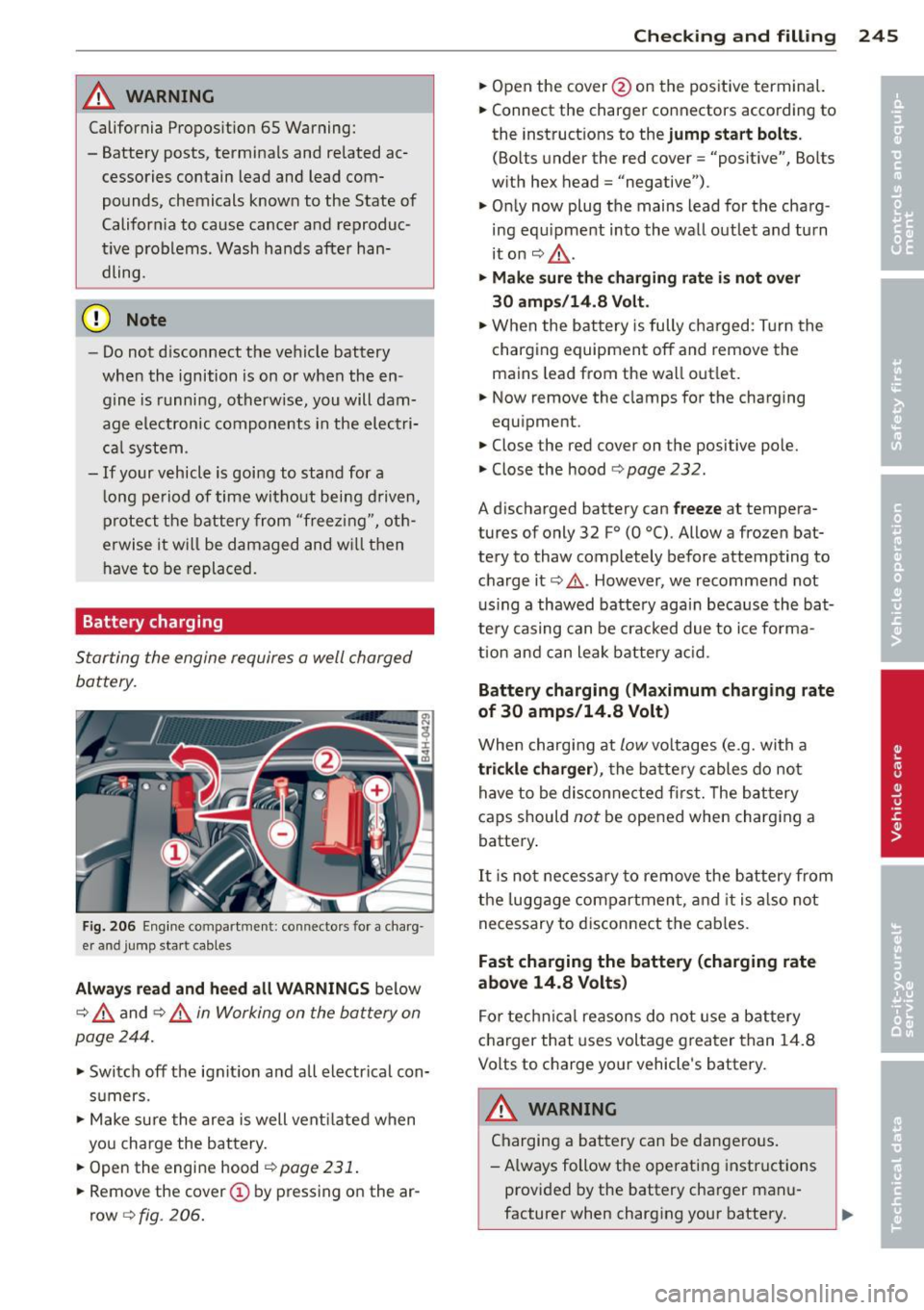
F ig. 206 Eng ine co mpartment : c o nnecto rs fo r a charg
er and ju mp sta rt cab les
Alway s read and heed all WARNINGS be low
¢ &. and
¢&. in Working on the ba ttery on
page 24 4.
• Switch off th e ignit ion and a ll electrica l con
s u mers.
• M ake sure the are a is well vent ilated when
yo u charge the bat tery.
• Open the engi ne hood
¢ page 231.
• Remove the cover@ by press ing o n the ar
row
¢ fig . 206.
Checkin g and fillin g 245
• Open the cover @on the pos itive termina l.
• Connect the charge r co nnectors accord ing to
the instruct ions to the
jump sta rt bolts.
(Bo lts under the red cover = "posit ive", Bo lts
w ith hex head= "negative") .
• On ly now plug the mains lead for the charg
ing equ ipment into the wall outlet and tu rn
iton ¢_& .
• Make sure the charging rate is not over
30 amps /14.8 Volt .
• W hen the bat tery is fully c harged: T urn the
charg ing equipment off and remove the
mains lead from the wa ll out let.
• Now remove the clamps for the charging
equ ipment .
• Close the red cover on the positive pole.
• Close the hood ¢
page 232.
A discharged battery can freeze at tempera
tures of only 32 F
0 (0 °C). Allow a frozen bat
tery to thaw completely before attempting to
charge it ¢ ,&. . However, we recommend not
u s ing a thawed batte ry aga in because th e ba t
te ry casing can be c racked due to i ce fo rma
t ion an d can leak ba ttery a cid.
Battery charging (Maximum charging rate
of 30 amps/14.8 Volt )
When charg ing at low vo ltages (e.g. wi th a
trickl e charger ), the ba tte ry cables do no t
have to be dis conne cte d firs t. T he bat tery
caps should
not be opened when charg ing a
batte ry .
I t i s no t ne cessa ry to remove the battery from
t he luggage compartmen t, a nd it is a lso not
necessary to d iscon nect the cab les.
Fast charging the battery (charging rate
above 14 .8 Volts)
Fo r tec hni ca l re asons do not use a battery
c h arger that uses voltage g reater than 14.8
Volts to charge yo ur vehicle's battery.
A WARNING
Charging a battery can be dangero us.
-Always follow the operating instructions
provided by the battery charger manu
facturer when charging your battery.
Page 249 of 314

Windshield/headlight washer container
Fig . 207 Eng ine co mpartmen t: cove r on the win dshield
w ash er flui d reservo ir
The washer flu id container is marked with the
symbol ~ on its cap
c> fig. 207, c> page 233 .
.. Before you check anyth ing in the engine
compartment ,
always read and heed all
WARNINGS c> A in Working in the engine
compartment on page 231 .
.. Lift the filler cap tongue to add washer flu
id . You can fill the container to the top .
.. Press the cap back onto the filler neck after
filling the containe r.
You can find the reservoir
capacity in the tab le
in
c> page 290 .
Clean water should be used when fill ing up. If
possible, use soft water to prevent scaling on
washer jets . Always add a glass cleaner solu
tion (with frost protection in the winter).
(D Note
Do not mix engine coolant antifreeze or
any other additives to fill up the wind
shield washer reservoir.
Checking and filling 247