Head AUDI A8 2014 Service Manual
[x] Cancel search | Manufacturer: AUDI, Model Year: 2014, Model line: A8, Model: AUDI A8 2014Pages: 314, PDF Size: 78.47 MB
Page 139 of 314
~ Always keep both feet in the footwell so
that you are in control of the vehicle at all
times.
For detailed information on how to adjust the
driver's seat, see
c';> page 59.
A WARNING
Drivers who are unbelted, out of position
or too close to the airbag can be seriously
injured by an airbag as it unfolds. To help
reduce the risk of serious personal injury:
- Always adjust the driver's seat and the
steering wheel so that there are at least
10 inches (25 cm) between your breast
bone and the steering wheel.
- Always adjust the driver's seat and the
steering wheel so that there are at least
4 inches (10 cm) between the knees and
the lower part of the instrument panel.
- Always hold the steering wheel on the
outside of the steering wheel rim with
your hands at the 9 o'clock and 3 o'clock positions to help reduce the risk of per
sonal injury if the driver's airbag inflates.
- Never hold the steering wheel at the
12 o'clock position or with your hands at
other positions inside the steering wheel
rim or on the steering wheel hub. Hold
ing the steering wheel the wrong way
can cause serious injuries to the hands,
arms and head if the driver's airbag in
flates.
- Pointing the steering wheel toward your
face decreases the ability of the supple
mental driver's airbag to protect you in a
collision .
- Always sit in an upright position and nev
er lean against or place any part of your
body too close to the area where the air
bags are located.
- Before driving, always adjust the front
seats and head restraints properly and make sure that all passengers are prop
erly restrained.
- Never adjust the seats while the vehicle
is moving. Your seat may move unexpect-
Driving Safely 137
ed ly and you could lose control of the ve
hicle.
- Never drive with the backrest reclined or
tilted far back! The farther the backrests
are tilted back, the greater the risk of in
jury due to incorrect positioning of the safety belt and improper seating posi
tion .
- Children must always ride in child seats
c';> page 177. Special precautions apply
when installing a child seat on the front passenger seat¢
page 153.
Proper seating position for the front
passenger
The proper front passenger seating position
is important for safe, relaxed driving.
For your own safety and to reduce the risk of
injury in the event of an accident, we recom
mend that you adjust the seat for the front
passenger to the following position :
~ Adjust the angle of the seatback so that it is
in an upright position and your back comes
in full contact with it whenever the vehicle is
moving.
~ Adjust the head restraint so the upper edge
is as even as possible with the top of your
head. If that is not possible, try to adjust
the head restraint so that it is as close to
this position as possible¢
page 139.
~ Keep both feet flat on the floor in front of
the front passenger seat .
~ Fasten and wear safety belts correctly
¢page 148.
For detailed information on how to adjust the
front passenger's seat, see ¢
page 58.
A WARNING
Front seat passengers who are unbelted,
out of position or too close to the airbag
can be seriously injured or killed by the air
bag as it unfolds. To help reduce the risk of
serious personal injury:
•
•
Page 140 of 314
138 Driving Safely
-Passengers must always sit in an upright
position and never lean against or place
any part of their body too close to the
area where the airbags are located.
- Passengers who are unbelted, out of po
sition or too close to the airbag can be
seriously injured by an airbag as it un
folds with great force in the blink of an eye.
-Always make sure that there are at least 10 inches (25 cm) between the front
passenger's breastbone and the instru
ment panel.
-Always make sure that there are at least
4 inches (10 cm) between the front pas
senger's knees and the lower part of the
instrument panel.
- Each passenger must always sit on a seat
of their own and properly fasten and
wear the safety belt belonging to that
seat.
- Before driving, always adjust the front
passenger seat and head restraint prop
erly.
- Always keep your feet on the floor in front of the seat. Never rest them on the seat, instrument panel, out of the win
dow, etc. The airbag system and safety
belt will not be able to protect you prop
erly and can even increase the risk of in
jury in a crash .
- Never drive with the backrest reclined or
tilted far back! The farther the backrests
are tilted back, the greater the risk of in
jury due to incorrect positioning of the
safety belt and improper seating posi
tion.
- Children must always ride in child seats
~ page 177. Special precautions apply
when installing a child seat on the front
passenger seat
~ page 153.
Proper seating positions for passengers
in rear seats
Rear seat passengers must sit upright with
both feet on the floor consistent with their
physical size and be properly restrained
whenever the vehicle is in use.
To reduce the risk of injury caused by an incor
rect seating position in the event of a sudden
braking maneuver or an accident, your pas
sengers on the rear bench seat must always
observe the following:
.., Adjust the head restraint so the upper edge
is as even as possible with the top of your
head. If that is not possible , try to adjust
the head restraint so that it is as close to
this position as possible~
page 139 .
.., Keep both feet flat in the footwell in front of
the rear seat.
.., Fasten and wear safety belts properly
~ page 148 .
.., Make sure that children are always properly
restrained in a child restraint that is appro
priate for their size and age~
page 177.
.&, WARNING ,.__
Passengers who are improperly seated on
the rear seat can be seriously injured in a
crash.
- Each passenger must always sit on a seat
of their own and properly fasten and
wear the safety belt belonging to that seat .
- Safety belts only
offer maximum protec
tion when the safety belts are properly positioned on the body and securely
latched . By not sitting upright, a rear
seat passenger increases the risk of per
sonal injury from improperly positioned
safety belts!
- Always adjust the head restraint properly
so that it can give maximum protection.
Page 141 of 314
Proper adjustment of head restraints
Correctly adjusted head restraints are an im
portant part of your vehicle's occupant re
straint system and can help to reduce the risk of injuries in accident situations.
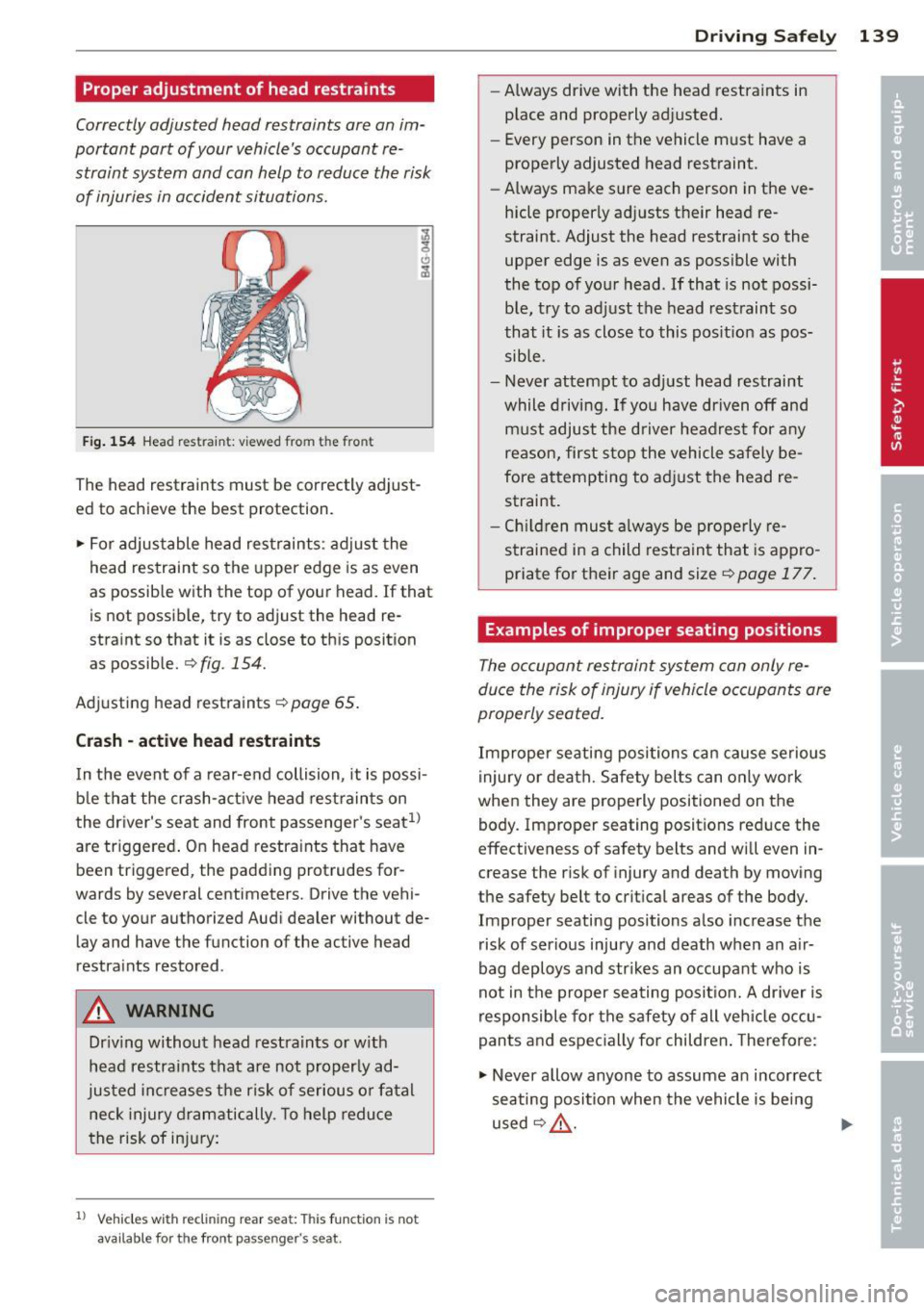
Fig. 154 H ead restra in t: v ie w ed fro m th e front
The head restraints must be correctly adjust
ed to achieve the best protection.
.,. For adjustable head restraints : adjust the
head restraint so the upper edge is as even
as possible with the top of your head. If that
is not possible, try to adjust the head re
stra int so that it is as close to th is position
as possible.
Q fig . 154.
Adjusting head restraints Q page 65.
Crash - active head restraints
In the event of a rear-end collision , it is possi
ble that the crash-active head restraints on
the driver's seat and front passenger's seat
1>
are triggered . On head restraints that have
been triggered, the padding protrudes for
wards by several centimeters. Drive the vehi
cle to your authori zed Audi dealer without de
lay and have the function of the active head
restraints restored .
A WARNING
Driv ing without head restraints or with
head restraints that are not properly ad
justed increases the risk of serious or fatal
neck injury dramatically . To help reduce
the risk of injury:
l) Vehicles w ith recl ining rear sea t: Thi s fun ction is not
ava ilable for the front passe nger's seat.
Driving Safely 139
-Always drive with the head restraints in
place and properly ad justed.
- Every person in the vehicle must have a
properly adjusted head restraint.
- Always make sure each person in the ve
hicle properly adjusts their head re
straint . Adjust the head restraint so the
upper edge is as even as possible with
the top of your head . If that is not possi
ble, try to adjust the head restraint so
that it is as close to this pos it ion as pos
sible.
- Never attempt to adjust head restraint
while driving. If you have driven off and
must adjust the driver headrest for any
reason, first stop the vehicle safely be
fore attempting to adjust the head re
straint.
- Ch ildr en mus t always be properly re
strained in a child restraint that is appro
priate for their age and size
Q page 177.
Examples of improper seating positions
The occupant restraint system can only re
duce the risk of injury if vehicle occupants ore
properly seated.
Improper seating positions can cause serious
injury or death. Safety belts can only work
when they are properly positioned on the
body. Improper seating positions reduce the
effectiveness of safety belts and will even in
crease the r isk of injury and death by moving
the safety belt to critical areas of the body.
Improper seating positions also increase the
risk of serious injury and death when an a ir
bag deploys and strikes an occupant who is
not in the proper seating posit ion. A driver is
responsible for the safety of all vehicle occu
pants and especially for children . The re fore :
... Never allow anyone to assume an incor rect
seating position when the vehicle is being
used
Q & . ...,
Page 151 of 314

To provide maximum protection, safety belts
must always be positio ned correctly on the
wearer's body .
... Adjus t the front seat and head restraint
properly
c::> page 58, General recommenda
tions .
... Hold the be lt by the tongue and pull it even
ly across the chest and pelvis
c::> &,. .
... Insert the tongue into the correct buckle of
you r seat until you hear it latch securely
c::> fig. 161.
... Pull on the belt to make su re that it is se-
c u rely latched in the buckle .
Automatic safety belt retractor s
Every safety belt is equipped with an automat
ic belt retractor on the shoulder belt. Th is fea
ture locks the belt when the belt is pulled out
fast, dur ing hard braking and in an accident .
The belt may also lo ck when you drive up or
down a steep hill or through a sharp curve .
D uring normal driving the belt le ts you move
freely.
Safety belt pretensione rs
The safety belts are equipped with a belt pre
tensioner that helps to t igh ten the safety belt
and remove s lack when the pretensione r is ac
tivated
c::> page 151. The function of the pre
tensioner is monitored by a warning light
c::> page 18 .
Switchable locking feature
E very safety belt except the one on the driver
seat is eq uipped w ith a switchab le locking fea
ture that
mu st be used when the safety belt is
used to attach a child seat. Be sure to read the important information about this feature
c:;,page 187.
A WARNING
Improperly positioned safety belts can
cause serious injury in an accident
c::> page 149, Safety belt position .
-Safety belts offer optimum protection
only when the seatback is up right and
belts are properly positioned on the
body.
-
Safety belts 149
- Never attach the safety belt to the buck
le for another seat. Attaching the belt to
the wrong buckle will reduce safety belt effectiveness and can cause serious per
sonal injury .
- A passenger who is not properly restrain
ed can be seriously injured by the safety
be lt itself when it moves from the stron
ge r parts of the body into critical ar eas
like the abdomen.
- Always lock the convertible locking re
tracto r when you a re secu ring a child
se at in the veh icle
c::>page 189.
@ Tips
For informat ion on safety belt pretension
e rs, refer to
c::> page 151 .
Safety belt position
Correct belt position is the key to getting
maximum protection from safety belts .
Fig. 1 62 Safety belt pos it ion
Use the heig ht adjus tment to change the posi
tion o f the shoulder belt of the front safety
belts.
A WARNING '-
Improperly positioned safety be lts can
cause ser ious persona l injury in an acc i
dent.
-
- The shou lder belt should lie as close to
the center of the collar bone as possible
and should fit well on the body. Hold the
be lt above the latch tongue and pull it
eve nly across the chest so that it sits as
low as possible on the pelv is and there is
no pressure on the ab domen. The belt .,_
Page 152 of 314
150 S afet y belt s
should a lways fit snugly ¢ fig. 162. Pull
on the belt to tighten if necessary.
- A loose-fitting safety be lt can cause seri
ous injuries by shifting its position on
your body from the strong bones to more
vulnerab le , soft tissue and cause serious
injury .
- Always read and heed all WARNINGS and
other important informat ion
¢ page 148.
Pregnant women must also be correctly
restrained
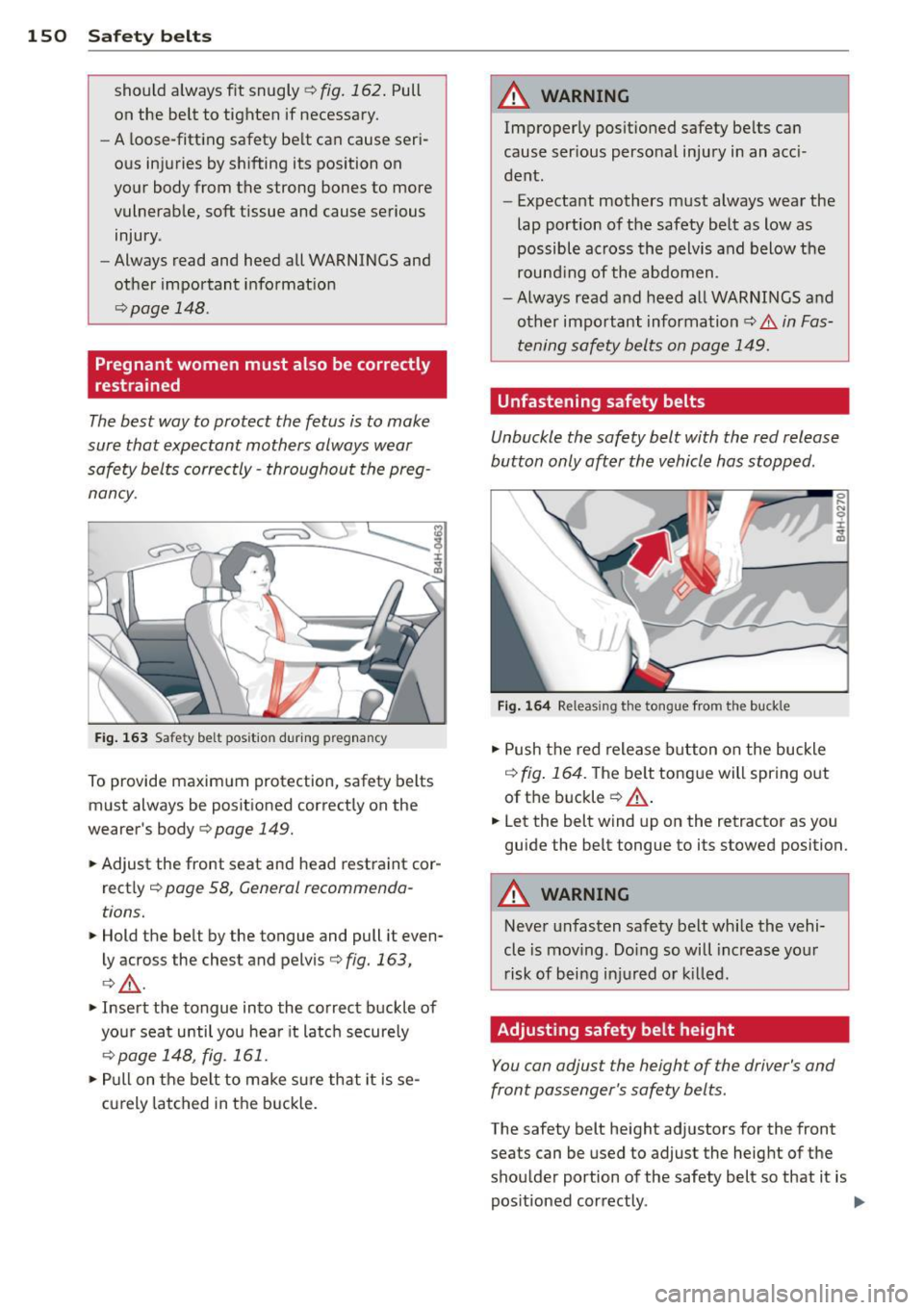
The best way to protect the fetus is to make
sure that expectant mothers always wear
safety belts correctly -throughout the preg
nancy.
Fig . 163 Safety belt posit ion duri ng pregnancy
To provide maximum protection, safety belts
must always be positioned correctly on the
wearer's body¢
page 149.
• Adjust the front seat and head restra int cor
rect ly ¢
page 58, General recommenda
tions.
• Hold the belt by the tongue and pull it even
ly across the chest and pelvis
¢ fig. 163,
¢Li). .
• Insert the tongue into the correct buckle of
your seat until you hea r it latch securely
¢page 148, fig. 161.
•Pullon the be lt to make su re that it is se
curely latched in the buckle .
A WARNING ,-
Improperly posit ioned safety be lts can
cause ser ious personal inju ry in an acc i
dent.
- Expectant mothers must always wear the
lap portion of the safety belt as low as
possible across the pelvis and below the round ing of the abdomen.
- Always read and heed all WARNINGS and
other important information¢
& in Fas
tening safety belts on page 149.
Unfastening safety belts
Unbuckle the safety belt with the red release
button only after the vehicle has stopped.
Fig . 164 Releas ing the tongue from the buck le
• Push the red release b utton on the buckle
¢ fig . 164. The be lt tongue will spring out
of the buckle
¢ _& .
0
" N 0 ±
~
• Let the belt wind up on the retractor as you
guide the belt tongue to its stowed position.
A WARNING
Never unfasten safety belt whi le the vehi
cle is mov ing . Do ing so will increase you r
risk of being inj ured or k illed .
Adjusting safety belt height
You can adjust the height of the driver's and
front passenger's safety belts.
The safety belt height adjusters for the front
seats can be used to adjust the height of the
shoulder portion of the safety belt so that it is
pos itioned correctly .
1J>-
Page 155 of 314
Airbag system Important things to know
Importance of wearing safety belts and
sitting properly
Airbags are only supplemental restraints. For
airbags to do their job , occupants must al
ways properly wear their safety belts and be
in a proper seating position.
For your safety and the safety of your passen
gers, before driving off, always:
"" Adjust the driver's seat and steering wheel
properly ¢
page 136,
"" Adjust the front passenger's seat properly
¢ page 59,
""Wear safety be lts properly ¢ page 148,
""Always properly use the proper child re-
straint to protect chi ldren
r::::> page 177.
In a collision, airbags must inflate within th e
blink of an eye and with considerable force .
The supplemental airbags can cause injuries if
the driver or the front seat passenger is not
seated properly . T herefore in order to help the
a irbag to do its job, it is important, both as a
driver and as a passenge r to s it properly at all
times.
By keeping room between your body and the
steer ing whee l and the front of the passenger
compartment, the airbag can inflate fully and
comp lete ly and provide supp lemental protec
tion in certain frontal collisions
r::::> page 136,
Proper occupant seating positions.
F or detai ls
on the operation of the seat adjustment con
trols ¢
page 59.
It's especially important that children a re
properly restrained
r::::> page 177.
There is a lot that the driver and the passen
gers can and must do to help the individual
safety features installed in your Aud i work to
gether as a system.
Prope r seat ing pos ition is important so that
the front airbag on the driver side ca n do its
job. If you have a physical impa irment or con-
A irbag system 153
dition that prevents you from sitting properly
on the driver seat with the safety belt properly
fastened and reaching the pedals, or if you
have concerns with regard to the function or
operation o f the Advanced Airbag System,
please contact your author ized Audi dealer or
qualified workshop, or call Audi Customer Re
l ations at 1-800-822-2834 for poss ible modi
ficat io ns to your veh icle.
When the airbag system dep loys, a gas gener
ator will fill the a irbags, break open the pad
ded covers, and inflate between the steer ing
whee l and the dr iver and between the instru
ment panel and the front passenger. The a ir
bags will deflate immediately after dep loy
ment so that the front occupants can see
through the windshield again witho ut inter
ruption .
A ll of th is takes place in the blink o f an eye, so
fast that many people don't even realize that
the airbags have deployed. The airbags a lso
inflate with a great dea l of force and nothing
should be in their way when they deploy.
Front a irbags in combinat ion with properly
worn safety belts slow down and lim it the oc
cupant's forward movement . Together they
help to prevent the driver and front seat pas
senger from h itti ng pa rts of the inside of the
vehicle while reducing the forces acting on the
occupant during the crash . In this way they
help to reduce the risk of injury to the head
and upper body in the crash. Airbags do not
protect the arms or the lower parts of the
body.
Both front airbags will not inflate in all fronta l
collisions . The triggering of the airbag system
depends on the vehicle de ce lerat ion rate
caused by the collision and regis te red by the
elec tron ic control unit. If th is rate is below
the reference value programmed into the con
trol unit, the airbags will not be trigge red,
even though the car may be bad ly damaged as
a res ult of the co llision . Ve hicl e damage, re
pair costs or even the lack of ve hicle damage
is not necessarily an indication of whether an
airbag should inflate or not . •
•
Page 160 of 314
158 Airbag system
that deployment under these special
conditions is impossible in all conceiva
ble situations that may happen during
the useful life of your vehicle .
- The Advanced Airbag System can deploy
in accordance with the "low risk" option
under the U.S . Federal Standard if a child
that is heavier than the typical one-year old child is on the front passenger seat
and the other conditions for airbag de
ployment are met .
- Accident statistics have shown that chil
dren are generally safer in the rear seat
area than in the front seating position.
- For their own safety, all children, espe
cially 12 years and younger, should al
ways ride in the back properly restrained
for their age and size.
Advanced front airbag system
Your vehicle is equipped with a front Advanced
Airbag System in compliance with United
States Federal Motor Vehicle Safety Standard
208 as applicable at the time your vehicle was manufactured .
The front Advanced Airbag System supple ments the safety belts to provide additional
protection for the driver's and front passeng
er's heads and upper bodies in frontal crashes .
The airbags inflate only in frontal impacts
when the vehicle deceleration is high enough.
The front Advanced Airbag System for the
front seat occupants is not a substitute for
your safety belts . Rather, it is part of the over
all occupant restraint system in your vehicle .
Always remember that the airbag system can
only help to protect you , if you are sitting up
right, wearing your safety belt and wearing it
properly. This is why you and your passengers
must always be properly restrained, not just
because the law requires you to be.
The Advanced Airbag System in your vehicle has been certified to meet the "low risk" re
quirements for 3 and 6 year-old children on
the passenger side and very small adults on
the driver side. The low risk deployment crite- ria
are intended to help reduce the risk of in
jury through interaction with the front airbag that can occur, for example, by being too
close to the steering wheel and instrument
panel when the airbag inflates.
In addition, the system has been certified to
comply with the "suppression" requirements
of the Safety Standard, to turn off the front
airbag for infants 12 months old and younger
who are restrained on the front passenger
seat in child restraints that are listed in the
Standard
¢ page 179, Child restraints and
Advanced Airbags .
"Suppression" requires the front airbag on the
passenger side to be turned off if:
- a child up to about one year of age is re strained on the front passenger seat in one
of the rear -facing or forward-facing infant
restraints listed in Federal Motor Vehicle
Safety Standard 208 with which the Ad
vanced Airbag System in your vehicle was
certified . For a listing of the child restraints
that were used to certify your vehicle's com
pliance with the US Safety Standard
¢page 179,
-weight less than a threshold level stored in
the control unit is detected on the front pas
senger seat.
When a person is detected on the front pas senger seat, weighing more than the total
weight of a child that is about 1 year old re
strained in one of the rear-facing or forward
facing infant restraints (listed in Federal Mo
tor Vehicle Safety Standard 208 with which
the Advanced Airbag System in your vehicle
was certified), the front airbag on the passen
ger side may or may not deploy.
The
PASSENGER AIR BAG OFF light comes on
when the electronic control unit detects a to
tal weight on the front passenger seat that re
quires the front airbag to be turned off. If the
PASSENGER AIR BAG OFF light does not
come on, the front airbag on the passenger
side has not been turned off by the control
unit and can deploy if the control unit senses ..,_
Page 163 of 314

& WARNING
Damage to the front passenger seat can
prevent the front airbag from working
properly.
- Improper repair or disassembly of the
front passenger and driver seat will pre
vent the Advanced Airbag System from
functioning properly.
- Repairs to the front passenger seat must
be performed by qualified and properly
trained workshop personnel.
- Never remove the front passenger or
driver seat from the vehicle.
- Never remove the upholstery from the
front passenger seat.
- Never disassemble or remove parts from
the seat or disconnect wires from it.
- Never carry sharp objects in your pockets
or place them on the seat. If the weight
sensing mat in the passenger seat is
punctured it cannot work properly.
- Never carry things on your lap or carry
objects on the passenger seat. Such
items can increase the weight registered
by the weight-sensing mat and send the
wrong information to the airbag control
unit.
- Never store items under the front pas
senger seat. Parts of the Advanced Air
bag System under the passenger seat
could be damaged, preventing them and
the airbag system from working proper
ly.
- Never place seat covers or replacement
upholstery that have not been specifical
ly approved by Audi on the front seats.
- Seat covers can prevent the Advanced
Airbag System from recognizing child re
straints or occupants on the front pas
senger seat and prevent the side airbag
in the seat backrest from deploying prop
erly.
- Never use cushions, pillows, blankets or
similar items on the front passenger
seat. The additional padding will prevent
the weight-sensing mat in the seat from
accurately registering the child restraint
-
Airbag system 161
or person on the seat and prevent the
Advanced Airbag System from function
ing properly.
- If you must use a child restraint on the
front passenger seat and the child re
straint manufacturer's instructions re
quire the use of a towel, foam cushion or
something else to properly position the
child restraint, make certain that the
PASSENGER AIR BAG OFF light comes
on and stays on whenever the child re
straint is installed on the front passen
ger seat.
- If the PASSENGER AIR BAG OFF light
does not come on and stay on, immedi
ately install child restraint in a rear seat
ing position and have the airbag system
inspected by your Audi dealer.
How the Advanced Airbag System
components work together
The front Advanced Airbag System and the
side airbags supplement the protection of
fered by the front three-point safety belts
with pretensioners and load limiters and the
adjustable head restraints to help reduce the
risk of injury in a wide range of accident and
crash situations. Be sure to read the impor
tant information about safety and heed the
WARNINGS in this chapter.
Deployment of the Adv a need Airbag System
and the activation of the safety belt preten
sioners depend on the deceleration measured by the crash sensors and registered by the
electronic control unit. The amount of infla
tion of the front airbags can also be adapted
to the front seat position, depending on the
distance between the respective front seat
and the steering wheel or instrument panel as registered by sensors in the seats. Crash se
verity depends on speed and deceleration as
well as the mass and stiffness of the vehicle
or object involved in the crash.
On the passenger side, regardless of safety
belt use, the airbag will be turned off if the
weight on the passenger seat is less than the
Iii>'
•
•
Page 164 of 314
162 Airbag system
amount prog rammed in the e lectronic control
unit. The front airbag on the passenger side
will also be turned off if one of the child seats
that has been certified under Federal Motor
Vehicle Safety Standard 208 has been recog n ized on the seat . The
PASS ENG ER AIR BAG
OFF light comes on and stays on to tell you
when the front Advanced Airbag on the pas
senger side has been turned
off ¢page 155,
Child restraints on the front seat -some im
portant things to know.
8_ WARNING
To reduce the risk of injury when an airbag
inf lates, a lways wear safety belts prope rly.
- If you are unrestrained, lean ing forward,
sitting sideways or out of position in any
way, your risk of injury is much higher.
- You wi ll also receive serio us injuries and
cou ld even be killed if you are up against
the a irbag or too close to it when it in
flates - even with an Advanced Airbag
¢page 153.
More important things to know about
front airbags
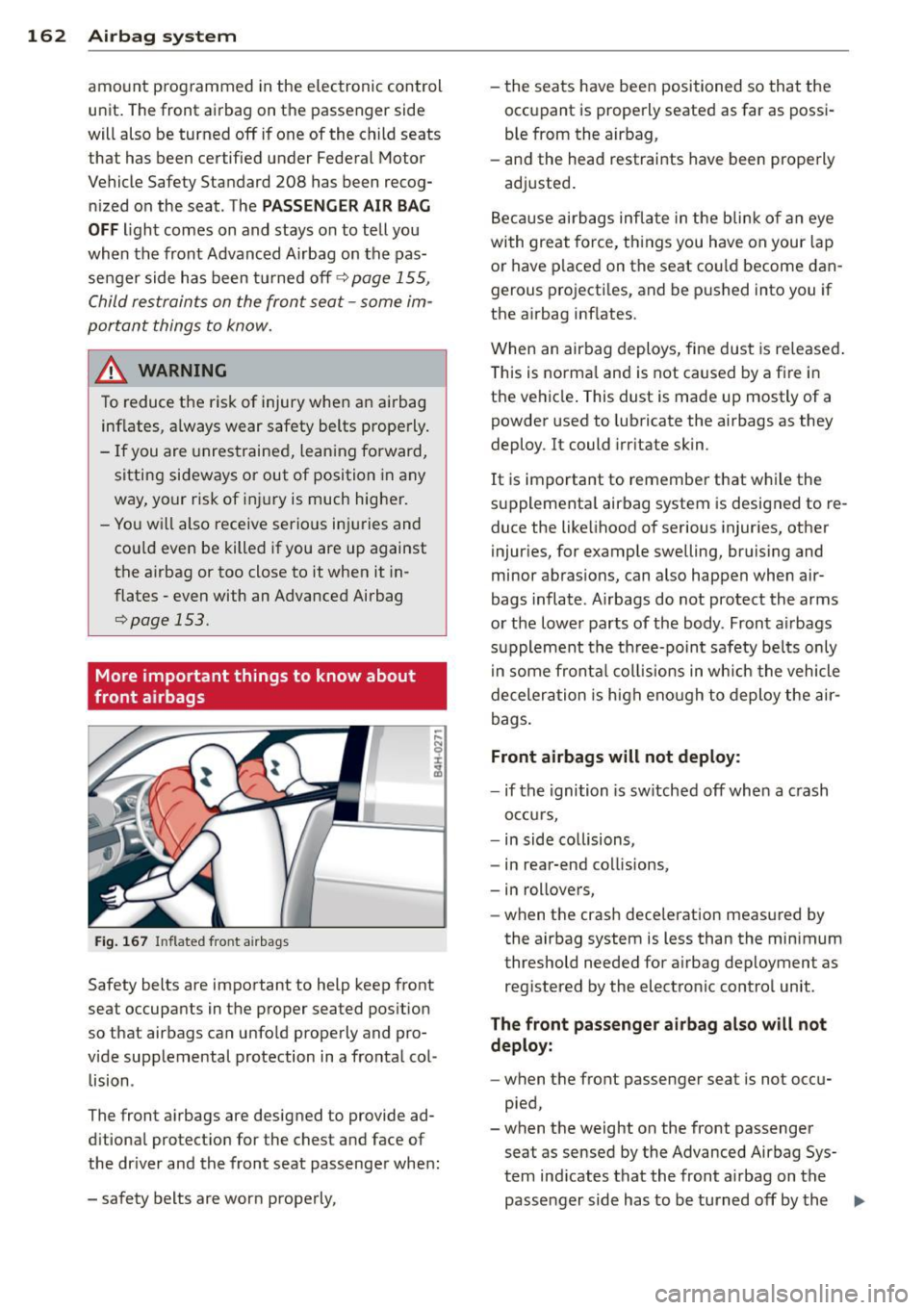
Fig . 167 Inflated front a irbags
Safety belts are important to help keep front
seat occupants in the proper seated pos ition
so that airbags can unfo ld prope rly and pro
vide supplemental protection in a frontal co l
lision .
The front airbags are designed to provide ad d itional protect ion for the chest and face of
the dr iver and the front seat passenger when :
- safety belts are worn properly, -
the seats have been positioned so that the
occupant is properly seated as far as possi
b le from the airbag,
- and the head restraints have been properly
adjusted .
Bec ause airb ags infla te in the blin k of an eye
with great force, th ings you have on your lap
or have p laced on the seat co uld become dan
gerous pro jecti les, and be p ushed into you if
the a irbag inf lates .
When an airbag deploys, fine dust is re leased .
This is no rma l and is not caused by a fire i n
the vehicle . This dust is made up mostly of a
powder used to lubricate the airbags as they
deploy. It could irr itate skin.
It is important to remembe r that wh ile the
supplementa l airbag system is designed to re
duce the like lihood of serious injur ies, other
injur ies, for example swelling, bruising and
minor abrasions, can also happen when air
bags inflate . A irbags do not protect the arms
o r the lower parts of the body . Front a irbags
supplement the three-point safety bel ts only
i n some fronta l co llisions in which the vehicle
de celeration is h igh enough to deploy the air
bags .
Front airbags will not deploy:
-if the ignition is sw itched off when a c rash
o ccu rs,
- in side co llisions,
- in rear-end collisions,
- in rollovers,
- when the crash deceleration measu red by
the airbag system is less than the min imum
threshold needed for a irbag deployment as
reg istered by the electronic contro l unit .
The front pa ssenge r airbag also will not
deploy:
- when the front passenger seat is not occu
pied,
- when the weight on the front passenger
seat as sensed by the Advanced Airbag Sys
tem ind icates that the front a irbag on the
passenger side has to be turned off by the ..,.
Page 175 of 314

Important safety instructions on the
side airbag system
Airbags are only supplemental restraints. Al
ways properly wear safety belts and ride in a
proper seating position.
There is a lot that you and your passengers
must know and act accordingly to help the
safety belts and airbags do their job to pro
vide supplemental protection .
A WARNING
An inflating side airbag can cause serious
or fatal injury. Improperly wearing safety
belts and improper seating positions in
crease the risk of serious personal injury
and death whenever a vehicle is being
used .
- In order to reduce the risk of injury when
the supplemental side airbag inflates:
-Always sit in an upright position and
never lean against the area where the
supplemental side airbag is located.
- Never let a child or anyone else rest
their head against the side trim panel
in the area where the supplemental
side airbag inflates.
- Always make sure that safety belts are worn correctly,
- Do not let anyone sitting in the front
seat put their hand or any other parts
of their body out of the window.
- Always make sure that the side airbag can inflate without interference.
- Never install seat covers or replace
ment upholstery over the front seat
backs that have not been specifically
approved by Audi.
- Never use additional seat cushions that
cover the areas where the side airbags
deploy.
- Damage to the original seat covers or
to the seam in the area of the side air bag module must always be repaired
immediately by an authorized Audi
dealer.
Airbag system 173
- Objects between you and the airbag can
increase the risk of injury in an accident
by interfering with the way the airbag
unfolds or by being pushed into you as
the airbag inflates.
- Never place or attach accessories or
other objects (such as cup holders, tel
ephone brackets, or even large, bulky
objects) on the doors, over or near the
area marked "AIRBAG" on the seat backrests .
- Such objects and accessories can be come dangerous projectiles and cause
injury when the supplemental side air
bag deploys.
- Never carry any objects or pets in the
deployment space between them and
the airbags or allow children or other passengers to travel in this position .
- Always use the built -in coat hooks only
for lightweight clothing . Never leave any
heavy or sharp-edged objects in the
pockets that may interfere with side air
bag deployment and can cause personal
injury in an accident.
- Always prevent the side airbags from be
ing damaged by heavy objects knocking
against or hitting the sides of the seat
backs.
- The airbag system can only be triggered
once. If the airbag has been triggered,
the system must be replaced by an au
thorized Audi dealership.
- Damage (cracks, deep scratches etc .) to
the original seat covers or to the seam in
the area of the side airbag module must always be repaired immediately by an au
thorized Audi dealer .
- If children are seated improperly, their
risk of injury increases in the case of an
accident ~
page 177, Child Safety.
-Never attempt to modify any compo
nents of the airbag system in any way .
- In a side collision, side airbags will not
function properly if sensors cannot cor rectly measure increasing air pressure in-
side the doors when air escapes through .,.. •
•