lock AUDI A8 2015 Repair Manual
[x] Cancel search | Manufacturer: AUDI, Model Year: 2015, Model line: A8, Model: AUDI A8 2015Pages: 312, PDF Size: 79.18 MB
Page 215 of 312

,....,
N ,....,
N
0 J:
'SI: ,...., \!) 1.1'1 ,...., 1.1'1 ,....,
~ Start the engine.
~ Se lect the D selector lever position.
~ Re lease the park ing brake and slowly pull
out and away from the wheel chocks .
~ Stop and have someone retrieve the wheel
chocks.
(D Tips
If you move the selector lever of the auto
matic transm ission to P before applying
the parking brake and before blocking the
wheels, you may have to use more force
later to move the lever out of the P posi
tion .
Trailer towing 213
•
•
Page 218 of 312
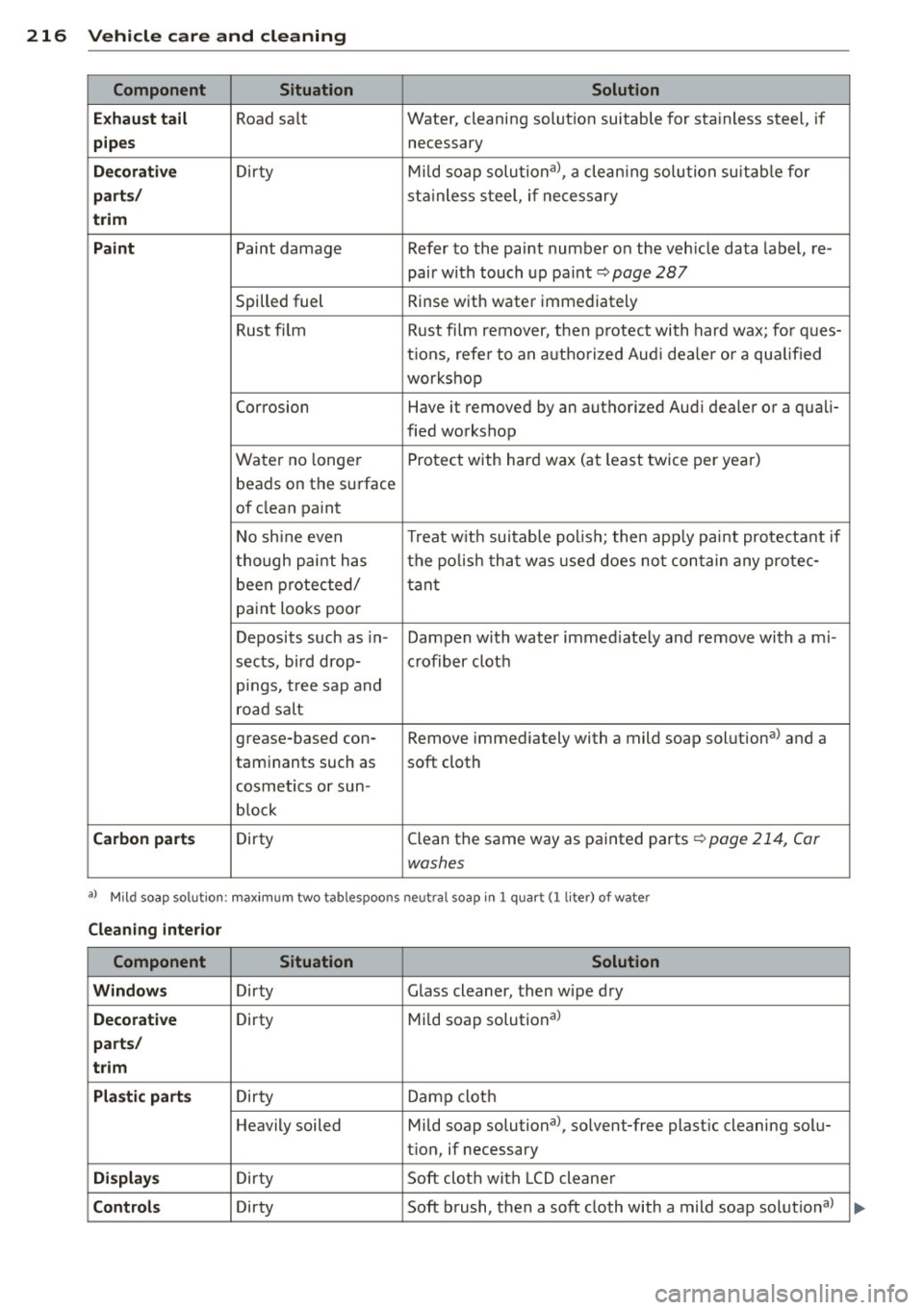
216 Vehicl e c are and cle aning
Component Situ ation Solution
Ex haus t tail
Road salt Water,
cleaning solution suitable for stainless steel, if
pipes necessary
Deco rative Dirty Mi
ld soap solutiona), a cleaning solution su itab le for
pa rts/ sta inless steel, if necessary
trim
Paint
Paint damage Refer to the paint number on the veh icle data label, re -
pair with touch up paint ¢
page 287
Spilled fuel Rinse with
water immediately
Rust f ilm Rust film remover, then protect with hard wax; for ques-
t ions, refe r to an authorized Audi dea le r or a qua lified
workshop
Corrosion Have it removed by an authorized Audi dealer or a quali-
fied workshop
Water no longer Protect
with hard wax (at least twice per year)
beads on the surface
of clean paint
No sh ine even Treat with suitable polish; then apply pa int protectant if
though paint has the po lish that was used does not contain any protec-
been protected/ tant
paint looks poor
Deposits such as in - Dampen with water immediately and remove with a mi-
sects, bird drop- crofiber cloth
pings, tree sap and
road salt
grease-based con-Remove immediately with a mild soap solutiona) and a
tam inants such as soft cloth
cosmetics or sun-
block
Car bon p art s Dirty Clean tlhe same way as painted parts ¢ page 214, Car
washes
a) Mil d soap so lu tion: maximu m two tab les poon s neut ra l soa p in 1 q uar t (l lit e r) of water
Cle ani ng inte rio r
Component Situation Solution
Wind ows
Dirty Glass cleaner, then wipe dry
Deco ra tive Dirty Mild soap solutional
p arts/
t rim
Pla st ic p art s
Dirty Damp cloth
Heavily soiled Mild soap solutional, solvent-free plastic cleaning solu-
t ion, if necessary
Displ ays Dirty Soft cloth with LCD cleaner
C ont rols Dirty Soft brush, then a soft cloth with a mild soap solutiona l
Page 220 of 312

218 Vehicle care and cleaning
- Never clean headlights or tail lights
with a dry cloth or sponge.
- Do not use any cleaning product that
contains alcohol, because they could
cause cracks to form.
-Wheels
- Never use any paint polish or other
abrasive materials.
- Damage to the protective layer on the
rims such as stone chips or scratches
must be repaired immediately.
- Sensors/camera lenses
- Never use warm or hot water to re-
move snow or ice from the camera
lens. This could cause the lens to crack.
- Never use abrasive cleaning materials
or alcohol to clean the camera lens.
This could cause scratches and cracks.
-Windows
- Remove snow and ice on windows and
exterior mirrors with a plastic scraper.
To avoid scratches, move the scraper
only in one direction and not back and
forth.
- Never remove snow or ice from win
dows and mirrors using warm or hot
water because this could cause cracks
to form.
- To avoid damage to the rear window
defogger, do not apply any stickers on
the heating wires on the inside of the
window.
- Decorative parts/trim
- Never use chrome care or cleaning
products.
- Paint
-To reduce the risk of scratches, the ve-
hicle must be free of dirt and dust be
fore polishing or waxing.
- To prevent paint damage, do not polish
or wax the vehicle in direct sunlight.
- To reduce the risk of paint damage, do
not polish away rust film .
- Remove cosmetics and sunblock imme
diately. Otherwise, the paint could be
damaged .
-Trim
- To reduce the risk of damage, do not
treat the trim around the panorama
sunroof with paint polish.
- Decorative decals
-To reduce the risk of damage, do not
use any rough powder or abrasive
cleaning products .
- To reduce the risk of damage, do not
polish decorative parts that have a
matte finish .
-Displays
-To avoid scratches, do not use dry
cleaning methods on displays.
- Controls
- Make sure that no fluids enter the con-
trols, because this could cause dam
age.
- Safety belts
- Do not remove the safety belts to clean
them.
- Never clean safety belts or their com
ponents chemically or with corrosive
fluids or solvents and never allow
sharp objects to come into contact
with the safety belts. This could cause
damage to the belt webbing.
- If there is damage to the webbing, the
connections, the retractors or the buck les, have them replaced by an author
ized Audi dealer or a qualified work
shop.
- Textiles/Vinyl/Alcantara
- Never treat Vinyl/Alcantara with leath-
er care products, solvents, floor polish,
shoe polish, stain remover or similar
products.
- To avoid damage, have stubborn stains
removed by an authorized Audi dealer
or a qualified workshop.
- Never use steam cleaners, brushes,
hard sponges, etc. when cleaning.
- Do not turn on the seat heating* to dry
the seat.
- Objects with sharp edges such as zip
pers, rivets on clothing or belts can
cause damage to the surface.
Page 224 of 312

222 Fuel su ppl y and fillin g yo ur fu el t an k
Cold diesel engines normally produce louder
noises during winter conditions than during
warmer periods . In addition, the exhaust gas
es may be light blue in color until the engine has warmed up.
.&_ WARNING
Never use starting assist fluids. They may
be potentially explos ive or cause a "run
away" engine condition . Th is could resu lt
in ser ious persona l injury and eng ine dam
age.
- Your vehicle's diesel engine was de signed so ley for use with ULSD No. 2.
Therefo re, never use gaso line, heat ing
oi l or other fuels. These fuels contain
substances that will severely damage the
fuel system and the engine. Such dam
age will not be covered by your New Ve hicle limited Warranty.
- If you put any amount of incorrect fue l in
the fue l tank, do not start the engine un
der any circumstances. Immediately con
tact the nearest authorized Audi dealer
or authorized Audi Service Facility for as
s istance. These fuels contain substances
that can severely damage the fuel sys
tem and the engine if the engine is start
ed .
- Do not mix additives such as "flow im
provers", gasoline or other substances
with ULSD No. 2.
Fuel tank
Fuel filler neck
The fuel filler neck is located on the right rear
side panel behind the fuel filler flap .
If the power locking system should fail, you
can still open the flap manually- for detailed instructions see
c> page 2 2 4 .
You can f ind the fue l tank ca pa city of your ve
hicle in
<=> page 288.
The label on the inside of the fuel f iller flap
te lls you the correct fue l for your vehicle. For
more information about fuel specifications,
see
c> page 220.
Your vehicle fuel tank has an on board refuel ling vapor recovery system. This feature helps
to prevent fuel vapors from escaping from the
tank and polluting the environment while you
refuel your vehicle. In order to fill the tank
proper ly while protecting the environment,
please follow this refueling procedure careful
ly .
.&_ WARNING
Under normal operating cond itions , never
ca rry addit ional fue l conta iners in your car .
Gas canisters and other containers used to
transport fuel can be dangerous. Such con
tainers, fu ll or empty, may leak and could
cause a fire in a collision. If you must
transport fuel to use for your lawn mower,
snow b lower, etc ., be very careful and al
ways observe local and state laws regard
i ng the use, transportation and storage of
such fuel containers. Make certa in the con
tainer meets industry standards (ANSI/
ASTM
F852 -86).
{(y Note
Never drive your veh icle until the fuel tank
i s completely empty. The irregula r supply
of fue l can cause misfir ing. Gasoline cou ld
enter the exhaust system and damage the
catalytic converter.
Page 225 of 312

Refuelling
Fig. 190 Right rear vehicle sid e: Opening t he fuel filler
flap
Fig. 191 Fu el filler flap with attached fuel cap
When activating the central locking, the fuel
filler flap is automatically unlocked or locked.
Refuel the vehicle with the ignition switched
off.
Taking the fuel cap off
• Press the left side of the fuel filler flap to
open it¢
fig. 190 -arrow- .
• Unscrew fuel filler cap counter-clockwise
and hang it on the fuel filler flap
r;, fig. 191.
• Check the label on the inside of the fuel fill
er flap to determine if the vehicle must be
fueled with gasoline or diesel fuel.
Refuelling procedure
• Insert the fuel nozzle from the gasoline
pump into the fuel filler neck as far as it will
go.
• Select a medium refuelling rate so that the
nozzle switches off automatically when the
tank is full.
Putting the fuel cap back on
• After filling your tank, twist the fuel filler
cap clockwise as far as it will go.
• Close the fuel filler flap.
Fuel supply and filling your fuel tank 223
To avoid fuel spilling or evaporating from the
fuel tank always close fuel filler cap properly
and completely. An improperly closed fuel fill
er cap may also cause the MIL lamp¢
page 29
to come on (only vehicles with gasoline en
gine).
A WARNING
-
Improper refueling or handling of fuel can
cause fire, explosion and severe burns.
- Fuel is highly flammable and can cause
severe burns and other injuries.
- Failure to shut the engine off while refu
eling and/or to insert the pump nozzle
fully into the fuel filler neck could cause
fuel to spray out of filler neck or to over
flow. Fuel spray and overflowing fuel can
cause a fire.
- Never use a cellular telephone while re
fueling. The electromagnetic radiation
can cause sparks that can ignite fuel va
pors and cause a fire.
- Never get back into your vehicle while re
fueling. If in exceptional circumstances
you must get back in your vehicle while
refueling, make certain that you close
the door and touch metal to discharge
static electricity before touching the fill
er nozzle again. Static electricity can
cause sparks that can ignite fuel vapors
released during refueling .
- Never smoke or have an open flame any
where in or near your vehicle when refu
eling or filling a portable fuel container.
- For your safety, we strongly recommend
that you do not travel with a portable
fuel container in your vehicle. The con
tainer, full or empty may leak and could
cause a fire, especially in a crash.
- If, under exceptional circumstances, you
must transport a portable fuel container,
please observe the following:
- Never fill a portable fuel container
while it is anywhere in or on the vehicle
(for example, in the luggage compart
ment, or on the trunk). Static electrici
ty can build up while filling and can ig-
nite fuel vapors causing a fire. .,.
'------------=---------
Page 226 of 312

224 Fuel supply and filling your fuel tank
-Always place a portable fuel container
on the ground before filling.
- Always keep the fi ller nozzle complete
ly inside the portable conta iner before
and during filling.
- If filling a portable container made of
metal , the filler nozz le must always be
in contact with the container. This will
help prevent static electricity from dis
charging and cause a fire .
- Never spill fuel inside the vehicle or
luggage compartment. Fuel vapors are
highly flammable .
- Always observe local and state/provin
cial laws regarding the use, storage
and transportation of fuel conta iners .
- Make certain the fuel container meets
industry standards (ANSI/ ASTM
F852 -86) .
Q) Note
If any fuel has spilled onto the car, it
should be removed immediately to prevent
damage to the paint.
@ For the sake of the environment
As soon as the correctly operated nozzle
sw itches off automatically for the first
time, the tank is full. Do not try to add
more fuel because fuel may spill out. In
add ition, the expansion space in the fuel
tank will be filled -caus ing the fue l to
overflow when it becomes warm and pol
lute the env ironment.
@ Tips
- Running yo ur engine while refuelling
may cause vapors to escape or
even
cause fue l to spill out of the tank. This
would then shut off the fuel nozzle be
fore the tank is full.
- Do not refuel your vehicle with the igni
tion switched on . The fuel gauge may
otherwise not indicate the correct fuel
level after refuelling.
- Diesel vehicles* are equipped with a die
se l m isfueling protector.
It allows the vehicle to be
fueled only with a diesel
fuel pump nozzle . A worn or damaged
nozzle or a nozzle that is too small may
not be ab le to open the diesel misfueling
protector. If this is the case, try turning
the nozzle before inserting it in the fuel
filler neck, use a different fuel pump or
see your authorized Aud i dealer or au
thorized repair facility for assistance.
- The fuel filler flap of your vehicle is not
locked when you lock the vehicle from
the inside .
Fuel filler flap emergency release
You can open the fuel filler flap by hand if the
power locking system should fail.
Fig. 192 V ehicl es with sele cti ve catalytic re d uc tion :
Right s ide tri m pan el
Fig. 19 3 Right s ide trim pan el in th e luggage compart·
m ent: em erg enc y re le ase m echani sm
The emergency release mechanism is located
behind the right side trim panel in the lug
gage compartment. In vehicles with selective
catalyt ic re duction* , re move th e vent gr ill e
first :
... Press both tabs@q
fig. 192 and tilt the
vent gr ille downward. You can then remove
the grille upward . ..,_
Page 228 of 312

226 Fuel supply and filling your fuel tank
When the minimum AdBlue leve l has been
reached, you must add Ad Blue ¢
page 226.
¢-fi Filling incorrectly
If the Ad Blue tank was filled with a different
fluid than Ad Blue and the system detects that
it is incorrect, a message w ill appear.
Ad Blue../ AdBlue: Sy stem fault No restart
in 600 miles (1000 km)! See owner's man
ual
This message appears when it is only poss ible
to drive the distance indicated in the dr iver in
formation system. Drive to the nearest quali
fied workshop to have the malfunction re
pa ired. Otherwise the engine will not start
again if you stop it once the distance ind icated
has been driven.
Ad Blue: System fault No restart!
See owner's manual
This message appears if the system detects it
was filled incorrect ly. Drive immed iately to
the nearest qualified workshop to have the
malfunction repaired. Otherwise you will not
be ab le to start the engine again once you
stop it.
Filling AdBlue
Applies to vehicles: with diesel engine
A special refill bottle must be used to fill the
AdBlue .
Fig. 195 Rig ht rear vehicle s ide: removing the Ad B lue
filler cap
Fig. 196 AdBl ue fille r tube: inse rti ng the refill bottle
The Ad Blue filler tube is located near the d ie
sel fi ller tube . Always add 1 ga llon (3.8 liters)
of Ad Blue (two bott les) . Th is is the minimum
amount required to ensure the system detects
the refill ing and to start the engine . You can
add a maximum of approxima tely 4 gallons
(16 liters).
Opening the filler tube and adding
AdBlue
Requirement: The request to add Ad Blue must
appear in the instrument cluster display.
" Switch the ignition off.
"O pen the tank cover
r::!> page 223.
"Tur n the Ad B lue filler cap counterclockwise
to remove it
r::!> fig. 195.
"Remove the cap from the refill bottle .
.. Position the refill bottle on the filler tube
and turn the bottle clockwise until it stops
turning (Dr:!>fig .196 .
" Press lightly against the bottom of the bot
tle @to empty it. Continue pressing the
bottom of the bottle until it is empty or un
til flu id stops flowing into the tank.
" Turn the bottle to the left w ithout pressing
on the bottom.
Closing the filler tube
" Turn the AdB lue fi ller cap clockw ise on the
fi ller tube until you hear it engage.
" Close the tank cover.
After filling
The vehicle must be driven. The system may
take up to two minutes to detect that the
AdBlue has been f illed. .,.
Page 231 of 312

,....,
N ,....,
N
0 J:
'SI: ,...., \!) 1.1'1 ,...., 1.1'1 ,....,
-Always disconnect the battery.
- Never smoke or work near heaters or open flames. Fluids in the engine com
partment could start a fire.
- Keep an approved fire extinguisher im
mediately available.
- To avoid electrical shock and personal in
jury while the engine is running or being
started, never touch :
- Ignition cables
- Other components of the high voltage
electronic ignition system.
- If you must perform a check or repair
with the engine running:
- First, fully apply the parking brake,
move selector lever to "P" (Park).
- Always use extreme caution to prevent
clothing, jewelry, or long hair from get
ting caught in the radiator fan, V-belts
or other moving parts, or from contact ing hot parts. Tie back hair before
starting, and do not wear clothing that
will hang or droop into the engine.
- Minimize exposure to emission and
chemical ha zards c:::> & .
A WARNING
California Proposition 65 Warning:
- Engine exhaust, some of its constituents,
and certain vehicle components contain
or emit chemicals known to the State of
California to cause cancer and birth de
fects and reproductive harm. In addition ,
certain fluids contained in vehicles and
certain products of component wear con
tain or emit chemicals known to the
State of California to cause cancer and
birth defects or other reproductive harm .
Checking and filling 229
-Battery posts, terminals and related ac
cessories contain lead and lead com
pounds, chemicals known to the State of
California to cause cancer and reproduc
tive harms. Wash hands after handling.
(D Note
When adding fluids, always make sure that
they are poured into the proper container
or filler opening, otherwise serious dam
age to vehicle systems will occur.
(® For the sake of the environment
To detect leaks in time, inspect the vehicle
floor pan from underneath regularly . If
you see spots from oil or other vehicle flu ids, have your vehicle inspected by an au
thorized Audi dealer.
Closing the engine hood
.,. Pull the hood down until the pressure from
the struts is reduced.
"'Let the hood
drop down and latch in place.
Do not try to push it shut; it may fail to en
gage
c:::> ,A .
A WARNING
-
A hood that is not completely latched
could fly up and block your view while driv
ing .
- When you close the engine hood, check it
to make sure the safety catch has proper ly engaged. The hood should be flush
with the surrounding vehicle body parts.
- If you notice while driving that the hood
is not secured properly , stop at once and
close it. •
•
Page 239 of 312

,....,
N ,....,
N
0 J:
'SI: ,...., \!) ..,.,
,...., ..,., ,....,
Checking the engine coolant level
The engine coolant level can be checked with
a quick glance .
Fig. 204 Eng ine compartme nt: cover o n the coolant
expansion tank
Before you check anything in the engine com
partment,
a lway s read and he ed all WARN
INGS ¢ & in Working in the engine compart
ment on page 228.
Park your vehicle on a level surface.
~ Switch off the ignition.
~ Read the engine coolant leve l from the cool
ant expansion tank¢
fig. 204, ¢ page 230.
With a cold engine, the coolant level should
be between the "min" and "max" markings.
When the engine is warm, the level may be sl ightly above the ''max" marking.
The location of the coolant expansion tank
can be seen in the engine compartment illus
tration ¢
page 230 .
To obtain an accurate reading, the engine
must be switched off.
The expansio n tank in your vehicle is equipped
with an electric coolant level sensor.
When t he coo lant level is too low, the warning
light in the Auto-Check System¢
page 15 will
illuminate unti l yo u add coolant and the level
has been restored to normal. Even thoug h
there is an electric coolant level sensor, we
still recommend you check the coolant level
from time to time.
Coolant loss
Coolant loss may indicate a leak in the cooling
system. In the event of coolant loss, the cool-
Checkin g and fillin g 237
ing system shou ld be inspected immediately
by your authorized Audi dealer . It is not
eno ugh merely to add coo lant .
In a
s ealed system, losses can occu r on ly if
the boiling point of the coo lant is exceeded as
a resu lt of overheating.
A WARNING
The cooling system is under pressure and
can get very hot. Red uce the risk of scald
ing from hot coolant by follow ing these
steps.
- Turn off the engine and allow it to cool
down.
- Protect your face, hands and arms from
escaping flu id a nd steam by cover ing the
cap with a la rge, th ick rag.
- Turn the cap slowly and very carefully in
a counter-clockwise d irect ion while ap
p lyi ng lig ht, dow nward pressure on the
top of the cap.
- To avo id being burned, do not sp ill anti
freeze o r coolan t on the exhaust system
or ho t engine parts. Und er certa in cond i
tions, the ethylene gly co l in engine coo l
an t can catch fire.
(D Note
Do not add any type of radiator leak sea l
ant to your veh icle's engine coo lant. Add
i ng radia to r repa ir flui d may adverse ly af
fe ct the fun ct io n and perfor man ce o f you r
coo ling system and could result in damage
not cove red by your New Vehicle Limi ted
War ranty.
Adding coolant
Be very careful when adding engine coolant .
Before you che ck a nyt hing in the eng ine com
partmen t,
alway s re ad and he ed alt WARN
INGS ¢ & in Working in the engine compart
ment on page 228.
~ Requirement: There must be a residua l
a mo unt of coolan t in the expansion ta nk
¢(D.
~Tu rnoff the engine . •
•
Page 240 of 312

238 Check ing and filling
• Let the engine coo l down .
• Place a thick rag over the coolant expansion
tank
¢ page 237, fig . 204 and care full y
twist the cap counter-clockwise¢ _&..
• Add coolant mixed in the correct ratio
¢
page 236, Coolant up to the MAX mark
i ng.
• Make sure that the fluid level rema ins sta-
ble. Add more coolant if necessary.
• Twist the cap on again
tightly.
Replacement engine coolant must conform to
exact specifications ¢
page 236, Coolant.
We recommend using only coolant additive
G12++, G13 or in an emergency G12+ . Do not
use a different additive . In an emergency use
p la in water unt il you can get the correct add i
tive and can restore the correct ratio. This
should be done as soon as possible .
If you have lost a considerable amount of
coolant, then you should add co ld antifreeze
and cold water only when the engine is co ld.
Always use
new eng ine coolant when refilling .
Do not fi ll coolant above the "MAX" mark. Ex
cess coolant will be forced out through the pressure relief valve in the cap when the en
g ine becomes hot .
A WARNING
- T he coo ling system is under p ressure and
can get very hot. Reduce the risk of
scalding from ho t coolant by following
these steps.
-Turn off the eng ine and a llow it to cool
down.
- Protect your face, hands and arms from escaping flu id and steam by cover ing
the cap with a large, thick rag.
- T urn the cap slowly and very carefully
in a counter-clockwise d irect ion while
apply ing light, downward pressure on
the top of the cap.
- To avo id being burned, do not sp ill an
tifreeze or coolant on the exhaust sys
tem or hot engine parts . Under certa in cond
it ions, the ethylene g lycol in en
gine coolant can catch fire.
- Antifreeze is poisonous . A lways store an
tifreeze in its origina l container and well
out of the reach of children.
- If you dra in the coo lant, it must be
caught and safely stored in a proper con
tainer clearly marked "po ison".
@ Note
- Do not add coolant if the expansion tank
is empty. Air co uld enter the cooling sys
tem and damage the engine. If this is
the case, do not cont inue driving. Seek
professional assistance .
- Coo lant pollutes the environment and
cou ld cause an engine f ire. Excess cool
ant will be forced out through the pres
sure relief valve in the cap when the en
gine becomes hot.
- If, in an eme rgency, only wate r can be
added, the co rrect ratio between water
and antifreeze ¢
page 236 must be re
stored as soon as possible.
@ For the sake of the environment
D rained coolant should not be reused . Al
ways d ispose of used coolant while observ
i ng all envi ro nmental regula tions.
Radiator fan
The radiator fan switches on automatically by
itself
The rad iator fan is driven by the e ngine via the
V-belt. The viscous clutch regulates the speed of the fan acco rding to the temperatu re of the
coolant.
An auxiliary electric radiato r fan* sw itches on
and off depending on coolant temperature
and ot her vehicle ope rat ing condit io ns.
After you switch the eng ine off, the aux iliary
fan can continue running for up to 10 m inutes
- even w ith the ignition off .
It can even switch
o n aga in later by itself¢.& , if
1111>