lock AUDI A8 2015 Service Manual
[x] Cancel search | Manufacturer: AUDI, Model Year: 2015, Model line: A8, Model: AUDI A8 2015Pages: 312, PDF Size: 79.18 MB
Page 117 of 312

,....,
N ,....,
N
0 J:
'SI: ,...., \!) 1.1'1 ,...., 1.1'1 ,....,
Selector lever lock
The selector lever lock prevents you from sel ecting a position unintentionally, causing the
vehicle to roll. When engaging some selector lever positions, you must press the button on
the selector lever
c:> fig. 124 and/or press the
brake pedal.
You must press the brake pedal to engage a
selector lever position when the engine is run
ning while the vehicle is stationary. The ar
rows
c:> fig. 125 indicate when you need to
press the button on the selector lever.
The selector lever does not lock if you shift
from D to R within one second. This allows
you to "rock" the vehicle to free it when it is
stuck.
P- Park
The whee ls are locked in this position. Only
shift into park when the vehicle is stationary
c:> &. To engage the P se lector lever position,
press the button on the selector lever and
shift into the P position .
You can only shift out of park when the engine is running and you are pressing the brake ped
al. Press the button on the selector lever to
release the parking lock and select the desired
selector lever pos it ion .
P engages automatically when you switch the
engine off while D, Sor R is engaged or in
manual mode .
If you switch the engine off when N is engag
ed, the transmission remains in N for approxi
mately 30 minutes and then Pis engaged.
You must use the emergency release proce dure to release the parking lock before towing
the vehicle
c:> page 119.
R -Reverse
The reverse gear is engaged in this position .
Only select reverse when the vehicle is sta
tionary and the engine is running at idle speed
c:> &. To engage the R selector lever position,
press the button on the selector lever, press
Automatic Transmission 115
the brake peda l and move the selector lever
into the R position.
T he back-up lights turn on when you select
the R selector lever position wh ile the engine
is running .
N -Neutral
The transmission is in idle in this pos it ion . To
engage the N selector lever posit ion, press
the button on the selector lever and shift into
the N position.
If you switch the eng ine off when N is engag
ed, the transmission remains in N for approxi
mately 30 minutes and then Pis engaged.
You cannot select the N position when the ig
nition is switched off. When driv ing through
an automat ic car wash, first select the N posi
tion and then switch the engine off
c:> table on
page 216.
The veh icle cannot be locked when the selec
tor lever is in the N position.
D/S - Posit ion for driv ing forward
In the D/S position, the transmission can be
operated either in the normal mode D or in
the sport mode S . You can only select the S se
lector lever position when Dis engaged. Move
the selector lever back to engage the S selec
tor lever position. To select the D selector lev
er position again when Sis engaged, move the
selector lever back
c:> .&. . To shift from N to D
when traveling at speeds below 1 mph (2km/
h), press the brake peda l and select the D se
lector lever position
c:> .&. .
In the normal mode D, the transmission auto
matically selects the suitable gear ratio.
It de
pends on engine load, vehicle speed and driv
ing style.
Se lect the
sport mode S for sporty driving.
The vehicle makes fu ll use of the engine's
power. Shift ing may become noticeab le when
accelerat ing.
The S selector lever position engages auto
matically when you select the dynamic mode
in Audi drive select.
liJI,
Page 118 of 312

116 Automatic Tran sm iss ion
& WARNING
-Never e ngag e R or P w hile driving . It
could cause a cras h.
-
-Power is sti ll t ransmi tte d to t he whee ls
whe n the e ngine is runni ng at idle . To
prevent the vehicle from "creepin g", you
must keep your foot on the brake in all
selector lever positions except P and N
when the eng ine is running. Do not inad
vertent ly press the accelerator pedal
when the veh icle is stationary . Otherwise
the vehicle will s tart to move immediate
ly. This cou ld happen even if the parking
brake is activa ted .
- Be fore opening the hood, select the P se
lector lever position and set the par king
brake. This red uces the risk of a crash. Al
ways read and follow the applicable
warnings
<=)page 228.
-Never get out of the driver's seat when
the engine is running.
- If you mus t get out of the vehicle, move
the se lector lever securely into the P po
sition an d apply the park ing brake .
(D Tips
-If you u nin tentionally shift into the N se
l ector lever posi tion while dr iv ing, ta ke
your foot off the acce lerator pedal and
wait for the e ngine to slow down until it
i s idling before you shift into Dor S.
Driving tips
The gears shi~ automatically .
Starting from a stop
"" Press and ho ld the brake pedal.
"" Sta rt the eng ine
c:> page 83.
"" Press the but ton on the se lector lever and
select the D, S or R selecto r lever pos it ion
c:> page 114 .
""Wait a moment until the transmission
shifts. You w ill not ice a slight movement
when the gear engages .
"" Re lease the brake pedal and press the accel
erator pedal¢ ,& .
Stopping temporarily
""Press the brake pedal to s top the ve hicle, for
examp le a t a traffic light . Do not press the
accelerato r peda l when doing this.
"" To prevent the vehicle from ro lling when yo u
start dr iving, set the parking brake when
stopping on large incl ines
c:> ,& .
"" The parking brake will release automat ica lly
and the vehicle will start mov ing once you
press the acce lerator pedal.
Parking
If the se lector lever is not in the P position
whe n you open the driver's door, the ve hicle
could roll. The message
Transmission: Car
may roll! Shift to park!
appears .
"" Press and hold the brake pedal¢ ,& .
"" Set the park ing brake.
"" To engage the P se lector lever position,
press the button on the selector lever and
shift into the P posit ion
c:> page 114 .
Under certa in conditions such as dr iv ing in the
mountains or when towing a trailer, it may be
helpful to switch to manual mode tempo rari ly
to shift
manually to adapt to the driving con
di tions
c:> page 117.
On s lopes, activate the parki ng bra ke first and
then move the selecto r leve r to the P position .
T his prevents too much st ress from be ing
pla ced on the locking mec hanism.
& WARNING
Read an d fol low all WAR NIN GS ¢ .&. in Se
lecting a selector lever position on
page 116.
- The vehicle can also roll when the engine
is stopped.
- Do not press t he acceler ator pe dal when
chan ging the se lector leve r posi tion
while the veh icle is stationary and t he
engine is running . This cou ld result in a
crash.
- Never engage R o r P while driving .
It
could cause a crash.
- Power is still transmitted to the wheels
when the engine is runn ing at idle. To
IJJ,,
Page 120 of 312

118 Automatic Transmission
8_ WARNING
Please note that the wheels could spin on
slick or slippery roads when kick-down is
active .
Transmission malfunction
r;J Transmission: please press the brake ped
al and select the position again
Press the brake pedal and select the des ired
selector lever posit ion again. You can then
continue dr iv ing .
r;J Transmission hot: please modify driving
style
The transmission temperature has increased
significantly due to the sporty driving manner.
Drive in a less sporty manner until the tem
perature returns to the normal range and the
indicator light switches of.
r;J Gearbox malfunction: you can continue
driving
There is a system ma lfunction in the transmis
sion. You may continue driving. Drive to your
authorized Audi dealer or qualified repair fa
cility soon to have the malfunction corrected.
@]JIJI Gearbox malfunction: you can contin
ue driving in D only until engine is off
There is a sys tem ma lfunction in the transmis
sion. The transmission is switching to emer
gency mode. If you turn the engine off, you
will not be able to select any other se lector
lever positions after starting the engine again.
Drive to your authorized Aud i dealer or quali
fied repair facility immediately to have the
malfunction corrected.
r;J Gearbox malfunction: you can continue
driving (limited functionality)
There is a system ma lfunction in the transmis
sion. The transmission is switching to emer
gency mode. Th is mode only shifts into cer
tain gears or will not longer shift at all. The
engine may stall. Dr ive to your authorized
Aud i dealer or qualified repair facility immedi
ate ly to have the malfunction corrected.
@]lift Gearbox malfunction: no reverse gear
(y ou can continue driving)
The re is a system malfunction in the transmis
s ion. The transm ission is swi tching to emer
gency mode. This mode on ly shifts into cer
tain gears or will not longer shift at al l. You
cannot engage the reverse gear . Dr ive to your
authorized Aud i dea ler immediately to have
the malfunction corrected.
r;J Vehicle may roll! Cannot shift to P. Please
apply parking brake
-The parking lock was released using the
emergency release
¢page 119. Or
- The parking brake cannot engage automati
cally . Drive to your authorized Audi dea ler or
qualified repair facility immediately to have
the malfunction corrected.
r;J Gearbox malfunction: Stop and shift to P
Do not continue dr iving . Select the P selector
lever position and see your authorized A udi
dealer or qualified repair faci lity for assis
tance.
Page 121 of 312
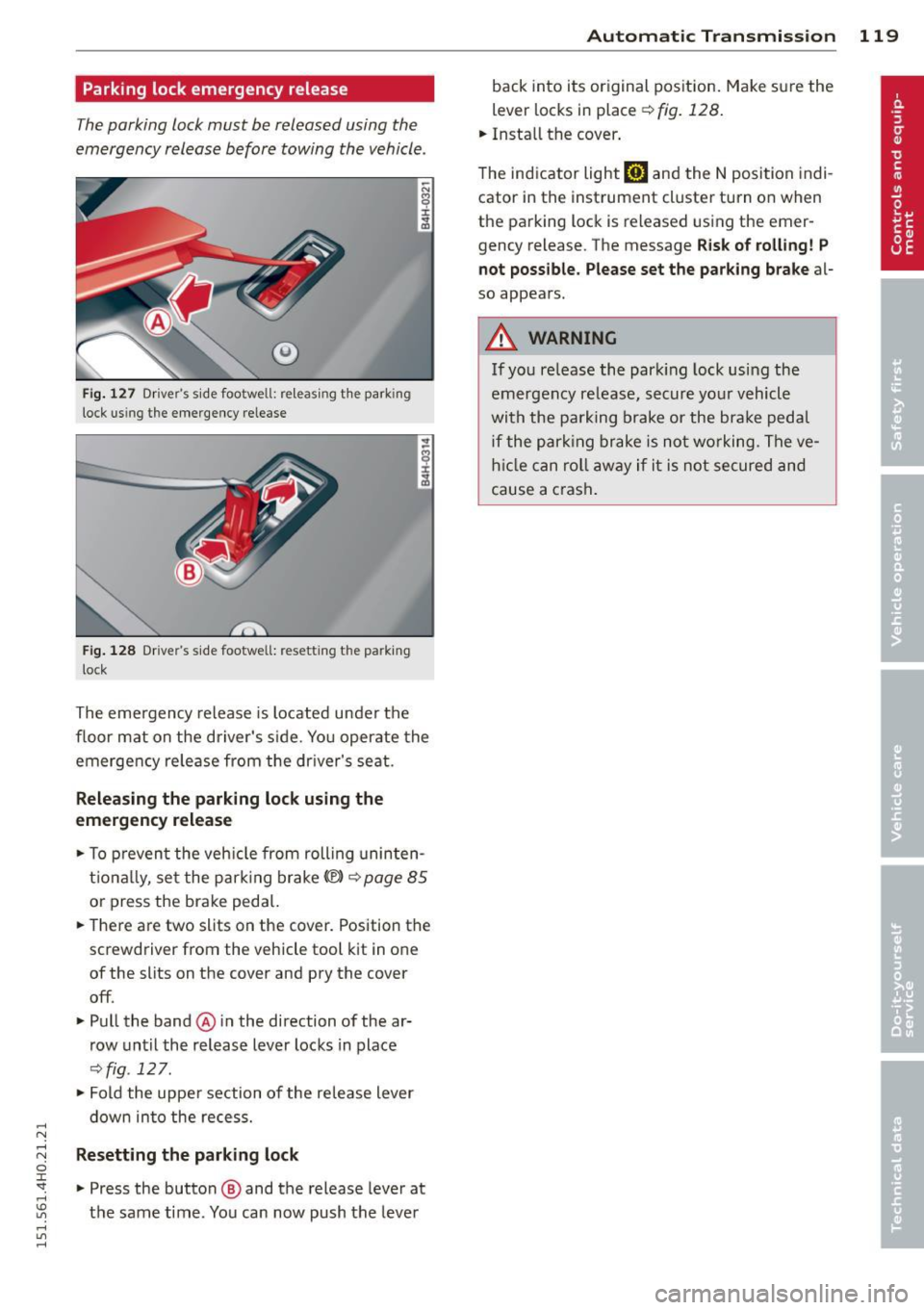
Parking lock emergency release
The parking lock must be released using the
emergency release before towing the vehicle .
®
Fig. 127 Driver's s ide footwell: re lea sing t he park ing
lock us ing the emergency release
Fig. 128 Driver's s ide footwell: resettin g th e pa rk ing
lock
The emergency release is located under the
f loor mat on the driver's s ide. You operate the
emergency re lease from the driver's seat.
Releasing the parking lock using the
emergency release
.,. To prevent the vehicle from rolling uninten
tionally, set the parking brake
«e)) q page 85
or press the brake peda l.
.,. There are two slits on the cover. Position the
screwdriver from the vehicle tool kit in one
of the slits on the cover and pry the cover
off .
.,. Pull the band@ in the direction of the ar
row until the release lever locks in place
qfig . 127 .
.,. Fold the uppe r section of the re lease lever
down into the recess.
Resetting the parking lock
.,. Press the button @ and the release lever at
t h e same time . You can now push the lever
Automatic Transmission 119
back into its original position. Make sure the
lever locks in place ~
fig. 128.
.,. Install the cover .
T he indicator light
mJ and the N position indi
cator in the instrument cluster turn on when
the parking lock is released using the emer
gency release. The message
Risk of rolling! P
not possible. Please set the parking brake
al
so appears .
.&_ WARNING
If you release the park ing lock using the
emergency release, secure your vehicle
with the parking brake or the brake pedal
i f the parking brake is not working. The ve
hicle can roll away if it is not secured and
cause a crash .
Page 124 of 312
122 Parking systems
If the distance to an obstacle remains con
stant, the volume of the distance warning
gradually drops after about four seconds (this
does not apply in the continuous tone range).
Rear view camera
The rear view camera is located above the rear
license plate bracket. Make sure that the lens
for the parking system
c:> fig. 132 is not cov
ered by deposits or any other obstructions be
cause this can affect the function of the park
ing system. For information on clean ing, refer
to
c:> page 214.
The rear view camera coverage area includes
(D ¢fig . 131. Only this area is shown in the
Infotainment display. Objects that are outside
of this area @are not displayed.
The accuracy of the orientation lines and the
blue surfaces is reduced if the adaptive air
suspens ion* is faulty, if the vehicle is lifted or
if the
dynamic mode is activated c;, page 108.
A WARNING
-Always read and follow the applicable
warnings
c:> &. in General information on
page 120.
- If the position and the installation angle
of the rear view camera was changed, for
example, after a collision, do not contin
ue to use the system for safety reasons.
Have it checked by your authorized Audi
dealership or authorized repair facility.
- Only use the rear view camera to assist
you if it shows a good, clear picture. For example, the image may be affected by
the sun shining into the lens, dirt on the
lens or if there is a system fault.
- Use the rear view camera only if the lug
gage compartment lid is completely
closed. Make sure any objects you may
have mounted on the luggage compart
ment lid do not block the rear view cam
era.
- The camera lens enlarges and distorts
the field of vision . The object appears
both altered and inaccurate on the
screen. -
In certain situations, people or objects in
the display appear closer or further
away:
- objects that do not touch the ground,
such as the bumper of a parked vehicle,
a trailer hitch or the rear of a truck. Do
not use the help lines in this case.
- If driven from a level surface onto an
incline , or a downward slope.
- If driven toward protruding objects.
-If the vehicle is carrying too much load
in the rear.
(D Note
-Always read and follow the applicable
warnings
c:> 0 in General information on
page 120.
- The orange colored orientation lines in
the Infotainment display show the vehi cle path depending on the steering
wheel angle. The front of the vehicle
front swings out more than the rear of
the vehicle. Maintain plenty of distance
so that your outside mirror or a corner of
your vehicle does not collide with any ob
stacles.
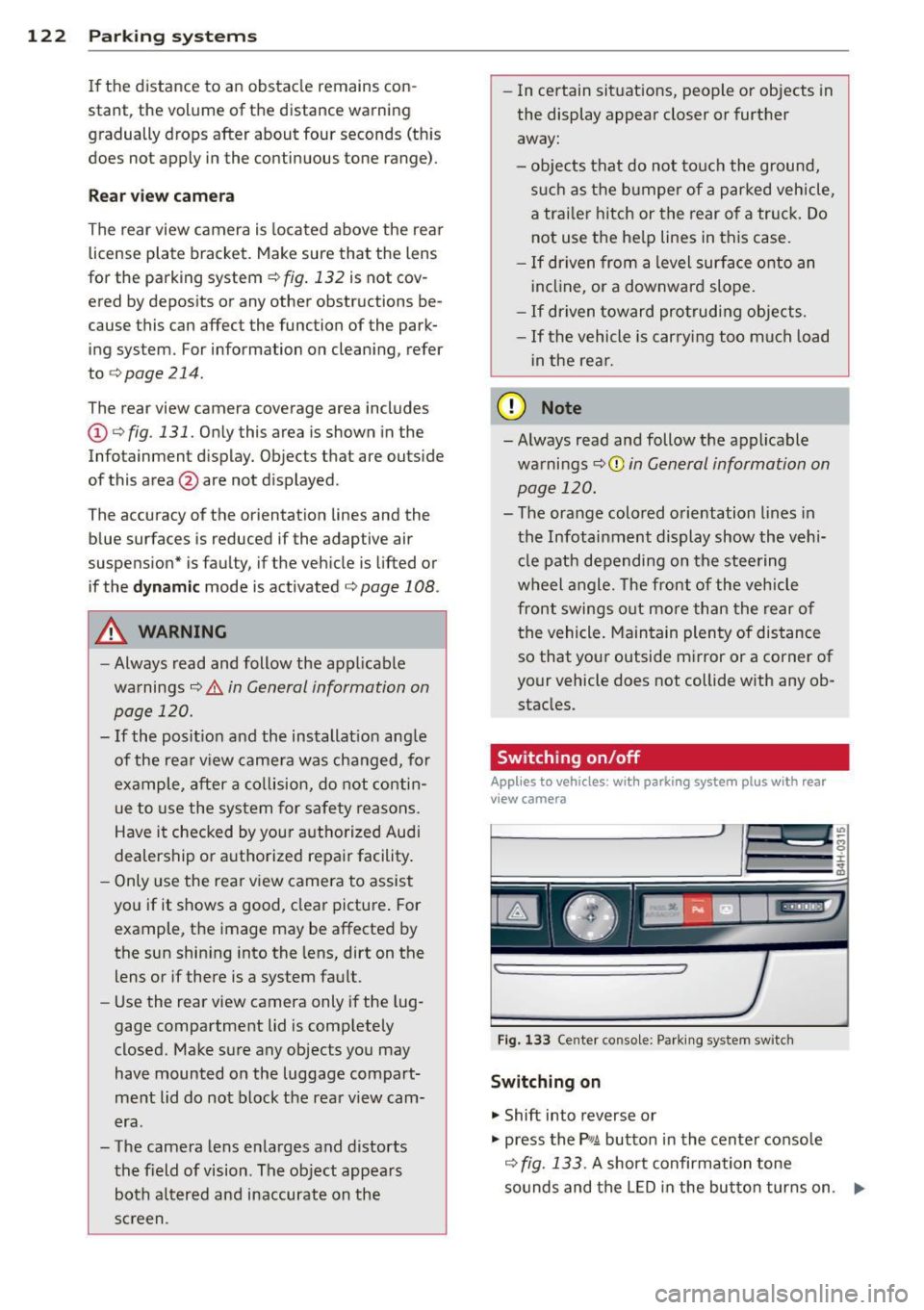
Switching on/off
Applies to vehicles : with parking system pl us with rear
v iew camera
Fig . 133 Center console: Parking system sw itch
Switching on
.,. Shift into reverse or
.,. press the
PwA button in the center console
c:> fig. 133 . A short confirmation tone
sounds and the LED in the button turns on. .,..
Page 137 of 312
.... N .... N
0 J:
'SI: .... \!) 1.1'1
.... 1.1'1 ,....,
~ Always keep both feet in the footwell so
that you are in control of the vehicle at all
times.
For detailed information on how to adjust the
driver's seat, see
c';> page 59.
A WARNING
Drivers who are unbelted, out of position
or too close to the airbag can be seriously
injured by an airbag as it unfolds. To help
reduce the risk of serious personal injury:
- Always adjust the driver's seat and the
steering wheel so that there are at least
10 inches (25 cm) between your breast
bone and the steering wheel.
- Always adjust the driver's seat and the
steering wheel so that there are at least
4 inches (10 cm) between the knees and
the lower part of the instrument panel.
- Always hold the steering wheel on the
outside of the steering wheel rim with
your hands at the 9 o'clock and 3 o'clock positions to help reduce the risk of per
sonal injury if the driver's airbag inflates.
- Never hold the steering wheel at the
12 o'clock position or with your hands at
other positions inside the steering wheel
rim or on the steering wheel hub. Hold
ing the steering wheel the wrong way
can cause serious injuries to the hands,
arms and head if the driver's airbag in
flates.
- Pointing the steering wheel toward your
face decreases the ability of the supple
mental driver's airbag to protect you in a
collision .
- Always sit in an upright position and nev
er lean against or place any part of your
body too close to the area where the air
bags are located.
- Before driving, always adjust the front
seats and head restraints properly and make sure that all passengers are prop
erly restrained .
- Never adjust the seats while the vehicle
is moving. Your seat may move unexpect-
Driving Safely 135
ed ly and you could lose control of the ve
hicle.
- Never drive with the backrest reclined or
tilted far back! The farther the backrests
are tilted back, the greater the risk of in
jury due to incorrect positioning of the safety belt and improper seating posi
tion .
- Children must always ride in child seats
c';> page 174 . Special precautions apply
when installing a child seat on the front passenger seat¢
page 151.
Proper seating position for the front
passenger
The proper front passenger seating position
is important for safe, relaxed driving.
For your own safety and to reduce the risk of
injury in the event of an accident, we recom
mend that you adjust the seat for the front
passenger to the following position :
~ Adjust the angle of the seatback so that it is
in an upright position and your back comes
in full contact with it whenever the vehicle is
moving.
~ Adjust the head restraint so the upper edge
is as even as possible with the top of your
head. If that is not possible, try to adjust
the head restraint so that it is as close to
this position as possible
¢page 137.
~ Keep both feet flat on the floor in front of
the front passenger seat .
~ Fasten and wear safety belts correctly
¢page 146.
For detailed information on how to adjust the
front passenger's seat, see ¢
page 58.
A WARNING
Front seat passengers who are unbelted,
out of position or too close to the airbag
can be seriously injured or killed by the air
bag as it unfolds. To help reduce the risk of
serious personal injury:
1111>
•
•
Page 142 of 312
140 Driving Safely
-Always distribute the load as evenly as
possible.
- Place heavy objects as far forward in
the luggage compartment as possible.
- Never exceed the Gross Axle Weight Rat
ing or the Gross Vehicle Weight Rating
specified on the safety compliance stick
er on the left door jamb. Exceeding per
missible weight standards can cause the
vehicle to slide and handle differently.
- Please observe information on safe driv
ing
q page 133.
A WARNING
-
To help prevent poisonous exhaust gas
from being drawn into the vehicle, always keep the rear lid closed while driving.
- Never transport objects larger than those fitting completely into the luggage
area because the rear lid cannot be fully
closed.
- If you absolutely must drive with the rear
lid open , observe the following notes to
reduce the risk of poisoning:
- Close all windows,
- Close the power roof,
- Open all air outlets in the instrument
panel,
- Switch off the air recirculation,
- Set the fresh air fan to the highest
speed.
A WARNING
Always make sure that the doors, all win
dows, the power roof and the rear lid are
securely closed and locked to reduce the
risk of injury when the vehicle is not being
used.
- After closing the rear lid, always make
sure that it is properly closed and locked.
- Never leave your vehicle unattended es pecially with the rear lid left open. A
child could crawl into the vehicle through
the luggage compartment and close the
rear lid becoming trapped and unable to
get out . Being trapped in a vehicle can
Lead to serious personal injury .
-
-Never let children play in or around the
vehicle.
- Never let passengers ride in the luggage
compartment. Vehicle occupants must
always be properly restrained in one of
the vehicle's seating positions .
(D Tips
-Air circulation helps to reduce window
fogging. Stale air escapes to the outside
through vents in the trim panel, on the
Left side of the Luggage compartment.
Be sure to keep these slots free and
open .
- The tire pressure must correspond to the
load . The tire pressure is shown on the
tire pressure label. The tire pressure la
bel is located on the driver's side B-pillar.
The tire pressure Label lists the recom
mended cold tire inflation pressures for
the vehicle at its maximum capacity
weight and the tires that were on your
vehicle at the time it was manufactured.
For recommended tire pressures for nor
mal Load conditions, please see chapter
¢ page 249.
Tie-downs
The luggage compartmen t is equipped wi th
four tie-downs to secure luggage and o ther
items.
Use the tie-downs to secure your cargo p rop
erly ¢
page 139 , Loading the luggage com
partment.
In a collision, the laws of physics mean that
even smaller items that are loose in the vehi
cle will become heavy missiles that can cause
serious injury. Items in the vehicle possess en
ergy which vary with vehicle speed and the
weight of the item. Vehicle speed is the most significant factor.
For example, in a frontal collision at a speed
of 30 mph (48 km/h), the forces acting on a 10-lb (4 .5 kg) object are about 20 times the
normal weight of the item. This means that
the weight of the item would suddenly be
Page 149 of 312

To provide maximum protection, safety belts
must always be positio ned correctly on the
wearer's body .
... Adjus t the front seat and head restraint
properly
c::> page 58, General recommenda
tions .
... Hold the be lt by the tongue and pull it even
ly across the chest and pelvis
c::> &,. .
... Insert the tongue into the correct buckle of
you r seat until you hear it latch securely
c::> fig. 161.
... Pull on the belt to make su re that it is se-
c u rely latched in the buckle .
Automatic safety belt retractor s
Every safety belt is equipped with an automat
ic belt retractor on the shoulder belt. Th is fea
ture locks the belt when the belt is pulled out
fast, dur ing hard braking and in an accident .
The belt may also lo ck when you drive up or
down a steep hill or through a sharp curve .
D uring normal driving the belt le ts you move
freely.
Safety belt pretensione rs
The safety belts are equipped with a belt pre
tensioner that helps to t igh ten the safety belt
and remove s lack when the pretensione r is ac
tivated
c::> page 149. The function of the pre
tensioner is monitored by a warning light
c::> page 18 .
Switchable locking feature
Every safety belt except the one on the driver
seat is eq uipped w ith a switchab le locking fea
ture that
mu st be used when the safety belt is
used to attach a child seat. Be sure to read the important information about this feature
<=>page 184.
A WARNING
Improperly positioned safety belts can
cause serious injury in an accident
c::> page 147, Safety belt position .
-Safety belts offer optimum protection
only when the seatback is upright and
belts are properly positioned on the
body.
-
Safety belts 14 7
-Never attach the safety belt to the buck
le for another seat. Attaching the belt to
the wrong buckle will reduce safety belt effectiveness and can cause serious per
sonal injury .
- A passenger who is not properly restrain
ed can be seriously injured by the safety
be lt itself when it moves from the stron
ge r parts of the body into critical ar eas
like the abdomen.
- Always lock the convertible locking re
tracto r when you are secu ring a child
se at in the veh icle
c::>page 186.
@ Tips
For informat ion on safety belt pretension
e rs, refer to
c::> page 149 .
Safety belt position
Correct belt position is the key to getting
maximum protection from safety belts .
Fig. 1 62 Safety belt pos it ion
Use the heig ht adjus tment to change the posi
tion o f the shoulder belt of the front safety
belts.
A WARNING '-
Improperly positioned safety be lts can
cause ser ious persona l injury in an acc i
dent.
-
- The shou lder belt should lie as close to
the center of the collar bone as possible
and should fit well on the body. Hold the
be lt above the latch tongue and pull it
eve nly across the chest so that it sits as
low as possible on the pelv is and there is
no pressure on the ab domen. The belt .,_
Page 165 of 312

,....,
N ,....,
N
0 J:
'SI: ,...., \!) 1.1'1 ,...., 1.1'1 ,....,
If the front passenger seat is not occupied,
the front airbag will not deploy, and the
PAS
SENGER AIR BAG OF F
light will stay on. Nev
er insta ll a rearward-fac ing ch ild restra int on
the front passenger seat, the safest place for
a child in any kind of child restraint is at one
of the seating positions on the rear seat
¢ page 153, Child restraints on the front seat
- some important things to know
and
¢ page 174, Child Safety .
If the PASSENGER AIR BAG OFF light c omes
on
when one of the conditions listed above is
met, be sure to check the light regularly to
make certa in that the
PASSENGER AIR BAG
O FF
ligh t stays on cont inuous ly whenever the
ignition is on . If the
PASSENGER AIR BAG
OFF
light does not appear on and does not
stay on all the time, stop as soon as it is safe
to do so and
- reactivate the system by switc hing the igni
tion off and then switching it on again;
- remove and reinstall the chi ld restraint .
Make sure that the child restraint is properly
insta lled and that the sa fety be lt for the
front passenger seat has been correct ly
ro uted th roug h the child restraint as descri
bed in the chi ld restraint manufacturer 's in
structions;
- make sure that the convertible locking fea
ture on the safety be lt for the front passen
ger seat has been activated and that the
safety belt has been pulled t ight . The belt
mus t not be loose o r have loops of slack so
that the senso r below the safety be lt latch
on the seat can do its job ¢
page 184.
-make su re that th ings that may increase the
weight of t he ch ild and child sea t are no t be
ing transported on the front passenger sea t;
- make su re that the safety be lt tension sen
so r is not b locked . Shake the safety be lt
latch on the front passenger seatbac k and
forth;
- If a st rap or tether is being used to tie the
child seat to the front passenger seat , make
s ur e that it is not so tig ht that it ca uses the
weight-sensing mat to meas ure more
weight than is actually on the seat.
A irbag system 163
If the PASSENGER AIR BAG OFF light still
does not come on
and does not stay on con
ti nu ous ly (when the ignition is switched on),
- take the child restra int off the front passen -
ge r seat and install it properly at one of the
rear seat positions. Have the airbag system
inspected by yo ur Audi dealer immed iate ly .
- move the child to a rear seat position and
make s ure that the c hild is properly restrain
ed in a ch ild rest ra int that is appropriate for
its si ze and age.
T he
PASSENGER AIR BAG OFF lig ht sho uld
NOT come on when t he ignitio n is on and an
adult is s itting in a proper seating position on
the front passenger seat. If the
PASSENGER
AIR BAG OFF
light comes on and stays on or
flashes fo r about 5 seconds wh ile driving, un
der these c ircumstances, make sure that:
- the adult on the front passenger seat is
properly seated on the center of the seat
cushion with his or her back up aga inst the
backrest and the backrest is not recl ined
¢ poge 134, Prope r occupant seating posi
tions,
-the adult is not tak ing weight off the seat by
holding on to the passenger assist handle
a bove the fron t passenger door o r su pport
ing their weight on the armres t,
- the safe ty be lt is be ing properly wo rn and
t ha t the re is no t a lot o f sla ck in the safety
be lt webb ing ,
- acce sso ry sea t covers or cushions or other
t hings tha t may cause an in correct reading
or imp ression on the weight-sensing mat
unde r th e upho lstery of the seat have been
removed from the front passenger seat,
- a safety belt extender has not bee n left in
the safety be lt latch for the front passenger
seat.
I n add ition to the
PASSENGER AIR BAG OFF
li ght in the center of the instrument panel,
the message
PASSENGER AIR BAG OFF or
PASSENGER AIR BAG ON wi ll briefly appear
i n the instrument cluster disp lay. This is to in
form the dr iver of the current front passenge r
a irbag status.
•
•
Page 179 of 312

,....,
N ,....,
N
0 J:
'SI: ,...., \!) 1.1'1 ,...., 1.1'1 ,....,
Model Manufactured on or
after
Evenflo First Choice December 1, 1999
204
Graco Infant 8457 December 1, 1999
Graco Snugride September 25, 2007
Peg Perego Primo Vi- September 25, 2007
aggio SIP IMUN00US
Subpart C - Forward-facing and
convertible child restraints
Model Manufactured on or
after
Britax Roundabout September 25, 2007
E9L02xx
Cosco Touriva 02519 December 1, 1999
Cosco Summit Deluxe September 25, 2007
H igh Back Booster
22-262
Cosco High Back September 25, 2007
Booster 22-209
Evenflo Tribute V September 25, 2007
379xxxx
Evenflo Medallion December 1, 1999
254
Evenflo Generations September 25, 2007
352xxxx
Graco Comfo rtSport September 25, 2007
Graco Toddler Safety September 25, 2007
Seat Step 2
Graco Platinum Cargo September 25, 2007
A WARNING
To reduce the risk of serious injury, make
sure that the
PASSENGER AIR BAG OFF
light comes on and stays on whenever a
child restraint is installed on the front pas
senger seat and the ignition is switched
on.
- Take the child restraint off the front pas
senger seat and install it properly at one
of the rear seat positions if the
PASSEN
GER AIR BAG OFF
light does not stay on.
Child Safety 177
-Have the airbag system inspected by
your author ized Audi dealer immed iate
ly.
@ Tips
The child seats listed in categories A to C
have been statically tested by Audi on ly for
the Advanced Airbag function.
Important safety instructions for using
child safety seats
Correct use of child safety seats substantially
reduces the risk of injury in an accident!
As the driver, you are responsib le for the safe
ty of everybody in the veh icle, especially ch il
dren:
... Always use the right chi ld safety seat for
each child and always use it properly
¢page 180.
... Always carefully follow the child safety seat
manufacturer's instruct ions on how to route
the safety belt properly through the child
safety sea t .
... When using the vehicle safety belt to install
a child safety seat, you must first activate
t he convertible locking retractor on the
safety belt to prevent the child safety seat
from moving
¢ page 184.
... Push the ch ild safety seat down with yo ur
full weight to get the safety belt really tight
so that the seat cannot move forward or
sideways more than one inch (2 .5 cm) .
... If a strap or tether is be ing used to tie the
child safety seat to the front passenger
seat, make sure that it is not so tight that it
causes the weight-sens ing mat to measure
more weight than is actually on the seat.
... Secure unused safety belts on the rear seat
¢page 179.
Always remember: Even though your vehicle is
equipped with an Advanced Airbag system, all
c hild ren, especially those 12 years and young
er, shou ld always r ide in the back seat proper-
ly restrained for the ir age and size. ..,. •
•