height AUDI A8 2017 User Guide
[x] Cancel search | Manufacturer: AUDI, Model Year: 2017, Model line: A8, Model: AUDI A8 2017Pages: 354, PDF Size: 88.68 MB
Page 242 of 354
Airbag syste m
service action is entered in your Audi War
ranty
& Maintenance book let under AIRBAG
REPLACEMENT RECORD.
- For safety reasons in severe accidents, the
alternator and starter are separated from
the vehicle battery with a pyrotechnic circuit interrupter.
- Work on the pyrotechnic circuit interrupt
er must only be performed by a qualified
dea ler· risk of an accident!
- If the veh icle or the circuit interrupter is
scrapped, all applicab le safety precautions
must be followed .
@ For the sake of the environment
Undeployed airbag modu les and pretension
ers might be classified as Perch lorate Materi
al -special handling may apply, see
www .dtsc.ca.gov/hazardouswaste/perchlo
rate. When the vehicle or parts of the re
straint system including airbag modules and
safety belts w ith pretensioners are scrapped,
all applicable laws and regulations must be
observed. Your authorized Audi dealer is fa
m iliar with these requirements and we recom
mend that you have your dealer perform this
serv ice for you .
Other things that can affect Advanced
Airbag performance
Changing the vehicle's suspension system can
change the way that the Advanced Airbag System
performs in a crash. For example, using t ire-r im
comb inat ions not approved by Audi, lower ing the
veh icle, chang ing the st iffness of the suspens ion,
including the springs, suspension struts, shock
absorbers etc. can change the forces that are
measured by the airbag senso rs and sent to the
electronic contro l unit. Some suspension changes
can, for example, increase the force levels meas
ured by the sensors and make the airbag system
deploy in crashes in which it would not deploy if
the changes had not been made. Other kinds of changes may reduce the force levels meas ured by
the sensors and prevent the airbag from deploy ing when it should .
240
A WARNING
Changing the vehicle's suspension including
use of unapproved tire-rim comb inations can
change Advanced Airbag performance and in
crease the r isk of serious personal injury in a
crash.
- Never insta ll suspension components that
do not have the same performance charac
ter istics as the components origina lly ins tal
led on you r vehicle.
- N ever use tire-r im combinations that have
no t been approved by Aud i.
A WARNING
It ems stored between the safety belt buckle
and the center conso le can cause the sensors
in the buckle to send the wrong information
to the electronic contro l module and prevent
the Advanced A irbag System from working
proper ly.
- Always make sure that nothing can interfere
with the safety belt buckles and that they
are not obstructed.
Knee airbags
Description of knee airbags
The knee airbag system can provide supplemen
tal protection to properly restrained front seat
occupants.
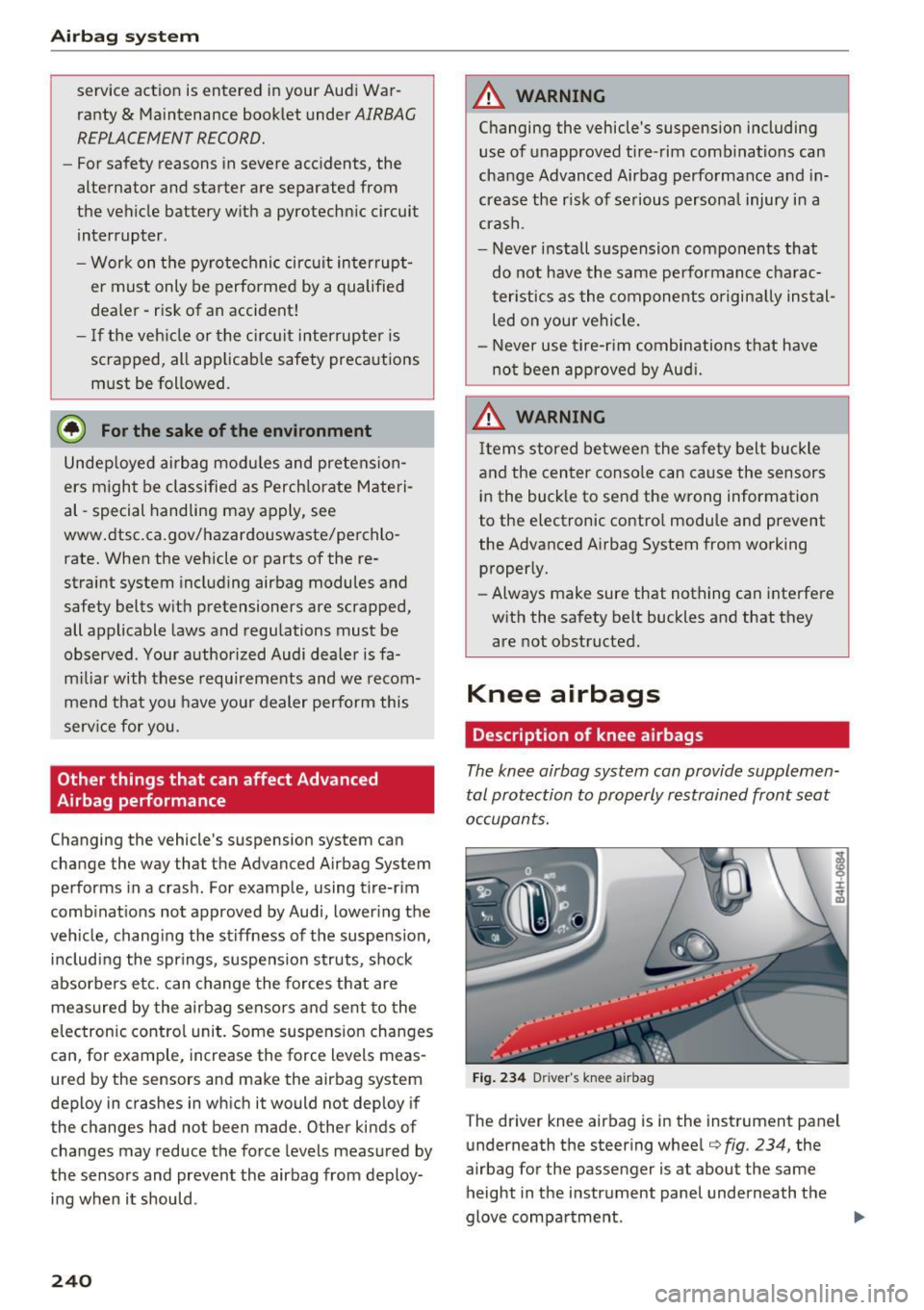
Fig . 234 D river 's knee a irbag
The driver knee airbag is in the instrument panel
underneath the steering wheel~
fig. 234, the
airbag for the passenger is at about the same height in the instrument panel underneath the
glove compartment . ..,_
Page 258 of 354
Child safety
place Q page 210. Driving with head
restra ints that are not properly adjusted in
creases the risk of serious or fatal neck in
jury dramatically .
- Always read and heed all WARNINGS when
ever using a child restrained in a vehicle is
being used
c::> page 218, Safety belts,
¢ page 226 , Airbag system and
c::> page 248, Important information.
_& WARNING
If exceptional circumstances require the use
of a forward-facing child restra int on the
front passenger's seat, the child's safety and
well -being require that the fo llowing special
precautions be taken:
- Make s ure the fo rward-facing seat has been
designed and certified by its manu facturer
for use on a front seat with a passenger
front and side airbag.
- Always follow the manufacturer's instruc
tions prov ided with the child safety seat or
infant carrier.
- Always move the front passenger seat to
the highest position in the up and down ad
justment range and move it back to the
rearmost position in the seat's fore and aft
adjustment range, as far away from the air
bag as possible, before installing the for
ward-facing child restra int .
- Always make sure that the safety belt upper anchorage is beh ind the child restraint and
not next to or in front of the child restraint
so that the safety belt will be properly pos i
t ioned.
- Always make sure tha t noth ing p revents the
front passenge r's seat from being moved to
the rearmost position in its fore and aft ad
justment range .
- Always make sure the backrest is in an up
right position .
- Make s ure tha t the
PASSENGER AIR BAG
OFF
light comes on and s tays on all the time
whenever the ignition is switched on.
- If the ligh t does no t stay on, perform the
checks
c::> page 236, Monitoring the Ad
vanced Airbag System.
256
- Take the child restra int off the front passen
ger seat and install it properly at one of the rear seat positions if the
PASSENGER AIR
BAG OFF
light does not stay on whenever
the ignition is switched on .
Booster seats and safety belts
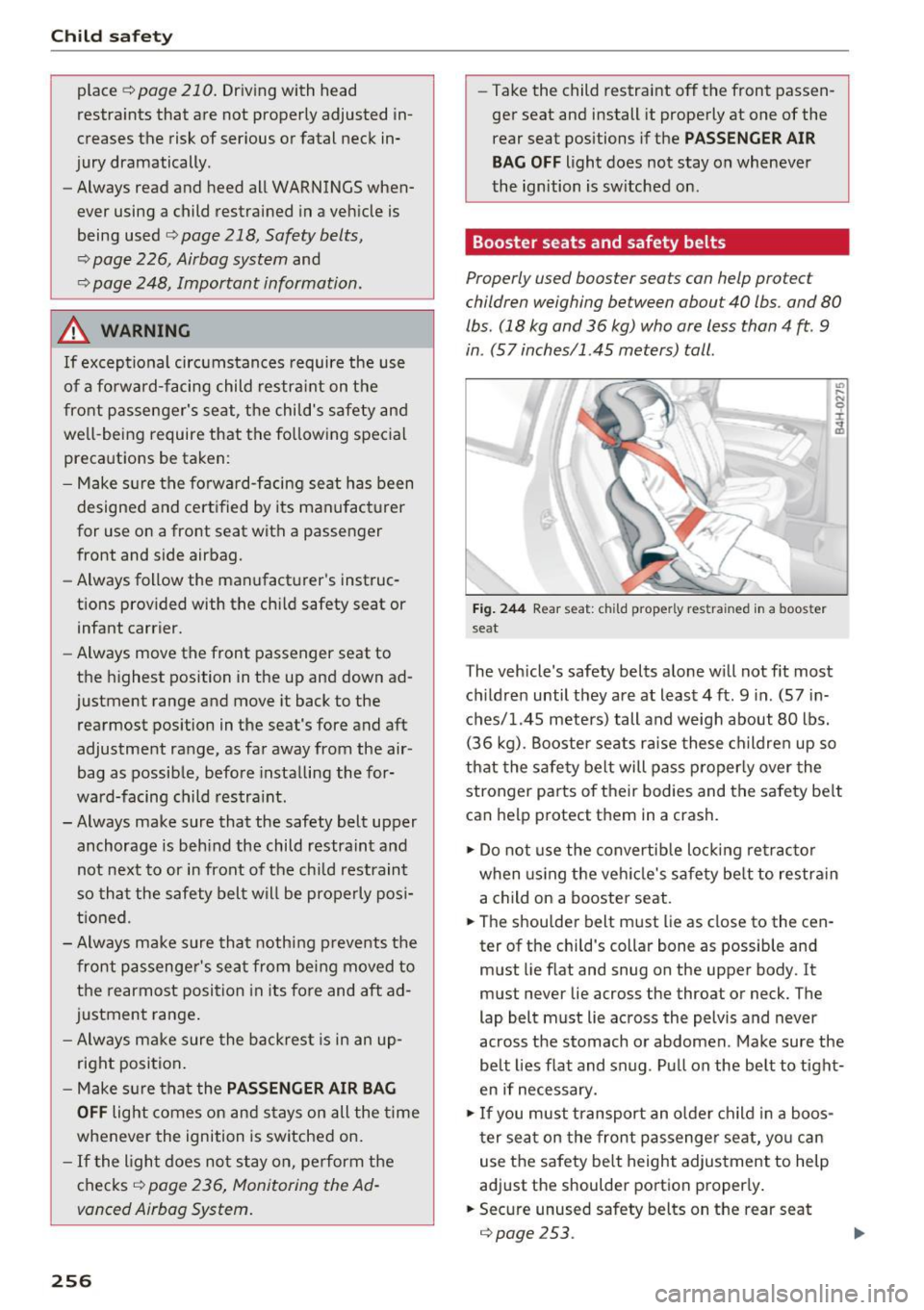
Properly used booster seats can help protect
children weighing between about 40 lbs . and 80
lbs . (18 kg and 36 kg) who are less than 4 ft.
9
in . (57 inches/1 .45 meters) tall .
Fig. 244 Rear seat: ch ild prope rly restrained in a booster
se at
The vehicle 's safety belts alone w ill not fit most
ch ildre n until they are at least 4 ft. 9 in . (57 in
ches/1.45 meters) tall and weigh about 80 lbs. (36 kg). Booster seats raise these ch ildren up so
that the safety belt will pass p roperly over the
stronger parts of their bodies and the safety be lt
can he lp protect them in a crash.
.,. Do not use the convertib le loc king re trac to r
when using the ve hicle's safety be lt to restra in
a child on a booster seat.
.,. The shoulder belt must lie as close to the cen
ter of the chi ld's collar bone as possible and
must lie flat and snug on the upper body. It
must never lie across the throat or neck. The
lap belt must lie across the pelvis and never
across t he stomach or abdomen . Make sure the
belt lies flat and snug . Pu ll on the belt to tight
en if necessary.
.,. If you must transport an o lde r child in a boos
ter sea t on the front passenge r seat, yo u can
use the safety belt height adjus tment to help
adjust the shoulder portion p roperly .
.,. Secure unused safety belts on the rear seat
c::> page253 .
Page 266 of 354
Child safety
Mounting
.. Make sure the seatback of the rear seat bench
is in the upright position and securely latched
in place .
.. Attach both hook-on connectors with the spring
catch re lease on the child safety seat onto the
LATCH lower anchorage so that the connectors
lock into place
c> fig. 250.
.. Pull on the connector attachments to make
sure they are properly attached to the LATCH
lower anchorage .
.. Pull straps tight follow ing the child restra int
manufacturer's instructions.
Releasing
.. Loosen the tension on the straps following the
child restraint manufacturer's instructions.
.. Depress the spring catches to release the an
cho rage hooks from the lower anchorages.
Remember: Use tether straps to help keep the
child restraint firmly in place .
.,&. WARNING
Improper use of the LATCH system can in
crease the risk of serious personal injury and
death in an accident .
- Th ese anchors were deve loped only for child
safety seats using the "LA TCH" system.
- Never attach other child safety seats, belts
or other objects to these anchors .
- Always make sure that you hear a click when
latch ing the seat in place. If you do not hear
a click the seat is not secure and could fly
forward and hit the interior of the vehicle,
or be ejected from the vehicle .
.,&. WARNING
Improper installation of child restraints will
increase the risk of injury in an acc ident.
- Always follow the child restraint system
manufacturer's instructions for proper in
stallation of the child restraint system and
proper use of tether straps as well as the
lower anchorages or safety belts in your ve
hicle .
- Always read and heed the important infor
mation and WARNINGS about child safety
264 and the installation of child restraint sys
tems
c> page 248, Child safety .
(D Note
On vehicles with power adjustable rear seats*
some crite ria must be observed when attach
ing the child restraint using the
LATCH sys
tem:
- To attach the ch ild restraint securely, the
seat must be moved to the farthest rear po
sition, the seat height set to the lowest po
sit ion and the head restraint must be ad
justed to the vertical position.
- If a child safety seat is attached to one of
the rear seats, this seat must not be adjust
ed using the power controls under any c ir
cumstances. The
Entry assistance for this
seat must also be deactivated in the MMI
c> page 58. Th e child safety seat as well as
the rear seat can be damaged by the adjust
ment process.
Tether anchors and tether straps
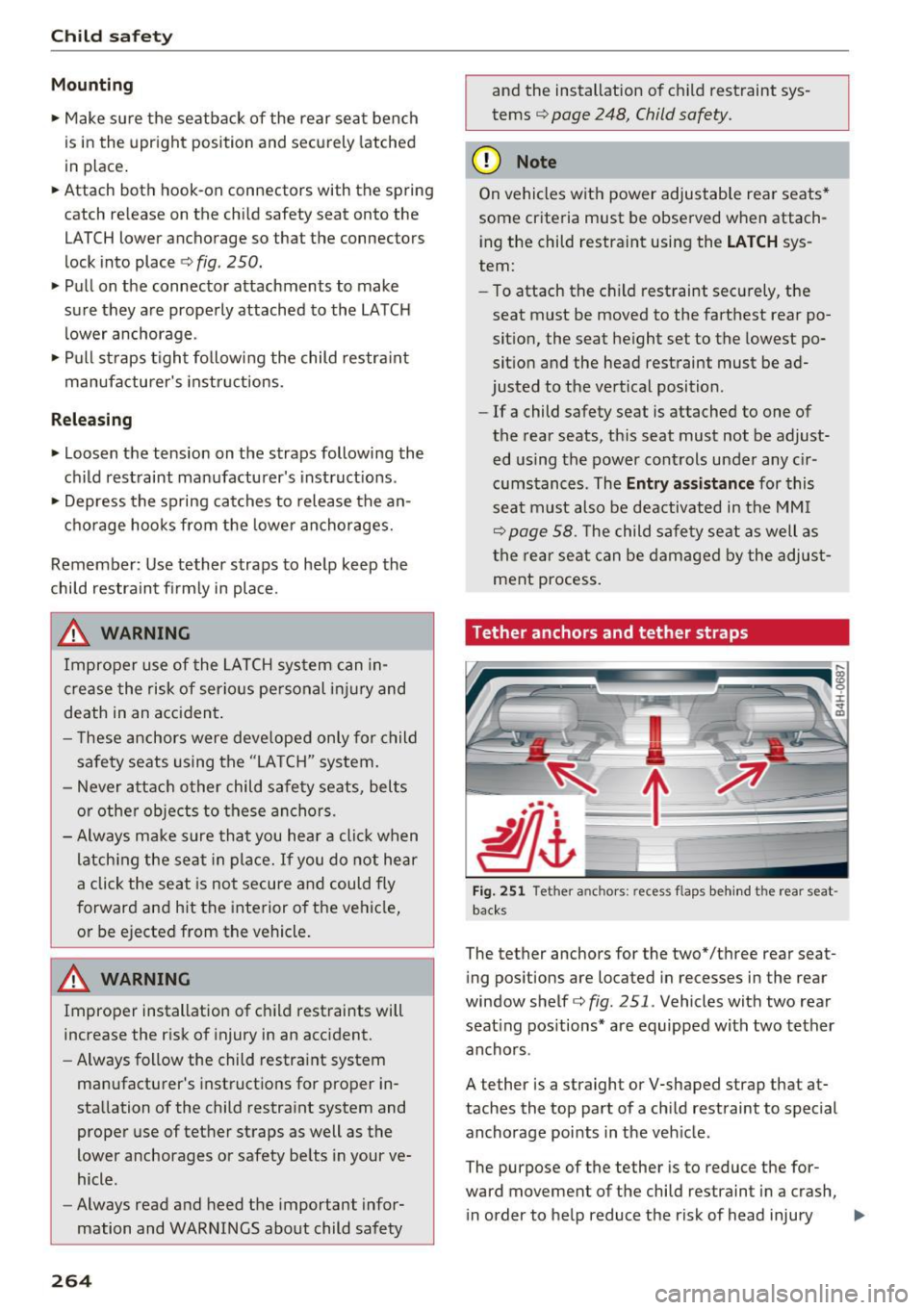
Fig. 251 Tether ancho rs: recess flaps behind the rear seat
backs
The tether anchors for the two* /three rear seat
ing positions are located in recesses in the rear
window shelf
c> fig . 251 . Vehicles with two rear
seat ing positions* are equipped with two tether
anchors .
A tether is a straight or V-shaped strap that at
taches the top part of a chi ld restraint to special
anchorage points in the veh icle.
The purpose of the tether is to reduce the for
ward movement of the child restraint in a crash,
in order to help reduce the risk of head injury
111JJ,
Page 286 of 354

Wheels
(D Tires for passenger vehicles
(if applicable)
P indicates a tire for a passenger
vehicle. T indicates a tire desig
nated for temporary use.
@ Nominal width
Nominal width of the tire be
tween the sidewalls in millime
ters. In general: the larger the
number, the wider the tire.
@ Aspect ratio
Height/width ratio expressed as a
percentage.
@ Tire construction
R indicates a radial tire.
® Rim diameter
Size of the rim diameter in inches.
@ Load index and speed rating
The load index indicates the tire's
load-carrying capacity.
The speed rating indicates the maximum permitted speed
¢ & in
Winter tires on page 298.
"EXTRA LOAD", "xl" or "RF" indi
cates that the tire is reinforced or
is an Extra Load tire.
Speed rat- Maximum permitted speed
ing
p
up to 93 mph (150 km/h)
Q up to 99 mph (160 km/h)
284
Speed rat- Maximum permitted speed
Ing
R
up t o 106 mph (170 km/h)
s up to 110 mph (180 km/h)
T up to 1 18 mph (190 km/h)
u up to 124 mph (200 km/h)
H up to 130 mph (210 km/h)
V up to 149 mph (240 km/h)al
z above 149 mph (240 km/h)al
w up to 168 mph (270 km/h)al
y up to 186 mph (300 km/h)al
a) For tires above 149 mph (240 km/h),
tire manufacturers sometimes use the
code "ZR".
(j) US DOT number (TIN) and
manufacture date
The manufacture date is listed on
the tire sidewall (it may only ap
pear on the inner side of the tire):
DOT ... 2216 ...
means, for example, that the tire
was produced in the 22nd week of
the year 2016.
@ Audi Original equipment
tires
Audi Original equipment tires
with the designation "AO" have
been specially matched to your
Audi. When used correctly, these
tires meet the highest standards
for safety and handling. An au
thorized Audi dealer or author
ized Audi Service Facility will be
Page 301 of 354

~ Check and correc t the seating of the snow
chains after driving a few feet , if necessary . Fo l
l ow the instructions from the manufacturer .
~ Note the maximum speed of 30 mph (SO km/
h). Note the loca l regulat ions.
Use of snow chains is on ly pe rmitted with certain
rim/tire combinations due to technical reasons.
Check w ith an authori zed Audi dealer or author
ized Audi Service Fac ility to see if you may use
snow chains .
You must remove the snow chains on roads with
out snow. Otherw ise, you could impair dr iving
ab ility and damage the tires.
_8 WARNING
Using incorrect snow chains o r insta lling snow
chains incorrectly can result in loss of vehicle
cont rol, which inc reases the risk of an acc i
dent.
(D Note
- Snow cha ins can damage the rims/wheel
covers* if the cha ins come into d irect con·
tact with t hem . Remove the whee l cove rs*
f irst. Use coate d snow chai ns.
- Using snow cha ins tha t add more than 0.4
i nch (10.5 mm) of he igh t ca n seve rely dam
age the wheel ho usings and other vehicle
componen ts .
- Do no t install and use s now chai ns if there is
a mal funct ion in the adaptive air suspe n
s ion, because the vehicle heigh t will be very
l ow . If you drive with snow chains anyway,
the wheel ho usings and other vehicle com
ponents can be severely damaged.
@ Tips
When using snow chains, it may be useful to
sw itch on sport mode ¢page
127.
Low aspect ratio tires
Your Aud i is factory-equipped with low aspect ra-
o tio tires. These t ires have been thorough ly tested co
~ and been selected specifically for your model for ,.....
~ their supe rb performance, road feel and handli ng 0 0 :c '
under a var iety o f dr iv ing condit ions . Ask your au
thorized Audi dea le r for more detai ls.
T he low aspect rat io of t hese tires is indicated by
a nu meral o f
55 or less in the tire's si ze des igna
tion . The n umera l represents the ratio of the
tire's sidewa ll height in relation to its tread width
expressed in percentage . Conve ntiona l tires have
a height/width ratio of 60 or more .
The performance of low-aspect- ratio tires is par
ti cula rly sen siti ve to imprope r inflation p res
sure. It is the refore important that low aspect
rat io tires are inflated to the specified pressure
and that the inflation pressure is regularly
checked and maintained . Tire pressures should
be checked at lea st once a month and always
before a long trip
¢ page 293 .
What you can do to avo id tire and rim
damage
Low aspect ratio tires can be damaged more eas i
ly by impact w ith potho les, curbs, gullies or
ridges on the road, particularly if the tire is un
der inflated .
In order to m in imize the occurrence of impact
damage to t he tires of yo ur vehicle , we recom
me nd tha t you observe the following preca u
tio ns:
- Always maintain recommended inflat ion pres
sures. Check you r ti re pressu re every 2,000
m iles (3,000 km) a nd add air if necessary.
- Dr ive carefully on roads w it h potholes, deep
gullies o r ridges. The impact from dr iving
t hrough or over such obst acles can damage
your tires. Impac t with a cur b may also ca use
damage to your tires.
- After a ny impac t, im med iate ly inspect yo ur
t ires or have them inspe cted by the neares t au
t horized A udi dealer. Replace a damaged tire as
soon as possible.
- I nspect your tires every 2,000 m iles (3,000 km)
for damage and wear. Damage is not a lways
easy to see. Damage can lead to loss of air and
underinflation, wh ich could event ually cause
tire fa ilure . If you believe that a tire may have
been damaged, replace the tire as soon as pos
sible .
- These tires may wear more quickly than others . .,.
299
Page 318 of 354

Emerg ency assis ta nce
ground . The base @ must be vertical under the
lifting point @.
.. Wind the jack up further unt il the flat tire
comes off the ground
c:> &,.
Position the vehicle jack onl y under the designat
ed lifting points on the sill
c:> fig. 2 77. There is ex
actly
one location for each wheel. The jack must
not be positioned at any other location
c::, ,&.c:>Q) .
An uns table surface u nder the jack can cause the
veh icle to slip off the jack. Always provide a firm
base for the jack on the ground. If necessary
place a sturdy board or similar support under the
jack. On
hard, slippery surfac es (such as tiles)
use a rubber mat or similar to prevent the jack
from slipping
c:> ,&. .
A WARNING
-
-Yo u or your passengers could be injured
wh ile chang ing a wheel if you do not follow
these safety precaut ions:
- Position the vehicle jack only at the desig
nated lifting points and align the jack.
Otherw ise, the vehicle jack cou ld slip and
cause an injury if it does not have suffi
cient hold on the vehicle.
- A soft or unstable surface under the jack may cause the vehicle to slip off the jack.
Always p rovide a firm base for the jack on
the grou nd.
If necessary, use a sturdy
board under the jack.
- On ha rd, s lippery surface (such as tiles)
use a rubber mat o r similar to prevent the
jack from slipping.
- T o help prevent injury to yourself and yo ur
passengers:
- Do not ra ise the vehicle until you are sure
the jack is securely engaged.
- Passengers must not remain in the vehicle
when it is jacked up.
- Make sure that passengers wait in a safe
place away from the vehicle and well away
from th e road and traff ic.
- Make sure jack position is correct, adjust
as necessary and then cont inue to raise
the jack.
316
-Changes in temperature or load can affect
the height of the vehicle .
(D Note
Do not lift the vehicle by the s ill. Pos ition the
vehicle jack only at the designated lifting points on the sill. Otherwise, your vehicle wi ll
be damaged.
(D Tips
The vehicle jack mode switches off automati
cally at speeds above 10 km/h.
58: Raising the vehicle
The vehicle must be li~ed with the jock first be
fore the wheel con be removed.
Fig. 279 Sill panels: markings
Fig. 2 80 Sill: pos ition ing the vehicle jack
"'"Activate the vehicle jack mode in the MMI:
!CARI function button> Car system s control
button >
Serv ici ng & che ck s > A ir su sp .: jack
mode > On .
.. Engage the parking brake to prevent your vehi
cle from rolling unintentiona lly.
.. Move the
selec to r le ver to p osition P .
"'" Find the marking (imprint) on the sill that is
nearest the wheel that will be changed
Iii>-
Page 319 of 354

0 co .... N ,..... N .... 0 0 :c '
ing point on the sill for the vehicle jack.
~ Turn the vehicle jack located under the lifting
point on the sill to raise the jack until its arm@
¢
fig . 280 is located under the designated plas
tic mount ¢.&.
in AB: Raising the vehicle on
page 316 ¢
(D.
~ Align the jack so that its arm @¢ fig. 280 en
gages in the designated lift ing point in the door
s ill and the movable base @ lies flat on the
ground . The base @ must be
vertical under the
lifting point@.
~ Wind the jack up further until the flat tire
comes
off the ground ¢ .&. in AB: Raising the
vehicle on page 316.
Position the vehicle jack only under the designat
ed lifting points on the sill
¢ page 315, fig. 277.
There is exactly
one l ocation for each wheel. The
jack must not be positioned at any other location
¢&. in AB: Raising the vehicle on page 316¢(]).
An unstable surface under the jack can cause the
vehicle to slip
off the jack . Always provide a firm
base for the jack on the ground. If necessary
place a sturdy board or similar support under the
jack . On
hard, slippery surfaces (such as tiles)
use a rubber mat or s imilar to prevent the jack
from sl ipping
Q &. .
A WARNING
-
-Yo u or your passe ngers could be injured
wh ile chang ing a wheel if you do not follow
these safety precautions:
- Position the veh icle jack only at the desig
nated lifting points and align the jack .
Otherw ise, the vehicle jack could slip and
cause an injury if it does not have suffi
cient hold on the vehicle.
-A soft or unstable surface under the jack
may cause the vehicle to slip off the jack.
Always provide a firm base for the jack on
the ground.
If necessary, use a stu rdy
board under the jack .
- On hard, slippery surface (such as tiles)
use a rubber mat or similar to prevent the
jack from slipping .
- To help prevent injury to you rself and yo ur
passengers:
Emergency assistance
- Do not raise the vehicle until you are sure
the jack is securely engaged.
- Passengers must not remain in the vehicle
when it is jacked up.
- Make sure that passengers wait in a safe
place away from the vehicle and well away
from the road and traffic.
- Make sure jack position is correct, adjust
as necessary and then continue to raise
the jack.
- Changes in temperature or load can affect
the height of the vehicle.
(D Note
Do not lift the vehicle by the sill. Position the
vehicle jack only at the designated lifting
points on the sill. Otherwise, your vehicle will
be damaged.
(D Tips
The vehicle jack mode switches off automati
cally at speeds above 10 km/h.
317
Page 336 of 354
Tech nical data
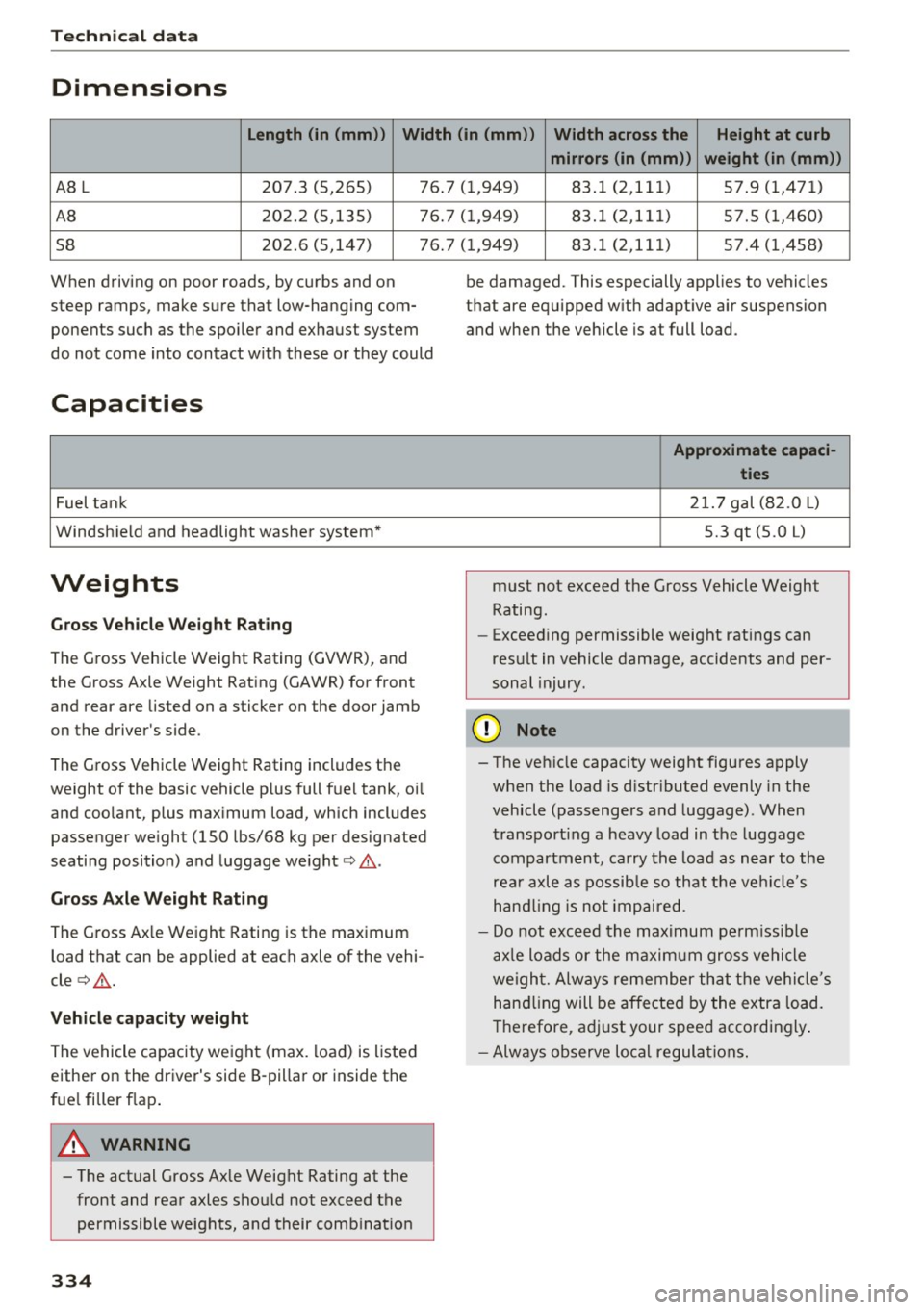
Dimensions
Length (in (mm )) Width (in (mm ))
Width across the Height at curb
mirrors (in (mm )) weight (in (mm ))
A8 L 207.3 (5,265) 76.7 (1,949) 83.l (2,111) 57.9 (1,471)
AB 202.2 (5,135) 76.7 (1,949) 83.1 (2,111) 57.5 (1,460)
58 202.6 (5,147) 76.7 (1,949) 83.l (2,111) 57.4 (1,458)
When driving on poor roads, by curbs and on
steep ramps, make sure that low-hanging com ponents such as the spoiler and exhaust system
do not come into contact w ith these or they could
Capacities
Fuel tank
Windshield and headlight washer system*
Weights
G ro ss Vehicl e Weight Rat ing
The Gross Vehicle Weight Rating (GVWR), and
the Gross Axle Weight Rating (GAWR) for front
and rear are listed on a sticker on the door jamb
on the driver's side .
The Gross Vehicle Weight Rating includes the
weight of the basic vehicle p lus full fuel tank, oi l
and coolant, plus max imum load, which includes
passenger we ight (150 lbs/68 kg per designated
seating position) and luggage weight¢ ,&..
Gross A xle W eight Rating
The Gross Ax le Weight Rating is the maximum
load that can be applied at each axle of the vehi
cle ¢,&. .
V ehicle capaci ty weight
The vehicle capacity we ight (max. load) is listed
either on the driver's side B-pillar or inside the
fue l filler flap .
A WARNING
- The actual Gross Axle Weight Rating at the front and rear axles shou ld not exceed the
permissible weights, and their comb inat ion
334
be damaged. This especially applies to vehicles
that are equipped w ith adapt ive air suspension
and when the vehicle is at full load .
Appro ximate capaci-
tie s
2 1. 7 gal (82.0
L)
5.3 qt (5.0 L)
must not exceed the Gross Vehicle Weight
Rating.
- Exceed ing permissible weight ratings can
result in vehicle damage, accidents and per
sonal injury.
(D Note
- The veh icle capacity weight figures apply
when the load is d istr ibuted evenly in the
vehicle (passengers and luggage) . When
transport ing a heavy load in the luggage
compartment, carry the load as near to the
rea r axle as possib le so that the ve hicl e's
h and ling is no t impaired.
- Do not exceed the maximum pe rm iss ible
ax le loads or the maxim um gross vehicle
we igh t. A lways remember that the ve hicl e's
hand ling will be affected by the extra load.
T herefore, adjust your speed accordingly .
- Always observe local regula tions.