weight AUDI A8 2017 Owner's Guide
[x] Cancel search | Manufacturer: AUDI, Model Year: 2017, Model line: A8, Model: AUDI A8 2017Pages: 354, PDF Size: 88.68 MB
Page 289 of 354

0
"' -N
" N
-0
0
:c ...
(a) Curb weight
(b) Accessory weight
(c) Vehicle capacity weight, and
(d) Production options we ight
Ma ximum (permissible)
inflation pressure
means the maximum cold infla
tion pressure to which a t ire may
be inflated. Also called "maxi
mum inflation pressure."
Normal occupant weight
means 150 lbs. (68 kilograms)
times the number of occupants
seated in the veh icle up to the to
tal seating capacity of your vehi c le.
Occupant distribution
means distribution of occupants
in a vehicle.
Outer diameter
means the overall diameter of an
inflated new tire.
Overall width
means the linear distance be
tween the exteriors of the side
walls of an inflated tire, including
elevations due to labeling, deco
rations, or protective bands or
ribs .
Wheels
Ply
means a layer of rubber-coated
parallel cords .
Production options weight
means the combined weight of
those installed regular production
options weighing over 5 lbs. (2.3 kg) in excess of those standard
items which they replace, not pre
viously considered in curb weight
or accessory weight, including
heavy duty brakes, ride levelers,
roof rack, heavy duty battery, and
special trim .
Radial ply tire
means a pneumatic tire in which
the ply cords that extend to the beads are laid at substantially 90
degrees to the centerline of the
tread.
Recommended inflation
pressure
see ~ page 286, Cold tire infla
tion pressure .
Reinforced tire
means a tire designed to operate
at higher loads and at higher in
flation pressures than the corre sponding standard tire. Rein
forced tires may be identified as .,.
287
Page 291 of 354
Uniform Tire Quality Grading
is a tire information system devel
oped by the United States Nation
al Highway Traffic Safety Admin
istration (NHTSA) that is designed
to help buyers make relat ive com
parisons among tires . The UTQG
is not a safety rating and not a
guarantee that a tire will last for
a prescribed number of mi les
(kilometers) or perform in acer
tain way. It simply gives t ire buy
e rs add itional informa tion to
combine with other considera
tions, such as p rice, brand loya lty
and dealer recommendations . Un
der UTQG, tires are graded by t he
tire manufacturers in th ree areas:
treadwear, traction, and tempera
ture res istance. The UTQG infor
mation on the tires, molded into
the s idewalls .
U.S. DOT Tire Identification
Number (TIN)
This is the tire's "serial number".
It beg ins with the le tters "DO T"
and indicates that the tire meets
all federal standards . T he nex t
two numbers or letters indicate
the plant where it was manufac -
~ tu red, and the last fo ur numbers
-~ represent the week and yea r of
-~ manufacture. For examp le, ...
Wheels
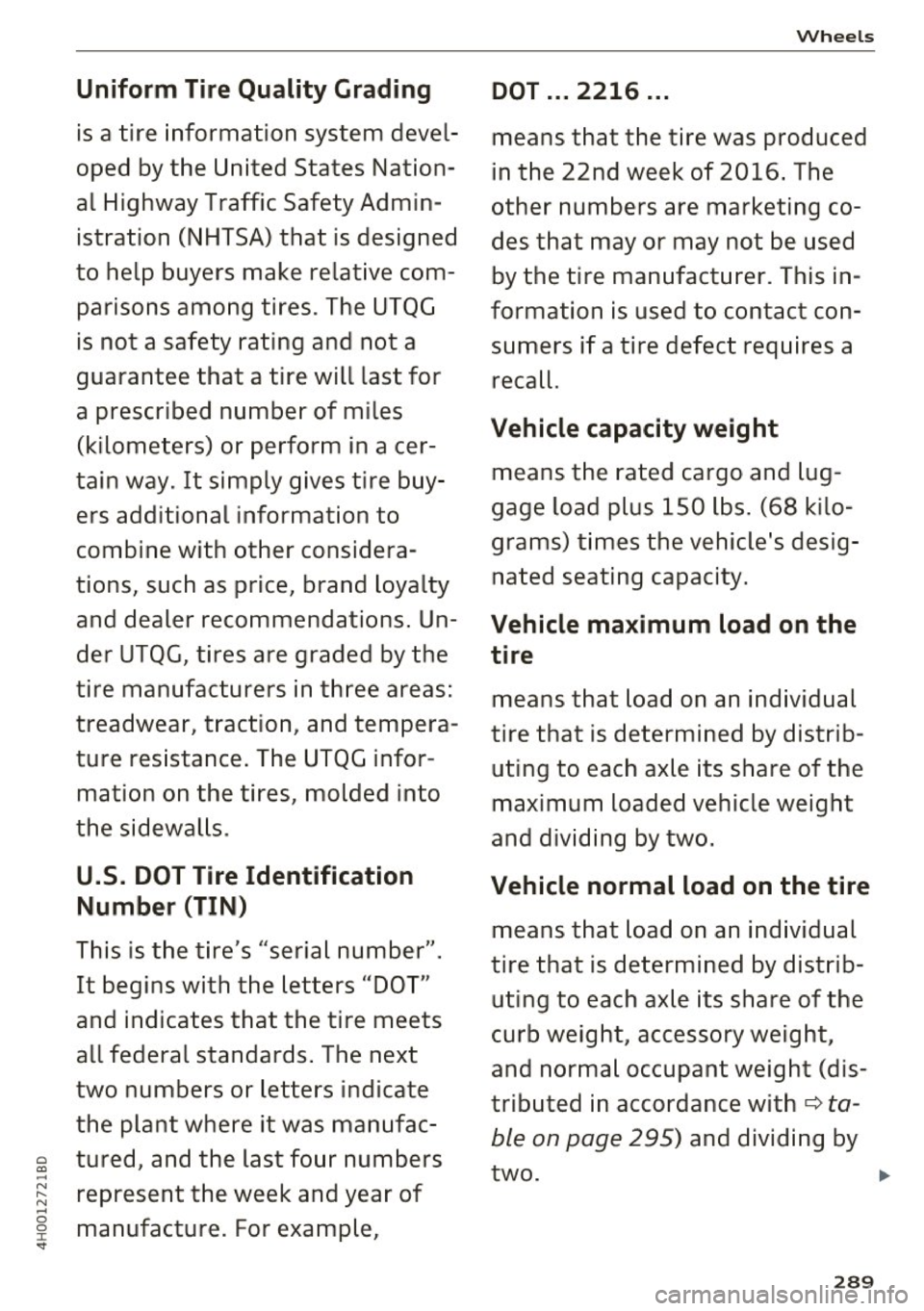
DOT ... 2216 ...
means that the tire was produced
in the 22nd week o f 2016 . The
other numbers are marketing co des that may or may not be used
by the t ire manufact urer. This in
formation is used to contact con sumers if a tire defec t req uires a
reca ll.
Vehicle capacity weight
means the rated cargo and lug
gage load plus lS0 lbs . (68 k ilo
grams) t imes the vehicle's desig
na ted seating capacity.
Vehicle maximum load on the
tire
means that load on an ind iv idual
tire tha t is determined by dist rib
ut ing to eac h ax le its share of the
maximum loaded vehic le weight
and dividing by two.
Vehicle normal load on the tire
means that load on a n individual
tire that is determined by dist rib
uting to each ax le its share of the
curb weight , accessory weight ,
and normal occupant weigh t (dis
tributed in accordance wit h
c:::> ta
ble on page 295) and dividing by
two. .,.
28 9
Page 297 of 354
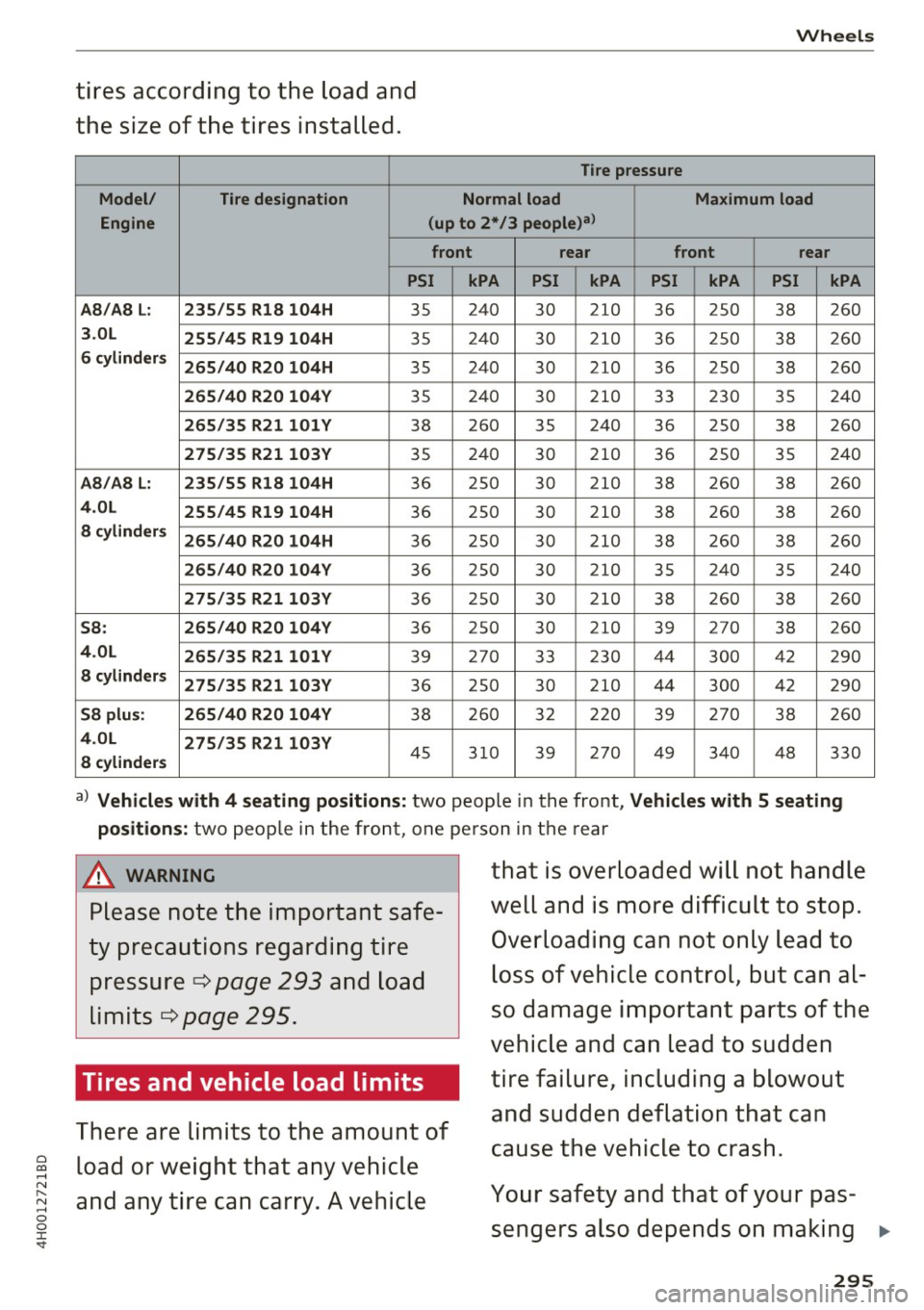
tires according to the load and
the size of the tires installed .
Wheels
Tire pressure
Model/ Tire designation Normal load Maximum load
Engine (up to
2*/3 people)al
front rear front rear
PSI kPA PSI kPA PSI kPA PSI kPA
A8/A8 L: 235/55 Rl8 104H
35 24
0 30 210
36 250
38 260
3.0L
255/45 Rl9 104H 35 240 30 210 36 250 38 260
6 cylinders 265/40 R20 104H 35 24
0
30 21
0
36 2
50
38 26
0
265/40 R20 104V 35 240 30 210 33 230 35 240
265/35 R21 101 Y 38 260
35 240 36 250
38 2
60
275/35 R21 103V 35 240 30 210 36 250 35 240
AS/ASL: 235/55 Rl8 104H 36 250 30 210 38 260 38 2
60
4.0L
255/45 Rl9 104H 36 250 30 210 38 260 38 260
8 cylinders 265/40 R20 104H 36 250 30 210 38 260 38 260
265/40 R20 104V 36 250 30 210 35 2
40
35 2
40
275/35 R21 103V 36 250 30 210 38 260 38 260
58: 265/40 R20 104V 36 250 3 0 21 0 39 27
0
38 260
4.0L 265/35 R21101 Y 39 270 33 230 44 300 42 290
8 cylinders 275/35 R21103Y 36 250 30 210 44
300 4
2
29 0
58 plus: 265/40 R20 104V 38 260 32 220 39 270 38 260
4.0L
275/35 R21 103V
8
cylinders 45 310 39 270 49 340 48 330
a ) Vehicles with 4 seating positions: two people in the front, Vehicles with 5 seating
positions:
two people in the front , one person in the rear
A WARNING
Please note the important safe
ty precautions regarding tire pressure
¢ page 293 and load
limits
¢ page 295.
Tires and vehicle load limits
There are limits to the amount of
~ load or weight that any vehicle that is
overloaded will not handle
well and is more difficult to stop .
Overloading can not only lead to
loss of vehicle control, but can al
so damage important parts of the
vehicle and can lead to sudden
tire failure, including a blowout
and sudden deflation that can
cause the vehicle to crash.
N
~ and any tire can carry. A vehicle
0 0 :c '
sengers also depends on making ..,.
295
Page 298 of 354
Wheels
sure that load limits are not ex
ceeded. Vehicle load includes ev
erybody and everything in and on
the vehicle. These load limits are
technically referred to as the vehi
cle's
Gross Vehicle Weight Rat
ing
("GVWR").
The "GVWR" includes the weight
of the basic vehicle, all factory in
stalled accessories, a full tank of
fuel, oil, coolant and other fluids plus maximum load. The maxi
mum load includes the number of
passengers that the vehicle is in
tended to carry ("seating capaci
ty") with an assumed weight of
150 lbs. (68 kg) for each passen
ger at a designated seating posi
tion and the total weight of any luggage in the vehicle. If you tow
a trailer, the weight of the trailer
hitch and the tongue weight of
the loaded trailer must be includ
ed as part of the vehicle load.
The
Gross Axle Weight Rating
("GAWR") is the maximum load
that can be applied at each of the
vehicle's two axles.
The fact that there is an upper
limit to your vehicle's Gross Vehi
cle Weight Rating means that the
total weight of whatever is being
296
carried in the vehicle (including
the weight of a trailer hitch and the tongue weight of the loaded
trailer) is limited. The more pas
sengers in the vehicle or passen
gers who are heavier than the
standard weights assumed mean
that less weight can be carried as l uggage .
The Gross Vehicle Weight Rating
and the Gross Axle Weight Rating
are listed on the safety compli
ance sticker label located on the
driver's side B-pillar
¢ page 293,
fig. 267.
.&_ WARNING
-
Overloading a vehicle can cause
loss of vehicle control, a crash
or other accident, serious per
sonal injury, and even death.
-Carrying more weight than
your vehicle was designed to
carry will prevent the vehicle
from handling properly and increase the risk of the loss of
vehicle control.
-The brakes on a vehicle that
has been overloaded may not
be able to stop the vehicle
within a safe distance.
Page 299 of 354
0
"' -N .... N
-0
0
:c ...
-Tires on a vehicle that has
been overloaded can fail sud
denly, including a blowout and
sudden deflation, causing loss
of control and a crash.
-Always make sure that the to tal load being transported -
including the weight of a trail
er hitch and the tongue
weight of a loaded trailer - does not make the vehicle
heavier than the vehicle's
Gross Vehicle Weight Rating.
Determining correct load
limit
Use the example below to calcu
late the total weight of the pas
sengers and luggage or other
things that you plan to transport so that you can make sure that
your vehicle will not be overload
ed.
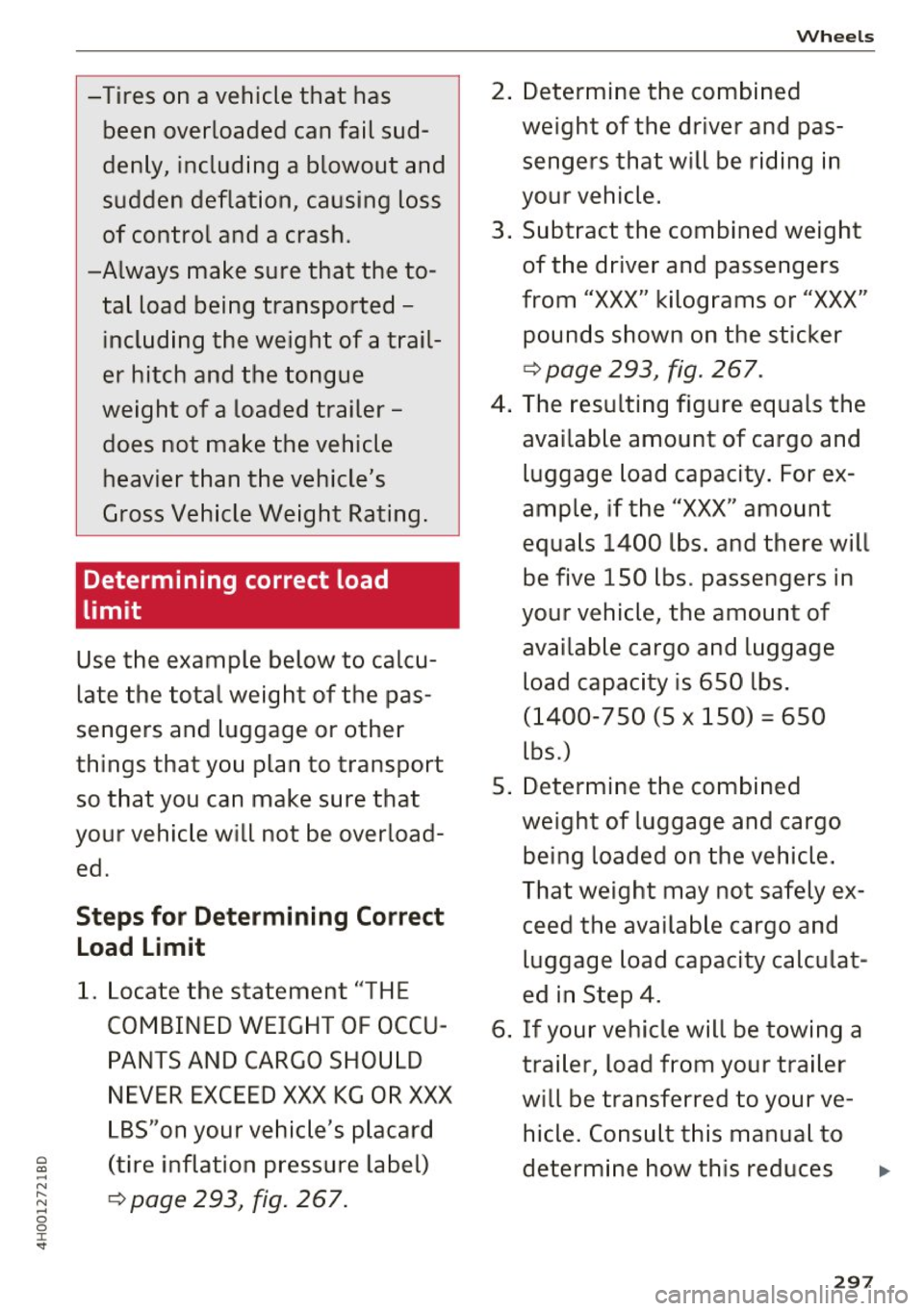
Steps for Determining Correct Load Limit
1. Locate the statement "THE
COMBINED WEIGHT OF OCCU
PANTS AND CARGO SHOULD
NEVER EXCEED XXX KG OR XXX
LBS "on your vehicle's placard
(tire inflation pressure label)
c::> page 293, fig. 267 .
Wheels
2. Determine the combined
weight of the driver and pas sengers that will be riding in
your vehicle.
3. Subtract the combined weight of the driver and passengers
from "XXX" kilograms or "XXX"
pounds shown on the sticker
c::> page 293, fig . 267 .
4. The resulting figure equals the
available amount of cargo and
luggage load capacity. For ex
ample, if the "XXX " amount
equals
1400 lbs. and there will
be five
150 lbs . passengers in
your vehicle, the amount of
available cargo and luggage
load capacity is 650 lbs.
(1400-750 (5 X 150) = 650
lbs .)
5. Determine the combined
weight of luggage and cargo
being loaded on the vehicle.
That weight may not safely ex ceed the available cargo and
luggage load capacity calculat
ed in Step 4.
6. If your vehicle will be towing a trailer, load from your trailer
will be transferred to your ve
hicle. Consult this manual to
determine how this reduces .,..
297
Page 333 of 354

C) C0 ....
"' " "' .... 0 0 :r
Lifting with workshop hoist and with floor
jack
The vehicle may only b e li~ ed at the lifting
points illustra ted.
F ig. 297 Front lift ing po int
F ig. 2 98 Rea r lift ing point
.,. Read and heed WARNING c:> &_ .
.. Activate the vehicle jack mode in the MMI:
I CAR I funct ion button> Car systems control
button>
Servicing & checks > Air susp.: jack
mod e> On.
~ :c ... a,
.. Loca te lift ing po ints c:> fig . 297 and c:> fig. 298 .
.. Adju st lifting arms of workshop ho ist o r floo r
j ac k t o ma tch vehicl e lifting poin ts.
.. In se rt a rubb er pa d between the f loor jack/
wor kshop hoist and the lifting points .
T he vehicle ja ck mode m ust be a ctiv ate d so th at
the au tomatic a djustment of the Adaptive Air
Suspension does not make it more diffic ult to
raise the ve hicle w it h the floo r jack.
If you must lift your vehicle with a floor jack to
work underneath , be sure the vehicle is safely
supported on stands intended for this purpose .
Emergency situations
Front lifting point
The li fting poi nt is locate d on the floor p an rein
f orceme nt ab out at the same level as the ja ck
mounting point
c:> fig . 297. Do not lift the vehi
cle at the vertical sill reinforcement.
Rear lifting point
T he lifting point is lo cated on the ver tic al rein
f orcement o f the lower s ill for the on- bo ar d jac k
<=> fig. 298 .
Lifting with vehicle jack
Refer to c:> pag e 315 .
A WARNING
- To reduce the r is k of se rious inju ry and vehi
cle damag e.
- Always lift the vehicle on ly at the special
workshop h oist a nd floor jack lift points
il
lustrated c:> fig. 297 and c:> fig. 298.
- Failure to lift t he veh icle at these points
could cause t he veh icle to tilt o r fall from
a lift i f th ere is a change in vehicle weight
dist ribution and balance . This might hap
pen, fo r example, when heavy com po
n ents such as the eng ine block o r trans
mis sio n are re moved.
- Whe n re mov ing heavy co m ponents like
these, an ch or vehicle t o hois t or ad d co rre
spon ding weig hts t o m aintai n the cen ter of
g ravi ty . Ot herw ise, the vehicle mig ht tilt or
slip off t he hoist, caus ing se rious pe rsonal
i njur y .
(D Note
-Be aw are of the fo llow ing points b efor e lift
ing the vehicle:
-The vehicle should never be lifted or
jacked up from underneath the engine oil
pan, the transmission housing, the front
or rear axle or the body side members.
This could lead to serious damage .
- To avoid damage to the underbody or
chassis frame, a rubber pad must be in
serted between the floor jack and the lift
points . ..,.
331
Page 334 of 354
Emergency situations
-Before driving over a workshop hoist,
check that the vehicle weight does not
exceed the permissible lifting capacity of
the hoist.
- Before driving over a workshop hoist, en
sure that there is sufficient clearance be
tween the hoist and low parts of the ve hicle.
332
Page 335 of 354

C) C0 ....
"' ,-...
"' .... 0 0 :r
Vehicle specifications
XXXXX XX · X · XXXX XXX XX
CD-+ :::::: XXXXXX XX XX X XX XXX XXX
IYP IT'il'! XXX XXX
xx xxxxxxx xx xx xx
XXX KW XXX
a.;. C1lll /TRANS. CIIOE xxxx XXX XXX ®i 11)10Al<8 ./lil'IR.k8.
©+ I.AO OIR. / IN NENAllSSl.
XXXX I XXXX XXX I XX PAI NT IIO. / ffl£ml
II. • AIJSlit / OPTIONS
EOA 70 5 4U B 6XM SSG SRW
2 EH JO Z 1LB 1AS l BA
3FC S MU 7Xl
F O A 9G3 OG7 OYH OJF
TL 6 3 KA 8EH UlA X 9B OZ7
lXW 803 908 8Z4 020
7T6 CV7 7KO 4X3 2K 2
3 L4 4KC 3YO 413 50 2
lS A 7GB 01A 4GO
XX. X XX X XX X xxxx
Fig. 299 Vehicle identifica tion labe l
Vehicle Identification Number (VIN)
The VIN number is located in the following pla
ces :
0
0
11:l :x: .,. al
-In the Infotainment system: se lect: the !CARI
func tion button > Car systems control button >
Servicing & checks > VIN number .
-on the vehicle identification label
- under the windshield on the driver's side
Vehicle identification label
The vehicle identification label ¢ fig. 299 is locat
ed in the luggage compartment under the cargo
floor cover in the spare wheel well.
The information of the vehicle identification label
can also be found in your Warranty
& Mainte
nance booklet.
Technical data
T he sticker contains the following vehicle data:
(D Vehicle Identification Number (VIN)
@ Vehicle type, engine output, transm ission
@ Engine and transmission codes
@ Paint and interior codes
® Optional equipment numbers
Safety compliance sticker
The safety compliance sticker is yo ur ass urance
that your new veh icle complies w ith all applicable
Federal Motor Vehicle Safety Standards which
were in effect at the time the vehicle was manu
factured. You can find this sticker on the door
jamb on the driver's side. It shows the month and
year of production and the vehicle identification
number of your vehicle (perforation) as well as
the Gross Vehicle Weight Rat ing (GVWR) and the
Gross Axle Weight Rating (GAWR).
High voltage warning label
The high voltage warning label is located in the
engine compartment next to the engine hood re
lease. The spark ignition system complies with
the Canadian standard ICES-002 .
Notes about technical
data
The values may differ for some markets depend
ing on equ ipment installed in certain markets
and the measuring methods.
Please note that the specifications listed in the
vehicle documentation always take precedence.
(0 Tips
Missing technical data was not available at
the time of print ing.
333
Page 336 of 354
Tech nical data
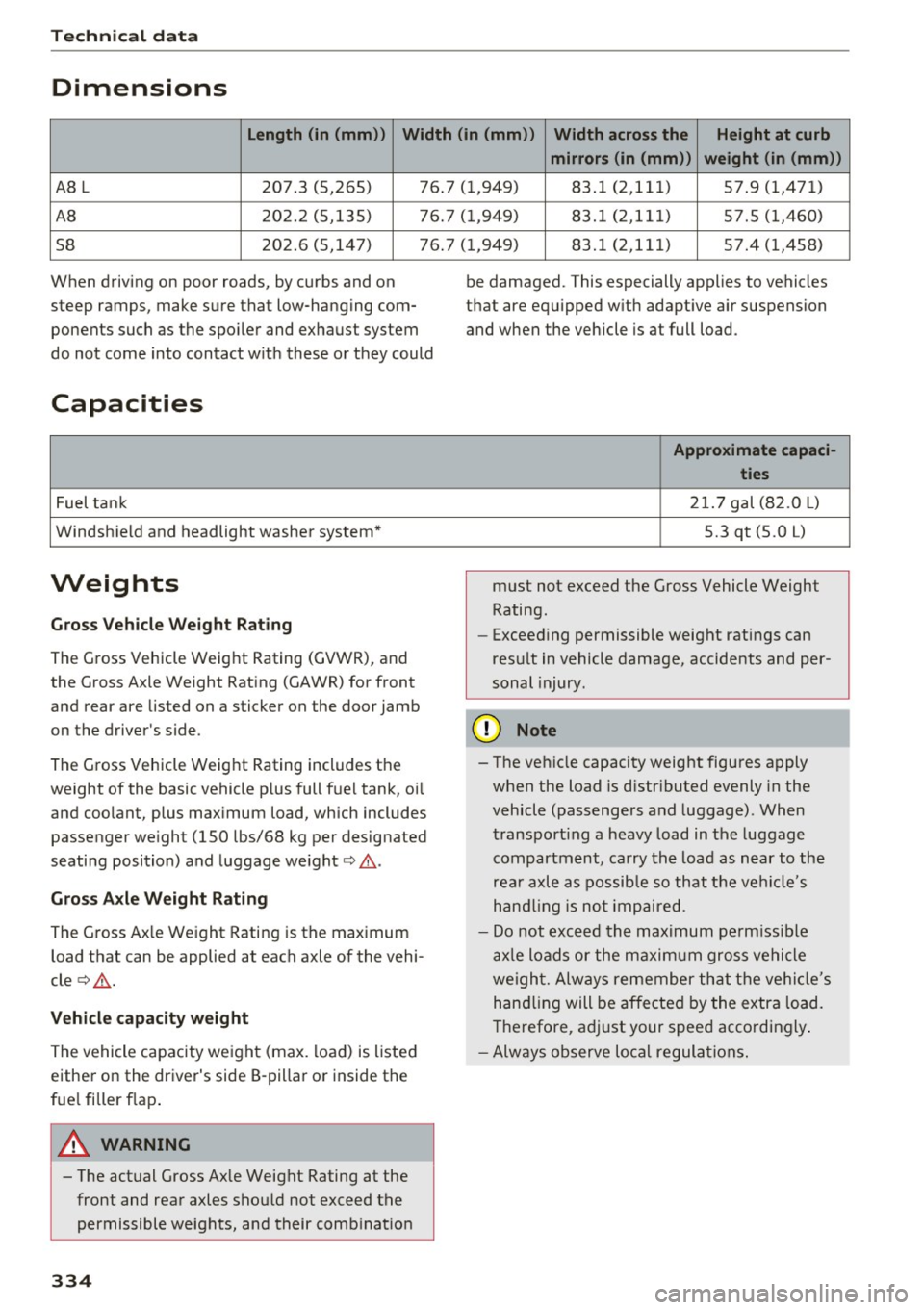
Dimensions
Length (in (mm )) Width (in (mm ))
Width across the Height at curb
mirrors (in (mm )) weight (in (mm ))
A8 L 207.3 (5,265) 76.7 (1,949) 83.l (2,111) 57.9 (1,471)
AB 202.2 (5,135) 76.7 (1,949) 83.1 (2,111) 57.5 (1,460)
58 202.6 (5,147) 76.7 (1,949) 83.l (2,111) 57.4 (1,458)
When driving on poor roads, by curbs and on
steep ramps, make sure that low-hanging com ponents such as the spoiler and exhaust system
do not come into contact w ith these or they could
Capacities
Fuel tank
Windshield and headlight washer system*
Weights
G ro ss Vehicl e Weight Rat ing
The Gross Vehicle Weight Rating (GVWR), and
the Gross Axle Weight Rating (GAWR) for front
and rear are listed on a sticker on the door jamb
on the driver's side .
The Gross Vehicle Weight Rating includes the
weight of the basic vehicle p lus full fuel tank, oi l
and coolant, plus max imum load, which includes
passenger we ight (150 lbs/68 kg per designated
seating position) and luggage weight¢ ,&..
Gross A xle W eight Rating
The Gross Ax le Weight Rating is the maximum
load that can be applied at each axle of the vehi
cle ¢,&. .
V ehicle capaci ty weight
The vehicle capacity we ight (max. load) is listed
either on the driver's side B-pillar or inside the
fue l filler flap .
A WARNING
- The actual Gross Axle Weight Rating at the front and rear axles shou ld not exceed the
permissible weights, and their comb inat ion
334
be damaged. This especially applies to vehicles
that are equipped w ith adapt ive air suspension
and when the vehicle is at full load .
Appro ximate capaci-
tie s
2 1. 7 gal (82.0
L)
5.3 qt (5.0 L)
must not exceed the Gross Vehicle Weight
Rating.
- Exceed ing permissible weight ratings can
result in vehicle damage, accidents and per
sonal injury.
(D Note
- The veh icle capacity weight figures apply
when the load is d istr ibuted evenly in the
vehicle (passengers and luggage) . When
transport ing a heavy load in the luggage
compartment, carry the load as near to the
rea r axle as possib le so that the ve hicl e's
h and ling is no t impaired.
- Do not exceed the maximum pe rm iss ible
ax le loads or the maxim um gross vehicle
we igh t. A lways remember that the ve hicl e's
hand ling will be affected by the extra load.
T herefore, adjust your speed accordingly .
- Always observe local regula tions.
Page 346 of 354
Index
Fue ling
F ue l filler door . . . . . . . . . . . . . . . . . . . . . . 269
Fue l gauge . . . . . . . . . . . . . . . . . . . . . . . . . . 1 0
Fue l tank capac ity . . . . . . . . . . . . . . . . . . . 334
F ull screen displ ay (DVD) . . . . . . . . . . . . . . . 190
Function buttons . . . . . . . . . . . . . . . . . . . . . 134
F uses . . . . . . . . . . . . . . . . . . . . . . . . . . . . . . . 322
G
Garage doo r opener (Home link) . . . . . . . . . . 41
Garment hooks . . . . . . . . . . . . . . . . . . . . . . . . 63
Gas discharge lamps . . . . . . . . . . . . . . . . . . . 326
Gas statio n mes sage . . . . . . . . . . . . . . . . . . 172
Glossary of tire and loading terminology . . 285
Glove compartment . . . . . . . . . . . . . . . . . . . . 63
Va let parking function . . . . . . . . . . . . . . . . . 40
Gross Vehicle Weight Rat ing (GVWR) . . . . . 334
H
H D radio (digital radio) . . . . . . . . . . . . . . . . . 178
Head -up Display . . . . . . . . . . . . . . . . . . . . . . . 16
H eadlights
Clean ing . . . . . . . . . . . . . . . . . . . . . . . . . . . 307
Headlig ht range contro l . . . . . . . . . . . . . . . 4 3
Washer system . . . . . . . . . . . . . . . . . . . . . . 50
H eadpho nes . . . . . . . . . . . . . . . . . . . . . . . . . 197
Conn ections (RS E) . . . . . . . . . . . . . . . . . . . 199
H eadphones connected by ca ble (RSE) . . . 199
W ireless headp hones (RSE) . . . . . . . . . . . . 197
H ead restra ints . . . . . . . . . . . . . . . . . . . . . . . 210
Ad justi ng .. .. .. .. . .......... .. .. .. . 210
H eating . . . . . . . . . . . . . . . . . . . . . . . . . . . . . . 69
H eavy clo thing and safety bel ts . . . . . . . . . . 220
H ex socket. .. .. .. .. . .. .. .... .. .. .. .. . 312
High beams . . . . . . . . . . . . . . . . . . . . . . . . . . . 44
Hi ll descent contro l . . . . . . . . . . . . . . . . . . . . 86
H ill hold ass ist . . . . . . . . . . . . . . . . . . . . . . . . 82
also refer to Hill hold ass ist . . . . . . . . . . . . 82
Ho ld assist (hi ll) . . . . . . . . . . . . . . . . . . . . . . . 82
H ome address . . . . . . . . . . . . . . . . . . . . . . . . 17 2
H omelink (garage door opener) . . . . . . . . . . 41
Horn . . . . . . . . . . . . . . . . . . . . . . . . . . . . . . . . . 7
344
I
Ign ition . . . . . . . . . . . . . . . . . . . . . . . . . . . . . . 76
Imbalance (whee ls) . . . . . . . . . . . . . . . . . . . 291
Immobilizer . . . . . . . . . . . . . . . . . . . . . . . 10, 28
I mpo rting and expo rting (cont acts ) . . . . . . 153
Improperly worn safety belts . . . . . . . . . . . 224
Indicator lights . . . . . . . . . . . . . . . . . . . . . . . . 17
Infan t seats . . . . . . . . . . . . . . . . . . . . . . . . . 254
Inflation pressure (Tire Pressure Mon itor ing
System) ........ .. .. .. ............. . .
I nflation press ure (t ires)
Info rmation 302
293
Audi music inte rface . . . . . . . . . . . . . . . . . 185
Infotainment display . . . . . . . . . . . . . . . . . . 135
Inp ut
U sing the M MI touch . . . . . . . . . . . . . . . . . 136
U sing the speller . . . . . . . . . . . . . . . . . . . . 137
I n pu t level (media) . . . . . . . . . . . . . . . . . . . . 190
Inspection interva l . . . . . . . . . . . . . . . . . . . . 282
I nstalling the upper tether st rap on t he an -
cho rage . . . . . . . . . . . . . . . . . . . . . . . . . . . . . 265
I nstr ument clus ter . . . . . . . . . . . . . . . . . . . . . . 9
Interior light ing . . . . . . . . . . . . . . . . . . . . . . . 46
I nterior re arview mirro r . . . . . . . . . . . . . . . . . 48
Intermitten t mode (winds hield wipers) . . . . SO
Internet
refer to Aud i connect . . . . . . . . . . . . . . . . . 157
i Pod
refer to Au di music interface . . . . . . . . . . . 185
J
Jukebox . . . . . . . . . . . . . . . . . . . . . . . . . . . . . 182
Jump-start ing ..... ... ...... ....... ... 327
Jump start cable 328
K
Key.............. .. .. .. ........... ... 28
Key not recognized . . . . . . . . . . . . . . . . . . . 78
K ick-down (au tomatic transm ission) . . . . . . . 86
Knee a irbags . . . . . . . . . . . . . . . . . . . . . . . . . 240
L
LAT CH . . . . . . . . . . . . . . . . . . . . . . . . . . . . . . 261
Leav ing home . . . . . . . . . . . . . . . . . . . . . . . . . 46