wheel AUDI A8 2017 Workshop Manual
[x] Cancel search | Manufacturer: AUDI, Model Year: 2017, Model line: A8, Model: AUDI A8 2017Pages: 354, PDF Size: 88.68 MB
Page 235 of 354
control unit when the ignition is on. The control
unit monitors the Advanced Airbag System and
turns the airbag indicator light on when a ma l
function in the system components is detected. The funct ion of the a irbag indicator light is de
scr ibed in greater deta il below . Because the front
passenger seat contains important parts of the
Advanced Airbag System, you must take care to p revent it from being damaged. Damage to the
seat may preven t the Advanced A irbag for the
fron t passenger seat from doing its job in a
crash .
The front Advanced Airbag System consists
of the follo wing :
-Crash sensors in the front of the vehicle that
measure vehicle acceleration/deceleration to
provide information to the Advanced Airbag
System a bout the severity of the crash.
- An e lectronic control unit, with integrated
crash sensors for front and side impacts. The
control unit "decides" whether to fire the front
airbags based on the information received from
the crash sensors. The control unit also "de
c ides" whether the safety belt pretens ioners
should be activated .
- An Advanced Airbag with gas generator and
control valve for the driver ins ide the steer ing
wheel hub .
- An Advanced Airbag with gas generator and control valve inside the instrument pa nel for
the front passenger.
- A weig ht-sensing mat under the upholstery
padd ing of the front passenger seat cushion
that meas ures the total weight on the seat. The
i nformation registered is sent continuously to
the e lectron ic cont rol unit to reg ulate dep loy
ment of the front Adv a need Airbag on the pas
senger side .
- An airbag monitoring system and indicator
light in the instrument cluster
¢ page 236.
-A sensor in eac h front seat registers the dis
tance between the respective seat and the steering wheel or instrument pane l. The infor
mation registered is sent contin uously to the
0 co electronic control unit to regulate deployment ....
~ of the front Adva need A irbags. N .... 0 0 :c '
- The PASSENGER AIR BAG OFF light comes on
and stays on in the center of the instrument
pane l¢
page 237, fig . 233 and te lls yo u when
the front Advanced Airbag on the passenger side has been turned off.
- A sensor below the safety be lt latch for the
front seat passenger to measure the tension on the safety belt. The tension on the safety belt
and the we ight registered by the weight -sens
ing mat help the contro l unit "decide" whether
the front airbag fo r the front passenger seat
should be tu rned off o r not ¢
page 22 7, Child
restraints on the front seat -some important
things to know.
- A sensor in the safety belt latch for the driver
and for the front seat passenger that senses
whether that safety be lt is latched o r not and
transmits this information to the electronic control unit.
A WARNING ,-
Damage to the front passenger seat can pre-
vent the front airbag from working properly.
- Improper repair or disassembly of the front passenger and driver seat will prevent the
Advanced Airbag System from funct ion ing
properly .
- Repairs to the front passenger seat must be
performed by qualified and properly trained
workshop personnel.
- Never remove the front passenger or driver
seat from the vehicle.
- Never remove the upholstery from the front
passenger seat.
- Never d isassemble or remove parts from the
seat or disconnect w ires from it.
- Never carry sharp objects in your pockets or
p lace them on the seat. If the weight-sens
ing mat in the passenger seat is punctured
it cannot work properly .
- Never carry things on your lap or carry ob
jects on the passenger seat . Such items can
increase the weight reg istered by the
weight-sensing mat and send the wrong in
formation to the a irbag con trol u nit.
- Never store items under the front passenger
seat. Parts of the Advanced Airbag System
under the passenger seat cou ld be
~
233
Page 238 of 354
Airbag syste m
-Ne ver t ransport items on or in the area of
t h e fr ont passenger seat. Objects could
m ove into the area of the front airbags dur
ing brak ing or oth er sudden maneuvers and
become dangerous projectiles that can
cause serious pe rsonal injury if the a irbags
inflate.
- Never place or attach accessor ies or other
objects (such as cup holders, te lephone
brackets, large, heavy o r bulky objects) on
the doors, over or ne ar the area marked
"AIRBAG" on the steering wheel, instru
ment pane l, seat bac krests or between
t h ose areas and yourself. These objects
could cause injury in a crash, especially
when the airbags inflate.
- Never recline the front passenge r's seat to
transport objects. Items can also move into
the area of the side airbag o r the front a ir
bag dur ing braking or in a s udden maneu
ver. Objects near the airbags can become
projectiles and cause in ju ry, particularly
when the sea t is re clin ed.
.8, WARNING
The f ine dust create d when airbags deploy can
cause breathing problems for people w ith a
his tory of asthma or o ther breathing condi
tions .
- T o reduce the risk o f brea thing pro blems,
those w ith asthma or o ther respiratory con
ditions should get fresh air right away by
gett ing out of the vehicle o r opening w in
dows o r doors.
- If you are in a collision in which airbags de
ploy, wash your hands and face with mild
soap and water before eat ing.
- Be careful not to get the dust into your eyes,
or into any cuts or scratches.
- If the resid ue should get into your eyes,
flush them with water.
236
Monitoring the
Advanced Airbag System
tli (USA models )/!{' (Canada model s)
Airbag monitoring indicator light
Two separate indicators monitor the function of
the Advanced Airbag System: the airbag moni
toring indicator light and the
PASSENGER AIR
BAG OFF
light.
The Advanced A irbag System ( including the e lec
tronic control unit, sensor circuits and system
wiring) is monitored continuously to make sure
that it is functioning properly whenever the igni
tion is o n. Each time you sw itch on the ig nition,
the a irbag mo nitor ing indica to r light
II (U SA
models)/ fll (Canada models) w ill come o n for a
few seconds (se lf d iagnost ic s) .
The system must be inspected when the
indicator light
fl (USA models) /E,I (Canada
models) :
-does not come on when the igni tion is sw itched
on,
- does not go out a few se co nd s afte r you h ave
sw itched on the ignit ion, or
- comes on while driv ing.
If an airbag system malfunction is detected, the
i ndica to r light will come on to se rve as a constant
r em inder to have t he system inspected immedi
ate ly.
If a ma lfunction occurs that turns the front air
bag on the passenge r side off, the
PASSENGER
A IR BAG OFF
light w ill come on and stay o n
whe never the ignition is on.
_& WARNING
A n a ir b ag system t hat i s no t functioning prop
e rly cannot provide sup plemental pro te ct ion
in a fronta l crash .
- If the air bag ind icator ligh t<=? page 23
comes when the vehicle i s being u sed, have
the system inspected immediately by your
author ized Audi dealer . It is possib le that
the airbag will inflate when it is not sup posed to, or will not inflate when it should.
Page 241 of 354
0 co .... N ,..._
N .... 0 0 :c '
whenever the ignition is switched on.
A WARNING
- If the PASSENGER AIR BAG OFF light does
not go out when an adult is sitting on the
front passenger seat after taking the steps described above, make sure the adult is
properly seated and restrained at one of the
rear seating positions.
- Have the airbag system inspected by your
Audi dealer before transporting anyone on
the front passenger seat.
{D) Tips
If the weight-sensing mat in the front passen
ger seat detects an empty seat, the front air
bag on the passenger side will be turned off,
and the
PASSENGER AIR BAG OFF light will
stay on.
Repair, care and disposal of the airbags
Parts of the airbag system are installed at many
different places on your Audi. Installing, remov
ing, servicing or repairing a part in an area of the
vehicle can damage a part of an airbag system
and prevent that system from working properly in a collision .
There are some important things you have to
know to make sure that the effectiveness of the
system will not be impaired and that discarded
components do not cause injury or pollute the
environment.
A WARNING
Improper care, servicing and repair proce
dures can increase the risk of personal injury
and death by preventing an airbag from de
ploying when needed or deploying an airbag
unexpectedly:
- Never cover, obstruct, or change the steer
ing wheel horn pad or airbag cover or the in
strument panel or modify them in any way.
- Never attach any objects such as cup holders
or telephone mountings to the surfaces cov
ering the airbag units.
Airbag system
-For cleaning the horn pad or instrument
panel, use only a soft, dry cloth or one mois
tened with plain water. Solvents or cleaners
could damage the airbag cover or change
the stiffness or strength of the material so
that the airbag cannot deploy and protect properly.
- Never repair, adjust, or change any parts of
the airbag system.
-All work on the steering wheel, instrument panel, front seats or electrical system (in
cluding the installation of audio equipment,
cellular telephones and CB radios, etc.) must be performed by a qualified technician
who has the training and special equipment
necessary.
- For any work on the airbag system, we
strongly recommend that you see your au
thorized Audi dealer or qualified workshop.
- Never modify the front bumper or parts of
the vehicle body.
- Always make sure that the side airbag can
inflate without interference:
- Never install seat covers or replacement
upholstery over the front seatbacks that
have not been specifically approved by
Audi.
- Never use additional seat cushions that
cover the areas where the side airbags in
flate.
- Damage to the original seat covers or to
the seam in the area of the side airbag
module must always be repaired immedi
ately by an authorized Audi dealer.
- The airbag system can be activated only
once. After an airbag has inflated, it must
be replaced by an authorized Audi dealer or
qualified technician who has the technical
information, training and special equipment
necessary.
- The airbag system can be deployed only
once. After an airbag has been deployed, it
must be replaced with new replacement
parts designed and approved especially for
your Audi model version. Replacement of complete airbag systems or airbag components must be performed by qualified work-
shops only. Make sure that any airbag
Ill-
239
Page 242 of 354
Airbag syste m
service action is entered in your Audi War
ranty
& Maintenance book let under AIRBAG
REPLACEMENT RECORD.
- For safety reasons in severe accidents, the
alternator and starter are separated from
the vehicle battery with a pyrotechnic circuit interrupter.
- Work on the pyrotechnic circuit interrupt
er must only be performed by a qualified
dea ler· risk of an accident!
- If the veh icle or the circuit interrupter is
scrapped, all applicab le safety precautions
must be followed .
@ For the sake of the environment
Undeployed airbag modu les and pretension
ers might be classified as Perch lorate Materi
al -special handling may apply, see
www .dtsc.ca.gov/hazardouswaste/perchlo
rate. When the vehicle or parts of the re
straint system including airbag modules and
safety belts w ith pretensioners are scrapped,
all applicable laws and regulations must be
observed. Your authorized Audi dealer is fa
m iliar with these requirements and we recom
mend that you have your dealer perform this
serv ice for you .
Other things that can affect Advanced
Airbag performance
Changing the vehicle's suspension system can
change the way that the Advanced Airbag System
performs in a crash. For example, using t ire-r im
comb inat ions not approved by Audi, lower ing the
veh icle, chang ing the st iffness of the suspens ion,
including the springs, suspension struts, shock
absorbers etc. can change the forces that are
measured by the airbag senso rs and sent to the
electronic contro l unit. Some suspension changes
can, for example, increase the force levels meas
ured by the sensors and make the airbag system
deploy in crashes in which it would not deploy if
the changes had not been made. Other kinds of changes may reduce the force levels meas ured by
the sensors and prevent the airbag from deploy ing when it should .
240
A WARNING
Changing the vehicle's suspension including
use of unapproved tire-rim comb inations can
change Advanced Airbag performance and in
crease the r isk of serious personal injury in a
crash.
- Never insta ll suspension components that
do not have the same performance charac
ter istics as the components origina lly ins tal
led on you r vehicle.
- N ever use tire-r im combinations that have
no t been approved by Aud i.
A WARNING
It ems stored between the safety belt buckle
and the center conso le can cause the sensors
in the buckle to send the wrong information
to the electronic contro l module and prevent
the Advanced A irbag System from working
proper ly.
- Always make sure that nothing can interfere
with the safety belt buckles and that they
are not obstructed.
Knee airbags
Description of knee airbags
The knee airbag system can provide supplemen
tal protection to properly restrained front seat
occupants.
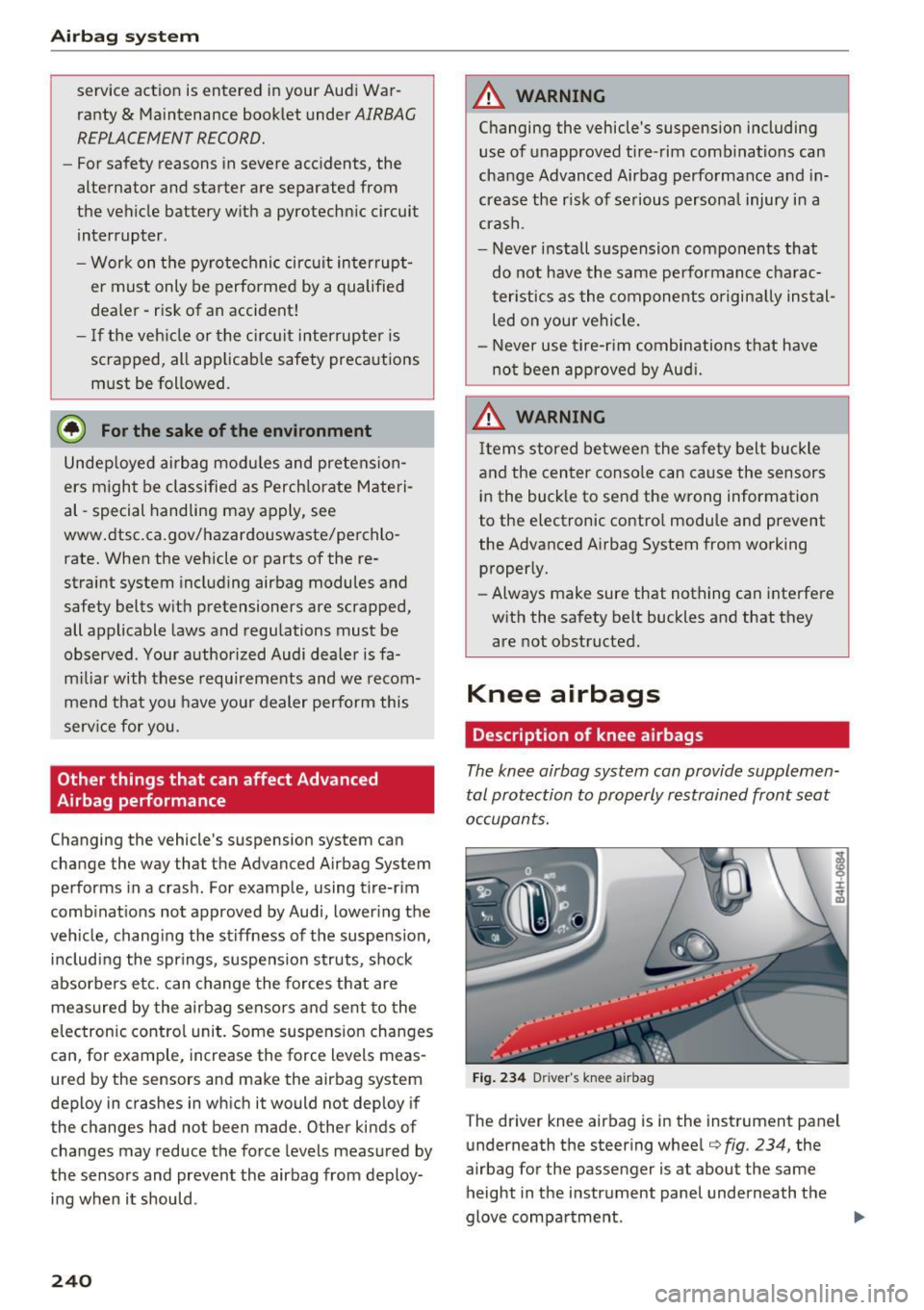
Fig . 234 D river 's knee a irbag
The driver knee airbag is in the instrument panel
underneath the steering wheel~
fig. 234, the
airbag for the passenger is at about the same height in the instrument panel underneath the
glove compartment . ..,_
Page 244 of 354
Airbag system
part of the instrument panel and the driver and
the lower part of the instrument panel and the
front passenger
c> poge 234, fig. 232.
Although they are not a soft pillow, they can
"cushion" the impact and in this way they can
help to reduce the risk of injury to the lower ex
tremities.
All of this takes place in the blink of an eye, so
fast that many people don't even realize that the
airbags have deployed. The airbags also inflate
with a great deal of force and it is important for
occupant safety that nothing should be in their
way when they deploy.
Fully inflated airbags in combinat ion with proper
ly worn safety belts slow down and limit the oc
cupant's forward movement and help to reduce
t he risk of injury.
Important safety instructions on the knee
a irbag system
Airbags ore only supplemental restraints. Always
wear safety belts correctly and ride in a proper
seating position.
There is a lot that you and your passengers must
know and do to help the safety belts and airbags
to provide supplemental protection .
A WARNING
An inflating knee airbag can cause serious in
jury. Wearing safety belts incorrectly and im proper seating positions increase the risk of
serious personal injury and death whenever a
vehicle is being used.
- The knee airbag system cannot protect you
properly if you are seated too close to any of
the airbag locations. When adjusting their
seat positions, it is important that both the
driver and the front passenger keep their
upper bodies and knees at the following
minimum safe distances :
- at least 10 inches (25 cm) between the
chest and the steering wheel/instrument panel.
242
- at least 4 inches (10 cm) between the
knees and the lower part of the instru
ment panel.
- The risk of personal injury increases if you
lean forward or to the side, or if the seat is
improperly positioned and you are not wear
ing your safety belt . The risk increases even
more should the airbag deploy.
- Always make sure that the knee airbag can
inflate without interference . Objects be
tween you and the airbag can increase the risk of injury in an accident by interfering
with the way the airbag deploys or by being
pushed into you as the airbag deploys.
- Never let anybody, especially children or
animals ride in the footwell in front of the passenger seat. If the airbag deploys, this
can result in serious or fatal injuries .
- Never carry objects of any kind in the foot
well area in front of the driver's or pas
senger's seat. Bulky objects (shopping bags, for example) can interfere with or
prevent proper deployment of the airbag.
Small objects can be thrown through the
vehicle if the airbag deploys and injure you
or your passengers.
- Make sure there are no cracks, deep scratch
es or other damage in the area of the instru
ment panel where the knee airbags are lo
cated .
- If children are incorrectly seated, their risk
of injury increases in a collision
c> page 248, Child safety.
Page 251 of 354
0 co .... N ,..... N .... 0 0 :c '
Child ren on the front seat of any car even w ith
Advanced Airbags can be seriously injured or
even killed when an airbag inflates. A child in
a rearward-facing child safety seat installed
on the front passenger seat will be seriously
injured and can be killed if the front airbag in
flates.
- The inflating airbag will hit the child safety
seat or infant carrier with great force and
will smash the ch ild safety seat and child
against the backrest, center armrest, or
door.
- Always install rear-facing child safety seats
on the rear seat.
- If you must install a rearward fac ing ch ild
safety seat on the front passenger seat in
exceptiona l circumstances and the
PA SSEN
GER AIR BAG OFF
light does not come on
and stay on, immediately insta ll the rear
facing child safety seat in a rear seating po
sition and have the airbag system inspected
immediately by your Audi dealer.
A WARNING
If, in except ional circumstances, you must in
stall a forward-facing chi ld restraint on the
front passenger's seat :
- Always make sure the forward-fac ing seat
has been designed and certified by its man
ufacturer for use on a front seat with a pas
senger front and s ide a irbag .
- Always follow the manufacturer's instruc
tions prov ided with the ch ild safety seat or
carrier.
- Always move the front passenger seat to
the highest position in the up and down ad
justment range and move it back to the
rea rmost position in the seat's fore and aft
adjustment range, as fa r away from the air
bag as possib le, before insta lling the for
ward- facing child restra int .
- Always ma ke sure that the s afety bel t upper
anchorage is beh ind the child restraint and
not next to or in front of the chi ld restraint
so that the safety belt will be properly pos i
t ioned.
Ch ild safety
-Always make sure that the PASSENGER AIR
BAG OFF
light comes on and stays on all the
time whenever the ignition is switched on.
@ Tips
A lways replace child restraints that were in
stalled in a vehicle du ring a c rash. Damage to
a child restraint that is not v is ible could cause
i t to fai l in another co llision situat ion.
Advanced front airbag system and children
You r vehicle is equipped with a front "Advanced
Airbag System" in compliance with Un ited States
Federal Motor Vehicle Safety Standa rd (FMVSS)
208, as we ll as Canada Moto r Vehicle Safety
Standard (CMVSS) 208 as app licab le a t the time
your vehicle was manufactured.
T he Advanced A irbag system in yo ur vehicle has
been certified to meet the "low-risk" require
ments fo r 3- and 6-year old ch ild ren on the pas
senger side and sma ll adu lts on the driver side.
T he low risk deployment criter ia are intended to
red uce the risk of inju ry t hrough interaction with
the airbag that can occur, for example, by be ing
too close to the steering wheel and instrument
panel when the airbag inflates. In addition, the
system has been cert ified to comply with the
"supp ression" requirements of the Safety Stand
ard, to turn off the front a irbag fo r infants up to
12 months who are restrained on the front pas
senger seat in c hild res traints t hat are lis ted in
t h e Standard.
E ven though your veh icle is eq uipped wit h an Ad
vanced Airbag system, all ch ild ren, especially
those 12 yea rs and you nger, sho uld a lways ride
in the back seat proper ly restrained for their age
and size . The airbag on the passenger side makes
the front seat a potentia lly dange rous p lace for a
child to ride. The front seat is not the safest place
for a child in a forward-fac ing ch ild safety seat. It
can be a very dangerous place fo r an infant o r a
larger ch ild in a rearward-facing seat .
249
Page 285 of 354
0
a:,
.... N ...... N .... 0
0
I
Wheels and Tires
General information
.,.Check your tires regularly for
damage (punctures, cuts, cracks
and bulges). Remove foreign ob
jects from the tire tread.
.,. If driving over c urbs or similar
obstacles, drive slowly and ap
proach the curb at an angle.
.,.Have faulty tires or rims re
placed immediately.
.,.Protect your tires from oil,
grease and fuel.
.,.Mark tires before removing
them so that the same running direction can be maintained if
they are reinstalled .
.,.Lay tires flat when storing and
store them in a cool, dry location
with as little exposure to light as possible.
(D Note
-Please note that summer and winter tires are designed for
the conditions that are typical in those seasons. Audi recom
mends using winter tires dur
ing the winter months. Low
temperatures significantly de
crease the elasticity of summ
er tires, which affects traction
Wheels
and braking ab ility. If summer
tires are used in very cold
temperatures, cracks can form on the tread bars, result ing in
permanent tire damage that
can cause loud driving noise
and unbalanced tires.
-Burnished, polished or chromed rims must not be
used in winter driving condi
tions. The surface of the rims does not have sufficient corro
sion protection for this and
could be permanently dam
aged by road salt or sim ilar
substances.
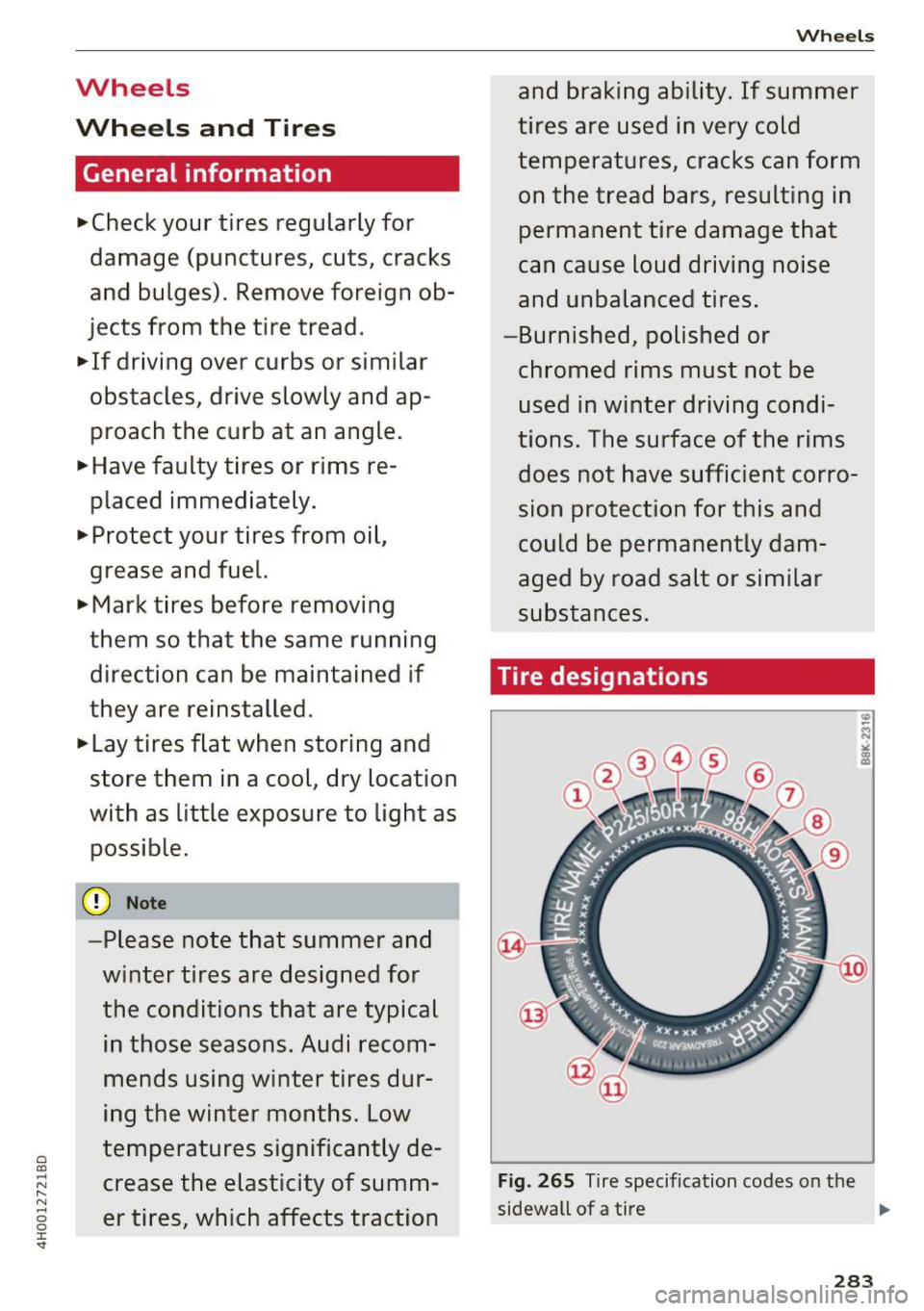
Ti re designations
Fig. 265 Tire specification codes on the
sidewall of a tire .,.
283
Page 286 of 354

Wheels
(D Tires for passenger vehicles
(if applicable)
P indicates a tire for a passenger
vehicle. T indicates a tire desig
nated for temporary use.
@ Nominal width
Nominal width of the tire be
tween the sidewalls in millime
ters. In general: the larger the
number, the wider the tire.
@ Aspect ratio
Height/width ratio expressed as a
percentage.
@ Tire construction
R indicates a radial tire.
® Rim diameter
Size of the rim diameter in inches.
@ Load index and speed rating
The load index indicates the tire's
load-carrying capacity.
The speed rating indicates the maximum permitted speed
¢ & in
Winter tires on page 298.
"EXTRA LOAD", "xl" or "RF" indi
cates that the tire is reinforced or
is an Extra Load tire.
Speed rat- Maximum permitted speed
ing
p
up to 93 mph (150 km/h)
Q up to 99 mph (160 km/h)
284
Speed rat- Maximum permitted speed
Ing
R
up t o 106 mph (170 km/h)
s up to 110 mph (180 km/h)
T up to 1 18 mph (190 km/h)
u up to 124 mph (200 km/h)
H up to 130 mph (210 km/h)
V up to 149 mph (240 km/h)al
z above 149 mph (240 km/h)al
w up to 168 mph (270 km/h)al
y up to 186 mph (300 km/h)al
a) For tires above 149 mph (240 km/h),
tire manufacturers sometimes use the
code "ZR".
(j) US DOT number (TIN) and
manufacture date
The manufacture date is listed on
the tire sidewall (it may only ap
pear on the inner side of the tire):
DOT ... 2216 ...
means, for example, that the tire
was produced in the 22nd week of
the year 2016.
@ Audi Original equipment
tires
Audi Original equipment tires
with the designation "AO" have
been specially matched to your
Audi. When used correctly, these
tires meet the highest standards
for safety and handling. An au
thorized Audi dealer or author
ized Audi Service Facility will be
Page 287 of 354

able to provide you with more in
formation .
® Mud and snow capability
"M/5" or "M+S" indicates the tire
has properties making it suitable
to drive in mud or snow .
& indi
cates a winter tire .
@Composition of the tire cord
and materials
The number of plies indicates the
number of rubberized fabric lay
ers in the tire. In general: the
more layers, the more weight a
tire can carry . Tire manufacturers
must also specify the materials
used in the tire. These inc lude
steel, nylon, polyester and other
materials.
@ Maximum permitted load
This number indicates the max i
mum load in kilograms and
pounds that the tire can carry.
@ Uniform tire quality grade
standards for treadwear,
traction and temperature resistance
Tread wear, traction and temper
ature ranges ¢
page 300.
0 @ Running direction
"' -~ The arrows indicate the running
-~ direction of unidirectional tires . ...
Wheels
You must always follow the speci
fied runn ing d irect ion
¢ page 319 .
@ Maximum permitted
inflation pressure
This number indicates the maxi
mum pressure to which a tire can
be inflated unde r normal operat
ing condit ions.
Glossary of tire and loading
terminology
Accessory weight
means the comb ined weigh t (in
excess of those standard items
which may be replaced) of auto
matic transm ission, power steer
ing , power brakes, power win
dows, power seats, radio, and
heater, to the extent that these
items are available as facto ry-in
stalled equipment (whether in
stalled or not) .
Aspect ratio
means the ratio of the heigh t to
the width of the tire in percent .
Numbers of 55 or lowe r indicate a
low sidewa ll for improved steer
ing response and better overall
handling on dry pavement. .,.
285
Page 288 of 354
Wheels
Bead
means the part of the tire that is
made of steel wires, wrapped or
reinforced by ply cords and that is
shaped to fit the rim .
Bead separation
means a breakdown of the bond
between components in the bead.
Cord
means the strands forming the
plies in the tire.
Cold tire inflation pressure
means the tire pressure recom
mended by the vehic le manufac
turer for a tire of a des ignated
size that has not been driven for more than a couple of miles (kilo
meters) at low speeds in the
three hour period before the tire pressure is measured or adj usted.
Curb weight
means the weight of a motor ve
hicle w ith standard equipment in
cluding the maximum capacity of
fuel, oil, and coolant, air condi
tioning and additiona l weight of
op tional equipment.
E x tra load tire
means a tire des igned to operate
at higher loads and at h igher in -
286
flation pressures than t he corre
spond ing standa rd tire. Extra load
tires may be identified as "XL",
"xl" , "EXTRA LOAD" , or "RF" on
the sidewall.
Gross A xle Weight Rating
("GAWR ")
means the load-carrying capacity
of a single axle system , measured
at the ti re-gro und interfaces.
Gross Vehicle Weight Rating
("GVWR")
means the max imum total loaded
weight of the vehicle .
Groove
means the space between two ad
jacent tread ribs .
Load rating (code)
means the maximum load tha t a
tire is rated to carry for a given in
flation pressure. You may not find
this informat ion on all ti res be
cause it is not required by law .
Maximum load rating
means the load rating for a tire at
the maximum permissible infla
tion p ressure for that ti re .
Maximum loaded vehicle
weight
means the sum of: