warning light AUDI A8 2017 Repair Manual
[x] Cancel search | Manufacturer: AUDI, Model Year: 2017, Model line: A8, Model: AUDI A8 2017Pages: 354, PDF Size: 88.68 MB
Page 209 of 354
Driving safety
Basics
Safe driving habits
Please remember -safety first!
This chapter contains important information,
tips, instructions and warnings that you need to
read and observe for your own safety, the safety
of your passengers and others . We have summar
ized here what you need to know about safety
belts, airbags, child restraints as well as child
safety. Your safety is for us
priority number 1. Al
ways observe the information and warnings in
this section - for your own safety as well as that
of your passengers.
The information in this section applies to all
model versions of your vehicle. Some of the fea
tures descr ibed in this sections may be standard
equipment on some models, or may be optional
equipment on others. If you are not sure, ask
your authorized Audi dealer.
A WARNING
- Always make sure that you follow the in
structions and heed the WARNINGS in this
Manual. It is in your interest and in the in
terest of your passengers .
-
-Always keep the complete Owner's Litera
ture in your Audi when you lend or sell your
vehicle so that this important information
will always be available to the driver and
passengers.
- Always keep the Owner's literature handy so
that you can find it easily if you have ques
tions.
Safety equipment
The safety features are part of the occupant re
straint system and work together to help reduce the risk of injury in a wide variety of accident sit
uations.
~ Your safety and the safety of your passengers
~ should not be left to chance. Advances in tech-,..._
~ nology have made a var iety of features available 0
~ to help reduce the risk of injury in an accident. '
The following is a list of just a few of the safety
features in your Audi:
- sophisticated safety belts for driver and all pas-
senger seat ing pos itions,
- safety belt pretensioners,
- safety belt force limiters for the front seats,
- safety belt height adjustment systems for the
front seats,
- front airbags,
- knee airbags for the front seats
- side airbags in the front seats and outer rear
seats,
- side curtain airbags,
- special LATCH anchorages for child restraints,
- head restraints for each seating position,
- adjustable steering column.
These individual safety features, can work to gether as a system to help protect you and your
passengers in a w ide range of accidents . These
features cannot work as a system if they are not
always correctly adjusted and correctly used.
Safety is everybody's responsibility!
Important things to do before driving
Safety is everybody 's job! Vehicle and occupant
safety always depends on the informed and care
ful driver .
For your safety and the safety of your passen
gers,
before driving always:
.,. Make sure that all lights and signals are operat
ing correctly .
.,. Make sure that the tire pressure is correct.
.,. Make sure that all windows are clean and afford
good visibility to the outside .
.,. Secure all luggage and other items carefully
c:c.> page 65, c:c.> page 63 .
.,. Make sure that nothing can interfere with the
pedals.
.,. Adjust front seat, head restraint and mirrors
correctly for your height.
.,. Instruct passengers to adjust the head re
straints according to their height.
.,. Make sure to use the right child restraint cor
rectly to protect children
¢ page 248, Child
safety. ..,.
207
Page 210 of 354
Driving safety
• Sit properly in your seat and make sure that
your passengers do the same
c:> page 54, Seats
and storage.
• Fasten your safety belt and wear it properly . Al
so instruct your passengers to fasten their safe
ty belts properly
c:> page 218 .
What impairs driving safety?
Safe driving is directly related to the condition of
the vehicle, the driver as well as the driver 's abili
ty to concentrate on the road without being dis
tracted .
The driver is responsible for the safety of the ve
hicle and all of its occupants. If your ability to
drive is impaired, safety risks for everybody in the
vehicle increase and you also become a hazard to
everyone else on the road
c:> Li').. Therefore :
• Do not let yourself be distracted by passengers
or by using a cellular telephone .
• NEVER drive when your driving ability is im
paired (by medications, alcohol, drugs, etc.).
• Observe all traffic laws, rules of the road and
speed limits and plain common sense.
• ALWAYS adjust your speed to road, traffic and
weather conditions.
• Take frequent breaks on long trips. Do not drive
for more than two hours at a stretch.
• Do NOT drive when you are tired, under pres
sure or when you are stressed.
A WARNING
Impaired driving safety increases the risk of
ser ious personal injury and death whenever a
vehicle is being used.
208
Correct passenger
seating positions
Proper seating position for the driver
The proper driver seating position is important
for safe, relaxed driving.
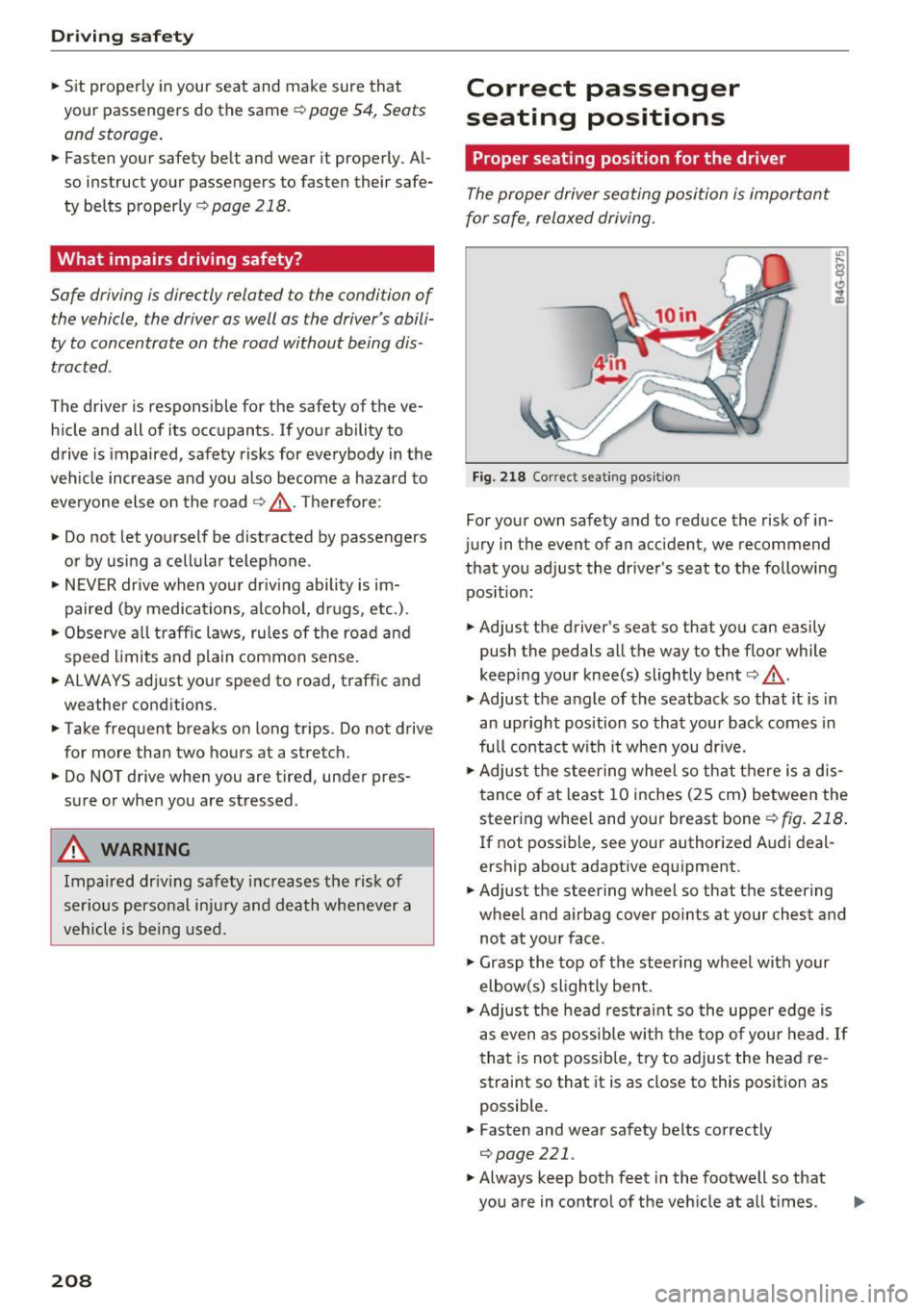
Fig. 218 Correct seating posit ion
For your own safety and to reduce the risk of in
jury in the event of an accident, we recommend
that you adjust the driver's seat to the following position:
• Adjust the driver's seat so that you can easily
push the pedals all the way to the floor while
keeping your knee(s) slightly bent
c:> .&_ .
• Adjust the angle of the seatback so that it is in
an upright position so that your back comes in
full contact with it when you drive.
• Adjust the steering wheel so that there is a d is
tance of at least 10 inches (25 cm) between the
steering wheel and your breast bone
r::!) fig. 218.
If not possible, see your authorized Audi deal
ership about adaptive equipment.
• Adjust the steering wheel so that the steering
wheel and airbag cover points at your chest and
not at your face.
• Grasp the top of the steering wheel with your
elbow(s) slightly bent.
• Adjust the head restraint so the upper edge is
as even as possible with the top of your head .
If
that is not possible, try to adjust the head re
straint so that it is as close to this position as
possible.
• Fasten and wear safety belts correctly
c:>poge 221.
• Always keep both feet in the footwell so that
you are in control of the vehicle at all t imes .
Page 218 of 354
Audi pre sense
Audi pre sense Preventative passenger
protection
A pp lies to: ve hicles w ith Audi p re se nse
Pre sense can initiate steps to protect vehicle oc
cupants in certain dangerous situations. The
fu nctions described a re available depending on
ve hicle equi pment:
Audi pre sense basic
The fo llow ing funct ions can be triggered in cer
tain driving situations:
- Tighten ing of the safety belts (for examp le,
during heavy braking): the front safety belts
have reversible belt tensioners. If a coll is ion
does not occur, the safety belts loosen slightly
and are ready to trigger again.
- Closing the w indows and the sunroof*
The function of the pre sense basic is activated at
a speed of 20 mp h (30 km/h) or higher. The de
p loyment time is adapted in the drive select dy
namic mode.
Audi pre sense front (vehicles with adaptive
cru ise control*)
Pre sense front contains the f unctions of pre
sense basic. In add ition, the likelihood of a rear
end collis ion with the vehicle ahead is also calcu
lated, withi n the limits of the system. If the risk
of a collision is detected, the following functions
can t rigge r:
- Audi braking gua rd¢
page 99
- Tensioning of the safety belts
- Closing the windows and the sunroof *
Audi pre sense rear (vehicles with side
a ss ist* )
Pre sense rear contains the functions of p re sense
basic. In addition, the li ke lihood of a rear-end
col lision from the vehicle be hind is a lso ca lculat
ed, w ith in the lim its of the system .
If the risk of a
collis ion is detected, the following functions can
tr igger:
- Tens ioning of the safety be lts
- Closing the windows and the sunroof *
216
- Adjusting the seats: the settings for the powe r
head restrains, the upper sections of the backr
ests and the pne umatic side bolsters* change
on the front seats and the outer rear seats*. If
a collision does not occur, the seat sett ings
that were previously used are restored .
Audi pre sen se plus
Pre sense plus contains the f unctions of p re
sense front and pre sense rear.
Error message
Audi pre sense : Unavailable
Preventative passenger protection is not ava ila
ble. Drive to yo ur autho rized Aud i dea le r o r au
t h ori zed Aud i Service Facility immedia tely to have
t h e malfunct ion corre cte d.
.&_ WARNING
Pr e sense canno t overcome natura l phys ica l
l aws . It is a system designed to assist and it
cannot prevent a co llision. Do not let t he in
creased sa fety provided tempt you into tak ing
risks . T his could inc rease your ris k of a colli
sion.
- The system can dep loy inco rrectly.
- Please note that the sensors do not always
detect a ll objects. Th is increases the r is k of
a co llision.
- Pre sense does not react to peop le or ani
mals or objects that a re c rossing the vehi
cle's path or are difficu lt to detect
¢page 94.
- Ref lective objects such as gua rd ra ils o r the
entrance to a tunne l, heavy rain and ice can
affect the funct io n of the radar sensors a nd
t he system 's ability to de tect a collision risk.
(D Note
The sensors can be d isplaced by impacts or
damage to the bumper , wheel housing a nd
underbody . Pre sense can be impaired by this .
Have an autho rized Aud i deale r or autho rized
A udi Service Fac ility ch eck their f unct io n. .,..
Page 220 of 354
Safety belt s
Safety belts
General information
Always wear safety belts!
Wearing safety belts correctly saves lives!
This chapter explains why safety be lts are neces
sary, how they work and how to adjust and wear
them correctly.
.. Read all the information that follows and heed
all of the instructions and WARNINGS.
&_ WARNING
Not wearing safety belts or wearing them im
properly increases the risk of serious personal
injury and death.
- Safety belts are the s ingle most effective
means ava ilable to reduce the risk of serious
injury and death in automobile accidents.
For your protect ion and that of your passen
gers, always co rrectly wear safety be lts
when the vehicle is moving .
- Pregnant women, injured, o r physically im
paired persons must a lso use safety belts.
L ik e all vehicle occ upants, they are mo re
likely to be serio usly injured i f they do not
wea r safety be lts. The best way to protect a
fetus is to protect the mother -throughout
the ent ire pregnancy .
Number of seats
Your Audi has a total of five seating positions:
two in the front and three in the rear. In some
veh icles, there are four seating positions: two in
the front and two in the rear . Each seating posi
tion has a safety belt .
&_ WARNING
Not wea ring safety belts or wearing them im
properly incre ases the risk of ser io us personal
injury and dea th.
- Never st rap more tha n one person, includ
ing small ch ild ren, into any be lt .
It is espe
c ia lly da ngerous to place a safety belt over a
child sitting on your lap .
218
-Never let more people ride in the vehicle
than there are safety be lts available .
- Be s ure everyone riding in the vehicle is
properly restrained with a separate safety
be lt or ch ild restraint.
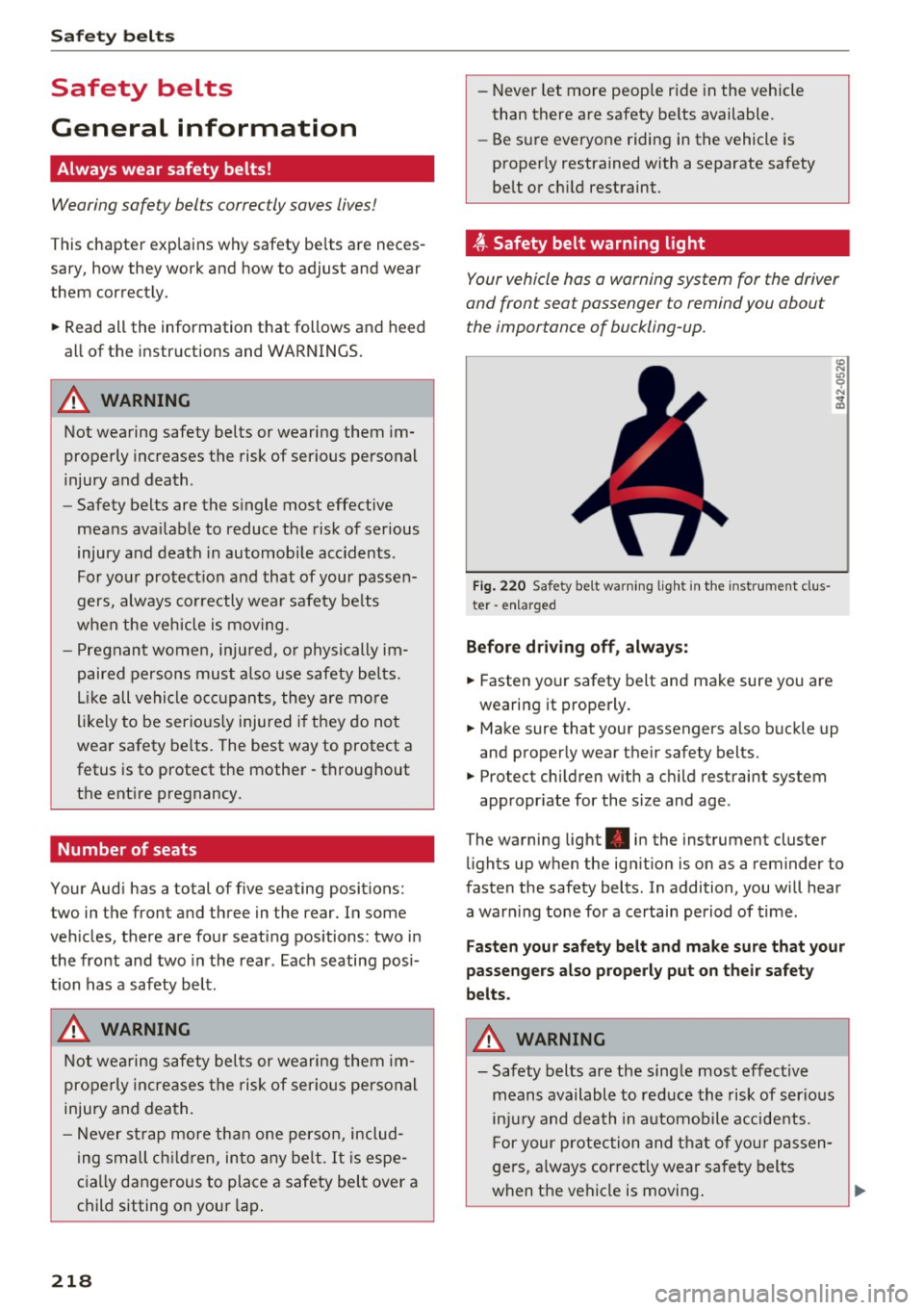
~ Safety belt warning light
Your vehicle has a warning system for the driver
and front seat passenger to remind you about the importance of buckling-up .
F ig. 220 Safety belt wa rning lig ht in the instrument clus·
ter -en larged
Befor e dri ving off , alway s;
.. Fasten your safety belt and make sure you are
wearing it properly.
"' N .,, 0
"' .. m
.. Make sure that your passengers a lso buckle up
and properly wear the ir safety belts.
.. Protect chi ldren with a c hild restraint system
appropr iate for the size and age.
The warning light . in the instrument cluster
lights up when the ign ition is on as a reminder to
fasten the safety belts. In addition, you will hear
a war ning tone for a certain period of time.
Faste n your safety belt and make su re that your
passenge rs al so properl y put on thei r safety
b e lts .
&_ WARNING
-
-Safety belts are the single most effective
means available to red uce the risk of ser io us
inj ury and death in a utomobile accidents.
For your protection and that of yo ur passen
gers, a lways correct ly wear safety belts
when t he vehicle is moving . ..,.
Page 224 of 354
Safe ty belts
during hard braking and in an accident. The be lt
may a lso lock when you drive up or down a steep
h ill or through a sharp curve. Dur ing normal driv
ing the belt lets you move freely .
Safety b elt pr ete nsione rs
The safety be lts are equ ipped with a belt preten
sioner that helps to tighten the safety belt and
remove slack when the pretensioner is activated
¢
page 224. The function of the pretensioner is
monitored by a warning light ¢
page 23.
Convertibl e loc king retra ctor
Every safety be lt except the one on the driver
seat is equipped with a convertible locking retrac
tor that
must be used when the safety belt is
used to attach a child seat. Be sure to read the
important information about this feature
¢page 258.
A WARNING
Improperly pos it ioned safety belts can cause
ser ious injury in an accident¢
page 222,
Safety belt position.
- Safety belts offer optimum protection only
when the seatback is upright and belts are
prope rly positioned on the body.
- Never attach the safety belt to the buckle
for another seat. Attaching the belt to the
wrong b uck le wi ll red uce safety belt effec
t iveness and can cause serious persona l in
jury.
- A passenger who is not p roper ly restrained
can be serio usly injured by the safety be lt it
self when it moves from the stronger parts
of the body into cr it ical areas like the abdo
men.
- Always lock the convertible lock ing retractor
when you are secur ing a child seat in the ve
hicle ¢
page 260.
@ Tips
For information on safety belt pretensioners,
refer to
¢ page 224.
222
Safety belt position
Correct belt position is the key to getting maxi
mum protection from safety belts.
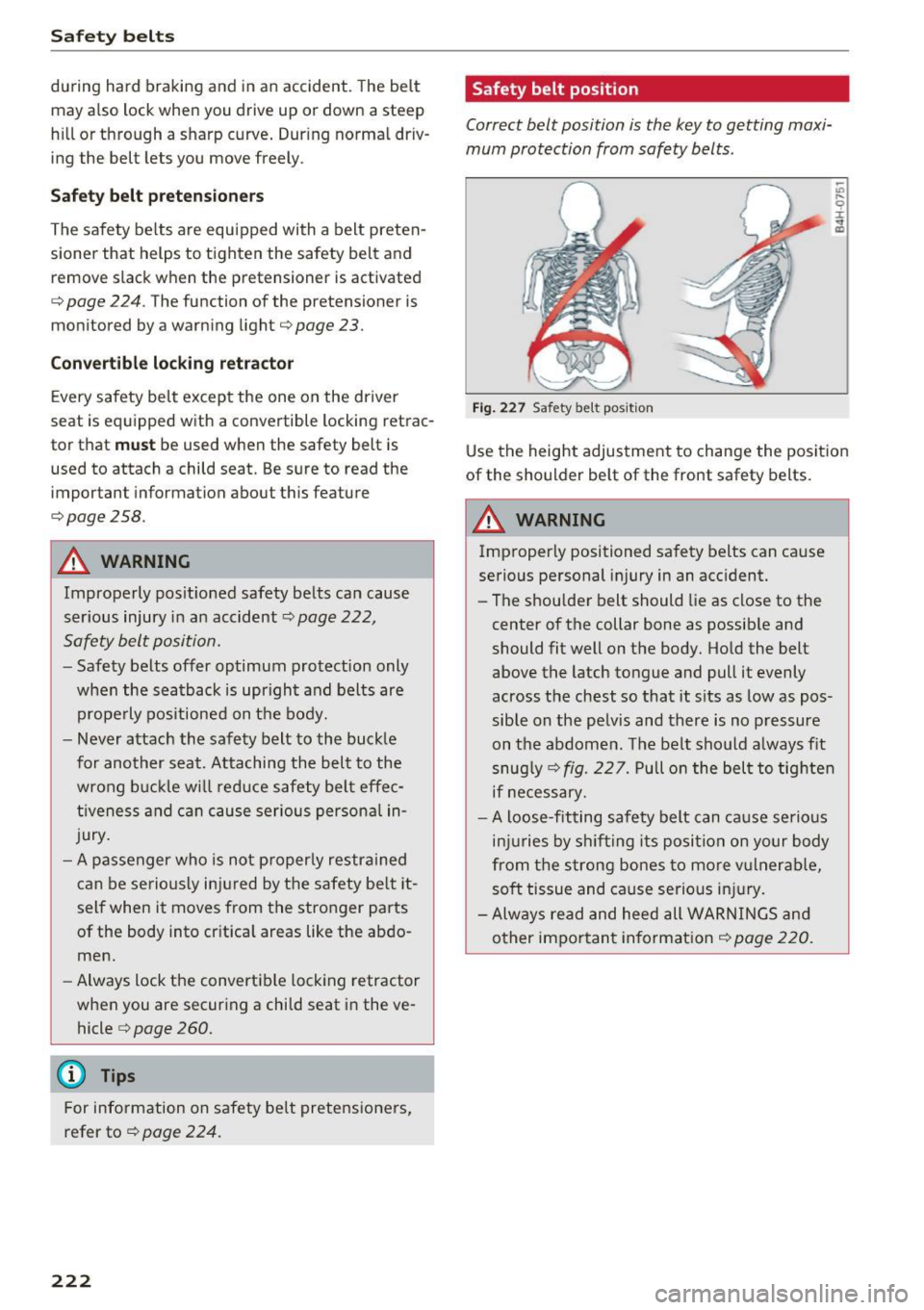
Fig. 2 27 Safety belt posit ion
Use the height adjus tment to change the posit io n
of the shoulder belt of the front safety belts.
A WARNING
Improperly positioned sa fety belts can cause
serious personal injury in an accident.
- The shou lder belt should lie as close to the
center of the collar bone as possib le and
should fit well on the body. Hold the belt
above the latch tongue and pull it evenly
across the chest so that it s its as low as pos
sible on the pe lvis and there is no p ressure
on the abdome n. T he belt sho uld a lways fit
snug ly¢
fig. 22 7. P u ll on the bel t to tigh ten
if necess ary.
- A loose-fit ting safety belt can ca use serious
in ju ries by s hifting its posi tion on yo ur body
from the strong bones to mo re v ulnera ble,
so ft tissue and cause serious in jury.
- Always read and heed all WARNINGS an d
o ther impor tan t in formation¢
page 220 .
Page 230 of 354
Airbag syste m
seat. It can be a very dangerous place fo r an
infant or a child in a rearward -facing seat.
The Advanced Airbag System i n your veh icle has
been ce rt ified to comp ly with the requirements
of United States Federa l Motor Vehicle Safety
Standard ( FMVSS)
208, as well as Canada Motor
Veh icle Safety Standard (CMVSS)
208 as applica
b le at the time your vehicle was manufactured.
According to requirements, the front Advanced
Airbag System on the passenger s ide has been
certified for "suppression " for infants of about
12 month old and younger and for "low risk de
p loyment " for children aged
3 to 6 years o ld (as
defined in the standard).
The
PA SSENGER AIR BAG OFF light in the instru
ment panel tells you when the front Advanced
Ai rbag on the passenger side has been tu rned off
by the ele ct roni c con trol unit.
Each t ime you sw itch on the ign it ion, the
PAS
SENGER AIR BAG OFF
li ght will come on fo r a
few seconds and:
- will stay on if the front passenger seat is not
occupied,
- will stay on if there is a small c hild or child re
straint on the front passenger seat,
- will go off if the front passenger seat is occu
pied by an adult as reg istered by the weight
sensing mat¢
page 236, Monitoring the Ad
vanced Airbag System .
The PASSENGER AIR BAG OFF light comes on
when the control unit detects a tota l we ight on
the front passenger seat that requires the front
a ir bag to be turned off.
If the tota l weight on the front passenger seat is
more than that of a typical 1 year -old child but
less than the we ight of a small adult, the front
a ir bag on the passenger side can deploy (the
PASSENGER AIR BAG OFF ligh t does not come
on) .
If the PASSENGER AIR BAG OFF light does
not come on, the front a irbag on the passenger
side has not been turned
off by the electronic
control unit and can deploy if the control unit
senses an impact that meets the condit ions stor
ed in its memory.
For e xample, the airbag may deploy if:
228
- a small ch ild that is heav ier than a typica l 1
year-o ld child is on the front passenger seat
(regard less of whether the child is in one of the
child seats listed
¢ page 250), or
- a child who has outgrown c hild restraints is on
the front passenger seat.
If the front passenger a irbag is t urned
off, the
PASSENGER AIR BAG OFF light comes on in the
i nstrument cluster and stays on.
The fro nt airbag on the passenge r side m ay
not
deploy (the PASSENGER AIR BAG OFF light does
not ill uminate and stay lit) even if a small adu lt
or teenager, or a passenger who is not sitting up
right with their back against a non-recl ined back
rest with the ir fee t on the vehicle floor in front of
the sea t is on the front passenger seat
<=> page 208 , Proper seating position for the driv
er .
If the front passenger a irbag deploys, the Feder
al Standard requires the airbag to meet the "low
risk" deployment cr iteria to reduce the r isk of in
j ury th rough interaction w ith the airbag . "low
risk" deployment occurs in th ose crashes that
take place at lowe r decele rations as defi ned in
the e lec tronic co ntro l unit ¢
page 23 7, PASSEN
GER AIR BAG O FF light.
Always remembe r, a ch ild seat or i nfant ca rr ie r
i nsta lled on the fron t seat may be s truck a nd
k nocked o ut of pos it ion by the rapid ly inflat ing
passenger 's airbag in a frontal co llision . The air
bag cou ld great ly reduce the effectiveness of the
c hi ld rest raint and even seriously injure the child
during in flat ion.
Fo r th is reason, and beca use the back seat is the
safest place for children - when proper ly restrain
ed according to their age and size -we strongly
recommend that children always sit in the back
seat
c> page 248, Child safety .
A WARNING
A child in a rearward-facing child seat instal
led on the front passenger seat will be seri
ously injured and can be killed if the front air
bag inflates - even with an Advanced Airbag
Sys tem.
Page 231 of 354
0 co .... N ,..... N .... 0 0 :c '
infant carrier w ith great force and will
smash the ch ild seat and child against the
backrest, center armrest, door or roof .
- Always install rear-facing child seats on the
rear seat.
- If you must install a rearward fac ing ch ild
seat on the front passenger seat because of
exceptional c ircumstances and the
PA SSEN
GER AIR BAG OFF
light does not come on
and stay on, immediately insta ll the rear
facing child seat in a rea r seat ing position
and have the airbag system inspected by
yo ur Audi dealer.
- Forward-fac ing ch ild seats insta lled on the
front passenge r's seat may in terfere with
the deployment of the airbag and cause se
rious persona l injury to the child.
,&. WARNING
I=
If, in exceptional circumstances, you must i;-
stall a forward-facing chi ld restraint on the
front passenger's seat:
- Always ma ke sure the forward -facing seat
has been designed and certified by its man
ufact urer for use on a front seat with a pas
senger front and side a irbag.
- Never put the forward-facing child restraint
up against or very near the instrument pan
el.
-Always move the front passenger seat to
the highest position in the up and down ad
justment range and move it back to the
rearmost position in the seat's fore and aft
adjus tment range, as fa r away from the air
bag as possib le, before insta lling the for
wa rd-facing child restra int.
- Always make sure tha t the safety belt upper
anchorage is beh ind the child restrain t and
not next to or in front of the chi ld res train t
so that the safety belt will be properly pos i
tioned.
- Make sure tha t the
PASSENGER AIR BAG
OFF
light comes on and stays on all the time
whenever the ignition is switched on .
Airbag sys tem
,&. WARNING
To reduce the risk of serious injury, make sure
that the
PASSENGER AIR BAG OFF light will
be d isplayed whenever a child restraint is in
stalled on the front passenger seat and the
i gnition is switched on .
-If the PASSENGER AIR BAG OFF light does
not stay on , perform t he checks described
~ page 236, Monitoring the Advanced Air
bag System.
- Take the child restra int off t he front passen
ge r seat an d install it prope rly at one of the
rear sea t positions i f the
PASSENGER AIR
BAG OFF
light does not stay on .
- Have the air bag system inspec ted by your
Aud i dealer immediately.
- Always c are fully follow ins tructions from
child restrain t manufacture rs when instal
ling child restraints .
If, in exceptional c ircumstances, you must in
stall a forward or rearward-facing child re
stra int on the front passenger's seat:
- Imp roper installation of child restraints can
reduce their effectiveness or even prevent
them f rom providing any protect ion.
- An improperly installed child restra int can
interfere with the airbag as it deploys and
serious ly injure or even kill the chi ld -even
with an Advanced A irbag System.
- Always care fully follow the manufacturer 's
instr uctions provided with the child seat or
car rier.
- Never p lace add itiona l items on the seat
that can increase the total weight registered by the weight -sensing mat and can cause in
jury in a crash.
229
Page 234 of 354
Airbag syste m
-a small adu lt or teenager is on the front pas
senger seat
- a passenger who is not sitting upright with
their back against a non -reclined backrest with
their feet on the vehicle floor in front of the
seat is on the front passenger seat.
I f the front passenger airbag dep loys, the Feder
al Standard requires the airbag to meet the "low
risk" deployment criteria to help reduce the risk
of injury through interaction with the airbag.
"Low risk" deployment occurs in those crashes
that take place at lower decelerations as def ined
in the electronic control unit¢
page 236.
Alway s remember: Even though your vehicle is
equ ipped w ith Advanced Airbags, the safest place
for children is properly restrained on the back
seat . Please be sure to read the important infor
mat ion in the sections that follow and be sure to
heed a ll of the WARN INGS.
A WARNING
To red uce the risk of inj ury when an ai rbag in
fla tes, a lways wear safety bel ts p roperly.
- If you are unrestrained, leaning fo rwa rd, s it
t ing s ideways or o ut of pos ition in any way,
yo ur risk of in jury is much h igher .
- Yo u will also re ceive serious injur ies and
could even be killed if you are up aga inst the
airbag or too close to it when it inflates -
even with an Advanced Airbag ¢
page 226.
A WARNING
A child in a rearward-facing chi ld seat insta l
led on the front passenger seat will be seri
ously injured and can be k illed if the front air
bag inflates -even with an Advanced Airbag
System.
- Although the Advanced A irbag System in
your vehicle is designed to turn off the front
airbag when a rearward-facing child re
straint has been installed on the front pas
senger seat, nobody can absolutely g uaran
tee that deployment is impossible in all con
ceivable s ituations that may happen during
the usef ul life of your vehicle .
- The inflating a irbag w il l hit the child seat or
infant carrier w ith great force and will
232
-
smash the child seat and child against the
backrest, center armrest, door, or roof.
- Always install rearward-facing child re
straints on the rear seat.
- If you must install a rearward facing child
seat on the front passenge r seat because of
except ional circumstances and the
PASSEN
GER AIR BAG OFF
light does not come on
and stay on, immed iate ly install the rear
facing chi ld seat in a rear seating posit ion
and have the airbag system inspected by
your Aud i dea le r.
A WARNING
If, in exceptional ci rcums tances, you must in
stall a forward-facing child restraint on the
fron t passenger's seat:
- Always make sure the forward-fa cing sea t
has been des igned and certified by its man
ufacturer for use on a front seat with a pas
senger front and side airbag.
- Never put the forwa rd-facing child restrain t
up against or very near the instr ument pan
el.
-Always move the front passenge r seat to
the highest position in the up and down ad
justment range and move it back to the
rearmost position in the seat's fore and aft
ad justment range, as far away from the air
bag as poss ible, before installing the for
ward-facing chi ld restraint.
- Always make sure that the safety be lt upper
anchorage is behind the ch ild restraint and
not next to or in fron t of the child restraint
so that the safety be lt will be p roperly posi
tioned.
- Ma ke sure that the
PASSENGER AIR BAG
OFF
li ght comes on and stays on a ll the time
wheneve r the ign it ion is swi tched on.
· Advanced Airbag System components
The fro nt passenge r sea t in your veh icle has a lo t
of ve ry important parts o f the Advanced A irbag
System in it. These parts include t he weight
sensing mat, sensors, wiring, brackets, and
more. The fu nction of the system in the front
passenger seat is checked by the electronic
1111>
Page 235 of 354
control unit when the ignition is on. The control
unit monitors the Advanced Airbag System and
turns the airbag indicator light on when a ma l
function in the system components is detected. The funct ion of the a irbag indicator light is de
scr ibed in greater deta il below . Because the front
passenger seat contains important parts of the
Advanced Airbag System, you must take care to p revent it from being damaged. Damage to the
seat may preven t the Advanced A irbag for the
fron t passenger seat from doing its job in a
crash .
The front Advanced Airbag System consists
of the follo wing :
-Crash sensors in the front of the vehicle that
measure vehicle acceleration/deceleration to
provide information to the Advanced Airbag
System a bout the severity of the crash.
- An e lectronic control unit, with integrated
crash sensors for front and side impacts. The
control unit "decides" whether to fire the front
airbags based on the information received from
the crash sensors. The control unit also "de
c ides" whether the safety belt pretens ioners
should be activated .
- An Advanced Airbag with gas generator and
control valve for the driver ins ide the steer ing
wheel hub .
- An Advanced Airbag with gas generator and control valve inside the instrument pa nel for
the front passenger.
- A weig ht-sensing mat under the upholstery
padd ing of the front passenger seat cushion
that meas ures the total weight on the seat. The
i nformation registered is sent continuously to
the e lectron ic cont rol unit to reg ulate dep loy
ment of the front Adv a need Airbag on the pas
senger side .
- An airbag monitoring system and indicator
light in the instrument cluster
¢ page 236.
-A sensor in eac h front seat registers the dis
tance between the respective seat and the steering wheel or instrument pane l. The infor
mation registered is sent contin uously to the
0 co electronic control unit to regulate deployment ....
~ of the front Adva need A irbags. N .... 0 0 :c '
- The PASSENGER AIR BAG OFF light comes on
and stays on in the center of the instrument
pane l¢
page 237, fig . 233 and te lls yo u when
the front Advanced Airbag on the passenger side has been turned off.
- A sensor below the safety be lt latch for the
front seat passenger to measure the tension on the safety belt. The tension on the safety belt
and the we ight registered by the weight -sens
ing mat help the contro l unit "decide" whether
the front airbag fo r the front passenger seat
should be tu rned off o r not ¢
page 22 7, Child
restraints on the front seat -some important
things to know.
- A sensor in the safety belt latch for the driver
and for the front seat passenger that senses
whether that safety be lt is latched o r not and
transmits this information to the electronic control unit.
A WARNING ,-
Damage to the front passenger seat can pre-
vent the front airbag from working properly.
- Improper repair or disassembly of the front passenger and driver seat will prevent the
Advanced Airbag System from funct ion ing
properly .
- Repairs to the front passenger seat must be
performed by qualified and properly trained
workshop personnel.
- Never remove the front passenger or driver
seat from the vehicle.
- Never remove the upholstery from the front
passenger seat.
- Never d isassemble or remove parts from the
seat or disconnect w ires from it.
- Never carry sharp objects in your pockets or
p lace them on the seat. If the weight-sens
ing mat in the passenger seat is punctured
it cannot work properly .
- Never carry things on your lap or carry ob
jects on the passenger seat . Such items can
increase the weight reg istered by the
weight-sensing mat and send the wrong in
formation to the a irbag con trol u nit.
- Never store items under the front passenger
seat. Parts of the Advanced Airbag System
under the passenger seat cou ld be
~
233
Page 236 of 354
Airbag syste m
damaged, preventing them and the airbag
system from working properly.
- Never place seat covers or rep lacement up
holstery that have not been specifically ap
proved by Audi on the front seats .
- Seat covers can prevent the Advanced Air
bag System from recognizing child re
straints or occupants on the front passenger
seat and prevent the side a irbag in the seat
backrest from deploying properly.
- Never use cush ions, pillows, blankets or
similar items on the front passenger seat.
The add it ional padding will prevent the
weight-sens ing mat in the seat from acc u
rately reg istering the ch ild restraint or per
son on the seat and prevent the Advanced
Airbag System from funct ioning properly.
- If you must use a child rest raint on the front
passenge r seat and the child restraint man
ufacturer 's instructions require the use of a
towel, foam cushion or something else to properly position the ch ild restraint, make
certain that the
PA SSENGER AIR BAG OFF
light comes on and stays on whenever the
child restraint is installed on the front pas
senger seat.
- If the
PASSEN GER AIR B AG OFF light does
not come on and stay on, immed iately in
stall child restraint in a rear seating position and have the airbag system inspected by
yo ur Audi dealer.
How the Advanced Airbag System
components work together
The front Advanced Airbag System and the side
airbags supplement the protection offered by the
front three-po int safety belts with pretensioners
and load limiters and the adjustable head re
stra ints to help reduce the r isk of injury in a wide
range of accident and crash situations. Be sure to read the important informa tion about safety and
heed the WARN INGS in t his chapter.
Deployment of the Advanced Airbag System and
the act ivat ion of the safety belt pretensioners de
pend on the deceleration measu red by the crash
sensors and regis tered by the electronic control
unit. Crash severity depends on speed and decel-
2 34
eration as well as the mass and stiffness of the
vehicle or object involved in the crash .
On the passenger side, regard less of safety be lt
u se, the airbag will be turned off if the weight on
the passenger seat is less than the amount pro
grammed in the electronic control unit . The front
airbag on the passenger side will also be turned
off if one of the child seats that has been certi
fied under Federal Motor Vehicle Safety Standard 208 has been recognized on the seat. The
PA S
S ENGER AIR BAG OFF
light comes on and stays
on to tell you when the front Advanced A irbag on
the passenger side has been turned off
q page 22 7, Child restraints on the front seat
some important things to know.
A WARNING
To reduce the ris k of injury when an airbag in
f lates, always wea r safety belts properly.
- If you are un restrained, leaning forward, sit
ting sideways or out of position i n any way,
your risk of injury is much higher.
- You will a lso receive serious injuries and
could even be killed if you are up against the
airbag or too close to it when it inflates -
even with an Advanced Airbag
q page 226.
More important things to know about front
airbags
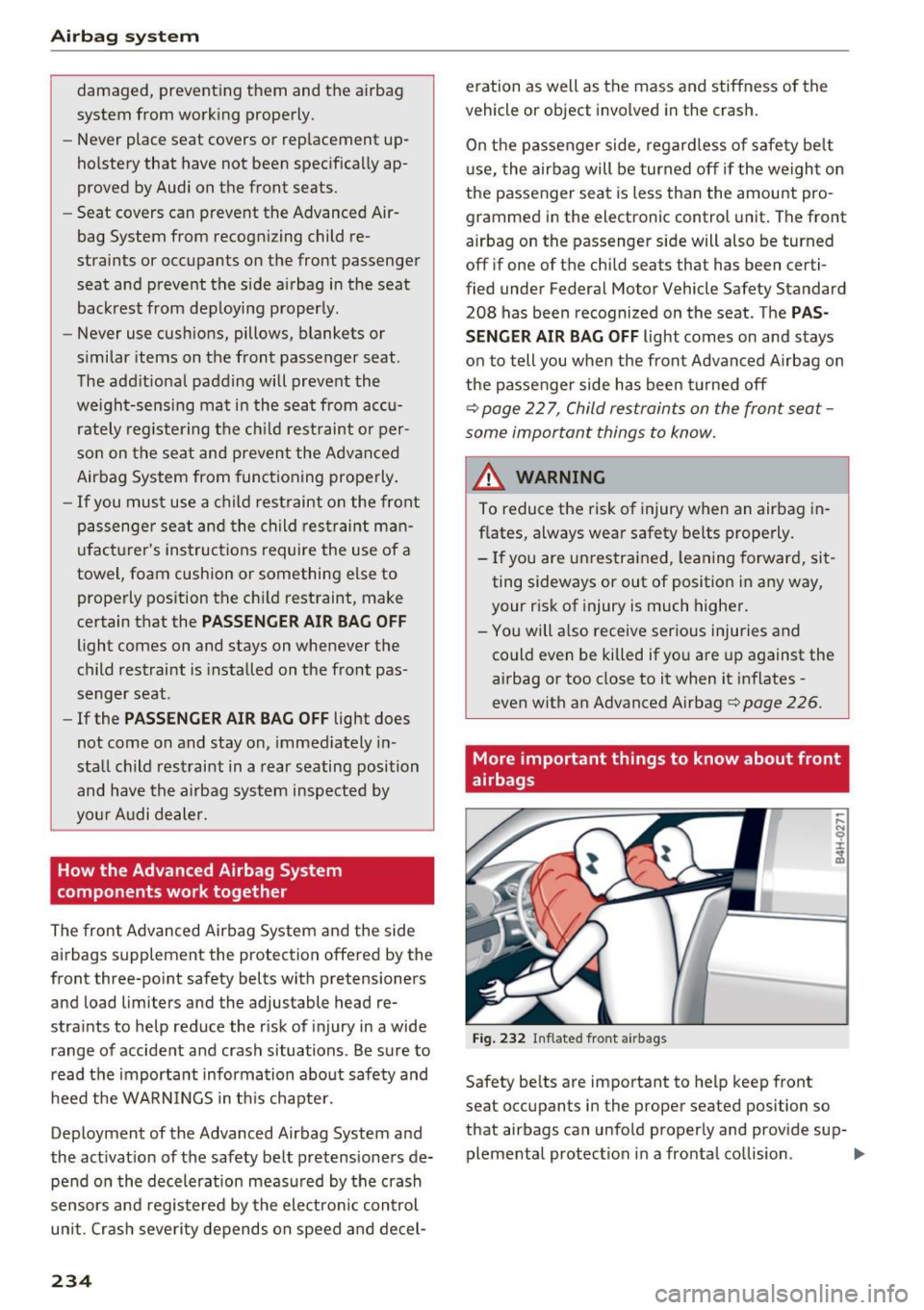
Fig . 232 Inflated front a irbags
Safety be lts are important to help keep front
seat occupants in the proper seated position so
that airbags can unfold properly and prov ide sup-
plemental protection in a fronta l collision . ..,.