battery AUDI A8 2018 Owner's Manual
[x] Cancel search | Manufacturer: AUDI, Model Year: 2018, Model line: A8, Model: AUDI A8 2018Pages: 356, PDF Size: 54.71 MB
Page 274 of 356
Checking and Filling
Emissions control
systems
Catalytic converter
A pp lies to: ve hicles w ith gasoline engines
The vehicle may on ly be driven with unleaded
gasoline, otherwise the catalyt ic converter will be
destroyed.
Never d rive until the tank is comp letely empty .
The irregular supp ly of f uel that results from that
can cause engine m isfires. Uncombusted fuel will
enter the exhaust system , w hich can cause over
heating and damage to the catalyt ic converter .
A WARNING
The temperature o f the exha ust system is
hig h, bo th whe n driving and after stopping
t he engine.
-
- Never touch the exha ust ta il pi pes once they
h ave become ho t. This could resul t in burns.
- Do no t park you r vehicle ove r flammable
m aterials such as g rass or leaves because
t h e hi gh te mperat ure of the emiss io ns con
t rol sys te m c ould star t a fire.
- D o no t apply u nder bod y p rote ctant in the
exha ust syste m are a, bec au se t his in cre ases
t h e ris k of fire .
Engine compartment
Working in the engine compartment
Special core is required if you ore working in the
engine comportment
For work in the engine compartment such as
checking and filling fluids, there is a risk of in
jury , scalding , accidents, and burns . For this
reason, follow all the warnings and general
safety precautions provided in the following in
formation . The engine compartment is a dan
gerous area on the vehicle .
~ ,&..
A WARNING
- T urn the engine off.
- Switch the ign ition off .
- Set the parking b rake .
- Select the P selector leve r pos ition.
272
- Let the eng ine cool down .
- Never open the hood when there is steam o r
coo lant escapin g from the engine compart
ment, because there is a risk that yo u could
be burned. Wait unt il no steam or coolant is
escaping.
- Keep children away from the eng ine com
pa rtment.
- Never sp ill fluids on a hot engine. These flu
ids (such as the anti-freezing agent con
tained in the coolant) can ignite .
- Avoid short c ircuits in the electrical system.
- When working in the engine compa rtment,
remember that the radiator fan can switch
on even if the ignition is switched off, wh ich
increases the r isk of persona l injury.
- Never open the cap on the coolant expan
sion tank when the engine is warm. The
cooli ng system is under p ressure .
- To protect your face, hands, and a rms from
hot steam or coolant, cover the cap with a
large cloth when opening.
- Do not remove the engine cove r under any
circumstances . T his increases the risk of
burns.
- If tests need to be perfo rmed with the en
gine running, there is add itiona l danger due
to mov ing components (such as the r ibbed
be lt, alterna tor and rad iator fan) and from
the high-voltage ignition system.
- Do not unde r any circ ums tances activate the
throttle inadvertently (for example, by hand
from t he e ngine compartment) if the veh i
cle is stat ionary but the en gine is r un ning
an d a gea r is en gaged. Otherwise, the veh i
cle will start to move immediately and this
could result in an acc ident .
- Pay a ttent ion to the following wa rnings lis t
e d w hen wor k on the fue l system o r on the
electrical equipment is require d.
- Do no t smoke.
- Never work near open flames .
- Always have a working fire extinguisher
nearby.
- All work on the battery or elect rical system
in your vehicle can result in injuries, chemi
cal b urns, acc idents or bu rns. Because o f
this, all work m ust be perfo rmed
only b y an ~
Page 275 of 356
lL t:0 ....
"' ......
"' .... 0 0 :c '
Service Facility.
- To reduce the risk of electric shock and in
jury, never touch the following components
when the eng ine is running or is being start
ed :
- I gnition cable
- Othe r components in the electronic h igh-
voltage ignition system
- If you must check o r perform work on the
engi ne while it is run ning:
- Set the parking bra ke and p lace the se lec
tor lever in the P (pa rk) position first .
-Always p roceed with extreme ca utio n so
that clothing, jewelry or long ha ir do not
become caught in the radiator fan, fan
belt or other moving components or do
not come into contact with hot compo
nents . Tie back long ha ir before beginning
work and do not wear cloth ing that can
hang down into the engine .
- L imit your exposure to exhaust a nd chemi
cals to as short a time as poss ible ¢
A.
A WARNING
California Proposi tion 6S Warn ing:
- Engine exhaust, some of its constituents,
and certain vehicle components contai n or
em it chem icals known to the State of C ali
forn ia to ca use cancer and bi rth defects an d
re produc tive harm. In ad dition , ce rtain fl u
ids contained in vehicl es and certa in prod
ucts of com ponent wear contain o r emit
chemica ls known to the State of California
to cause cancer and birth defects or other
reproduct ive harm.
- Battery posts, termina ls and re lated acces
sories contain lead and lead compounds,
chemica ls known to the State of California
to cause ca ncer and reproduct ive harms .
Wash hands after handling .
(D Note
When fil ling fl uids, be sure not to mix the flu
ids up . Otherwise severe ma lfunctions and en
gine damage w ill occur.
Chec king and Filling
@) For the sake of the environment
You should regularly check t he gro und under
your vehicle in order to detect leaks quick ly .
If
the re are visible spots from o il or other fluids,
b ring your veh icle to an authorized A udi deal
er o r aut ho rized Aud i Serv ice Facility to be
checked .
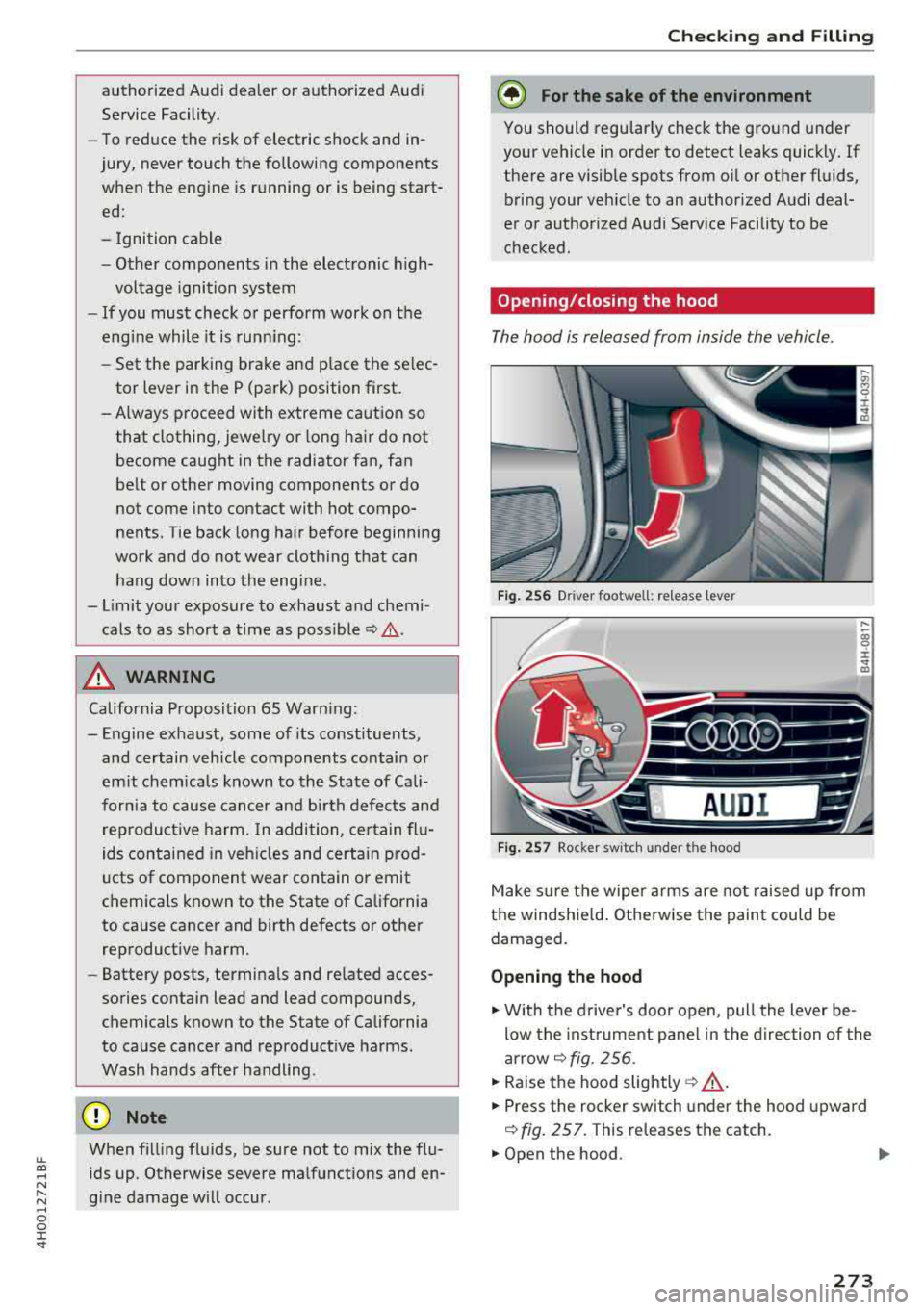
Opening/closing the hood
The hood is released from inside the vehicle .
Fig. 256 Drive r footwell : re lea se leve r
Fig. 25 7 Rocker sw itc h unde r the hood
M ake s ure th e wipe r arms are no t rais e d up from
t h e windshie ld . Otherwise the pain t could be
damaged.
Opening the hood
.,. With the d rive r's doo r open, pull the lever be
low t he instrume nt pane l in the direction of the
ar row ¢
fig. 256.
.,. Ra ise the hoo d slightly¢&_ .
.. Press the rocker switch under the hood upward
¢ fig . 257. T his re leases the catch.
.,. Open the hood . ..,.
273
Page 281 of 356
lL
_& WARNING
-The cooling system is under pressure. Do
not open the coolant expansion tank cap
when the engine is hot. This increases the
risk of burns .
- The coolant additive and the coolant can be dangerous to your health. For this reason,
keep the coolant in the original container
and away from children. There is a risk of
poisoning.
- When working in the engine compartment,
remember that the radiator fan can switch
on even if the ignition is switched off, which
increases the risk of injury.
CD Note
Do not add coolant if the expansion tank is
empty. Air could enter the cooling system and
damage the engine. If this is the case, do not
continue driving. See an authorized Audi deal
er or authorized Audi Service Facility for assis
tance.
Brake fluid
N N
-N
" co IX)
Fig. 261 Engine compartment: cap on brake flu id reservoir
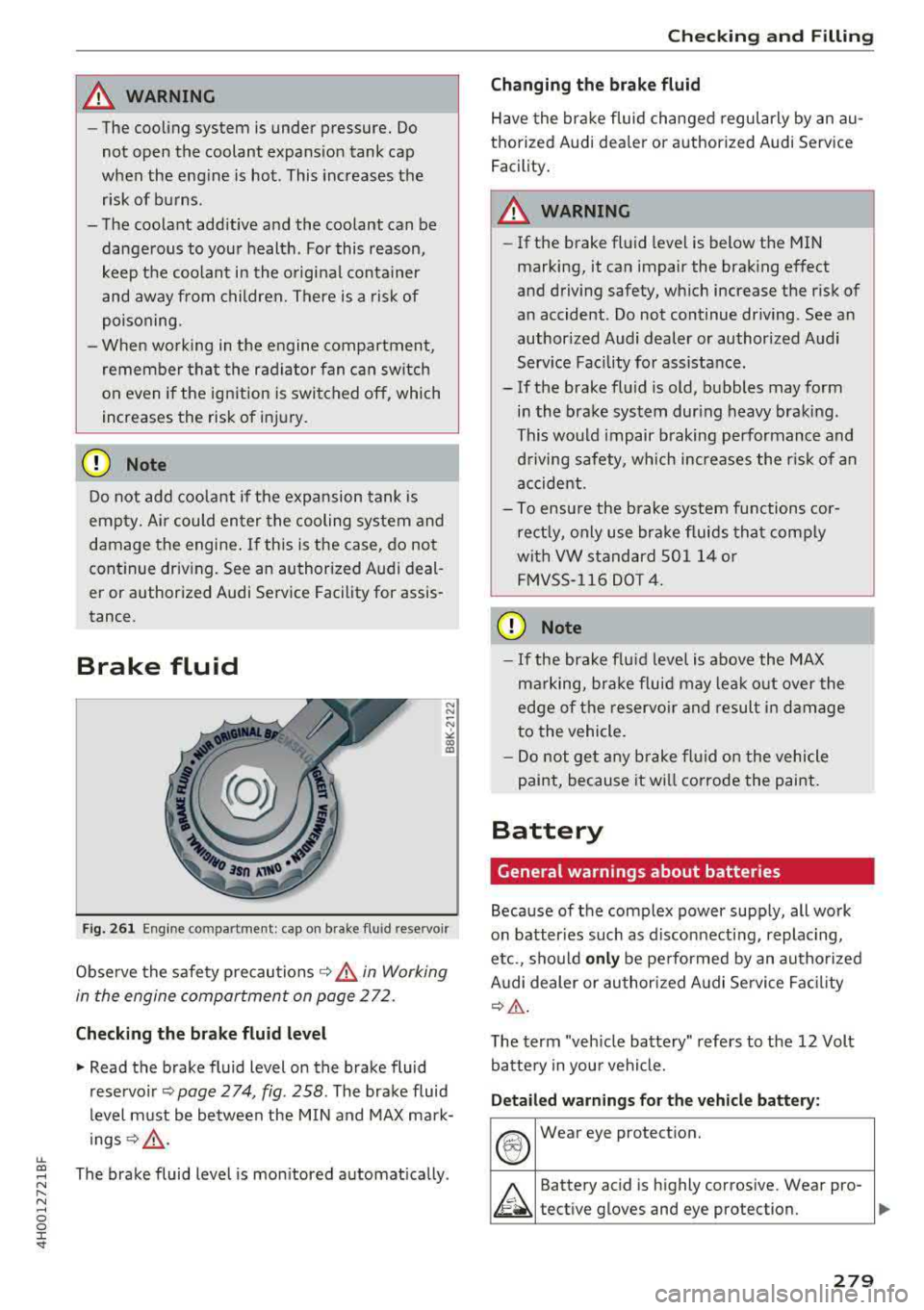
Observe the safety precautions ~&. in Working
in the engine compartment on page 2
72.
Checking the brake fluid level
.. Read the brake fluid level on the brake fluid
reservoir
~ page 274, fig. 258. The brake fluid
level must be between the MIN and MAX mark
ings~&. -
~ The brake fluid level is monitored automatically .
...... N ...... 0 0 :c '
Changing the brake fluid
Have the brake fluid changed regularly by an au
thorized Audi dealer or authorized Audi Service
Facility.
_& WARNING
-
- If the brake fluid level is below the MIN
marking, it can impair the braking effect
and driving safety, which increase the risk of
an accident . Do not continue driving . See an
authorized Audi dealer or authorized Audi
Service Facility for assistance.
- If the brake fluid is old, bubbles may form
in the brake system during heavy braking.
This would impair braking performance and
driving safety, which increases the risk of an
accident.
- To ensure the brake system functions cor
rectly, only use brake fluids that comply
with VW standard 50114 or FMVSS-116 DOT 4.
CD Note
- If the brake fluid level is above the MAX
marking, brake fluid may leak out over the
edge of the reservoir and result in damage
to the vehicle.
- Do not get any brake fluid on the vehicle
paint, because it will corrode the paint.
Battery
General warnings about batteries
Because of the complex power supply, all work
on batteries such as disconnecting, replacing,
etc., should
only be performed by an authorized
Audi dealer or authorized Audi Service Facility
~ .&. .
The term "vehicle battery" refers to the 12 Volt
battery in your vehicle.
Detailed warnings for the vehicle battery:
® Wear eye protection.
b. Bat~ery acid is highly corrosive. Wear pro-
~ tect1ve gloves and eye protection. Ill>-
279
Page 282 of 356
Checking and Filling
@
Fire, sparks, open flame and smok ing are
forb idden.
~
A highly explosive mixture of gases can
form when charging batteries.
®
Keep c hildren away from battery acid and
batteries.
A WARNING
All work on the battery or electrical system in
your vehicle can result in injuries, chemical
burns, accidents or burns. Because of this, a ll
work must be performed
only by an author
ized Aud i dea le r o r authorized Aud i Serv ice
Facility.
A WARNING
California Proposit ion 65 Warning:
- Battery posts, terminals and re lated acces
sories contain lead and lead compounds,
chemicals known to the Sta te of California
to ca use ca nce r and rep roduct ive p roblems.
Wash hands after handling.
{Q) Note
If the v ehicle wi ll be par ked for long periods
of t ime, pro tect i t against the co ld so that it
w ill not be destroyed by "freezing"
¢page 280.
Vehicle battery
The term "vehicle battery" refers to the 12 Volt
bat tery in your vehicle.
Not running the vehicle for long periods of
time
I f you do not dr ive your vehicle for seve ral days or
weeks, elec trical equipmen t is gradually scaled
back or switched off. This reduces energy use and
ensu res the vehicle wi ll be able to start after long
periods of
time ¢ page 131. Some convenience
functions, such as interior lighting or power seat
ad justment, may not be available under certa in
circumstances. These convenience funct ions w ill
be ava ilable aga in once you switch the ignition on
and start the engine.
280
Even when electrical equipment is swi tched o ff,
the equipment can still drain the vehicle battery i f the ve hicle is not dr iven fo r long periods of
time. Deep draining results in a chemica l reaction
that destroys the ins ide of the vehicle battery.
The vehicle battery must be charged every month
to reduce the risk of this
happen ing ¢ page 280.
Contact an autho rized Aud i dea le r or a uthorized
A udi Se rvice Fa cility for mo re information.
Winter operation
Co ld weather places higher demands on the vehi
cle battery. T his res ults in reduced starting abili
ty . Have the vehicle ba tte ry checked by an au
thorized Aud i dea ler or author ized Audi Service
Fa cil ity befo re the cold time of ye ar.
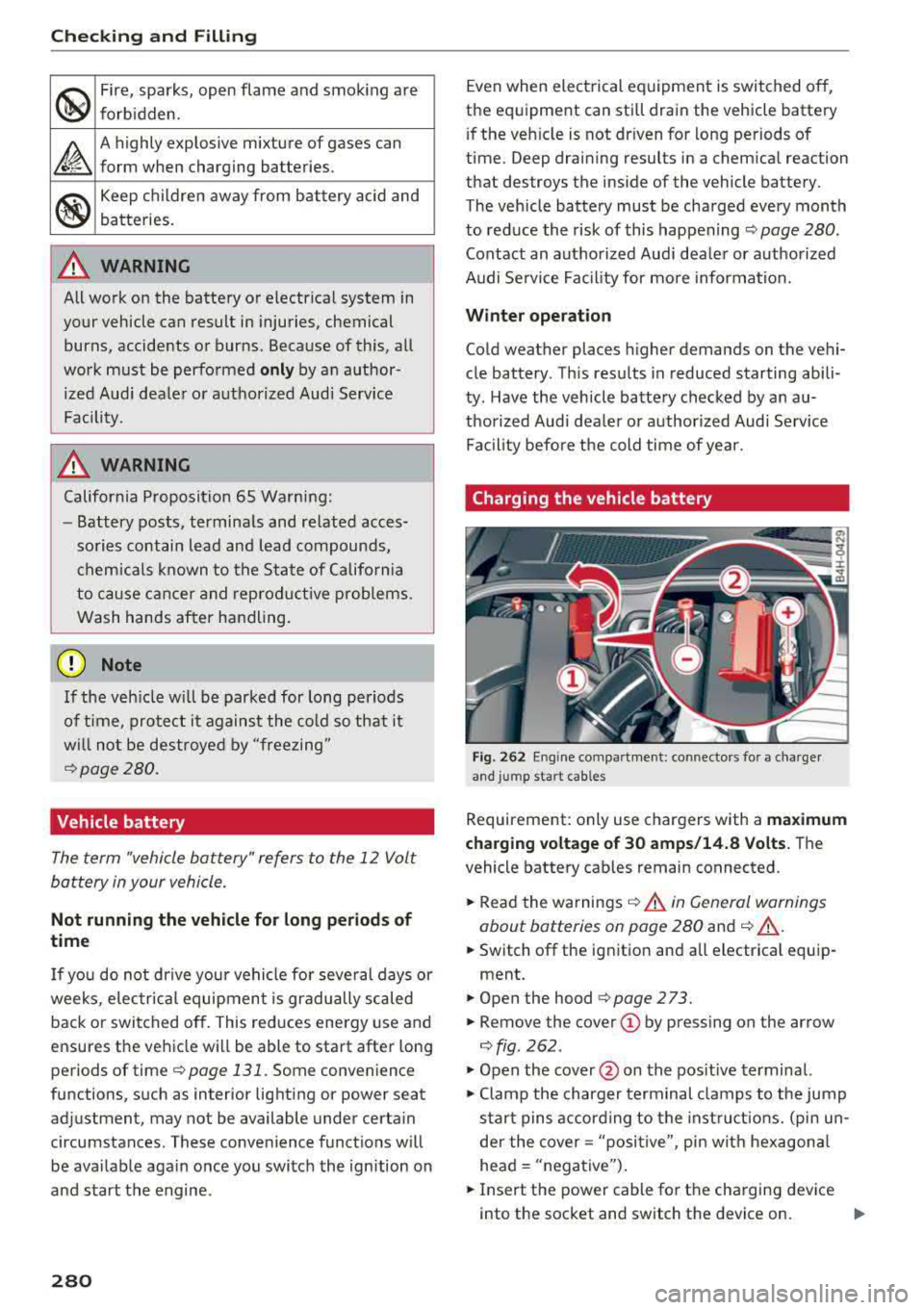
Charging the vehicle battery
Fi g. 262 Eng ine compa rtment: connectors fo r a cha rger
and jump start cab les
Requirement: only use chargers with a ma ximum
charging voltage of 30 amp s/14.8 Volts.
The
vehicle battery cab les remain connected .
.. Read the warnings ¢.&. in General warnings
about batteries on page 280
and ¢ _&. .
.. Switch off the ignitio n and all electrica l equip
ment.
.. Open the hood ¢ page 2 73 .
.. Remove the cover (I) by pressing on the arrow
¢fig. 262.
.. Open the cover @on the pos it ive terminal.
.. Clamp the charger terminal clamps to the jump
star t pins accord ing to the inst ru ct ions. (pin un
de r the cover= "positive", p in wit h hex agon al
head = "nega tive") .
.. Insert the power cable for t he cha rging dev ice
into the socket and switch the device on.
Ill>
Page 283 of 356
u. co .... N
" N .... 0 0 :c '
charger off and pull the power cab le out of the
socket.
~ Now remove the charg ing device terminal
clamps .
~ Close the cover @on the positive term inal and
re-install the
cover (!).
~ Close the hood c:;, page 2 73 .
A drained battery can freeze at temperatures
around
322F (0QC) . A frozen or thawed out bat
tery must no longer be used . The battery hous ing
could be cracked by the format ion of ice , which
could cause battery acid to leak out
c:;, ,&. .
Charg ing the b attery
Only use chargers with a ma ximum charg ing
v oltage of 14 .8 V.
The battery connecting cables
do not need to be disconnected . Do not open the
battery when charg ing .
Read all of the manufacturer's instructions for
the charger before charging the battery .
A WARNING
-A h ighly exp losive mixture of gases can form
w hen cha rging batter ies. O nly charge t he
vehicle ba tte ry in well -vent ilated a reas.
- A d rained vehicle battery can freeze at tem
peratu res a round 32
Q F (0 QC). A froze n or
thawed ve hicle battery m ust not be ch arged
and must not be used anymore. The battery
housing can crack and battery acid can leak
out if ice forms, whic h increases the risk of
an exp losion and chemical burns. Contact an
authorized Audi dealer or authorized Aud i
Service Facility for more information.
- Do not connect or disconnect the charg ing
cable while charg ing because th is increases
the risk of an explosion .
(D Tips
-Only charge the vehicle battery through the
connections in the engine compartment.
-Read all of the manufacturer's instructions
for the charger before charg ing the ve hicle
battery .
Ch eck ing and F illing
Windshield washer
system
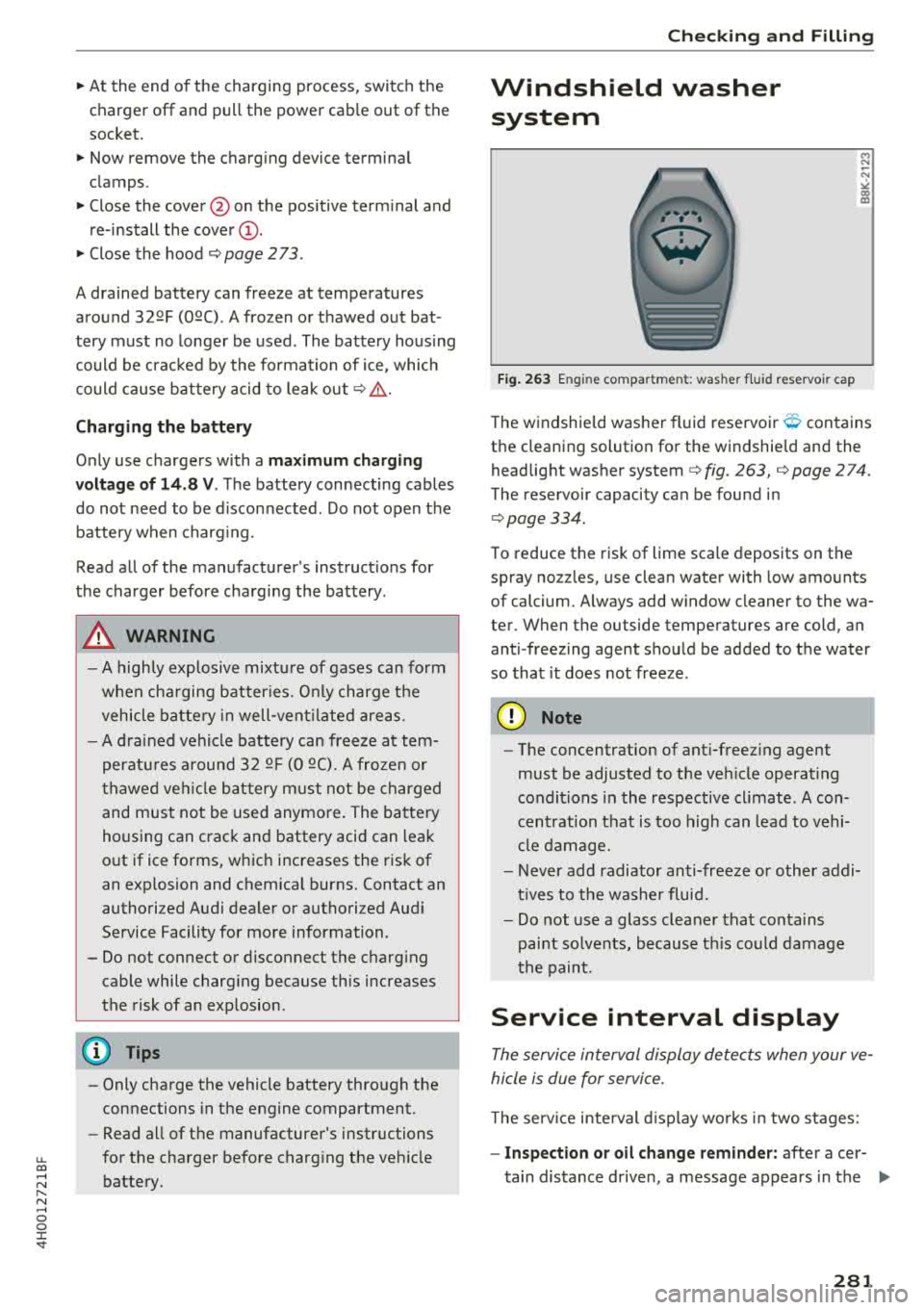
F ig . 263 E ngin e compar tmen t: was he r fl ui d reservo ir cap
M N
-N ' "' "' m
The windshield washer fluid reservoir O contains
the cleaning solution for the windshie ld and the
headlight washer system
c:;, fig. 263, c:;, page 274.
The reservoir capacity can be found in
<=> page 334.
To reduce the risk of lime scale depos its on the
spray nozzles, use clean water with low amounts
of calcium. Always add w indow cleaner to the wa
ter . When the outside temperatures are cold, an
anti -freezing agent should be added to the water
so that it does not freeze .
@ Note
-The concentration of ant i-freez ing agent
must be adjusted to the veh icle operat ing
condit ions in the respective cl imate . A con
centration that is too high can lead to vehi
cle damage.
- Never add radiato r anti-freeze or other addi
t ives to the washer fluid.
- Do not use a glass cleaner that conta ins
paint so lvents, because t his could damage
the paint.
Service interval display
The service interval display detects when your ve
hicle is due for service.
T he serv ice interval d isplay wo rks in two stages:
-In sp ec tio n o r oil change remind er: after a cer-
tain distance driven , a message appears in the
.,.
2 8 1
Page 289 of 356
....
"' -N .... N
-0
0
J: ..
(a) Curb weight
(b) Accessory weight
(c) Vehicle capacity weight, and
(d) Production options weight
Ma ximum (permissible }
inflation pres sure
means the maximum cold infla
tion pressure to which a t ire may
be inflated . Also called "maxi
mum inflation pressure."
Normal occupant weight
means 150 l bs. (68 kilograms)
times the number of occupants
seated in the veh icle up to the to
tal seating capacity of your vehi
c le.
Occupant distribution
means distribution of occupants
in a vehicle.
Outer diameter
means the overall diameter of an
inflated new tire .
Overall width
means the linear distance be
tween the exteriors of the side
walls of an inflated tire, including
elevations due to labeling, deco
rations, or protective bands or
ribs .
Wheels
Ply
means a layer of rubber-coated
parallel cords .
Production options weight
means the combined weight of
those installed regular production
options weighing over 5 lbs. (2.3 kg) in excess of those standard
items which they replace, not pre
viously considered in curb weight
or accessory weight, including heavy duty brakes , ride levelers ,
roof rack, heavy duty battery, and
special trim .
Radial ply tire
means a pneumatic tire in which
the ply cords that extend to the beads are laid at substantially 90
degrees to the centerline of the
tread .
Recommended inflation
pressure
see ~ page 286, Cold tire infla
tion pressure .
Reinforced tire
means a tire designed to operate
at higher loads and at higher in
flat ion pressures than the corre
sponding standard tire. Rein
forced tires may be iden tified as
.,.
28 7
Page 329 of 356
u. co .... N
" N .... 0 0 :c '
General
This chapter is intended for trained emergency
crews and working personnel who have the nec
essary tools and equipment to perform these
operations.
Starting by pushing or
towing
~ Note
Vehicles with an automatic transmission can
not be started by pushing or towing.
Starting with jumper
cables
If necessary, the engine can be started by con
necting it to the battery of another vehicle .
If the engine should fail to start because of a dis
charged or weak battery, the battery can be con
nected to the battery of
another vehicle, using a
pair of jumper cables to start the engine.
Jumper cables
Use only jumper cables of sufficiently large cross
section
to carry the starter current safely. Refer
to the manufacturer's specifications.
Use only jumper cables with
insulated terminal
clamps which are distinctly marked :
plus(+) cable in most cases colored red
minus(-) cable
in most cases colored black.
A WARNING -
Batteries contain electricity, acid, and gas.
Any of these can cause very serious or fatal in
jury. Follow the instructions below for safe
handling of your vehicle's battery .
-Always shield your eyes and avoid leaning
over the battery whenever possible.
-A dead battery can freeze at temperatures
around 32 °F (0 °C) . If the vehicle battery is
frozen, you must thaw it before connecting
the jump start cables. If you do not, this in-
Emergency situations
creases the risk of an explosion and chemi
cal burns. After jump starting the vehicle,
drive to an authorized Audi dealer or author ized Audi Service Facility immediately to
have the vehicle battery checked.
- Do not allow battery acid to contact eyes or
skin . Flush any contacted area with water
immediately.
- Improper use of a booster battery to start a
vehicle may cause an explosion .
- Vehicle batteries generate explosive gases .
Keep sparks, flame and lighted cigarettes
away from batteries.
- Do not try to jump start any vehicle with a
low acid level in the battery .
- The voltage of the booster battery must also
have a 12-Volt rating . The capacity (Ah) of
the booster battery should not be lower
than that of the discharged battery. Use of
batteries of different voltage or substantial
ly different "Ah " rating may cause an explo
sion and personal injury.
- Never charge a frozen battery. Gas trapped
in the ice may cause an explosion.
- Never charge or use a battery that has been
frozen. The battery case may have be weak
ened.
- Use of batteries of different voltage or sub
stantially different capacity (Ah) rating may
cause an explosion and injury. The capacity
(Ah) of the booster battery should not be
lower than that of the discharged battery.
- Before you check anything in the engine
compartment, always read and heed all
WARNINGS
c>page 272.
@ Note
- Applying a higher voltage booster battery
will cause expensive damage to sensitive
electronic components, such as control
units, relays, radio, etc.
- There must be no electrical contact between
the vehicles as otherwise current could al
ready start to flow as soon as the positive
( + ) terminals are connected.
327
Page 330 of 356
Emergency situations
@ Tips
The discharged battery must be properly con
nected to the vehicle's electrical system .
When jump starting or charging the battery,
never connect the negative ground cable to
the battery negative post because the battery
manager system must be able to detect the
battery's state of charge. Always connect the
negat ive g round cable to the negative ground
post of the battery manager control unit.
Using the jump start
cable
Both jump start cables must be connected in the
correct order!
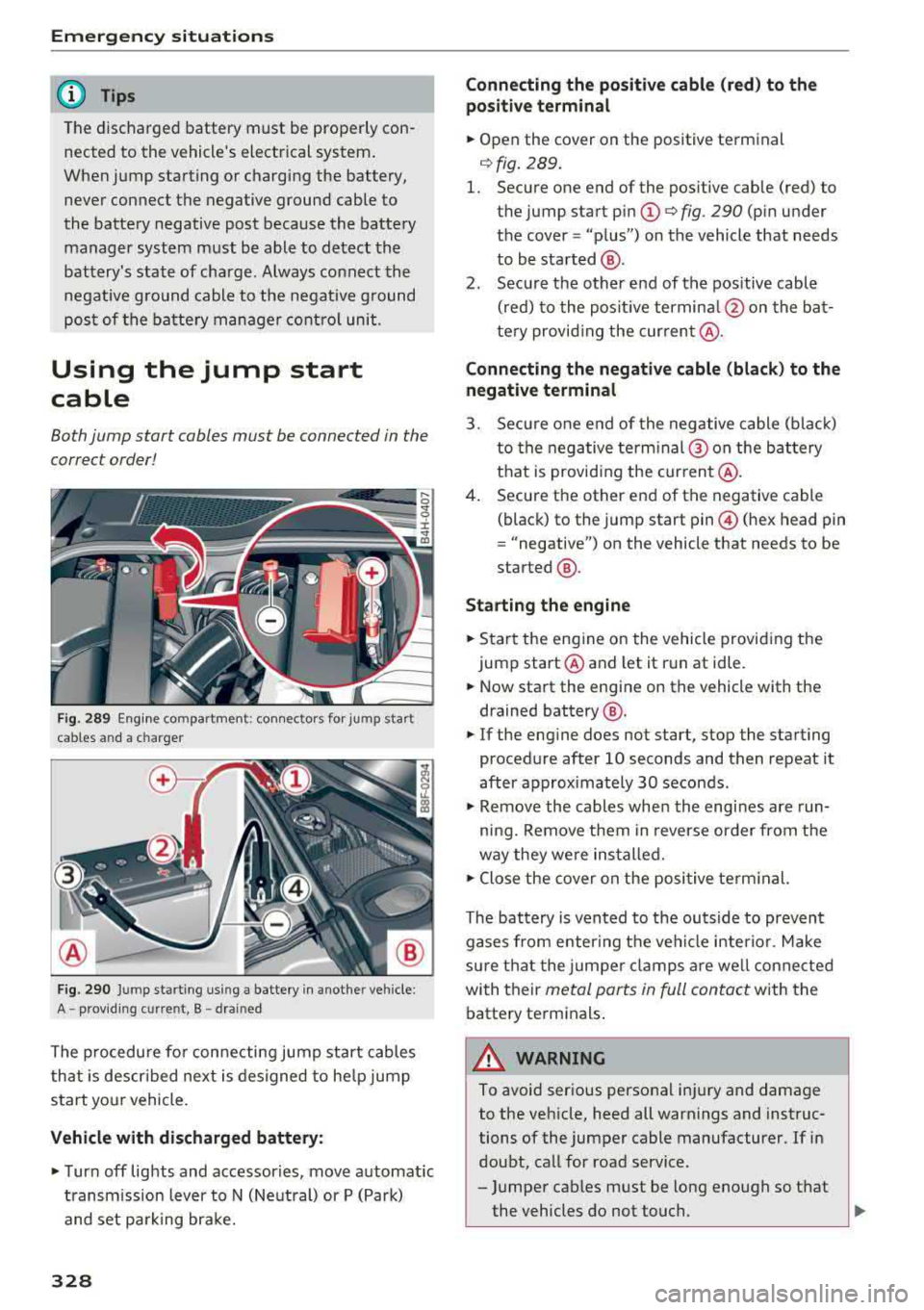
Fig. 289 E ngin e compartme nt: co nn ectors for jump start
cables and a charger
Fig. 290 Jump starting using a battery in anot her vehicle:
A
-p rov id in g current, B -drai ned
The procedure for connecting jump start cables
that is descr ibed next is designed to help jump
start your vehicle.
Vehicle with discharged battery:
~ Turn off lights and accessories, move automatic
transmission lever to N (Neutral) or P (Park)
and set parking bra ke.
328
Connecting the positive cable (red) to the
positive terminal
~ Open the cover on the positive terminal
qfig . 289.
1. Secure one end of the pos itive cable (red) to
the jump start pin
(D q fig. 290 (pin under
the cover =
"plus") on the vehicle that needs
to be started @.
2. Secure the other end of the positive cable
(red) to the posit ive terminal @on the bat
tery provid ing the cur rent @.
Connecting the negative cable (black) to the
negative terminal
3. Secure one end of the negative cable (black)
to the negative terminal @ on the battery
that is providing the current @.
4. Secure the other end of the negative cable
(black) to the jump start
pin @ (hex head pin
= "negative") on the vehicle that needs to be
started @.
Starting the engine
~ Sta rt the eng ine on the vehicle providing the
jump start @and let it run at idle.
~ Now start the engine on the vehicle with the
drained battery @.
~ If the engine does not start, stop the starting
procedure after 10 seconds and then repeat it
after approx imately 30 seconds.
~ Remove the cables when the engi nes are run
ning. Remove them in reverse order from the
way they were installed.
~ Close the cover on the posi tive terminal.
The battery is vented to the outside to prevent
gases from enter ing the vehicle interior. Make
sure that the jumper clamps are well connected
with their
metal ports in full contact with the
battery terminals .
A WARNING
-To avoid serious personal injury and damage
to the vehicle, heed all warnings and instruc
tions of the jumper cable manufacturer. If in
doubt, call for road service.
-Jumper cables must be long enough so that
the vehicles do not touch.
..,.
Page 331 of 356
-When connecting jumper cables, make sure
that they cannot get ca ught in any mov ing
parts in the engine compartment.
- Before you check anything in the engine
compartment, a lways read and heed a ll
WARNINGS
¢ page 272.
(D Note
Impro per hook-u p of jum per cables can ru in
the generato r.
- Always connect P OSITIVE( +) to POSITIV E
( + ), and NEGATIVE( -) to NEGATIVE( -)
g round post of the battery manager contro l
unit.
- Check that a ll sc rew p lugs on the battery
cells are sc rewed in firmly . If not, t ighten
pl ugs p rior to connect ing clamp on negative
b atte ry te rmi nal.
- Please note t hat the procedure fo r con nect
i ng a jumper cab le as desc ribed above ap
p lie s specifica lly to the case of yo ur vehicle
b eing ju mp starte d. When you are g iv ing a
ju mp s tart to ano ther vehicle, do
not con
n ect th e neg ative( -) ca b le to the neg ative
(-) t ermin al on t he disch arged batte ry @
¢ fig . 290. Instead, securely connect the
negat ive(- ) cab le to either a solid metal
component that is f irm ly bolted to the en
gine block o r to the engine bloc k itself. If
the battery that is be ing c ha rged does not
vent to the outs ide, escap ing batte ry gas
could ignite and ex plod e!
Towing with a tow truck
General hints
Yo ur Audi requires special h andling for towing .
The follow ing informa tion is to be used by com
mercia l tow tr uck o pera tors who know how to op
e rat e the ir equip men t sa fely.
- Never tow your Audi. Towing will cause dam
age to the engine and transmission.
- Never wrap the safety chains or winch cables
~ around the brake lines. ....
~ -To prevent unnecessary damage, your Audi N
8 must be transported with a flatbed truck. 0 :c '
-To load the vehicle on to the flatbed, use the
towing loop found in the vehicle tools and at
tach to the front or rear anchorage
¢ page 329 and c> page 330.
A WARNING
A veh icle being towed is not safe for passen
ge rs. Neve r allow a nyo ne to ride in a vehicl e
b eing towed, fo r any reason.
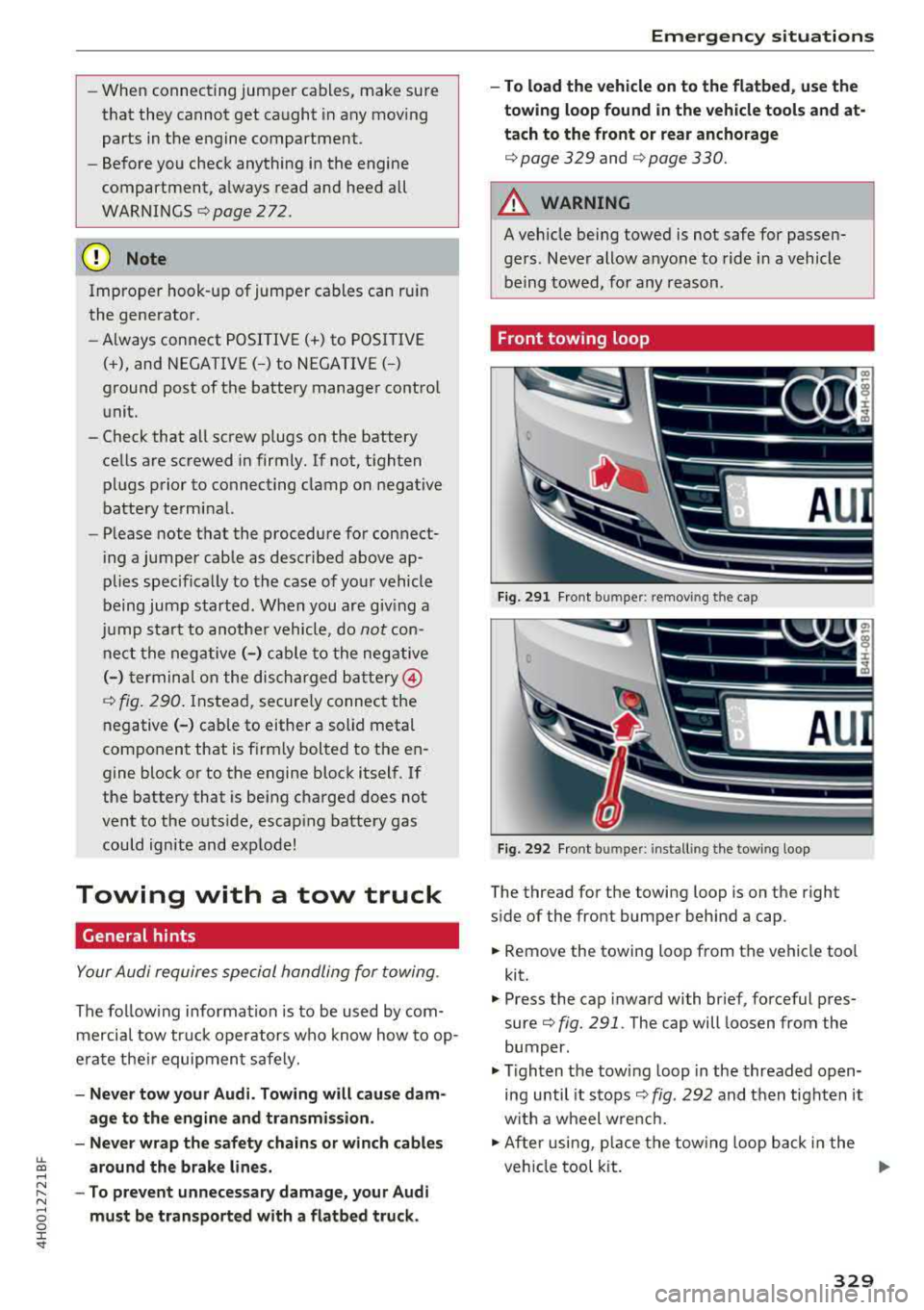
Front towing loop
Fi g. 291 Fron t bu mpe r: removing t he cap
Fig. 292 Fron t bu mpe r: insta llin g the tow ing loop
The thread for the towing loop is on the right
s ide of the front bumper beh ind a cap.
.,. Remove the towing loo p from the vehicle too l
kit.
.,. Press the cap inward with brief, forceful pres
sure
c> fig. 291 . The cap will loosen from the
bumper.
.,. T igh ten the tow ing loop in the threaded open
ing until it stops
c> fig. 292 and t hen tighten it
w ith a wheel w re nc h .
.,. Afte r usi ng, p lace the tow ing loop b ack in the
veh icle tool kit.
IJJ>-
329
Page 344 of 356
Index
Brakes Brake assist
Brake fluid
129
127
279
Electromechanical parking brake . . . . . . . . 81
Emergency braking function . . . . . . . . . . . . 81
New brake pads . . . . . . . . . . . . . . . . . . . . . 129
Worn brake pads . . . . . . . . . . . . . . . . . . . . . 23
Braking g uard . . . . . . . . . . . . . . . . . . . . . 95, 100
Messages 102
Brea k-in period
Tires . . . . . . . . . . . . . . . . . . . . . . . . . . . . . . .
73
Break ing in
New b rake pads
129
New engine . . . . . . . . . . . . . . . . . . . . . . . . . 73
New tires 290
Browsing through album covers . . . . . . . . . 191
Bulbs . . . . . . . . . . . . . . . . . . . . . . . . . . . . . . . 326
Bu ttons
Mul tifunction steeri ng wheel . . . . . . . . . . .
11
C
Cable (Aud i mus ic interface)
California Proposition
65 Warning .... .. .
Battery specific . ............. .... .. .
Ca ll
.. .. .. ...... ... .. ..... ... .. .. ...
Call l ist
186
273
280
150
149
Ca ll opt ions . . . . . . . . . . . . . . . . . . . . . . . . . . 156
Ca pac it ies
F ue l tank
....... ... .. ..... ... .. .. ... 334
Washer fluid rese rvoir . . . . . . . . . . . . . . . . 334
Ca r ca rr ie r
T ra nsport ing you r vehicle . . . . . . . . . . . . .
330
Care . . . . . . . . . . . . . . . . . . . . . . . . . . . . . . . . 306
Ca rgo area
refer to L uggage compartment. ... .. ... 2 13
Cata lytic conve rte r
CD 27 2
refer to Med ia . . . . . . . . . . . . . . . . . . 181, 190
Ce ll phone
P laying music . . . . . . . . . . . . . . . . . . . . . . .
184
also refer to Telephone . . . . . . . . . . . . . . . 147
Ce nte r console ligh ting . . . . . . . . . . . . . . . . . 4 7
Central locking . . . . . . . . . . . . . . . . . . . . . . . . 27
Central lock ing switch . . . . . . . . . . . . . . . . . 3 1
Conven ience key . . . . . . . . . . . . . . . . . . . . . . 30
E me rgency lock ing . . . . . . . . . . . . . . . . . . . . 3 2
342
Luggage compartment lid . . . . . . . . . . . . . . 33
Remote control key . . . . . . . . . . . . . . . . . . . 30
Setting . . . . . . . . . . . . . . . . . . . . . . . . . . . . . 32
Certification .. .. .. .. .. ............. ..
Ch . · ·1 anging engine 01 •• •• •.. .. ..... ... ..
Changing the battery ... ... .. ..... ... . .
Charg ing and chang ing the battery ...... .
Child restra ints .. .. .. .. ............. . .
Danger of using child restra ints in the front
339
277
199
199
267
seat . . . . . . . . . . . . . . . . . . . . . . . . . . . . . . . 228
Child restraint system anchors . . . . . . . . . . 262
Child safety . . . . . . . . . . . . . . . . . . . . . . . . . . 249
G ui dance fixtures for lowe r ancho rages . . 2 63
Child safety lock . . . . . . . . . . . . . . . . . . . . . . . 36
Child safety seat . . . . . . . . . . . . . . . . . . . . . . 254
Child safety seats . . . . . . . . . . . . . . . . . . . . . 255
Convertib le child seats . . . . . . . . . . . . . . . 256
Infa nt seats . . . . . . . . . . . . . . . . . . . . . . . . 2 55
Installing a c hild restraint using t he LATCH
system . . . . . . . . . . . . . . . . . . . . . . . . . . . .
264
LATCH system . . . . . . . . . . . . . . . . . . . . . . 264
Lower anchorages . . . . . . . . . . . . . . . . . . . 263
Mounting and re leas ing the anchorage
hook ..... .... .. .. .. ............. ..
264
Safety instructions . . . . . . . . . . . . . . . . . . . 252
Securing
Cleaning 259
306
Cleaning/removing ice from w indows . . . . . 308
Cleaning Alcantara . . . . . . . . . . . . . . . . . . . . 309
Cleaning artificia l leather. . . . . . . . . . . . . . . 309
Cleaning carbo n pa rts . . . . . . . . . . . . . 308, 309
Cleaning cont rols . . . . . . . . . . . . . . . . . . . . . 308
Cleaning decorative p arts and trim . . . . . . . 308
Cleaning disp lays . . . . . . . . . . . . . . . . . . . . . 308
Cleaning exhaust tail pipes . . . . . . . . . . . . . 308
Cleaning plastic pa rts . .. ............. . .
Cleaning tail lights . .. .. ............. . . 308
307
Cleaning textiles . . . . . . . . . . . . . . . . . . . . . . 309
Clock . . . . . . . . . . . . . . . . . . . . . . . . . . . . . . . . 16
Closing
Hood . . . . . . . . . . . . . . . . . . . . . . . . . . . . . .
273
Panorama glass roof . . . . . . . . . . . . . . . . . . 39
Su nroof . . . . . . . . . . . . . . . . . . . . . . . . . . . . . 38
Su nshade (panorama glass roof) . . . . . . . . 40
Sunshade (slid ing/t ilting sunroof) . . . . . . . 38
Windows . . . . . . . . . . . . . . . . . . . . . . . . . . . 3 7