door lock AUDI A8 2018 Owner's Manual
[x] Cancel search | Manufacturer: AUDI, Model Year: 2018, Model line: A8, Model: AUDI A8 2018Pages: 356, PDF Size: 54.71 MB
Page 66 of 356
Seats and storage
(D Note
Beverage containers in the cup holders should
always have a lid. If not, beverages could spill
and cause damage to vehicle equipment, such
electronics or seat covers.
Cooled glove compartment
The cooled glove compartment only functions
when the A/C system is switched on.
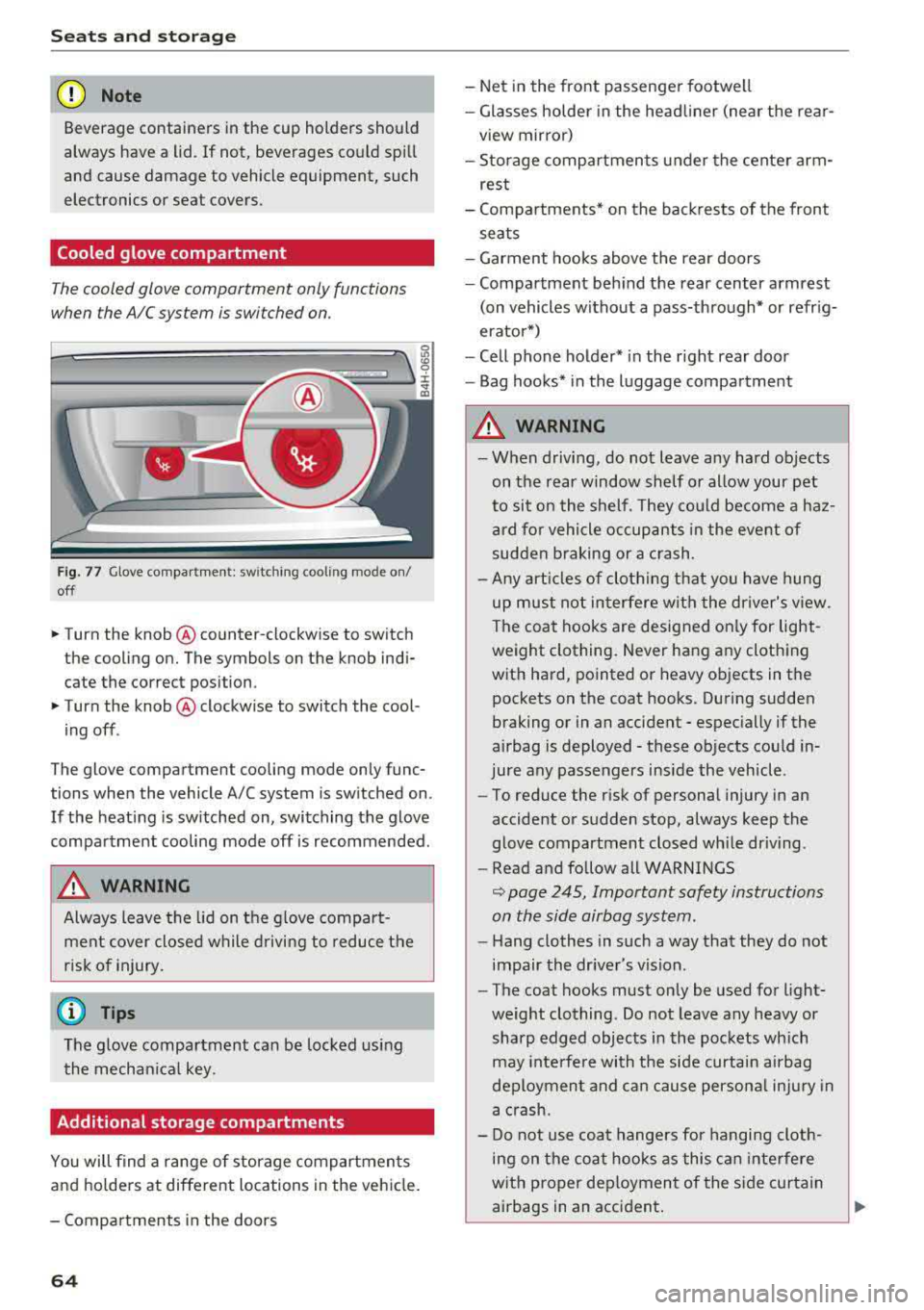
Fig. 77 Glove compar tment: switching cooling mode on/
off
.. Turn the knob @counter-clockwise to switch
the cooling on. The symbols on the knob indi
cate the correct position.
.. Turn the knob @clockwise to switch the cool-
ing off .
The glove compartment cooling mode only func
tions when the vehicle A/C system is switched on.
If the heating is switched on, switching the glove
compartment cooling mode off is recommended.
A WARNING
-
Always leave the lid on the glove compart
ment cover closed while driving to reduce the
risk of injury.
(D Tips
The glove compartment can be locked using
the mechanical key.
Additional storage compartments
You will find a range of storage compartments
and hold ers at different locations in the vehicle.
- Compartments in the doors
64
- Net in the front passenger footwell
- Glasses holder in the headliner (near the rear-
view mirror)
- Storage compartments under the center arm
rest
- Compartments* on the backrests of the front
seats
- Garment hooks above the rear doors
- Compartment behind the rear center armrest
(on vehicles without a pass-through* or refrig
erator*)
- Cell phone holder* in the right rear door
- Bag hooks* in the luggage compartment
A WARNING
-When driving, do not leave any hard objects
on the rear window shelf or allow your pet
to sit on the shelf. They could become a haz
ard for vehicle occupants in the event of
sudden braking or a crash.
- Any articles of clothing that you have hung
up must not interfere with the driver's view .
The coat hooks are designed only for light
weight clothing. Never hang any clothing
with hard, pointed or heavy objects in the
pockets on the coat hooks. During sudden
braking or in an accident
-especially if the
airbag is deployed
-these objects could in
jure any passengers inside the vehicle .
- To reduce the risk of personal injury in an
accident or sudden stop, always keep the
glove compartment closed while driving.
- Read and follow all WARNINGS
~ page 245, Important safety instructions
on the side airbag system.
- Hang clothes in such a way that they do not
impair the driver's vision.
- The coat hooks must only be used for light
weight clothing. Do not leave any heavy or
sharp edged objects in the pockets which
may interfere with the side curtain airbag
deployment and can cause personal injury in
a crash.
- Do not use coat hangers for hanging cloth
ing on the coat hooks as this can interfere
with proper deployment of the side curtain
airbags in an accident.
Page 79 of 356
u. co .... N
" N .... 0 0 :c '
-Some noise after starting the engine is nor
mal and is no cause for concern.
- If you leave the vehicle with the ignition
switched on, the ignition will switch off af
ter a certain amount of time. Make sure that
electrical equipment such as the exterior
lights are switched off.
Stopping the engine
.,. Bring the vehicle to a full stop.
.,. Select the P or N selector lever position .
.. Press the I START ENGI NE STOPI button
~ page 76, fig. 90.
Steering lock
The steering locks when you turn the engine off
using the lSTART
ENGINE STOPlbutton and
open the driver's door. The locked steering helps
prevent vehicle theft.
Emergency off function
If it is absolutely necessary, the engine can also
be turned off while driving in the
R, Dor S selec
tor lever position at speeds below 6 mph (10 km/
h). To stop the engine, press and hold the
I START ENGINE STOPI button and also press the
brake pedal.
& WARNING
-Never turn off the engine before the vehicle
has come to a complete stop. The full func
tion of the brake booster and the power
steering is not guaranteed. You must use
more force to turn or brake. Because you
cannot steer and brake as you usually
would, this could lead to accidents and seri
ous injuries .
-Always take the key with you whenever you
leave your vehicle. Otherwise, the engine
cou ld be started or electrical equipment
such as the power windows could be operat
ed. This can lead to serious injury.
-For safety reasons, always park the vehicle
with the selector lever in the P position .
Driving
Otherwise, there is the risk that the vehicle
could roll unintentionally.
@ Note
If the engine has been under heavy load for
an extended period of time, heat builds up in
the engine compartment after the engine is
switched off and there is a risk of damaging
the engine. For this reason, let the engine run
at idle for approximately two minutes before
shutting it off .
(D Tips
For up to 10 minutes after stopping the en
gine, the radiator fan may turn on again auto
matically or it may continue to run (even if
the ignition is switched off) for the following
reasons :
- The coolant temperature is increasing due
to trapped heat.
- If the engine is warm and the engine com
partment also heats up from strong sun
light.
Messages in the instrument cluster display
Turn off ignition before leaving car
This message appears and a warning tone sounds
if you open the driver's door when the ignition is
switched on.
Press brake pedal to start engine
This message appears when you press the
I START ENGINE STOP ! button to start the engine
and do not press the brake pedal while doing so.
The engine can only be started when the brake pedal is pressed .
Ill Is key in the vehicle?
This indicator light turns on and this message ap
pears if the ignition key was removed from the
vehicle when the engine was running. If the igni
tion key is no longer in the vehicle, you cannot
switch on the ignition or start the engine once
you stop it. You also cannot lock the vehicle from
the outside .
.,.
77
Page 80 of 356
Driving
Shift to P, otherwise vehicle can roll away.
Doors do not lock if lever is not in
P.
This driver message appears fo r safety reasons if
the transmission has not been shifted to the P
position when you switch the ignition off. Move
the selector lever to the P position . Otherwise the
veh icle is not protected from ro lling and it cannot
be locked.
(I Key is not recognized. Hold back of key
against marked area. See owner's manual
If the i ndicator light turns on and this message
appears, there is a
malfunction ~ page 78.
Turn off ignition before leaving car
This message appears if the driver's door is
ope ned while the ignition is switched on . Always
sw itch off the ignition if you are leavi ng the vehi
cle .
Shift to P and turn off ignition before leav ing
car, otherwise vehicle can roll away
This message appears if the driver's door is
opened while the ignition is switched on and the
transmission has not been shifted to the P posi
tion . Shift the transm iss ion into the P posit ion
and turn off the ign ition if you are leaving the ve
h icle . Otherwise the vehicle could roll.
Starting the engine when there is a
malfunction
It may not be possible to start the engine under
certain circumstances, for example if the battery
in the vehicle key is drained, if interference is af
fected the key or if there is a system malfunc
tion .
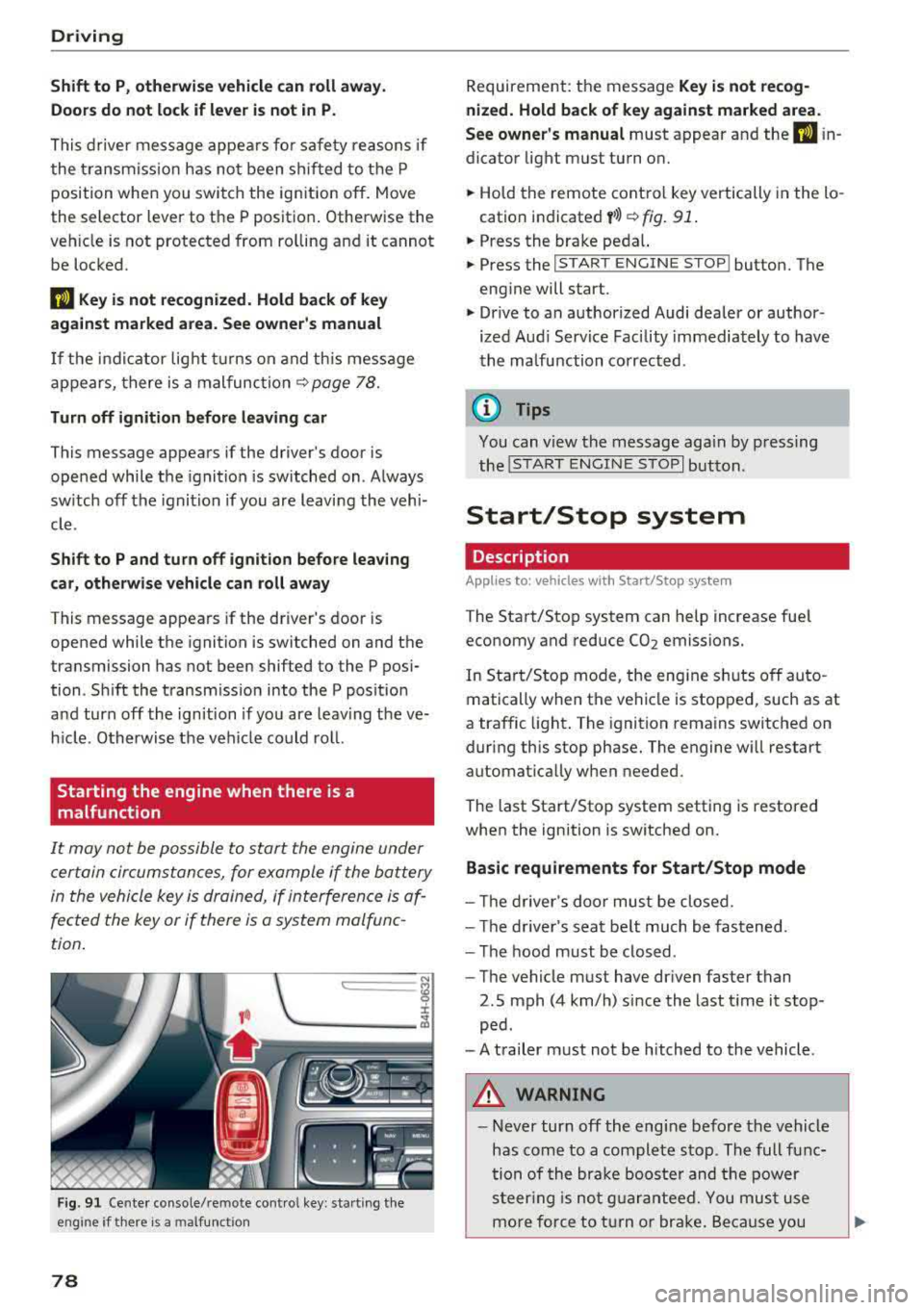
c:====== ~
~ _____ ___ ci5
Fig . 91 Cente r console/remote cont ro l key : sta rt ing the
eng ine
if t here is a malfunc tion
78
Requirement: the message Key is not recog
nized. Hold back of key against marked area .
See owner's manual
must appear and the (I i n
dicator light must turn on.
.,. Hold the remote control key vertically in the lo
cation indicated
y >l) ~ fig. 91 .
.,. Press the brake peda l.
.,. Press the I START ENGINE STOPI button. The
engine will start.
.,. Drive to an authorized Audi dealer or author
ized Aud i Serv ice Facility immediately to have
the malfunction corrected .
(0 Tips
You can v iew the message aga in by pressing
the
I S TAR T ENGINE STOP I button.
Start/Stop system
Description
Applies to: vehicles with Start/Stop syste m
The Start/Stop system can help increase fuel
economy and reduce CO2 emissions.
In Start/Stop mode, the eng ine s hut s off auto
matically when the vehicle is stopped, such as at
a traffic light . The ignition remains switched on
during this stop phase. The engine w ill restart
automat ically w hen needed.
The last Start/Stop system setting is restored
when the ignition is switched on.
Basic requirements for Start/Stop mode
- Th e driver's door must be closed.
- The driver's seat belt much be fastened.
- The hood must be closed .
- The vehicle must have dr iven faster than
2.5 mph (4 km/h) since the last t ime it stop
ped .
- A trailer must not be hitched to the vehicle .
A WARNING
-Never turn off the eng ine before the vehicle
has come to a complete stop . The full func
tion of the brake booster and the power
steering is not guaranteed. You must use
more force to turn or brake. Because you
Page 82 of 356
Driving
-The inter ior temperature differs from the tem
perature se lected in the A/C system.
-The windshield is being defrosted q page 71 .
-The brake pedal is pressed seve ral t imes in a
r ow.
-T he vehicle ba tte ry charge Leve l is too Low.
-Power consumption is high .
Ignition is switched off automatically
To prevent the veh icle battery from drain ing, the
ignit ion w ill switch off
automatically under the
following conditions:
-The vehicle has already been driven .
-The Start/Stop system has stopped the e ngine.
- T he driver's door is opened.
- T he dr iver's safety be lt is unb uckled.
- The brake pedal is not p ressed .
-The vehicle is stationary .
In this case, the activated low beam is replaced
by the parking Light. The parking Lights will
sw itch off after app roximately 30 minutes or
when you Lock the vehicle .
If the Start/Stop system has not turned off the
engine o r if you have sw itched the Start/Stop sys
tem off manually, the ignition will not be auto mat ically switched off and the engine w ill contin
ue to r un
q I!::::,. .
.&_ WARNING
To re duce the risk of poisoni ng, neve r allow
t he engine to r un in confined s paces.
(D Tips
If you select the D, N or S selector Lever posi
tion after shifting into reverse, the vehicle
m ust be driven faster than 6 mph (10 km/h)
in orde r for the engine to switch off again.
80
-
Manually switching the Start/Stop system
off/on
Appl ies to : vehicles wi th Start/Stop sys te m
If you do not wish to use th e system, you con
switch i t off manually.
------------ ~
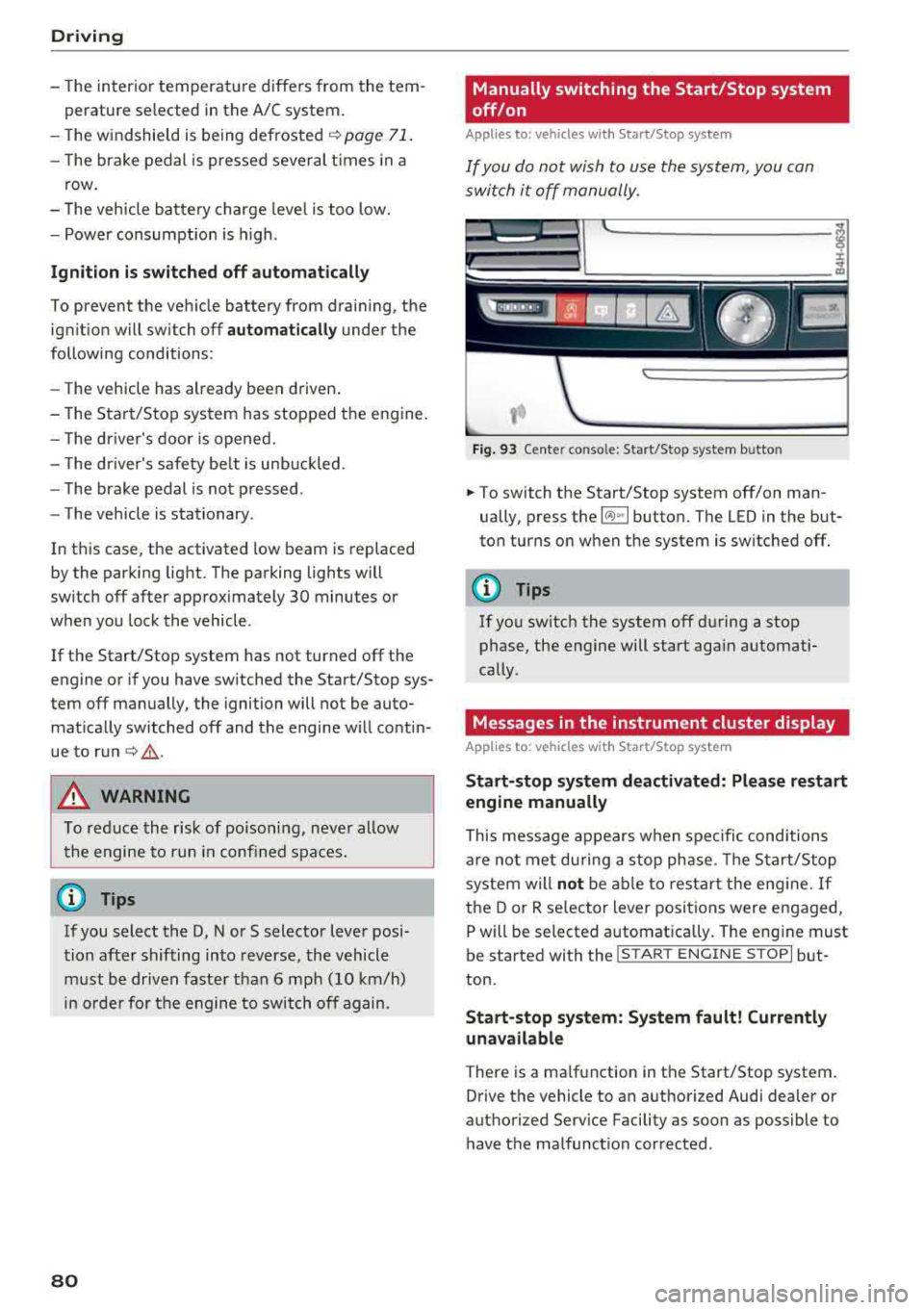
:i:
~
Fig . 93 Ce nte r conso le: Start/Stop system b utto n
.. To switch the Start/Stop system off/on man
ually, press the
l (A) ~I button. The LED in the but
ton turns on when the system is switched off.
(D Tips
If you switch the system off d uring a stop
phase, the engine will start aga in automati
cally .
Messages in the instrument cluster display
Applies to: vehicles wit h Start/Stop syste m
Start-stop system deactivated: Please restart
engine manually
This message appears w hen spec ific conditions
are not me t du ring a stop phase. The S tart/S top
system will
not b e abl e to re st art the eng ine. If
the D or R se lector Lever positions were engaged,
P will be selected a utomat ically . The eng ine must
be started with the
I START ENGI NE STOPI but
ton.
Start -stop system: System fault! Currently
unavailable
There is a ma lfunction in the Start/Stop system.
Drive the vehicle to an authorized Audi dea ler or
authorized Serv ice Facility as soon as possible to
have t he malfunction corrected .
Page 84 of 356
Drivin g
During emergency braking, your vehicle will
brake sim ilar to heavy brak ing. ESC and the
associated components (ABS, ASR, EDL)
cannot overcome the laws of physics . In cor
ners and when road or weather cond it ions
are bad, a full b rake applicat ion ca n cause
the vehicle to skid o r the rear end to swerve,
wh ic h increases the r is k of an accident.
- If the powe r supply fa ils, you cannot set the
par king b rake if it is re leased. In th is case,
par k the vehicle on level ground and secure
it by placing the selector lever in the P posi
tion . See an authorized Audi dea ler or a u
thorized Audi Service Facility for assistance .
- Always take the vehicle key with you when
leaving your vehicle, even fo r a short period
of time . This applies particular ly w hen ch il
dren rema in in the vehicle. Otherwise ch il
dren could start the engine, release the
park ing brake or operate electrical eq uip
ment such as powe r windows, which in
c reases the risk of an acc ident.
- No one sho uld rema in in the vehicle when it
is locked - especially ch ild ren. Locked doo rs
make it mo re diff icu lt fo r eme rgency wor k
ers to get into the vehicle, which puts lives
at r is k .
0) Tips
When stopping at a traffic s ignal or stopping
in c ity traffic, you can set the parking b rake
manually. The vehicle does no t have to be
he ld w it h t he br ake peda l. The parking b rake
elim ina tes the tendency to creep when a se
lecto r lever position is engaged . As soon as
you p ress t he accelerator pedal, the parking
brake releases automat ica lly and your vehicle
starts to move
c::, page 82.
(D Tips
- Occasiona l noises when the parking brake is
set and re leased a re normal and a re not a
cause for concer n.
- The park ing bra ke goes thro ugh a se lf-test
cycle at regular intervals when the ve hicle is
stopped. Any noises associated w ith this a re
normal.
82
- If there is a powe r fail ure, the par king b rake
wi ll not set if it is released, and it wi ll not
re lease if it is
set ~.&. . See an a uth orized
Audi dealer or author ized Audi Se rvice Fa
cility for assistance.
Starting to drive
Various convenience and safety f unct ions may be
available when the vehicle begins dr iving, de
pendi ng on vehicle equipment .
Starting on hills with th e pa rking brake set
Requirement: the driver's door must be closed
and the driver's safety belt must be fastened.
.,. To sta rt driving comfortably when on a h ill, set
the parking brake and begin driving as usu a l.
The braking force of the parking brake does not
release automatically unt il the whee ls build up
enoug h driving force.
Starting on hills with hill hold assist
Hill hold assis t makes it easier to start on hills.
Requireme nt: the d rive r's doo r must be closed
and t he engine must be runn ing.
.,. To activate h ill hold assist, press and hold the
brake pedal for several seco nds . The vehicle
m ust be in an uphill d irect io n of t ravel.
After re leas ing the brake pedal, the brak ing pow
er is maintained for a brief moment
c::, &. to pre
vent the veh icle from rolli ng back w hen starting.
Du ring this t ime, you can easily begin to move
yo ur vehicle.
_8. WARNING
Applies to: vehicles with hill hold assist
-If you do not beg in d riving immed iate ly or
the engine stalls after releasing the bra ke
pedal, your veh icle may beg in to roll back
ward. Press the brake pedal or set the park
ing brake immedia tely.
- The inte lligent technology of hill ho ld assist
cannot ove rcome the limitat ions imposed by
natural p hys ica l laws. The increased comfort
offe red by hill ho ld assist should not cause
you to t ake safety r is ks.
Page 87 of 356
u. co ..... N
" N ..... 0 0 :c '
lect the R or P posit ions w hile d riving.
- Power is sti ll transmitted to the w heels
when the eng ine is r unning at idle. To pre
vent the veh icle from "creeping", you must
keep your foot on the brake i n all se lector
lever posi tions (except P and N) when the
eng ine is ru nning. Do not inadvertent ly
press the acce le ra to r pedal whe n the veh icle
is sta tionary. Oth e rw ise the vehicle will s tart
to move immed iate ly, even if t he pa rking
bra ke is set . This could r esult in a crash.
- B efore open ing the hood, se lect t he P s ele c
to r leve r pos it ion and se t the pa rk ing br ake.
T his red uces the r is k of an accident. Always
read and fo llow the applicable warnings
¢ page 2 72, Working in the engine com
partment.
- Never leave yo ur vehicle with the engine
running wh ile in gear. If yo u must leave
yo ur vehicle when the engine is ru nning, set
the parking brake and move t he se lector lev
er to the P pos ition .
(D Tips
If you accidentally se lect N w hile driving, take
your foot off the acce lerato r peda l and wa it
for the engine to s low down to idle before se
lect ing Dor S.
Driving tips
Starting the engine
.,. T he selector lever must be in the P or the N po
s it ion.
St arting from a stop
.. Press and hold the brake pedal.
.. Start the engine¢ page 76.
.. Press the button o n the selector lever and se
lect the D, Sor R selector lever pos ition
¢ page 83 .
.,. Wait a moment unt il the t ransm iss ion shifts .
Yo u will no tice a slight movement when t he
gear engages.
.. Release t he brake pedal and press the acce le ra
tor pedal
¢ ,&. .
Driving
Various convenience functions are available for
starting on hi lls
¢ page 82.
Stopping temporarily
.,. Press the bra ke pedal to stop the ve hicle, for
examp le a t a tra ffic lig ht. Do not press the ac
celerator pedal when doing this .
.. To prevent the vehicle from ro ll ing when you
start driving, set the pa rking brake when stop
ping on steep
hills ¢&. and ¢@ .
.. The parking brake will release automat ically
and the vehicle will start movi ng once you press
the accelerator pedal.
Stopping /par king
If the selector lever is not in the P position when
you open the driver's door, the vehicle cou ld roll.
The message
V ehicle may roll! Selector le ver not
in P
appears.
.. Press and hold the b rake peda l¢ ,&. .
.. Set the park ing brake.
.. To engage the P selector lever position, press
the button on the selector lever and shift into
the P position ¢ page 83 .
Under certain conditions, such as driving in the
mountains or when towing a trai ler, it may be
helpful to switch to manual mode temporar ily
and shift manually to adapt to the drivi ng cond i
tions ¢ page 86 .
On hills, activate the park ing brake first and then
shift into the P
position ¢ page 81 . This prevents
too much stress from being p laced on the lock ing
mechan ism .
.&, WARNING
- The vehicle can roll even if t he ignit ion is
sw itche d off .
- D o not press the acce le rato r peda l when
cha ng ing the se lec to r lever posi tion while
t he ve hicle is s ta ti onary and the engi ne is
r u nning . This could result in a crash.
- T o redu ce the r is k of an accident, neve r se
lec t the R o r P posi tions while driv ing.
- P owe r is still tr ansmit ted to t he wheels
when the engine is runn ing at idle . T o pr e
vent the vehicle from "creepi ng", yo u must
-
85
Page 224 of 356
Safety belts
A WARNING
Not wearing safety belts or wearing them im
properly increases the risk of serious personal
injury and death . Safety belts can work only
when used correctly .
-Always fasten your safety belts correctly be fore driving off and make sure all passen
gers are correctly restrained.
-For maximum protection, safety belts must
always be positioned properly on the body.
-Never strap more than one person, includ
ing small children, into any belt .
-Never place a safety belt over a child sitting
on your lap.
- Always keep feet in the footwell in front of
the seat while the vehicle is being driven .
-Never let any person ride with their feet on
the instrument panel or sticking out the
window or on the seat.
-Never remove a safety belt while the vehicle
is moving . Doing so will increase your risk of
being injured or killed .
- Never wear belts twisted.
-Never wear belts over rigid or breakable ob-
jects in or on your clothing, such as eye
glasses, pens, keys, etc ., as these may cause
injury .
-Never allow safety belts to become dam
aged by being caught in door or seat hard
ware .
-Do not wear the shoulder part of the belt
under your arm or otherwise out of position.
-Several layers of heavy clothing may inter
fere with correct positioning of belts and re duce the overall effectiveness of the system.
-Always keep belt buckles free of anything
that may prevent the buckle from latching
securely .
-Never use comfort clips or devices that cre
ate slack in the shoulder belt. However, spe
cial clips may be required for the proper use
of some child restraint systems.
-Torn or frayed safety belts can tear, and
damaged belt hardware can break in an acci
dent . Inspect belts regularly .
If webbing,
bindings, buckles, or retractors are dam-
222
aged, have belts replaced by an authorized
Audi dealer or qualified workshop.
-Safety belts that have been worn and loaded
in an accident must be replaced with the
correct replacement safety belt by an au
thorized Audi dealer. Replacement may be
necessary
even if damage cannot be clearly
seen . Anchorages that were loaded must al
so be inspected.
-Never remove, modify , d isassemble, or try
to repair the safety belts yourself .
-Always keep the belts clean. Dirty belts may not work properly and can impair the func
tion of the inertia
reel¢ table Interior
cleaning on page 308.
Safety belts
Fastening safety belts
Safety first -everybody buckle up!
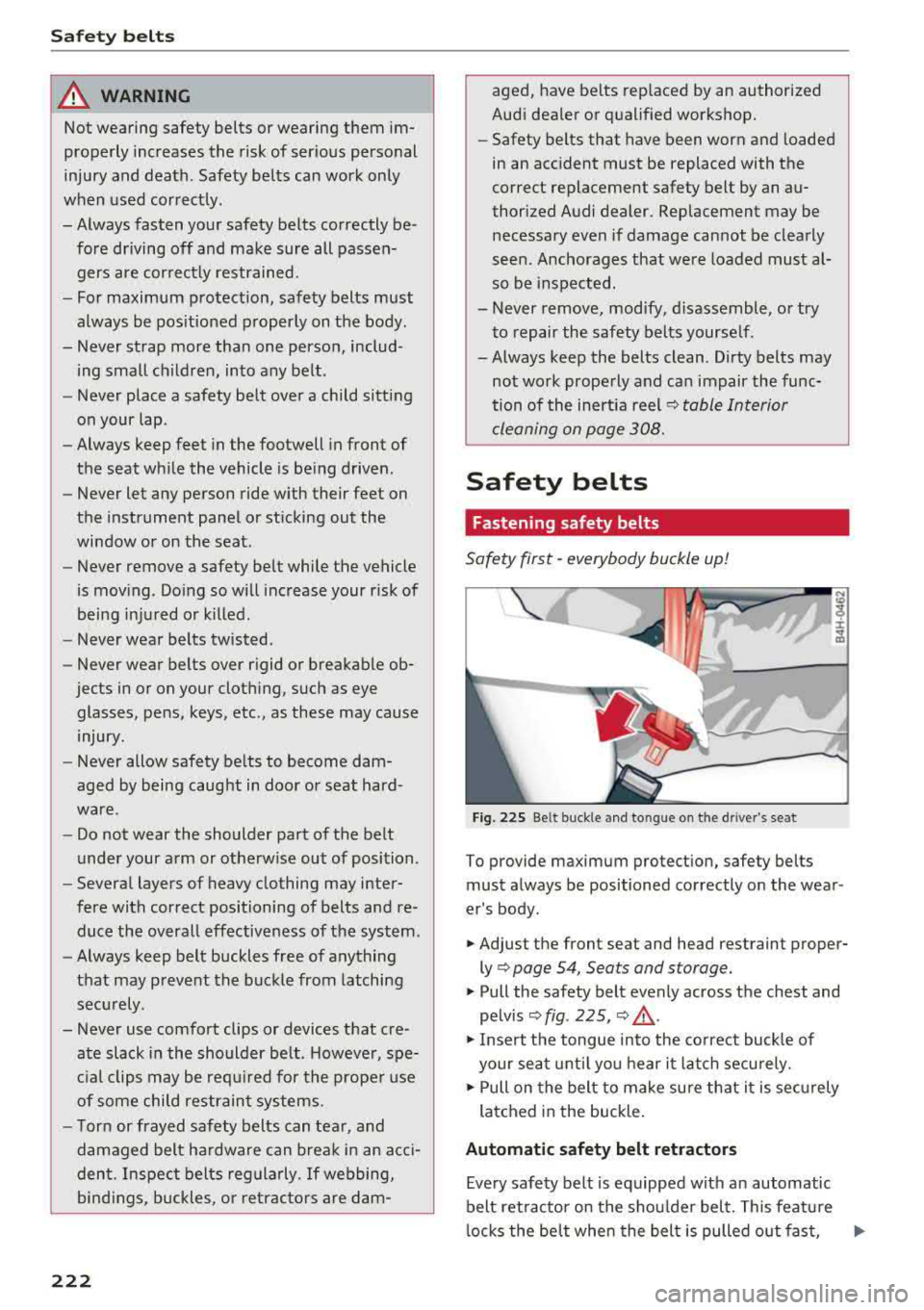
Fig. 225 Be lt buckle and tongue on the drive r's seat
To provide maximum protection, safety belts
must always be positioned correctly on the wear
er's body .
.. Adjust the front seat and head restraint proper
ly¢ page 54, Seats and storage.
.. Pull the safety belt evenly across the chest and
pelvis
Q fig . 225, Q _&. .
.. Insert the tongue into the correct buckle of
your seat until you hear it latch securely.
.. Pull on the belt to make sure that it is securely
latched in the buckle.
Automatic safety belt retractors
Every safety belt is equipped with an automatic
belt retractor on the shoulder belt. This feature
locks the belt when the belt is pulled out fast,
..,.
Page 257 of 356
Child safety seats
Infant seats
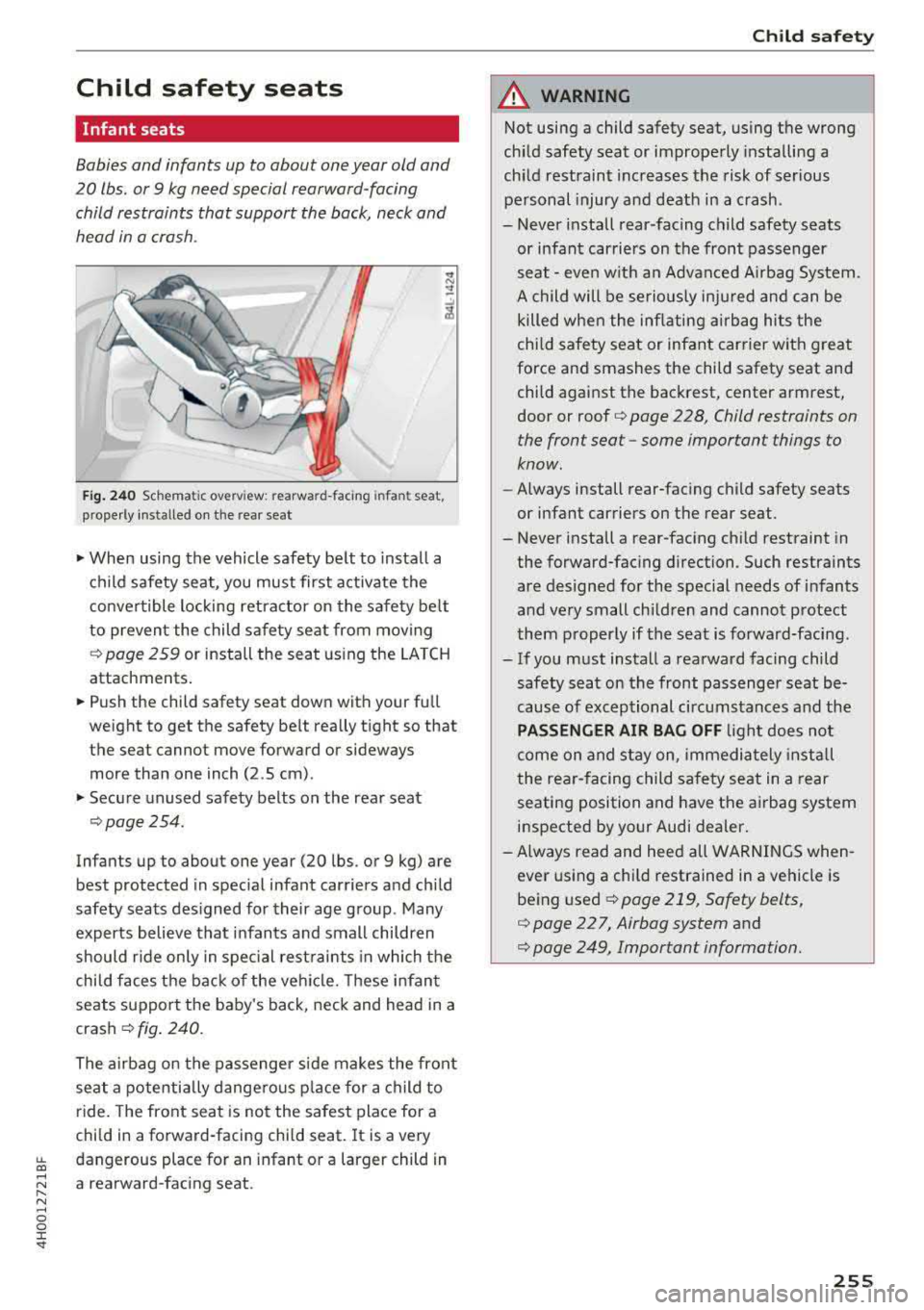
Babies and infants up to about one year old and
20 lbs. or 9 kg need special rearward -facing
child restraints that support the back, neck and
head in a crash .
Fig. 2 4 0 Sche matic overview: rearward-facing infant seat,
properly installed on the rear seat
• When using the vehicle safety be lt to install a
child safety seat, you must first activate the
convertible locking retractor on the safety be lt
to prevent the child safety seat from moving
¢ page 259 or install the seat using the LA TCH
attachments.
• Push the child safety seat down with your full
weight to get the safety belt really tight so that
the seat cannot move forward or sideways
more than one inch (2.5 cm).
• Secure unused safety belts on the rear seat
¢page 254 .
Infants up to about one year (20 lbs. or 9 kg) are
best protected in spec ial infant carriers and child
safety seats des igned for their age group . Many
experts believe that infants and small children
should ride only in spec ial restraints in which the
chi ld faces the back of the veh icle. These infant
seats support the baby 's back, neck and head in a
crash
c!;> fig . 240.
The airbag on the passenger side makes the front
seat a potentially dangero us p lace for a child to
ride. The front seat is not the safest place for a
chi ld in a forward -facing child seat . It is a very
lL dangerous place for an infant or a larger child in t:0
;:::: a rearward-facing seat.
" N ...... 0 0 :c '
A WARNING
Not using a child safety seat, using the wrong
child safety seat or improperly installing a
child restraint increases the risk of ser ious
personal injury and death in a c rash .
-Never install rear-facing child safety seats
or infant car riers on the front passenger
seat
-even w ith an Advanced A irbag System .
A child will be serio usly inj ured and can be
killed when the inf lating airbag hits the
chi ld safety seat or infant carrier with great
force and smashes the child safety seat and
child against the backrest, center armrest,
door or roof
c!;> page 228, Child restraints on
the front seat
-some important things to
know.
- Always install rear-fac ing child safety seats
or infant carriers on the rear seat.
-Never install a rear-facing child restraint in
the forward-fac ing direction . Such restraints
are designed for the special needs of infants
and very small children and cannot protect
them p roperly if the seat is forward-facing .
-If you must install a rearward facing child
safety seat on the front passenger seat be
cause of exceptional circumstances a nd the
PASSENGER AIR BAG OFF li ght does not
come on and stay on, immedia tely install
the rea r-facing child sa fety seat in a rear
seating position and have the a irbag system
inspected by your Audi dealer .
-A lways read and heed all WARNINGS whe n
ever using a child restrained in a vehicle is
be ing used
c!;> page 219, Safety belts,
c!;> page 227, Airbag system and
c!;> page 249, Important information.
255
Page 258 of 356
Child safety
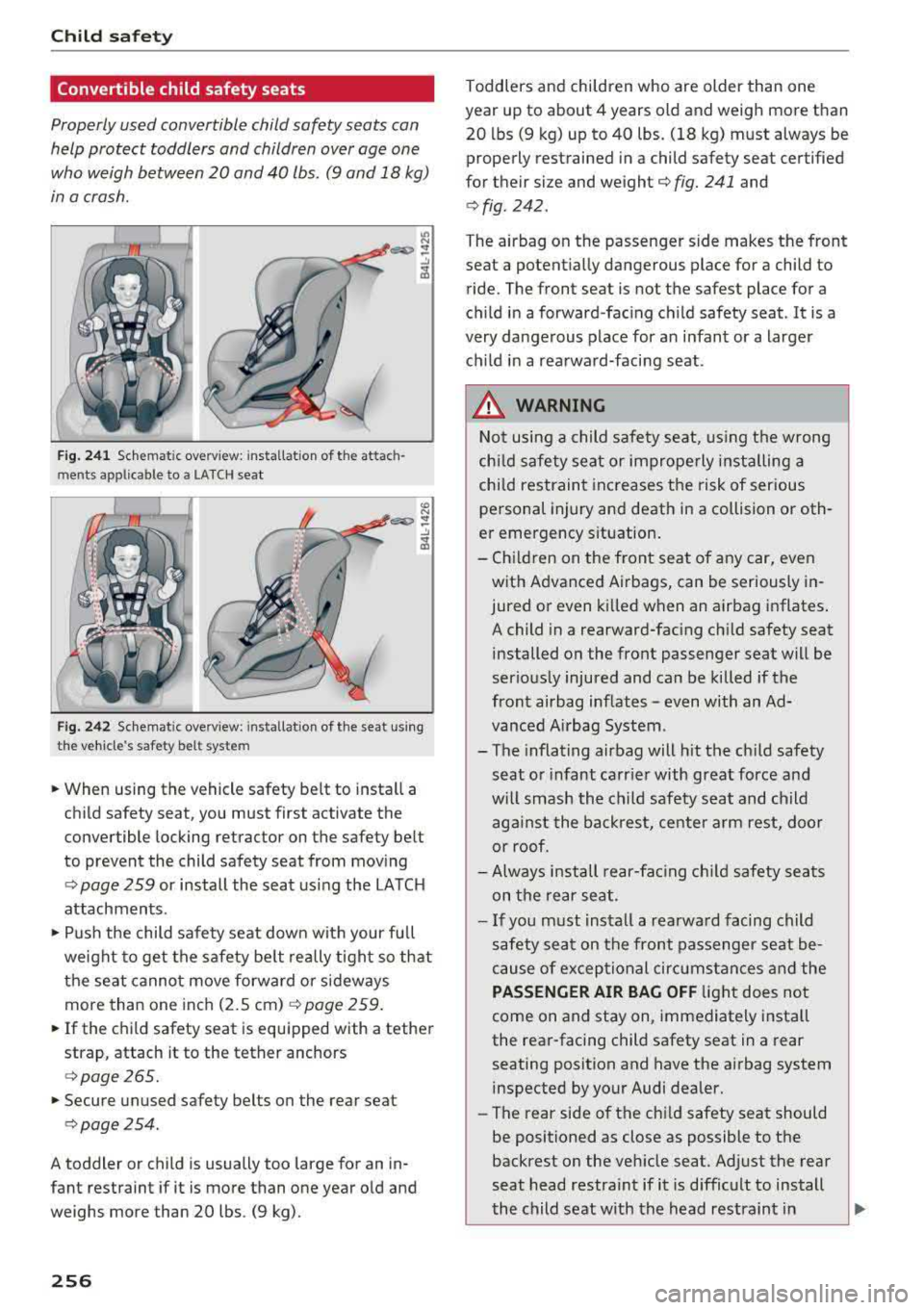
Convertible child safety seats
Properly used convertible child safety seats can
help protect toddlers and children over age one
who weigh between 20 and 40 lbs. (9 and 18 kg)
in a crash.
Fig. 241 Schematic overview: installat ion of the attach
ments app licable to
a LATCH seat
Fig. 242 Schematic overview: installat ion of the seat using
the vehicle 's safety belt system
... When using the vehicle safety belt to install a
child safety seat, you must first activate the
convertible locking retractor on the safety belt
to prevent the child safety seat from moving
c:>page 259 or install the seat using the LATCH
attachments .
... Push the child safety seat down with your full
weight to get the safety belt really tight so that
the seat cannot move forward or sideways more than one inch (2.5 cm)
c:>page 259.
... If the child safety seat is equipped with a tether
strap, attach it to the tether anchors
r::>page 265.
... Secure unused safety belts on the rear seat
r::>page254 .
A toddler or child is usually too large for an in
fant restraint if it is more than one year old and
weighs more than 20 lbs. (9 kg).
256
Toddlers and children who are older than one
year up to about 4 years old and weigh more than
20 lbs (9 kg) up to 40 lbs. (18 kg) must always be
properly restrained in a child safety seat certified
for their size and weight
c> fig. 241 and
c:>fig. 242 .
The airbag on the passenger side makes the front
seat a potentially dangerous place for a child to
ride. The front seat is not the safest place for a
child in a forward-facing child safety seat . It is a
very dangerous place for an infant or a larger
child in a rearward-facing seat .
.&_ WARNING
Not using a child safety seat, using the wrong
child safety seat or improperly installing a
child restraint increases the risk of serious
personal injury and death in a collision or oth
er emergency situation.
-Children on the front seat of any car, even
with Advanced Airbags, can be seriously in
jured or even killed when an airbag inflates. A child in a rearward-facing child safety seat
installed on the front passenger seat will be
seriously injured and can be killed if the
front airbag inflates -even with an Ad
vanced Airbag System .
-The inflating airbag will hit the child safety
seat or infant carrier with great force and
will smash the child safety seat and child
against the backrest, center arm rest, door
or roof.
-Always install rear-facing child safety seats
on the rear seat.
-If you must install a rearward facing child
safety seat on the front passenger seat be
cause of exceptional circumstances and the
PASSENGER AIR BAG OFF light does not
come on and stay on, immediately install
the rear-facing child safety seat in a rear seating position and have the airbag system
inspected by your Audi dealer .
- The rear side of the child safety seat should
be positioned as close as possible to the
backrest on the vehicle seat. Adjust the rear
seat head restraint if it is difficult to install
the child seat with the head restraint in
II>-
Page 261 of 356
any way during an accident can be struck by
a deploying air bag. This will result in ser ious
persona l injury or deat h.
- If you mus t install a boos ter seat on the
front passenger seat because of exceptional
c ircumstances the
PASSENGER AIR BAG
OFF
light must com e on and stay on, wh en
e v er th e ignition is switch ed o n.
- If the
PA SSEN GER AIR BAG OFF light does
not com e on and stay on, perform t he
c hecks d escribed
¢ page 237, Monitoring
t he A dvanced Airbag Syste m.
-Take the ch ild restraint off the front passen
ger seat and install it p roperly at one of the
rea r seat positions if the
PASSENGER AIR
BAG OFF
l ight does not stay on whenever
the ignition is switched on.
- Always read and heed all WARN INGS when
ever using a child res trained in a veh icle is
being used ¢
page 219, Safety belts,
¢ page 22 7, Airbag system and
¢ page 249, Important information.
Securing child safety
seats
Securing a child safety seat using a safety
belt
Safety belts for the rear seats and the front pas
senger can be locked with the convertible locking
retractor to properly secure child safety seats.
The safe ty be lts eme rgency locking ret racto rs fo r
the rear seats safety belts and for the front pas
senger's seat safety belt have a convertib le lock
ing retractor for child restraints. The safety belt
must be locked so that belt webbing cannot un
reel. The retractor can be activated to lock the
safety belt and prevent the safety belt webbing
from loose ning up du ring normal driving . A child
safety seat can only be p roperly installed w hen
the safety belt is locked so that the child and
chi ld safety seat w ill stay in pla ce.
A lways remember: Even though yo ur vehicle is
~ equ ipped w it h an Advanced A irbag system, all
~ chi ld ren, espe cially those 12 years and younge r,
g should always r ide in t he back se at prope rly re -
~ stra ined fo r their age and size .
Child s af ety
_& WARNING
= -
Imp roperly installed child safety seats in-
crease the risk of serious personal injury and
death in a co llision .
- Always make sure that the safety be lt re
tractor is locked when installing a child
safety seat. An un locked safety belt retrac
tor cannot hold t he ch ild safety seat in p lace
du ring normal driving or in a crash.
- Always buckle the child safety seat fi rm ly in
p lace even if a ch ild is not si tting in it. A
loose child safety seat can fly a round dur ing
a sudden s top or in a co llision .
- Always make sure that the rear seat back
rest to which the center rear safety belt is
at tached is securely lat ched whenever the
rear center safety belt is bein g used to se
cure a child restra int .
- If the backrest is not securely latched, the
child and the ch ild restraint will be thrown
forward togethe r with the backrest and w ill
strike parts of the veh icle inter io r. The child
can be seriously injured or killed.
- Never install rear-facing child safety seats or infant car riers on the front passenger
seat . A child w ill be seriously injured and
can be killed when the passenger a irbag in
flates .
- The inflating airbag will h it the ch ild safety
seat o r infant carr ier with great force and
will smash the child safety seat and child
aga inst the backrest, cente r arm res t, door
o r roof.
- Always install rear-fac ing child safety seats
or infant c arriers on t he rear se at.
- Forward-facing child safety seats o r infant
car riers installed on the front passenger's
se at m ay interfere w ith the deployment of
the airbag and ca use serio us in jury to the
child.
- I t is sa fer to install a forw ard- facing child
safety sea t on the rear seat.
- Always read and hee d all WARNINGS when
eve r using a child restrained in a vehicle is
be ing used ¢
page 249 . Special p recautions
apply when install ing a child safety seat on
the front passenger seat ¢
page 228, Child ~
259