service AUDI A8 2018 Repair Manual
[x] Cancel search | Manufacturer: AUDI, Model Year: 2018, Model line: A8, Model: AUDI A8 2018Pages: 356, PDF Size: 54.71 MB
Page 286 of 356
Wheels
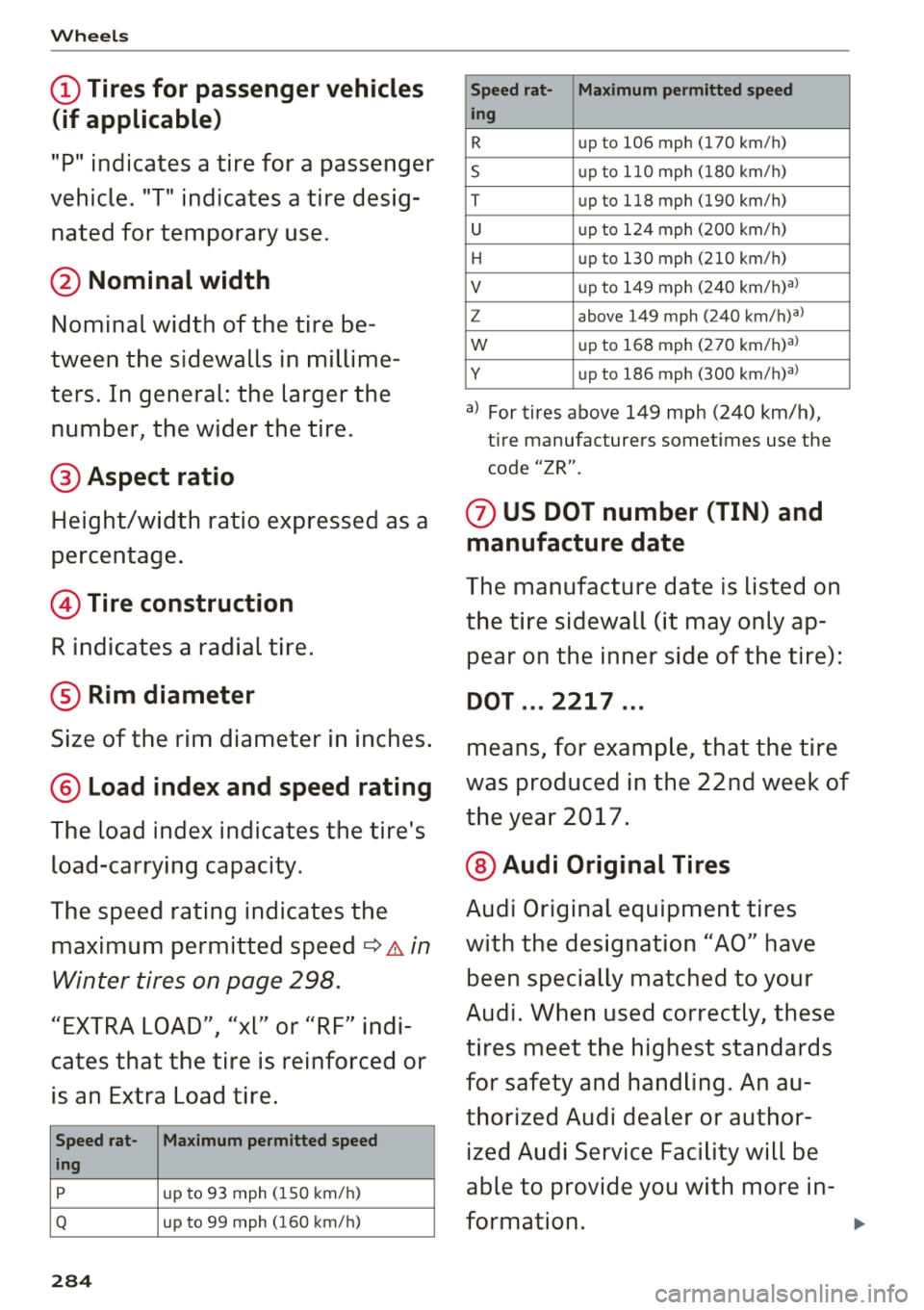
(D Tires for passenger vehicles
(if applicable)
"P" indicates a tire for a passenger
vehicle. "T" indicates a tire desig
nated for temporary use.
@ Nominal width
Nominal width of the tire be
tween the sidewalls in millime
ters. In general: the larger the number, the wider the tire.
@ Aspect ratio
Height/width ratio expressed as a
percentage.
© Tire construction
R indicates a radial tire.
® Rim diameter
Size of the rim diameter in inches.
@ Load index and speed rating
The load index indicates the tire's
load-carrying capacity.
The speed rating indicates the maximum permitted speed
c> & in
Winter tires on page 298.
"EXTRA LOAD", "xl" or "RF" indi
cates that the tire is reinforced or
is an Extra Load tire.
Speed rat-
Maximum permitted speed
ing
p
up to 93 mph (150 km/h)
Q up to 99 mph (160 km/h)
284
Speed rat- Maximum permitted speed
ing
R up to 106 mph (170 km/h)
s up to 110 mph (180 km/h)
T up to 1 18 mph (190 km/h)
u up to 124 mph (200 km/h)
H up to 130 mph (210 km/h)
V up to 149 mph (240 km/h) al
z above 149 mph (240 km/h)a)
w up to 168 mph (270 km/h) al
y up to 186 mph (300 km/h)a)
a) For tires above 149 mph (240 km/h),
tire manufacturers sometimes use the
code
"ZR".
0 US DOT number (TIN) and
manufacture date
The manufacture date is listed on
the tire sidewall (it may only ap
pear on the inner side of the tire):
DOT ... 2217 ...
means, for example, that the tire
was produced in the 22nd week of
the year 2017.
@ Audi Original Tires
Audi Original equipment tires
with the designation "AO" have
been specially matched to your
Audi. When used correctly, these
tires meet the highest standards
for safety and handling. An au
thorized Audi dealer or author
ized Audi Service Facility will be
able to provide you with more in
formation.
Page 292 of 356
Wheel s
Occupant loading and distri
bution for vehicle normal load
for various designated seating
capacities
Refer to the tire inflation pres
sure
label ¢ page 293, fig . 267
for the number of seating posi
tions . Refer to the
table¢ table
on page 295
for the number of
people that correspond to the ve
hicle normal load .
New tires or wheels
Audi recommends having all work
on tires or wheels pe rformed by
an authorized Audi dealer or au
thorized Audi Service Facility .
T hese facilities have the proper
knowledge and are equipped with
the required tools and replace
ment parts.
.,. New tires do not yet have the
optimum gripping properties. Drive carefully and at moderate
speeds fo r the first 350 miles
(500 km) with new tires .
.,. Use tires of the same construc
tion, size (rolling circumference)
and as close to the same tread pattern as poss ible on all four
wheels .
290
.,.Do not replace tires individually .
At least replace both tires on the
same axle at the same time.
.,. Audi recommends that you use
Audi Original Tires. If you would like to use different tires, please
note that the tires may perform
differently even if they are the
same
size¢ ,&.
.,. If you would like to equip your
vehicle with a tire/rim combina
tion that is different from what
was installed at the factory, con
sult with an authorized Audi
dealer or authorized Audi Service
F acility before making a pur
chase ~ &-
The spare tire* is different from
the regular tires installed on the
vehicle - for example, if winter
tires or wide tires are installed -
so only use the spare tire* tempo
rarily in case of emergency and
drive carefully while it is in use. It
should be replaced with a regular
tire as soon as possible.
All four wheels must be equipped
with tires that are the same brand and have the same construction
and tread pattern so that the
drive system is not damaged by
different tire speeds. For this rea-
son, in case of emergency, only
.,.
Page 294 of 356
Wheels
-Have an authorized Audi dealer or authorized Audi Service Facili
ty check the wheel alignment if
there is unusual wear .
-Have the wheels rebalanced if an imbalance is causing noticeab le
vibration in the steering wheel.
If you do not, the tires and other
vehicle components could wear more qu ickly .
Treadwear indicator
Original equipment t ires contain
treadwear indicators in the tread pattern, which are bars that are 1/16 in (1 .6 mm) high and are
spaced evenly around the ti re per
pendicular to the running direc
tion. The letters
"TWI" or trian
gles on the tire sidewall indicate
the location of the treadwear in
dicators .
T he tires have reached the mini
mum tread depth
l) when they
have worn down to the treadwear
indicators. Replace the tires with
new ones
c:::> ,.1. .
Tire rotation
Rotating the tires regularly is rec
ommended to ensure the tires
1> Obey any applicable regulations in your
country.
2 92
wear evenly . To rotate the tires,
install the tires from the rear ax le
on the front axle and vice versa .
This will allow the tires to have app roximately the same lengt h of
service life .
F or unidirectional tires , make
sure the ti res are installed accord
ing to the running direction indi
cated on the tire sidewall
c:::>page 319 .
Hidden damage
Damage to tires and rims can of
ten occur in locations that are hidden. Unusual vibrations in the
vehicle or pulling to one side may indicate that there is tire damage.
Reduce your speed immediately .
Check the tires for damage . If no
damage is visible from the out
side , drive slow ly and caref ully to
the nearest authorized Audi deal er or authorized Audi Service Fa
cility to have the vehicle inspect
ed .
& WARNIN G ~
Tread that has worn too low or
different tread depths on the
tires can reduce driving safety.
11>
Page 300 of 356
Wheels
the available cargo and luggage load capacity of your vehi
cle.
.,.Check the tire sidewall
(¢ page 283, fig. 264) to deter
mine the designated load rating
for a specific tire.
Wheel bolts and rims
Wheel bolts
Wheel bolts must be clean and loosen/tighten
easily .
Rims
Rims with a bolted rim ring* or with bolted wheel
covers* consist of multiple pieces . These compo
nents were bolted together using special bolts
and a special procedure. You must not repair or
disassemble
them £:=?.&. .
A WARNING
Wheel bolts that are tightened or repaired in
correctly can become loose and result in loss
of vehicle control, which increases the risk of
an accident. For the correct tightening specifi
cation, see
¢page 314.
- Always keep the wheel bolts and the
threads in the wheel hub clean and free of grease.
- Only use wheel bolts that fit the rim.
- Always have damaged rims repaired by an
authorized Audi dealer or authorized Audi
Service Facility. Never repair or disassemble
rims yourself, because this increases the risk
of an accident .
Winter tires
Winter tires significantly improve the vehicle's
handling when driving in winter conditions. Be
cause of their construction (width, compound,
tread pattern) , summer tires provide less trac
tion on ice and snow.
298
.. Use winter tires on all four wheels .
.. Only use winter tires that are approved for your
vehicle.
.. Please note that the maximum permitted
speed may be lower with winter
tires¢ _&.. An
authorized Audi dealer or authorized Audi Serv
ice Facility can inform you about the maximum
permitted speed for your tires .
.,. Check the tire pressure after installing wheels
¢page 293 .
The effectiveness of winter tires is reduced great
ly when the tread is worn down to a depth of
0.157 in (4 mm). The characteristics of winter
tires also decrease greatly as the tire ages , re
gardless of the remaining tread.
A WARNING
- Never drive faster than the maximum per
mitted speed for your tires. This could cause
the tires to heat up too much. This increases
the risk of an accident because it can cause
the tire to burst .
- Always adapt your driving to the road and
traffic conditions. Drive carefully and reduce
your speed on icy or slippery roads. Even
winter tires can lose traction on black ice .
® For the sake of the environment
Reinstall summer tires at the appropriate
time, because they provide better handling
when roads are free of snow and ice. Summer
tires cause less road noise, tire wear and fuel
consumption.
(D Tips
You can also use all season tires instead of
winter tires. Please note that in some coun
tries where winter tires are required, only
winter tires with the
& symbol may be per
mitted.
Snow chains
-
Snow chains not only improve the driving in win
ter road conditions, but also the braking.
.,. Only install snow chains on the front wheels. .,.
Page 301 of 356
u. co .... N
" N .... 0 0 :c '
chains after driving a few feet, if necessary. Fol
low the instructions from the manufacturer.
~ Note the maximum speed of 30 mph (SO km/
h). Note the loc al regulations.
Use of snow chains is only permitted with certain
rim/tire combinations due to technical reasons.
Check with an authori zed Audi dealer or author
ized Audi Service Facility to see if you may use
snow chains .
You must remove the snow chains on roads with
out snow. Otherwise, you could impair driving
ability and damage the tires.
A WARNING
Using incorrect snow chains or installing snow
chains incorrectly can result in loss of vehicle
control, which increases the risk of an acci
dent.
0 Note
-Snow chains can damage the rims/wheel
covers* if the chains come into direct con·
tact with them . Remove the wheel covers*
first. Use coated snow chains.
-Using snow chains that add more than 0.4
inch (10.5 mm) of height can severely dam
age the wheel housings and other vehicle
components.
-Do not install and use snow chains if there is
a malfunction in the adaptive air suspen
sion, because the vehicle height will be very
low. If you drive with snow chains anyway,
the wheel housings and other vehicle com ponents can be severely damaged.
@ Tips
When using snow chains, it may be useful to
switch on sport mode
¢ page 128.
Low-profile tires
Appl ies to: ve hicles w ith low-profile tires
Your vehicle is equipped with low-profile tires* at
the factory . Compared to other tire/rim combina
tions, low-profile tires offer a wider tread surface
and a larger rim diameter with shorter tire side-
Wheels
walls. This results in an agile driving style. How
ever, it may reduce the level of comfort and in
crease road noise when driving on roads in poor
condition.
Low-profile tires can become damaged more
quickly than standard tires when driving over
large bumps, potholes, manhole covers, speed
bumps and curbs. Therefore, it is particularly im
portan t to maintain the correct tire pressure
¢ page 293.
To reduce the risk of damage to the tires and
rims, drive very carefully on poor roads.
Check your wheels regularly every 2,000 mi
(3,000 km) for damage. For example, check for
bulges/cracks on the tires or deformations/
cracks on the rims.
After a heavy impact or damage, have the tires
and rims inspected or replaced immediately by
an authorized Audi dealer or authori zed Audi
Service Facility.
Low-profile tires can wear out faster than stand
ard tires.
Summer tires are not suitable for cold weather,
snow or black ice. If you are driving in these con
ditions, use winter or all season tires
¢ page 298.
Uniform tire quality grading
-Tread wear
-Traction AA AB C
-Temperature ABC
Quality grades can be found where applicable on
the tire side wall between tread shoulder and
maximum section width
¢ page 283, fig. 264.
For example: Tread wear 200, Traction AA, Tem
perature
A .
All passenger car tires must conform to Federal
Safety Requirements in addition to these grades .
Tread wear
The tread wear grade is a comparative rating
based on the wear rate of the tire when tested
299
Page 302 of 356
Wheels
under controlled conditions on a specified
government test course.
For example, a tire graded 150 would wear one
and one ha lf (11/2) times as well on the govern
ment course as a tire graded 100 .
The relative performance of tires depends upon
the actual conditions of their use, howeve r, and
may depart significant ly from the norm due to
variations in driving habits, service practices and
differences in road characteristics and climate .
Traction
The traction grades, from highest to lowest, are
AA, A, Band
C. Those grades represent the tire's
ability to stop on wet pavement as measured un
der contro lled conditions on specified govern
ment test surfaces of aspha lt and concrete. A tire
marked C may have poor traction performance
¢ & .
Temperature
The temperatu re grades are A (t he highest), B ,
and C, representing the tire's resistance to the
generation of heat and its ability to dissipate
heat when tested under controlled conditions on
a specified indoor laboratory test wheel.
Sustained high temperature can cause the mate
rial of the tire to degenerate and reduce tire life,
and excessive temperature can lead to sudden
tire
fa ilure¢ fr:. .
The grade C corresponds to a leve l of perform
ance which a ll passenger car tires must meet un
der the Federa l Motor Vehicle Safety Standard
No. 109. Grades B and A represent higher leve ls
of performance on the laboratory test wheel than
the mi nimum required by law.
A WARNING
-
The traction grade assigned to this tire is
based on straight-ahead braking traction
t ests, and does not include acceleration, cor
nering, hydroplaning or peak traction charac
teristics.
300
A WARNING
The temperature grade for t his tire is estab
lished for a tire that is properly inflated and
not overloaded. Excessive speed, underinfla
tion, or excessive loading, either separately or
in comb ination , can cause heat buildup and
possible tire failure.
A WARNING
-
-
Temperature grades apply to tires that are
properly inflated and not over or under inflat
ed .
Tire Pressure Monitoring
System
(AS, S8)
ill General notes
Applies to: AS, 58
Each tire, including the spare (if prov ided),
shou ld be checked monthly when cold and inflat
ed to the inflation pressure recommended by the
vehicle manufacturer on the vehicle placard or
tire inflation pressure labe l.
(If your veh icle has
tires of a different size than the size ind icated on
the ve hicle placard or tire inflat ion pressure la
bel , you should determ ine the proper tire infla
tion pressure for those tires).
As an added safety feature, your vehicle has been
equipped with a tire pressure mon itor ing system
(TPMS) that illum inates a low tire pressure tell
tale when o ne or more of your tires is significant
l y unde r-inflated. According ly, when the low tire
pressure telltale illum inates, you sho uld stop and
check your tires as soon as possible, and inflate
them to the proper pressure . Driving on a signifi
cant ly under -inflated tire causes the tire to over
heat and can lead to tire fai lure. Under-inflation
also reduces fue l eff iciency and tire tread life,
and may affect the vehicle's handling and stop ping ability.
Please note that the TPMS is not a substitute for
proper tire maintenance, and it is the dr iver's re
spons ibility to maintain correct t ire pressure,
even if under-inflation has not reached the level
to trigger illumination of the TPMS low tire pres-
sure te lltale .
.,.
Page 303 of 356
lL t:0 ....
"" ......
"" .... 0 0 :c '
malfunction indicator to indicate when the sys
tem is not operating properly. The TPMS mal
function indicator is combined with the low tire
pressure telltale. When the system detects a
malfunction, the telltale will flash for approxi
mately one minute and then remain cont inuously
illuminated . This sequence will continue upon
subsequent vehicle start-ups as long as the mal
function ex ists.
When the malfunction indicator is illuminated,
the system may not be ab le to detect or signal
low tire pressure as intended . TPM S malfunctions
may occur for a var iety of reasons, including the
installation of replacement or alternate tires or
wheels on the vehicle that prevent the TPMS
from functioning properly. Always check the
TPMS malfunction telltale after replacing one or
more tires or wheels on your vehicle to ensure
that the replacement or alternate tires and
wheels allow the TPMS to continue to function
properly.
If the Tire Pressure Monitoring System
indicator appears
Applies to: AS, 58
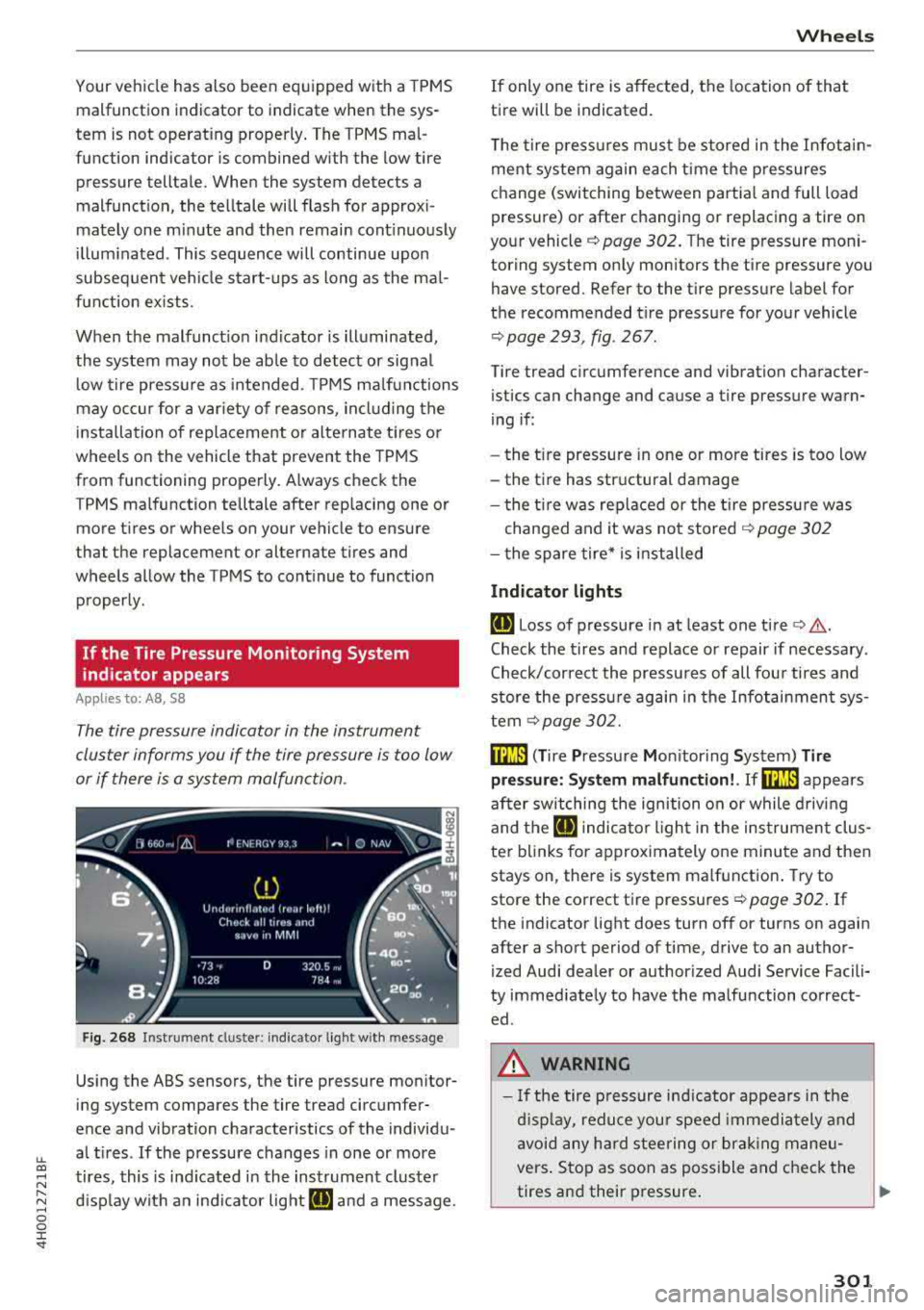
The tire pressure indicator in the instrument
cluster informs you if the tire pressure is too low
or if there is a system malfunction .
Fig. 268 Instrument clus ter: indicator light with message
Using the ABS sensors, the tire pressure monitor
ing system compares the tire tread circumfer
ence and vibration characteristics of the individu
al tires . If the pressure changes in one or more
tires, this is ind icated in the instrument cluster
display with an indicator light
ti] and a message .
Wheels
If only one tire is affected, the location of that
tire will be indicated.
The tire pressures must be stored in the Infotain
ment system again each time the pressures
change (switching between partial and full load
pressure) or after changing or replacing a tire on
your vehicle
c:> page 302. The tire pressure mon i
toring system only monitors the tire pressure you
have stored. Refer to the tire pressure label for
the recommended tire pressure for your vehicle
c:> page 293, fig . 267 .
Tire tread circumference and vibration character
istics can change and cause a tire pressure warn
ing if :
- the t ire pressure in one or more tires is too low
- the tire has structural damage
- the tire was replaced or the tire pressure was
changed and it was not stored
c:> page 302
- the spare tire* is installed
Indicator lights
ti] Loss of pressure in at least one tire c:> ,&..
Check the tires and replace or repair if necessary.
Check/correct the pressures of all four tires and
store the pressure again in the Infotainment sys
tem
c:>page 302.
mm ( T ire Pressure Monitor ing System) Tire
pressure: System malfunction!. Ifm:m appears
after switching the ignition on or while driving
and the
ti] indicator light in the instrument clus
ter blinks for approximately one minute and then
stays on, there is system malfunction. Try to
store the correct tire pressures
c:> page 302. If
the indicator light does turn off or turns on again
after a short period of time, drive to an author
ized Audi dealer or authorized Audi Service Facili
ty immediately to have the malfunction correct ed .
.&, WARNING
- If the tire pressure ind icator appears in the
display, reduce your speed immediately and
avoid any hard steering or braking maneu
vers. Stop as soon as possible and check the
tires and their pressure.
..,.
301
Page 304 of 356
Wheels
-The driver is responsible for maintaining the
correct tire pressure. You must check the
tire pressure regularly.
- Under certain conditions (such as a sporty
driving style, winter conditions or unpaved
roads), the tire pressure monitoring system
indicator may be delayed .
- Do not use run-flat tires on your vehicle. Us
ing them when not permitted can lead to
vehicle damage or accidents .
(D Tips
- The tire pressure monitoring system can al
so stop working when there is an ESC mal
function .
- Using snow chains may result in a system
malfunction.
- The tires with the identification
"AO" or
"RO" ¢ page 290 have been matched with
your Audi tire pressure monitoring system.
Using these tires is recommended.
Storing tire pressures
Applies to: AB, S8
If the tire pressure changes or a tire is replaced,
it must be confirmed in the Infotainment sys
tem .
.,. Make sure before storing that the tire pressures
of all four tir es meet the specified values and
are adapted to the
load ¢ page 291 .
.,. Switch the ignition on .
.,. Select : the ICARI function button > Car Systems
control button > Service & control > Tire pres
sure monitor> Store tire pressure > Yes, store
now.
(D Tips
Do not store the tire pressures if snow chains
are installed. Otherwise the system could
malfunction.
302
Tire Pressure Monitoring System (SB plus)
ill General notes
Applies to: S8 plus
Each tire, including the spare (if provided),
shou ld be checked monthly when cold and inflat
ed to the inflation pressure recommended by the
vehicle manufacturer on the vehicle placard or
tire inflation pressure label. (If your vehicle has
tires of a different size than the size ind icated on
the veh icle placard or tire inflat ion pressure la
bel, you should determine the proper tire infla
tion pressure for those tires).
As an added safety feature, your vehicle has been
equipped with a tire pressure mon itor ing system
(TPMS) t hat illuminates a low tire pressure tell
ta le when o ne or more of your tires is significant
l y under-inflated. According ly, when the low tire
pressure telltale illuminates, you should stop and
check your tires as soon as possible, and inflate
them to the proper pressure . Driving on a signifi
cant ly under-inflated tire causes the tire to over
heat and can lead to tire failure . Under-inflation
also reduces fuel efficiency and tire tread life,
and may affect the vehicle's handling and stop
ping ability .
Please note that the TPMS is not a substitute for
proper tire maintenance, and it is the driver's re
spons ibility to maintain correct t ire pressure,
even if under-inflation has not reached the level
to trigge r illumination of the TPM S low t ire pres
su re te lltale.
Your vehicle has also been equipped with a TPMS
malfunction indicator to ind icate when the sys
tem is not operating prope rly . The TPM S mal
function indicator is combined with the low t ire
pressure telltale. When the system detects a
malfunction, the telltale will flash for approxi
mately one minute and then remain continuously
illuminated. This sequence wi ll continue upon
subsequent vehicle start-ups as long as the mal
function exists.
When the malfunction indicator is illuminated,
the system may not be able to detect or signal
low tire pressure as intended. TPMS
malfunctions ..,_
Page 305 of 356
u. co .... N
" N .... 0 0 :c '
installation of replacement or alternate tires or
wheels on the vehicle that prevent the TPMS
from functioning properly . Always check the
TPMS malfunction telltale after replacing one or
more tires or wheels on your vehicle to ensure
that the replacement or alternate tires and
wheels allow the TPMS to continue to function
properly.
Description
Applies to: 58 plus
The tire pressure monitoring system monitors
the pressure in the four tires when driving.
The system uses sensors that measure the tem
perature and pressure in the tires . The data is
sent from these sensors to the control module by
radio frequency.
The Tire Pressure Monitoring System shows the
current pressures and temperatures of the tires
in the Infota inment system
c:> page 303 . It also
compa res the current tire pressures with the
stored tire press ures and gives a warning in the
driver information system if the tire pressure is
different from what is stored
c:> page 304.
The system does not detect if the stored tire
pressures match the recommended tire pres
sures.
- Every time the tire pressures change, for exam-
ple when the load in the vehicle changes,
- after replac ing a tire, or
- if wheels with new wheel sensors are used,
you must store the tire pressures again
c:> page 304.
A WARNING
-The tire pressure mon itor ing system assists
the driver in monitoring tire pressures. The
dr iver is responsible for having the tires in
flated to the correct pressure.
- Do not change the tire pressure when the
temperature of the tire is extremely high.
T his cou ld result in serious damage to the
t ir e and even cause the tire to burst, in
creasing the risk of an accide nt.
Wheels
-A tire with low pressure flexes more . This
heats the tire up too much. This could cause
the tread to separate and even cause the
tire to burst, increasing the risk of an acci
dent.
- The Tire Pressure Monitoring System does
not warn you of damage or defects in the
tire construct ion that could cause the tire to
burst, for example. Inspect your tires regu
larly.
@ For the sake of the environment
Low tire pressure increases fuel consumption
and tire wear.
(D Tips
-The pressure of the spare t ire* is not mon i
tored.
- If tires are replaced, the sensors/va lves do
not need to be removed or replaced. Just re
placed the valve stem and, if necessary, the
valve and the whee l electronics . If you have
questions, see an authorized Audi dealer or
authorized Audi Service Facility.
Displaying tire pressures/temperatures
Applies to: 58 plus
Requirement: the ignition must be switched on.
.. Select: the I CAR! funct ion button > Car systems
> Service & control > Tire pressure monitor >
Display tire pressure .
The current tire pressures are shown in green and
yellow numbers in the Infotainment system:
-Green: the current tire pressure and the spec i
fied tire pressure are approx imately the same .
-Yellow: the current tire pressure is too low
compared to the specified tire pressure .
The specified tire pressure is the last tire pres
sure that was stored
c:> page 304 .
Note that the tire pressure also depends on the
temperature of the tire . The tire pressure in
creases as the engine becomes warmer while
driv ing.
.,.
303
Page 306 of 356
Wheels
~ WARNING
Read and follow the important information
and notes ¢
page 303.
© Tips
The tire pressure or tem perature a re not di s
played in ada pta tion mode. Da shes --.-- a re
shown in place of the press ure and tempera
ture .
Tire pressure loss
Applies to: 58 plus
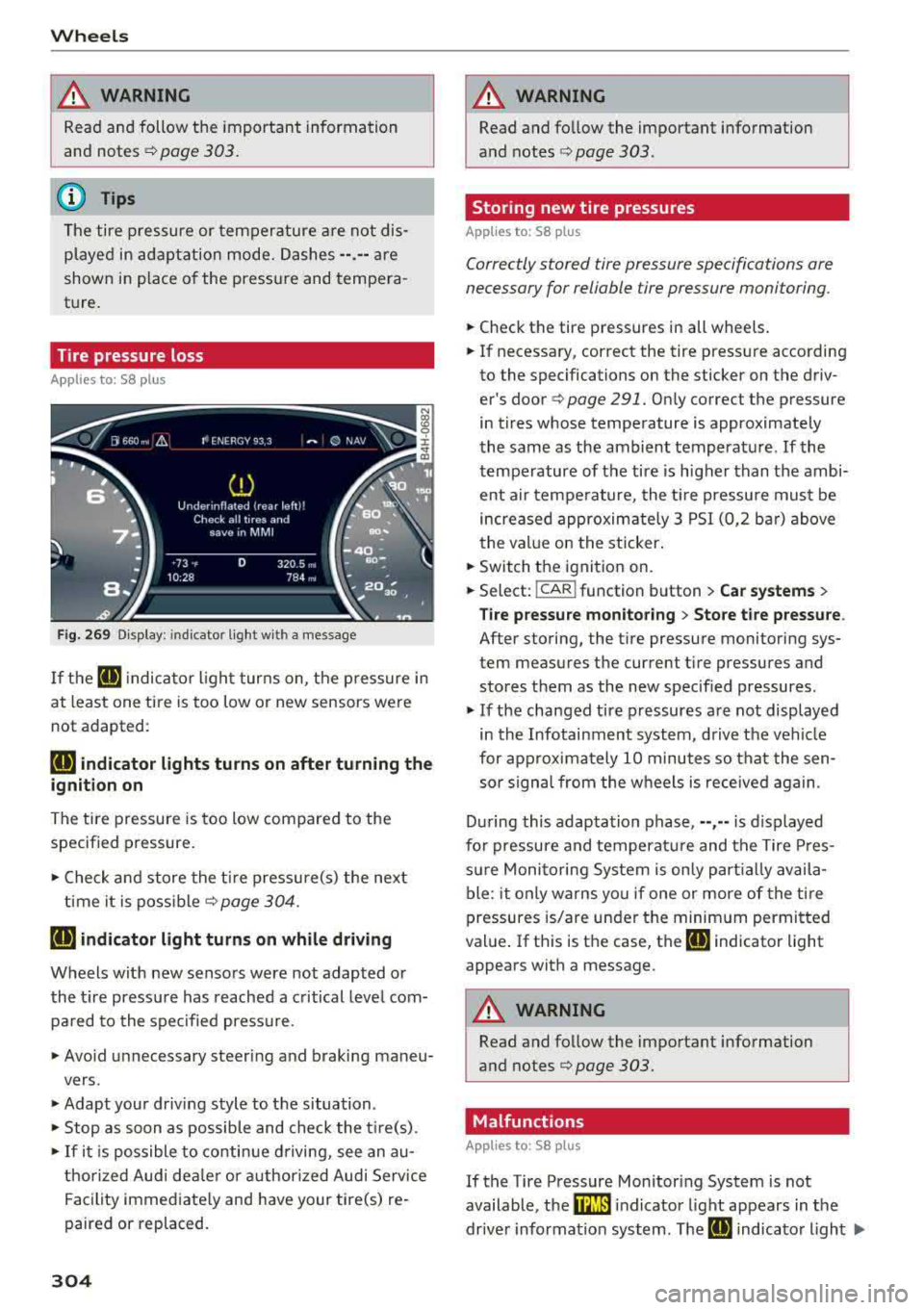
F ig. 269 D isp lay: ind icator light wi th a message
-
If the IE indica to r li ght turns on, the p ressure in
at least one ti re is too low or new sensors were
not adapted :
RE indicator lights turns on after turning the
ignition on
The tire pressure is too low compared to the
specif ied pressure .
.,. Check and store the t ire pressure(s) the next
ti me it is poss ible¢
page 304 .
RE indicator light turns on while driving
Wheels with new senso rs were not adapted or
the t ire pressu re has reached a c ritical leve l com
p ar ed to the specified press ure.
.,. Avo id unnecessary steering and braking maneu-
vers .
.,. Adapt you r d riving style to the situation .
.,. Stop as soon as possible and check the t ire(s) .
.,. If it i s po ssible to co nti nu e d riving, see an au-
t horized Audi dea le r or a uthorized Audi Service
Fa cility immed iate ly and have your tire(s) re
paired or replaced.
304
A WARNING
, -
Read and fo llow the important information
and notes
¢ page 303.
Storing new tire pressures
App lies to: 58 pl us
Correctly stored tire pressure specifications are
necessary for reliable tire pressure monitoring.
.,. Check the tire pressures in all wheels .
-
.,. If necessary , correct the tire press ure according
to the specifications on the sticker on the driv
er's doo r
q page 291. On ly co rrect t he pressure
in t ires whose tempe rature is appro ximate ly
the same as the ambient tempera ture. If the
tempe rature of the tire is higher than the ambi
ent air tempe rature, the t ire pressure must be
i n creased approxim ate ly 3 PSI (0 ,2 ba r) above
the val ue on the sticker .
.,. Switch the ignitio n on .
.,. Select: !CAR ! function button > Car systems >
Tire pressure mon itoring > Sto re tire pressure .
After storing, the t ire pressu re monitoring sys
tem measures t he current t ire pressures and
s to res them as the new specif ied pressures .
.,. If the changed tire p ressures are not displayed
in the Infotainment system, d riv e the veh icle
for approximately 10 minutes so that the sen so r signa l from the w heels is received again.
D ur ing this adapta tion phase, --,--is displayed
fo r pressure and temperat ure and t he Tire Pres
su re Moni toring Sys tem is on ly p arti all y av ail a
ble: it only warns yo u if one or more of the tire
pressures is/are under t he minim um permitted
val ue. If th is is the case, the
IE indicator light
appears with a message .
A WARNING
Read and follow the important information
and notes
q page 303.
Malfunctions
App lies to: 58 plus
-
If the Tire Pressure Mon itoring System is not
available, t he
mm indicato r light appears in the
dr ive r informa tion system . T he
IE indica to r light .,..