light AUDI ALLROAD 2000 Owners Manual
[x] Cancel search | Manufacturer: AUDI, Model Year: 2000, Model line: ALLROAD, Model: AUDI ALLROAD 2000Pages: 306, PDF Size: 9.95 MB
Page 214 of 306
Washing
The best protection against environmental
influences is frequent washing and waxing.
How often this is required depends on how
much the vehicle is used, where it is parked
(garage, in the open under trees, etc.), the
seasonal and weather conditions as well as
env ironmental influences. The longer bird
droppings, insects, tree resin, road and in
dustrial grime, tar, soot, road salt and other
materials remain on the vehicle paint, the
more lasting their destructive effect will be.
High temperatures, as from strong sunlight,
intensify the corrosive effect.
Under certain circumstances, weekly
washing may be necessary. Under other
conditions. a monthly washing and waxing
may be adequate.
After the winter, the underside of the ve
hicle should be thoroughly washed. Automatic
car wash
The vehicle paint is so durable that the ve
hicle can normally be washed without prob
lems in an automatic car wash. However,
the effect on the paint depends to a large
extent on the design of the facil ity, the filter
ing of the wash water, the type of wash and
care material, etc. If the paint has a dull ap
pearance after going through the car wash
or is scratched, bring this to the atte ntion of
the operator immediately. If necessary use
a different car wash.
Notes
• Before going through a car wash, be sure
to take the usual precautions such as clos
ing the windows and sunroof*.
• You don't have to remove the factory
installed radio antenna. However, if your ve
hicle is equipped with the Navigation Sys
tem*, then you must remove the antenna.
• If you have installed additional accesso
ries on the vehicle -such as spoilers, roof
rack, etc. -it is best to ask the car wash op
erator if these should be remov ed. VE
HICLE CARE
Washing the vehicle by hand
� In the intsi'Sst of the environ
� msnt, the vehicle should only be
washed in special wash bays.
First soften the dirt with plenty of water and
rinse off as well as possible.
Then clean the vehicle with a soft sponge,
glove or brush starting on the roof and work
ing down using only slight pressure. Special
car wash soap should only be used for very
persistent dirt.
Rinse the sponge or glove thoroughly and
oft en.
Clean wheels .and sill panels last, using a dif
ferent sponge if pos sible.
After washing the vehicle, rinse thoroughly
with water and wipe it off.
213
Page 215 of 306
VEHICL E CA
RE----------------------------------------------------
Notes
• Do not wash the vehicle in direct sun
light.
• If the vehicle is rinsed with a hose, do not
direct the water into the lock cylinders -
otherwise they may freeze up in the winter.
�W ARNING
• Do not wash, wax or dry the ve
hicle with the engine running.
• Do not clean the underside of
chassis, fenders, wheel covers,
etc. without protecting your
hands and arms. You may cut your
self on sharp-edged metal parts.
• Moisture and ice on brakes may
affect braking efficiency. Test the
brakes carefully after each vehicle
wash.
214 Washing
your vehicle with a power
washer
If you use a power washer, please note the
following:
• Always follow the operating instructions
for the power washer -especially for pres
sure and spraying distance.
• Make sure that the jet on the spray hose
produces a "fan shape" spray. Do not use
a jet which sprays the water out in a direct
stream or one that has a rota ting jet.
• Water temperature should not exceed
140 °F (60 °C).
�W ARNING
Never wash tires with a jet that
sprays the water out in a direct
stream. This could invisibly dam
age and weaken the tires, even if
they are sprayed from a relatively
long distance for a vary short
amount of time. Damaged and
weakened tires can fail and cause
accidents and personal injury. Headli
ghts
Do not clean your headlights with a dry
towel or sponge. They must be cleaned
with a moistened towel.
Never use a sponge designed for removing
dried-on insects, a kitchen scrubber or any
other similar product since the lens surface
can be damaged by scrat ching and scour
ing.
When using high-pressure washing equip
ment or steam-cl eaning units, never spray
the vehicle with the nozzle close the vehicle
surface and never aim the spray at the same
point for a relatively long period of time.
Polishing Please refer to the imp ortant information on
page 212.
Polish your vehicle only if the paint has lost
its shine and the gloss cannot be brought
back with wax. If the polish used doesn't
contain preservative compounds, the paint
must be waxed afterwards.
Do not treat matte- pain�ed and plas
tic parts with polish or wax.
Page 216 of 306
Waxing
Please refer to the important information on
page 212.
• A good wax coati ng protects the vehicle
paint to a large extent against the environ
mental influences listed under "Washing"
and even agains t light scratches.
• When water doesn't form small drops
and roll off clean paint, apply a coat of good
hard wax. Even if a wax solution is used reg
ularly for washing your vehicle, it is advis
able to protect the paint with a coat of hard
wax at least twice a year.
• To protect bright metal trim, use car wax.
• Protect plastic body parts painted the
same as the vehicle body with car wax.
• Do not use car wax on ...
- matte or anodized metal trim
rubber or rubber-l ike trim. Tr
im strips
Dirty patches and marks on the trim strips
should be removed with a pH-balanced
cleaning agent (do not use a chrome
cleaner). Audi Dealers carry cleaning prod
ucts which have been tested for use on your
vehicle and are not harmful to the environ
ment.
To avoid corrosion on the exterior trim
str ips, only a pH-balanced solution should
be used for the windshield washer.
To uch-up paint
Yo ur Audi Dealer has touch-up paint for mi
nor scratches and stone chips. Scratches
should be touched up soon after they occur
to prevent corrosion.
If a spot starts to rust, however, a simple
touch-up job won't be enough. The affected
surface must be smoothed with sand paper
and covered with an anti-rust primer before
the painted finish can be restored.
The n umber for the original vehicle paint can
be found on the vehicle identification label
- see page 291 . VE
HICLE CARE
Windows Clean all windows regularly to remove road
film and car- wash wax buildup. Use a luke
warm soap and water sol uti on or an alcohol
based commercial window cleaning agent.
If a chamois is used for polishing the glass,
it should be used exclusively for that pur
pose.
Also, be sure to clean all windows regularly
on the inside.
Use a plastic scraper to remove snow and
ice from windows and mirrors. To help pre
vent dirt from scratching the windo w, al
ways scrape in a forward direction -push
ing the scraper away from you-never back
and forth.
Note
To prevent damage the wires of the rear
defogger, do not place any adhesive stick
ers in the inside of the rear window over the
wires.
215
Page 217 of 306
VEHICL E
CA RE-------------------------
Weatherstrips
Keep silicone sprays off the wind
shield to avoid wiper smear in rain.
To seal properly, weatherstrips around
hood, rear lid, doors, etc., must be pliable.
Spray with silicone or coat with talcum pow
der or glycerine to reta in flexibility of the
rubber and to protect against freezing in the
w1nter.
Dull finishes and plastics
Plas .tic pa �s. such as light bulb lenses, dec
orative stnpes, panels, bumpers, etc., will
come clean with regular washing. Should
additional cleaning or spot remova l be nec
essar y, use a soft brush or cloth soaked with
a mild detergent solution. Then rinse thor
oughly and imme diately with clear water.
Do not use anyth ing which could
mar the plastic or dull finished sur
faces, such as wax, polish, abrasive
detergents or chemical cleaning sol
vents.
216 Bright
metal trim
Bright or black anodized metal trim will
come clean with regular washing. Remove
spots or dirt from chrome and stainless
steel with a chrome cleaner. Apply a
chrome polish for continued luster and
protec tion.
Steel wheels
Always include the hub caps and wheel
rims when washing your vehicle to remove
road dirt, salt sprays and brake dust. If nec
essary, use a commercial wheel cleaner to
remove accumulated brake dust. Paint
scratches should be touched up as soon as
possible to prevent corrosion.
Light alloy wheels
To preserve the decorative appearance of
the light alloy wheels, some special care is
necessary. In addition to road dirt and salt
sprays, brake dust is also corrosive. If left on
too long, brake dust can cause pitting. Wash
the wheels with a sponge or hose brush ev
ery other week. Road salt
should be removed weekly with
an acid free cleaning solution. Every three
months (after regular cleaning) coat the
wheels with petroleum jelly or car wax. Rub
it in firmly with a soft cloth. Never use abra
sive or metal polishing cleaning agents.
� WARNING
Moisture, ice, and road salt on
brakes may affect braking effi
ciency. Test the brakes carefully
after each washing. Always heed
WA RNING on page 203.
Page 219 of 306
VE
HICL E CA
RE-------------------------
Dust and small particles of dirt lodging in the
pores, grain and seams can have an abra
sive effect and damage the surface and the
seams. If the vehicle is left standing for a
long time in the sun, cover the upholstery or
use the sun blinds to protect the leather
from direct sunlight and prevent fading or
discoloration.
Depending on the amount of use, clean it
occasionally according to the following
instructions. Never use solvents, wax
polish, shoe cream, spot removers
or similar materials.
For normal cleaning of leather -covered
steering wheels, leather seat upholstery,
etc., slightly moisten a cotton or woollen
cloth with water and wipe over the areas af
fected.
218 More
stubborn dirt can be removed using a
mild soap solution (pure liquid soap: two
tablespoons dissolved in 1 quart of water).
It is very important not to let the wa
ter soak through the leather or pene
trate into the seams. Then wipe off with
a soft, dry cloth.
In addition to this regular cleaning, it is
worth while treating the leather with a suit
able leather -care product. This should be
done about twice a year for uphol stery in
normal use. Apply these products very spar
ingly and follow the manufacturer's direc
tions.
Safety belts
Keep belts clean! Dirty belts may
not retract properly.
For cleaning, use a mild soap and water
solution. Let belts dry thoroughly and away
from direct sunlight.
Do not allow inertia reel safety belts to re
tract before they are completely dry. �W
ARNING
• Any thing that might damage
your safety balta could mean that
you and your passengers would
not be adequately protected in an
accident.
• Do not use chemical cleaning
agents, bleach or dyes. They have
corrosive properties which weak
en the webbing.
• When cleaning your safety
belts, inspect them for damage. If
you discover damage. see your
Audi Dealer.
• Safety belt performance de
pends on correct installation.
Never remove belts from the ve
hicle to clean them.
Page 232 of 306
Engine
hood
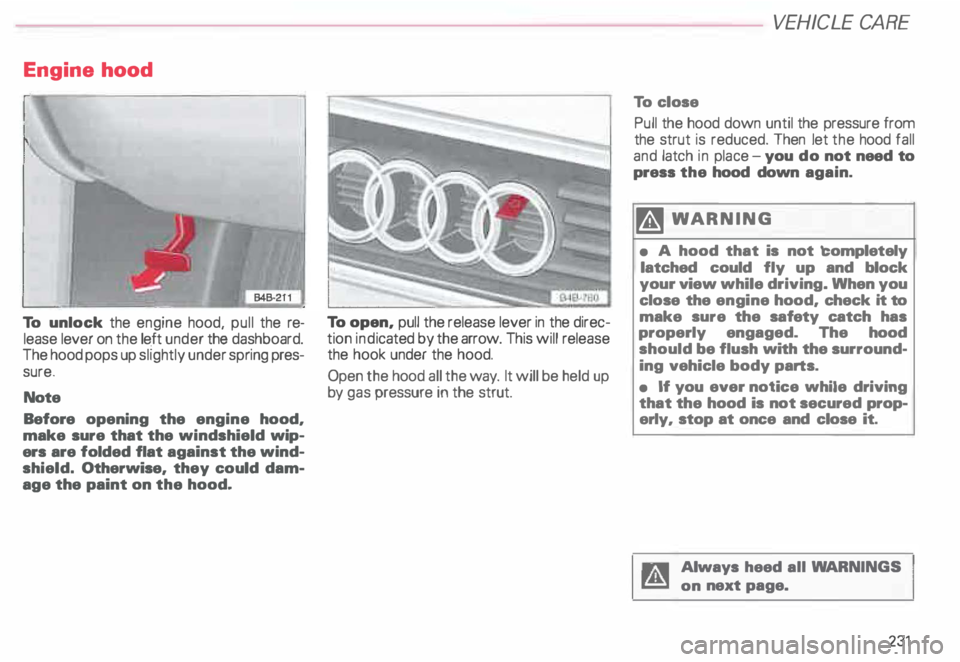
To unlock the engine hood, pull the re
lease lever on the left under the dashboard.
The hood pops up slightly under spring pres
sure.
Note
Before opening the engine hood,
make sure that the windshield wip
ers are folded flat against the wind
shield. Otherwise, they could dam
age the paint on the hood. To
open, pull the release lever in the direc
tion indicated by the arrow. This will release
the hook under the hood.
Open the hood all the way. It will be held up
by gas pressure in the strut. VEH
ICLE CARE
To close
Pull the hood down until the pressure from
the strut is reduced. Then Jet the hood fall
and latch in place -you do not need to
press the hood down again.
m WARNING
• A hood that is not 'completely
latched could fly up and block
your view while driving. When you
close the engine hood, check it to
make sure the safety catch has
properly engaged. The hood
should be flush with the surround
ing vehicle body parts.
• If you ever notice while driving
that the hood is not secured prop
erly, stop at once and close it.
Always heed all WA RNINGS
on next page.
231
Page 234 of 306
When
adding fluids, always make
sure that they are poured into the
proper container or filler opening,
otherwise serious damage to ve
hicle systems will occur. r:Gb To detect leaks in time, inspect
� the vehicle floor pen from under
neath regular ly. If you see spots
from oil or other vehicle fluids, have
your vehicle inspected by an autho
ri zed Audi Dealer .
D Always heed all WA RNINGS
� on page 232.
Always exercise extreme caution
when working under the engine
hood. -
VE HICLE CARE
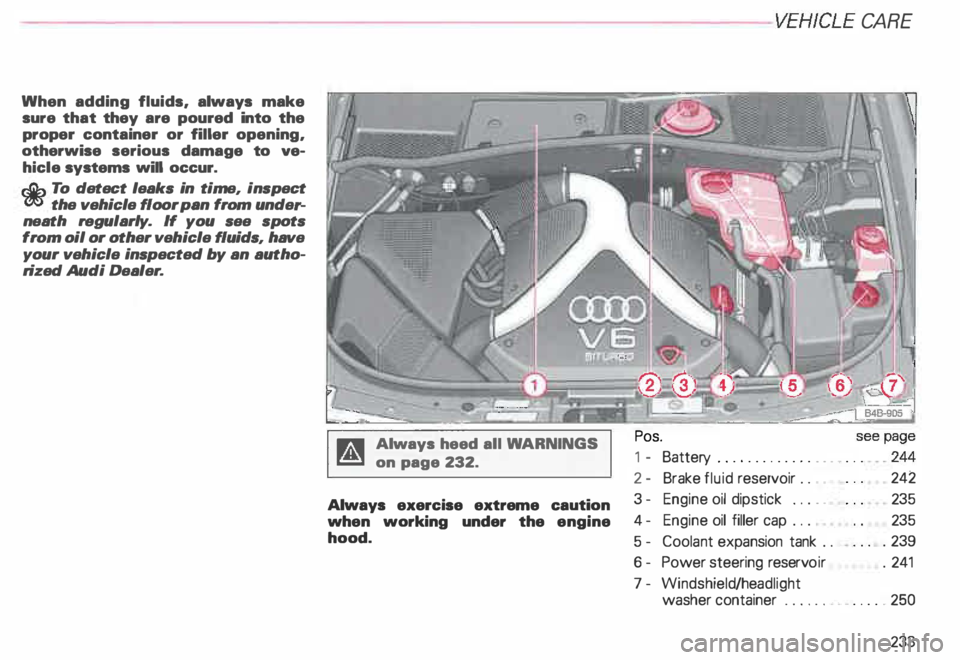
Pos.
1 - Battery ............. . _ .. .. .
2- Brake fluid reservoir . . . 242
3 - Engine oil dipstick ... . _ 235
4- Engine oil filler cap . . . 235
5- Coolant expansion tank . . . 239
6 - Power steering reservoir .
241
7 - Windshield /headlight
washer container ......•• _ .... . 250
233
Page 236 of 306
Engine
oil consumption
The rate of the oil consumption depends on
the quality and viscosity of oil, the speed at
which the engine is operated, the climate,
and road conditions as well as amount of
dilution and oxidation of the lubricant.
Because of these variables, no standard
rate of oil consumption can be established,
but drivers should expect higher oil con
sumption at high speeds and when the en
gine is new.
Therefore, we recommend that you check
the oil level at regular intervals (for example,
each time you are refuelling, or before going
on a long trip).
If the oil level should go below the minimal
level, the check engine oil level warn
ing light* in the instrument cluster will
come on. See page 144. You should check
the oil level using the oil dip stick as soon as
possible, and then top off the oil as neces
sary. Notes
• The engine in your vehicle de
pends on oil to lubricate and cool all
of its moving parts. Therefore the
engine oil should be checked regu
larly and kept at the required level.
• Lack of sufficient engine oil may
lead to severe engine damage.
• The oil pressure warning light is
not an oil level indicator.
A Always
heed all WAR NINGS
� on page 232.
Checking the engine oil level
The best time to check the engine oil level
is when the oil is warm.
To get a true reading, the vehicle must be on
level ground.
A Always heed all WAR NINGS
� on page 232.
• After turning off the engine, wait a few
minu tes for the oil to return to the oil pan. VE
HICLE CARE
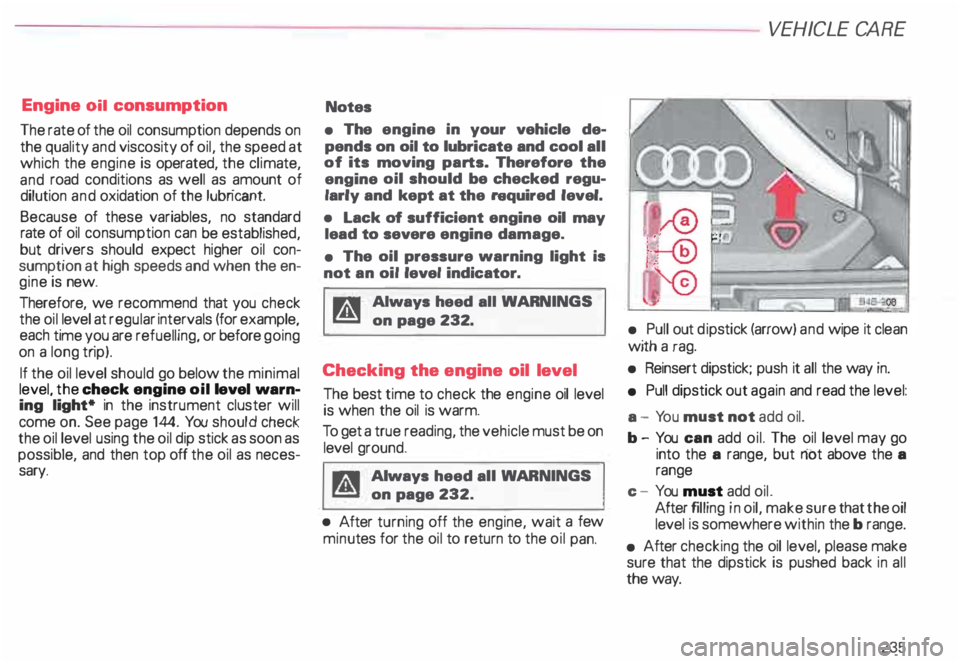
• Pull out dipstick (arrow) and wipe it clean
with a rag.
• Reinsert dipstick; push it all the way in.
• Pull dipstick out again and read the level:
a - Yo u must not add oil.
b- You can add oil. The oil level may go
into the a range, but riot above the a
range
c - You must add oil.
After filling in oil, make sure that the oil
level is somewhere within the b range.
• After checking the oil level, please make
sure that the dipstick is pushed back in all
the way.
235
Page 240 of 306
Checking the
engine coolant
level
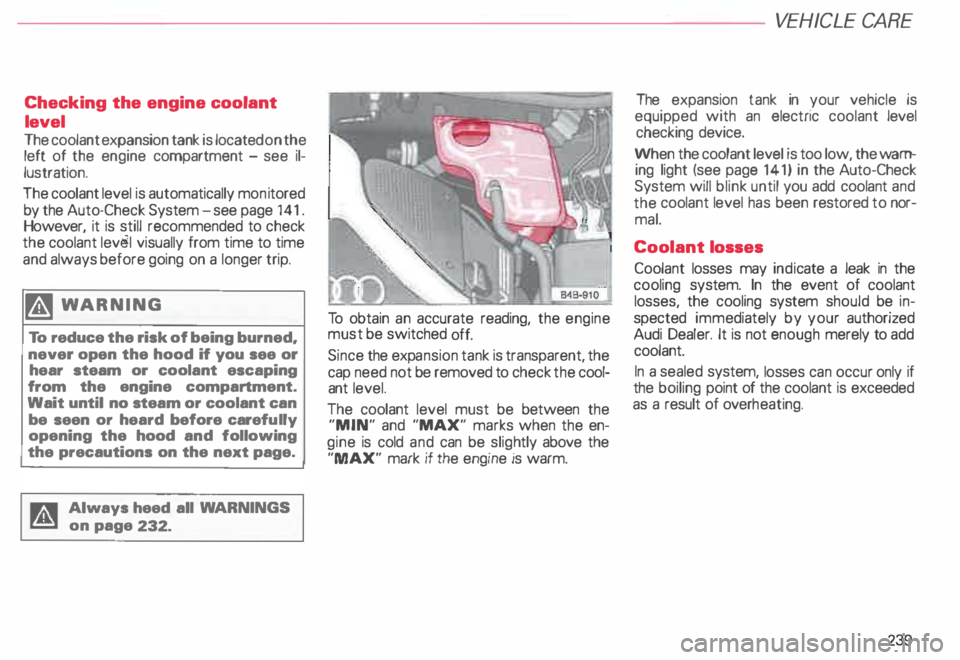
The coolant expansion tank is located on the
left of the engine compartment -see il
lustration.
The coolant level is automatically monitored
by the Auto-Check System -see page 141.
However, it is still recommended to check
the coolant lev�l visually from time to time
and always before going on a longer trip.
�W ARNING
To reduce the risk of being burned.
never open the hood if you see or
hear steam or coolant escaping
from the engine compartment.
Wait until no steam or coolant can
be seen or heard before carefully
opening the hood and following
the precautions on the next page.
Always heed all WA RNINGS
on page 232. To
obtain an accurate reading, the engine
must be switched off.
Since the expa nsion tank is transparent, the
cap need not be removed to check the cool
ant level.
The coolant level must be between the
"MIN" and "MAX" marks when the en
gine is cold and can be slig htly above the
"MAX" mark if the engine is warm. VE
HICLE CARE
The expansion tank in your vehicle is
equipped with an electric coolant level
checking device.
When the coolant level is too low, the warn
ing light (see page 141) in the Auto-Check
System will blink until you add coolant and
the coolant level has been restored to nor
mal.
Coolant losses
Coolant losses may indicate a leak in the
cooling system. In the event of coolant
losses, the cooling system should be in
spected immediately by your authorized
Audi Dealer. It is not enough merely to add
coolant.
In a sealed system, losses can occur only if
the boiling point of the coolant is exceeded
as a result of overheating.
239
Page 241 of 306
VE
HICLE CARE
Adding coolant
� WARNING
The cooling system is under pres
sura and can get very hot. Reduce
the risk of scalding from hot cool
ant by following these steps.
• Turn off the engine and allow it
to cool down.
• Protect face, hands and arms es
caping fluid and steam by covering
the cap with a large, thick rag.
• Turn the cap slowly and very
care fully in a counter--clockwise di
rection while applying light, down
ward pressure on the top of the
cap.
• To help avoid being burned, do
not spill antifreeze or coolant on
the exhaust system or hot engine
parts. Under some conditions, the
ethylene glycol in engine coolant
can catch fire.
240 If,
in an emergency, only water can be add
ed, the correct ratio between water and an
tifreeze (see page 238) must be restored as
soon as possible.
If you have lost a considerable amount of
coolant. then you should add cold antifreeze
and cold water only when the engine is cold.
Do not fill coolant above the "MAX"
mark.
Note
Coolant pollutes the environment
and could cause an engine fire. Ex
cess coolant will be forced out
through the pressure relief valve in
the cap when the engine becomes
hot. Screw cap
on again tightly.
� WARNING
Antifreeze is poisonous. Always
store antifreeze in its original con
tainer and well out of the reach of
children. If you drain the coolant,
it must be caught and safely
stored in a proper container
clearly marked "poison ...
<£> Drained coolant should not be
reused. Always dispose of used
coolant observing all env ironmen
tal regulations.
Always heed all WARNINGS
on page 232.