warning AUDI ALLROAD 2000 Owners Manual
[x] Cancel search | Manufacturer: AUDI, Model Year: 2000, Model line: ALLROAD, Model: AUDI ALLROAD 2000Pages: 306, PDF Size: 9.95 MB
Page 238 of 306
---------------------------------------------------VEHICLE CA
RE
�W ARNING
• If you must change the engine
oil in your vehicle:
• Wear eye protection.
• To reduce the risk of burns from
hot engine oil let the engine cool
down to the touch.
• When removing the oil drain
plug with your fingers, stay as far
away as possible. Always keep
your forearm parallel to the
ground to help prevent hot oil
from running down your arm.
• Drain the oil into a container de�
signed for this purpose, one large
enough to hold at least the total
amount of oil in your engine. ,A
WARNING continued
• Engine oil is poisonous. Keep it
well out of the reach of children.
• Continuous contact with used
engine oil is harmful to your skin.
Always protect your skin by wash
ing thoroughly with soap and wa
ter. �
BefoN changing your oil, first
make sure you know where you
can properly dispose of the old oil.
Always dispose of used engine oil
proper ly. Do not dump it on garden
soil, wooded areas, Into open
streams or down sewage drains.
Recycle used engine oi l by taking it
to a used engine oil collection facil
ity in your area, or contact a service
station.
Because of the problem of proper
disposal, along with the special
tools and necessary expertise re
quired, we strongly recommend that
you have your oil changed by an au
thorized Audi Dealer or a qualified
workshop.
Always heed all WA RNINGS
on page 232.
237
Page 241 of 306
VE
HICLE CARE
Adding coolant
� WARNING
The cooling system is under pres
sura and can get very hot. Reduce
the risk of scalding from hot cool
ant by following these steps.
• Turn off the engine and allow it
to cool down.
• Protect face, hands and arms es
caping fluid and steam by covering
the cap with a large, thick rag.
• Turn the cap slowly and very
care fully in a counter--clockwise di
rection while applying light, down
ward pressure on the top of the
cap.
• To help avoid being burned, do
not spill antifreeze or coolant on
the exhaust system or hot engine
parts. Under some conditions, the
ethylene glycol in engine coolant
can catch fire.
240 If,
in an emergency, only water can be add
ed, the correct ratio between water and an
tifreeze (see page 238) must be restored as
soon as possible.
If you have lost a considerable amount of
coolant. then you should add cold antifreeze
and cold water only when the engine is cold.
Do not fill coolant above the "MAX"
mark.
Note
Coolant pollutes the environment
and could cause an engine fire. Ex
cess coolant will be forced out
through the pressure relief valve in
the cap when the engine becomes
hot. Screw cap
on again tightly.
� WARNING
Antifreeze is poisonous. Always
store antifreeze in its original con
tainer and well out of the reach of
children. If you drain the coolant,
it must be caught and safely
stored in a proper container
clearly marked "poison ...
<£> Drained coolant should not be
reused. Always dispose of used
coolant observing all env ironmen
tal regulations.
Always heed all WARNINGS
on page 232.
Page 242 of 306
Radiator
fan
The radiator fan is driven by the engine via
the V-belt. The viscous clutch regulates the
speed of the fan according to the tempera
ture of the coolant.
An auxiliary electric radiator fan switches on
and off depending on coolant temperature
and other vehicle operation conditions.
� WARNING
• Always use extreme caution to
prevent clothing. jewelry, or long
hair from getting caught in the en
gine driven radiator fan, V-belt or
other moving parts.
• Never touch the auxiliary elec
tric radiator fan. The fan can
switch on suddenly and injure you.
Always heed all WA RNINGS
on page 232. Power
steering
Yo ur vehicle is equipped with a Servotro
nic power steering. The degree of
power assistance is regulated electronically
according to road speed.
The fluid reservoir is in the engine compart
ment near the windshield washer container.
The correct fluid level in the reserv oir is im
portant for the proper functioning of power
steer ing.
The power steering fluid level is checked
during the scheduled Maintenance ser
vices.
If the electronic regulating system is not
working properly, this is most noticeable
when turning the steering wheel at low
speeds (for example when parking) -more
effort will be required than usual. The fault
should be rectified by an Audi Dealer as
soon as possible. VEH
ICLE CARE
Note
• When the engine is running, never hold
the steering wheel turned all the way to the
right or to the left for longer than 15 sec
onds. The power steering pump will over
heat the hydraulic fluid if you hold the steer
ing wheel all the way turned.
This will damage the power steering
system.
Each time the steering wheel is turned all
the way to the right or left when stopped,
you will hear noises caused by the severe
stress placed on the power steering pump.
At the same time, engine idle speed drops.
• If the power steering system
should fail, or if the engine is not
running (for example, while being
towed). you will still be able to steer
the vehicle, however. more effort
will be required.
• If the power steering system should
have a leak, or is not functioning properly,
contact your authorized Audi Dealer imme
diately.
241
Page 243 of 306
VE
HICLE CA
RE----------------------------------------------------
Brake fluid
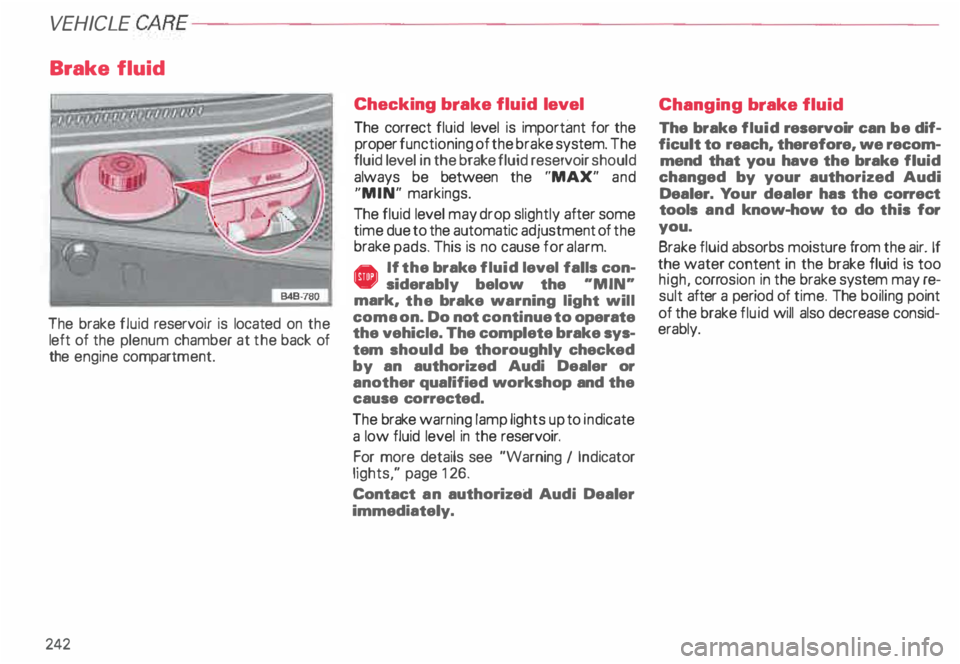
The brake fluid reservo ir is located on the
left of the plenum chamber at the back of
the engine compartm ent.
242 Checking
brake fluid level
The correct fluid level is important for the
proper functioning of the brake system. The
fluid level in the brake fluid reservoir should
always be between the "MAX" and
"MIN" markings.
The fluid level may drop slightly after some
time due to the automatic adjustment of the
brake pads. This is no cause for alarm.
• If the brake fluid level falls con
siderably below the "MIN"
mark, the brake warning light will
coma on. Do not continue to operate
the vehicle. The complete brake sys
tem should be thoroughly checked
by an authorized Audi Dealer or
another qualified workshop and the
cause corrected.
The brake warning lamp lights up to indicate
a low fluid level in the reservoir.
For more details see "Warning I Ind icator
lights," page 126.
Contact an authorized Audi Dealer
immediately. Changing
brake fluid
The brake fluid reservoir can be dif
ficult to reach, therefore, we recom
mend that you have the brake fluid
changed by your authorized Audi
Dealer. Your dealer has the correct
tools and know-how to do this for
you.
Brake fluid absorbs moisture from the air. If
the water content in the brake fluid is too
high, corrosion in the brake system may re
sult after a period of time. The boiling point
of the brake fluid will also decrease consid
erably.
Page 247 of 306
VEHICLE CA
RE---------------------------------------------------
Battery acid level
g Always heed all WA RNINGS
� on page 232.
Under normal operating conditions, the
battery in your Audi does not need any
maintenance.
At high outside temperatures it is advisable,
however, to check the fluid level at regular
intervals through the transparent battery
housing. Also check the fluid level each
time you charge the battery.
The fluid level should always be between
the "min" and "max" marks in each cell.
If the fluid level has reached the "min"
marks, let your authorized Audi Dealer cor
rect the condition.
�W ARNIN G
• Always shield your eyes and
avoid leaning over the battery
whenever possible.
• Do not let battery acid come in
contact with skin, eyes, fabric, or
painted surfaces.
246 ��
WARNING continued
• If you get battery acid in your
eyes or on your skin, immediately
rinse with cold water for several
minu tes and call a doctor.
• Do not expose the battery to an
open flame or electric spark.
Hydrogen gas generated by the
battery can explode and cause per
sonal injury.
Note Do not overfill the battery. Other
wise battery acid will overflow
through the vent opening. This will
damage the paint and cause corro
sion.
�W ARNIN G
Battery posts, terminals and re
lated accessories contain lead and
lead compounds. Wash hands af
ter handling. Charging
of battery
�W ARNING
• The battery contains sulfuric
acid. Therefore, keep battery out
of reach of children.
• Charge the battery in a well ven
tilated area. Keep away from open
flame or electrical spark. Do not
smoke. Hydrogen gas generated
by the battery is explosive.
• Always shield your eyes and
avoid leaning over the battery
whenever possible.
• If you gat battery acid in your
eyes or on your skin, immediately
rinse with cold water for several
minu tes and call a doctor.
• Fast charging a battery is dan
gerous and should only be at
tempted by a competent mechanic
with the proper equipment.
Page 248 of 306
f4 WARNING
continued
• Never charge a frozen battery. It
may explode because of gas
trapped in the ice. Allow a frozen
battery to thaw out first.
• Do not reuse batteries which
have fr ozen. The baUery housing
may have cracked and weakened
when the battery froze.
Always heed all WA RNINGS
on page 232.
• Battery acid that may spill during
charging should be washed off with
a solution of warm water and baking
soda to neutralize the acid.
• Never use a fast charger as a boo
ster to start the engine. This will se
riously damage sensitive electronic
components, such as control units,
relays, radio, etc., as well as the bat
tery charger. Slow
battery charging
�W ARNING
Heed all WA RNINGS and follow in
structions that come with your
battery charger.
• Before charging the battery, switch off
the ignition and all electrical consumers.
• Make sure the area is well ventilated
when you charge the battery.
• It is not necessary to remove the battery
from the engine compartment, and it is also
not necessary to disconn ect the cables.
• Make sure the electrolyte level in each
cell is between the .. min" and "max ..
marks. If the fluid level is below the "min"
mark, let your authorized Audi Dealer cor
rect the condition. VE
HICLE CARE
• Conne ct charger cables.
Charger cables must be connected
POSITIVE (+ ) to POSITIVE (+ ) and
NEGATIVE (-) to NEGATIVE (-).
�W ARNING
To reduce the danger of explosion,
never connect or disconnect char
ger cables while the charger is op
erating.
• Switch on charger.
• Charging rate not over 6 amps.
Normal ly, a battery should be charged at no
more than 1 0 percent of its rated capacity.
For example, a charging current of 4.5 amps
would be used on a battery rated at 45 Ah.
Rated capacity of the battery in your vehicle
is listed on the battery housing.
• After charging, first turn off the charger
and then disconnect charger cables. g Always heed all WARNINGS
� on page 232.
247
Page 250 of 306
-------------------------VEHICLE
CARE
Spark plugs
Spark plugs are replaced during the Audi
scheduled Maintenance Service.
If you have to replace the spark plugs be
tween the Audi Maintenance services, be
sure to note the following:
• Engine, spark plugs and the ignition sys
tem are matched to each other. To avoid
faulty operation or engine damage, use only
Original Audi spark plugs. It is especially im
portant to note the number of electrodes on
the spark plug and the heat value.
• Since spark plug specifications may
change for technical reasons during a model
year, we recommend that you obtain your
spark plugs from an authorized Audi Dealer,
who has the latest information.
Always heed all WARNINGS
on page 232. Belts
Ribbed V-Belt
The radiator fan, hydraulic pump (power
steering), alternator and air conditioner
compressor are driven by one V-belt.
The installed V-belt conforms to the highest
quality requirements. The V-belt adjusts its
own tension.
Replacing of the V-belt should be
performed by your authorized Audi
Dealer or a qualified workshop.
When replacing a belt, it is not sufficient to
use just any belt of the same size. For safe
and reliable operation, use only Genuine
Audi V-belts specially designed for your ve
hicle. The correct belts can be obta ined at
your authorized Audi Dealer. �W
ARNING
To prevent serious personal inju
ries stay well clear of the V-belt,
The radiator fan and the V-belt
driven accessories when the en
gine is running. The V-belt will be
inspected and replaced by your au
thorized Audi Dealer during a
scheduled Maintenance Service.
Timing belt
• Yo ur engine is equipped with a long last
ing toothed belt. The belt will be in
spected and replaced during a scheduled
Maintenance Service.
Always heed all WA RNINGS
on page 232.
249
Page 258 of 306
-------------------------VEHICL E
CA RE
The speed rating letter 9ode indicates the
maximum permissible road speeds:
Summer tires:
S - up to 11 0 mph (180 km/h)
T- up to 118 mph (190 km/h)
H- up to 130 mph (21 0 km/h)
V- up to 150 mph (240 km/h)
Z - over 150 mph (240 km/h)
W- up to 168 mph (270 k.m/h)
Y- up to 185 mph (300 km/h).
"Z" tires carry the speed rating code letter
in combination with the tire construction let
ter "R".
Winter tires see page 260. m
WARNING
• Driving faster than the maxi
mum speed for which tires are
rated and approved can lead to
sudden tire failure. This can cause
loss of vehicle control and lead to
an accident and personal injury.
• Never operate a vehicle at
speeds greater than the maximum
speed rating of its tires.
• Always observe speed limits
and adjust your vehicle to prevail
ing road and traffic conditions. Note
Yo ur vehicle is normally factory equipped
with all season tires. which possess excel
lent driving characteristics and give your
Audi optimum driving comfort. The speed
limit of this tire is 130 mph (21 0 km/ h). An
electronic speed limiter (see page 129) will
normally prevent your vehicle from going
faster then the tire speed ravng.
�W ARNING
Never operate this vehicle at
speeds greater than 130 mph. Ex
ceeding 130 mph (210 km I h) un
der any conditions will lead to sud
dan tire failure which can causa
loss of vehicle control and person
al injury. Always observe speed
limits and adjust your vehicle
speed to prev ailing road and traf
fic conditions.
257
Page 260 of 306
-------------------------VEHICLE
CARE
Te mperature
The temperature grades are A (the highest),
8, and C, repres enting the tire's resistance to
the generation of heat and its ability to dissi
pate heat when tested under contro lled con
ditions on a specified indoor laboratory test
wheel. Sustained high temJ)erature can
cause the material of the tire to degenerate
and reduce tire life, and excessive tempera
ture can lead to sudden tire failure. The
grade C corres ponds to a level of perfor
mance which all passenger car tires must
meet under the Federal Motor Vehicle Safety
Sta ndard No. 1 09. Grades Band A represent
higher levels of performance on the laborato
ry test wheel than the minimum required by
law.
�W ARNIN G
The temperature grade for this tire
is est ablished for a tire that is
properly inflated and not over
loaded. Excessive speed, under
inflation, or excessive loading, ei
ther separately or in combination,
can causa heat buildup and pos
sible tire failure. Wheel
replacement
If you wish to equip your vehicle with tires
or wheels other than those installed at the
factory, please note the following:
• For technical reasons it is not al
ways possible to use wheels from
other vehicles -under certain condi
tions not even wheels from the same
vehicle model.
• Wheel rims and wheel bolts are
matched to fit your Audi. When
installing different wheels (for ax
ample, wheels with winter tires), the
correct wheel bolts with the proper
length and conical shape of the bolt
head must be used. The secure fit of
the wheels and the proper function
ing of the brake system and safety
are dependent upon this.
• Wheel rims and wheal bolts are
matched to fit your Audi. •
Before you plan on exchanging
steel wheels, light alloy wheals, or
winter tires already mounted on
wheel rims, consult your authorized
Audi Dealer. They have the technical
information necessary to advise you
which wheal rims and wheel bolts
are compatible with the original fac
tory installations.
1ft WARNING
• Incorrect tire/wheel parts may
cause an accident and personal in
jury. Such parts will adversely af
fect the safe operation of your ve
hicle. Always use tires, wheel rims
and wheel bolts that meat specifi
cations of the original factory
installed equipment.
• If wheel trim discs or a front
spoiler are Installed, make sura the
airflow for cooling the brakes is
not obstructed.
259
Page 261 of 306
VEH
ICLE CARE
Winter tires
The tires for your vehicle were selected for
optimal performance under a variety of driv
ing conditions.
If your Audi is equipped with high perfor
mance tires (identified by code letter V, W
or Z on the tire flank) and you drive frequent
ly on ice or sno w, you should consider the
installation of all season or winter tires. Let
your authorized Audi Dealer advise and as
sist you.
For winter driving, the driveability of your
vehicle can be improved by installing radial
winter tires (M+S) with or without studs1l.
The all season tires with which your ve
hicle may have been equipped at the factory
are perform ance tires advertised by the tire
manufacturer as suitable for all weather use
or with special mud and snow (M+S) capa
bility.
Winter tires, sometimes also called snow
tires, are designed for maximum traction in
mud and snow.
,, Check with your local Motor Vehicle Bu
reau for possible restrictions.
260 When
installing winter tires, please
note the following:
• Only radial ply winter tires may be
installed. Ask your authorized Audi Dealer
for the recommended tire size.
• Winter tires must be mounted on all four
wheels.
• Because of the special design character
istics of radial ply M+S tires, they must be
inflated 3 psi above the cold tire inflation
pressures required for the regular radial ply
tires. However, never exceed the maximum
tire inflation pressure listed on the tire side
wall.
• Winter tires will not do their job if the
tread depth is less than 5/32 of an inch
(4 mm). �
WARNING
• Tires with badly wom treads
and studs are very dangerous.
Make sure they are replaced imme
diately.
• Never mix tires of different de
sign such as steel belted radials
with radial bias belted or bias ply
tires, etc. Mixing tire types will ad
versely affect road holding and
can lead to loss of vehicle control
and personal inlury.