warning AUDI ALLROAD 2000 Manual Online
[x] Cancel search | Manufacturer: AUDI, Model Year: 2000, Model line: ALLROAD, Model: AUDI ALLROAD 2000Pages: 306, PDF Size: 9.95 MB
Page 217 of 306
VEHICL E
CA RE-------------------------
Weatherstrips
Keep silicone sprays off the wind
shield to avoid wiper smear in rain.
To seal properly, weatherstrips around
hood, rear lid, doors, etc., must be pliable.
Spray with silicone or coat with talcum pow
der or glycerine to reta in flexibility of the
rubber and to protect against freezing in the
w1nter.
Dull finishes and plastics
Plas .tic pa �s. such as light bulb lenses, dec
orative stnpes, panels, bumpers, etc., will
come clean with regular washing. Should
additional cleaning or spot remova l be nec
essar y, use a soft brush or cloth soaked with
a mild detergent solution. Then rinse thor
oughly and imme diately with clear water.
Do not use anyth ing which could
mar the plastic or dull finished sur
faces, such as wax, polish, abrasive
detergents or chemical cleaning sol
vents.
216 Bright
metal trim
Bright or black anodized metal trim will
come clean with regular washing. Remove
spots or dirt from chrome and stainless
steel with a chrome cleaner. Apply a
chrome polish for continued luster and
protec tion.
Steel wheels
Always include the hub caps and wheel
rims when washing your vehicle to remove
road dirt, salt sprays and brake dust. If nec
essary, use a commercial wheel cleaner to
remove accumulated brake dust. Paint
scratches should be touched up as soon as
possible to prevent corrosion.
Light alloy wheels
To preserve the decorative appearance of
the light alloy wheels, some special care is
necessary. In addition to road dirt and salt
sprays, brake dust is also corrosive. If left on
too long, brake dust can cause pitting. Wash
the wheels with a sponge or hose brush ev
ery other week. Road salt
should be removed weekly with
an acid free cleaning solution. Every three
months (after regular cleaning) coat the
wheels with petroleum jelly or car wax. Rub
it in firmly with a soft cloth. Never use abra
sive or metal polishing cleaning agents.
� WARNING
Moisture, ice, and road salt on
brakes may affect braking effi
ciency. Test the brakes carefully
after each washing. Always heed
WA RNING on page 203.
Page 220 of 306
-------------------------VEHICLE CA
RE
Engine compartment
�W ARNING
• Before working in the engine
compartment. be sure to read the
information on page 232.
I) Before reaching into the front
plenum panel. always re!"ove the
ignition key. Otherw1se. the
windshield wiper system could
unin tentionally be switched on.
possibly causing personal injury
from the moving wiper linkage.
• Do not wash. wax or dry the en�
gine with the engine ru!'l'! ing. Mov
ing or hot parts could 1n1ure you. ,Al
WARNING continued
e Do not clean the underside of
the chassis, fenders. wheel cov
ers. or other hard to reach parts
without protecting your hands and
arms. You may cut yourself on
sharp-edged metal parts.
• Moisture and ice on brakes may
affect braking efficiency. Test the
brakes carefully after each vehicle
wash.
The engine compartment and transmission
have been corrosion protected at the facto
ry.
Remove leaves from the plenum panel in
front of the windshield under the engine
hood. This prevents the water drain holes
from becoming blocked, and it prevents de
bris from entering the vehicle interior
throug h the heating and ventilation ducts. Good
anti-corrosion treatment is very im
porta nt, particularly in the winter. If the ve
hicle is frequently driven on salted roads,
the entire engine compartment and plenum
panel should be thor oughly cleaned at the
end of winter and retreated to prevent salt
damage. At the same time, the underside of
the vehicle should be washed as well.
�W ARNING
Never touch the radiator fan. The
auxiliary electric fan can switch on
suddenly and injure you-
Always switch off the ignition be
fore cleaning the engine _
219
Page 221 of 306
VEHICL E
CA RE-------------------------
If the engine compartment is cleaned at any
time with grease removing solutions 1 ), or if
you have the engine washed, the antK:orr
as well. It is therefore essential to ask: for a
long-lasting corrosion protection of all sur
faces, seams, joints and components in the
engine compartment.
c£> If you must rinse off gasoline, oil
residue or grease while you are
washing your engine, then tha dirty
water should be run through an oil
separator filter. We recommend that
you have your engine washed at a
qualified workshop or service sta
ti on.
11 Use only
the correct cleaning solutions.
Never use gasoline or Diesel.
220 Chassis
The lower body shell of your Audi is also
thoroughly protected against corrosion.
Any damage to the undercoat ing caused by
road hazards should be repaired promptly.
g WARNING
Do not apply additional undercoat
ing or rustproofing on or near the
exhaust manifold, exhaust pipes.
catalytic converter or heat shields.
During driving, the substance
used for undercoating could over
heat and cause a fire. Body
cavity sealing
All body cavities which could be affected by
corro sion have been given thorough protec
tion at the factory.
This sealing does not require any inspection
or additional treatments. If any wax should
seep out of the cavity when the ambient
temperature is high, it can be removed with
a plastic scraper and a suitable solvent.
c£> If you use benzine for removing
the wax, keep sparks, flame and
ligh ted cigara ttas away. Nsver
dump benzine on the ground, into
open streams or down sewage
dr ains.
Be sure to observe all safety and en
vi ronmental regulations.
Page 222 of 306
General
notes
• We recommend that you have the engine
compartment and the underside of your ve
hicle inspected twice a year for any damage
to the protective coating, preferably before
and after the winter season. Have neces
sary repairs done as soon as possible.
• Also, whenever the lower body sh�ll.
axle, transmission or engine assemblies
have been repaired, any anti-corrosion coat
ing lost on the affected surfaces should be
reapplied.
• Oil-based protective sprays must not be
applied. Only tar-or wax -based anti-corro
sion protectors are compatible with the fac
tory applied corrosion pro tection. Bef_ore ap
plication, road dirt, salt spray deposits and
oily substances must be removed. Yo
ur authorized Audi Dealer stocks the
cleaning and preservation solutions recom
mended by the factory for this purpose and
has the equipment necessary to apply
them. Therefore, any additional corrosion
protection work should be perform .ed by an
Audi Dealer. Using incorrect cleamng solu
tions could damage rubber parts or painted
surfaces.
� WARNING
Use only the correct cleaning solu
tions. Never use gasoline, Diesel
fuel or solvents which could cause
a fire. VE
HICLE CARE
221
Page 225 of 306
VEHICLE CA
RE-------------------------
Filling a portable fuel container
in excep tional cases
�W ARNING
To reduce the risk of fire and per
sonal injury when filling a fuel con
tainer for a lawn mower or snow
blower, etc. please remember:
• Never fill a portable fuel con
tainer leaving It still in the luggage
compartment or on top of the car.
Static electricity can build up
while filling and can ignite fuel va
pors causing a fire. Always place a
portable fuel container on the
ground before filling.
224 ��
WARNING continued
• Never spill fuel inside the lug
gage compartment or vehicle inte
rior. Fuel vapors are highly flam
mable and can cause fire and seri
ous bums.
• Always observe local and state
(provincaU laws regarding the use,
storage and transportation of such
containers. ·
• Make certain the fuel container
meets industry standards (ANSI/
ASTM F852-86). Emergency
unlocking of the
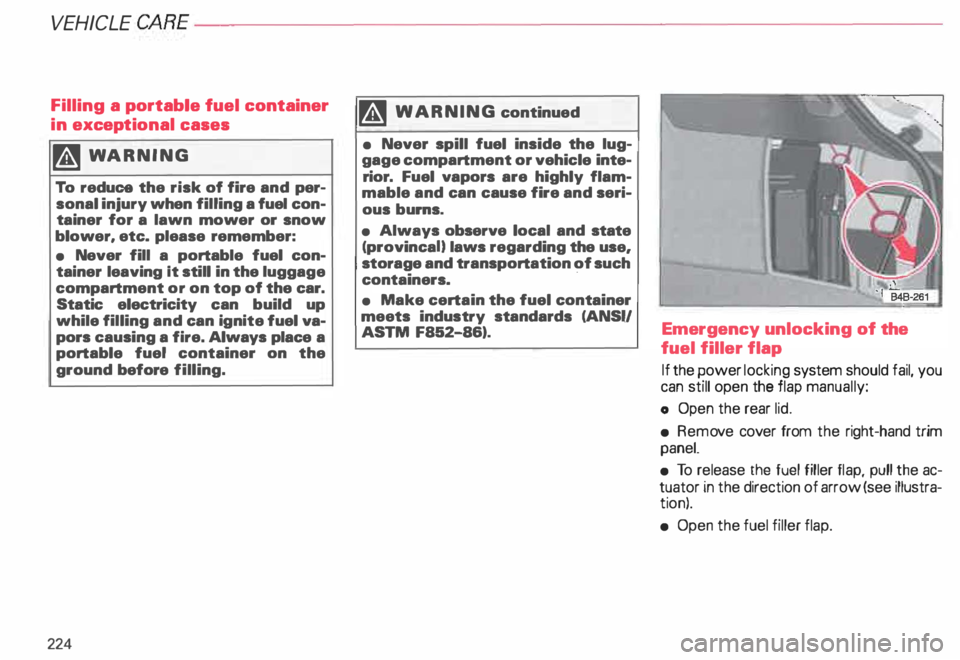
fuel filler flap
If the !?ower locking system should fail, you
can still open the flap manually:
o Open the rear lid.
• Remo ve cover from the right-hand trim
panel.
• To release the fuel filler flap, pull the ac
tuator in the direction of arrow (see illustra
tion).
• Open the fuel filler flap.
Page 230 of 306
---------------------------------------------------VEHICLE CARE
If in doubt about any servicing, nave 1t done
by your authorized Audi Dealer or any other
properly equipped and qualif ied workshop.
We strongly urge you_ to give your autho
rized Audi Dealer the opportunity to perform
all scheduled maintenance and necessary
repairs. Your dealer has the facilities, origi
nal parts and trained specialists to keep your
vehicle running properly.
Perf orming limited maintenance
yourself
The following pages describe a limited num
ber of procedures which can be performed
on your vehicle with ordinary tools, should
the need arise and trained personnel be un
available. Before perform ing any of these
procedures, always thoroughly read all of
the applicable text and carefully follow the
instructions given. Always rigorously ob
serve the WA RNINGS provided. �W
ARNING
• Serious personal injury may oc
cur as a result of improperly per
formed maintenance, adjustments
or repairs.
• Be extremely careful when
working on the vehicle. Follow
commonly accepted safety prac
tices and good judgment. Never
risk personal injury.
• Do not attempt any of the main
tenance, checks or repairs de
scribed on the following pages if
you are not fully familiar with
these or other procedures with re
spect to the vehicle, or are uncer
tain how to proceed. Do not do any
work without the proper tools and
equipment. Have the necessary
work done by your authorized
Audi Dealer or another properly
equipped and qualified workshop. '4
WARNING continued
• The engine compartment of any
motor vehicle is a potent ially haz
ardous area.
• Always support your vehicle
with safety stands if it is neces
sary to work underneath the ve
hicle. The jack supplied with the
vehicle is not adequate for this
purpose and could collapse caus
ing serious personal injury.
• Never reach into the area
around or touch the radiator fan.
The auxiliary fan is temperature
controlled and can switch on sud
denly.
Always heed all WAR NINGS
on next page.
229
Page 232 of 306
Engine
hood
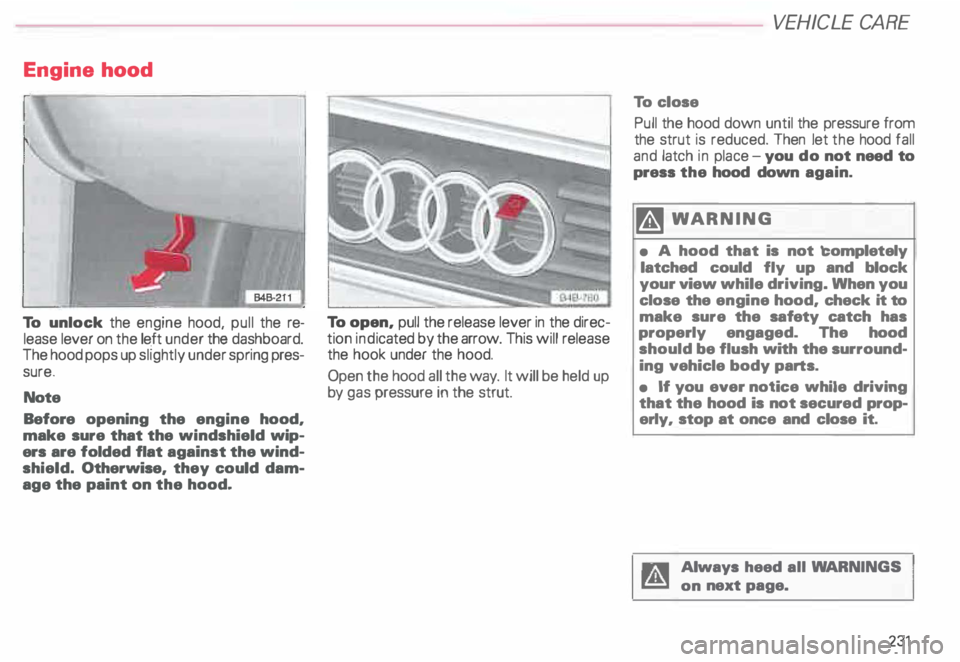
To unlock the engine hood, pull the re
lease lever on the left under the dashboard.
The hood pops up slightly under spring pres
sure.
Note
Before opening the engine hood,
make sure that the windshield wip
ers are folded flat against the wind
shield. Otherwise, they could dam
age the paint on the hood. To
open, pull the release lever in the direc
tion indicated by the arrow. This will release
the hook under the hood.
Open the hood all the way. It will be held up
by gas pressure in the strut. VEH
ICLE CARE
To close
Pull the hood down until the pressure from
the strut is reduced. Then Jet the hood fall
and latch in place -you do not need to
press the hood down again.
m WARNING
• A hood that is not 'completely
latched could fly up and block
your view while driving. When you
close the engine hood, check it to
make sure the safety catch has
properly engaged. The hood
should be flush with the surround
ing vehicle body parts.
• If you ever notice while driving
that the hood is not secured prop
erly, stop at once and close it.
Always heed all WA RNINGS
on next page.
231
Page 233 of 306
VEH
ICLE CARE---------------------------------------------------
Engine compartment
�W ARNING
To help avoid injury, before you
check anything under the hood:
• Switch off the engine. Remove
the ignition key.
• Set the parking brake fully.
Move the selector lever toP (Park).
• Always let the engine cool
down. Hot components will burn
skin on contact.
• Never spill fluids on hot engine
components. They can cause a
fire.
• Never touch the radiator fan.
The auxiliary electric fan can
switch on suddenly and injure you.
232 r4
WARNING continued
• If work on the fuel system or the
electrical system is necessary:
- Always disconnect the battery.
Never smoke or work near heat
ers or open flames. Fluids in the
engine compartment could start
a fire.
Keep an approved fire extin
guisher immediately available.
• To avoid electrical shock and
personal injury while the engine is
running or being started, never
touch:
- Ignition cables
- Other components of the high
voltage electronic ignition system. M
WARNING continued
• If you must perform a check or
repair with the engine running:
First, fully apply the parking
brake, move selector lever to
P (Park).
Always use extreme caution to
prevent clothing, jewelry, or
long hair from getting caught in
the radiator fan, V-belts or other
moving parts, or from contact
ing hot parts. Tie back hair be
fore starting, and wear no cloth
ing that will hang or droop into
the engine.
Page 236 of 306
Engine
oil consumption
The rate of the oil consumption depends on
the quality and viscosity of oil, the speed at
which the engine is operated, the climate,
and road conditions as well as amount of
dilution and oxidation of the lubricant.
Because of these variables, no standard
rate of oil consumption can be established,
but drivers should expect higher oil con
sumption at high speeds and when the en
gine is new.
Therefore, we recommend that you check
the oil level at regular intervals (for example,
each time you are refuelling, or before going
on a long trip).
If the oil level should go below the minimal
level, the check engine oil level warn
ing light* in the instrument cluster will
come on. See page 144. You should check
the oil level using the oil dip stick as soon as
possible, and then top off the oil as neces
sary. Notes
• The engine in your vehicle de
pends on oil to lubricate and cool all
of its moving parts. Therefore the
engine oil should be checked regu
larly and kept at the required level.
• Lack of sufficient engine oil may
lead to severe engine damage.
• The oil pressure warning light is
not an oil level indicator.
A Always
heed all WAR NINGS
� on page 232.
Checking the engine oil level
The best time to check the engine oil level
is when the oil is warm.
To get a true reading, the vehicle must be on
level ground.
A Always heed all WAR NINGS
� on page 232.
• After turning off the engine, wait a few
minu tes for the oil to return to the oil pan. VE
HICLE CARE
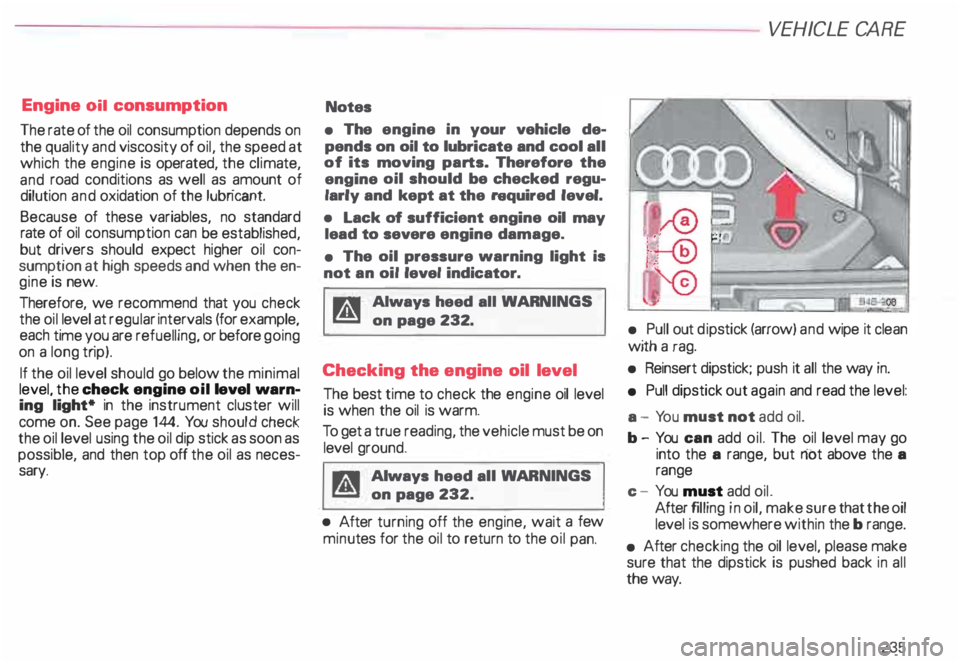
• Pull out dipstick (arrow) and wipe it clean
with a rag.
• Reinsert dipstick; push it all the way in.
• Pull dipstick out again and read the level:
a - Yo u must not add oil.
b- You can add oil. The oil level may go
into the a range, but riot above the a
range
c - You must add oil.
After filling in oil, make sure that the oil
level is somewhere within the b range.
• After checking the oil level, please make
sure that the dipstick is pushed back in all
the way.
235
Page 237 of 306
VEHICLE CA
RE---------------------------------------------------
Adding engine oil
A Always heed all WA RNINGS
r!!J on page 232.
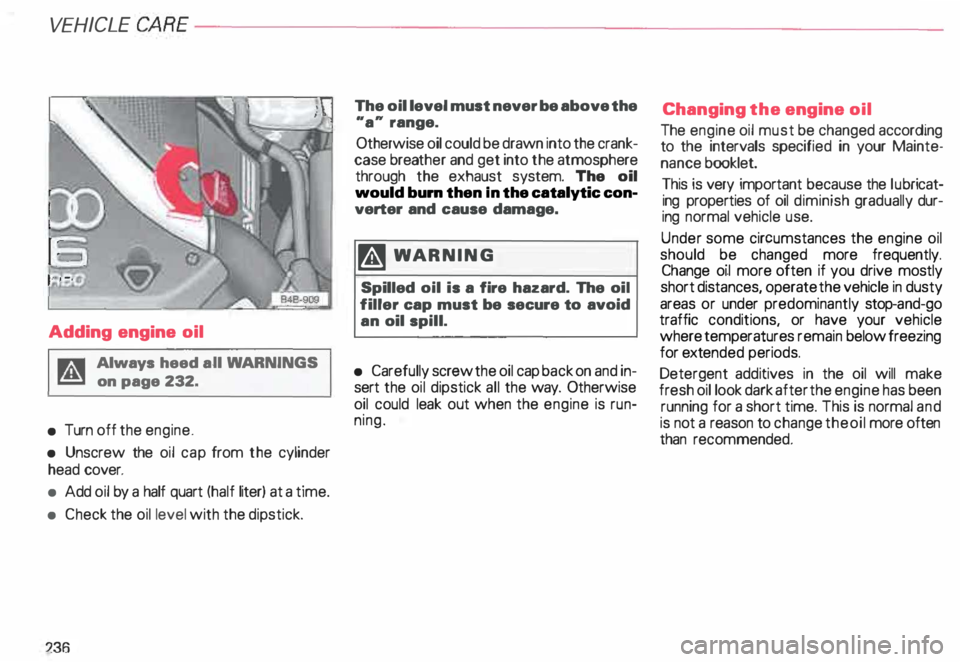
• Turn off the engine.
• Unscrew the oil cap from the cylinder
head cover.
• Add oil by a half quart (half liter) at a time.
• Check the oil level with the dipstick.
:236 The
oil level must never be above the
"a .. range.
Otherwise oil could be drawn into the crank
case breather and get into the atmosphere
through the exhaust system. The oil
would bum then In the catalytic con
verter and cause damage.
� WARNING
Spilled oil is a fire hazard. The oil
filler cap must be secure to avoid
an oil spill.
• Carefully screw the oil cap back on and in
sert the oil dipstick all the way. Otherwise
oil could leak out when the engine is run
ning. Changing
the engine oil
The engine oil must be changed according
to the intervals specified in your Mainte
nance booklet.
This is very important because the lubricat
ing properties of oil diminish gradually dur
ing normal vehicle use.
Under some circumstances the engine oil
should be changed more frequently.
Change oil more often if you drive mostly
short distances, operate the vehicle in dusty
areas or under predominantly stop-and-go
traffic conditions, or have your vehicle
where temperatures remain below freezing
for exte nded periods.
Detergent additives in the oil will make
fresh oil look dark after the engine has been
running for a short time. This is normal and
is not a reason to change the oil more often
than recommended.