ECU AUDI ALLROAD 2000 User Guide
[x] Cancel search | Manufacturer: AUDI, Model Year: 2000, Model line: ALLROAD, Model: AUDI ALLROAD 2000Pages: 306, PDF Size: 9.95 MB
Page 94 of 306
-------------------CONTROLS AND
EQUIPMENT
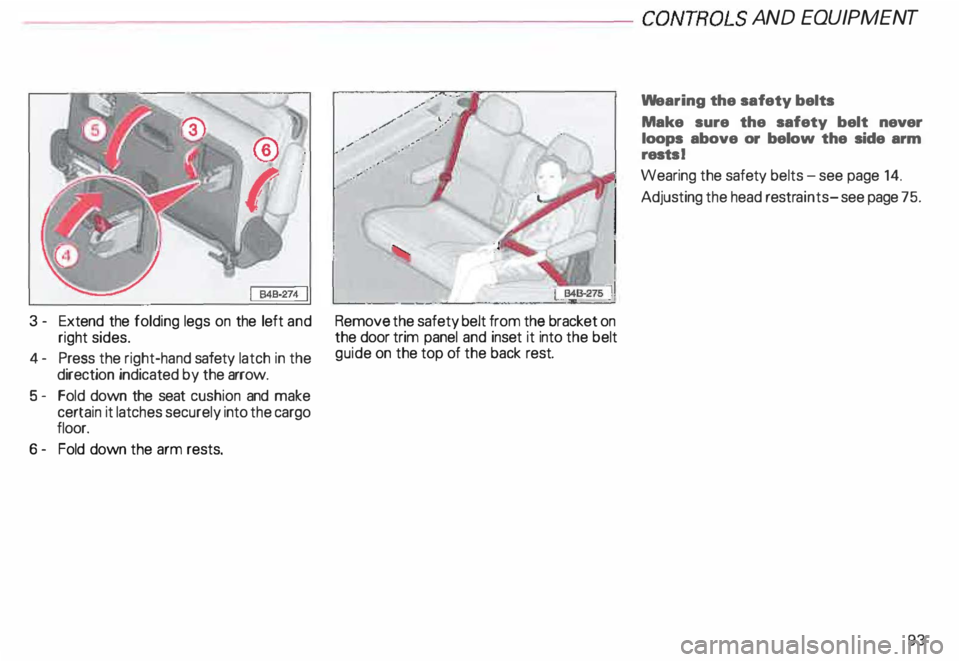
3 - Extend the folding legs on the left and
right sides.
4- Press the right-hand safety latch in the
direction indicated by the arrow.
5- Fold down the seat cushion and make
certain it latches securely into the cargo
floor.
6 - Fold down the arm rests. Remove
the safety belt from the bracket on
the door trim panel and inset it into the belt
guide on the top of the back rest. We
aring the safety belts
Make sure the safety belt never
loops above or below the side arm
rests I
Wearing the safety belts-see page 14.
Adjusting the head restraints- see page 75.
93
Page 96 of 306
------------------------------------------CONTROLSAND EOWPMEN T
12- Lift up on the seat bench, pivot it off to
the left side of the vehicle, and push it
down into the mounting provided for
this purpose in the cargo floor. Then ro
tate the two levers (9) to secure the
seat bench.
Hook the tensioning belt in the left-hand tie
down near the loading edge, rotate and pull
the free end until the belt is taut - refer to
the center illustration on the previous page.
Roll-up the sun shade on the rear window.
B4B-279 j
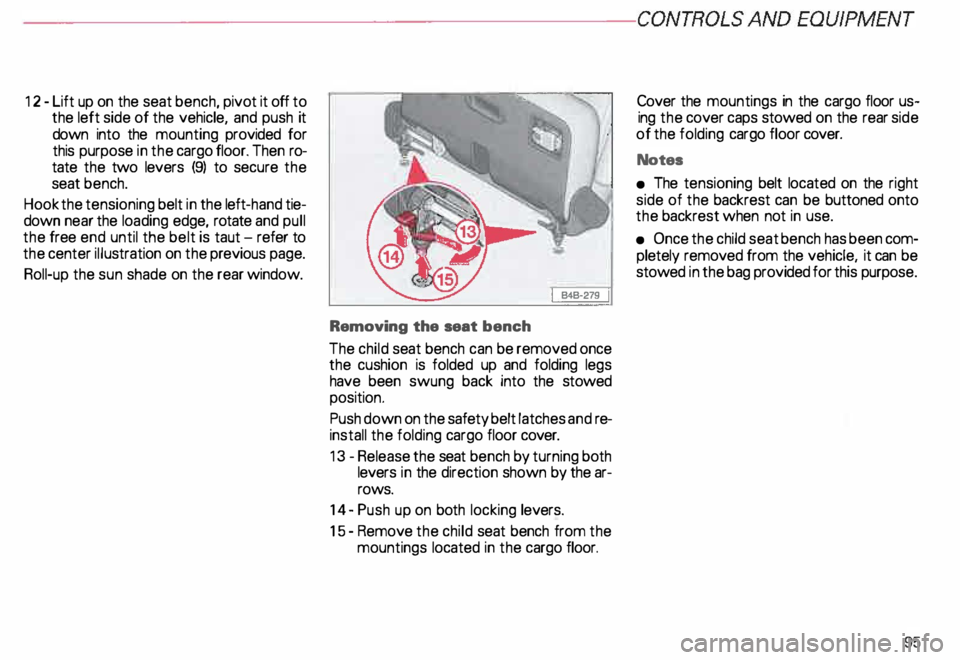
Removing the seat bench
The child seat bench can be removed once
the cushion is folded up and folding legs
have been swung back into the stowed
position.
Push down on the safety belt latches andre
install the folding cargo floor cover.
13 -Release the seat bench by turning both
levers in the direction shown by the ar
rows.
14- Push up on both locking levers.
15- Remove the child seat bench from the
mountings located in the cargo floor. Cover
the mountings in the cargo floor us
ing the cover caps stowed on the rear side
of the folding cargo floor cover.
Notes
• The tensioning belt located on the right
side of the backrest can be buttoned onto
the backrest when not in use.
• Once the child seat bench has been com
pletely removed from the vehicle, it can be
stowed in the bag provided for this purpose.
95
Page 97 of 306
CONTROLS
AND
EQUIPMENT---------------------
Ski sack
Use the ski sack to transport and protect
skis and other long, light items in the pas
senger compartment.
Loading the ski sack
Load the ski sack from the luggage
compartment.
• Open the luggage compartment lid and
clear a space in tho center.
• Press the release button for the ski sack
flap in the luggage compartment (see arrow
in illustration) and pull down the flap.
96 •
Fold out center armrest in the rear seat
backrest.
• Press the release button for the ski sack
flap on the inside of the vehicle and open the
flap.
• Pull out and unfold the ski sack.
• Load skis or similar objects through the
luggage compartment into the interior of
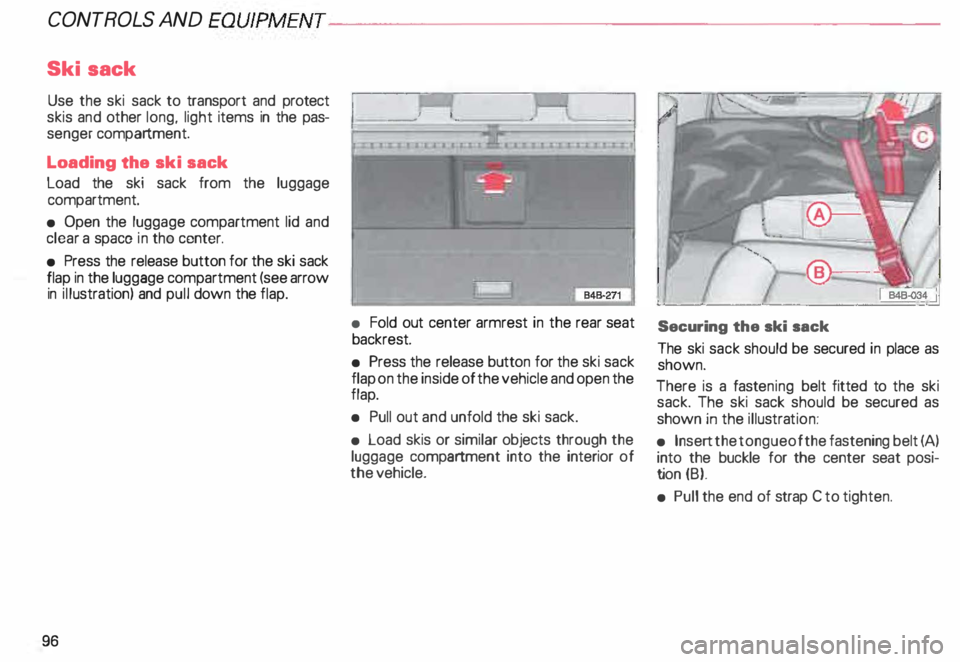
the vehicle. Securing
the ski sack
The ski sack should be secured in place as
shown.
There is a fast ening belt fitted to the ski
sack. The ski sack should be secured as
shown in the illustra tion:
• Insert the tongue of the fastening belt (A)
into the buckle for the center seat posi
ti on (B).
• Pull the end of strap C to tighten.
Page 103 of 306
CONTROLS AND EQUIPMENT---------------------
Pedals
The movement of the pedals must
never be obstructed by a floor mat
or any other object.
• In case one of the two brake circuits fails,
incr eased brake pedal travel is required to
bring the vehicle to a full stop.
• You should always be able to depress the
accelerator and the clutch pedals all the way
down to the floor.
• All pedals must be able to return to their
original position unhindered.
Only use floor mats which leave the pedal
area free and can be secured with floor mat
faste ners.
�W ARNING
Never place any objects in the area
of the pedals. In case of sudden
braking or an accident. an object
could interfere with pedal
function. You would not be able to
brake or accelerate.
10 2
I -
.· t\
•J I ·. ·· -· I
--···· ·-· ..... ___ -..... . .
- - _ _I
__ l_�4B·31 1 ij
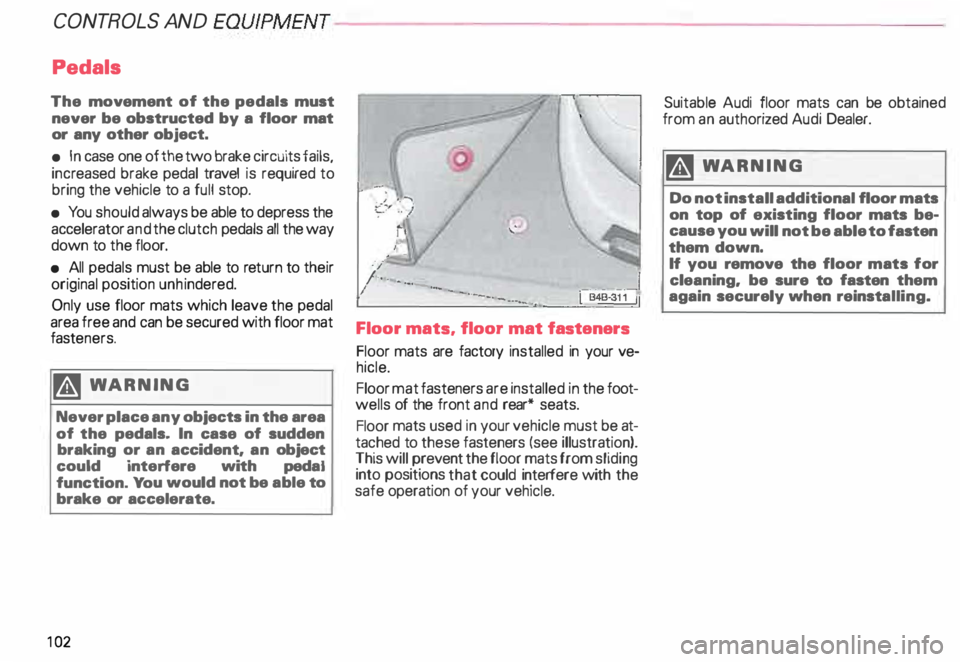
Floor mats. floor mat fasteners
Floor mats are factory installed in your ve
hicle.
Floor mat fasteners are installed in the foot
wells of the front and rear* seats.
Floor mats used in your vehicle must be at
tached to these fasteners (see illustration).
This will prevent the floor mats from sliding
into positions that could interfere with the
safe operation of your vehicle. Suitable Audi
floor mats can be obtained
from an auth orized Audi Dealer.
�W ARNING
Do not install additional floor mats
on top of existing floor mats be
cause you will not be able to fasten
them down.
If you remove the floor mats for
cleaning. be sure to fasten them
again securely when reinstalling.
Page 111 of 306
CONTROLS AND
EQUIPMEN T--------------------
Selecting a driving position
�W ARNING
• Power is transmitted to the
wheels as soon as a driving posi
tion Is engaged. Therefore, when
the selector lever is in a driving
position, the vehicle may creep
even at idle speed. Do not release
the parking brake or foot brake un
til you are ready to move.
• If you must check under the
hood with the engine running,
never have any driving position en
gaged. Make sure the selector le
ver is securely locked into the P
(Park) position with the parking
brake firmly set. Otherwise, any
increase in engine speed may set
the vehicle in motion, even with
the parking brake applied.
• Do not accelerate while select
ing a driving position. At this time
the engine must run at idle speed
so that no undue stress will be
placed on the automatic clutches
in the transmission.
110 rA'J
WARNING continued
o If the selector lever is uninten
tionally moved into N (Neutral}
while you are driving, take your
foot off the accelerator pedal and
wait to idle speed before selecting
a driving position.
• Never shift into R (Reverse) or P
(Park) when the vehicle is in mov
ing. You will damage the transmis
sion.
Sta rting off
Select a gear. Wait for the transmis·
sion to engage the gaar (the vehicle
may move slightly). Then press the gas
pedal.
Maneuvering
When alternating between forward (D) and
reverse (R)-for instance, while maneuver
ing the vehicle into a tight parking space -
shift only when the vehicle has come to a
full stop and the engine is running at idle
speed. Stopping
• When stopping briefly, at a traffic light for
example, it is not necessary to move these
lector lever to N (Neutra l). Simply apply
the foot brake.
• The driving positions must never be used
for holding the vehicle on a hill. Always use
the foot brake when stopped on inclines.
mi WARNING
It is best never to get out of the
driver's seat when the engine is
running. However, if you must get
out of the vehicle, do this: Move
the selector lever securely into the
P (Park) position and apply the
parking brake firmly. If you are not
securely in P (Park), your vehicle
could move, possibly causing a se
rious accident.
Page 174 of 306
-------------�-------CONTROLS AND
EQUIPMEN T
Audi Homelink ® Uni versal Transm itter*
-� ....... ..
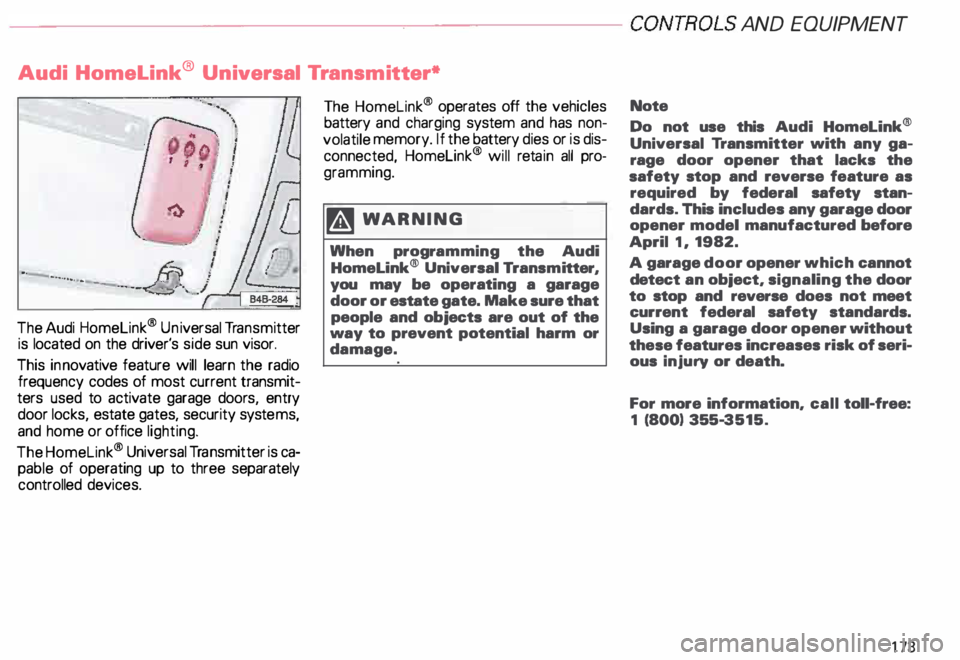
The Audi Homelink ® Un iversal Transm itter
is located on the driver's side sun visor.
This innovative feature will learn the radio
frequency codes of most current transmit
ters used to activate garage doors, entry
door locks, estate gates, security systems,
and home or office lighting.
The Homelink ® Universal Transmitter is ca
pable of operating up to three separately
controlled devices. The
Homelink ® operates off the vehicles
battery and charging system and has non
volatile memory. If the battery dies or is dis
connected, Homelink® will retain all pro
gramming.
�W ARNING
When programming the Audi
Homelink® Universal Transm itter,
you may be operating a garage
door or estate gate. Make sure that
people and objects are out of the
way to prevent potential harm or
damage. Note
Do not
use this Audi Homelink®
Universal Transmitter with any ga
rage door opener that lacks the
safety stop and reverse feature as
required by federal safety stan
dards. This includes any garage door
opener model manufactured before
April 1, 1982.
A garage door opener which cannot
detect an object, signaling the door
to stop and reverse does not meet
current federal safety standards.
Using a garage door opener without
these features increases risk of seri
ous injury or death.
For more information, call toll-free:
1 (800) 355-3515.
173
Page 176 of 306
Training a Garage Door
Equip ped with Rolling Code
To train your rolling code garage door
opener to operate from your Homelink®
Universal Transmi tter, follow these steps
after completing the "Program
ming" portion of this text (the aid of a sec
ond person may make the training quicker
and easier):
1 - Locate and press and relaaaa the
training (or "learning") button on the
garage door opener motor head unit.
(Exact location and color of the button
may vary by garage door opener brand.)
If there is difficulty locating the training
button, reference the garage door
opener owner's manual or call toll free:
1- 800-355- 3515.
2 - Return to the vehicle and press and re
lease the progr ammed Homelink ®
channel. Press and release the
Homelink ® channel a second time to
complete the progra mming process.
(Some garage door openers may re
qu i· re you to do this procedure a thir d
ti me.) The
garage door opener should now recog
nize the Audi Homelink ® Un iversal Trans
mitter. You may use either the hand-held
transmitter or the Audi Home link® Univer
sal Transmi tter to activate the garage door.
Oper ating the Audi HomeLink ®
Uni versal Transmitter
1 - Tum the ignition switch on.
2 - Select and firmly press and release the
appropriate channel (1, 2, or 3) to acti
vate the trained device (e.g. garage
door, estate gate, home security sy
stem, entry door lock, or home or office
lighting). CONTROLS
AND EQUIPMENT
Erasing the Audi HomeLink ®
Universal Transm itter's Pro
gramming
1 - Turn the ignition switch on.
2 - Simult aneously press and hold chan
nels 1 and 3 until the indicator light be
gins to flash after 20 seconds.
3 - Release both buttons.
This process will erase the trained codes of
the three channels or erase the factory set
default codes.
The Audi Homelink ® Un iversal Transmitter
is now in the train (or progra mming) mode
and can be progra mmed at any time follow
ing steps 3 through 5 in the "Progr amming"
portion of this text.
175
Page 200 of 306
-----------------------VEHICLE OPERATION
Driving on rough roads or rugged terrain
For off road use, your Audi allroad is
equipped with a 4-level air suspension ride
height adjustment system, in addition to all
wheel drive.
Yo ur vehicle's ground clearance (ride height)
can be adjusted to changing terrain condi
tions with the push of a butt on.
At the highe st level setting (maximum clear
ing level), ground clearance is 8.2 inches
(20.8 em).
Some general tips
Navar drive on terra in that is too de
manding for the design of your ve
hicle or for your driving abilities.
Navar t�;�ke any unnecessary
chances!
• Before you take your vehicle off-roa d,
make certain that you know how to operate
the ride height adjustment system-see pa
ge 153. •
Make sure that you adjust the ride height
just before you travel on any rough sections
of terra in.
• Always adjust the vehicle's speed
to the trail and terrain conditions.
• Stow any luggage or other items in the
luggage compartment and make certain
that they are properly secured so that they
do not shift.
• Never travel on any roads, trails or terrain
on which motor vehicle travel is prohibited.
r.:Cib Always protect the environW ment. Respect our natural su�
roundings.
• After traveling off-road, remember to re
move any branches or other foreign objects
caught in the grille, underbody or wheels. In
particular, look for foreign objects (stones)
caught in the tire treads.
Check the vehicle for possible damage.
• Clean dirty windows, headlight and tail
light lenses and license plates. •
Check your brakes after traveling off-road
especially after driving through water.
• If need be, clean the underbody, suspen
sion parts, etc. (for example, in an under
body wash).
Some driving tips
Unpaved roads and off-road
• Drive slowly on unfamiliar roads and ter
rain, and stay alert for unexpected hazards
(for example, potholes, rocks and stumps).
• To avoid hanging up the vehicle and dam
aging the undercarriage on extremely un
even terrain, drive over large humps with
the hump in the center of the vehicle.
Instead, always drive over the hump with
the vehicle wheels on one side of the ve
hicle positioned over the crown of the
hump.
199
Page 209 of 306
VEHICLE OPERA
TION-----------------------
Trailer towing
Yo ur Audi was designed primarily for pas
senger transportat ion. The additional load
will affect durability, economy and perfor
mance.
Tra iler towing not only places more stress
on the vehicle, it also calls for more con
centration from the driver.
For this reasons, always follow the opera
ting and driving instructions given and use
common sense.
208 Te
chnical requirements
Tr ailer hitch
Use a weight-carrying hitch conforming to
the gross trailer weight. The hitch must be
suitable for your vehicle and trailer and
securely bolted to appropriate place on the
vehicle's chassis. Use only a trailer hitch
with removable ball mount. Always check
with the trailer hitch manufacturer to make
sure that you are using the correct hitch.
Do not use a bumper hitch.
The hitch must be installed in such a way
that it does not interfere with the impact-ab
sorbing bumper system. No modifications
should be made to the vehicle exhaust and
brake systems. From time to time, check
that all hitch mounting bolts remain secure
ly fastened. When
you are not towing a trailer, remove
the trailer hitch ball mount. This prevents
the hitch from causing damage should your
vehicle be struck from behind.
�W ARNING
When you are no longer towing a
trailer, remove the entire trailer
hitch. When doing so, seal all bolt
holes to prevent water and deadly
exhaust fumes from entering the
vehicle.
Engine cooling system
To wing a tr ailer make the engine work hard
er. It is important that the engine cooling
system be up to the job. Make sure that the
cooling system has enough fluid.
Page 231 of 306
VEHI
CLE CARE
J'4 WARN ING continued
• If you must work underneath
the vehicle with the wheels on the
ground, always make sure the ve
hicle is on level ground. that the
wheels are always securely
blocked and that the engine can
not be started. Always remove the
ignition key before anyone gets
under the vehicle.
Always make sure the transmis
sion selector lever (automatic
transmission) is in "P" (Park posi
tion) and the hand brake is firmly
applied.
• Always be extremely careful
when working on the vehicle. Always follow commonly accepted safety practices and general com
mon sense. Never risk personal in
jury.
230 �
Changing the engine settings
will adversely aHect emission
levels. This Is detrimental to the en
vi ronment and increases fuel con
sumption.
Always observe environmental reg
ulations when disposing of old en
gine oil. used brake fluid, dirty en
gine coolant, spent batteries or
worn out tires.