ECU AUDI ALLROAD 2000 Owner's Manual
[x] Cancel search | Manufacturer: AUDI, Model Year: 2000, Model line: ALLROAD, Model: AUDI ALLROAD 2000Pages: 306, PDF Size: 9.95 MB
Page 232 of 306
Engine
hood
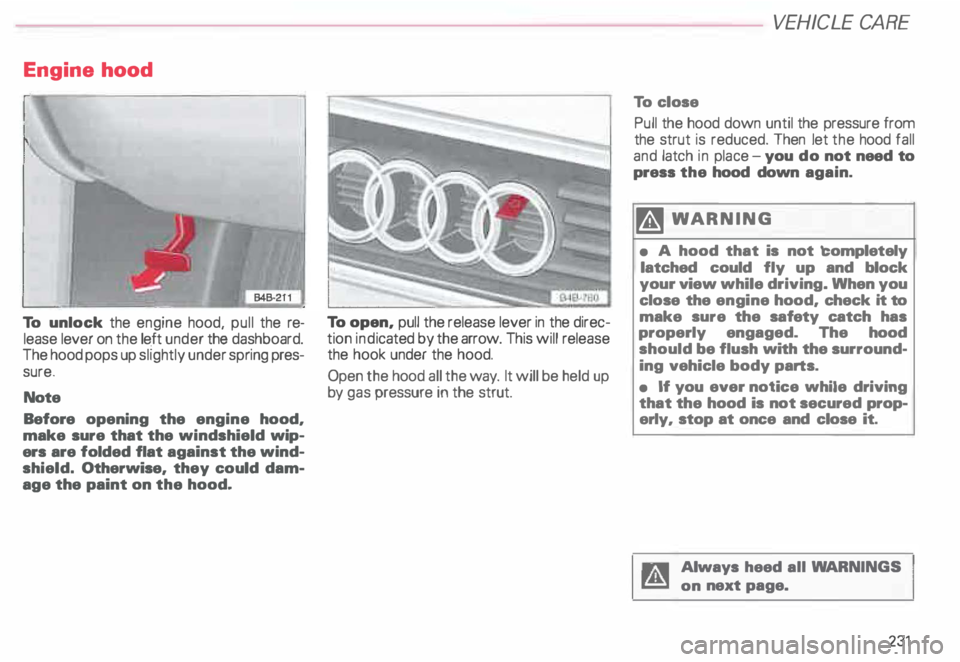
To unlock the engine hood, pull the re
lease lever on the left under the dashboard.
The hood pops up slightly under spring pres
sure.
Note
Before opening the engine hood,
make sure that the windshield wip
ers are folded flat against the wind
shield. Otherwise, they could dam
age the paint on the hood. To
open, pull the release lever in the direc
tion indicated by the arrow. This will release
the hook under the hood.
Open the hood all the way. It will be held up
by gas pressure in the strut. VEH
ICLE CARE
To close
Pull the hood down until the pressure from
the strut is reduced. Then Jet the hood fall
and latch in place -you do not need to
press the hood down again.
m WARNING
• A hood that is not 'completely
latched could fly up and block
your view while driving. When you
close the engine hood, check it to
make sure the safety catch has
properly engaged. The hood
should be flush with the surround
ing vehicle body parts.
• If you ever notice while driving
that the hood is not secured prop
erly, stop at once and close it.
Always heed all WA RNINGS
on next page.
231
Page 237 of 306
VEHICLE CA
RE---------------------------------------------------
Adding engine oil
A Always heed all WA RNINGS
r!!J on page 232.
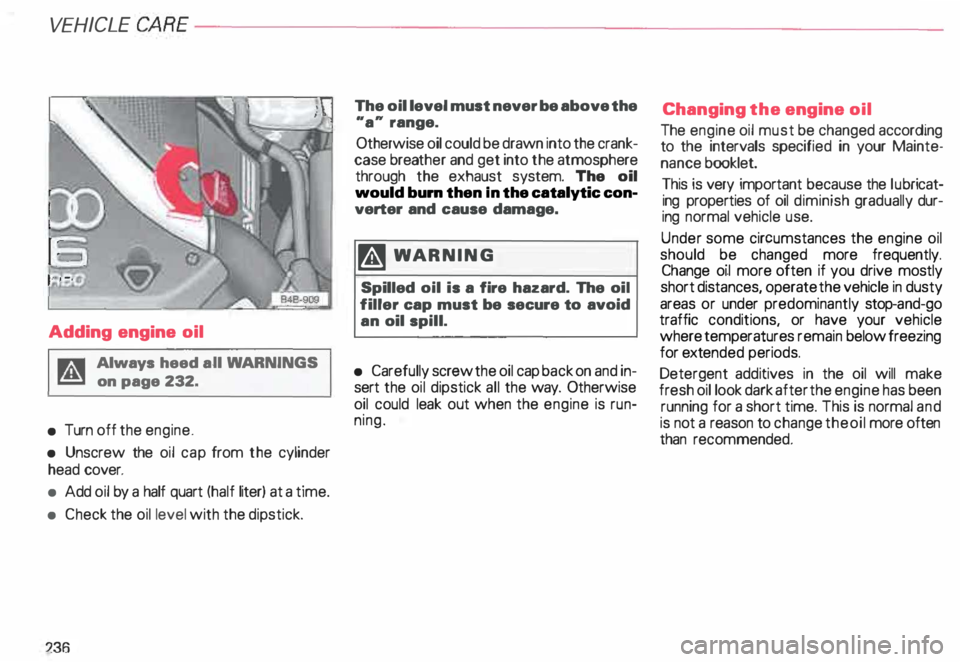
• Turn off the engine.
• Unscrew the oil cap from the cylinder
head cover.
• Add oil by a half quart (half liter) at a time.
• Check the oil level with the dipstick.
:236 The
oil level must never be above the
"a .. range.
Otherwise oil could be drawn into the crank
case breather and get into the atmosphere
through the exhaust system. The oil
would bum then In the catalytic con
verter and cause damage.
� WARNING
Spilled oil is a fire hazard. The oil
filler cap must be secure to avoid
an oil spill.
• Carefully screw the oil cap back on and in
sert the oil dipstick all the way. Otherwise
oil could leak out when the engine is run
ning. Changing
the engine oil
The engine oil must be changed according
to the intervals specified in your Mainte
nance booklet.
This is very important because the lubricat
ing properties of oil diminish gradually dur
ing normal vehicle use.
Under some circumstances the engine oil
should be changed more frequently.
Change oil more often if you drive mostly
short distances, operate the vehicle in dusty
areas or under predominantly stop-and-go
traffic conditions, or have your vehicle
where temperatures remain below freezing
for exte nded periods.
Detergent additives in the oil will make
fresh oil look dark after the engine has been
running for a short time. This is normal and
is not a reason to change the oil more often
than recommended.
Page 260 of 306
-------------------------VEHICLE
CARE
Te mperature
The temperature grades are A (the highest),
8, and C, repres enting the tire's resistance to
the generation of heat and its ability to dissi
pate heat when tested under contro lled con
ditions on a specified indoor laboratory test
wheel. Sustained high temJ)erature can
cause the material of the tire to degenerate
and reduce tire life, and excessive tempera
ture can lead to sudden tire failure. The
grade C corres ponds to a level of perfor
mance which all passenger car tires must
meet under the Federal Motor Vehicle Safety
Sta ndard No. 1 09. Grades Band A represent
higher levels of performance on the laborato
ry test wheel than the minimum required by
law.
�W ARNIN G
The temperature grade for this tire
is est ablished for a tire that is
properly inflated and not over
loaded. Excessive speed, under
inflation, or excessive loading, ei
ther separately or in combination,
can causa heat buildup and pos
sible tire failure. Wheel
replacement
If you wish to equip your vehicle with tires
or wheels other than those installed at the
factory, please note the following:
• For technical reasons it is not al
ways possible to use wheels from
other vehicles -under certain condi
tions not even wheels from the same
vehicle model.
• Wheel rims and wheel bolts are
matched to fit your Audi. When
installing different wheels (for ax
ample, wheels with winter tires), the
correct wheel bolts with the proper
length and conical shape of the bolt
head must be used. The secure fit of
the wheels and the proper function
ing of the brake system and safety
are dependent upon this.
• Wheel rims and wheal bolts are
matched to fit your Audi. •
Before you plan on exchanging
steel wheels, light alloy wheals, or
winter tires already mounted on
wheel rims, consult your authorized
Audi Dealer. They have the technical
information necessary to advise you
which wheal rims and wheel bolts
are compatible with the original fac
tory installations.
1ft WARNING
• Incorrect tire/wheel parts may
cause an accident and personal in
jury. Such parts will adversely af
fect the safe operation of your ve
hicle. Always use tires, wheel rims
and wheel bolts that meat specifi
cations of the original factory
installed equipment.
• If wheel trim discs or a front
spoiler are Installed, make sura the
airflow for cooling the brakes is
not obstructed.
259
Page 265 of 306
DO-IT-Y
OURSELF SERVICE----------------------
Jack and
tools
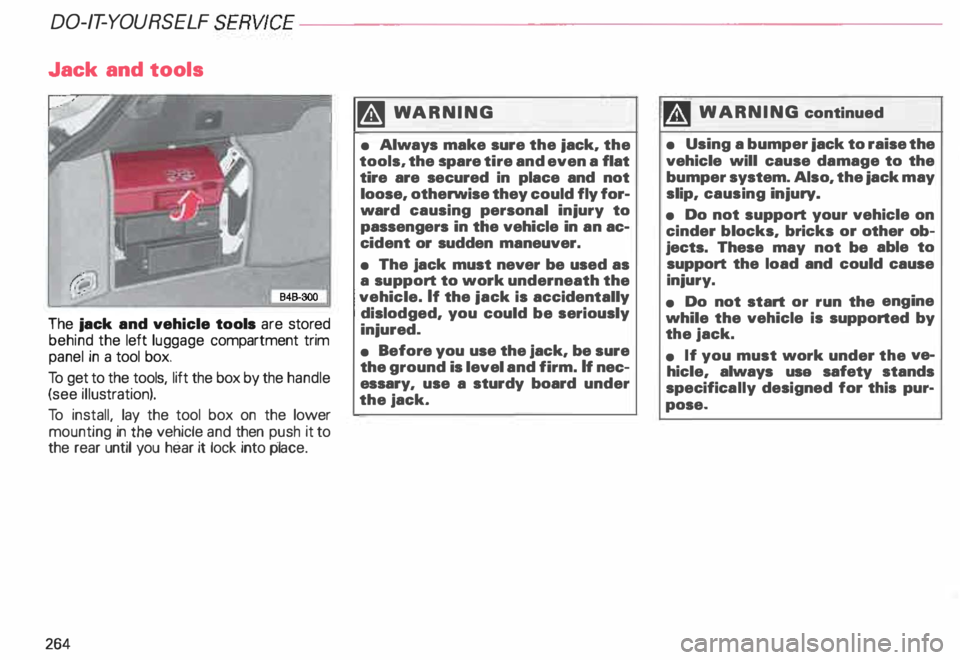
The jack and vehicle tools are stored
behind the left luggage compartment trim
panel in a tool box.
To get to the tools, lift the box by the handle
(see illustration).
To install, lay the tool box on the lower
mounting in the vehicle and then push it to
the rear until you hear it lock into place.
264 �W
ARNING
• Always make sure the jack. the
tools, the spare tire and even a flat
tire are secured in place and not
loose, otherwise they could fly for
ward causing personal injury to
passengers in the vehicle in an ac
cident or sudden maneuver.
• The jack must never be used as
a support to work underneath the
vehicle. If the jack is accidentally
dislodged, you could be seriously
injured.
• Before you use the jack, be sure
the ground is level and firm. If nec
essary, use a sturdy board under
the jack.
, ... WARNING continued
• Using a bumper jack to raise the
vehicle will cause damage to the
bumper system. Also, the jack may
slip, causing injury.
• Do not support your vehicle on
cinder blocks, bricks or other ob
jects. These may not be able to
support the load and could cause
injury.
• Do not start or run the engine
while the vehicle is supported by
the jack.
• If you must work under the ve
hicle, always usa safety stands
specifica lly designed for this pur
pose.
Page 266 of 306
Yo
ur vehicle comes equipped with the fol
lowing tools:
- Vehicle jack
Before storing the jack, make sure it is
wound back down as far as it will go.
Hook for removing hook caps
- Lug wrench
Plastic pin for changing wheels
- Screwdriver with a hexagonal opening in
the handle for removing wheel bolts.
The screwdriver has a rever sible blade
(flat blade on one end and Phillips head
on the other).
- Open ended wrench 1 0 x 13
- Towing loop for transporting the vehicle
(see page 281). Note
Never
use the hexagonal opening in
the handle of the screwdriver to
loosen or tighten the wheel bolts.
�W ARNING
Always make sure the spare tire
and even a flat tire are secured in
place and not loose, otherwise
they could fly forward causing per
sonal injury to passengers in the
vehicle in an accident or sudden
maneuver. DO-IT-YOURSELF
SERVICE
265
Page 268 of 306
•
The deflated full size spare tire cannot be
repaired or mounted using conventional
shop equipment. This work always has to
be performed by the man ufacturer of the
collapsible tire.
• All the air must be let out of the tire after
use before stowing it in the storage area
prov ided for it in the vehicle. Once all the air
is out, the tire will return to its original form.
To let the air out of the tire, either use a
sharp object to press down on the metal pin
in the valve, or use the valve-remo ving tool
on the back side of the dust cap to unscrew
the valve stem. Changing
a wheel
�W ARNING
You or your passengers could be
injured while changing a wheel if
you do not follow safety precau
tions:
• If you have a flat tire, move a
safe distance off the road. Turn off
the engine, turn the emergency
flasher on and use other warning
devices to alert other motorists.
• Passengers must not rema in in
the vehicle when it is jacked up.
This includes children as well as
adults.
• Make sure that passengers wait
in a safe place away from the ve
hicle and well away from the road
way and traffic.
• Before you change a wheel, be
sure the ground is level and firm.
If necessary, use a sturdy board
under the jack. DO-IT-YOURSELF
SERVICE
�� WARN ING continued
• After installing the spare wheel,
make sure that you remount the
flat tire/Wheel in its storage area
properly and tighten the plastic
knurled screw securely.
• To help prevent the vehicle from
moving suddenly and possibly
slipping off the jack, always fully
set the parking brake and block
the wheel diagonally opposite the
wheel being changed. When one
front wheel is lifted off the
ground, placing the automatic
transmission in P (Park) will not
prevent vehicle movement.
267
Page 271 of 306

DO-IT-Y
OURSELF SERVICE----------------------
\
�W ARNING
Yo u or your passengers could be
injured while changing a wheel if
you do not follow safety precau
tions:
• Jacking at any other place may
damage the vehicle or may result
in personal injuries.
• An unstable surface under the
jack may cause the vehicle to slip
off the jack. Always provide a firm
base for the jack on the ground. If
necessa ry. use a sturdy board un
der the jack.
• On hard. slippery surface (such
as tiles) use a rubber mat or similar
to prevent the jack from slipping.
270 Step
5
• Turn the handle on the jack until the jack
arm just fits underneath the vehicle.
• Position the jack arm on the lower sill of
the vehicle so that the rib in the recess is
surrounded by the jack claw (A) and the
movable base plate (8) of the jack lies flat on
the floor.
When you straighten the jack, make sure
claw doesn't slip off the rib. �W
ARNING
o Do not raise the vehicle until
you are sure the jack is securely
engaged.
• Passengers must not rema in in
the vehicle when it is jacked up.
• Make sure that passengers wait
in a safe place away from the ve
hicle and well away from the road
way and traffic.
• To raise the vehicle, turn the handle
clockwise. Only raise the vehicle as much
as is needed to change a wheel.
Page 273 of 306
DO-IT-Y
OURSELF SERVICE----------------------
Step
7
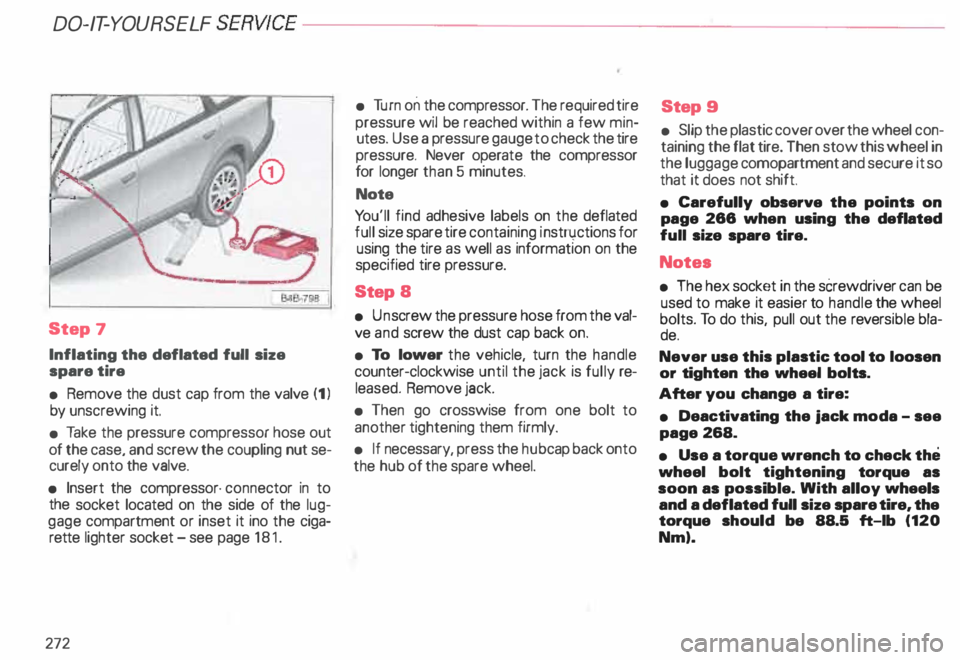
Inflating the deflated full size
spare tire
• Remove the dust cap from the valve (1 l
by unscrewing it.
• Take the pressure compressor hose out
of the case, and screw the coupling nut se
curely onto the valve.
• Insert the compressor· connector in to
the socket located on the side of the lug
gage compartment or inset it ino the ciga
rette lighter socket -see page 181.
272 •
Turn on the compressor. The required tire
pressure wil be reached within a few min
utes. Use a pressure gauge to check the tire
pressure. Never operate the compressor
for longer than 5 minutes.
Note
Yo u'll find adhesive labels on the deflated
full size spare tire containing i nstn .1ctions for
using the tire as well as information on the
specified tire pressure.
Step S
• Un screw the pressure hose from the val
ve and screw the dust cap back on.
• To lower the vehicle, turn the handle
counter-clockwise until the jack is fully re
leased. Remove jack.
• Then go crosswise from one bolt to
another tightening them firmly.
• If necessary, press the hubcap back onto
the hub of the spare wheel. Step
9
• Slip the plastic cover over the wheel con
taining the flat tire. Then stow this wheel in
the luggage comopartment and secure it so
that it does not shift.
• Carefully observe the points on
page 288 when using the deflated
full size spare tire.
Notes
• The hex socket in the screwdriver can be
used to make it easier to handle the wheel
bolts. To do this, pull out the revers ible bla-
de. ·
Never use this plastic tool to loosen
or tighten the wheel bolts.
After you change a tire:
• Deactivating the jack moda -see
page 268.
• Use a torque wrench to check the
wheel bolt tightening torque as
soon as possible. With alloy wheels
and a deflated full size spare tire, the
torque should be 88.5 ft-lb (120
Nm).
Page 274 of 306
•
Be sure to check the tire pressure
as quickly as possible after you
install a wheal that is fitted with
new tires.
If you notice while changing a tire
that the wheal bolts are corroded
and difficult to turn, then they
should be replaced before you
check the tightening torque.
Until then, drive with extra care and
at reduced speeds. m
WARNING
• If you are going to equip your ve
hicle with tires or rims which dif
fer from those which were factory
installed, then be sure to read the
information on page 257.
• Always store damaged wheel,
jack and tools securely in luggage
compartment. DO-IT-YO
URSELF SERVICE
Note
Remember that the deflated full size
spare tire is for temporary use only!
273
Page 283 of 306
00-/T-YOURSELF SERV/CE----------------------
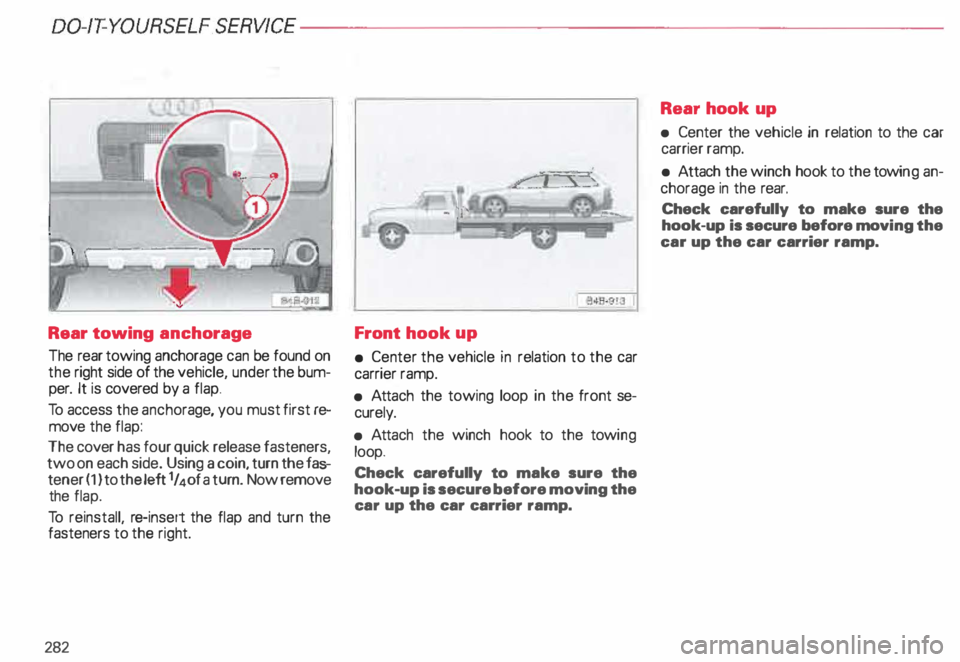
Rear towing anchorage
The rear towing anchorage can be found on
the right side of the vehicle, under the bum
per. It is covered by a flap.
To access the ancho rage, you must first re
move the flap:
The cover has four quick release fasteners,
two on each side. Using a coin, turn the fas
tener ( 1) to the left 1 I 4 of a turn. Now remove
the flap.
To reinstall, re-insert the flap and turn the
fasteners to the right.
282 Front
hook up
• Center the vehicle in relation to the car
carrier ramp.
• Atta ch the towing loop in the front se
curely.
• Atta ch the winch hook to the towi ng
loop.
Check carefully to make sure the
hook-up is secure before moving the
car up the car carrier ramp. Rear
hook up
• Center the vehicle in relation to the car
carrier ramp.
• Attach the winch hook to the towi ng an
chorage in the rear.
Check carefully to make sure the
hook-up is secure before moving the
car up the car carrier ramp.