fuel AUDI ALLROAD 2000 Owner's Manual
[x] Cancel search | Manufacturer: AUDI, Model Year: 2000, Model line: ALLROAD, Model: AUDI ALLROAD 2000Pages: 306, PDF Size: 9.95 MB
Page 193 of 306
CONT
ROLS AND
EQUIPMENT---------------------
Loading a roof rack
Always distribute the loads evenly.
The total maximum permissible load
carrying capacity of 200 lbs ( 1 00 kg)
for the roof rack installation (includ
ing weight the roof rack system)
must not be exceeded -see
page 290 for details.
19 2 �
WARNING
• Improper use of a roof rack can
cause accidents and personal inju
ries.
• The use of a roof rack can nega
tively affect the way a vehicle han
dles.
• Cargo that is large. heavy,
bulk y, long or flat will have a
greater negative influence on the
vehicle's aerodynamics. center of
gravity and over all handling.
• Never exceed the maximum per
missible load carrying capacity of
the roof of your vehicle.
• Always drive slowly, avoid sud
den braking and maneuvers when
transp orting cargo on the roof of
your vehicle. When to
remove the roof rack
If you have installed a roof rack on your ve
hicle, it is best to ask the car wash operator
if it should be removed before going
through an automatic car wash.
When not in use, remove the roof rack to re
duce wind noise, improve handling, fuel
consump tion and guard against theft.
Page 194 of 306
The
first 1,000 miles (1 500 km)
and afterwards
Break-in period
During the first few hours of driving, the en
gine's internal friction is higher than later
when all the moving parts have been broken
in. How well this break-in process is done
depends to a considerable extent on the
way the vehicle is driven during the first
1, 000 miles (1 500 kilometres").
For the first 600 miles
(1 000 kilometres):
As a rule of thumb:
• Do not use full throttle.
• Do not drive faster than 3/4 of top
speed shown on the speedometer.
• Avoid high engine speeds.
• If possible, avoid towing a trailer. �
WARNING
• New tires tend to be slippery
and must also be "broken-ln." Be
sure to remember this during the
first 300 miles (500 kilometres).
Brake gently. Avoid following
closely behind other vehicles or
other situations that might require
sudden, hard braking.
• New brake pads don't have the
best stopp ing power and must be
.. brok en-in" during the initial 100
to 150 miles (150 to 200 kilo
metres) of normal city driving. You
can compensate for this by press
ing the brake pedal more firmly.
This also applies later when new
pads are installed.
From 600 to 1,000 miles
(1 000 to 1 500 kilometres):
Speeds can gradually be increased to maxi
mum permissible road or engine speed. VE
HICL E OPER ATION
During and after break-in
period
• Do not rev the engine up to high speeds
when it is cold. This applies whether the
transmission is in N (Neutral) or in gear. dib Do not drive with unnece ssarily C!1'5 high engine speeds -upshifting
early saves fuel, reduces noise and
protects the environmeht -see also
page 195.
After the break-in period
Do not exceed maximum engine
speed under any circumstances. Up
shift into the next higher gear before reach
ing the red area at the end of the tachome
ter scale -see page 117.
Excessive engine speeds are automatically
reduced.
193
Page 195 of 306
VEHICLE OPERA
TION-----------------------
Operate your vehicle safely
The condition of the vehicle is es
sential for driving safety.
Therefore, always be sure to observe the
following points before you drive off:
• Check lights and turn signals.
• Check fuel level.
• Adjust the mirrors.
• Make sure that all lights and all
windows are clean.
• Make sure the air Intake slot be
tween the engine hood and the
windshield is free of leaves, snow
and ice.
• Check warning and indicator
lights when starting the engine.
For driving safety, always follow the speci
fied maintenance intervals in your Mainte
nance booklet -especially for changing
the brake fluid, see page 242.
Yo ur personal driving style and your
attitude affect driving safety to a
very great extent.
19 4 Therefore,
for your own safety:
• Wear your safety belts and wear
them properly, even if you're just
driving in the city or to the corner
store -see page 14.
• Make sure that all passengers are
wearing their safety belts properly,
even those sitting in the rear -
see page 14.
Passengers not wearing safety belts endan
ger not only themselves in case of an acci
dent, but also the driver and other passen
gers.
• Make sure that children always sit
on the rear seat properly restrained
by a res traint system appropriate
for their size and age.
• Never transport a child in a rear
facing child or infant seat on the
front passenger seat.
• Adjust your seat so that you can
easily reach all controls as far away
from the airbag as possible but no
closer than 10 in. (25 em) -
see page 76. •
The seating position is very im
portant for the airbag performance
- see page 29.
• Always adjust the head restra ints
to the correct height.
For maximum protection, the upper edge of
the head restraints should be at least at
eye level, or higher .
• Always make sure that the move
ment of the pedals is not restricted
In any way-see page 102.
• Store luggage and light items
properly
in the luggage compartment
see page 88.
of the roof - see page 191.
• If you drink, do not drive.
The use of alcohol, drugs and certain medi
cations will seriously impair perception,
reactions and driving ability, and substan
tially increase the risk of an accident and
personal injury.
Page 196 of 306
------------------------VEHICLE
OPERATION
Operate your vehicle economically and
• Do not drive if you are tired.
Make frequent rest stops, at least after ev
ery two hours of driving.
• Always adapt vehicle speed to
traffic, weather and road condi
tions.
Remember that especially on smooth, slip
pery roads, vehicle handling and braking de
pend a great deal on tire adhesion. On wet
roads, the front wheels can hydroplane es
pecially at higher speeds. If this happens,
you will then, no longer be able to steer or
brake properly.
• Always observe the posted speed
limits and use common sense. Your
good judgment can mean the differ
ence between arriving safely at your
destination and having an accident.
Additional information regarding safety can
be found in the individual chapters of this
manual. minimize
pollution
Va rious factors influence fuel consumption:
engine wear, brakes and tires, environmen
tal impact.
This chapter addresses some of these
points.
Yo ur personal sty!e of driving
wi II determine the economy of your vehicle,
as well as exhaust and noise levels.
«i? Do not let your vehicle stand and
, warm
up.
When the engine is idling, it takes a very
long time to warm up. Moreover, during
warm-up, both engine wear and exhaust
gas emissions are very high. Therefore, be
ready to drive off immediately after starting
the engine and avoid high engine speeds.
«i? Avoid full throttle.
Accelerating gently reduces fuel consump
tion, engine wear, and does not disturb the
environment. <£'
Avoid driving at high speed.
Fuel consumption, exhaust emissions and
engine noise increase disproportionately at
high speeds. If you drive at approximately
three quarters of top speed, fuel consump
tion will be reduced by one half. Never drive
faster than the posted speed limit and
weather conditions permitting.
r.:Cib Drive as smoothly as possible
W5 and keep a lookout ahead.
Unn ecessary accelerating and braking in
crease fuel consumption and disturb the en
vironment.
r.:Cib Switch off your engine if you are
W5 caught in a traffic jam. This
saves fuel and reduces emissions.
195
Page 197 of 306
VE
HICLE OPERATION------------------------
The external conditions
in which you drive also affect your fuel con
sumption.
The following conditions increase fuel con
sumption:
• Heavy traffic, especially in large cities
with many traffic lights.
• Stop-and-go driving, especially short dis
tances so that the engine never warms up
as it should.
• Driving in heavy, slow moving traffic in
low gear so that the engine speed is rela
tively high when compared to the distance
driven.
� Plan your trips ahaad of time. Or
� ganizs your trips to include sev
sral errands and to avoid heavy traf
fi c.
Of course, there are some conditions that
will affect fuel consumption that you can't
control.
For example, fuel consumption increases in
the winter or under difficult conditions (bad
roads, towing a trailer, etc.).
19 6 The
technical requirements
for optimum fuel consumption and eco
nomy were ''built" intoyourvehicle. Special
attention was paid to the environment. To
reta in and make use of these characteris
tics, please note the following points:
riJ Use only unleaded gasoline.
Leaded gasoline causes damage to the cat
alytic converter and other components of
the emission system.
t:Gh Have your vehicle serviced by an
� Audi Dealar at the specified in
tervals -see page 228 and your
Main tenance booklet.
Having your vehicle regularly serviced by an
Audi Dealer helps ensure that it runs prop
erly and economical ly, that it does not dis
turb the environment, and that it has a long
service life. t:Gh
Check
your tire pressure once a
W month.
Low tire pressure increases fuel consump
tion and tire wear, and impair s vehicle han
dling.
�W ARNING
Underinflation and overloading of
tires can lead to tire failure. Sud
den failur e on the road could cause
a serious or fata l accident. See
page 253 for inflation informa
tion.
� Do not carry unnecessary items
in the luggage compartment.
Particularly in city traffic where you must
often accelerate, weight influences fuel
consumption.
Page 198 of 306
----------------------VEHICLE
OPERATION
,:lib Remove
supplementary roof
� rack components when not In
use.
At high road speeds, the increased air �e
sistance caused by the cross bars also In
creases fuel consumption.
,:lib Switch oH any electrical equip
� ment when no longer needed.
The more electricity you consume, the
higher the fuel consumption.
,:lib Check your vehicle 's fuel co?'l!�Sr sumption regularly. Keep a writ
ten record or use the trip odometer .
Check your fuel consumption ea?h time you
refu el. By doing this, you can d1scov �r a �y
inc onsistencies which could result 1n In
creased fuel consumption and have these
checked before other problems appear. •
Check your oil each time you fill
your tank
The amount of oil used is related to engine
load and speed.
It is normal for the oil consumption of a new
engine to reach its lowest value after a cer
tain mileage has been driven.
You must drive your vehicle about 3,000
miles (5 000 kilome tres) before you can
properly assess oil consumption.
This also applies to fuel consumption and
engine output.
• The published ENVIRONME NTAL
PROTECTION AGENCY (EPA) and
Tr ansport Canada consumption esti
mates may not correspond to your
actual consumption on the road.
which will vary depending upon ve
hicle load and speed. road and
weather conditions. trip length. etc. The
catalytic converter is an efficient
"clean-up" device built into the exhaust
system of the vehicle. The catalyttc convert
er burns many of the pollutants in the ex
haust gas before they are released into the
atmosphere.
The exclusive use of unleaded fuel is
critically important fo.r the life of
the catalytic converter and proper
functioning of the engine - see
page 225.
The catalytic converter will be per
manently damaged by:
• Exc eeding the correct engine oil
level - see page 236;
• Driving until the fuel tank be
comes completely empty. The en
gine could misfire. Unburned fuel
could also get into the exhaust sys
tem and this could cause the catalyt
ic converter to overheat;
197
Page 199 of 306
VE
HICL E OPER ATION ------------------------
• Tu rning off the ignition while the
vehicle is movin g-sea page 115 -or
• Other unusual operating condi
tions.
Do not continue to operate your ve
hicle under these conditions, as
otherwise fuel can reach the catalyt
ic converter. This could result in
overheating of the converter, requir
ing its replacement.
To assure eHiciant operation of the
Emission Control System:
• Have your vehicle maintained
properly and in accordance with the
service recommendations in your
Maintenance booklet.
Lack of proper maintenance as well
as improper usa of the vehicle will
impair the function of the emission
control system and could lead to
damage.
19 8 Cl
Do not alter or remove any com
ponent of the Emission Control Sys
ta.m unless approved by the
manufacturer.
• Do not alter or remove any device,
such as heat shields, switches, igni
tion wires, valves, which are de
signed to protect your vehicle 's
Emission Control System and other
important vehicle components.
Nota
Do not leave engine idling unat
tended after starting. If warning
lights should come on to indicate
improper operation, they would go
unheeded. Extended idling also pro
duces heat, which could result in
overheat ing or other damage to the
vehicle or other property. �W
ARNING
• Parking
Do not park or operate the vehicle
in areas where the hot exhaust sys
tem may coma in contact with dry
grass, brush, fuel spill or other ma
terial which can causa a fire.
• Undercoating
Do not apply additional undercoat
ing or rustproofing on or near the
exhaust manifold, exhaust pipes,
cata lytic converter or heat shields.
During driving, the substance
used for undercoating could over
heat and causa a fire.
Page 213 of 306
VEHICLE CA
RE---------------------------------------------------
Cleaning and protec tion
Any automobile is subjected to abuse from
indus trial fumes, corrosive road salt, aban
doned lollipops, muddy dog feet, etc. A well
cared- for Audi can look like new many years
after purchase. Regular and correct care will
contribute to maintaining the beauty and
value of your Audi.
Furthermore. good care may be a
condition for upholding a warranty
claim should corrosion damage or
paint defects occur.
Yo ur Audi Dealer has a variety of vehicle
care products and can advise you which
ones to use for cleaning the exterior and in
terior of your vehicle.
Whether you use products recommended
by Audi or other commercially available
cleaning agents, please make very sure you
apply them correctly.
212
r.Gb Select only environmentally � friendly cleaning products. Any
remaining cleaning products do not
belong in the household waste.
�W ARNING
• Cleaning agents may be poison
ous. Keep them out of the reach of
children.
• Observe all caution labels.
• Always read directions on the
cont ainer before using any prod
uct. Follow these directions care
fully.
• Most chemical cleaners are con
centrates which require dilution.
• Only use spot removing fluids in
well ventilated areas.
• Do not use gasoline. kerosene.
Diesel fuel. nail polish remover or
other volatile fluids. They may be
toxic, flammable or hazardous in
other ways. Care
of exterior
Important Never use polishes or hard waxes on
matte- painted parts or plastic parts,
since this can permanently damage
the visual appearance of the sur
faces of these parts.
In parti cular , make certain that the roof,
bumper, trim moldings, rocker panel mol
ding and wheel house liners do not come
in contact with cleaners I polishes or hard
waxes.
Page 222 of 306
General
notes
• We recommend that you have the engine
compartment and the underside of your ve
hicle inspected twice a year for any damage
to the protective coating, preferably before
and after the winter season. Have neces
sary repairs done as soon as possible.
• Also, whenever the lower body sh�ll.
axle, transmission or engine assemblies
have been repaired, any anti-corrosion coat
ing lost on the affected surfaces should be
reapplied.
• Oil-based protective sprays must not be
applied. Only tar-or wax -based anti-corro
sion protectors are compatible with the fac
tory applied corrosion pro tection. Bef_ore ap
plication, road dirt, salt spray deposits and
oily substances must be removed. Yo
ur authorized Audi Dealer stocks the
cleaning and preservation solutions recom
mended by the factory for this purpose and
has the equipment necessary to apply
them. Therefore, any additional corrosion
protection work should be perform .ed by an
Audi Dealer. Using incorrect cleamng solu
tions could damage rubber parts or painted
surfaces.
� WARNING
Use only the correct cleaning solu
tions. Never use gasoline, Diesel
fuel or solvents which could cause
a fire. VE
HICLE CARE
221
Page 223 of 306
VEHICL E CA
RE----------------------------------------------------
Fuel tank
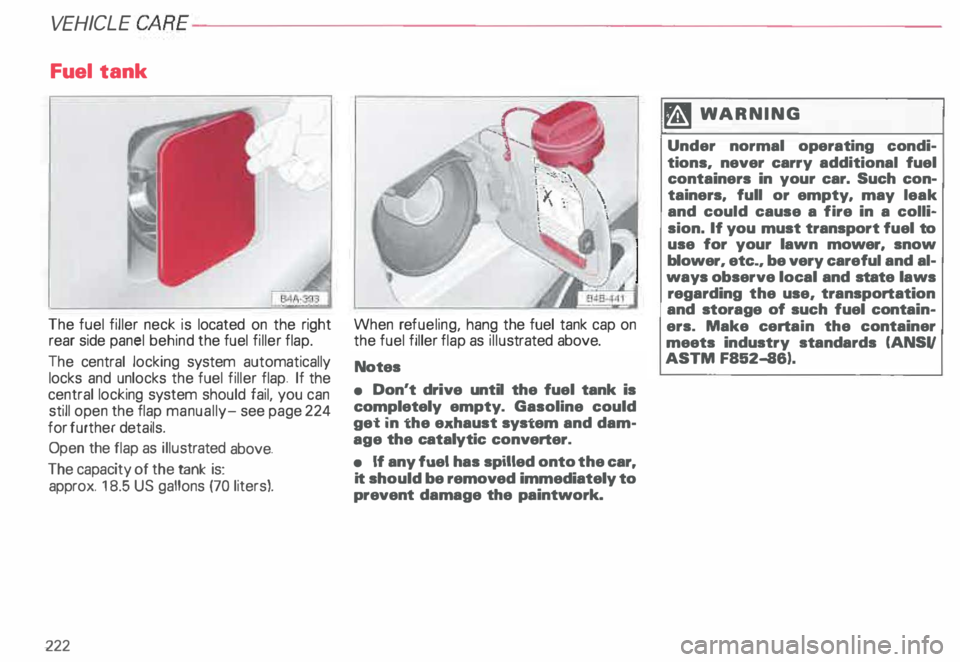
The fuel filler neck is located on the right
rear side panel behind the fuel filler flap.
The central locking system automatically
locks and unlocks the fuel filler flap. If the
central locking system should fail, you can
still open the flap manually- see page 224
for further details.
Open the flap as illustrated above.
The capacity of the tank is:
approx. 18.5 US gallons (70 liters).
-222 When
refueling, hang the fuel tank cap on
the fuel filler flap as illus trated above.
Notes
• Don't drive until the fuel tank is
completely empty. Gasoline could
get in the exhaust system and dam
age the catalytic converter.
• If any fuel has spilled onto the car,
it should be removed immediately to
prevent damage the paintwork. �W
ARNING
Under normal operating condi
tions, never carry additional fuel
containers in your car. Such con
tainers, full or empty, may leak
and could cause a fire in a colli
sion. If you must transport fuel to
use for your lawn mower, snow
blower, etc., be very careful and al
ways observe local and state laws
regarding the use, transportation
and storage of such fuel contain·
ers. Make certain the container
meets industry standards CANSII
ASTM F852-86).