page 57 AUDI ALLROAD 2000 Owner's Manual
[x] Cancel search | Manufacturer: AUDI, Model Year: 2000, Model line: ALLROAD, Model: AUDI ALLROAD 2000Pages: 306, PDF Size: 9.95 MB
Page 38 of 306
-----------------------------------------------------SAFETYRRST
M WARNING continued
• Be careful not to get the dust
into your eyes or into any cuts or
scratc hes.
• If the residue should get into
your eyes, flush them with water.
Importance of proper seating
position
In a collision supplemental side airbags
must inflate within a fraction of a second
and with considerable force. In order to help
the airbag to do its job, it is important, both
as a driver and as a passenger to sit properly
at all times. By keeping room between your
body and the side of the passenger
compartment, the airbag can inflate fully
and completely and provide supplemental
protection in certain side collisions. �W
ARNING
Failure to maintain an upright and
proper seating position will in�
crease the risk of personal injury
when the supplemental side air�
bag inflates. To reduce the risk of
injury that can be caused by an in�
flating supplemental side airbag:
Never lean against the door and
over the area where the side ai�
bag is located.
- Navar let anyone to place their
hand, lag or face near the sup�
plemental side airbag.
- Do not let anyone sitting in the
front seat put their hand out of
the window or lean against the
door.
- Never let anyone sitting in the
rear seat hold onto the sides of
the front seat backrest. Some
other important points to
know
Because airbags inflate in the blink of an eye
with great force, things you have on your lap
or have placed on the seat could become
dangerous projectiles and be pushed into
you if the airbag inflates.
�W ARNING
• Objects between you and the
airbag can increase the risk of in�
jury in an accident by interfering
with the way the airbag unfolds or
by baing pushed into you as the
airbag inflates.
• Never hold things in your hands
or on your lap when the vehicle is
in use.
Always heed all WAR NINGS
on next page.
37
Page 39 of 306
SA
FETY FIRST
1\1 WARNING continued
• Never place or attach accesso
ries or other objects (such as cup
holders. telephone brackets. or
even large. bulky objects) on the
doors. over or near the area
marked ., Airbag" on the seat back
rests or between those areas and
yourself (an umbrella. bag. etc.}.
Such objects can become danger
ous projec tiles and cause injury if
the supplemental side airbag in
flates.
• Always prevent heavy objects
from knocking against or hitting
the sides of the seatbacks. This
could damage the side airbag sys
tems and they would not deploy in
case of an accident!
38 ��
WARNING continued
• Use the built-in coat hooks only
for lightweight clothing. Do not
leave any heavy or sharp-edged ob
jects in the pockets which may in
terfere with side airbag deploy
ment and can cause personal inju
ry in an accident.
• Never recline the front passen
ger's seat to transport objects.
Items can also move into the area
of the side airbags during braking
or sudden maneuvers. Objects
near the supplemental side airbag
can become projectiles and cause
injury particularly when the seat is
reclined. Child
restraints on the front seat
important things to know
The airbag on the passen gers ide makes the
front seat a potentially dangerous place for
a child to ride. The front seat is not the saf
est place for a child in a forward-facing child
seat. It is a very dangerous place for an in
fant or a larger child in a rearward-facing
seat. For additional important information
and WARNINGS please see chapters
"Front airbags" and "Child Safety," begin
ning on page 44.
Page 40 of 306

Head airbags (SIDEGUARD)
The head airbags (inflatable curtain head
airbags) are located on the left and right
sides above the doors underne ath the head
lin er. These locations are marked with the
word "AIRBAG".
The head airbags are inflated together with
the supplemental side airbags only in se
vere side collisions occuring on the impact
side of the vehicle. The
head airbags will not inflate ...
• if the ignition is switched off
• in frontal collisions
• in side collisions in which vehicle
deceleration is not high enough
• in rear collisions
• in roll-overs.
Under some accident conditions, front and
side and head airbags may inflate.
Remember too, airbags will deploy only
once and only in certain kinds of accidents
-y our safety belts are always there to offer
protection in those accidents in which air
bags are not supposed to deploy or when
they have already deployed.
A head airbag is not a substitute for the
safety belt It is part of the overa ll vehicle
safety system. The airbag system works
most effectively when used with the safety
belts. Therefore, always wear your safety
belts. See pages 14 to 24. SA
FETY FIRST
How the head airbag system works
In the event of a side-impact collision, the
head airbag deploys to reduce the risk that
persons sitting next to the doors will be in
jured if their heads strike the windows or
door columns. In addition, the head airbag
protects occupants from objects hurtled
into the vehicle from the outside, such as
broken glass.
In order to provide optimal protection for ve
hicle occupants, the airbag system is de
signed so that the head and side airbags on
the accident side are always triggered to
gether.
Therefore, the conditions under which the
head airbags are deployed are identical to
those for the side airbags. See page 35.
39
Page 42 of 306
Some other important points
to
know
Because head airbags inflate in the blink of
an eye with a certain force, things you have
on your lap or have placed on the seat could
become dangerous projectiles and be
pushed into you if the airbag inflates.
�W ARNING
• Objects between you and the
airbag can Increase the risk of in
jury in an accident by interfering
with the way the airbag unfolds or
by being pushed Into you as the
airbag inflates.
• Only genuine Audi roll-up sun
screens may be used on the rear
doors. �W
ARNING
• Do not swivel the sun visors to
the side if you have any objects
clipped onto them (for example
pens). If the airbag should deploy,
you could be injured by these ob
jects.
• Use the built-in coat hooks only
for lightweight clothing. Do not
usa any hangers when hanging
clo thing on the coat hooks. Do not
leave any heavy or sharp-edged ob
jects in the pockets which may in
terfere with head airbag deploy
ment and can cause personal in
jury in an accident. SA
FETY FIRST
Care, Service and Disposal of
Airbags
Parts of the airbag system have been
installed at different places on your Audi.
Servicing or repairing in an area of the car
could impair airbag performance.
Some general requirements for airbags
must be observed to make sure the effec
tiveness of the system will not be impaired
and that discarded components do not
cause injury or pollute the environment.
�W ARNING
A damaged airbag system may not
work properly in an accident. In
correct service procedures could
cause an airbag to deploy unex
pectedly during service, injuring
someone. To avoid damaging the
airbag system, possibly causing
malfunction leading to injury in an
accident or during repair:
Always heed all WA RNINGS
on next page.
41
Page 45 of 306
SAFET YRRST---------------------------------------
Child safety
The physical principles of what happens
when your car is in an accident, illustrated
on pages 14-17 , apply also to children. But
unlike adults and teenagers. their muscles
and bones a.re not fully developed. In many
respects chrldren are at greater risk of seri
ous injury in accidents than are adults.
Because children's bodies are not fully de
veloped, they require restraint systems es
pecially designed for their size. weight, and
body structure. Many countries and all
states of the United States and provinces of
Canada have laws requiring the use of ap
proved child restraint systems for infants
and small children.
Child restraints, like adult safety belts, must
be used properly to be effective. Used im
properly, they can increase the risk of seri
ous injury in an accident.
44 �W
ARNING
• Accident statistics have shown
that children are generally safer in
the rear seat area than in the front
seating position. Always restrain
any child age 12 and under in the
rear.
• . All ve�icle occupants and espe
Cially children must be restra ined
properly whenever riding in a ve
hicle. An unrestrained or improp
erly restra ined child could be in
jur
_ed b
y stri king the interior or by
bemg eJected from the vehicle dur
ing a sudden maneuver or impact. J'A1
WARNING
continued
An unrestrained or improperly re
strained child is also at greater
risk of injury or death through con
ta c:t with �n inflating airbag. A
su1table child restraint properly
installed and used at one of the
rear seating positions provides the
highest degree of protec tion for
infants and small children in most
accidents.
Consult the child seat manufacturer's in
structions to be sure the seat is right for
your child's size.
Page 46 of 306
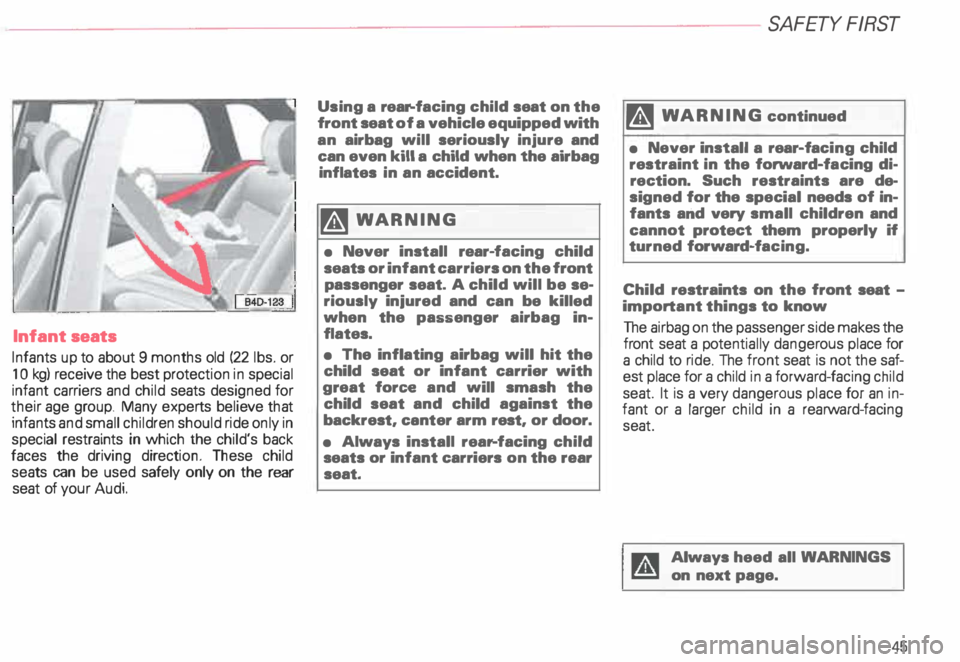
Infant
seats
Infants up to about 9 months old (22 lbs. or
1 0 kg) receive the best protection in special
infant carriers and child seats designed for
their age group. Many experts believe that
infants and small children should ride only in
special restraints in which the child's back
faces the driving direction. These child
seats can be used safely only on the rear
seat of your Audi. Using
a rear-fa cing child seat on the
front seat of a vehicle equipped with
an airbag will seriously injure and
can even kill a child when the airbag
inflates in an accident.
� WARNING
• Never install rear-facing child
seats or infant carriers on the front
passenger seat. A child will be se
riously iniured and can be killed
when the passenger airbag in
flates.
• The inflating airbag will hit the
child seat or infant carrier with
great force and will smash the
child seat and child against the
backrest, canter arm rest, or door.
• Always install rear--facing child
seats or infant carriers on the rear
seat. SA
FETY FIRST
ftl WARNING continued
• Never install a rear-fac ing child
restraint in the forward-fa cing di
rection. Such restraints are de
signed for the special needs of in
fants and very small children and
cannot protect them properly if
turned forward-fa cing.
Child restraints on the front seat -
important things to know
The airbag on the passenger side makes the
front seat a potentially dangerous place for
a child to ride. The front seat is not the saf
est place for a child in a forward-facing child
seat. It is a very dangerous place for an in
fant or a larger child in a rearward-facing
seat.
Always heed all WARNINGS
on next page.
45
Page 53 of 306
SA
FETYRRST---------------------------------------------------
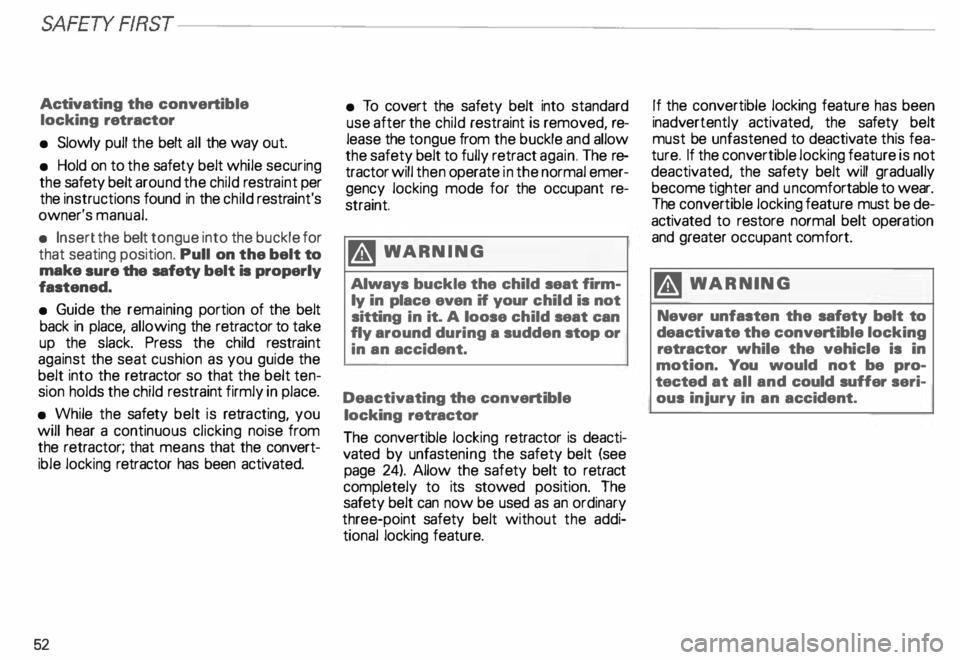
Activ ating the convertible
locking retractor
• Slowly pull the belt all the way out.
• Hold on to the safety belt while securing
the safety belt around the child restraint per
the instructions found in the child restraint's
owner's manual.
• Insert the belt tongue into the buckle for
that seating position. Pull on the belt to
make sure the safety belt is properly
fas tened.
• Guide the remaining portion of the belt
back in place, allowing the retractor to take
up the slack. Press the child restraint
against the seat cushion as you guide the
belt into the retractor so that the belt ten
sion holds the child restraint firmly in place.
• While the safety belt is retra cting, you
will hear a continuous clicking noise from
the retractor; that means that the convert
ible locking retractor has been activated.
52 •
To covert the safety belt into standard
use after the child restraint is removed, re
lease the tongue from the buckle and allow
the safety belt to fully retract again. The re
tractor will then operate in the normal emer
gency locking mode for the occupant re
straint.
�W ARNING
Always buckle the child seat firm
ly in place even if your child is not
sitting in it. A loose child seat can
fly around during a sudden stop or
in an accident.
Deactivating the convertible
locking retractor
The convertible locking retractor is deacti
vated by unfaste ning the safety belt (see
page 24). Allow the safety belt to retract
completely to its stowed position. The
safety belt can now be used as an ordinary
three-point safety belt without the addi
tional locking feature. If
the convertible locking feature has been
inadvertently activated, the safety belt
must be unfastened to deactivate this fea
ture. If the convertible locking feature is not
deactivated, the safety belt will gradually
become tighter and uncomfortable to wear.
The convertible locking feature must be de
activated to restore normal belt operation
and greater occupant comfort.
�W ARNING
Never unfasten the safety belt to
deactivate the convertible locking
retractor while the vehicle is in
motion. You would not be pro
tected at all and could suffer seri
ous injury in an accident.
Page 57 of 306
CONT
ROLS AND
EQUIPMENT---------------------
Keys
@ !
848-371
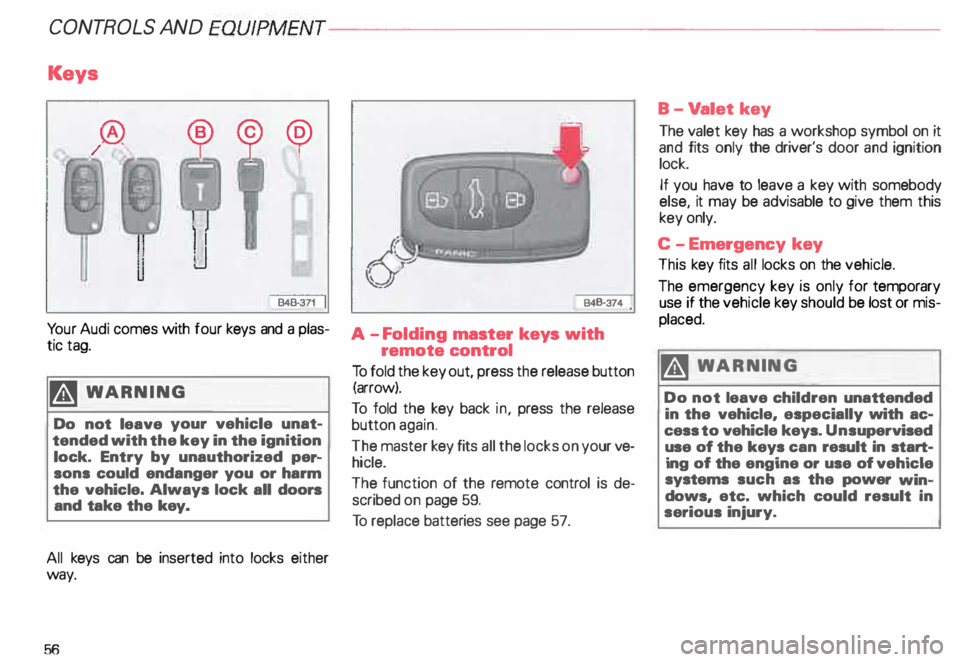
Yo ur Audi comes with tour keys and a plas
tic tag.
�W ARNING
Do not leave your vehicle unat
tended with the key in the ignition
lock. Entry by unauthorized per-
sons could endanger you or harm
the vehicle. Always lock all doors
and take the key.
All keys can be inserted into locks either
way.
56 B48-374
A -F olding master keys with
remote control
To fold the key out, press the release button
(arrow).
To told the key back in, press the release
button again.
The master key fits all the locks on your ve
hicle.
The function of the remote control is de
scribed on page 59.
To replace batteries see page 57. B-V
alet key
The valet key has a workshop symbol on it
and fits only the driver's door and ignition
lock.
If you have to leave a key with somebody
else, it may be advisable to give them this
key only.
C -E mergency key
This key fits all locks on the vehicle.
The emergency key is only for temporary
use if the vehicle key should be lost or mis
placed.
�W ARNING
Do not leave children unattended
in the vehicle, especially with ac
cess to vehicle keys. Unsupervised
use of the keys can result in start
ing of the engine or use of vehicle
systems such as the power win
dows, etc. which could result in
serious injury.
Page 58 of 306
D-
Tag
This tag gives the key num ber.
For your protection against theft:
• Record the key number and keep it in a
safe place, such as your wallet. Do not
keep it in the vehicle.
• If you �houlo IOSfl A key, rrovilie your AU
thorized Audi Dealer with the key number to
obtain a duplicate key.
Note If you open the driver's door with the key left
in the ignition lock, a chime will sound.
This is your reminder to remove the key and
lock the door. Electronic
immobilizer
Yo ur vehicle is equipped with an electronic
immobili zer.
With the help of an electronic component in
the key head, the imm obilizer prevents your
vehicle from being started by una uthorized
persons. See page 124.
Therefore, the engine can only be started
using the factory -equipped key.
If you lose a key, contact your authorized
Audi dealer immediately to have the lost key
disabled.
Note
In some cases, you may not be able to start
your vehicle if an ignition key of a different
vehicle make is also located on your set of
keys. CONT
ROLS AND EQUIPMEN T
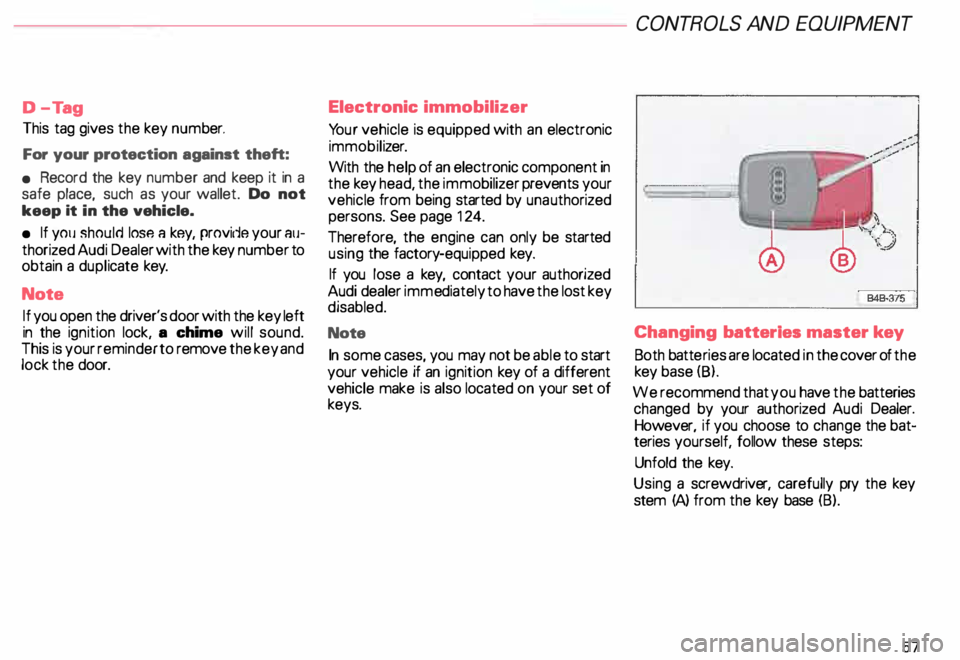
Changing batteries master key
Both batte ries are located in the cover of the
key base (8).
We recommend that you have the batteries
changed by your authorized Audi Dealer.
However, if you choose to change the bat
teries yourself, follow these steps:
Unfold the key.
Using a screwdriv er, carefully pry the key
stem (A) from the key base (B).
57
Page 59 of 306
.
Remove the dead batteri es.
58 \
j
I 840-333
t
• Install the new batteries.
W")
CONT
ROLS AND EQUIPMEN T---------------------
848-376
Remove the cover from the key base (ar
row).
Remove the dead batteri es.
58 \
j
I 840-333
t
• Install the new batteries.
When installing the batteries, make sure
the side of the battery with the "+" symbol
on it is facing down. See illustration. A pic
ture on the inside of the lid shows you the
correct battery position.
• Take the lid with the installed batteries,
place it over the key base and press the two
parts together.
• Place the key base on the key stem and
press both parts together. Notes
• The replacement batteries must be iden
tical in size and specification to the original
batteries provided.
• Spare batteries are available at your au
thorized Audi Dealer.
&.. Dispose of dead batteries prop� erly so as not to pollute the envi
ronment. Many stores that sell bat
teries will accept dead batteries for
recycling or proper disposal.
• If you cannot Jock or unlock your vehicle
after you have changed the batteries, then
the system must be re-synchronized. See
page 60.