airbag off AUDI Q2 2021 Owner´s Manual
[x] Cancel search | Manufacturer: AUDI, Model Year: 2021, Model line: Q2, Model: AUDI Q2 2021Pages: 364, PDF Size: 87.77 MB
Page 272 of 364
Safe driving
A WARNING
To avoid serious or fatal injury, children trav
elling in the vehicle must always be protected
with child restraint systems appropriate to
their height, weight and age.
- Children under 1.50 m tall or younger than
12 must not travel in the vehicLe if there are
no suitable child seats. Please observe any
other applicable regulations in the country
in which you are travelling.
- Babies and children must never travel on an
other occupant's lap.
- Never allow more than one child to occupy
one child seat.
- Never leave a child without supervision in a
child seat.
- Never allow a child to travel unrestrained or
to stand up or kneel on a seat while the car
is moving. In an accident, the child could be
catapulted through the car, causing possibly
fatal injuries to itself and other occupants.
- To ensure proper protection by the child re
straint, it is important to wear the seat belts
in the correct position
^>page
277. Always
check that the belt is properly positioned ac
cording to the instructions provided by the
manufacturer of the child seat. Incorrectly
worn seat belts can give rise to injuries even
in a minor collision.
- If children are out of position when the car
is moving, they are at greater risk of injury
during a sudden braking manoeuvre or in an
accident. This is particularly the case if the
child is travelling on the front passenger's
seat and the airbag system is triggered in an
accident. This incorrect sitting position can
result in serious or even fatal injury.
- Make sure there is sufficient clearance in
front of the child sitting in the child seat. If
necessary, adjust the seat position and
backrest angle of the seat in front of the
child seat.
- If
you
are using a child seat on the front
passenger seat in which the child faces the
direction of
travel,
you should move the
front passenger seat as far back as possible.
- Child seats in which the child faces the rear
of the car are located directly in the path of
the front passenger's airbag if it inflates. In
this case, the child could sustain serious or
fatal injuries if the airbag were to be de
ployed.
- Applies to vehicles on which the front pas
senger's airbag cannot be deactivated: Do
NOT use a rearward-facing child seat on
the front passenger's seat.
- Applies to vehicles with key-operated
switch for deactivating the front passeng
er's airbag: Do NOT use a rearward-facing
child seat on the front passenger's seat
while the front passenger's airbag is ac
tive.
If
you
have no alternative but to use a
rearward-facing child seat on the front
passenger's seat, the front passenger's
airbag must be deactivated beforehand via
the key-operated switch*
^>page
288.
Make sure that the front passenger's air-
bag is reactivated by means of the key-op
erated switch* as soon as the child seat is
no Longer needed on the front passenger's
seat.
- Always replace the child seat with a new one
after an accident as damage not externally
visible may have occurred.
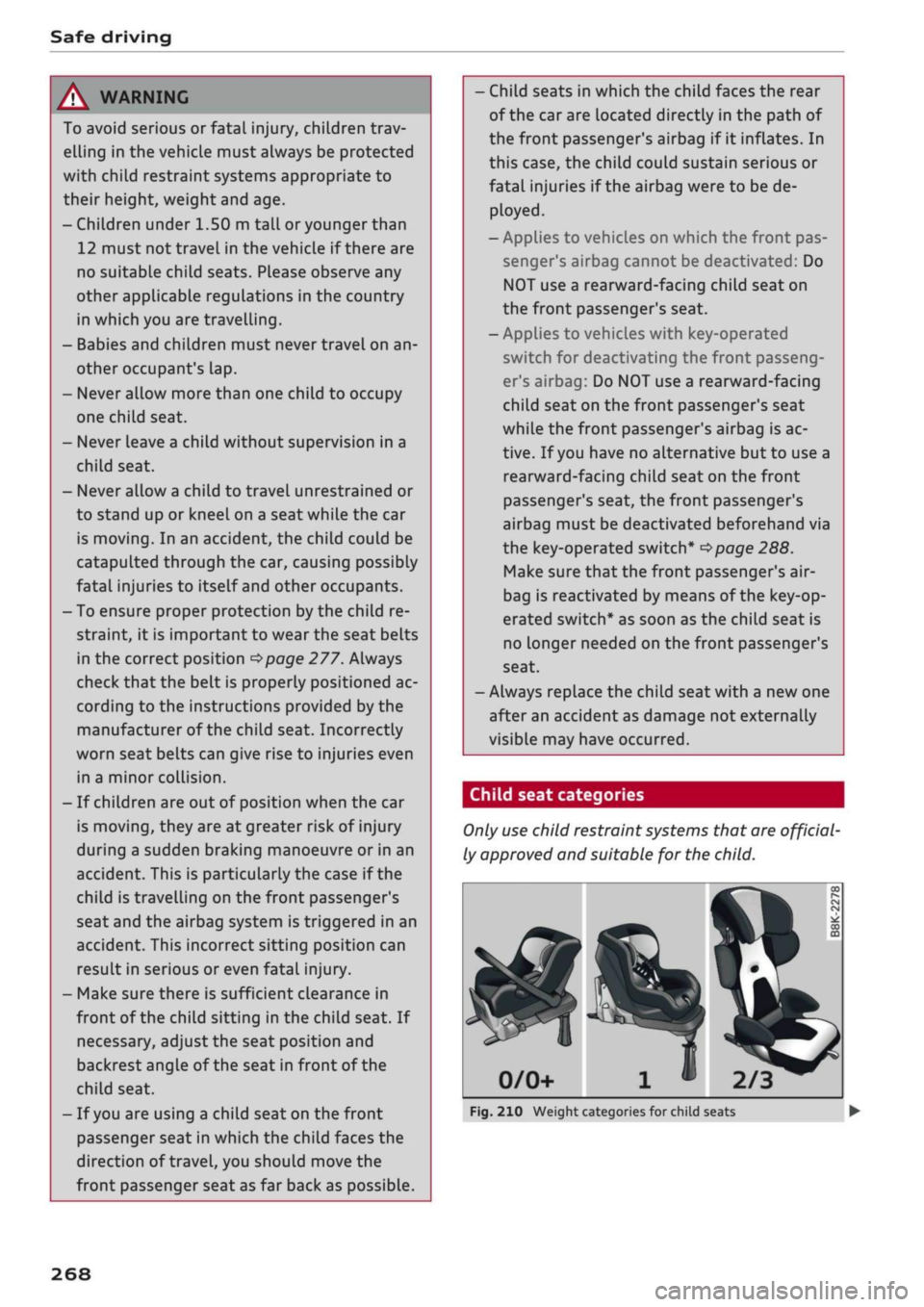
Child seat categories
Only
use
child restraint systems that are official
ly approved and suitable for the child.
2/3
Fig.
210 Weight categories for child seats
268
Page 275 of 364
Safe driving
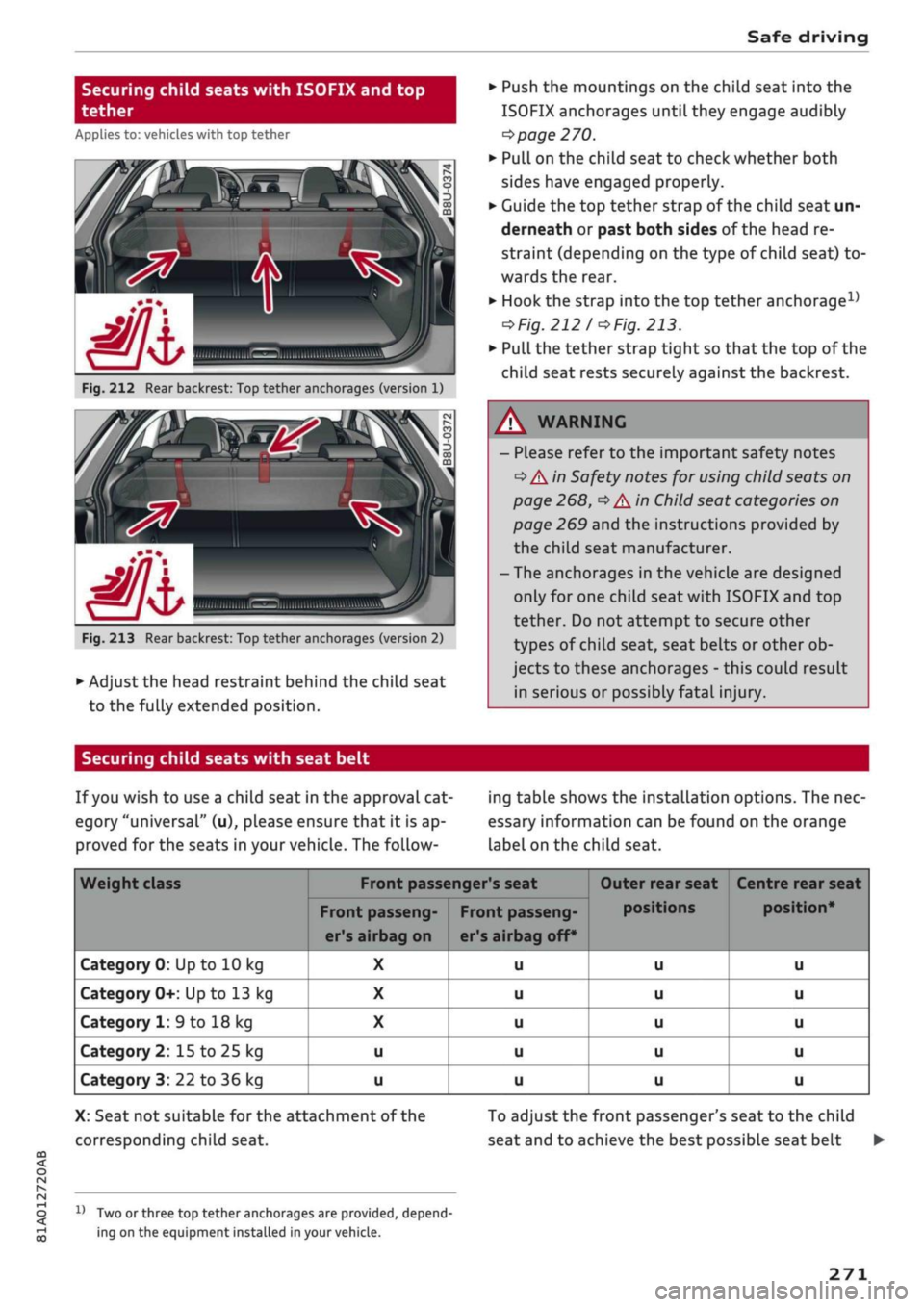
Securing child seats with ISOFIX and top
tether
Applies to: vehicles with top tether
â
I
Fig.
212 Rear backrest: Top tether anchorages (version 1)
7k
C
Fig.
213 Rear backrest: Top tether anchorages (version 2)
•
Adjust the head restraint behind the child seat
to the fully extended position.
•
Push the mountings on the child seat into the
ISOFIX anchorages until they engage audibly
^> page
270.
*•
Pull on the child seat to check whether both
sides have engaged properly.
•
Guide the top tether strap of the child seat un
derneath or past both sides of the head re
straint (depending on the type of child seat) to
wards the rear.
•
Hook the strap into the top tether
anchorage15
=>
Fig.
212/o
Fig.
213.
•
Pull the tether strap tight so that the top of the
child seat rests securely against the backrest.
WARNING
- Please refer to the important safety notes
•=>
A in Safety notes for using child seats on
page 268,
•=>
A in Child seat categories on
page 269 and the instructions provided by
the child seat manufacturer.
- The anchorages in the vehicle are designed
only for one child seat with ISOFIX and top
tether. Do not attempt to secure other
types of child seat, seat belts or other ob
jects to these anchorages - this could result
in serious or possibly fatal injury.
CO
<
O
rN
iv
rN
t-H
o < 00
Securing child seats with seat belt
If
you
wish to use a child seat in the approval cat
egory "universal" (u), please ensure that it is ap
proved for the seats in your vehicle. The follow
ing table shows the installation options. The nec
essary information can be found on the orange
label on the child seat.
Weight class
Category 0: Up to 10 kg
Category 0+: Up to 13 kg
Category 1: 9 to 18 kg
Category 2: 15 to 25 kg
Category 3: 22 to 36 kg
Front passenger's seat
Front passeng
er's airbag on
X
X
X
u
u
Front passeng
er's airbag off*
u
u
u
u
u
Outer rear seat
positions
u
u
u
u
u
Centre rear seat
u
u
u
u
u
X: Seat not suitable for the attachment of the
corresponding child seat.
1}
Two or three top tether anchorages are provided, depend
ing on the equipment installed in your vehicle.
To adjust the front passenger's seat to the child
seat and to achieve the best possible seat belt •
271
Page 285 of 364

Airbag system
Airbag system
Description of airbag
system
General notes on airbag system
The airbag is an integral part of the car's passive
safety system.
In conjunction with the three-point seat belts,
the airbag system gives the front occupants
addi
tional protection for the head and chest in the
event of a severe frontal collision.
In a severe side collision the side airbags and the
head-protection airbags reduce the risk of injury
to the occupants
•=>
A-
In addition to their normal function of protecting
the occupants in a collision, the seat belts also
hold them in a position where the airbags can in
flate properly and provide maximum protection.
The airbag system will only work with the
igni
tion on. The airbag system is monitored electron
ically; the airbag warning lamp indicates whether
the system is functioning properly.
The main parts of the airbag system are:
-The electronic monitoring system (control unit
and sensors)
- The two front airbags
- The front side airbags
-The head-protection airbags
- The indicator Lamp
Q
in the instrument cluster
There is a fault in the airbag system if the
warning lamp
- does not come on when the ignition is switched
on.
- does not go out about 4 seconds after the
igni
tion is switched on.
- goes out and then comes on again after the ig
nition is switched on.
- comes on or flickers while the car is moving.
CO
< o rN
iv
rN
t-H
o <
A WARNING
- The airbags are not a substitute for the seat
belts;
they are an integral part of the car's
overall passive safety system. The airbags
can only offer effective protection if the oc
cupants are wearing their seat belts. For
this reason it is very important to wear the
seat belts at all times
^>page
275, Why is it
so important to use seat belts?.
The seat belts and airbags can only provide
maximum protection if the occupants are
seated correctly
^>page
58, Front seats.
•
If you do not wear a seat belt, if you lean
forward,
or are not seated correctly while
the vehicle is in motion, you are at greater
risk of injury should the airbag system be
triggered in an accident.
Components of the airbag system are loca
ted in various parts of the vehicLe. If repairs
to other vehicle components make it neces
sary to perform work on the airbag system
or to remove or install parts of the airbag
system,
this may cause damage to the air-
bag system. As a result, the airbags may not
inflate correctly or may not be triggered at
all in an accident situation. For this reason,
you should always have the work carried out
by a qualified workshop.
If a fault should occur in the airbag system,
have the system checked immediately by a
qualified workshop. Otherwise the system
may fail to trigger in an accident.
Do not attempt to modify components of
the airbag system in
anyway.
Never make any alterations to the front
bumper
or
the body.
Do not remove the front seats.
The airbag system can only be activated
once;
if the airbag has been triggered, the
system must be replaced. Should the airbag
system or airbag modules have to be re
placed,
the qualified workshop carrying out
the replacement will document all details.
•
If any repair work is required
or
the airbag
and restraint systems have to be replaced,
have the work carried out by your authorised
Audi dealer or a qualified workshop which
adheres to the Audi factory standards. This
will minimise the risk of injury.
If you sell the vehicle, remember to pass on
the complete Service Wallet to the new
owner. If any of the airbags have been
281
Page 289 of 364

Airbag system
CO
< o rN
iv
rN
•-i
•H
00
Side airbags
Description of side airbags
The
airbag system is not a substitute for the seat
belts.
Fig.
232 Side airbags: Location in driver's seat (example)
The side airbags are located in the backrest
pad
ding of the front seats.
In conjunction with the three-point seat belts,
the side airbags give the occupants additional
protection for the whole upper part of the body
(i.e.
the chest, stomach and pelvis) in the event
of
a
severe side collision
•=> A
in Important safety
notes on the side airbag system on page 285.
In a side collision the side airbags reduce the risk
of injury to the areas of the body facing the im
pact.
How the side airbags work
When fully inflated, the side airbags reduce the
risk of injuries to the upper part of the
body.
Fig.
233 Side airbags in inflated condition
In certain types of side collision, the side airbag
(front) is triggered on the impact side of the
vehi
cle
^Fig.
233. Further airbag systems may also
be triggered, depending on the circumstances.
When the system is triggered, the airbag is filled
with propellant gas.
In order to provide the desired extra protection in
an accident, the airbags have to inflate extremely
rapidly (within fractions of
a
second).
The fully deployed airbags cushion the impact for
the occupants and help to reduce the risk of in
jury to the upper part of the body on the side fac
ing the door.
Important safety notes on the side airbag
system
There
are a number of safety points concerning
the airbag system which you should remember.
This will help to reduce the risk of injury in an ac
cident.
WARNING
-If
you
do
not
wear
a
seat belt, if
you
Lean
forward,
or are not seated correctly while
the vehicle is in motion, you are at greater
risk of injury should the side airbags be
trig
gered in an accident. This applies particular
ly to children if they are not properly protec
ted by
a
child restraint system.
- If children are not seated correctly, they are
at greater risk of injury should the airbag
system be triggered in an accident. This is
particularly the case if the child is travelling
on the front passenger's seat and the airbag
system is triggered in an accident. This
could result in serious or potentially fatal in
jury
^>page
267, Child seats.
- It is important not to attach any accessories
(such as cup holders) to the doors. This
would impair the protection offered by the
front side airbags.
- The sensors for the airbags are located in
the front doors. You must therefore not
make any modifications to the doors or door
trim (e.g. retrofitting loudspeakers),
as
this
could impair the function of the side air-
bags.
Any damage to the front doors could
285
Page 290 of 364
Airbag system
lead to faults in the system. Repairs or any
other work on the front doors must there
fore always be carried out by
a
qualified
workshop.
- The built-in coat hooks* should only be used
for lightweight clothing. Do not leave any
heavy or sharp-edged objects in the pockets.
- Do not apply excessive force to the sides of
the backrests (such as hard knocks or kicks),
as this could damage parts of the system.
The side airbags could then fail to operate
when required.
- If
you
intend to fit protective covers over
the seats, these must be of the specific type
approved for use on Audi seats with side air-
bags.
Conventional seat covers would ob
struct the side airbag when it inflates out of
the backrest, and seriously reduce the air-
bag's effectiveness.
- Any damage to the original seat upholstery
or around the seams of the side airbag units
must be repaired immediately by a qualified
workshop.
- Any work involving the side airbag system or
removal and installation of the airbag com
ponents for other repairs (such as repairs to
the seats) must always be performed by a
qualified workshop. Otherwise the airbag
system may fail to work properly.
© Note
All the other airbags in the car will remain
functional if the front passenger's airbag has
been deactivated.
Head-protection airbags
Description of head-protection airbags
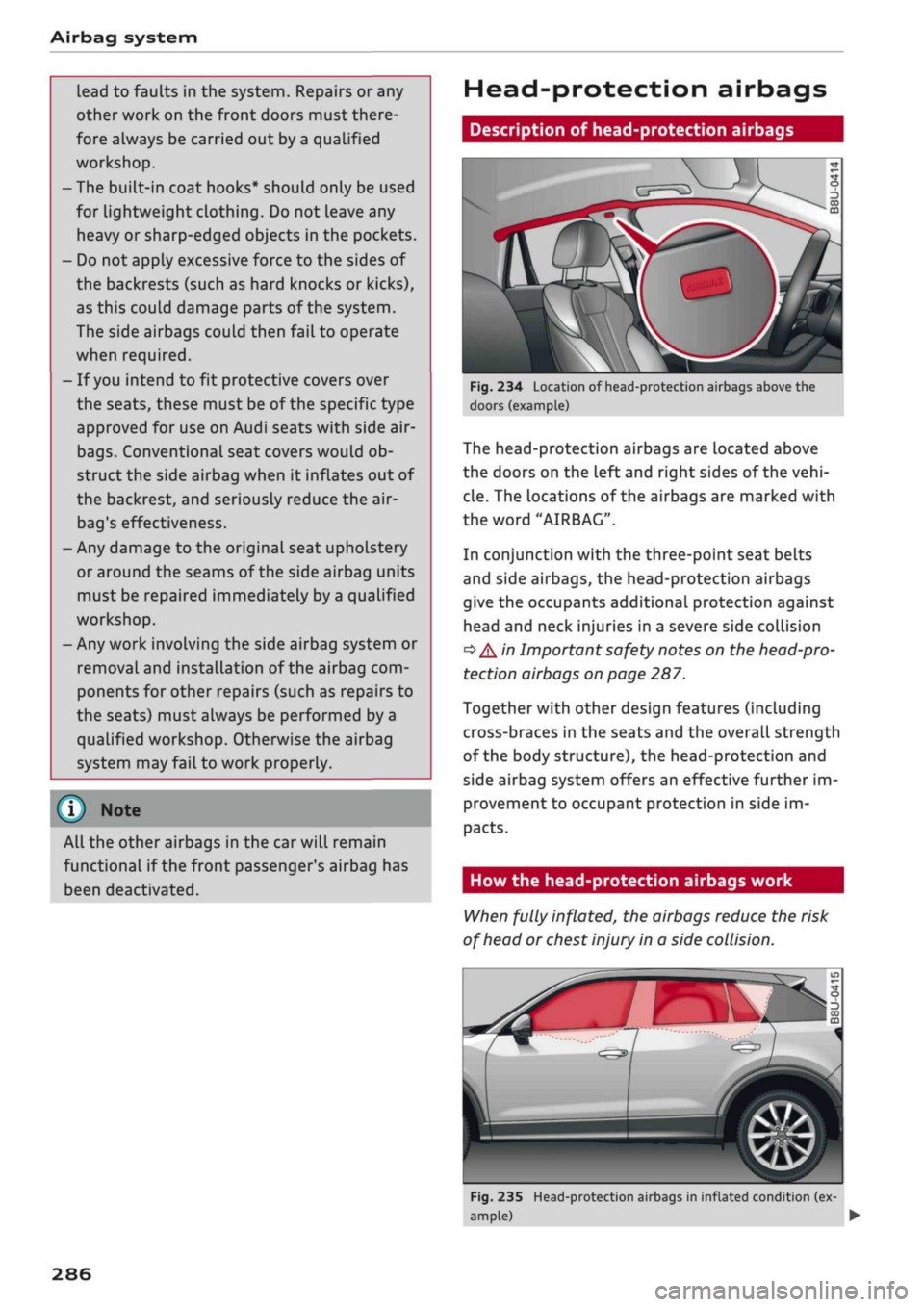
Fig.
234 Location of head-protection airbags above the
doors (example)
The head-protection airbags are located above
the doors on the left and right sides of the
vehi
cle.
The locations of the airbags are marked with
the word "AIRBAG".
In conjunction with the three-point seat belts
and side airbags, the head-protection airbags
give the occupants additional protection against
head and neck injuries in a severe side collision
•=>
A in Important safety notes on the head-pro
tection airbags on page 287.
Together with other design features (including
cross-braces in the seats and the overall strength
of the body structure), the head-protection and
side airbag system offers an effective further im
provement to occupant protection in side im
pacts.
How the head-protection airbags work
When fully inflated, the airbags reduce the risk
of head or chest injury in a side collision.
jfW
Fig.
235 Head-protection airbags in inflated condition (ex
ample) •
286
Page 292 of 364
Airbag system
Deactivating the front
passenger's airbag
Applies to: vehicles with key-operated switch for front pas
senger's airbag
If
an
airbag has been deactivated, it should be
reactivated as soon as possible so that it can
continue to give the required protection.
••
-,
CG
^
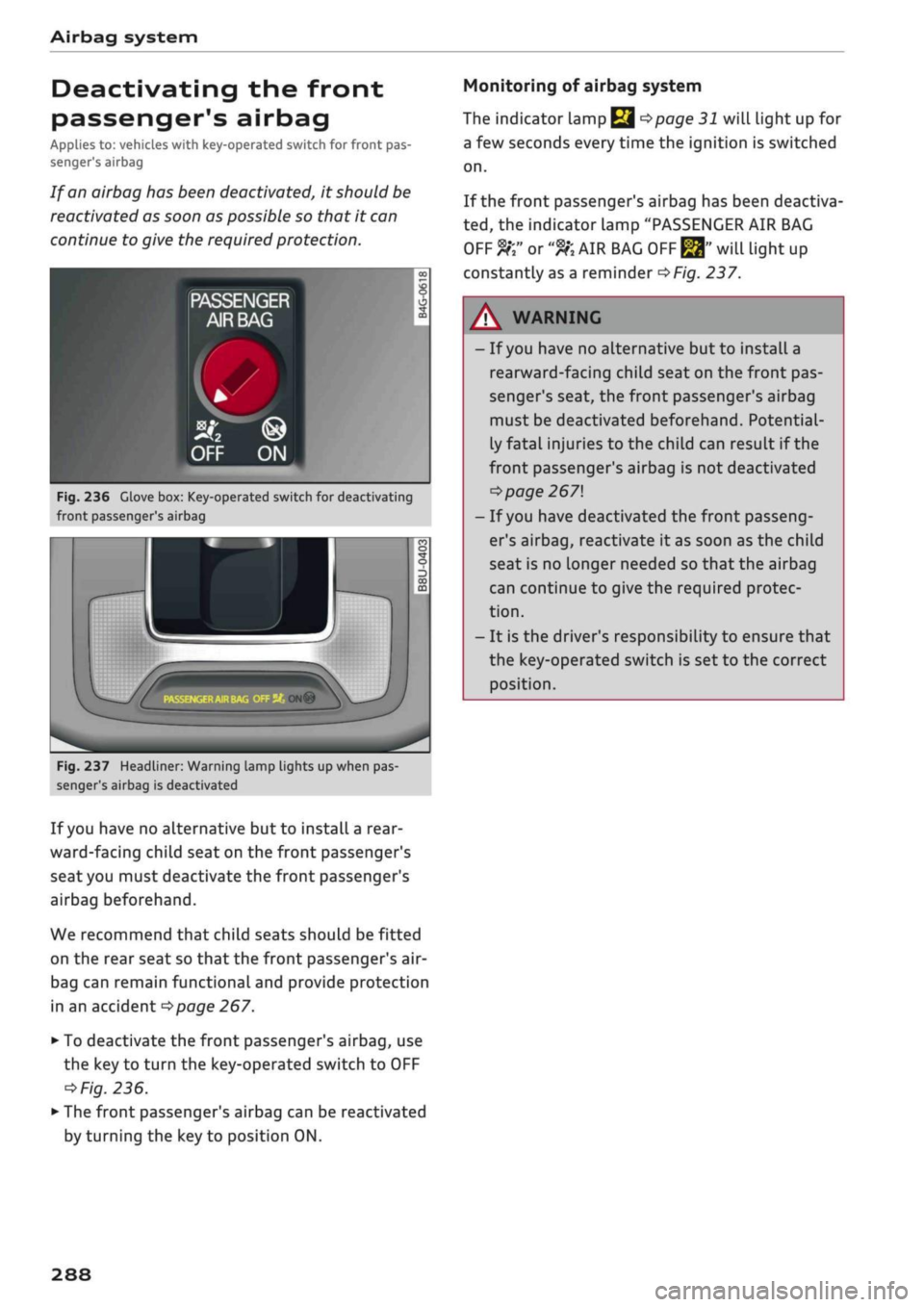
Fig.
236 Glove box: Key-operated switch for deactivating
front passenger's airbag
r
;•••;
:
m
^
hu
ON®
Fig.
237 Headliner: Warning lamp lights up when pas
senger's airbag is deactivated
If
you
have no alternative but to install
a
rear
ward-facing child seat on the front passenger's
seat you must deactivate the front passenger's
airbag beforehand.
We recommend that child seats should be fitted
on the rear seat so that the front passenger's air-
bag can remain functional and provide protection
in an accident
^>page
267.
•
To deactivate the front passenger's airbag, use
the key to turn the key-operated switch to OFF
=*
Fig.
236.
•
The front passenger's airbag can be reactivated
by turning the key to position ON.
Monitoring of airbag system
The indicator Lamp
Q ^>page
31 will light up for
a few seconds every time the ignition is switched
on.
If the front passenger's airbag has been deactiva
ted,
the indicator Lamp "PASSENGER AIR BAG
OFF ft" or
"9K
AIR BAG
OFF ^"
will light up
constantly as a reminder
^>Fig.
237.
A WARNING
- If
you
have no alternative but to install a
rearward-facing child seat on the front pas
senger's seat, the front passenger's airbag
must be deactivated beforehand. Potential
ly fatal injuries to the child can result if the
front passenger's airbag is not deactivated
•=>
page 267
- If
you
have deactivated the front passeng
er's airbag, reactivate it as soon as the child
seat is no longer needed so that the airbag
can continue to give the required protec
tion.
- It is the driver's responsibility to ensure that
the key-operated switch is set to the correct
position.
288
Page 344 of 364

Accessories
and
modifications
to the
vehicle
Accessories
and
modifi
cations
to the
vehicle
Accessories,
replacement parts
and
repairs
Always
ask
your dealer
or
specialist retailer
for
advice before purchasing accessories
and
re
placement parts.
Your
car is
designed
to
offer
a
high standard
of
active and passive safety. For this reason,
we
rec
ommend that you ask your Audi dealer
for
advice
before fitting accessories
or
replacement parts.
Audi dealers have
the
latest information from
the manufacturer and
can
recommend accesso
ries and replacement parts which
are
suitable
for
your requirements. They can also answer
any
questions you might have regarding official
regu
lations.
We recommend you
to
use only Audi accessories
and Audi Genuine Parts. Audi has tested these
products
for
suitability, reliability and safety.
Audi dealers have
the
necessary experience
and
facilities
to
ensure that
the
parts
are
installed
properly.
Although
the
market
is
constantly scrutinised,
Audi
cannot
judge
or
assume responsibility
for
the reliability, safety and suitability
of
non-genu
ine products
-
even though
in
some instances,
these parts
may
have been approved
by
an
offi
cially recognised technical testing authority
or
accompanied
by
an official approval certificate.
Any retro-fitted equipment which has a direct
ef
fect on
the
vehicle and/or
the
way
it is
driven
(e.g.
cruise control system
or
electronically-con
trolled suspension) must
be
approved
for
use
in
your vehicle and bear
the e
mark
(the
European
Union's approval symbol).
If any additional electrical components are fit
ted which
do not
serve
to
controL
the
vehicLe
it
self
(for
instance a refrigerator box, laptop
or
ventilator
fan,
etc.), these must bear the C€ mark
(manufacturer conformity declaration
in the Eu
ropean Union).
A,
WARNING
Never attach accessories (such
as cup
holders
or telephone brackets)
to the
surfaces cover
ing
the
airbag units
or the
areas around
the
airbags: this could cause injury
if
the airbag
is
triggered.
Modifications
Modifications must always
be
carried
out
accord
ing
to our
specifications.
Unauthorised modifications
to the
electronic
components, software, wiring
or
data transfer
in
the vehicLe may cause malfunctioning. Due
to the
way
the
electronic components
are
linked togeth
er
in
networks, other systems
may be
affected
by
the faults. This can seriously impair safety, lead
to excessive wear
of
components,
and
also inva
lidate
the
type approval
for
your vehicle.
You will appreciate that your Audi dealer cannot
be held liable
for
any damage caused
by
modifi
cations and/or work performed incorrectly.
We recommend that
all
work should
be
per
formed
by
an Audi workshop using Audi Genuine
Parts.
/K
WARNING
- Incorrectly performed modifications
or
oth
er work
on
your vehicLe can lead
to
malfunc
tions and cause accidents.
-
Do not
use an additional
or
replacement
number plate holder other than
the
original
one fitted
at the
front
of
the vehicle.
Radio transmitters
and
business equipment
Transmitters
An external aerial
is
required
in
order
to
operate
radio equipment inside
the
vehicle. The maxi
mum range
of
the equipment can only
be
ach
ieved with
an
external aerial.
Retrofit installations
of
radio transmitters
in the
vehicle
are
subject
to
official approval and can
af
fect
the
type approval
for
your vehicle.
In •
340
Page 354 of 364
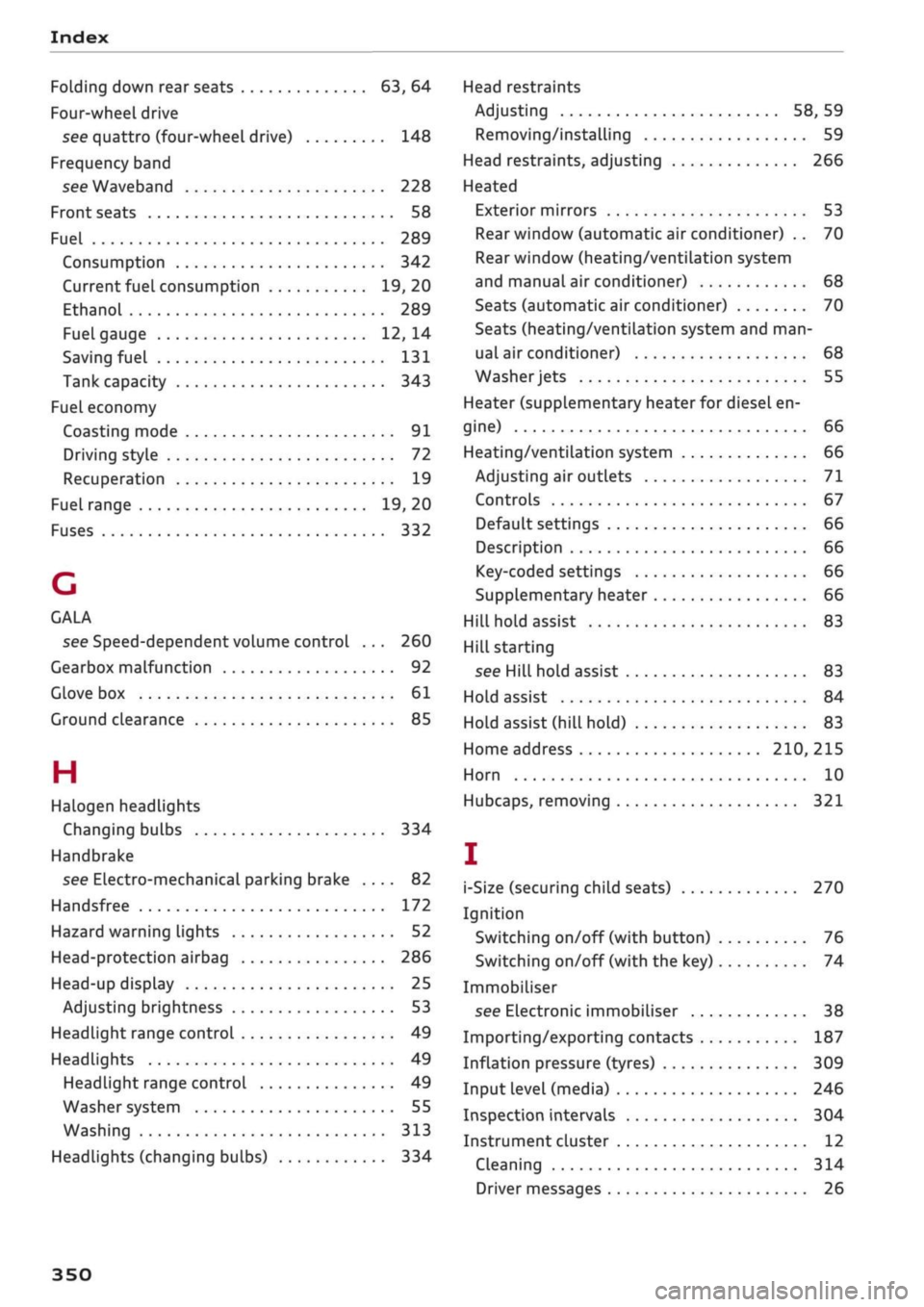
Index
Folding down rear seats 63, 64
Four-wheel drive
see quattro (four-wheel drive) 148
Frequency band
see Waveband 228
Front seats 58
FueL 289
Consumption 342
Current fuel consumption 19,20
Ethanol 289
Fuel gauge 12, 14
Saving fuel 131
Tank capacity 343
FueL
economy
Coasting mode 91
Driving style 72
Recuperation 19
Fuel range 19, 20
Fuses 332
G
GALA
see Speed-dependent volume control ... 260
Gearbox malfunction 92
Glove box 61
Ground clearance 85
H
Halogen headlights
Changing bulbs 334
Handbrake
see Electro-mechanical parking brake .... 82
Handsfree 172
Hazard warning lights 52
Head-protection airbag 286
Head-up display 25
Adjusting brightness 53
Headlight range control 49
Headlights 49
Headlight range control 49
Washer system 55
Washing 313
Headlights (changing buLbs) 334
Head restraints
Adjusting 58,
59
Removing/installing 59
Head restraints, adjusting 266
Heated
Exterior mirrors 53
Rear window (automatic air conditioner) .. 70
Rear window (heating/ventilation system
and manual air conditioner) 68
Seats (automatic air conditioner) 70
Seats (heating/ventilation system and
man
ual air conditioner) 68
Washer
jets 55
Heater (supplementary heater for diesel en
gine) 66
Heating/ventilation system 66
Adjusting air outlets 71
Controls 67
Default settings 66
Description 66
Key-coded settings 66
Supplementary heater 66
Hill hold assist 83
Hill starting
see Hill hold assist 83
Hold assist 84
Hold assist (hill hold) 83
Home address 210, 215
Horn 10
Hubcaps, removing 321
I
i-Size
(securing child seats) 270
Ignition
Switching on/off (with button) 76
Switching on/off (with the key) 74
Immobiliser
see Electronic immobiliser 38
Importing/exporting contacts 187
Inflation pressure (tyres) 309
Input level (media) 246
Inspection intervals 304
Instrument cluster 12
Cleaning 314
Driver messages 26
350
Page 358 of 364
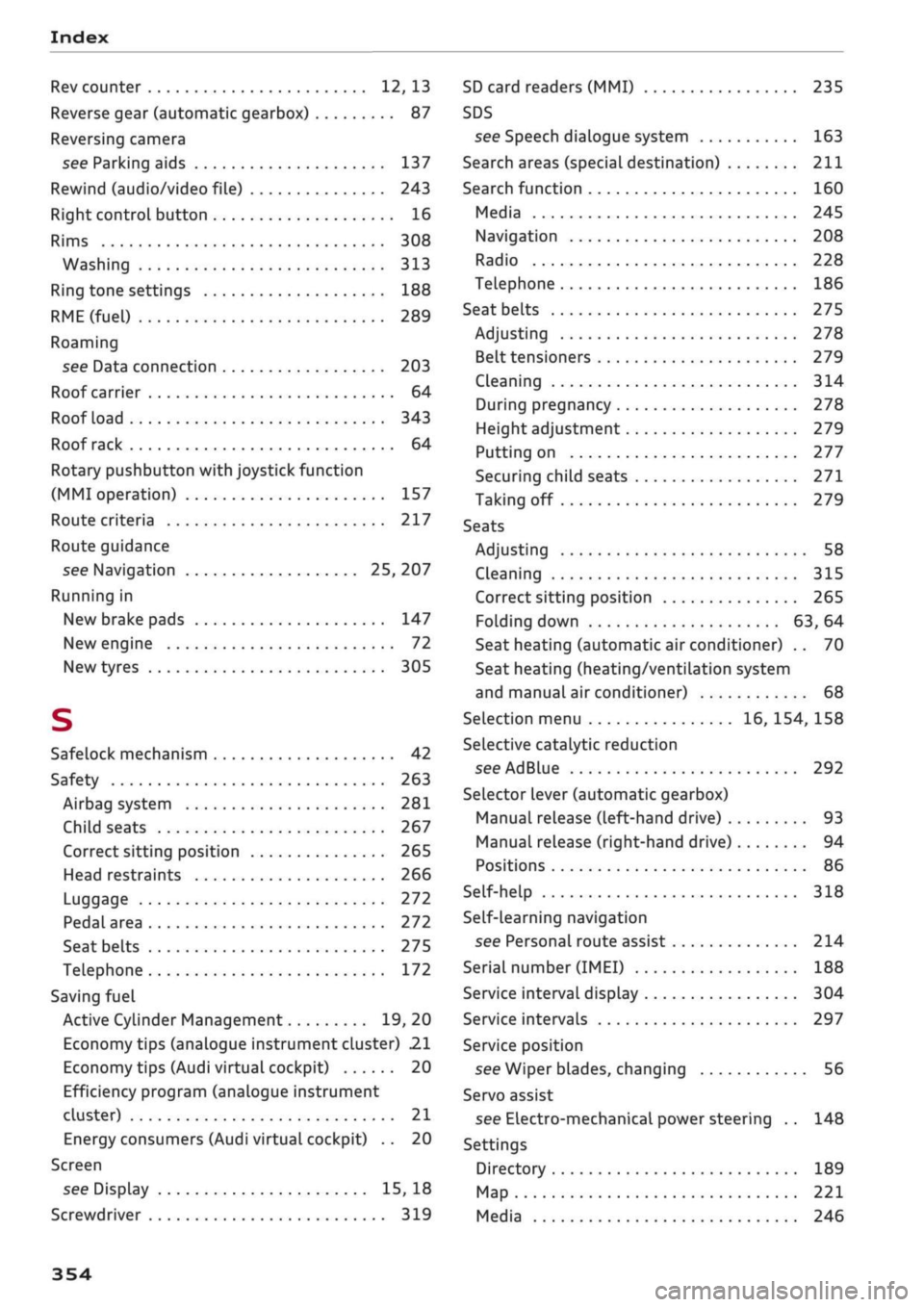
Index
Rev counter 12, 13
Reverse gear (automatic gearbox) 87
Reversing camera
see Parking aids 137
Rewind (audio/video file) 243
Right control button 16
Rims 308
Washing 313
Ring tone settings 188
RME(fuel)
289
Roaming
see Data connection 203
Roof carrier 64
Roof load 343
Roof rack 64
Rotary pushbutton with joystick function
(MMI operation) 157
Route criteria 217
Route guidance
see Navigation 25, 207
Running in
New brake pads 147
New engine 72
New tyres 305
S
Safelock mechanism 42
Safety 263
Airbag system 281
Child seats 267
Correct sitting position 265
Head restraints 266
Luggage 272
Pedal area 272
Seat belts 275
Telephone 172
Saving fuel
Active Cylinder Management 19, 20
Economy tips (analogue instrument cluster) 21
Economy tips (Audi virtual cockpit) 20
Efficiency program (analogue instrument
cluster) 21
Energy consumers (Audi virtual cockpit) .. 20
Screen
see Display 15, 18
Screwdriver 319
SD card readers (MMI) 235
SDS
see Speech dialogue system 163
Search areas (special destination) 211
Search function 160
Media 245
Navigation 208
Radio 228
Telephone 186
Seat belts
275
Adjusting 278
Belt tensioners 279
Cleaning 314
During pregnancy 278
Height adjustment 279
Putting on 277
Securing child seats 271
Taking off 279
Seats
Adjusting 58
Cleaning 315
Correct sitting position 265
Folding down 63, 64
Seat heating (automatic air conditioner) .. 70
Seat heating (heating/ventilation system
and manual air conditioner) 68
Selection menu 16, 154, 158
Selective catalytic reduction
see AdBlue 292
Selector lever (automatic gearbox)
Manual release (left-hand drive) 93
Manual release (right-hand drive) 94
Positions 86
Self-help 318
Self-learning navigation
see Personal route assist 214
Serial number
(IMEI)
188
Service interval display 304
Service intervals 297
Service position
see Wiper blades, changing 56
Servo assist
see Electro-mechanical power steering .. 148
Settings
Directory 189
Map 221
Media 246
354