side panel AUDI Q2 2021 Owner´s Manual
[x] Cancel search | Manufacturer: AUDI, Model Year: 2021, Model line: Q2, Model: AUDI Q2 2021Pages: 364, PDF Size: 87.77 MB
Page 329 of 364
Mobility
CO
rN
IV
rN
•-i
00
Removing the spare wheel
• Lift the floor panel up by the plastic handle un
til the panel is fixed in position behind the re
taining tabs on the two side sections
©
*
Fig.
266.
• Applies to vehicles with bass box in spare wheel
well:
Remove the bass box*. Please first check
the connector to establish which bass box is fit
ted in your vehicle: version 1)
*page
325 or
version 2)
*page
326.
• Turn the plastic knob anti-clockwise.
• Take out the spare wheel.
Snow chains
For technical reasons, snow chains must not be
used on the compact temporary spare wheel.
Should you have a puncture on one of the front
wheels when using snow chains, fit the compact
temporary spare wheel in place of one of the rear
wheels. You can then attach the snow chains to
the wheel taken from the rear and use this wheel
to replace the punctured front wheel.
A WARNING
- The tyre pressure must be checked as soon
as possible after fitting the spare wheel - an
incorrectly inflated tyre can increase the risk
of accident. You can find the tyre pressures
here
*page
307, Fig. 253.
- Do not drive faster than 80 km/h when the
compact temporary spare wheel is fitted -
higher speeds can cause an accident.
-Avoid heavy acceleration, hard braking and
fast cornering when the compact temporary
spare wheel is fitted - risk of accident!
- Never use two or more compact spare tyres
at the same time - risk of accident!
- No other type of tyre (normal summer or
winter tyres) may be fitted on the compact
temporary spare wheel.
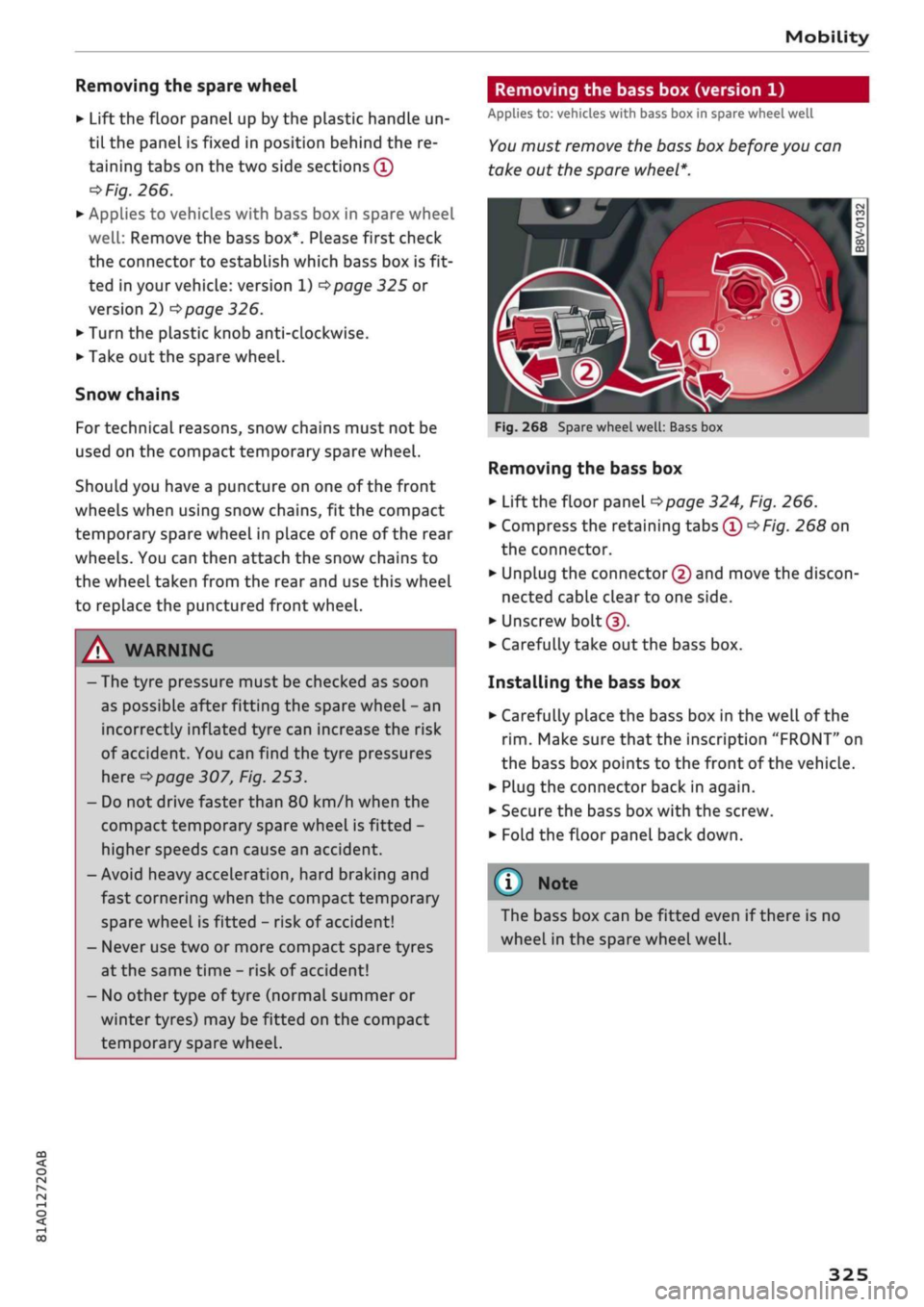
Removing the bass box (version 1)
Applies to: vehicles with bass box in spare wheel well
You
must remove the bass box before you can
take out the spare wheel*.
«
Fig.
268 Spare wheel
well:
Bass box
Removing the bass box
• Lift the floor panel
<=>page
324, Fig. 266.
• Compress the retaining
tabs©*Fig.
268 on
the connector.
• Unplug the connector © and move the discon
nected cable clear to one side.
• Unscrew
bolt©.
• Carefully take out the bass box.
Installing the bass box
• Carefully place the bass box in the well of the
rim.
Make sure that the inscription "FRONT" on
the bass box points to the front of the vehicle.
• Plug the connector back in again.
• Secure the bass box with the screw.
• Fold the floor panel back down.
(T) Note
The bass box can be fitted even if there is no
wheel in the spare wheel
well.
325
Page 330 of 364
Mobility
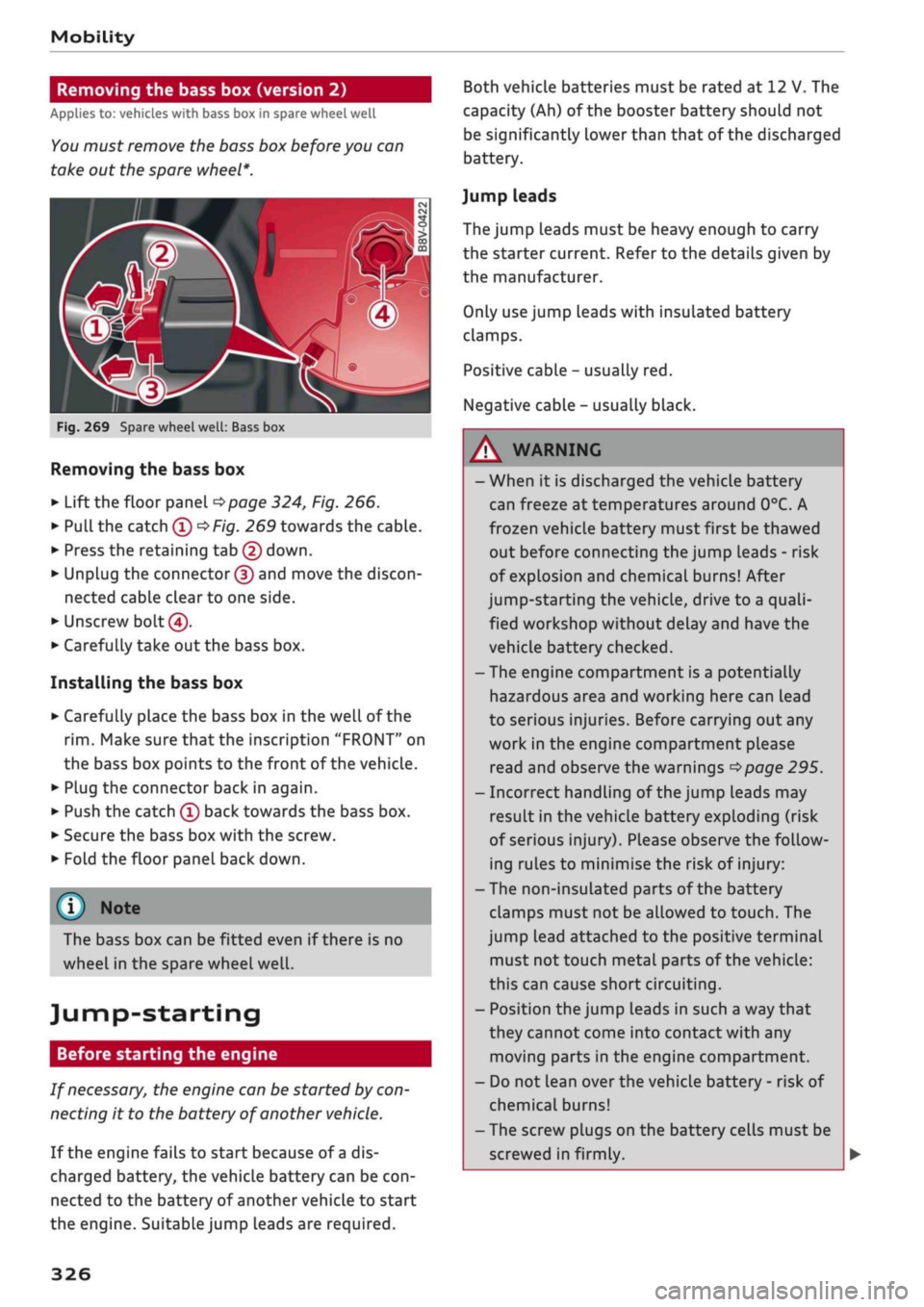
Removing the bass box (version 2)
Applies to: vehicles with bass box in spare wheel well
You
must remove the bass box before you can
take out the spare wheel*.
f
Fig.
269 Spare wheel
well:
Bass box
Removing the bass box
• Lift the floor panel
*page
324, Fig. 266.
•
Pull
the
catch
Q^F/g.
269 towards the cable.
• Press the retaining tab © down.
• Unplug the connector © and move the discon
nected cable clear to one side.
• Unscrew
bolt
(4).
• Carefully take out the bass box.
Installing the bass box
• Carefully place the bass box in the well of the
rim.
Make sure that the inscription "FRONT" on
the bass box points to the front of the vehicle.
• Plug the connector back in again.
• Push the catch © back towards the bass box.
• Secure the bass box with the screw.
• Fold the floor panel back down.
Note
The bass box can be fitted even if there is no
wheel in the spare wheel
welL.
Jump-starting
Before starting the engine
If
necessary,
the engine can be started by con
necting it to the battery of another vehicle.
If the engine fails to start because of
a
dis
charged battery, the vehicle battery can be
con
nected to the battery of another vehicle to start
the engine. Suitable jump leads are required.
Both vehicle batteries must be rated at 12 V. The
capacity (Ah) of the booster battery should not
be significantly lower than that of the discharged
battery.
Jump leads
The jump Leads must be heavy enough to carry
the starter current. Refer to the details given by
the manufacturer.
Only
use
jump leads with insulated battery
clamps.
Positive cable - usually red.
Negative cable - usually black.
WARNING
- When it is discharged the vehicle battery
can freeze at temperatures around 0°C. A
frozen vehicle battery must first be thawed
out before connecting the jump leads - risk
of explosion and chemical burns! After
jump-starting the vehicle, drive to a quali
fied workshop without delay and have the
vehicle battery checked.
- The engine compartment is a potentially
hazardous area and working here can lead
to serious injuries. Before carrying out any
work in the engine compartment please
read and observe the warnings
*page
295.
- Incorrect handling of the jump leads may
result in the vehicLe battery exploding (risk
of serious injury). Please observe the follow
ing rules to minimise the risk of injury:
- The non-insulated parts of the battery
clamps must not be allowed to touch. The
jump lead attached to the positive terminal
must not touch metal parts of the vehicle:
this can cause short circuiting.
- Position the jump leads in such a way that
they cannot come into contact with any
moving parts in the engine compartment.
- Do not lean over the vehicle battery - risk of
chemical burns!
- The screw plugs on the battery cells must be
screwed in firmly.
326
Page 343 of 364
Fuses
and
bulbs
CO
rN
IV
rN
•-i
00
Changing bulbs
for
rear
Lights
Preparations
Applies
to: vehicles with bulbs
Changing
a
bulb
Applies
to: vehicles with bulbs
Fig.
292
Side
panel:
Removing cover
Fig.
293
Removing rear light from body panel
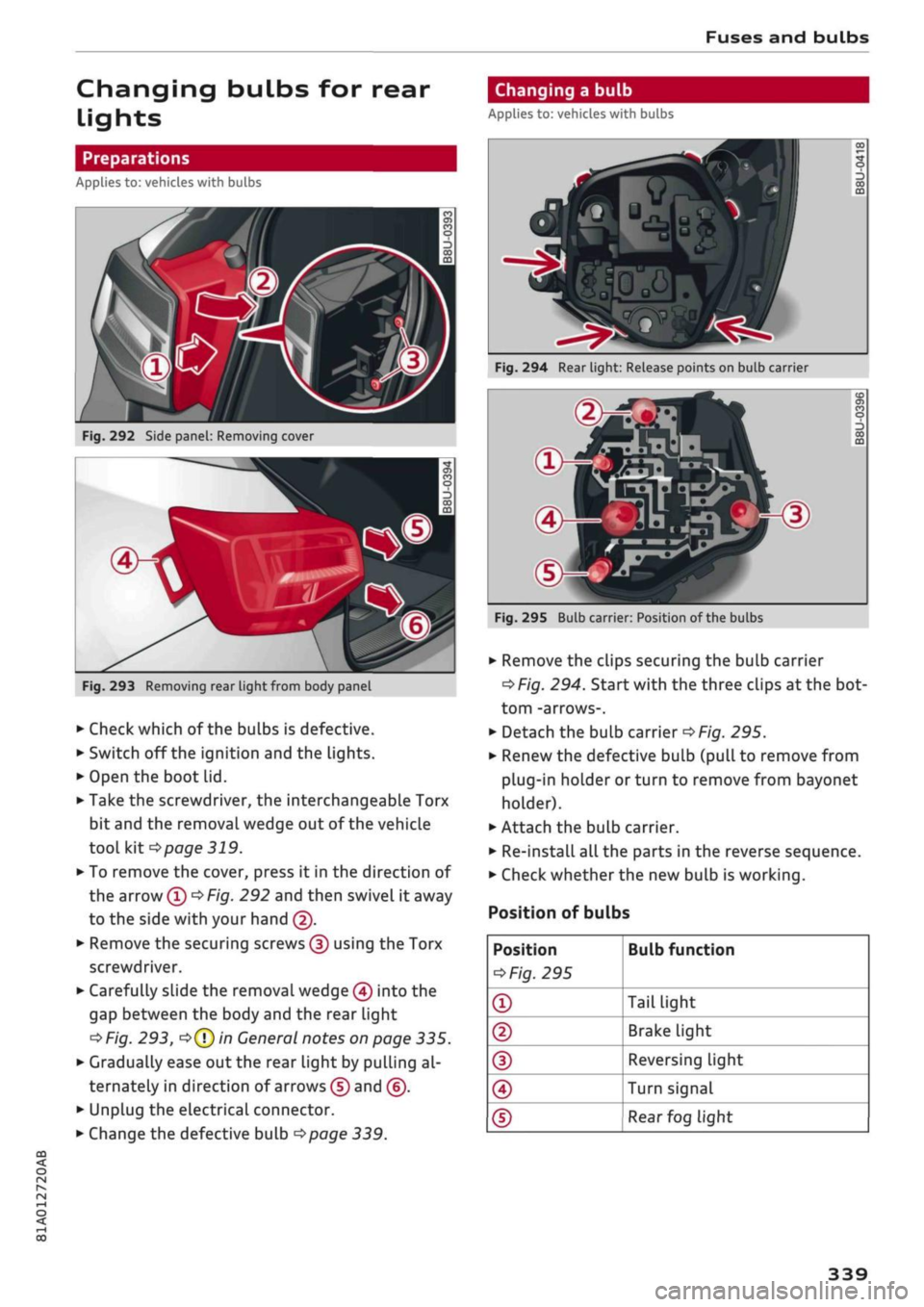
• Check which
of
the bulbs
is
defective.
• Switch
off
the ignition and
the
lights.
• Open
the
boot lid.
• Take
the
screwdriver,
the
interchangeable Torx
bit and
the
removal wedge
out of
the vehicle
tool
kit
*page
319.
• To remove
the
cover, press
it in the
direction
of
the arrow
©
*
Fig.
292
and then swivel
it
away
to
the
side with your hand
©.
• Remove the securing screws
©
using
the
Torx
screwdriver.
• Carefully slide
the
removal wedge
©
into
the
gap between
the
body and
the
rear light
•=>
Fig.
293,
o©
in
General notes on page
335.
• Gradually ease out the rear light
by
pulling
al
ternately
in
direction
of
arrows
©
and
©.
• Unplug
the
electrical connector.
• Change the defective bulb
*page
339.
1
u
f"
00
o
00 m
Fig.
294 Rear light: Release points on bulb carrier
^
®-g
Fig.
295
Bulbcarr
4B
&fï|
STPJ
ml
»Wm
er: Position
sio^
P*^^^HP^
of the bulbs
O)
CO
o
OQ
• Remove the clips securing
the
bulb carrier
*Fig.
294.
Start with
the
three clips
at
the bot
tom -arrows-.
• Detach
the
bulb carrier
*Fig.
295.
• Renew the defective bulb (pull
to
remove from
plug-in holder
or
turn
to
remove from bayonet
holder).
• Attach
the
bulb carrier.
• Re-install all the parts
in the
reverse sequence.
• Check whether the new bulb
is
working.
Position
of
bulbs
Position
*
Fig.
295
®
®
(D
©
®
Bulb function
Tail light
Brake light
Reversing Light
Turn signal
Rear
fog light
339