tyre pressure AUDI Q2 2021 Owner´s Manual
[x] Cancel search | Manufacturer: AUDI, Model Year: 2021, Model line: Q2, Model: AUDI Q2 2021Pages: 364, PDF Size: 87.77 MB
Page 312 of 364
Wheels
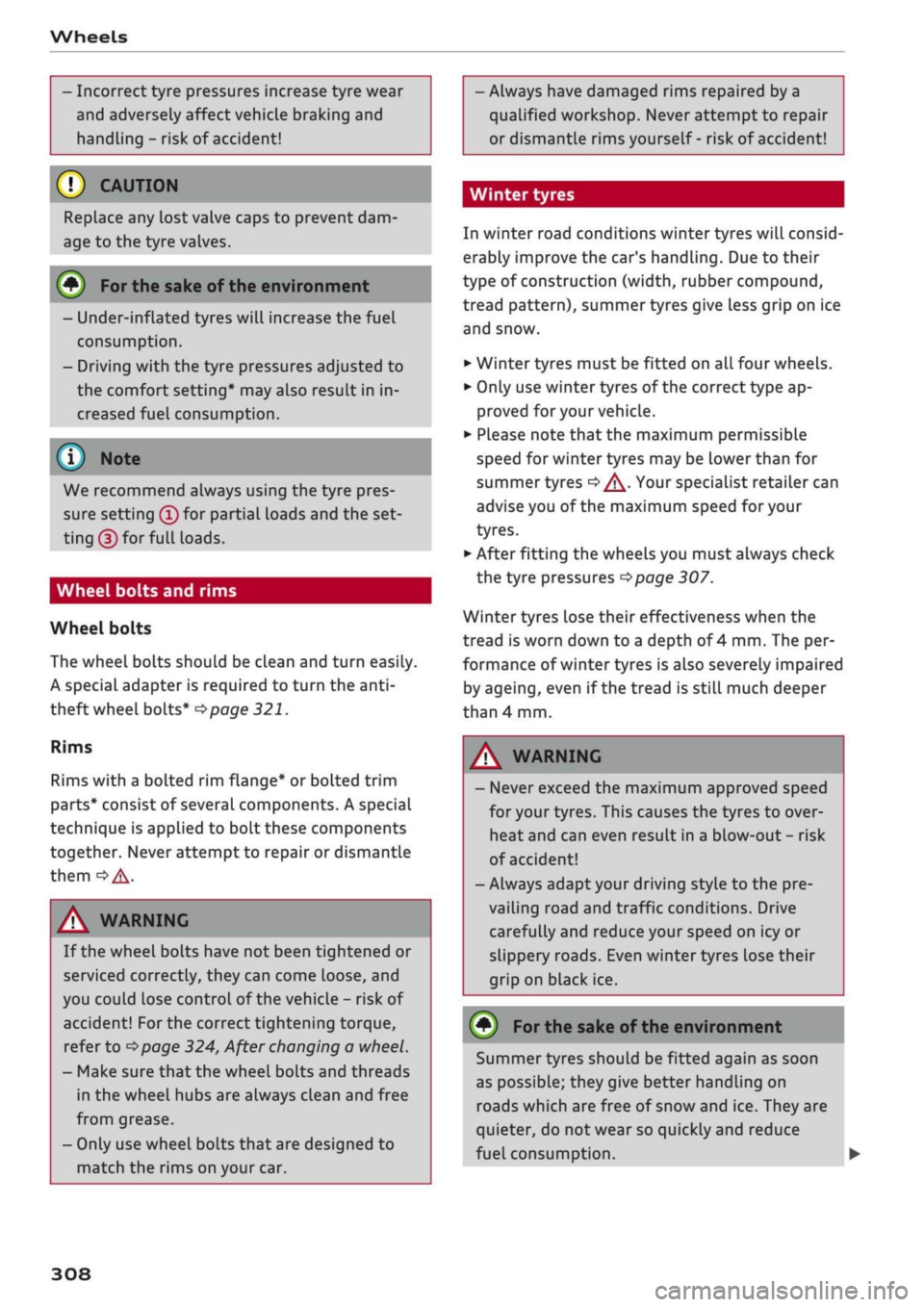
- Incorrect tyre pressures increase tyre wear
and adversely affect vehicle braking and
handling - risk of accident!
(7) CAUTION
Replace any lost valve caps to prevent dam
age to the tyre valves.
(#) For
the sake of the environment
- Under-inflated tyres will increase the fuel
consumption.
- Driving with the tyre pressures adjusted to
the comfort setting* may also result in in
creased fuel consumption.
©
We recommend always using the tyre pres
sure setting
(T)
for partial loads and the set
ting
(?) for
full loads.
Wheel bolts and rims
Wheel bolts
The wheel bolts should be clean and turn easily.
A special adapter is required to turn the
anti-
theft wheel bolts*
^
page 321.
Rims
Rims with a bolted rim flange* or bolted trim
parts*
consist of several components. A special
technique is applied to bolt these components
together. Never attempt to repair or dismantle
them
o
A-
A,
WARNING
If the wheel bolts have not been tightened or
serviced correctly, they can come loose, and
you could lose control of the vehicLe - risk of
accident! For the correct tightening torque,
refer to
^page
324, After changing a wheel.
- Make sure that the wheel bolts and threads
in the wheel hubs are always clean and free
from grease.
- Only use wheel bolts that are designed to
match the rims on your car.
- Always have damaged rims repaired by a
qualified workshop. Never attempt to repair
or dismantle rims yourself - risk of accident!
Winter tyres
In winter road conditions winter tyres will consid
erably improve the car's handling. Due to their
type of construction (width, rubber compound,
tread pattern), summer tyres give less grip on ice
and snow.
•
Winter tyres must be fitted on all four wheels.
•
Only use winter tyres of the correct type ap
proved for your vehicle.
•
Please note that the maximum permissible
speed for winter tyres may be lower than for
summer tyres
•=> A-
Your specialist retailer can
advise you of the maximum speed
for
your
tyres.
•
After fitting the wheels you must always check
the tyre pressures
^>page
307.
Winter tyres Lose their effectiveness when the
tread is worn down to a depth of 4 mm. The per
formance of winter tyres is also severely impaired
by ageing, even if the tread is still much deeper
than 4 mm.
A WARNING
- Never exceed the maximum approved speed
for your tyres. This causes the tyres to over
heat and can even result in a blow-out - risk
of accident!
- Always adapt your driving style to the pre
vailing road and traffic conditions. Drive
carefully and reduce your speed on icy or
slippery roads. Even winter tyres lose their
grip on black ice.
(^)
For the sake of the environment
Summer tyres should be fitted again as soon
as possible; they give better handling on
roads which are free of snow and ice. They are
quieter, do not wear so quickly and reduce
fuel consumption. •
308
Page 313 of 364
Wheels
CO
< o rN
iv
rN
i—i
o < 00
All-weather tyres can also be used instead of
winter tyres. Please note that winter tyres
with the
A
symbol are required by law during
the winter season in some countries.
Snow chains
Snow chains will improve braking ability as well
as traction in winter conditions.
• Snow chains can be used on the front wheels
only. This also applies to vehicles with four-
wheel drive*.
•
Check that the snow chains are correctly seated
after driving for
a
few yards; follow the instruc
tions given by the manufacturer.
•
Keep your speed below 50 km/h. Please ob
serve the applicable local regulations.
Only use snow chains with fine-pitch links. The
links must not protrude more than 13.5 mm
from the tyres (including tensioner).
You must remove the snow chains on roads which
are free of snow; otherwise the vehicLe handling
may be impaired and the tyres may be damaged.
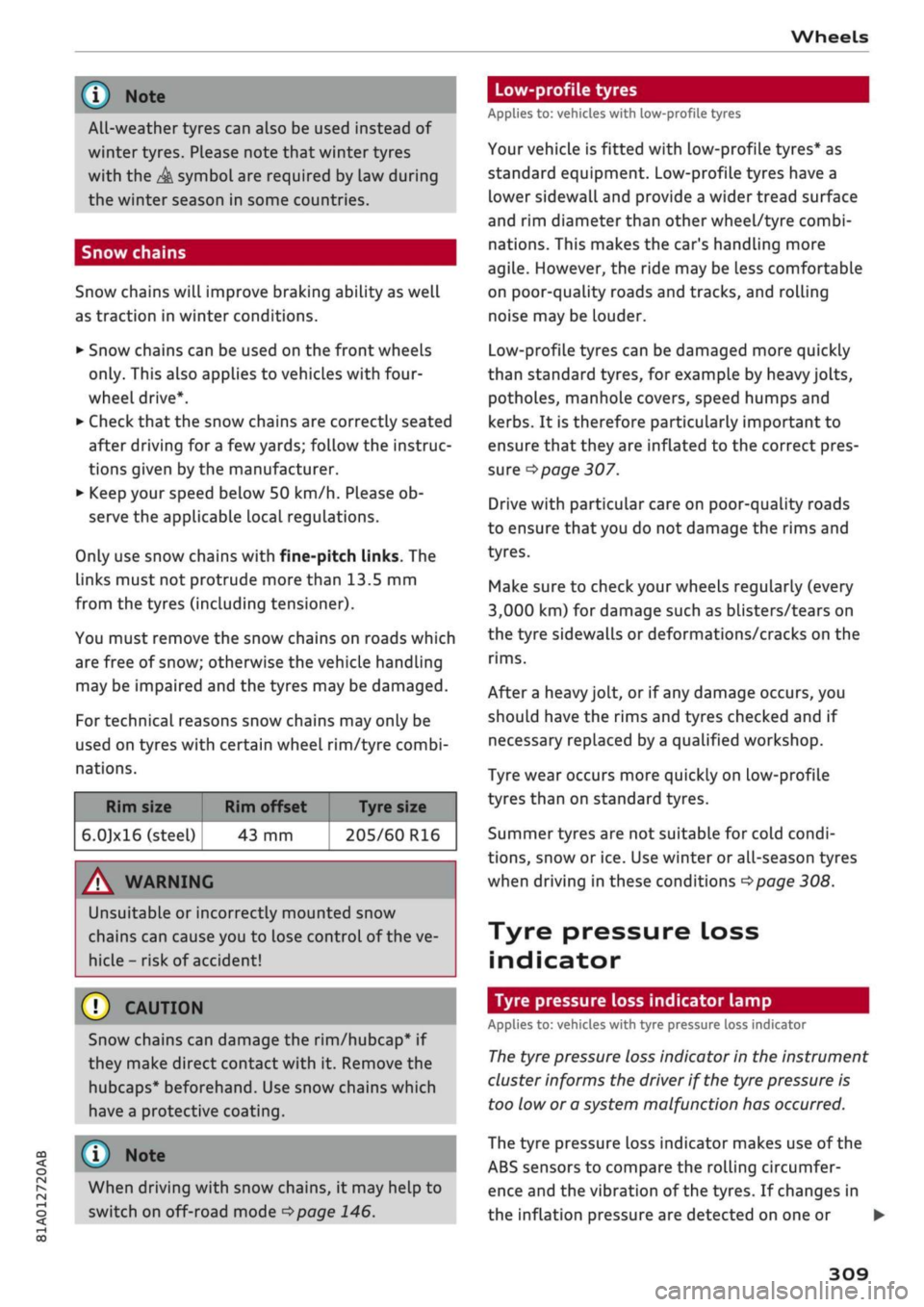
For technical reasons snow chains may only be
used on tyres with certain wheel rim/tyre combi
nations.
Rim size
6.0]xl6 (steel)
Rim offset Tyre size
43 mm 205/60 R16
A WARNING
UnsuitabLe
or incorrectly mounted snow
chains can cause you to lose control of the ve
hicLe-
risk
of accident!
© CAUTION
Snow chains can damage the rim/hubcap* if
they make direct contact with it. Remove the
hubcaps* beforehand. Use snow chains which
have a protective coating.
© Note
When driving with snow chains, it may help to
switch on off-road mode
^page
146.
Low-profile tyres
Applies to: vehicles with low-profile tyres
Your vehicLe is fitted with low-profile tyres* as
standard equipment. Low-profile tyres have a
lower sidewall and provide a wider tread surface
and rim diameter than other wheel/tyre combi
nations. This makes the car's handling more
agile.
However, the ride may be Less comfortable
on poor-quality roads and tracks, and rolling
noise may be louder.
Low-profile tyres can be damaged more quickly
than standard tyres, for example by heavy jolts,
potholes, manhole covers, speed humps and
kerbs.
It is therefore particularly important to
ensure that they are inflated to the correct pres
sure
o
page 307.
Drive with particular care on poor-quality roads
to ensure that you do not damage the rims and
tyres.
Make sure to check your wheels regularly (every
3,000 km) for damage such as blisters/tears on
the tyre sidewalls or deformations/cracks on the
rims.
After a heavy jolt, or if any damage occurs, you
should have the rims and tyres checked and if
necessary replaced by
a
qualified workshop.
Tyre wear occurs more quickly on low-profile
tyres than on standard tyres.
Summer tyres are not suitable for cold condi
tions,
snow or ice. Use winter or all-season tyres
when driving in these conditions
^>page
308.
Tyre pressure loss
indicator
Tyre pressure loss indicator lamp
Applies to: vehicles with tyre pressure loss indicator
The
tyre pressure loss indicator in the instrument
cluster informs the driver if the tyre pressure is
too low or a system malfunction has occurred.
The tyre pressure loss indicator makes use of the
ABS sensors to compare the rolling circumfer
ence and the vibration of the tyres. If changes in
the inflation pressure are detected on one or •
309
Page 314 of 364
Wheels
more tyres, the driver is alerted by an indicator
lamp
0H ar|d a
message in the instrument cluster
display. If only one tyre is affected, the display
will indicate its position.
Each time you change a tyre, change the wheels
round or change the tyre pressures on your
vehi
cle (e.g. when switching from partial load to full
load and vice-versa), you must store the new tyre
pressures in the menu display
<=>page
311.
Mon
itoring of the tyre pressures is based on the tyre
pressures you have stored. The inflation pres
sures recommended for your vehicle are given on
the tyre pressure sticker
opage
307, Fig. 253.
The rolling circumference and vibration can
change and cause a tyre pressure warning if:
- The inflation pressure in one or more tyres is
too low.
- The tyre has suffered structural damage.
- The wheels were changed or the tyre pressures
were changed and the new tyre pressures were
not stored
<>page
311.
- The vehicLe load is not balanced (more load on
one side).
- There is more load on the wheels of one of the
axles (e.g. when towing a trailer or driving up
or down a gradient).
- You are driving with snow chains.
- You are driving with the temporary spare
wheel*.
- Only one wheel of an axle has been changed.
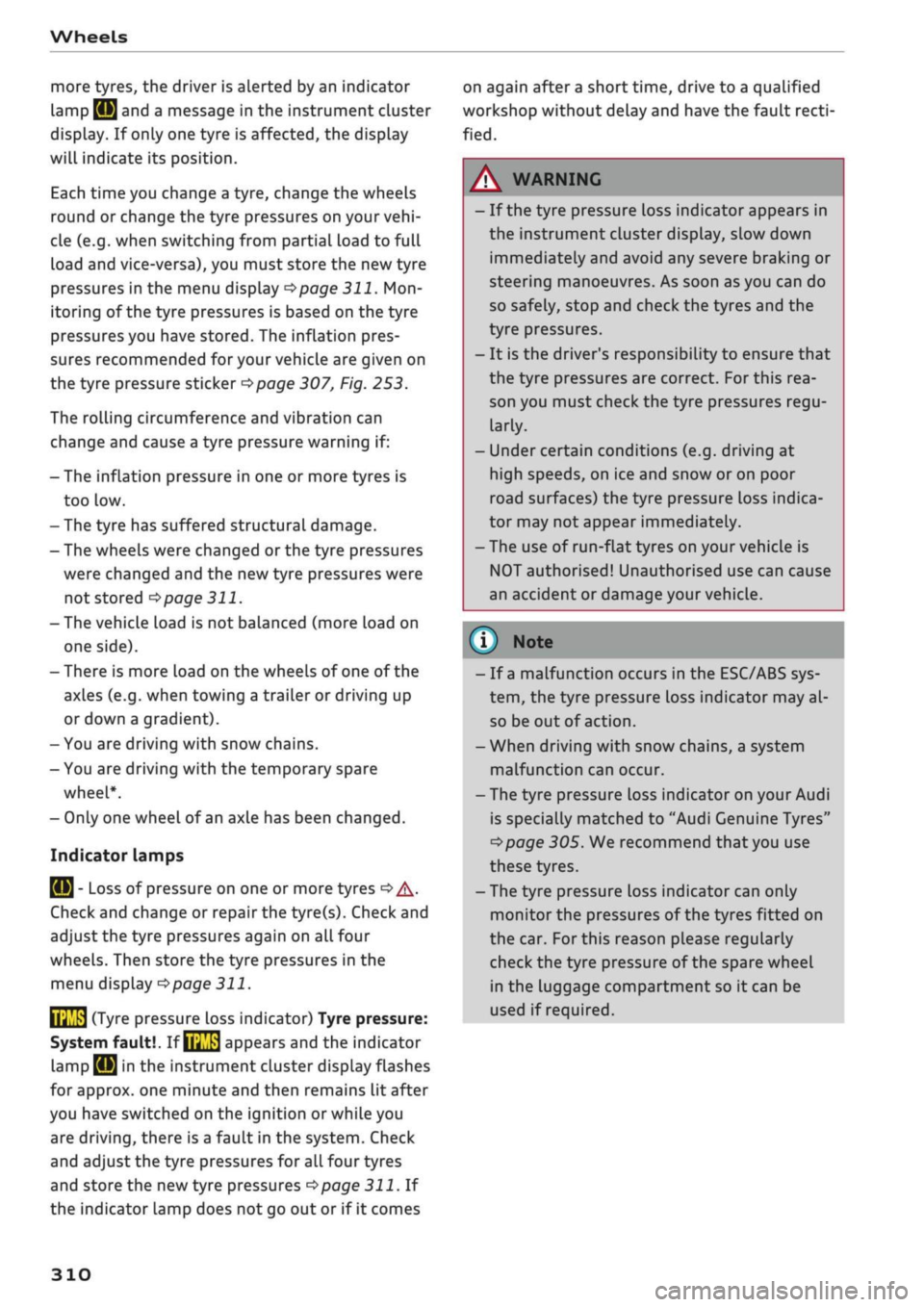
Indicator lamps
flfl - Loss of pressure on one or more tyres
o
A-
Check and change or repair the tyre(s). Check and
adjust the tyre pressures again on all four
wheels. Then store the tyre pressures in the
menu dispLay
opage
311.
IIJ'f.1
(Tyre pressure loss indicator) Tyre pressure:
System fault!.
If llil'f>1
appears and the indicator
LampBH in the
instrument cluster dispLay flashes
for approx. one minute and then remains lit after
you have switched on the ignition or while you
are driving, there is a fault in the system. Check
and adjust the tyre pressures for all four tyres
and store the
new
tyre pressures
•=>page
311. If
the indicator lamp does not go out or if it comes
on again after
a
short time, drive to a qualified
workshop without delay and have the fault
recti
fied.
®
No
- If
a
malfunction occurs in the ESC/ABS sys
tem,
the tyre pressure loss indicator may al
so be out of action.
-When driving with snow chains, a system
malfunction can occur.
-The tyre pressure Loss indicator on your Audi
is specially matched to "Audi Genuine Tyres"
^>page
305. We recommend that you use
these tyres.
- The tyre pressure Loss indicator can only
monitor the pressures of the tyres fitted on
the car. For this reason please regularly
check the tyre pressure of the spare wheel
in the luggage compartment so it can be
used if required.
A
WARNING
- If the tyre pressure loss indicator appears in
the instrument cluster display, slow down
immediately and avoid any severe braking or
steering manoeuvres. As soon as you can do
so safely, stop and check the tyres and the
tyre pressures.
- It is the driver's responsibility to ensure that
the tyre pressures are correct. For this rea
son you must check the tyre pressures
regu
larly.
- Under certain conditions (e.g. driving at
high speeds, on ice and snow or on poor
road surfaces) the tyre pressure loss indica
tor may not appear immediately.
- The use of run-flat tyres on your vehicLe is
NOT authorised! Unauthorised use can cause
an accident or damage your vehicle.
310
Page 315 of 364
Storing tyre pressure settings
Applies to: vehicles with tyre pressure loss indicator
When
you change a tyre or the tyre pressure on
your vehicle, you must confirm the change on the
system.
Before storing the new tyre pressures, check that
the current pressures on all four wheels corre
spond to the specified values and adapt the pres
sures to the current Load
^>page
306.
•
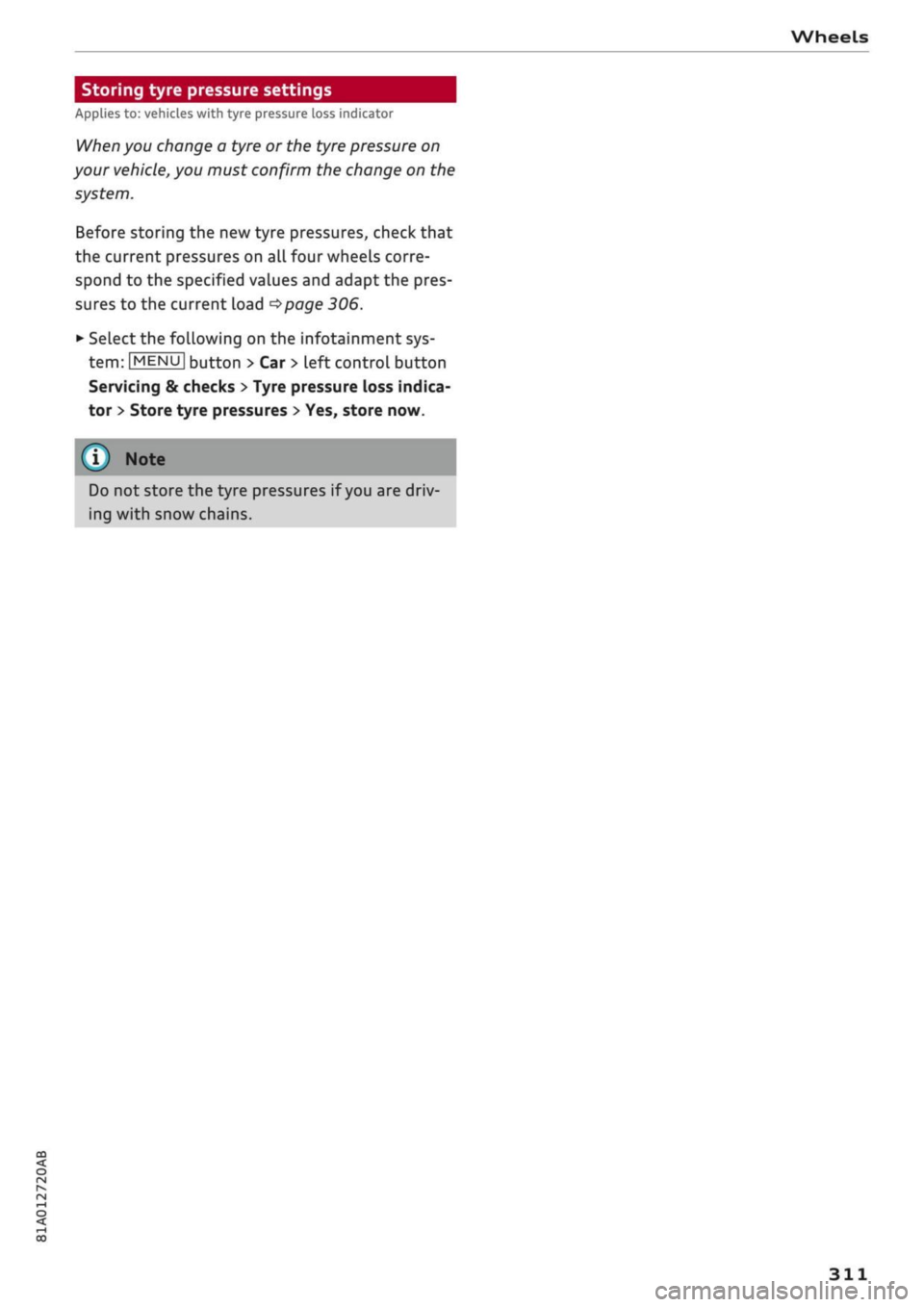
Select the following on the infotainment sys
tem:
|MENU|
button > Car
>
left control button
Servicing & checks
>
Tyre pressure loss indica
tor
>
Store tyre pressures
>
Yes, store now.
Do not store the tyre pressures if
you
are driv
ing with snow chains.
Page 316 of 364
Care of vehicle and cleaning
Care of vehicLe and
cleaning
General notes
Regular and careful care helps to maintain the
value of the vehicLe. This may also be one of the
requirements for upholding any warranty claims
in the event of corrosion or paint defects.
Qualified workshops carry stocks of suitable car
care products. PLease
foLLow
the instructions for
use on the packaging.
A WARNING
- Cleaning products and other materials used
for car care can damage health if misused.
- Car care products can contain toxic substan
ces and must always be kept in a safe place
out of reach of children.
+) For
the sake of the environment
- Please choose care products that are not
harmful to the environment.
- Surplus cleaning materials should not be
disposed of together with ordinary house
hold waste.
Washing the vehicle
The longer residues like insects, bird droppings,
resinous tree sap or road salt are alLowed to re
main on the vehicle, the more damage they can
do to the paintwork. High temperatures (for in
stance in direct sunlight) further intensify the
damage.
Before washing, soak heavy dirt with plenty of
water.
Stubborn dirt, such as bird droppings or resinous
tree sap, is best removed with plenty of water
and a micro-fibre cloth.
After the period when salt is put on the roads,
have the underside of the vehicLe washed thor
oughly.
High-pressure cleaners
When cleaning the vehicle with a high-pressure
cleaner, always follow the operating instructions
for the equipment. This applies particularly to
the operating pressure and the spraying dis
tance.
Do not point the spray jet directly at the
seals on the windows, doors, boot lid, bonnet or
panorama sun roof*, or at the tyres, rubber ho
ses,
insulating material, sensors* or camera
len
ses*.
Maintain a distance of at least 40 cm.
Do not use a high-pressure cleaner to remove
snow and ice.
Never use high-pressure cleaners with a round-
jet nozzle or "dirt blasters".
The water must not be hotter than 60 °C.
Automatic car washes
Spray the vehicle with water before washing.
Ensure that the windows and panorama sun roof*
are closed and that the windscreen wipers are
switched off. Follow the car wash operator's rules
and recommendations, especially if any accesso
ries are attached to your vehicle.
If possibLe use a brushless car wash.
Washing by hand
Clean the car with a soft sponge or brush, start
ing on the roof and working down. Use solvent-
free cleaning agents.
Washing matt-painted vehicles by hand
To avoid damaging the paintwork when washing
the car, first remove any dust, sand and grit. In
sects,
grease stains and fingerprints are best re
moved using a special cleaning agent for matt-
painted surfaces.
Apply the product with a micro-fibre cloth. Do
not apply too much pressure to avoid damaging
the paintwork.
Rinse the car thoroughly with water. Then clean
the car with a neutral shampoo and a soft micro-
fibre cloth.
Rinse the car with lots of water again and then
let it dry in the air. Remove any water stains with
a chamois. •
312
Page 323 of 364
Mobility
Tool kit/tyre repair kit/compressor Using the tyre repair kit
Applies to: vehicles with tool kit/tyre repair kit/compressor Applies to: vehicles with tyre repair kit
CO
rN
IV
rN
•-i
00
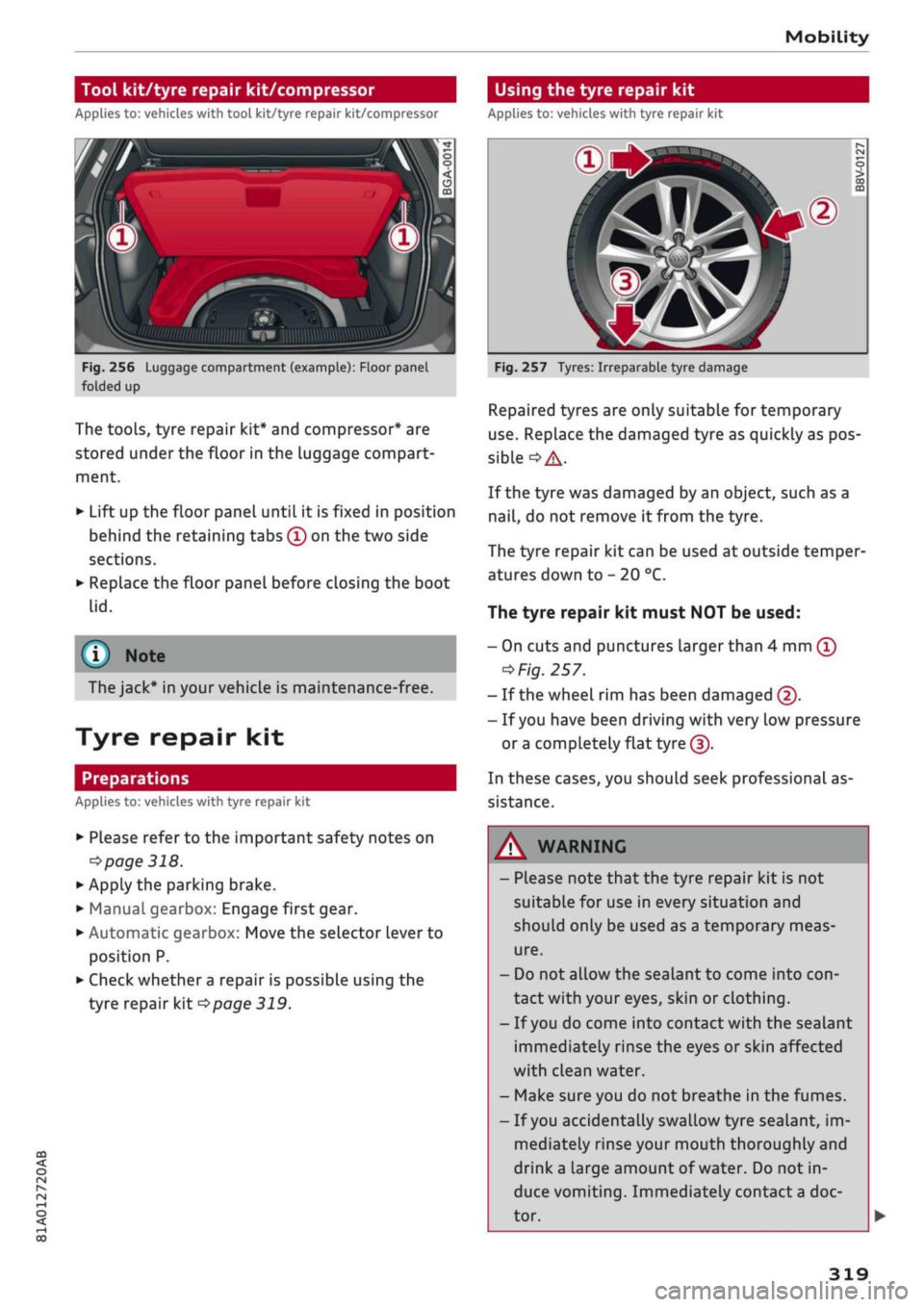
Fig.
256 Luggage compartment (example): Floor panel
folded up
The tools, tyre repair kit* and compressor* are
stored under the floor in the luggage compart
ment.
•
Lift up the floor panel until it is fixed in position
behind the retaining tabs
©
on the two side
sections.
•
Replace the floor panel before closing the boot
lid.
(T)
Note
The jack* in your vehicle is maintenance-free.
Tyre repair kit
Preparations
Applies to: vehicles with tyre repair kit
•
Please refer to the important safety notes on
•=>
page 318.
•
Apply the parking brake.
•
Manual gearbox: Engage first gear.
• Automatic gearbox: Move the selector lever to
position P.
•
Check whether
a
repair is possible using the
tyre repair kit
^page
319.
Fig.
257 Tyres: Irreparable tyre damage
Repaired tyres are only suitable for temporary
use.
Replace the damaged tyre as quickly as pos
sible
°=>A-
If the tyre was damaged by an object, such as a
nail,
do not remove it from the tyre.
The tyre repair kit can be used at outside temper
atures down to - 20 °C.
The tyre repair kit must NOT be used:
- On cuts and punctures larger than 4 mm
©
^Fig.
257.
- If the wheel rim has been damaged ©.
- If
you
have been driving with very low pressure
or a
completely flat
tyre(|).
In these cases, you should seek professional as
sistance.
A
WARNING
- Please note that the tyre repair kit is not
suitable for use in every situation and
should only be used as a temporary meas
ure.
- Do not allow the sealant to come into
con
tact with your eyes, skin or clothing.
- If
you
do come into contact with the sealant
immediately rinse the eyes or skin affected
with clean water.
- Make sure you do not breathe in the fumes.
- If
you
accidentally swallow tyre sealant, im
mediately rinse your mouth thoroughly and
drink
a
large amount of water. Do not in
duce vomiting. Immediately contact
a
doc
tor.
319
Page 324 of 364
Mobility
- Change clothing immediately if it becomes
soiled with the tyre sealant.
- If any allergic reactions should occur get
medical help immediately.
- Keep the sealant away from children.
©
Note
- If sealant should leak out, leave it to dry.
When it has dried, you can pull it off like a
piece of
foil.
- Observe the expiry date stated on the
seal
ing compound can. Have the sealing com
pound exchanged by
a
qualified workshop.
- Interference to the radio reception may oc
cur when using the compressor*.
- Please observe the relevant regulations.
Tyre repairs
Applies to: vehicles with tyre repair kit
*
a
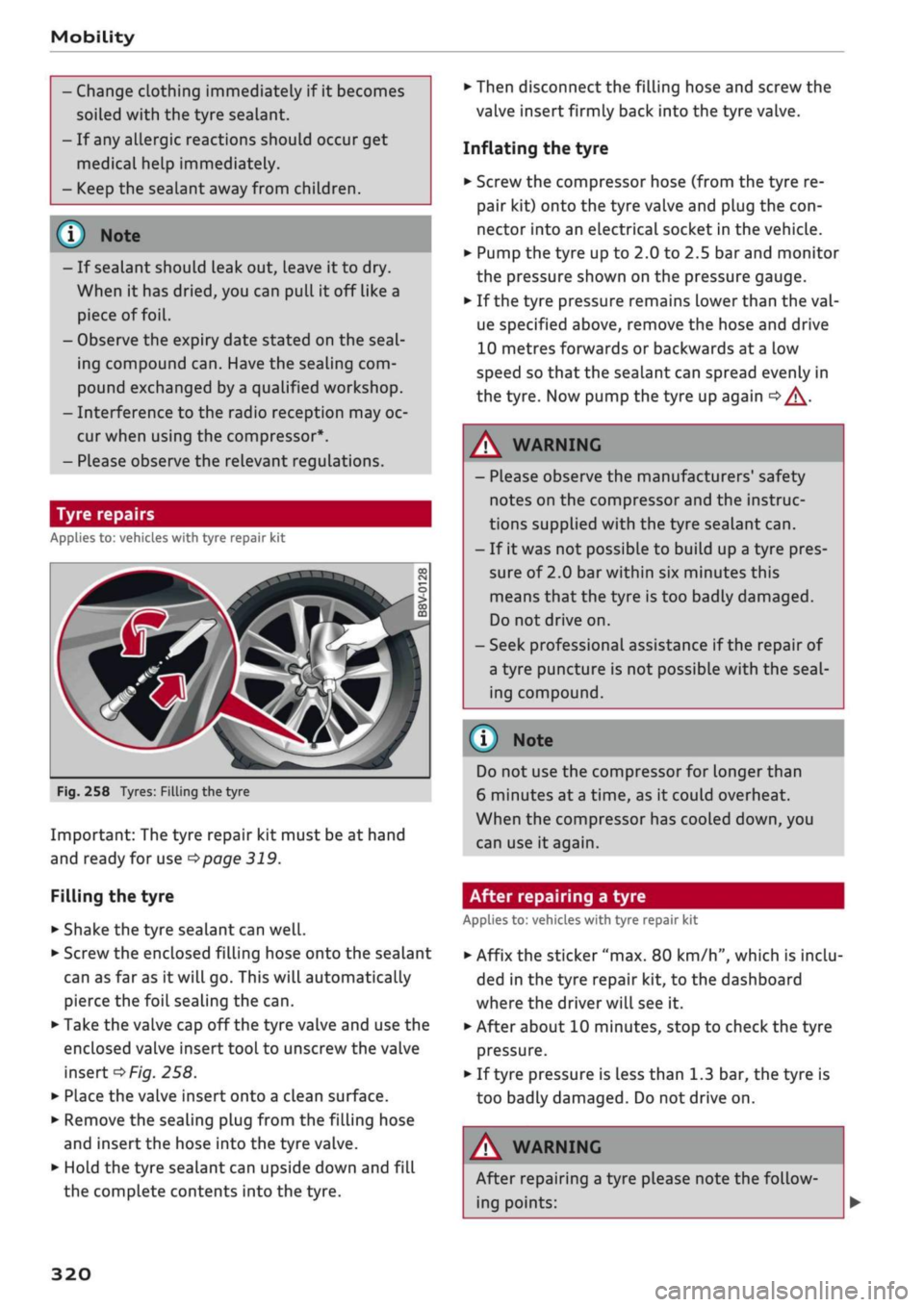
Fig.
258 Tyres: Filling the tyre
Important: The tyre repair kit must be at hand
and ready for use
•=>page
319.
Filling the tyre
•
Shake the tyre sealant can
well.
•
Screw the enclosed filling hose onto the sealant
can as far as it will go. This will automatically
pierce the foil sealing the can.
• Take the valve cap off the tyre valve and use the
enclosed valve insert tool to unscrew the valve
insert
^F/'g.
258.
• Place the valve insert onto a clean surface.
• Remove the sealing plug from the filling hose
and insert the hose into the tyre valve.
• Hold the tyre sealant can upside down and fill
the complete contents into the tyre.
• Then disconnect the filling hose and screw the
valve insert firmly back into the tyre valve.
Inflating the tyre
• Screw the compressor hose (from the tyre re
pair kit) onto the tyre valve and plug the
con
nector into an electrical socket in the vehicle.
• Pump the tyre up to 2.0 to 2.5 bar and monitor
the pressure shown on the pressure gauge.
• If the tyre pressure remains lower than the
val
ue specified above, remove the hose and drive
10 metres forwards or backwards at
a
low
speed so that the sealant can spread evenly in
the tyre. Now pump the tyre up again
o
A.
A WARNING
- Please observe the manufacturers' safety
notes on the compressor and the instruc
tions supplied with the tyre sealant can.
- If it was not possible to build up a tyre pres
sure of 2.0 bar within six minutes this
means that the tyre is too badly damaged.
Do not drive on.
- Seek professional assistance if the repair of
a tyre puncture is not possible with the
seal
ing compound.
© Note
Do not use the compressor for longer than
6 minutes at
a
time, as it could overheat.
When the compressor has cooled down, you
can use it again.
After repairing a tyre
Applies to: vehicles with tyre repair kit
• Affix the sticker "max. 80
km/h",
which is
inclu
ded in the tyre repair kit, to the dashboard
where the driver will see it.
• After about 10 minutes, stop to check the tyre
pressure.
• If tyre pressure is less than 1.3 bar, the tyre is
too badly damaged. Do not drive on.
A WARNING
After repairing a tyre please note the follow-
ng points:
320
Page 328 of 364

Mobility
not possible to tighten the bolts to the re
quired torque using the hexagonal socket
risk
of accident!
© CAUTION
When removing/fitting the wheel the rim
may hit and damage the brake disc. For this
reason,
please take care and get
a
second per
son to assist you.
(T) Note
The wheel bolts are easier to remove from the
wheel rim if
you
use the hexagonal socket in
the screwdriver handle. The reversible screw
driver blade should be removed as a precau
tionary measure when the tool is used for this
purpose.
Tyres with directional tread pattern
A directional tread pattern can be identified by
arrows on the sidewall that point in the direction
of rotation. Always note the direction of rotation
indicated when mounting the wheel. This is im
portant so that these tyres can give maximum
grip and avoid excessive noise, tread wear and
aquaplaning.
If
you
ever have a puncture and need to fit the
spare wheel* in the wrong direction, please drive
with extra care because the tyre will not give op
timum performance in this situation. Bear this in
mind particularly when driving on wet roads.
To benefit from the advantages of tyres with this
type of tread pattern, the defective tyre should
be replaced and refitted as soon as possible so
that all tyres again rotate in the correct direction.
After changing a wheel
• Fit the hubcap or wheel bolt caps back on, as
required.
• Put the tools and jack back in the luggage com
partment.
• If the replaced wheel will not fit into the spare
wheel
well,
stow it safely in the luggage com
partment
*page
272.
• Check the tyre pressure of the fitted wheel as
soon as possible.
• On vehicles with tyre pressure loss indicator,
adjust the tyre pressures and store them via the
infotainment system
opage
311.
• The wheel bolts should be tightened to 140
Nm.
Have this checked as soon as possibLe with
a torque wrench. Until
then,
drive with caution.
• Have the flat tyre replaced as quickly as possi
ble.
Spare wheel
General notes
Applies to: vehicles with compact temporary spare wheel
Fig.
266 Luggage compartment: Floor panel folded up
Fig.
267 Compact temporary spare wheel (example)
The compact temporary spare wheel
*Fig.
267 is
only intended for temporary use over short dis
tances. Have the damaged wheel checked as soon
as possible by
a
qualified workshop and, if neces
sary, replaced.
PLease note the following restrictions when using
the compact temporary spare wheel. The com
pact temporary spare wheel is designed specifi
cally for this model. For this reason, do not use a
spare wheel from a different type of
vehicle.
•
324
Page 329 of 364
Mobility
CO
rN
IV
rN
•-i
00
Removing the spare wheel
• Lift the floor panel up by the plastic handle un
til the panel is fixed in position behind the re
taining tabs on the two side sections
©
*
Fig.
266.
• Applies to vehicles with bass box in spare wheel
well:
Remove the bass box*. Please first check
the connector to establish which bass box is fit
ted in your vehicle: version 1)
*page
325 or
version 2)
*page
326.
• Turn the plastic knob anti-clockwise.
• Take out the spare wheel.
Snow chains
For technical reasons, snow chains must not be
used on the compact temporary spare wheel.
Should you have a puncture on one of the front
wheels when using snow chains, fit the compact
temporary spare wheel in place of one of the rear
wheels. You can then attach the snow chains to
the wheel taken from the rear and use this wheel
to replace the punctured front wheel.
A WARNING
- The tyre pressure must be checked as soon
as possible after fitting the spare wheel - an
incorrectly inflated tyre can increase the risk
of accident. You can find the tyre pressures
here
*page
307, Fig. 253.
- Do not drive faster than 80 km/h when the
compact temporary spare wheel is fitted -
higher speeds can cause an accident.
-Avoid heavy acceleration, hard braking and
fast cornering when the compact temporary
spare wheel is fitted - risk of accident!
- Never use two or more compact spare tyres
at the same time - risk of accident!
- No other type of tyre (normal summer or
winter tyres) may be fitted on the compact
temporary spare wheel.
Removing the bass box (version 1)
Applies to: vehicles with bass box in spare wheel well
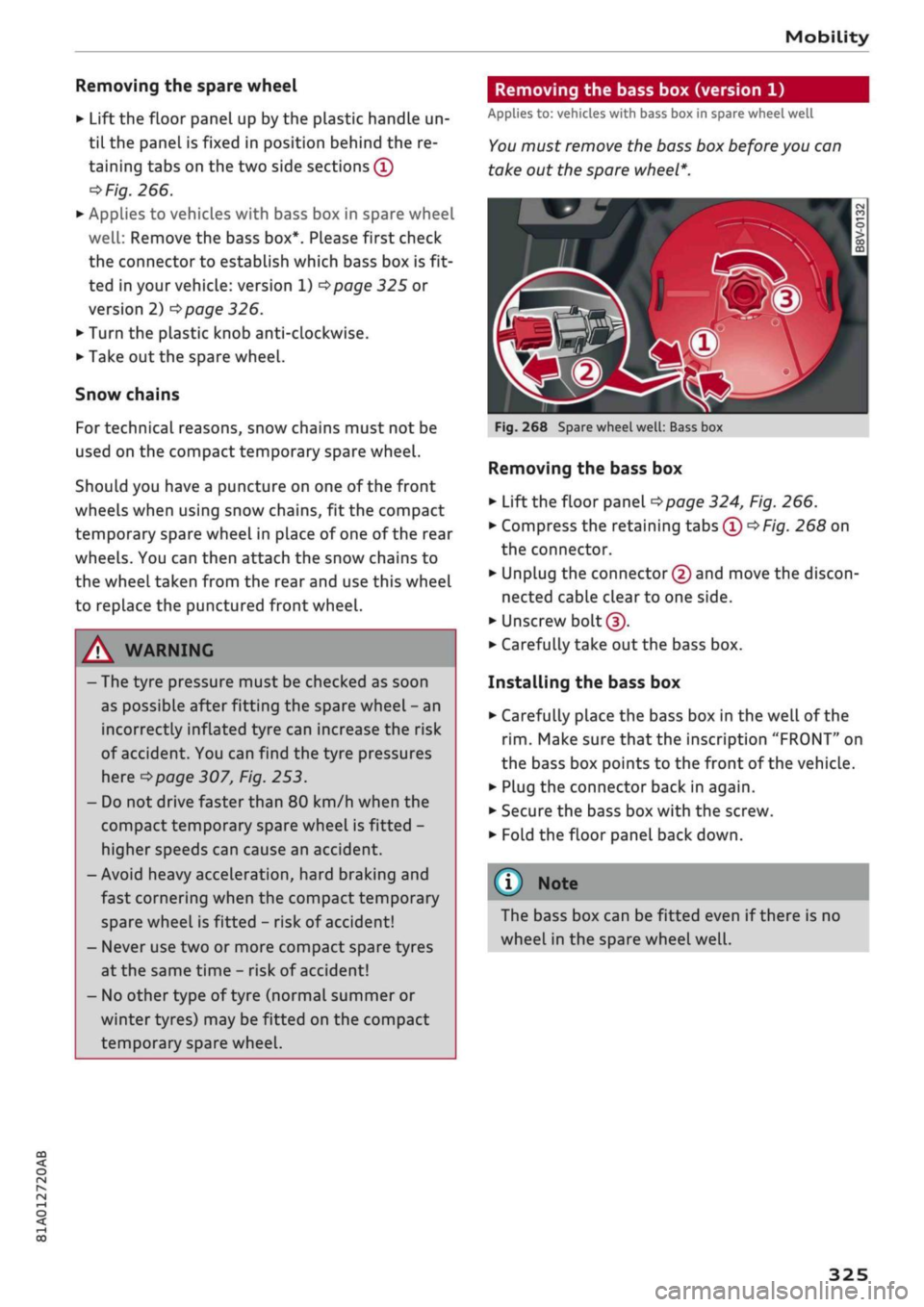
You
must remove the bass box before you can
take out the spare wheel*.
«
Fig.
268 Spare wheel
well:
Bass box
Removing the bass box
• Lift the floor panel
<=>page
324, Fig. 266.
• Compress the retaining
tabs©*Fig.
268 on
the connector.
• Unplug the connector © and move the discon
nected cable clear to one side.
• Unscrew
bolt©.
• Carefully take out the bass box.
Installing the bass box
• Carefully place the bass box in the well of the
rim.
Make sure that the inscription "FRONT" on
the bass box points to the front of the vehicle.
• Plug the connector back in again.
• Secure the bass box with the screw.
• Fold the floor panel back down.
(T) Note
The bass box can be fitted even if there is no
wheel in the spare wheel
well.
325
Page 354 of 364
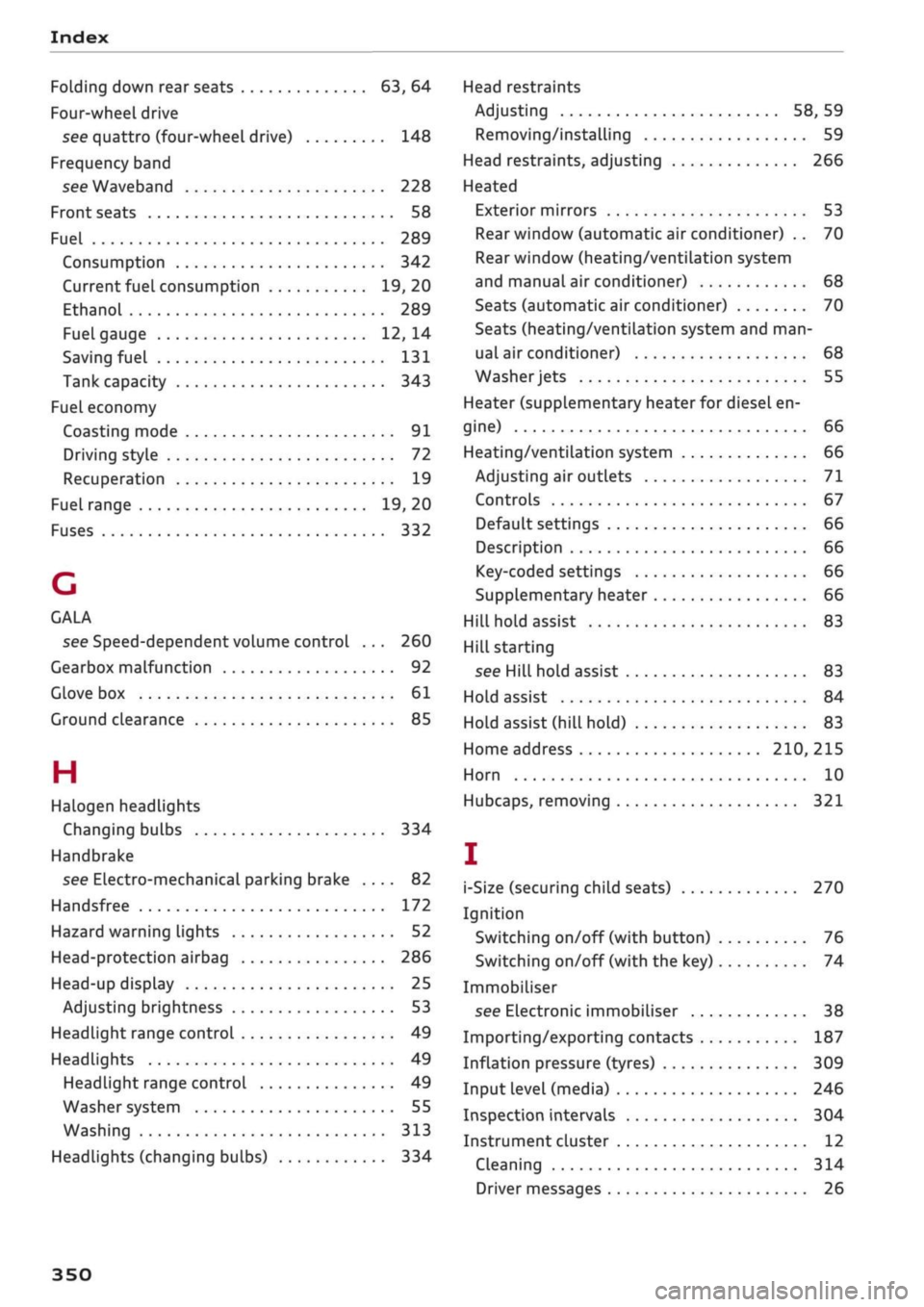
Index
Folding down rear seats 63, 64
Four-wheel drive
see quattro (four-wheel drive) 148
Frequency band
see Waveband 228
Front seats 58
FueL 289
Consumption 342
Current fuel consumption 19,20
Ethanol 289
Fuel gauge 12, 14
Saving fuel 131
Tank capacity 343
FueL
economy
Coasting mode 91
Driving style 72
Recuperation 19
Fuel range 19, 20
Fuses 332
G
GALA
see Speed-dependent volume control ... 260
Gearbox malfunction 92
Glove box 61
Ground clearance 85
H
Halogen headlights
Changing bulbs 334
Handbrake
see Electro-mechanical parking brake .... 82
Handsfree 172
Hazard warning lights 52
Head-protection airbag 286
Head-up display 25
Adjusting brightness 53
Headlight range control 49
Headlights 49
Headlight range control 49
Washer system 55
Washing 313
Headlights (changing buLbs) 334
Head restraints
Adjusting 58,
59
Removing/installing 59
Head restraints, adjusting 266
Heated
Exterior mirrors 53
Rear window (automatic air conditioner) .. 70
Rear window (heating/ventilation system
and manual air conditioner) 68
Seats (automatic air conditioner) 70
Seats (heating/ventilation system and
man
ual air conditioner) 68
Washer
jets 55
Heater (supplementary heater for diesel en
gine) 66
Heating/ventilation system 66
Adjusting air outlets 71
Controls 67
Default settings 66
Description 66
Key-coded settings 66
Supplementary heater 66
Hill hold assist 83
Hill starting
see Hill hold assist 83
Hold assist 84
Hold assist (hill hold) 83
Home address 210, 215
Horn 10
Hubcaps, removing 321
I
i-Size
(securing child seats) 270
Ignition
Switching on/off (with button) 76
Switching on/off (with the key) 74
Immobiliser
see Electronic immobiliser 38
Importing/exporting contacts 187
Inflation pressure (tyres) 309
Input level (media) 246
Inspection intervals 304
Instrument cluster 12
Cleaning 314
Driver messages 26
350