car stand AUDI Q2 2021 Owner´s Manual
[x] Cancel search | Manufacturer: AUDI, Model Year: 2021, Model line: Q2, Model: AUDI Q2 2021Pages: 364, PDF Size: 87.77 MB
Page 259 of 364

System settings
System settings
Setting the time and
date
The
time can be set manually or via
GPS*
• Select:
|MENU|
button > Settings
>
left control
button > MMI settings > Date & time.
•
Or: Select:
|MENU|
button > Car
>
left control
button
>
Vehicle settings > Date & time.
Set automatically
The time and date are automatically updated
when this function is switched on
0.
Time
Important: The Set automatically function must
be deactivated.
Press the rotary pushbutton. You can adjust the
time manually by turning and pressing the rotary
pushbutton.
Date
Important: The Set automatically function must
be deactivated.
Press the rotary pushbutton. You can adjust the
date manually by turning and pressing the rotary
pushbutton.
Time zone
When selecting the correct time zone, a list of
corresponding countries is displayed as an exam
ple.
Automatic time zone*
When this function is activated
(vf,
the time is au
tomatically adjusted to the relevant time zone.
Automatic summer time*
When this function is activated
0,
the time is au
tomatically adjusted from normal time to sum
mer time.
Time format
When this option is set to 24h, for example
13:00 will be displayed as the time. When
it
is
set to AM/PM, for example 1:00 PM will be dis
played.
Date format
When this option is set to DD.MM.YYYY, for ex
ample
31.08.2017
will be displayed as the date.
When
it
is set to MM/DD/YYYY, for example
08/31/2017
will be displayed. When
it
is set to
YYYY-MM-DD, for example
2017-08-31
will be
displayed.
MMI settings
•
Select:
|MENU|
button > Settings > left control
button > MMI settings.
Language
You can change the language of the display along
with the language of the navigation cues* and
the speech dialogue system*.
The number of languages available depends on
the market.
Measurement units
The following measurement units are available:
- Speed (km/h or
mph)
- Distance (km or miles)
- Temperature (°C or °F)
- Consumption
(ltr/100
km,
mpg
(US),
mpg
(UK)
or
km/ltr)
- Capacity (litres, gallons)
Reminder signal
Applies to: vehicles with Audi phone box
Important: Your mobile phone must be Qi com
patible1^,
or
it
must be connected to the Audi
music interface
(l) ^page
177, Fig. 161 using a
USB adapter cable.
You can use the reminder signal to keep yourself
informed of the charging status of the mobile
•
CO
<
O
rN
iv
rN
t-H
o < 00
1}
The Qi standard enables you to charge your mobile phone
wirelessly.
255
Page 271 of 364
Safe driving
CO
< o rN
iv
rN
t-H
o < 00
The head restraints must be adjusted properly to
provide maximum protection.
•
Adjust the front head restraints so that the top
of the head restraint is level with the top of
your head. If this is not possibLe, try to adjust
the head restraint as near as possibLe to this
position.
•
Before carrying passengers on the rear seats,
pull
the head restraints on the occupied seats
all the way up
^>page
59.
For more information on how to adjust the head
restraints, see
^page
58.
A WARNING
- Travelling with the head restraints removed
or incorrectly adjusted increases the risk of
severe injuries.
- Incorrectly adjusted head restraints can also
increase the risk of injury during sudden or
unexpected braking or other manoeuvres.
Examples of incorrect seating positions
Occupants can suffer
severe
or fatal injuries if
they sit in an incorrect position while the vehicle
is moving.
Seat belts can only provide maximum protection
if the belt webbing is positioned correctly. Sitting
out of position greatly reduces the effectiveness
of the seat belts and increases the risk of injury
since the belt webbing is not worn in the position
for which it is designed. The driver is responsible
for the safety of all vehicle occupants, especially
for children.
•
Never allow anyone to sit out of position while
the vehicle is moving
•=>
A..
The following list shows just some examples of
incorrect sitting positions which can be danger
ous to all occupants. The List is not complete, but
will help to make you aware of possible dangers
which can be avoided.
Therefore, whenever the vehicle is moving:
- Never stand up in the vehicle.
- Never stand on the seats.
- Never kneel on the seats.
- Never travel with the backrest reclined too far.
- Never lean against the dash panel.
- Never lie down on the rear seat.
- Never sit on the front edge of
a
seat.
- Never sit sideways.
- Never lean out of the window.
- Never put your feet out of the window.
- Never put your feet on the dash panel.
- Never put your feet on the seat cushion.
- Never ride in the footwell.
- Never travel on a seat without wearing the seat
belt.
- Never climb into the luggage compartment.
WARNING
Sitting out of position increases the risk of se
vere injuries.
- Sitting out of position exposes the occu
pants to potentially fatal injuries if, for in
stance, the airbags inflate and strike an oc
cupant who is not seated in one of the prop
er positions.
- Before starting a trip, sit in the correct
posi
tion and stay in this position as Long as the
vehicle is moving. Before every trip, make
sure all passengers are sitting in the correct
positions and remain correctly seated at all
times
^page
58, Front seats.
Child seats
Safety notes for using child seats
To
reduce the risk of injury in the event of
an
ac
cident, children must always use child restraint
systems when travelling in the car.
Please note the information in this Owner's
Man
ual when installing and using child seats. Follow
the manufacturer's instructions and observe any
statutory requirements.
For safety reasons, we recommend that child
seats be installed on the rear seats. You should
only use a child seat on the front passenger seat
in exceptional circumstances. •
267
Page 272 of 364
Safe driving
A WARNING
To avoid serious or fatal injury, children trav
elling in the vehicle must always be protected
with child restraint systems appropriate to
their height, weight and age.
- Children under 1.50 m tall or younger than
12 must not travel in the vehicLe if there are
no suitable child seats. Please observe any
other applicable regulations in the country
in which you are travelling.
- Babies and children must never travel on an
other occupant's lap.
- Never allow more than one child to occupy
one child seat.
- Never leave a child without supervision in a
child seat.
- Never allow a child to travel unrestrained or
to stand up or kneel on a seat while the car
is moving. In an accident, the child could be
catapulted through the car, causing possibly
fatal injuries to itself and other occupants.
- To ensure proper protection by the child re
straint, it is important to wear the seat belts
in the correct position
^>page
277. Always
check that the belt is properly positioned ac
cording to the instructions provided by the
manufacturer of the child seat. Incorrectly
worn seat belts can give rise to injuries even
in a minor collision.
- If children are out of position when the car
is moving, they are at greater risk of injury
during a sudden braking manoeuvre or in an
accident. This is particularly the case if the
child is travelling on the front passenger's
seat and the airbag system is triggered in an
accident. This incorrect sitting position can
result in serious or even fatal injury.
- Make sure there is sufficient clearance in
front of the child sitting in the child seat. If
necessary, adjust the seat position and
backrest angle of the seat in front of the
child seat.
- If
you
are using a child seat on the front
passenger seat in which the child faces the
direction of
travel,
you should move the
front passenger seat as far back as possible.
- Child seats in which the child faces the rear
of the car are located directly in the path of
the front passenger's airbag if it inflates. In
this case, the child could sustain serious or
fatal injuries if the airbag were to be de
ployed.
- Applies to vehicles on which the front pas
senger's airbag cannot be deactivated: Do
NOT use a rearward-facing child seat on
the front passenger's seat.
- Applies to vehicles with key-operated
switch for deactivating the front passeng
er's airbag: Do NOT use a rearward-facing
child seat on the front passenger's seat
while the front passenger's airbag is ac
tive.
If
you
have no alternative but to use a
rearward-facing child seat on the front
passenger's seat, the front passenger's
airbag must be deactivated beforehand via
the key-operated switch*
^>page
288.
Make sure that the front passenger's air-
bag is reactivated by means of the key-op
erated switch* as soon as the child seat is
no Longer needed on the front passenger's
seat.
- Always replace the child seat with a new one
after an accident as damage not externally
visible may have occurred.
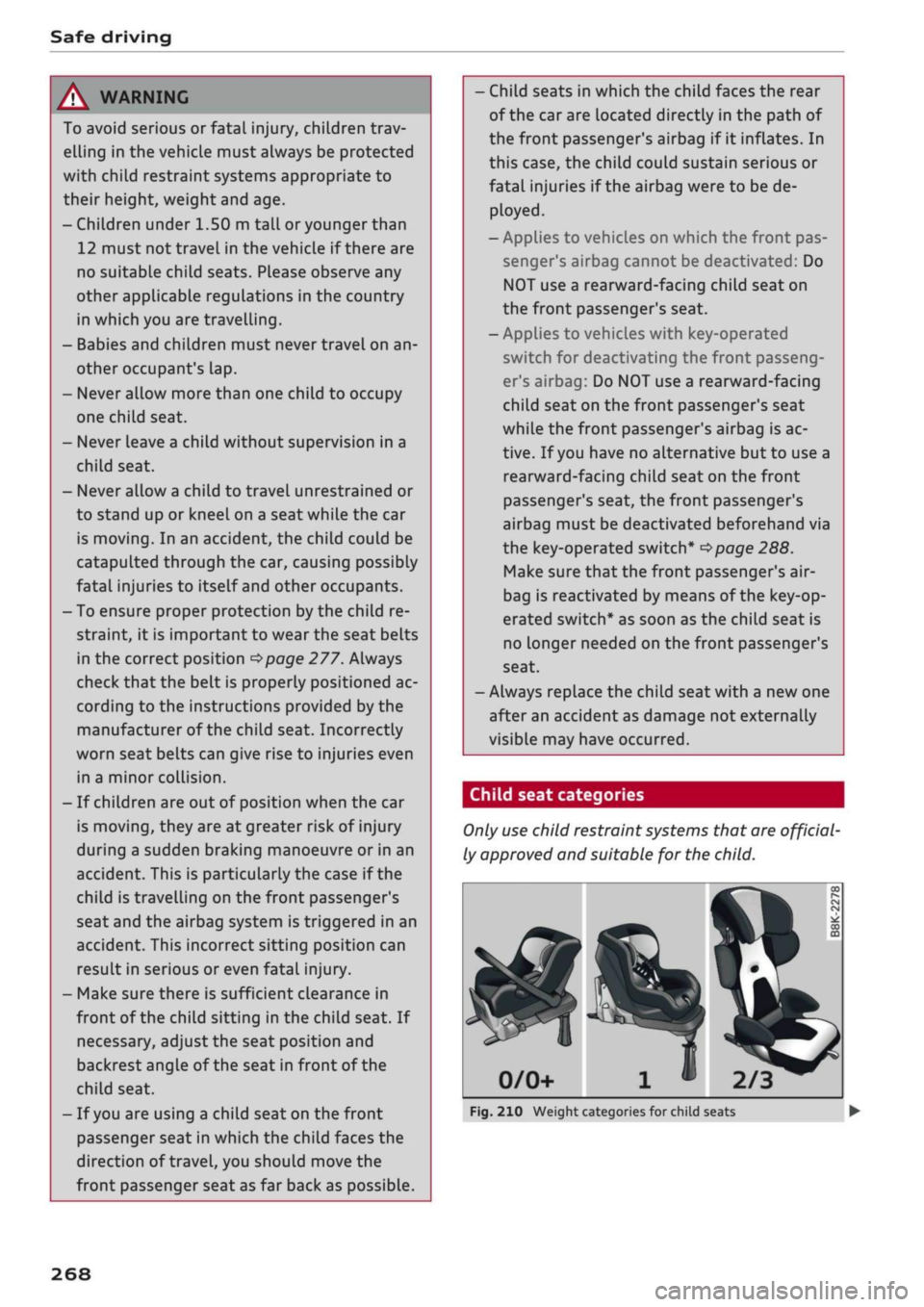
Child seat categories
Only
use
child restraint systems that are official
ly approved and suitable for the child.
2/3
Fig.
210 Weight categories for child seats
268
Page 273 of 364
Safe driving
CO
<
O
rN
iv
rN
t-H
o < 00
Child restraint systems are regulated by Europe
an standards ECE
R
44 or ECE-R
129x).
Both
standards apply in parallel. An orange label is
normally attached to child seats which have been
tested in accordance with these standards. Infor
mation on weight categories, ISOFIX size class
and the approval category of the child seat can
be found on this Label.
Weight categories for child seats
- Child seats: categories 0 and 0+: Rearward-
facing carry cots are most appropriate for these
categories (up to 13 kg). Our recommendation:
Audi carry cot with optional ISOFIX base.
- Child seats: category 1: In this category (9 to
18 kg), rearward or forward-facing child seats
with an integrated seat belt system are most
appropriate. Rearward-facing child seats
should be used for as long as safely possible.
Our recommendation: Audi child seat with ISO-
FIX base.
- Child seats: categories 2 and 3: Child seats
with backrests used in conjunction with seat
belts are most appropriate for these categories
(15 to 36 kg). Our recommendation: Audi child
seat "youngster plus".
Approval categories for child seats
Child seats can have the approval categories
uni
versal,
semi-universal, vehicle-specific (all ac
cording to the ECE-R 44 standard) or
i-Size
(ac
cording to the ECE-R 129 standard).
- Universal: Child seats approved for the univer
sal category are suitable for installation in any
vehicle. A model list is not required. Universal
category child seats for ISOFIX anchorages
must be secured additionally by
a
top tether
strap.
- Semi-universal: Safety appliances requiring ad
ditional tests are required for securing a child
seat with semi-universal approval. Child seats
with semi-universal approval have a model list
which must include your vehicle.
-Vehicle-specific: Vehicle-specific approval re
quires that the child seat undergo a separate
1)
The ECE-R 129 standard has not yet been implemented by
the national authorities in all countries.
dynamic test for each vehicle model. Child
seats with a vehicle-specific approval also have
a model List.
- i-Size: Child seats with
i-Size
approval must
comply with the installation and safety require
ments specified in the ECE-R 129 standard.
Your child seat manufacturer can inform you
which child seats with
i-Size
approval are ap
propriate for your vehicle.
A WARNING
- Rearward-facing child seats: Never install a
rearward-facing child seat on the front pas
senger's seat unless the front passenger's
airbag has been deactivated - this can result
in potentially fatal injuries to the
child.
If
you have no alternative but to let
a
child
travel on the front passenger's seat, the
front passenger's airbag must be deactiva
ted*
beforehand
^>page
288.
- Forward-facing child seats: The back of the
child seat should be flush with the backrest
of the vehicle seat. If the rear head restraint
obstructs you when installing the child seat,
adjust or remove it completely
^>page
59.
Install the head restraint again immediately
after removing the child seat. Adjust the
head restraint to the correct height for the
passenger. Travelling with the head re
straints removed or incorrectly adjusted in
creases the
risk
of severe injuries.
- Categories 2 and 3: The shoulder section of
the belt must be fitted across the centre of
the child's collar bone close to the torso. It
must never run against or across the neck.
The lap belt must be worn tightly across the
hips,
and not over the stomach or abdomen.
Pull the belt tight if necessary to take up
any slack.
- Wait for as long as possibLe before changing
up to the next child seat group.
© Note
We recommend child seats from the range of
Audi Genuine Accessories: www.audi.com.
269
Page 285 of 364

Airbag system
Airbag system
Description of airbag
system
General notes on airbag system
The airbag is an integral part of the car's passive
safety system.
In conjunction with the three-point seat belts,
the airbag system gives the front occupants
addi
tional protection for the head and chest in the
event of a severe frontal collision.
In a severe side collision the side airbags and the
head-protection airbags reduce the risk of injury
to the occupants
•=>
A-
In addition to their normal function of protecting
the occupants in a collision, the seat belts also
hold them in a position where the airbags can in
flate properly and provide maximum protection.
The airbag system will only work with the
igni
tion on. The airbag system is monitored electron
ically; the airbag warning lamp indicates whether
the system is functioning properly.
The main parts of the airbag system are:
-The electronic monitoring system (control unit
and sensors)
- The two front airbags
- The front side airbags
-The head-protection airbags
- The indicator Lamp
Q
in the instrument cluster
There is a fault in the airbag system if the
warning lamp
- does not come on when the ignition is switched
on.
- does not go out about 4 seconds after the
igni
tion is switched on.
- goes out and then comes on again after the ig
nition is switched on.
- comes on or flickers while the car is moving.
CO
< o rN
iv
rN
t-H
o <
A WARNING
- The airbags are not a substitute for the seat
belts;
they are an integral part of the car's
overall passive safety system. The airbags
can only offer effective protection if the oc
cupants are wearing their seat belts. For
this reason it is very important to wear the
seat belts at all times
^>page
275, Why is it
so important to use seat belts?.
The seat belts and airbags can only provide
maximum protection if the occupants are
seated correctly
^>page
58, Front seats.
•
If you do not wear a seat belt, if you lean
forward,
or are not seated correctly while
the vehicle is in motion, you are at greater
risk of injury should the airbag system be
triggered in an accident.
Components of the airbag system are loca
ted in various parts of the vehicLe. If repairs
to other vehicle components make it neces
sary to perform work on the airbag system
or to remove or install parts of the airbag
system,
this may cause damage to the air-
bag system. As a result, the airbags may not
inflate correctly or may not be triggered at
all in an accident situation. For this reason,
you should always have the work carried out
by a qualified workshop.
If a fault should occur in the airbag system,
have the system checked immediately by a
qualified workshop. Otherwise the system
may fail to trigger in an accident.
Do not attempt to modify components of
the airbag system in
anyway.
Never make any alterations to the front
bumper
or
the body.
Do not remove the front seats.
The airbag system can only be activated
once;
if the airbag has been triggered, the
system must be replaced. Should the airbag
system or airbag modules have to be re
placed,
the qualified workshop carrying out
the replacement will document all details.
•
If any repair work is required
or
the airbag
and restraint systems have to be replaced,
have the work carried out by your authorised
Audi dealer or a qualified workshop which
adheres to the Audi factory standards. This
will minimise the risk of injury.
If you sell the vehicle, remember to pass on
the complete Service Wallet to the new
owner. If any of the airbags have been
281
Page 297 of 364

Checking and topping up fluids
Preparations
Applies to: vehicles with selective catalytic reduction
CO
<
O
rN
iv
rN
i—i
00
Fig.
241 Vehicle as seen from the rear right: Unscrewing
the AdBlue cap
The AdBlue filler neck is located immediately be
side the diesel filler neck. Add at least the
amount of AdBlue displayed in the instrument
cluster. If
you
do not refill this amount of
fluid,
the system may not detect that the tank has
been refilled and it may not be possible to restart
the engine. You can refill with a maximum of 12
litres.
Important: A message in the instrument cluster
display informs you if
you
need to refill AdBlue.
•
Park the vehicle on a level surface.
•
Switch off the ignition.
• Open the tank flap
<^>page
290.
•
Unscrew the cap on the filler neck
anti-clock
wise
^>Fig.
241.
*•
Refill AdBlue from a filler nozzle
^>page
293,
canister
^>page
294 or bottle
^>page
294.
A WARNING
AdBlue can cause irritation to the
skin,
eyes,
and respiratory organs. Wash thoroughly with
clean water should you come into contact
with this
fluid.
Seek medical assistance if nee
ded.
© CAUTION
- Use only
AdBLue
that complies with the ISO
22241-1 standard. Do not mix AdBlue with
additives and do not dilute it with water.
- AdBlue must not be added to the diesel
tank, and diesel must not be added to the
AdBlue tank. Never start the engine if you
fill up with the wrong type of
fuel,
as this
could damage the tank system and the en
gine.
Obtain professional assistance.
-AdBlue attacks surfaces such as paintwork,
plastic veneer and carpets. Remove spilt
flu
id as soon as possible with a damp cloth and
plenty of water. If the AdBlue has already
solidified,
use warm water and a sponge.
Residues of AdBlue solidify after
a
while if
they are not removed and can damage the
affected surface.
- Do not keep refill bottles or canisters in the
vehicle, as AdBlue can leak and damage the
vehicle interior.
- Keep AdBlue away from clothing. Wash
thoroughly with clean water should you
come into contact with this
fluid.
\J
Note
Please follow the AdBlue manufacturer's in
structions for storage and use.
Refilling AdBlue from a filler nozzle
Applies to: vehicles with selective catalytic reduction
•
Open the tank flap
^>page
290.
*•
Unscrew the cap on the filler neck
anti-clock
wise
^>page
293, Fig. 241.
*•
Fill up with AdBlue until the first time the filler
nozzle cuts off the supply
•=>(]}.
•
Put the tank cap back on
opage
294, After re
filling.
CAUTION
- The handle of the filler nozzle must point
downwards when filling the tank. Otherwise
the filler nozzle will not cut off the supply
automatically
^0
in Preparations on
page 293.
- You should stop refilling the first time the
filler nozzle automatically cuts off the sup
ply. Otherwise the level of AdBlue in the
tank may be too high and AdBlue could
overflow
<=>©
in Preparations on page 293.
293
Page 303 of 364
Checking and topping up fluids
CO
<
O
rN
iv
rN
i—i
o <
Markings on oil dipstick
^>Fig.
246
®
CD
(D
0
When the oil level is near the marking
(Î)
you must top up the engine oil. Please refer
to-=>®.
Do NOT add engine oil.
Do NOT add engine oil.
Drive to a qualified workshop without delay
and have the engine oil changed
•=>©.
Topping up the engine oil
- Unscrew the cap
"fc^
^>Fig.
247 from the
oilfill
er opening
^>page
297, Fig. 245.
-Carefully add 0.5 Litres of suitable engine oil
^>
page 297.
- After two minutes check the oil level once
again.
- If the oil level is too low, add a smaller quantity
of engine oil. The level must always be below
the marking (5)
<^Fig.
246
<=>©.
- Screw the oil filler cap
*£/;
back on and push
the dipstick all the way in.
A WARNING
- Ensure that no engine oil comes into contact
with hot engine components when topping
up:
this could cause a fire.
- The oil filler cap must be properly closed to
prevent oil from squirting onto the hot en
gine or exhaust system while the engine is
running - risk of fire!
- Wash your skin thoroughly if it comes into
contact with engine oil.
- The engine oil must never drop below the
marking®
^>Fig.
246- risk of engine dam
age!
- When topping up the engine oil, make sure
that the oil level is not above the marking
@
^Fig.
246, as this may result in damage
to the catalytic converter or to the engine.
Do NOT start the engine. Contact a qualified
workshop to extract the engine oil if neces
sary.
- Applies to vehicles which have an oil
dip
stick with area
(3)^
Fig. 246: If you run your
vehicle on diesel fuel of poorer quality than
EN 590 standard
fuel,
the fuel can get into
the engine oil. In this case, the oil level
gradually rises and the quality of the engine
oil decreases. Once the oil level has reached
the marking
@
or the indicator lamp
E
has come on, the engine oil level must not
be corrected by extracting the surplus oil -
risk
of engine damage! The engine oil must
be changed
^>page
34.
- No additives should be used with engine oil.
Any damage caused by the use of such
addi
tives would not be covered by the factory
warranty.
© For the sake of the environmen
- Never pour engine oil down drains or into
the ground.
-Always observe statutory requirements
when disposing of empty oil canisters.
© Note
Depending on
how
you drive and the condi
tions in which the car is used, oil consumption
can be up to 0.5
Itr./lOOO
km. Oil consump
tion is likely to be higher for the first 5,000
km.
The engine oil Level must be checked at
regular intervals, preferably when refuelling
and before setting off on a long trip.
Cooling system
Coolant
The engine cooling system is filled at the factory
with a mixture of conditioned water and coolant
additive. This coolant must not be changed.
The coolant level is monitored by a warning lamp
|
<^page
30. However, we recommend that it
should be checked occasionally.
If you do need to top up the coolant, use a mix
ture of water and coolant additive. We recom
mend mixing coolant additive with distilled wa
ter.
299
Page 306 of 364
Checking and topping up fluids
the reservoir in certain circumstances and
cause damage to the vehicle.
- Brake fluid must not be allowed to come in
to contact with the vehicle's body, other
wise it will attack the paintwork.
©
For the sake of the environment
1?
Batteries contain toxic substances including
sulphuric acid and
lead.
PLease contact a
qualified workshop if
you
have any questions.
Battery
General warnings for batteries
Because of the complexity of the power supply,
any battery work, such as disconnection, replace
ment, etc. must be carried out by
a
qualified
workshop
^A-
The term "vehicle battery" refers to the 12 Volt
battery in your vehicle.
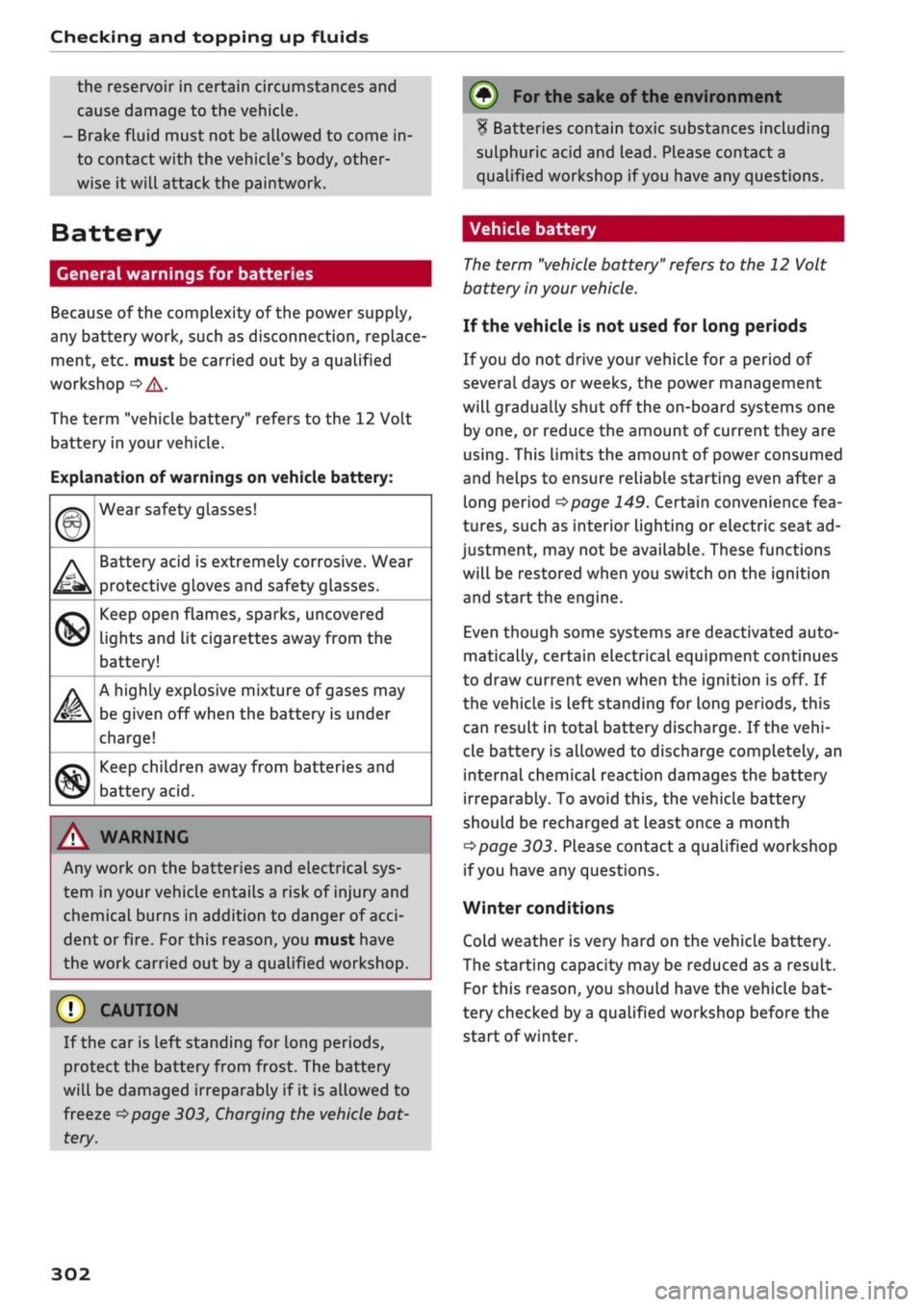
Explanation of warnings on vehicle battery:
m
Wear safety glasses!
Battery acid is extremely corrosive. Wear
protective gloves and safety glasses.
A
Keep open flames, sparks, uncovered
Lights and lit cigarettes away from the
battery!
A highly explosive mixture of gases may
~\
be given off when the battery is under
charge!
Keep children away from batteries and
battery
acid.
A WARNING
Any work on the batteries and electrical sys
tem in your vehicLe entails a risk of injury and
chemical burns in addition to danger of
acci
dent or fire. For this reason, you must have
the work carried out by a qualified workshop.
©
CA UTION
If the car is left standing for long periods,
protect the battery from frost. The battery
will be damaged irreparably if it is allowed to
freeze
^>page
303, Charging the vehicle
bat
tery.
Vehicle battery
The
term "vehicle battery" refers to the 12 Volt
battery in your vehicle.
If the vehicle is not used for long periods
If
you
do not drive your vehicle for a period of
several days or weeks, the power management
will gradually shut off the on-board systems one
by one, or reduce the amount of current they are
using.
This limits the amount of power consumed
and helps to ensure reliable starting even after a
long period
^>page
149. Certain convenience fea
tures,
such as interior lighting or electric seat ad
justment, may not be available. These functions
will be restored when you switch on the ignition
and start the engine.
Even though some systems are deactivated auto
matically, certain electrical equipment continues
to draw current even when the ignition is off. If
the vehicLe is left standing for long periods, this
can result in total battery discharge. If the
vehi
cle battery is allowed to discharge completely, an
internal
chemicaL
reaction damages the battery
irreparably. To avoid this, the vehicle battery
should be recharged at Least once a month
^>page
303. PLease contact a qualified workshop
if
you
have any questions.
Winter conditions
Cold weather is very hard on the vehicle battery.
The starting capacity may be reduced as a result.
For this reason, you should have the vehicle bat
tery checked by
a
qualified workshop before the
start of winter.
302
Page 310 of 364
Wheels
DOT ...2216...
means, for example, that the tyre was produced
in the 22nd week of 2016.
Audi Genuine Tyres
Audi Genuine Tyres with the marking "AO" are
specially matched to your Audi. When used prop
erly, these tyres meet the highest standards in
safety and handling. Your specialist retailer will
be glad to provide more information.
Tyre wear / damage
A
WARNING
- Use only tyre/rim combinations and match
ing wheel bolts approved by Audi. Otherwise
damage to the vehicLe and an accident could
result.
- For technical reasons, it is not possible to
use wheels from other vehicles. In certain
cases, it is not even possible to use wheels
from another vehicle of the same model.
- It is very important to ensure that the tyres
you have chosen have adequate clearance.
When selecting replacement tyres, do not
rely entirely on the nominal tyre size
marked on the tyre; with some makes of
tyre the effective tyre size can differ signifi
cantly from the nominal dimensions, even
though the tyres have the same size desig
nation.
Inadequate tyre clearance can result
in damage to the tyres or the vehicle, caus
ing a serious safety risk.
- Avoid running the car on tyres that are more
than 6 years old. If
you
have no alternative,
you should drive slowly and with extra care
at all times.
- The use of run-flat tyres on your vehicle is
NOT authorised! Unauthorised use can cause
an accident or damage your vehicLe.
- If wheel trims are fitted after the car is pur
chased,
ensure that there is an adequate
flow of air for cooling the brakes - risk of ac
cident!
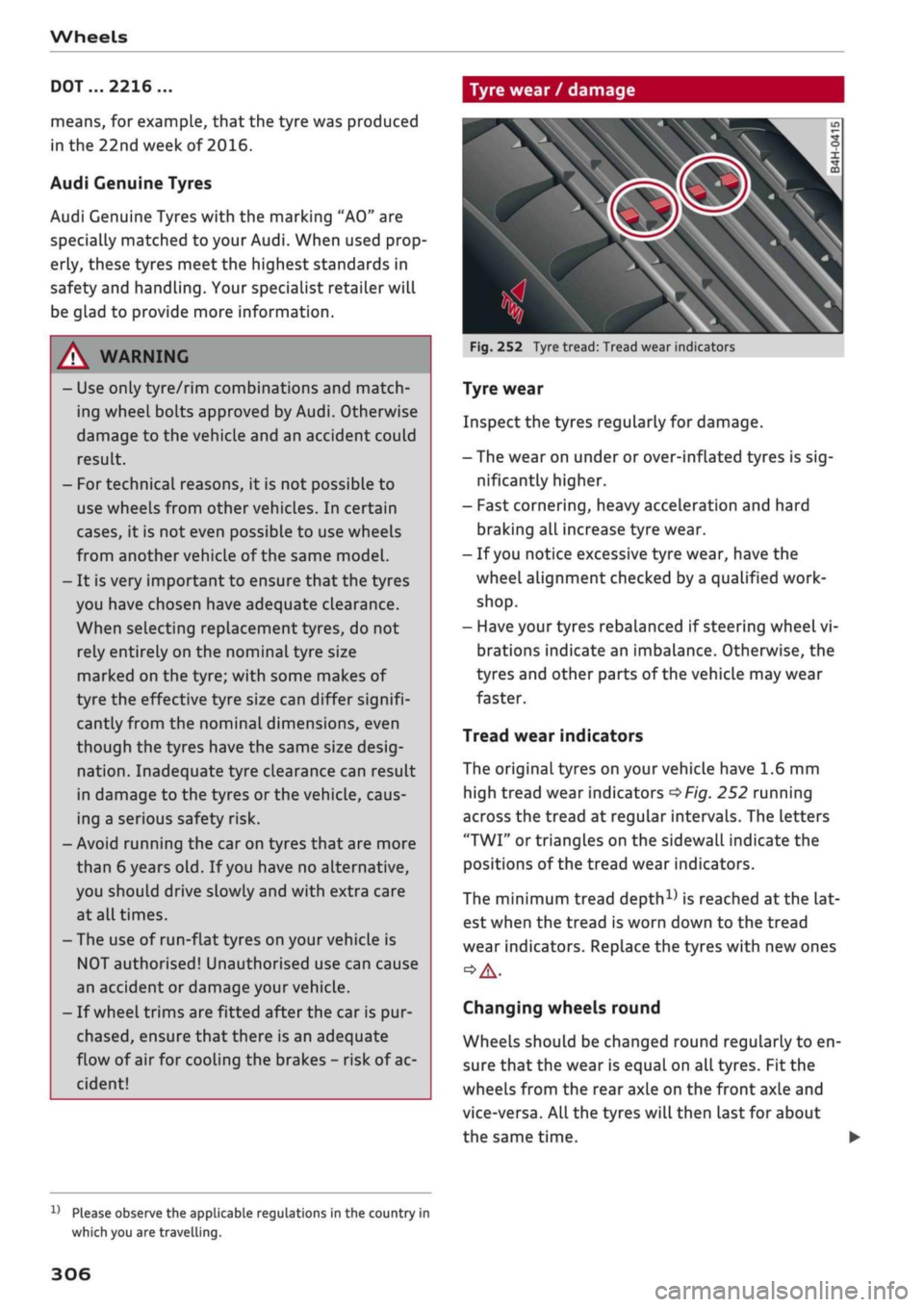
Fig.
252 Tyre tread: Tread wear indicators
Tyre wear
Inspect the tyres regularly for damage.
- The wear on under or over-inflated tyres is
sig
nificantly higher.
- Fast cornering, heavy acceleration and hard
braking all increase tyre wear.
- If
you
notice excessive tyre wear, have the
wheel alignment checked by a qualified work
shop.
- Have your tyres rebalanced if steering wheel vi
brations indicate an imbalance. Otherwise, the
tyres and other parts of the vehicLe may wear
faster.
Tread wear indicators
The original tyres on your vehicle have 1.6 mm
high tread wear indicators
^>Fig.
252 running
across the tread at regular intervals. The letters
"TWI"
or triangles on the sidewall indicate the
positions of the tread wear indicators.
The minimum tread
depth1)
is reached
at
the lat
est when the tread is worn down to the tread
wear indicators. Replace the tyres with new ones
Changing wheels round
Wheels should be changed round regularly to en
sure that the wear is equal on all tyres. Fit the
wheels from the rear axle on the front axle and
vice-versa. All the tyres will then last for about
the same time.
x)
Please observe the applicable regulations in the country in
which you are travelling.
306
Page 313 of 364
Wheels
CO
< o rN
iv
rN
i—i
o < 00
All-weather tyres can also be used instead of
winter tyres. Please note that winter tyres
with the
A
symbol are required by law during
the winter season in some countries.
Snow chains
Snow chains will improve braking ability as well
as traction in winter conditions.
• Snow chains can be used on the front wheels
only. This also applies to vehicles with four-
wheel drive*.
•
Check that the snow chains are correctly seated
after driving for
a
few yards; follow the instruc
tions given by the manufacturer.
•
Keep your speed below 50 km/h. Please ob
serve the applicable local regulations.
Only use snow chains with fine-pitch links. The
links must not protrude more than 13.5 mm
from the tyres (including tensioner).
You must remove the snow chains on roads which
are free of snow; otherwise the vehicLe handling
may be impaired and the tyres may be damaged.
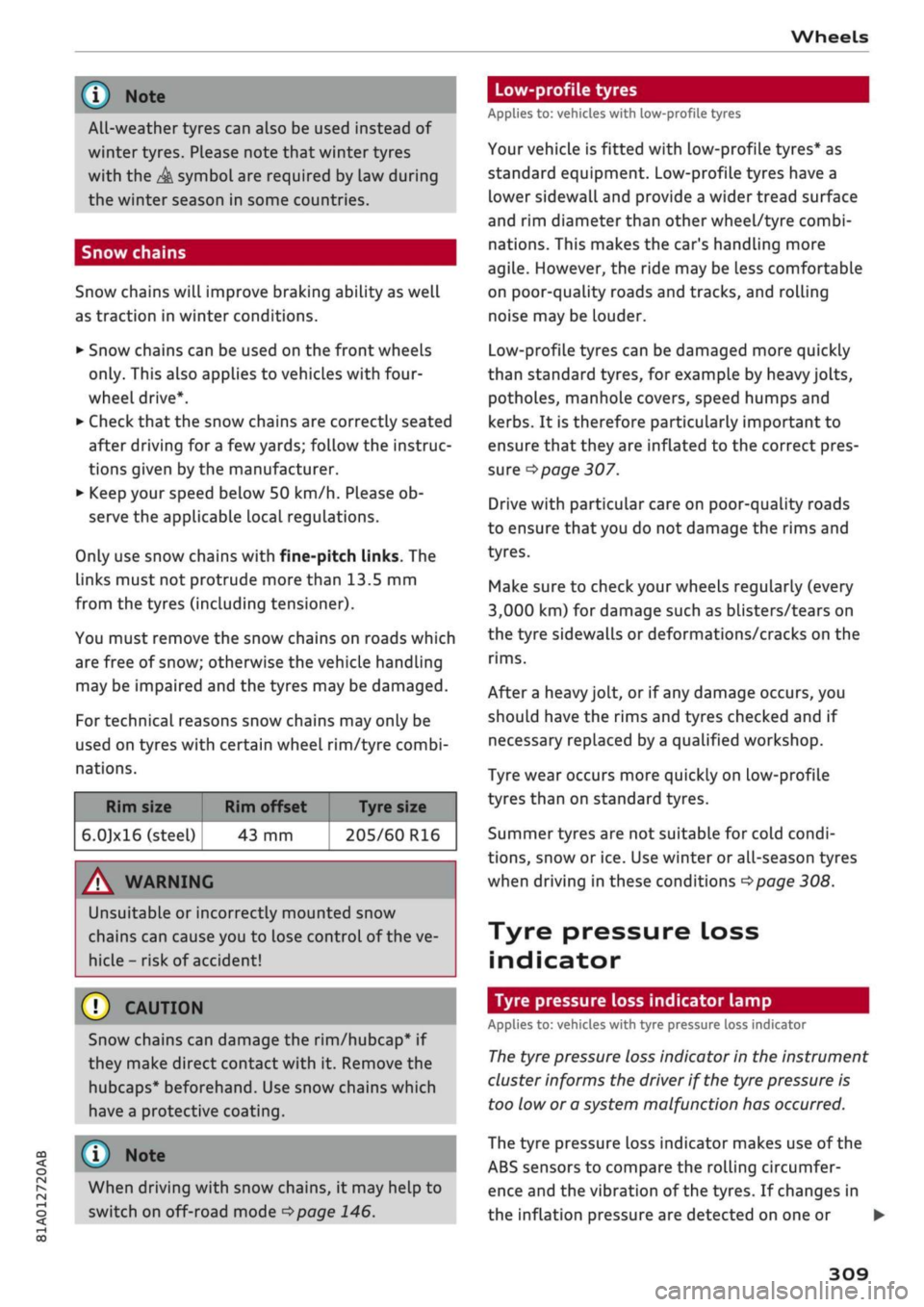
For technical reasons snow chains may only be
used on tyres with certain wheel rim/tyre combi
nations.
Rim size
6.0]xl6 (steel)
Rim offset Tyre size
43 mm 205/60 R16
A WARNING
UnsuitabLe
or incorrectly mounted snow
chains can cause you to lose control of the ve
hicLe-
risk
of accident!
© CAUTION
Snow chains can damage the rim/hubcap* if
they make direct contact with it. Remove the
hubcaps* beforehand. Use snow chains which
have a protective coating.
© Note
When driving with snow chains, it may help to
switch on off-road mode
^page
146.
Low-profile tyres
Applies to: vehicles with low-profile tyres
Your vehicLe is fitted with low-profile tyres* as
standard equipment. Low-profile tyres have a
lower sidewall and provide a wider tread surface
and rim diameter than other wheel/tyre combi
nations. This makes the car's handling more
agile.
However, the ride may be Less comfortable
on poor-quality roads and tracks, and rolling
noise may be louder.
Low-profile tyres can be damaged more quickly
than standard tyres, for example by heavy jolts,
potholes, manhole covers, speed humps and
kerbs.
It is therefore particularly important to
ensure that they are inflated to the correct pres
sure
o
page 307.
Drive with particular care on poor-quality roads
to ensure that you do not damage the rims and
tyres.
Make sure to check your wheels regularly (every
3,000 km) for damage such as blisters/tears on
the tyre sidewalls or deformations/cracks on the
rims.
After a heavy jolt, or if any damage occurs, you
should have the rims and tyres checked and if
necessary replaced by
a
qualified workshop.
Tyre wear occurs more quickly on low-profile
tyres than on standard tyres.
Summer tyres are not suitable for cold condi
tions,
snow or ice. Use winter or all-season tyres
when driving in these conditions
^>page
308.
Tyre pressure loss
indicator
Tyre pressure loss indicator lamp
Applies to: vehicles with tyre pressure loss indicator
The
tyre pressure loss indicator in the instrument
cluster informs the driver if the tyre pressure is
too low or a system malfunction has occurred.
The tyre pressure loss indicator makes use of the
ABS sensors to compare the rolling circumfer
ence and the vibration of the tyres. If changes in
the inflation pressure are detected on one or •
309