brakes AUDI Q3 2015 User Guide
[x] Cancel search | Manufacturer: AUDI, Model Year: 2015, Model line: Q3, Model: AUDI Q3 2015Pages: 258, PDF Size: 64.9 MB
Page 156 of 258
154 Intellig ent technolog y
Anti-slip r egulation (ASR )
ASR reduces engine power when the drive
wheels begin to spin and adapts the force to
the road conditions. This makes it easier to
start, accelerate and drive up hills.
Electronic diffe rential lock (EDL )
The ED L brakes wheels that are spinn ing and
transfers the drive power to the o ther d rive
wheel or whee ls if the vehicle is equipped with
all-wheel drive* . This function is available up
to about 60 mph (100 km/h).
I n extreme cases , ED L automat ica lly switches
off to help keep the brake on the braked whee l
from overheating . EDL wi ll switch on again au
tomatically when conditions have returned to normal.
El ectron ic inte ra xle diff ere ntial lock */
se lec tive wheel t orque contr ol*
The electronic interaxle differential lock (front
wheel drive) or the select ive wheel torque
control (all-wheel drive) operates when driv
ing through curves. The front wheel on the in·
side of the curve or both wheels on the inside
of the curve are braked select ively as needed .
This minimizes s lid ing in the front wheels a nd
allows for more p rec ise driving through
curves. The app licab le system may not acti
vate when driving in wet or snowy conditions .
A WARNING
-ESC, ABS, ASR, EDL, the electronic inter
axle differentia l lock* /selective whee l
torque control* and the hill descent as
sist cannot overcome the laws of physics.
Th is is especially important on slippery
o r wet roads . If the systems begin acting to stabilize your vehicle, you should im
mediately change your speed to match
the road and traffic conditions. Do not let the increased safety provided by
these systems tempt you to take r isks .
Doing so will increase the risk of a loss of
veh icle cont ro l, collision and ser ious per
sonal injur ies.
- Always adapt your speed to road, traffic
and weather conditions. The risk of los
ing control of the vehicle increases when
driving too fast , espec ially through
curves and on slippery or wet roads, and
when driving too close to vehicles up
ahead. ESC, ABS, the brake ass ist sys
tem, ASR, EDL and the electronic inter
axle d ifferential lock*/selective wheel
torque control* cannot prevent colli
sions .
- Always accelerate with special care on
even, smooth surfaces such as those that
are wet or covered with ice and snow .
The drive wheels can spin even w ith
these assistance systems t hat cannot al
ways he lp to reduce the risk of loss of ve
hicle control.
(D Tips
- ABS and ASR only wo rk correct ly when
all four wheels are equipped with identi
cal tires. D ifferent tire sizes can lead to a
reduction in engine power.
- You may hear noises when the systems
described are working .
-If the ind icator light DJ or Ell (USA
mode ls)/ lCO)J
page 16.
Page 158 of 258
156 Intellig ent technol ogy
Hill descent assist brakes a ll four wheels auto
matica lly in order to limit speed when driving
e ither forward or reverse on hills with a grade
up to approximately 50%.
When the hi ll descent assist is on, the current
driving speed, when your vehicle entered the incline is maintained . It is only possib le to
switch on the assist when driving slower than
37 mph (60 km/h). The assist works between
approximately 2 and 19 mph (4 and 30 km/ h) . T he driver can increase or decrease the ve
h icle speed w ith in these lim its by depressing
the accelerato r o r brake pedal In addition, ve
h icle steerability is increased d ue to the brak
ing d istribution when driving in reverse .
There must be however sufficient ground ad hes io n. The hill descent assis t can
no t do its
job if the incl ine is icy or if the incline ground
is loose¢ &..
The system does not work at speeds between 19 and 37 mph (30 and 60 km/h) . T he system
i s then in the ready-mode . The diode in the
button will come on. The system automatical
ly switched off when you drive faster than 37
mph (60 km/h). The diode will go out in this
case.
The flashing indicator lamp
-0-in the instru
ment cluster indicates whenever the driving
speed is being actively controlled to a certain
speed up to approximate ly 19 mph (30 km/h) .
The indicator lamp lights up continuously
when the system goes into standby mode.
Hill descent assist is automatically activated
under the fo llow ing cond itions:
- the d iode in the button illuminates,
- vehicle speed is be low approximately
19 mph (30 km/h)
- the in cl in e is 10%.
_&, WARNING
- Always adapt your speed to the weather,
road and traffic conditions . Do not let
the increased safety provided tempt you
into taking risks. -
The hill descent assist system cannot
overcome the laws of physics. Your dr iv
ing style must always be adapted to the
current road and traffic cond itions .
- The hill descent ass ist may not be ab le to
hold your vehicle at a constant speed un
de r all conditions while driv ing on an in
cline (for example if ground under the
veh icle is loose).
Braking
What affects braking efficiency?
New br ake p ad s
During the first 250 miles (400 km), new
brake pads do not possess the ir full brak ing
effect, they have to be "broken in" first ¢&. .
You can compensate for this slightly reduced
braking power by pushing harder on the brake
pedal. Avoid heavy b ra ki ng loads dur ing the
break-in pe riod.
Operating conditions and driving h abits
The brakes on today 's automobiles are still
subjec t to wear, depending largely on operat
i ng condit ions and driving hab its
~ &. -On
vehicles that are either dr iven mos tly in stop
and -go city t ra ffi c or are dr iven hard, the
brake pads should be chec ked by your author
ized Audi dea ler mo re often than specified in
the
Warranty & M aintenan ce booklet. Failure
to have your brake pads inspected can result in reduced brake performance.
On steep slopes, you sho uld use the braking
effect of the eng ine. This way, you prevent un
necessary wear on the brake system. If you
must use your brakes, do not hold the brakes
down cont inuous ly . Pump the brakes at inter
vals .
Oper ating n ois e
Noises may occur when braking depending on
the speed, braking force and outside condi-
tions such as temperature and humidity. .,,.
Page 159 of 258
M N
M N
0 ::i co ,...., \!) 1.1'1 ,...., 1.1'1 ,....,
Effect of w ate r and ro ad salt
In certain situa tions, for example after driving
through water, in heavy rain, after overnight
condensation or after washing your car, the braking effect can be reduced by moisture or
ice on the brake rotors and brake pads. The
brakes must be dried first with a few careful
brake applications.
At higher speeds and with the windshield wip
ers turned on, the brake pads press against
the brake rotors for a short amount of time.
This occurs at regular intervals w ithout the
driver noticing and provides for better brake response time under wet condit ions.
The effectiveness of the brakes can be reduced
when the vehicle is dr iven o n a salt-covered
road and the brakes are not used . Likewise,
you clean
off accumulated sa lt coating from
brake discs and pads with a few caut ious ap
p lications of the brake¢.&. -
Cor ro sion
There may be a tendency for dirt to build up
on the b rake pads and corrosion to form on
the discs if the car is not dr iven regular ly or
only for short t rips with little use of the
brakes.
If the brakes are not used frequently, or if cor rosion has formed on the discs, it is advisable
to clean
off the pads and discs by b rak ing
fi rm ly a few times from a modera tely high
speed¢ .&..
Faults in the brake system
If you should notice a sudden increase in
brake pedal travel, then one of the two brake
circu its may have failed¢&. -
Low brake fluid le vel
Malfunct ions can occur in the brake system if
the brake fluid level is too low. T he brake fluid
level is monitored electronically .
Brake boo ster
The brake booster increases the pressure that
you generate with the brake pedal. It works
only when the engine is running .¢ .&.
Int ellig ent technolog y 157
Brak e lining we ar status
B rake lining wear may be checked by visual in
spection o f the condition of the brake pads
thro ugh the openings in the wheel. If neces
sary, the wheel may be removed for this in
spection
¢ page 218, Changing a wheel.
A WARNING
-New brake pads don't have the best stop
ping power and must be "broken-in" dur
ing the initial 100 to 150 miles (150 to
200 kilometers) of normal c ity dr iving .
You can compensate for this by pressing
the brake pedal more firmly. This also
applies la ter when new pads are instal
led.
- You should perform braking maneuvers
for the purpose of cleaning the brake
system only if road conditions permit .
Other road users must not be put at risk -
you may cause an accident!
- Before descending a steep grade, reduce
speed and shift transmission into a lower
gea r or lower dr iving range. Do not ride
the brakes or hold the pedal down too
long or too often. This could cause the
brakes to get hot and diminish braking
efficiency.
- Do not "ride the brakes" by rest ing your
foot on the pedal when you do not intend
to brake. This may cause the brakes to overheat, p remature wear and increased
s topping distance.
- Unde r ce rtain cl imati c and ope rat ing
conditions such as passing thro ugh wa
ter, dr iv ing in heavy rain o r after washing
the vehicle, the effectiveness of the
brakes can be reduced. In winte r, ice can
accumu late on the brake pads, lin ings,
discs and drums. Carefully app ly brakes
for a test. Brakes w ill dry and ice coat
ings w ill be cleaned
off after a few care
ful brake applicat ions.
- Driving for an extended period of time on
salt-covered roads without using your brakes can a lso affect braking efficiency.
Clean
off accum ulated salt coating from
•
•
Page 160 of 258
158 Intellig ent technolog y
brake discs and pa ds with a few caref ul
brake a pplicat ions.
- If you damage the front s poiler, or if you
insta ll a different spoiler, be su re the air
flow to the front brakes is not obstruct ed. Otherwise the brake system could
ov erhe at r educi ng the eff ect iveness of
t h e enti re brak e system.
- Failure of one brake ci rcuit will impair
the braking capability resulting in an in creased stopp ing distance. Avoid driv ing
the vehicle and have it towed to the near
est author ized Audi dealer or qualif ied
wor kshop.
- Never let the vehicle rol l to a stop w ith
the engine shu t off.
- If the brake booster is not working, the
brake pedal must be pressed conside ra
bly harder to make up for the lac k of
booster assistance.
Electromechanical
steering
The electromechanical steering supports the
driver 's steering movements .
Power steering adapts electronically based on
the vehicle speed.
Ind icator light s and messages
• Steering fault! Do not drive vehicle !
If this indicator light tu rns on and stays on
and this message appears, t he power steering
may have fa iled.
Stop the vehicle in a safe locat ion as soon as
possib le . Do
not continue driving . See your
author ized Audi dealer or other qua lified re
pa ir facility for assistance .
If the indicator light turns on, the steer ing
may be more d ifficu lt to move or more sensi
tive than usual. The steer ing may also be at an
angle when dr iving st raight . Drive slowly to you
r authorized Audi dea ler or
qualified workshop to have the ma lf u nction
corrected.
l ;:!" ij Steering lock : S ys tem fault! Please con
tact de aler.
The re is an elect ron ic steering column lo ck
malfunction .
Drive to an author ized Audi dealer or qualified
r epair fac il ity immediate ly to have the mal
funct ion corrected.
(D Tips
If the . or ,To n ind icator light only stays
on for a short t ime, yo u may continue dr iv
i ng.
Driving with your
quattro
Applies to veh icles: w ith all-w hee l d ri ve
With all-wheel drive, all four wheels are driv
en.
General information
Wi th a ll-w heel d rive, power is dis trib ute d to
all four wheels . This happens automatically
depending on your driving style and the road
conditions at the time . See a lso
¢ page 153.
The all -whee l dr ive concept is des igned for
high eng ine power. Your veh icle is except ion
ally powerfu l and has excellent d riving charac
terist ics both under normal driving conditions
and on snow and ice. Always read and follow
safety precaut ions¢ .&..
Winter tires
When driving in the winter, yo ur vehicle with
all-wheel drive has an advantage, eve n wit h
regular tires. In winter road conditions it may
be advisable to mount winter tires (or all-sea
son tires) for improved driveability and brak
ing: these tires must be mounted on
all four
wheel s.
See also ¢ page 210, Winter tires.
Tire chains
Where tire chains are mandatory on certain
roads, this norma lly also app lies to ve hicles
Page 167 of 258
M N
M N
0 ::i co ,...., \!) ..,.,
,...., ..,., ,....,
conditions. Drive especially slow if
offroad with low visibility.
- Please note that the wheels can spin and
the vehicle can break away when the ESC
Offroad Mode is switched off, especially
when the road is slippery.
- Driv ing stability is reduced in the ESC
Offroad mode.
@ For the sake of the envi ronment
Avoid harming the environment and take
nature into consideration .
(D Tips
On ly drive where it is allowed and always
stay on the provided roads and paths .
Driver messages
There is only one right way to drive in difficult
conditions: slowly and with caution!
When driv ing offroad, observe the following:
• Never dr ive the veh icle in terra in which is
not suitable for the veh icle, or wh ich ex
ceeds your driving skills. Never take any un
necessary risks!
• Drive slowly and cautiously!
• Pay attention to the
gro und cl earance of
your vehicle! This may vary depending on
the load and composition of the ground and
the environment. The driver is therefore re
spons ible for deciding whether a vehicle can
handle a specific situation .
• Activate the
ESC-Offr oad-Mode Q page 155
as needed.
• Use the
hill desce nt ass is t Q page 155 when
driv ing down steep sections on hi lls.
Difficult terr ain
Never drive in areas that are not familiar to
you and dr ive slowly when offroad and be pre
pared and expect the unexpected (e.g . pot
holes, bou lders, tree stumps, etc.)
To prevent the vehicle from bottoming and
avoid damage to the underbody , you should
drive straight across severe bumps in the
Dri vin g and en vironm ent 165
ground with only one side o f the veh icle so
that only two of your whee ls cross the bumps.
Drive quickly through sandy or marshy offroad
sections and do not stop, if at all possible .
Driving throu gh w ater on road s
Note the following to avoid veh icle damage
when driving through water, for examp le on
flooded roads:
- The water must not be any higher than the
bottom of the vehicle body.
- Do not drive faster than walking speed .
A WARNING
--After driving through water, mud, slush,
etc., the brakes may be slow to take effect because of wet brake rotors and pads. D ry
the bra kes first by braking carefully to re
store the fu ll braking effect.
(D Note
Vehicle components such as the eng ine,
transmission, suspension or electrical sys
tem can be severe ly damaged by dr iv ing
th rough water.
(D Tips
- Check the depth of the water before d riv
ing through it.
- Do not stop the vehicle, drive in reverse
or switch the engine off when driving
thro ugh water.
- Keep i n mind that oncoming veh icles
may create waves that raise the water
level and make it too deep for your vehi
cle to drive through sa fely.
- Avo id d riving through salt wate r because
i t can cause corros ion.
•
•
Page 168 of 258
166 Trailer towing
Trailer towing Driving with a trailer
General information
Your Audi was designed primarily for passen
ger transportation .
If you plan to tow a trai ler, p lease remember
that the additional load will affect durability,
economy and performance .
Trailer towing not on ly places more stress on
the vehicle, it also calls for more concentra
tion from the driver.
For this reason, always fo llow the operating
and driving instructions provided and use
common sense.
Technical requirements
Tr aile r hitch
Use a weight-carrying hitch conforming to the
gross trailer weight. The hitch must be suita
ble for your vehicle and trailer and mu st be
mounted securely on the veh icle's chassis at a
technically sound location. Use only a trailer
h itch with a removab le ball mount. A lways
check with the trai ler h itch manufact urer to
make sure that you are using the correct
hitch.
Do not use a bumper hi tch .
The hitch must be installed in such a way that
it does not interfere with the impact-absorb
ing bumper system . No modifications should
be made to the vehicle exhaust and brake sys
tems . From t ime to time, check that all hitch
mounting bo lts remain securely fastened.
When you are not towing a trailer, remove the
trailer h itch ball mount. This prevents the
h itch from causing damage should your veh i
cle be struck from behind
¢ A .
Traile r brak es
If your tra iler is equipped w ith a braking sys
tem, check to be sure that it conforms to a ll
regulat ions . The trailer hydraulic brake system must not be
direct ly connected to the vehicle's hydraulic
brake system
~ A .
Saf ety ch ain s
Always use safety chains between your veh icle
and the trai le r.
Trail er light s
Trailer lights must meet all regulations. Be
sure to check w ith your authorized Audi dealer
for correct wi ring, switches, and relays.
Mirrors
If you are unable to see the traffic behind you
us ing the regular outside mirrors, then you
must install extended mirrors .
It is important
that you always have clea r vis io n to the rear.
,8. WARNING
- I f a trai ler has electrical brakes p lease
note that these brakes are not activated
by the factory -fitted control unit -risk of
accident!
- Afte r removing the trailer hitch, do not
store it in your vehicle. In case of sudden
braking, the hitch could fly forward and
injure you or your passengers.
- Never install a "weight distributing" or
"load equalizing" trailer hitch on your ve
h icle. The vehicle was not designed for
these kinds of trailer h itches. The h itch
attachment can fail, caus ing the trailer
to tear loose from the veh icle.
- The Gross Vehicle Weight Rating for your
veh icle, found on the safety compliance
label on the driver's s ide B-pillar, must
never be exceeded under any c ircumstan
ces. Exceeding the Gross Vehicle Weight
Rating of yo ur vehicle is likely to damage
your vehicle, and such damage will not
be covered by yo ur Limited New Ve hicle
Warranty . Exceeding the Gross Vehicle
Weight Rating will a lso change the per
formance and handling characteristics of
your veh icle, wh ich could cause a crash
resulting in serious injury or death.
-
Page 170 of 258
168 Trailer towing
• Do not drive at the maximum permissible
speed.
• Always apply brakes early.
• Monitor the temperature gauge.
Weight distribution
Towing a loaded trailer with an empty car re
sults in a highly unstable distribution of
weight. If this cannot be avoided, drive at very low speeds only to avoid the risk of losing
steering control.
A "balanced" rig is easier to operate and con
trol. This means that the tow vehicle should
be loaded to the extent possible and permissi
ble, while keeping the trailer as light as possi
ble under the circumstances. Whenever possi
ble, transfer some cargo to the luggage com
partment of the tow vehicle while observing
tongue load requirements and vehicle loading
considerations .
Speed
The higher the speed, the more difficult it be
comes for the driver to control the rig . Do not
drive at the maximum permissible speed. Re
duce your speed even more if load, weather or
wind conditions are unfavorable -particularly
when going downhill.
Reduce vehicle speed
immediately if the trail
er shows the slightest sign of swaying.
Do not
try to stop the swaying by accelerating.
Observe speed limits . In some areas, speeds
for vehicles towing trailers are lower than for
regular vehicles.
Always apply brakes early. When driving
downhill, shift into a lower gear to use the en
gine braking effect to slow the vehicle. Use of
the brakes alone can cause them to overheat
and fail.
Coolant temperature
The coolant temperature gauge c:> page 10
must be observed carefully . If the needle
moves close to the upper end of the scale, re
duce speed immediately and/or turn off the
air conditioner. If the coolant temperature warning light in
the instrument cluster starts flashing., pull
off the road, stop and let the engine
idle for
about two minutes to prevent heat build-up.
A WARNING
Anyone not properly restrained in a mov
ing vehicle is at a much greater risk in an
accident . Never let anyone ride in your car
who is not properly wearing the restraints
provided by Audi.
Trailer towing tips
Important to know
Your vehicle handles differently when towing
-
a trailer because of the additional weight and
different weight distribution. Safety, perform
ance and economy will greatly depend on how carefully you load your trailer and operate
your rig.
Before you actually tow your trailer, practice
turning, stopping and backing up in an area
away from traffic. Keep practicing until you
have become completely familiar with the way
your vehicle-trailer combination behaves and
responds.
Backing up is difficult and requires practice.
Backing up with a trailer generally requires
steering action opposite to that when backing
up your vehicle without a trailer.
Maintain a greater distance between your ve
hicle and the one in front of you. You will need
more room to stop. To compensate for the
trailer, you will need a larger than normal
turning radius.
When passing, remember that you cannot ac
celerate as fast as you normally would be
cause of the added load. Make sure you have
enough room to pass. After passing, allow
plenty of room for your trailer before chang
ing lanes again.
Avoid jerky starts, sharp turns or rapid lane
changes.
Page 171 of 258
M N
M N
0 ::i co ,...., \!) 1.1'1 ,...., 1.1'1 ,....,
@ Tips
-Do not tow a traile r during the break-in
period o f your vehicle .
- If you tow a t railer, your A udi may re
quire more frequent maintenance due to
the extra load
¢ page 23 7.
Parking on a slope
Do not park on a slope with a trailer. If it can
not be avoided, do so only after doing the fol
lowing:
When parking:
.,. Apply the foo t brake .
.,. Have someone place chocks under bo th t he
vehicle and the trai ler whee ls .
.,. With chocks in p lace, slowly re lease the
brakes unti l th e wheel chocks abso rb the
load .
.,. Turn the wheels towards the curb .
.,. Apply the parking brake .
.,. Move t he se lecto r leve r to P.
When restarting after parking:
.,. Apply the foot brake .
.,. Start the eng ine .
.,. Move t he selector lever to D/S .
.,. Re lease the park ing brake and slowly pull
out and away from the whee l choc ks .
.,. Stop and have someone retrieve the w heel
chocks.
(D Tips
If you move the sele ctor lever of t he a uto
mat ic t ransm ission to P before app lying
t he p ark ing brake an d befo re blocking the
wheels, you may have to use mo re force
later to move the lever out of the P posi
tion.
Trailer towin g 169
•
•
Page 173 of 258
M N
M N
0 ::i co ,...., \!) 1.1'1 ,...., 1.1'1 ,....,
Vehicle care and cleaning 171
Rinse the vehicle thoroughly again and let it
air dry. Remove any water residue using a
shammy .
A WARNING
- Only wash the vehicle when the ignition
is off and follow the instructions from
the car wash operator to reduce the risk
of accidents .
- To reduce the r isk of cuts, protect your
self from sharp metal components when
wash ing the underbody or the inside of
the wheel housings.
- After washing the vehicle, the braking ef
fect may be de layed due to moisture on
the brake rotors or ice in the winter. The
brakes must be dried first with a few
careful brake applications.
([) Note
-If you wash the vehicle in an automatic
car wash, you must fold the exterior m ir
rors in to reduce the ris k of damage to
the mirrors. Power folding exterior mir
rors* must only be folded in and out us
ing the power folding function. -
To prevent paint damage, do not wash
the vehicle in direct sunlight.
- To reduce the risk of damage to the sur
face, do not use insect removing spong
es, kitchen sponges or similar items.
- Matte finish painted vehicle compo
nents:
- To reduce the risk of damage to the
surface, do not use polishing agents or
hard wax.
- Never use car wash cycles that apply
protective wax.
It can destroy the
matte finish effect .
- Do not place any stickers or magnet ic
signs on vehicle parts painted w ith
matte fin ish paint. The paint could be
damaged when the stickers or magnets
are removed.
@ For the sake of the environment
Only wash the vehicle in facilities spec ially
designed for that purpose . This will red uce
the r isk of dirty water contam inated with
oil from entering the sewer system.
Cleaning and care information
When cleaning and caring for individual vehi
cle components, refer to the following tab les .
The information contained there is simply rec
ommendations . For questions or for compo- nents that are not listed,
refer to an author
ized Audi dealer or qualified workshop. A lso
follow the information found in ¢ ,& .
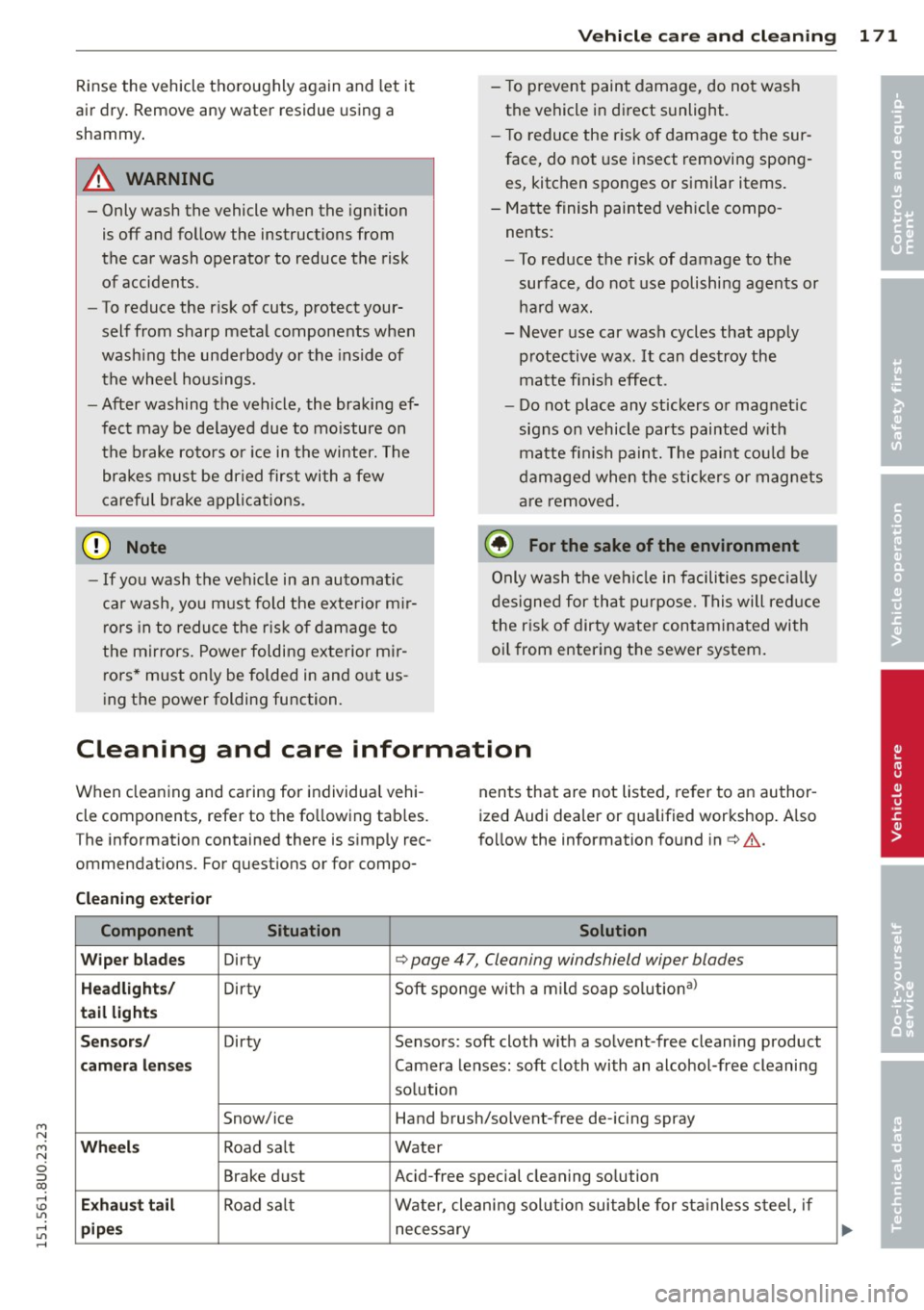
Cleaning exterior
Component Situation Solution
Wiper blades
Dirty Q page 4 7, Cleaning windshield wiper blades
Headlights/ Dirty Soft sponge with
a m ild soap solutiona>
tail lights
Sensors/
Dirty Sensors: soft cloth with a solvent -free cleaning product
camera lenses Camera lenses: soft cloth with an alcohol-free cleaning
solution
Snow/ice Hand brush/solvent-free de-icing spray
Wheels Road sa lt Water
Brake dust Acid-free special cleaning solution
Exhaust tail Road salt Water, cleaning solut ion suitable for stainless steel, if
pipes necessary
•
•
Page 191 of 258
M N M N
0 ::i co
rl I.O
"' rl
"' rl
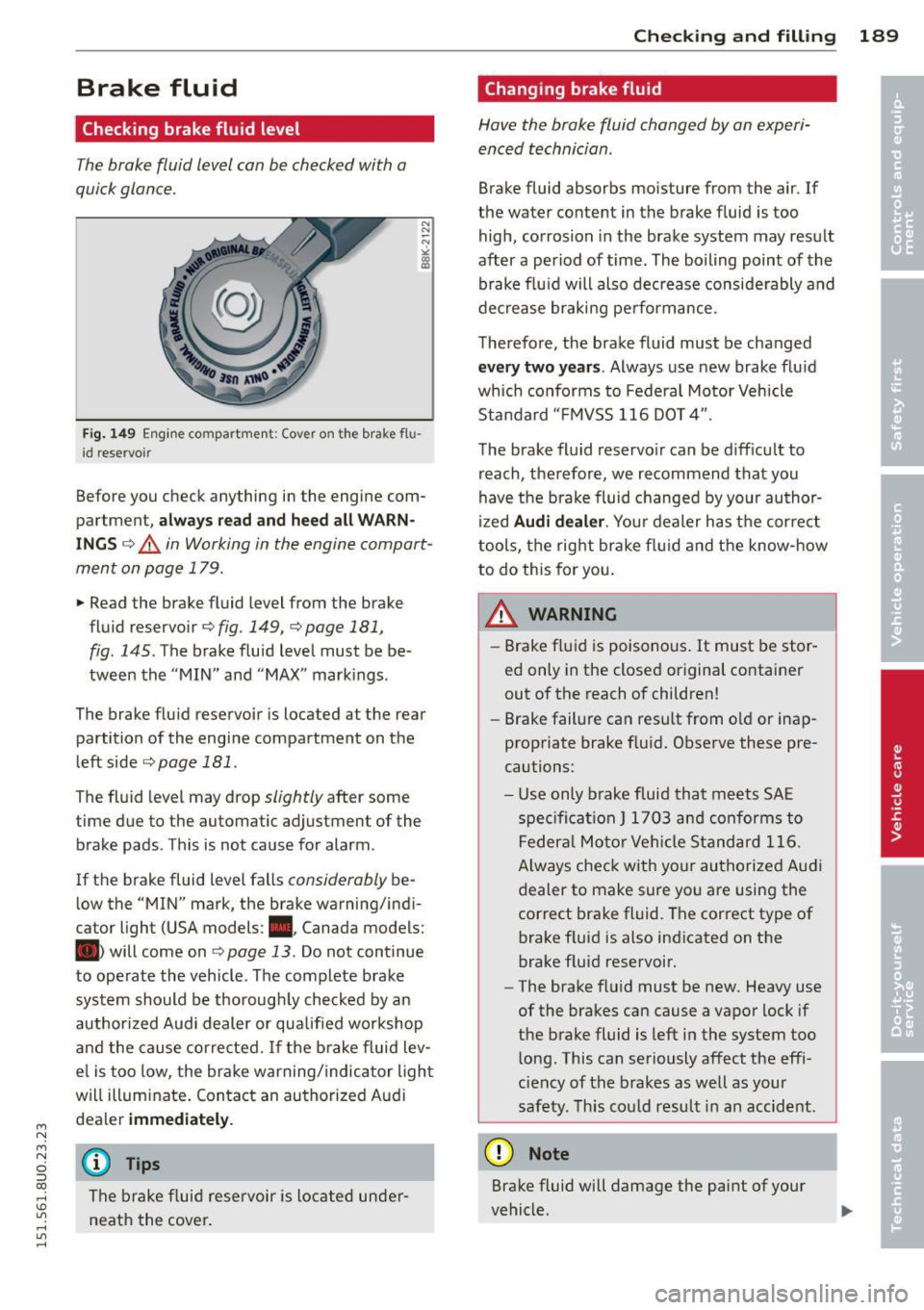
Brake fluid
Checking brake fluid level
The brake fluid level can be checked with a
quick glance.
N
N
;:;;
" 03
"'
Fi g. 149 Eng ine compartment: Cover on the brake flu
id reservoir
Before you check anything in the engine com
partment,
a lwa ys read and heed all WARN
ING S c:> .&.. in Working in the engine compart
ment on page 179 .
~ Read the brake fluid level from the brake
fluid reservoir
c:> fig. 149, <=> page 181,
fig . 145.
The brake flu id level must be be
tween the "MIN" and "MAX" markings.
The brake fluid reservoir is located at the rear
partition of the engine compartment on the
left side <::;>
page 181 .
The fluid level may drop slightly after some
time due to the automatic adjustment of the
brake pads . This is not cause for alarm .
If the brake fluid level falls
considerably be
low the "MIN" mark, the brake warning/indi
cator light (USA models: ., Canada models:
• will come on
<::;> page 13. Do not continue
to operate the vehicle . The complete brake
system should be thorough ly checked by an
author ized Audi dealer or qua lified workshop
and the cause corrected.
If the brake fluid lev
e l is too low, the brake warning/indicator ligh t
will illuminate . Contact an authorized A ud i
dealer
immediately.
@ Tips
The brake f luid reservoir is located under
neath the cover .
Checking and fillin g 189
Changing brake fluid
Have the brake fluid changed by on experi
enced technician.
Brake fluid absorbs moisture from the air. If
the water content in the brake fluid is too
high, corrosion in the brake system may result
after a period of time . The boiling point of the
brake flu id will also dec rease considerably and
decrease braking pe rformance.
Therefore, the brake fluid must be changed
ev ery two years. Always use new brake flu id
which conforms to Federal Motor Vehicle
Standard "F MVSS 116 DOT 4".
The brake fluid reservo ir can be d iff icult to
reach, the refore, we recommend that you
have the brake fluid changed by your author
i zed
Audi d ealer. Your dealer has t he correct
tools, the right brake fl uid and t he know-how
to do this for you .
A WARNING -.
-Brake fluid is poisonous . It must be stor
ed only in the closed original container
out of the reach of children!
- Brake failure can resu lt from o ld or inap
propriate brake f luid. Observe these pre
cautions:
- Use only brake fluid that meets SAE
spe cificat ion
J 1 7 03 and conforms to
Federa l Moto r Ve hicl e Standard 116.
Always check with yo ur authorized Audi
dealer to make sure yo u are using the
correct bra ke fluid. The correct type of
brake f luid is also indicated on the
brake f luid reservoir.
- The brake fluid must be new. Heavy use
of the brakes can cause a vapor lock if
the brake fluid is left in the system too
l ong . This can seriously affect the effi
c iency of the brakes as well as your
safety. This cou ld resu lt in an accident.
(D Note
Brake fluid will damage the paint of your
vehicle .