fuel AUDI Q3 2015 User Guide
[x] Cancel search | Manufacturer: AUDI, Model Year: 2015, Model line: Q3, Model: AUDI Q3 2015Pages: 258, PDF Size: 64.9 MB
Page 31 of 258
M N M N
0 ::i co
rl I.O
"' rl
"' rl
-Do not leave children inside the vehicle
unsupervised. In an emergency it would
be impossible to open the doors from
the outside without the key.
(D Tips
- In the event of a crash with airbag de
ployment all locked doors will be auto
matically unlocked to give access to the
vehicle occupants from the outside .
- If the power lock ing system should mal
function, you can lock the driver's door
using the ign it ion key¢
page 33.
-If the power lock ing system should fail,
you can still open the fuel tank flap in an
emergency
c:> page 178.
- You are well advised not to keep valua
bles inside an unattended vehicle, visible
or not . Even a properly locked vehicle
cannot provide the security of a safe.
- If the LED in the upper edge of the driv
er's door panel comes on for about 30
seconds after the vehicle is locked, there
i s a ma lfunction in the power locking or
the anti-theft warning system. Have the
malfunction corrected by an authorized
Audi dealership or qualified repair facili
ty.
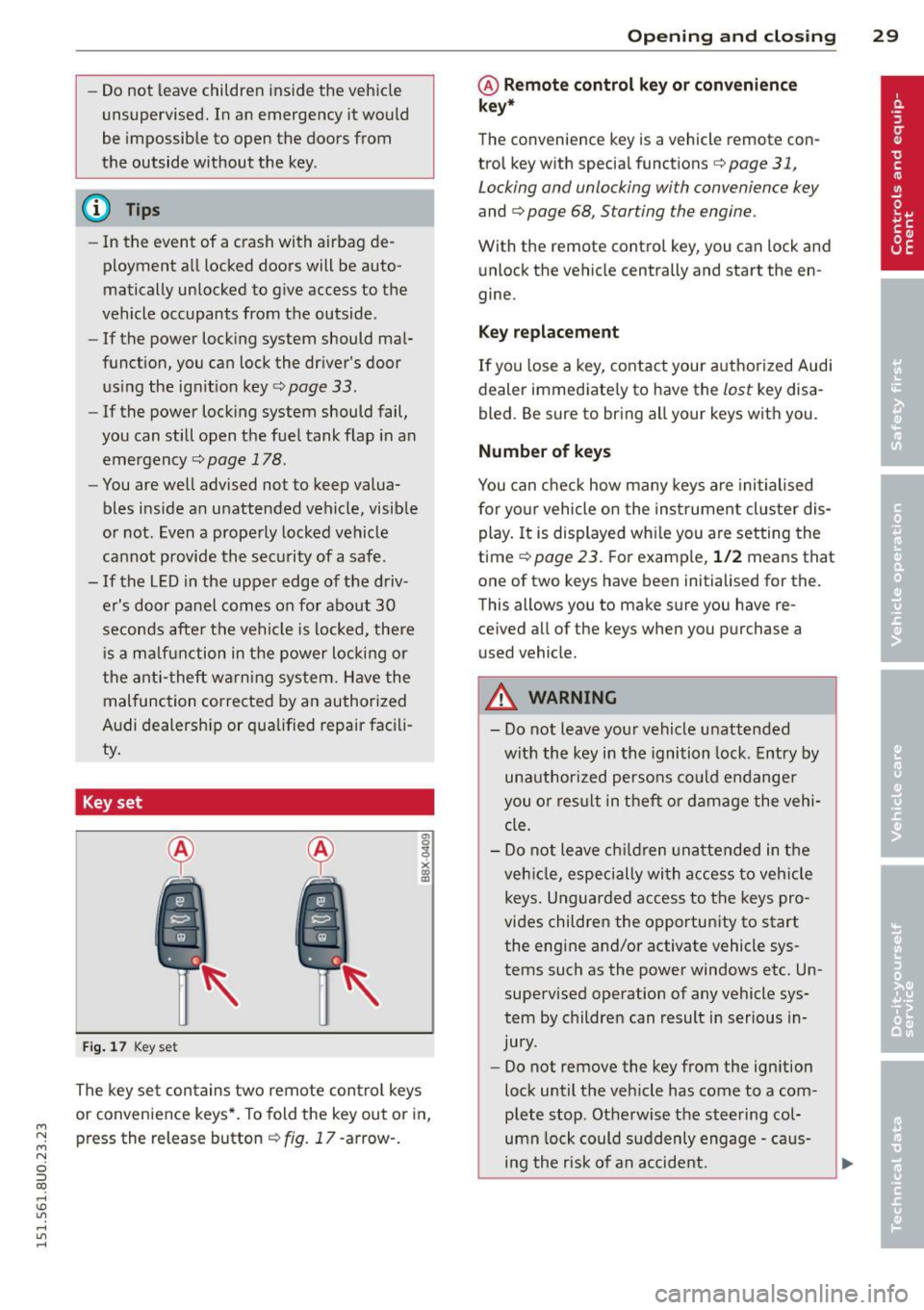
Key set
Fig. 17 Key set
The key set contains two remote control keys
or convenience keys*. To fold the key out or in,
press the release button¢
fig. 17 -arrow-.
Opening and closing 29
@ Remote control key or convenience
key*
The convenience key is a vehicle remote con
trol key with special functions
c> page 31,
Locking and unlocking with convenience key
and c> page 68, Starting the engine.
With the remote contro l key, you can lock and
unlock the vehicle centrally and start the en
gine.
Key replacement
If you lose a key, contact your authorized Audi
dealer immediate ly to have the
lost key disa
bled. Be sure to bring all your keys with you.
Number of keys
You can check how many keys are initialised
for yo ur vehicle on the instrument cluster dis
play. It is displayed wh ile you are setting the
time
c:> page 23. For example, 1/2 means that
one of two keys have been initialised for the.
This allows you to make sure you have re
ce ived all of the keys when you purchase a
u sed vehicle.
A WARNING
--
-Do not leave your vehicle unattended
with the key in the ignition lock. Entry by
unauthorized persons could endanger
you o r result in theft or damage the vehi
cle.
- Do not leave children unattended in the
veh icle, especially with access to vehicle
keys . Unguarded access to the keys pro
vides children the opportunity to start
the engine and/or activate vehicle sys
tems such as the power windows etc. Un
supervised operation of any vehicle sys
tem by children can result in serious in
jury .
- Do not remove the key from the ign ition
lock until the vehicle has come to a com
plete stop. Otherwise the steering col
umn lock could suddenly engage -caus
ing the risk of an accident.
Page 59 of 258
M N M N
0 ::i co
rl I.O
"' rl
"' rl
any clothing with hard, pointed or heavy
objects in the pockets on the coat hooks.
During sudden braking or in an accident -
especially if the airbag is deployed -
these objects could injure any passen
gers inside the vehicle .
- To reduce the r isk of personal injury in an
acc ident or sudden stop, always keep the
glove compartment closed while driving.
- Read and follow all WARNINGS
Q page 129, Important safety instruc
tions on the side airbag system.
- Hang clothes in such a way that they do
not impair the driver's v ision.
- The coat hooks must only be used for
lightwe ight cloth ing . Do not leave any
heavy o r sharp edged objects in the pock
ets which may interfere with the side cur
tain a irbag deployment and can cause
persona l injury in a crash .
- Do not use coat hangers for hanging
clothing on the coat hooks as this can in
terfere with proper dep loyment of the
side curtain airbags in an accident .
- Do not hang heavy objects on the coat
hooks, as they cou ld cause persona l in
jury in a sudden stop.
- Always keep the compartment above the
rearview mirror closed whi le driving to
reduce the risk of injury in the event of
sudden braking maneuvers or a collision.
(D Note
Objects located on the rear shelf that rub
against the rear w indow cou ld damage the
heating wires for the rear window defog
ger.
@ T ips
- A vent slot is located between the shelf
and the rear window. Do not b lock the
vent with any items you may place on the rear window shelf.
- Do not p lace bulky items on the rear w in
dow shelf as they could restrict or b lock
the driver's vis ion in the rear view mirro r.
S ea ts a nd s to rage 57
Description and
mounting locations
Additional cargo can be carried with a roof
luggage rack.
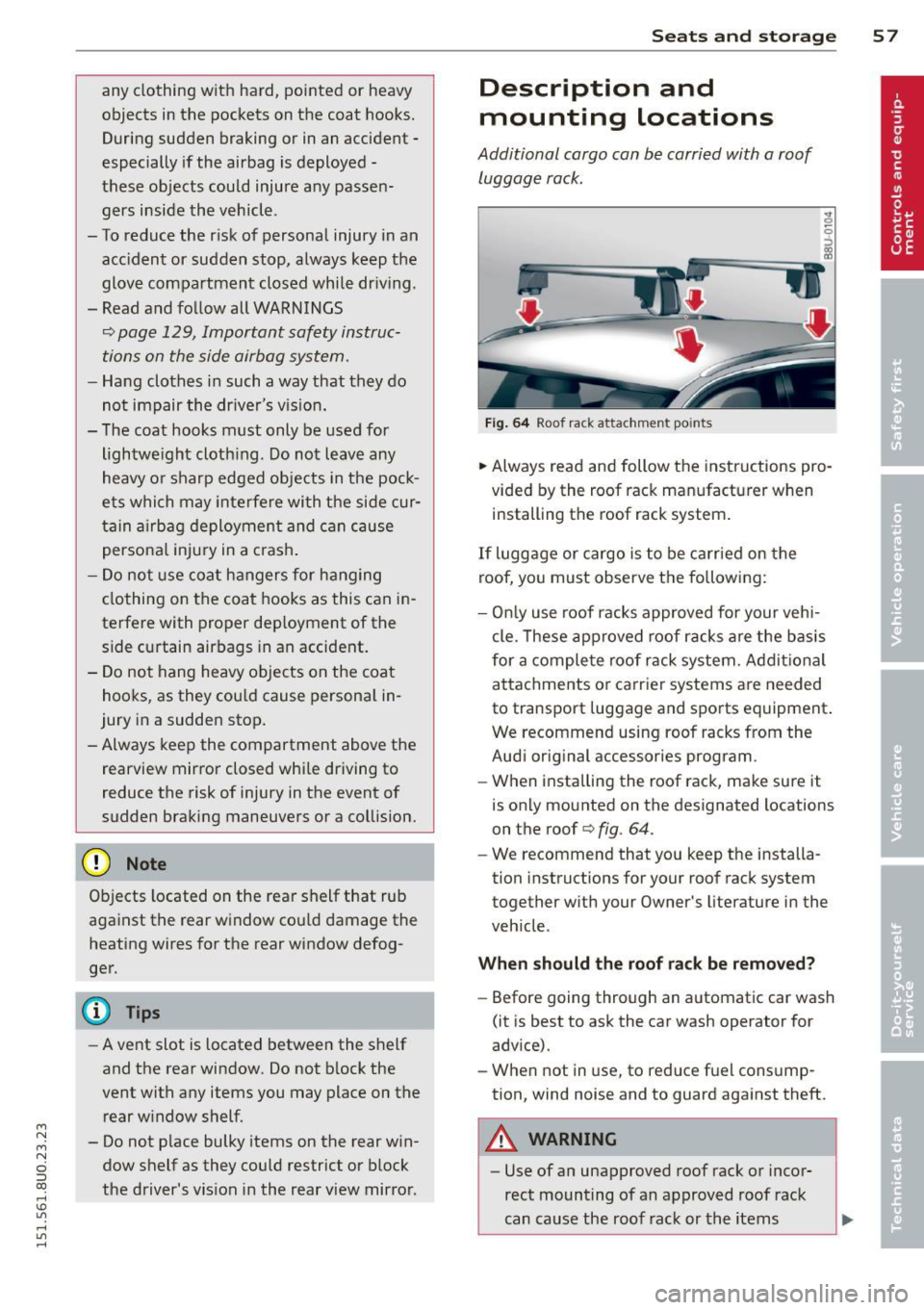
Fig . 64 Roof rack attachment points
.,. Always read and follow the instructions pro
vided by the roof rack manufacturer when
installing the roof rack system .
If luggage or cargo is to be carried on the
roof, you must observe the following:
- On ly use roof racks approved for your vehi
cle. These approved roof racks are the basis
for a complete roof rack system. Additional attachments or carr ier systems are needed
to transport luggage and sports equipment .
We recommend using roof racks from the
Audi original accessories program.
- When installing the roof rack, make sure it
is only mounted on the designated locations
on the roof
Q fig. 64.
-We recommend that you keep the installa
tion instructions for your roof rack system
together with your Owner's literature in the
veh icle .
Wh en sh ould th e roo f rack be re mov ed ?
-Before going through an automatic car wash
(it is best to ask the car wash operator for
advice).
- When not in use, to reduce fuel consump
tion, wind noise and to guard against theft.
A WARNING
-
-Use of an unapproved roof rack or incor-
rect mounting of an approved roof rack
can cause the roof rack or the items
Page 83 of 258
M N
M N
0 ::i co ,...., \!) 1.1'1 ,...., 1.1'1 ,....,
Automatic
transmission
tiptronic
Introduction
The automatic transmission is controlled elec
tronically. The transmission upshifts or down
shifts automatically depending on which drive
program is selected.
When a
moderate driving style is used, the
transmission selects the most economica l
driving mode. It will then change up early and
delay the downshifts to give better fuel econ
omy.
The transmission switches to a sporty mode
after a kick-down or when the driver uses a
sporty driving style characterized by quick ac
celerator pedal movements, heavy accelera
tion, frequent changes in speed and traveling
at the maximum speed.
If desired, the driver can also select the gears
manually
(tiptronic mode) o page 84.
In the tiptronic transmission, power is trans
ferred by a torque converter .
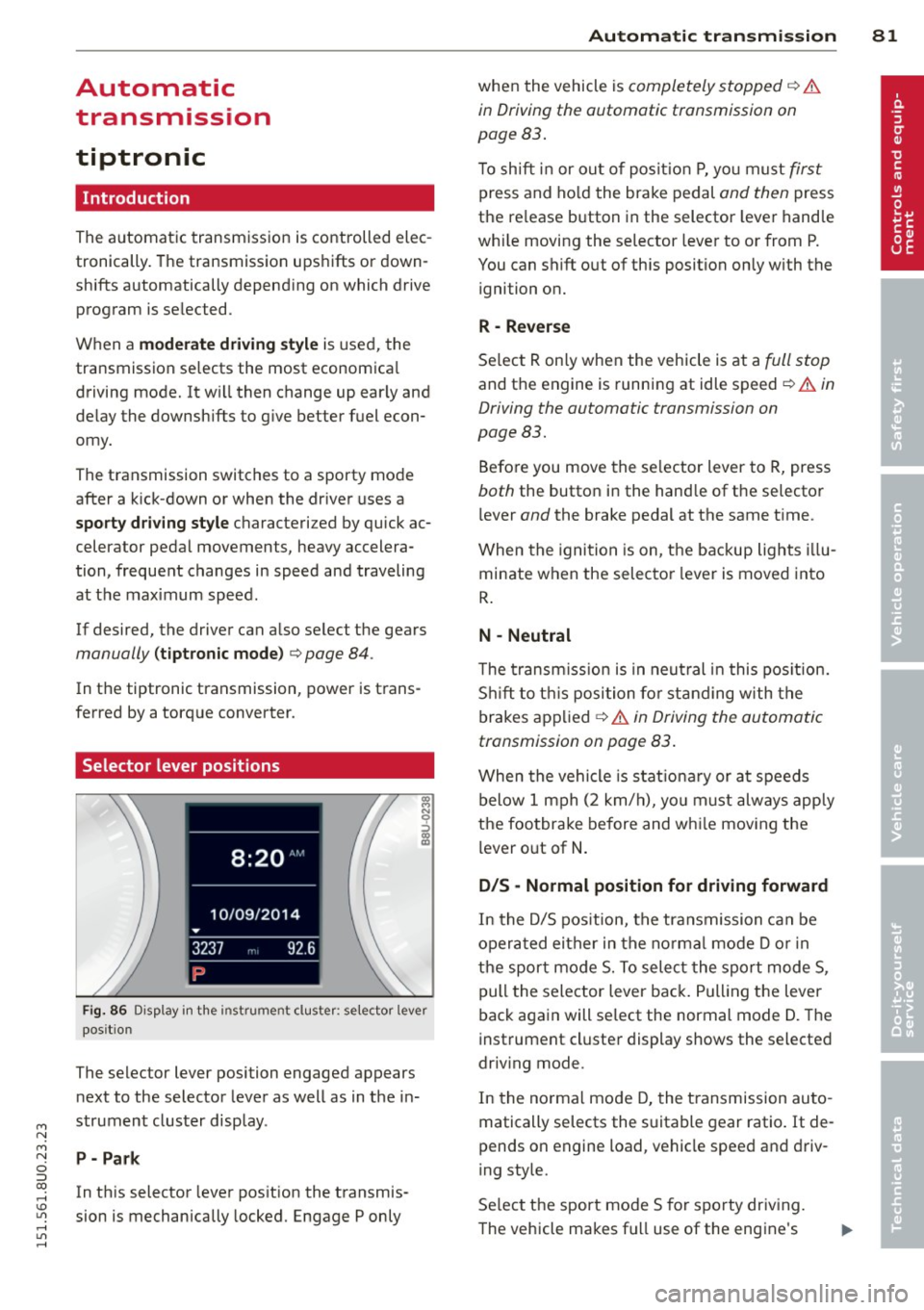
Selector lever positions
Fig. 86 Disp lay in the instru men t clu ster: se lecto r lever
pos it io n
The selector lever posi tion engaged appears
next to the selector lever as well as in the in
strument cluster display.
P- Park
In this selector lever posit ion the transmis
sion is mechanically locked. Engage P only
Automatic transmission 81
when the vehicle is completely stopped q A
in Driving the automatic transmission on
page 83.
T o shift in or out of position P, yo u must first
press and hold the brake pedal and then press
the re lease button in the selector lever handle
wh ile moving the selector lever to or from P.
You can shift out of th is position only with the
ignition on.
R -Reverse
Select R only when the vehicle is at a full stop
and the engine is running at idle speed¢.&. in
Driving the automatic transmission on
page 83.
Before you move the selector lever to R, press
both the button in the hand le of the selector
l ever
and the brake pedal at the same time .
When the ignition is on, the backup lights illu
minate when the selector lever is moved into
R.
N -Neutral
The transmission is in neutral in this position.
Shift to this position for standing with the
brakes applied
q A in Driving the automatic
transmission on page 83.
When the vehicle is stat ionary or at speeds
below 1 mph (2 km/h), you must always apply
the footbrake before and whi le moving the
lever out of
N.
D/S -Normal position for driving forward
In the D/S position, the transmission can be
operated either in the norma l mode D or in
the sport mode S. To select the sport mode S,
pull the selector lever back. Pulling the lever
back again will select the normal mode D. The
instrument cluster display shows the selected
driv ing mode .
In the normal mode D, the transmission auto
matically selects the suitable gear ratio. It de
pends on engine load, vehicle speed and driv
ing style.
Select the sport mode S for sporty driving.
The vehicle makes fu ll use of the engine's
Page 163 of 258
M N
M N
0 ::i co ,...., \!) 1.1'1 ,...., 1.1'1 ,....,
Driving and
environment
The first 1
1000
miles
(11500 km) and
afterwards
New engine
The engine needs to be run-in during the first
1,000 miles (1 ,500 km) .
For the first 600 mile s (1,000
kilometers ):
.,. Do not use full throttle.
.,. Do not drive at engine speeds that are more
than
2/3 of the max imum permitted RPM .
From 600 to 1 ,000 miles (1,000 to
1,500 kilometers ):
.. Speeds can gradually be increased to the
maximum perm iss ible road or eng ine speed .
During and after br eak-in period
.. Do not rev the eng ine up to h igh speeds
when it is cold. Th is applies whether the
transmission is in N (Neutral) or in gear.
Afte r the break- in peri od
.. Do not exceed max imum eng ine speed un
der any circumstances .
.. Upshift into the next higher gear
before
reaching the red area at the end of the tach
ometer scale
c.> page 10.
During the first few hours of driving, the en
g ine's interna l friction is higher than later
when all the moving parts have been broken in . How well this break -in process is done de
pends to a considerable extent on the way the
ve hicl e is driven du ring the first 1,000 miles
(1,500 k ilome ters).
(D Note
Extremely h igh engine speeds are auto
mat ica lly reduc ed. However , th ese rpm
lim its are programmed for a n engine well
r u n- in, not a new engine.
Driving and environment 161
@) For the sake of the environment
Do not drive with unnecessarily high en
g ine speeds - upshifting ear ly saves f uel,
reduces noise and protects the environ
ment.
New tires
If your vehicle is running on new tires, drive
very carefully for the first 350 miles (500 ki lo
meters) after fitting.
.&, WARNING
N ew tires tend to be sl ippery and mus t al
so be "b roken -in" . Be sure to remember
this dur ing the f irst 350 m iles (500 kilo
meters) . Brake gently . Avoid fo llowing
closely behind other vehicles or other sit
uations that m ight require sudden, hard
b raking .
Avoid damaging the
vehicle
When you are d rivi ng on poo r roads, or over
cu rbs, steep ramps, etc., make certa in that
low- ly in g parts s uch as spo ile rs and ex ha ust
system parts do not bottom o ut and get dam
aged.
Th is is espec ially true for veh icles with low
s lung chassis (spo rts chas sis)* and fully load
ed vehicles.
Catalytic converter
It is very important that your emission con trol system (catalytic converter) is function
ing properly to ensure that your vehicle is run
ning in an environmentally sound manner.
.. Always use lead -free gasoline c'.> page 175,
Fuel supply .
.. Never r un the tank down all the way to emp
ty.
.. Never put too much motor o il in your engine
c.> page 184, 'l::1: Adding engine oil .
.. Never try to push -or tow-sta rt you r vehicle . I),
•
•
Page 164 of 258

162 Driving and en vironm ent
The cata lytic converter is an efficient "clean
up" device built into the exhaust system of
the veh icle. The catalytic converter burns
many of the pollutants in the exhaust gas be
fore they are released into the atmosphere.
The exclusive use of unleaded fuel is critically
important for the life of the catalytic convert
er and proper functioning of the engine.
A WARNING
-The temperature of the exhaust system
is high, both when driv ing and after stop
ping the engine.
- Never touch the exhaust tail p ipes once
they have become hot. This could result
in burns .
- Do not park or operate the veh icle in
areas where the hot exhaust system may
come in contact with dry grass, brush,
fuel spill or other material which can
c ause a fi re.
- Do not apply additional undercoating or
rustproofing on o r near the exhaust
man ifold, exhaus t pipes, catalytic con
verte r o r heat shie lds. D uring driving, the
substance used for undercoating cou ld
overheat and cause a fire.
(D Note
- Be aware th at just one tank fi lling with
leaded fue l will already seriously de
grade the performance of the catalytic
conve rter .
- Do not exceed the correc t engine oil leve l
~page 184.
-Do not drive un til the fue l tank becomes
completely empty . The engine could mis
fire. Unburned f uel could a lso get into
the exhaust system and this could cause
the catalyt ic converter to overheat.
- Do not turn off the ignit ion while the ve
hicle is moving.
- Do not continue to operate yo ur vehicle
u nder these conditions , as otherw ise fuel
can reac h the catalytic converter. This
could result in overheat ing of the con
verter, requ iring its replacement. -
To assu re efficient operation of the Emis
sion Control System :
- Have your vehicle maintained properly and in accordance w ith the service rec
ommendat ions in your Warranty &
M ain tenance book let.
- L ack of prope r maintenance as we ll as
i mproper use of t he vehicle wi ll impair
the function of the em ission cont ro l
sys tem an d could lea d to damage.
~ For the sake of the environment
Eve n when the Emiss io n Control System is
ope rat ing proper ly, the exha ust gas c an
have a sul fur- like ex haust gas smell under
some ope rat ing states . This depends on
the sulfur content of the fuel being used. Using a different brand of fue l may help,
or f illing the tank with lead-free super
grade gasoline.
Shutting down vehicle
If you would like your vehicle to remain inop
erative for a longer per iod of time, contact an
Audi or other specialized dealer. They can ad
vise you on necessary precautions e .g . corro
s ion p revention, maintenance and sto rage .
Pay attent ion to additional info rmat io n con
ce rn in g the battery. Refe r to~
page 190.
Operate your vehicle
economically and
minimize pollution
Gene ral
Your personal style of driving will determine
the economy of your vehicle, as well as ex
haust and noise levels .
Fuel economy, e nvir onme nta l impact, and
we ar on your eng ine, b rakes and tires la rgely
depend on three fac to rs:
- your personal driving style
- operati ng conditions
- technical limitations
Page 165 of 258
M N
M N
0 ::i co ,...., \!) 1.1'1 ,...., 1.1'1 ,....,
If you anticipate what you need to do next and
drive economically, you can easily cut your
fuel consumption by 10-15 percent. This sec
tion will give you some tips on how you can help the environmen t and your pocketbook.
The consumption estimates as published by ENVIRONMENTAL PROTECTION AGENCY
(EPA) and Transport Canada may not corre
spond to your actual consumption on the
road, wh ich will vary depend ing upon vehi
cle load and speed, road and weather con
ditions, tr ip length, etc.
Drive smoothly and keep a lookout
ahead
Vehicles use the most fuel when they are ac
celerating.
.,. Avoid unnecessa ry accelerating and braking.
Vehicles use the most fuel when they are ac
celerating . If you anticipate what is go ing to
happen next, you will need to brake less and,
thus , accelerate less. Let the vehicle coas t
whenever poss ible -for example when you see
that the next traffic light is red.
Avoid full throttle
Driving at moderate speeds saves fuel and
improves your mileage.
.,. Try and keep well be low your car's max imum
speed.
Accelerating gently reduces fuel consump
tion, engine wear, and does not disturb the
environment. Fue l consumption, exhaust emissions and en
g ine no ise increase d isproportionately at high
speeds . If you dr ive at approximately three
qua rters of top speed, fue l consumption will
be red uced by one half. Never dr ive faste r
than the posted speed limi t and wea ther con
ditions permit.
Dri vin g and en vironm ent 163
Reducing unnecessary idling
Even when your car is just idling it burns up
fuel .
.,. Shut the engine off when you are not driving
the vehicle .
.,. Do not warm up the vehicle by lett ing the
eng ine run at idle .
It makes sense to shut off the engine in traffic
jams, when wa it ing for tra ins to pass at rail
road crossings, or at t raff ic lights that have
l ong waits on red . T u rning the eng ine off for
just 30-40 seconds saves mo re fuel tha n is
bur ned star ting the engine again.
It takes a long t ime for the engine to warm up
fully when it is runn ing at id le. However, wear
and noxious emissions are especia lly hig h
when the eng ine is wa rm ing up. So yo u shou ld
drive away as soon as yo u start the engine and
avoid r unning at high rpms whi le the engine is
still warming up.
(D Note
D o not leave engine idling unattended af
ter starting. If warning lights sho uld come
on to indicate improper operation, they
would go unheeded. Extended idling also produces heat, w hich could res ult in over
heating or other damage to the veh icle or
other p roperty .
Regular maintenance
A badly tuned engine unnecessarily wastes a
lot of fuel .
.,. Have you r veh icle serviced at regu lar inter-
vals.
By having your ve hicle reg ularly serviced by an
a uthorized Audi dea le r helps to ensure that it
runs properly and econom ica lly. The cond ition
of your veh icle not only affects its safety and
ability to ho ld its va lue, it a lso affects
fuel
con sumption .
Chec k your o il each t ime you fill your tank.
Ill-
•
•
Page 166 of 258
164 Driving and en vironm ent
The amount of oil used is related to eng ine
load and speed.
I t is normal for the oil consumption of a new
engine to reach its lowest val ue after a certain
mileage has been driven.
You must drive your vehicle about 3 ,000 miles
(5,000 kilometers) before you can properly
assess o il cons umption .
This a lso applies to fuel consumption and en
g ine output .
0 Note
-Have your vehicle maintained properly
and in accordance with the service rec
ommendations in your War ranty
& Main
tenance booklet. Lack of proper mainte
nance as well as imp roper use of the ve
hicle will impair the function of the
emission control system and could lead
to damage.
- Do not a lter or remove any component of
the Emi ssion Contro l System unless ap
proved
by the manufacturer.
- Do not a lter or remove any device, such
as heat shields, switches, ignition wires,
va lves, which are designed to protect
your vehicle's Emiss ion Control System
and other important veh icle compo
nents .
Fewer short trips
Fuel consumption will always be relatively
high on short trips .
• Try to avo id driving sho rt distances with a
cold eng ine.
The engine and catalytic converter have to reach their optimal
ope rating tempe ratu re to
reduce fuel con sumption and noxious emis
sions effect ively.
Just after starting, a cold engine in a mid-size car on ly achieves a fuel economy of 6-8 miles
per gallon (30-40 l/100 km) . After about a
half a m ile, fuel economy climbs to 12 mpg
(20 l/100 km) . After about
2. 5 miles (4 km), the engine is at its proper operating tempera
ture and fuel economy has reached a normal
l evel. So you can see that you should avo id
short trips whenever possible.
T he
out sid e tempe rature is also critical in this
regard . Your car consumes more fue l in the
winter than in the s ummer.
Driving offroad
General information
When driving off road, the functions fo r the
electron ic stabiliza tion control ( ESC) are ex
panded . The ESC-Offroad-Mode can be activat
ed in driving situations in which a wheel lock
or a differential lock function is needed
c> page 155.
Your Audi i s howev er, n ot an offroad vehicle.
Ne ver dri ve the vehicle in te rrain wh ich i s n ot
suitable for the vehicle , o r w hich ex ceeds
y ou r driv ing skill s. Ne ver tak e an y u nneces
s ar y risk s!
Aft er d riving offroad
-After driving offroad, remove branches and
other debris from the radiator gri lle, under
body, and wheels. Look especially for objects
(stones) that have been caught in the tire
tread.
- Clean the body and the vehicle underbody
and inspect the vehicle for possible damag
es.
- Clean off the dirty windows, headlights, tail
lights and the license plate .
- Pe rform a brake test (especially after driving
through water).
A WARNING
- Be especially aware and attent ive when
driving under difficult condit ions . Dam
ages to the vehicle and injur ies may oc
cur when driv ing at an excessively high
speed or with incor rect driving maneu
vers.
- Always adjust you r speed and hand ling
to the roads, terrain, t raff ic and weather
~
Page 174 of 258
172 Vehicle care and cleaning
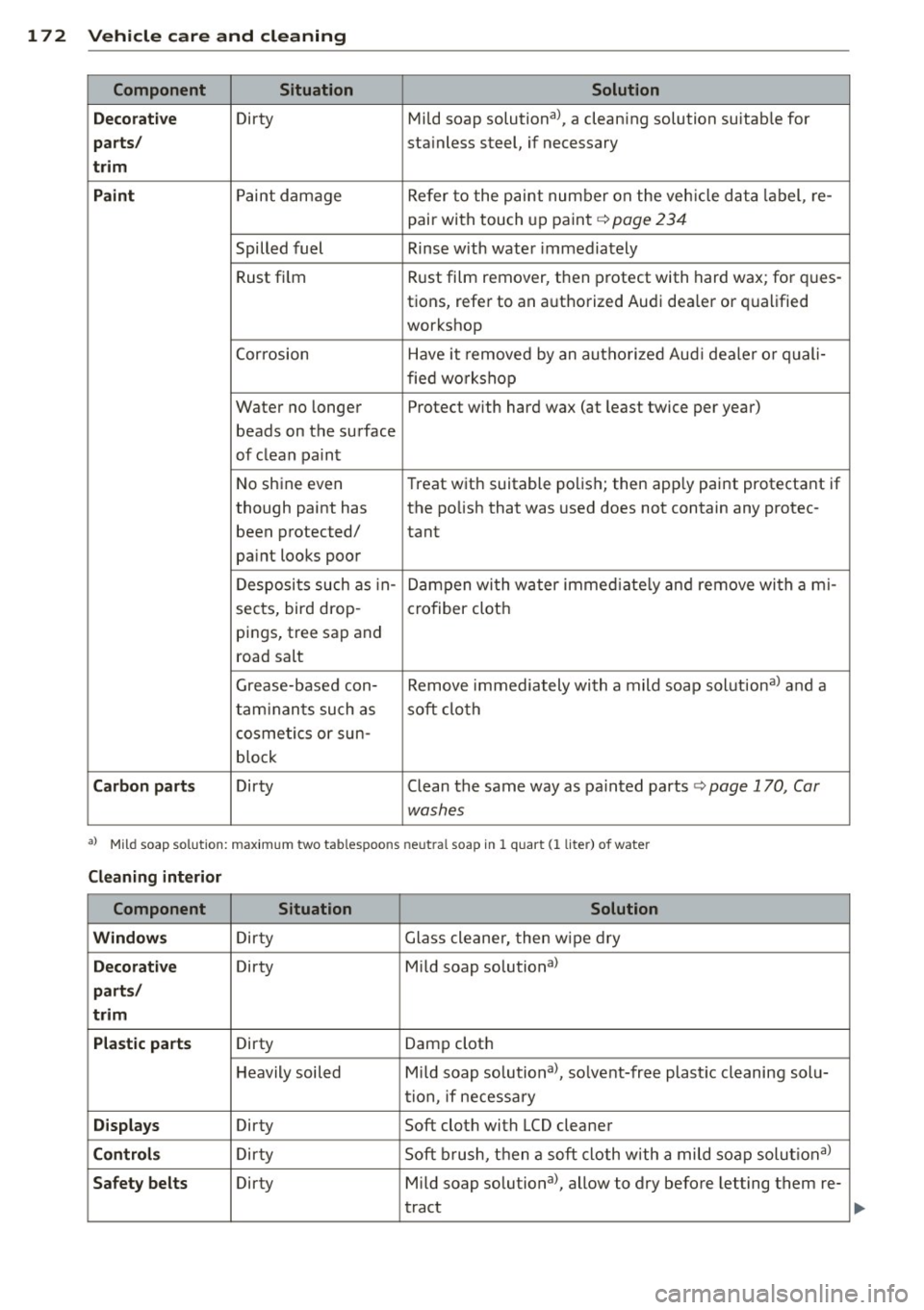
Component Situation Solution
Decorative
Dirty Mild soap solutional, a cleaning solution suitab le for
parts/ sta inless steel, if necessary
trim
Paint
Paint damage Refer to the paint number on the vehicle data label, re-
pair with touch up paint¢
page 234
Spilled fuel Rinse with water immediately
Rust film Rust
film remover, then protect with hard wax; for ques-
tions, refer to an authorized Audi dea ler or qualified
workshop
Corrosion Have it removed by an autho rized Aud i dealer or quali-
fied workshop
Water no longer Protect with hard wax (at least twice per year)
beads on the surface
of clean paint
No shine even T
reat with suitable polish; then app ly paint protectant if
though paint has the polish that was used does not contain any protec-
been protected/
tant
pa int looks poor
Desposits such as in- Dampen with water immed iate ly and remove with a mi-
sects, bird drop- crofiber cloth
pings, tree sap and
road salt
Grease-based con- Remove immediately with a mild soap solutiona> and a
taminants such as soft cloth
cosmetics or sun-
block
Carbon parts Dirty Clean tlhe same way as pa inted parts ¢ page 170, Car
washes
a l Mi ld soap so lution: maximum two tab lespoons neut ra l soap in 1 quart (1 lite r) of water
Cleaning interior
Component Situation Solution
Windows
Dirty Glass cleaner, then wipe dry
Decorative Dirty Mild soap solutional
parts/
trim
Plastic parts
Dirty Damp cloth
Heavily soiled Mild soap solutional, solvent-free plast ic cleaning solu-
t ion, if necessary
Displays Dirty Soft cloth with LCD cleaner
Controls Dirty Soft brush, then a soft cloth with a mild soap solutiona>
Safety belts Dirty Mild soap solutional, allow to dry before letting them re-
tract
Page 177 of 258
M N
M N
0 ::i co ,...., \!) 1.1'1 ,...., 1.1'1 ,....,
Fuel supply and filling
your f uel tank
Gasoline
Fuel supply
Using the right fuel helps keep the environ
ment clean and prevents engine damage.
Fuel recommendation
The fuel recommended for your vehicle is un
leaded premium
grade gasoline. Audi recom
mends using TOP TIER Detergent Gasoline
with a minimum octane rating of 91 AKI (95
RON) . For more information on TOP TIER De
tergent Gasoline, please go to the official
website (www.toptiergas.com).
The recommended gasoline octane rating for
your engine can also be found on a label locat
ed on the inside of the fuel filler flap. This rat
ing may be specified as AKI or RON.
Your vehicle may also be operated using un leaded regular gasoline with a minimum oc
tane rating of 87 AKI/91 RON. However, using
87 AKI/91 RON octane fuel will slightly re
duce engine performance.
Use unleaded gasoline only. Unleaded gaso
line is available throughout the USA, Canada,
and in most European countries. We recom
mend that you do not take your vehicle to
areas or countries where unleaded gasoline
may not be available.
For more information on refueling your vehi
cle, see~
page 176.
Octane rating
Octane rating indicates a gasoline's ability to
resist engine damaging "knock" caused by
premature ignition and detonation. Therefore,
buying the correct grade of gasoline is very
important to help prevent possible engine
damage and a loss of engine performance.
Gasoline most commonly used in the United
States and Canada has the following octane ratings that can usually be found on the filler
pump:
Fuel supply and filling your fuel tank 175
- Premium Grade: 91 -96 AKI
- Regular Grade: 87 -90 AKI
Explanation of the abbreviations:
AKI = Anti Knock Index= (R+M)/2 = (RON
+MON)/2
RON= Research Octane Number
MON= Motor Octane Number.
@ Note
-Do not use any fuel with octane ratings
lower than 87 AKI or 91 RON otherwise
expensive engine damage will occur.
- Do
not use leaded gasoline. The use of
leaded gasoline will severely damage
your vehicle's catalytic converter and its
ability to control exhaust emissions.
Blended gasoline
Use of gasoline containing alcohol or
MTBE (methyl tertiary butyl ether)
You may use unleaded gasoline blended with
alcohol or MTBE (commonly referred to as
oxygenates) if the blended mixture meets the
following criteria:
Blend of gasoline methanol (wood alcohol or
methyl alcohol)
- Anti-knock index must be 87 AKI or higher.
- Blend must contain no more than 3% meth-
anol.
- Blend must contain more than 2% co-sol-
vents.
Blend of gasoline and ethanol (grain alcohol
or ethyl alcohol)
- Anti-knock index must be 87 AKI or higher.
- Blend must not contain more than 15%
ethanol.
Blend of gasoline and MTBE
- Anti-knock index must be 87 AKI or higher.
- Blend must contain not more than 15%
MTBE.
Seasonally adjusted gasoline
•
•
Page 178 of 258
176 Fuel suppl y and fillin g your fu el tank
Many gaso line grades are blended to perform
especially we ll for winter or summer driving.
During seasonal change-over, we suggest that
you fill up at busy gas stations where the sea sonal adjustment is more likely to be made in
time.
@ Note
- Methanol fuels which do not meet these
requirements may cause corrosion and
damage to plastic and rubber compo
nents in the fuel system.
- Do not use fuels that fail to meet the
spec ified criter ia in this chapter .
- If you are unable to determine whether
or not a particular fuel blend meets the
spec ificat ions, ask your service station o r
i ts fuel supplier .
- Do not use fuel for wh ich the contents
cannot be identified .
- Fuel system damage and performance
problems resulting from the use of fuels
different from those specified are not
the respons ibility of Audi and are not
covered under the New Ve hicle or the
Emission Control System Warranties.
- If you experience a loss of fue l economy
or driveabil ity and performance prob
l ems due to the use o f one of these fuel
blends, we recommend that you switch
to unblended fuel.
Gasoline additives
A major concern among many auto manufac
turers is carbon deposit build-up caused by
the type of gasoline you use .
A lthough gasoline grades diffe r from one
manufac turer to another, they have certa in
things in common. All gasoline grades contain
substances that can cause depos its to collect
on vital engine parts, such as fuel injectors
and intake valves . Although most gasoline
b rands include additives to keep eng ine and
fuel systems clean , they are not eq ua lly effec
tive. Audi recommends using
TOP TIER Detergent
Gasoline . For more information on TOP TIER
Detergent Gasoline, please go to the official
website (www.toptiergas .com) .
After an extended period o f using inadeq uate
fuels, built-up carbon deposits can rob your engine of peak performance.
(D Note
- Damage or malfunction due to poor fuel
quality is not covered by the Audi New
Vehicle Limited Warranty .
- Do not add afte rmarket fuel additive
produc ts to your f uel tank .
Fuel tank
Fuel filler neck
The fuel filler neck is located on the right rear
s ide panel behind the fuel filler flap.
If the power locking system should fail, you
can still open the flap manually -for detailed
instruct ions see o page 178.
You can find the fuel tank capacity of your ve
hicle in
o page 235 .
The label on the inside of the f uel fi ller flap
te lls you the correct fue l for your vehicle. For
more information about fue l specifications,
see
c:;, poge 175.
Your vehicle fue l tank has an on -board refuel
ing vapor recovery system . This feature helps
to prevent fuel vapors from escaping from the
tank and pollut ing the environment while you
refuel your vehicle. In order to fill the tank
properly while protecting the environment,
please follow this refueling procedure careful
ly.
.&_ WARNING
Under normal operating cond itions, never
carry addit ional fue l conta iners in your car .
Gas canisters and other conta iners used to
transport f uel can be dangero us. Such con-
tainers, fu ll or empty, may leak and could ..,.