fuel AUDI Q3 2015 Owner's Manual
[x] Cancel search | Manufacturer: AUDI, Model Year: 2015, Model line: Q3, Model: AUDI Q3 2015Pages: 258, PDF Size: 64.9 MB
Page 179 of 258

M N M N
0 :::i co
rl I.O
"' rl
"' rl
cause a fire in a co llision. If you must
transport fue l to use for yo ur lawn mowe r,
snow blower, etc., be very careful and al
ways observe local and state laws regard
ing the use, transportat ion and storage of
such fuel containers . Make certain the con
t ainer meets industry standards (ANSI/
AS TM F 852 -86).
(D Note
Never drive yo ur vehicle unt il the fuel tank
is completely empty . The irregular supp ly
of fuel can cause misfi ring. Gasoline could
enter the exhaust system and damage the
catalyt ic converte r.
Refueling
Fig. 140 Rig ht rea r veh icle s ide: Opening t he fuel f iller
fl ap
Fi g. 14 1 Fu el filler fla p with attach ed fu el c ap
When activating the central locking, the fuel
f ill er flap is automatically unlocked or locked .
Refue l the vehicle with the ignition turned
off.
Tak ing th e fuel cap off
• Press the left side of the fue l filler flap to
open it ¢
fig . 140 -arrow- .
• Unscrew fuel cap counter-clockwise and
hang it on the fuel f iller flap ¢
fig. 141.
Fuel suppl y and filling your fuel t ank 17 7
Refueling procedure
• Insert the fuel nozzle from the gasoline
pump into the fuel fi ller neck as far as it wi ll
go .
• Select a medium refueling rate so that the
no zz le switches off automatically when the
tank i s full .
Putting th e fuel cap bac k on
• After filling your tank, twist the fuel cap
clockw ise as far as it will go .
• Close the fue l filler flap.
T o avoid fuel spill ing or evaporating from the
fuel tank always close fuel cap properly and
completely . An improper ly closed fuel filler
cap may also cause the MIL lamp ¢
page 26
to come on.
A WARNING
Improper refue ling or handling of fuel can
cause fire, explosion and severe burns.
- Fuel is highly flammable and can cause
severe burns and other injur ies .
- Failure to shut the engine off while refu
eling and/or to insert the pump nozzle
fully into the fuel filler neck could cause
fue l to spray out of filler neck or to over
flow. Fue l spray and overflowing fuel can
cause a fire .
- Never use a ce llu lar telephone while re
fue ling. The electromagnet ic rad iation
can cause sparks that can ignite f uel va
pors and cause a fire.
- Never get back into yo ur vehicle while re
fuel ing.
If in excep tional circumstances
you must get back in your vehicle while refueling, make certain that you close
the door and touch metal to discharge static electricity before touching the fill
er nozzle again . Static electr icity can
cause sparks that can ignite fuel vapors
released during refueling.
- Never smoke or have an open f lame any
where in or near your veh icle when refu
eling or filling a portab le fuel conta iner .
- For your safety, we strongly recommend
that you do not t ravel with a portable
Page 180 of 258
1 78 Fuel supply and filling your fuel tank
fuel container in your vehicle. The con
tainer, full or empty may leak and could
cause a fire, especially in a crash.
- If, under exceptional circumstances, you
must transport a portable fuel container,
please observe the following:
- Never fill a portable fuel container
while it is anywhere in or on the vehicle
(for example, in the luggage compart
ment, or on the trunk). Static electrici
ty can build up while filling and can ig nite fuel vapors causing a fire .
- Always place a portable fuel container
on the ground before filling.
- Always keep the filler nozzle complete
ly inside the portable container before
and during filling.
- If filling a portable container made of
metal, the filler nozzle must always be in contact with the container. This will
help prevent static electricity from dis
charging and cause a fire.
- Never spill fuel inside the vehicle or
luggage compartment. Fuel vapors are
highly flammable.
- Always observe local and state/provin
cial laws regarding the use, storage
and transportation of fuel containers .
- Make certain the fuel container meets
industry standards (ANSI/ ASTM
F8S2 -86) .
d) Note
If any fuel has spilled onto the car, it
should be removed immediately to prevent
damage to the paint .
@ For the sake of the environment
As soon as the correctly operated nozzle
switches off automatically for the first
time, the tank is full. Do not try to add more fuel because fuel may spill out. In
addition, the expansion space in the fuel
tank will be filled -causing the fuel to
overflow when it becomes warm and pol
lute the environment.
(D Tips
- Running your engine while refueling may
cause vapors to escape or even cause
fuel to spill out of the tank. This would
then shut off the fuel nozzle before the
tank is full .
- Do not refuel your vehicle with the igni
tion turned on. The fuel gauge may oth erwise not indicate the correct fuel level
after refueling .
- The fuel filler flap of your vehicle is not
locked when you lock the vehicle from
the inside .
Unlocking the fuel filler flap
by hand
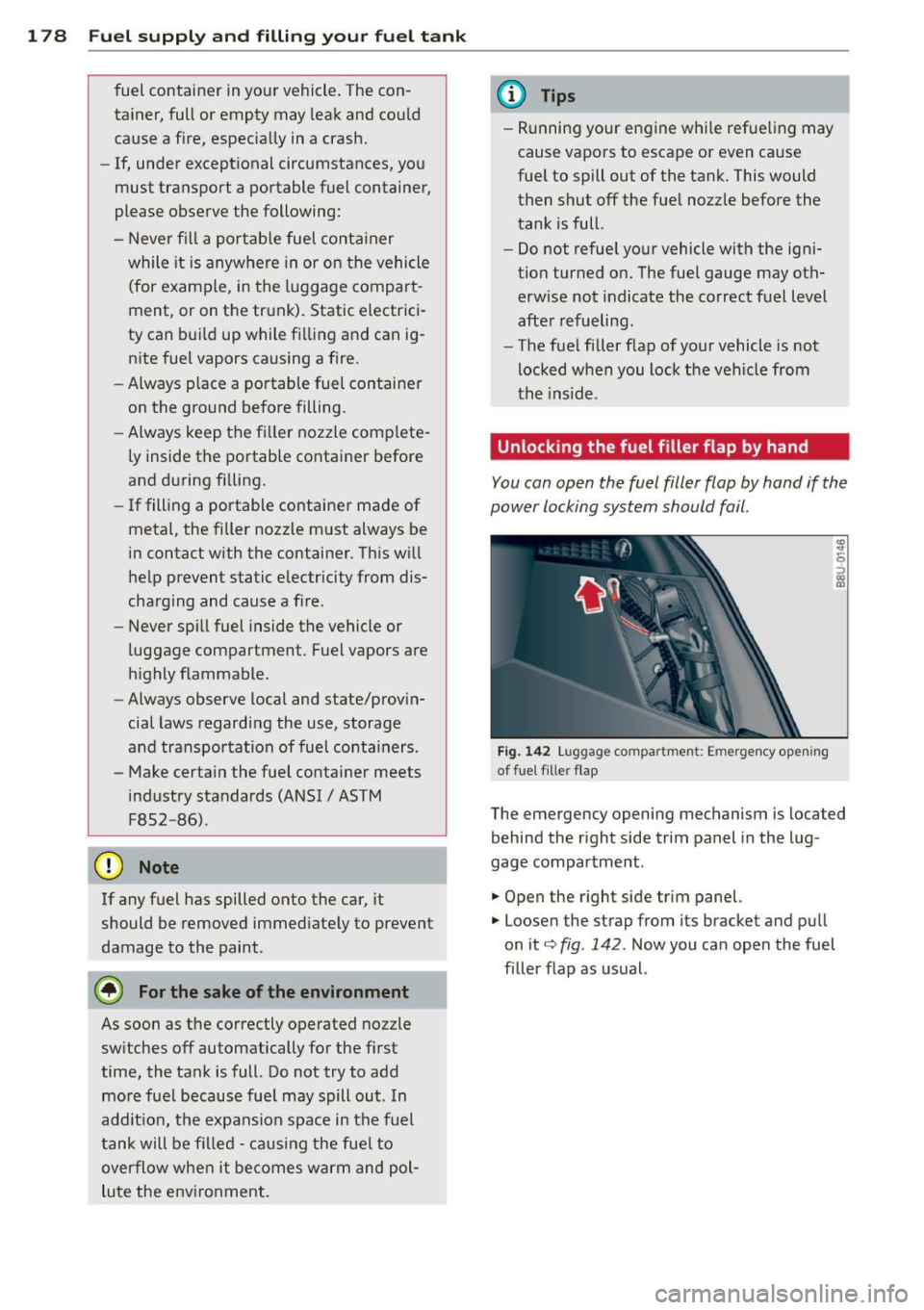
You can open the fuel filler flap by hand if the
power locking system should fail.
Fig. 142 L uggage compart men t: E mergency opening
o f fuel fille r flap
The emergency opening mechanism is located
behind the right side trim panel in the lug
gage compartment .
.,. Open the right side trim panel.
.,. Loosen the strap from its bracket and pull
on it
r::';> fig. 142 . Now you can open the fuel
filler flap as usual.
Page 182 of 258
180 Checking and filling
coolant can be seen or heard before
carefully opening the hood.
- Keep children away from the engine com
partment.
- Never spill fluids on hot engine compo
nents. They can cause a fire.
- Never touch the radiator fan. The auxili ary electric fan is temperature controlled
and can switch on suddenly.
- Never open the coolant reservoir cap
when the engine is still warm. The cool
ant system is pressurized and hot cool
ant could spray out .
- Protect your face, hands and arm from
steam or hot engine coolant by placing a
thick rag over the cap when you open the
coolant reservoir .
- Do not remove the engine cover under
any circumstances. This increases the
risk of burns.
- If work on the fuel system or the electri
cal system is necessary:
- Always disconnect the battery .
- Never smoke or work near heaters or
open flames. Fluids in the engine com
partment could start a fire.
- Keep an approved fire extinguisher im
mediately available.
- To avoid electrical shock and personal in
jury while the engine is running or being
started, never touch:
- Ignition cables
- Other components of the high voltage
electronic ignition system.
- If you must perform a check or repair
with the engine running:
- First, fully apply the parking brake,
move selector lever of automatic trans
mission to "P" (Park) .
-Always use extreme caution to prevent
clothing, jewelry, or long hair from get- ting caught in the
radiator fan, V-belts
or other moving parts, or from contact
ing hot parts. Tie back hair before
starting, and do not wear clothing that
will hang or droop into the engine .
- Minimize exposure to emission and
chemical hazards
c> A .
A WARNING
-California Proposition 65 Warning:
- Engine exhaust, some of its constituents,
and certain vehicle components contain
or emit chemicals known to the State of
California to cause cancer and birth de
fects and reproductive harm. In addition,
certain fluids contained in vehicles and
certain products of component wear con
tain or emit chemicals known to the
State of California to cause cancer and
birth defects or other reproductive harm.
- Battery posts, terminals and related ac
cessories contain lead and lead com
pounds, chemicals known to the State of
California to cause cancer and reproduc
tive harms. Wash hands after handling.
(D Note
When adding fluids, always make sure that
they are poured into the proper container
or filler opening, otherwise serious dam
age to vehicle systems will occur.
@ For the sake of the environment
To detect leaks in time, inspect the vehicle
floor pan from underneath regularly. If
you see spots from oil or other vehicle flu
ids, have your vehicle inspected by an au
thorized Audi dealer.
Page 185 of 258
M N
M N
0 ::i co ,...., \!) ..,.,
,...., ..,., ,....,
temperatures stay below freezing point for l ong periods.
Detergent add itives in the o il w il l make fresh
oil look dark after the eng ine has been run
ning fo r a short time . This is norma l and is not
a reason to change the oi l more often than
recommended.
D am ag e or m alfun ction s due to lack of
ma intenanc e
It is essential that you change your oil at the
r ecommended inte rva ls using only engine o il
t hat complies wi th A udi oi l standard
VW 502 00 . Your Limited New Vehicle War
ranty does not cover damage or malfunctions
d ue to fa ilure to fo llow recommended mainte
nance and use requ irements as set forth in
the Audi Owner's Manua l and Warranty
&
Maintenance book let . Your dea ler will have to
deny warranty coverage u nless you present to
the dea ler p roof in the fo rm of Serv ice or Re
pa ir Orde rs that all s chedu led maintenance
wa s pe rformed in a t imely manner .
Engine oil consumption
The engine in your vehicle dep ends on an ade
quate amount of oil to lubricate and cool all
of its moving parts.
In o rder to provide effective lubrication and
cool ing of i nternal engine components, a ll in
ternal comb ustion eng ines consume a cert ain
amo unt of o il. Oil cons umption varies from
engine to engine and may change significantly
over the life of the engine. Typ ica lly, engines
with a specified break-in per iod (see
c::;, page 161) consume more oil during the
break-in per iod than they consume after oil
consumption has stabilized.
Under norma l conditions, the rate of oil con
sumpt ion depends on the quality and viscosity
of the oil, the RPM (revo lutions per m inute) at
which the engine is operated, the amb ient
temperature and road condit ions. Furthe r fac
tors ar e the amount of o il d ilution from wate r
condensation or fuel residue and the ox ida
tion level of the oi l. As any engine is s ubje ct to
Checkin g and fillin g 183
wear as m ileage builds up, the oil consump
tion may increase over time until replacement
of worn components may become necessary.
Wi th a ll these variab les coming into p lay, no
standard rate of oil consumpt ion can be es
tablished or specified. There is no alternative
to regular and frequent check ing of the o il lev
el, see
Note .
If the yellow engine oil leve l warning symbo l
E\I in the instrument cl uster lights up, you
sho uld check the oil leve l as soon as possib le
c::;, page 184. Top off the oil at your earliest
convenience
c::;, page 184.
A WARNING
Before you c heck anythi ng i n the engine
com partment, always read a nd heed all
WARNINGS
c::;, .&. in Working in th e engine
c ompartment on page 179.
(D Note
D riving w ith an insufficient o il level is like
ly to cause sever e damage to the engine .
(D Tips
- The oil pressure warning display. is
not an indicator of the oil le vel. Do not
re ly on it. In stead, check the oil level in
your engine at regular intervals, pref erably ea ch time you refuel, and alway s
before going on a long trip .
-If you have the impression you r engi ne
c ons umes ex ce ss ive amoun ts of o il, we
recommend that you consu lt an author
ized Aud i dea ler to have the cause of
your concern properly d iagnosed. Keep in
m ind that the accurate measu rement of
oil consumption requ ires great care and
may take some t ime. An authorized Aud i
dealer has instructions about how to
measu re oil consumption accurately.
-
•
•
Page 198 of 258
196 Tire s and wheel s
-Never mount used tires on yo ur vehicle if
yo u are not sure of their "previous histo
ry." Old used tires may have been dam
aged even though the damage cannot be
seen that can lead to sudden t ire failure
and loss of vehicle control.
- If you notice unusual vibration or if the
vehicle pulls to one side when driving, al
ways stop as soon as it is safe to do so
and check the wheels and tires for dam
age.
(D Note
- Please note that summer and winter
tires are designed for the cond itions that
a re typ ica l in those seasons. Aud i recom-
Glossary of tire and loading terminology
Accessory weight
means t he comb ined we ight (in excess of
those sta ndard items wh ich may be rep lace d)
of automa tic transmission, power s teering ,
power brakes, power wi ndows, power seats,
radio, and heater, to the extent that thes e
items are availab le as factory-installed equip
ment (whether ins talled or not) .
Aspect ratio
means the ratio o f the height to the width of
the tire in percent. Numbers of 55 or lower in
d icate a low sidewall for improved steer ing re
sponse and better overall handling on dry
pavement.
Bead
means t he pa rt of the tire that is made of
steel wires, wrapped or reinforced by ply cords
and that is shaped to fit the rim .
Bead separat ion
means a b reakdown of the bond between
components in the bead.
Cord
means the strands forming the plies in the
tire. mends using winter tires during the w
in
ter months. Low temperatures signifi
cantly decrease the elastic ity o f summe r
tires, which affects traction and braking ability . If summer tires are used in very
co ld temperatures, cracks ca n form o n
the tread bars, resu lting in permanent
tire damage that can cause lo ud driving
noise and unbalanced tires. Aud i is no t
responsib le for this type of d amage .
- Burn ished , polished or chromed rims
must not be used in winter road condi
tions. The s urface of the rims does not
have s uff ic ient corrosion protection for
this and could be permanently damaged
by road sa lt o r similar substances .
Cold tire inflation pressure
means the t ire p ress ure recommended by the
vehicle m anufacture r fo r a tire o f a des ign ated
s ize that has not been d riven for more than a
coup le of miles (ki lometers) at low speeds in
the three hour period before the tire p ress ure
is measured or adjusted .
Curb weight
means the we ight of a motor ve hicl e w ith
standard equipment including the maximum
capac ity of fuel, oi l, and coolant, air condi
tion ing and additional weig ht o f optiona l
equipment.
E x tra load tire
means a t ire design to operate at higher loads
and at higher inflation pressures than the cor
responding standa rd tire . Extra load tires may
be identified as "XL", "x l" , "E X TRA LOAD", or
"RF" on the sidewall.
Gross Axle Weight Rating ("GAWR ")
means the load-carrying capa city of a s ingle
axle system, measured at the tire-ground in-
terfaces.
liJJ>
Page 213 of 258
M N
M N
0 ::i co ,...., \!) ..,.,
,...., ..,., ,....,
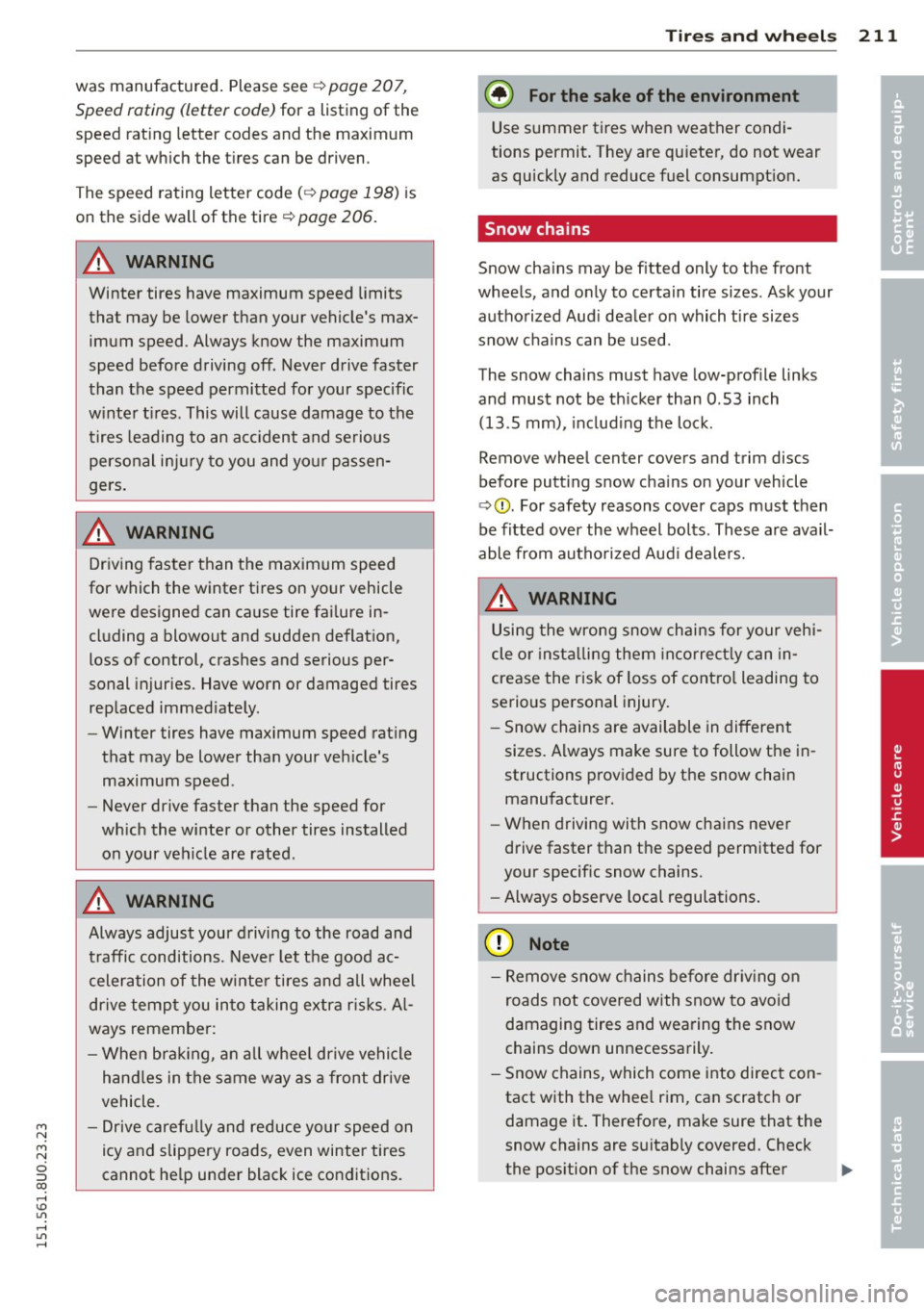
was manufactured. Please see ¢ page 207,
Speed rating (letter code) for a listing of the
speed rat ing letter codes and the maximum
speed at which the tires can be driven .
The speed rating letter code(¢
page 198) is
on the side wall of the tire
c::> page 206.
A WARNING
Winter tires have maximum speed limits
that may be lower than your vehicle's max
imum speed. Always know the maximum
speed before driving off . Never drive faster
than the speed permitted for your specific
w inte r tires . This will cause damage to the
tires leading to an ac cident and serious
pe rsonal inj ury to you and yo ur passen
gers .
A WARNING
Driving faster than the maximum speed
for which the winter tires on your vehicle
were designed can ca use tire fai lure in
cluding a blowout and sudden deflat ion,
loss of control, crashes and serious per
sonal injuries . Have worn or damaged tires
rep laced immed iate ly.
- Winter tires have maximum speed rat ing
that may be lower than your veh icle's
maximum speed .
- Never drive faster than the speed for
w hich the winter or other tires installed
on your veh icle are rated .
A WARNING
Always adjust your d rivi ng to the road and
traffic conditions. Neve r let the good ac
c eleration of the w inte r ti res and all whee l
drive temp t you in to taking extra r is k s . A l
ways remember:
- When bra king, an a ll whee l dr ive vehicle
hand les in the s ame way as a front drive
vehicle.
- Drive carefu lly and reduce your speed on
icy and slippery roads, even winter tires
cannot he lp under blac k ice conditions.
Tire s an d wheel s 211
'
@) For the sake of the environment
Use summer tires when weather condi
tions permit. They are qu ieter, do not wear
as quickly and reduce fuel consumpt ion.
Snow chains
Snow cha ins may be fitted only to the front
wheels, and o nly to certain tire sizes . Ask your
autho rized Aud i deale r on which tire sizes
snow cha ins can be used .
The snow chains must have low-prof ile links
and must not be th icker than 0.53 inch
(13.5 mm) , includ ing the lock .
Remove wheel center covers and trim discs
before putt ing snow cha ins on your vehicle
c::> Q) . For safety reasons cover caps must then
be fitted over the wheel bolts. These are ava il
able from autho rized Aud i dealers.
A WARNING
Using the wrong snow chai ns for your vehi
cle o r insta lling them incorrect ly can in
crease the risk of loss of cont ro l leading to
serious personal injury.
- Snow chains are available in different
sizes. A lways make sure to follow the in
structions p rov ided by the snow chain
manufacturer.
- When driving with snow chains never
drive faster than the speed permitted for
your specif ic snow chains.
- Always observe local regulations .
(D Note
-Remove snow chains before dr iv ing o n
roads not covered with snow to avoid
damaging tires and wea ring the snow
chains down unnecessarily.
- Snow chains, which come into direct con
tact with the whee l rim , can scratch or
damage it . Therefore, make sure that the
snow chains are suitably covered. Check
the pos ition of the snow chains after
•
•
Page 215 of 258
M N
M N
0 ::i co ,...., \!) 1.1'1 ,...., 1.1'1 ,....,
In o rder to minimize the occurrence o f imp act
damage to the tires of y our vehicle, we recom
mend that you observe the following precau
tions :
- Always maintain recommended inflation
pressures. Check your tire pressure every
2,000 miles (3,000 km) and add a ir if neces
sary.
- Drive carefu lly on roads with potholes, deep
gullies or ridges. The impact from driving
through or over such obstacles can damage
your tires. Impact with a curb may also cause damage to your tires .
- After any impact, immediately inspect your
tires or have them inspected by the nearest
authorized Aud i deale r. Replace a damaged
t ire as soon as poss ible .
- In spect your t ires every 2,000 miles (3,000
km) for damage and wear . Damage is not al
ways easy to see. Damage can lead to loss of
air and unde rinflation, wh ic h could eventu
ally cause ti re fa il ur e.
If yo u be lieve that a
t ir e may have been damaged , replace the
tire as soon as possible.
- These tires may wea r more q uick ly than oth
ers.
- Please a lso remembe r that, whi le these t ires
deliver respons ive handling, they may ride
l ess comfortably and make more noise than
other c hoices.
Reduced p erformance in winter /cold
s ea son condit ion s
All ti res are designed for certain purposes .
The low aspect ratio, ultra hig h pe rformance
tires orig inally installed on your veh icle are in
tended for max imum dry and wet road per
formance and handling . They are not suitable
for cold, snowy or icy weather cond it ions . If
you dr ive under those circumstances, you
should equip your vehicle with all-season or
winter tires, whi ch offe r better trac tion under
t hose cond itions . We suggest yo u use the rec
ommended snow or all -season tires specified
for your ve hicle, or their equiva lent .
Refe r to
~ page 210 for mo re deta iled info r
mat io n regarding w in ter t ires.
Tire s an d wheel s 213
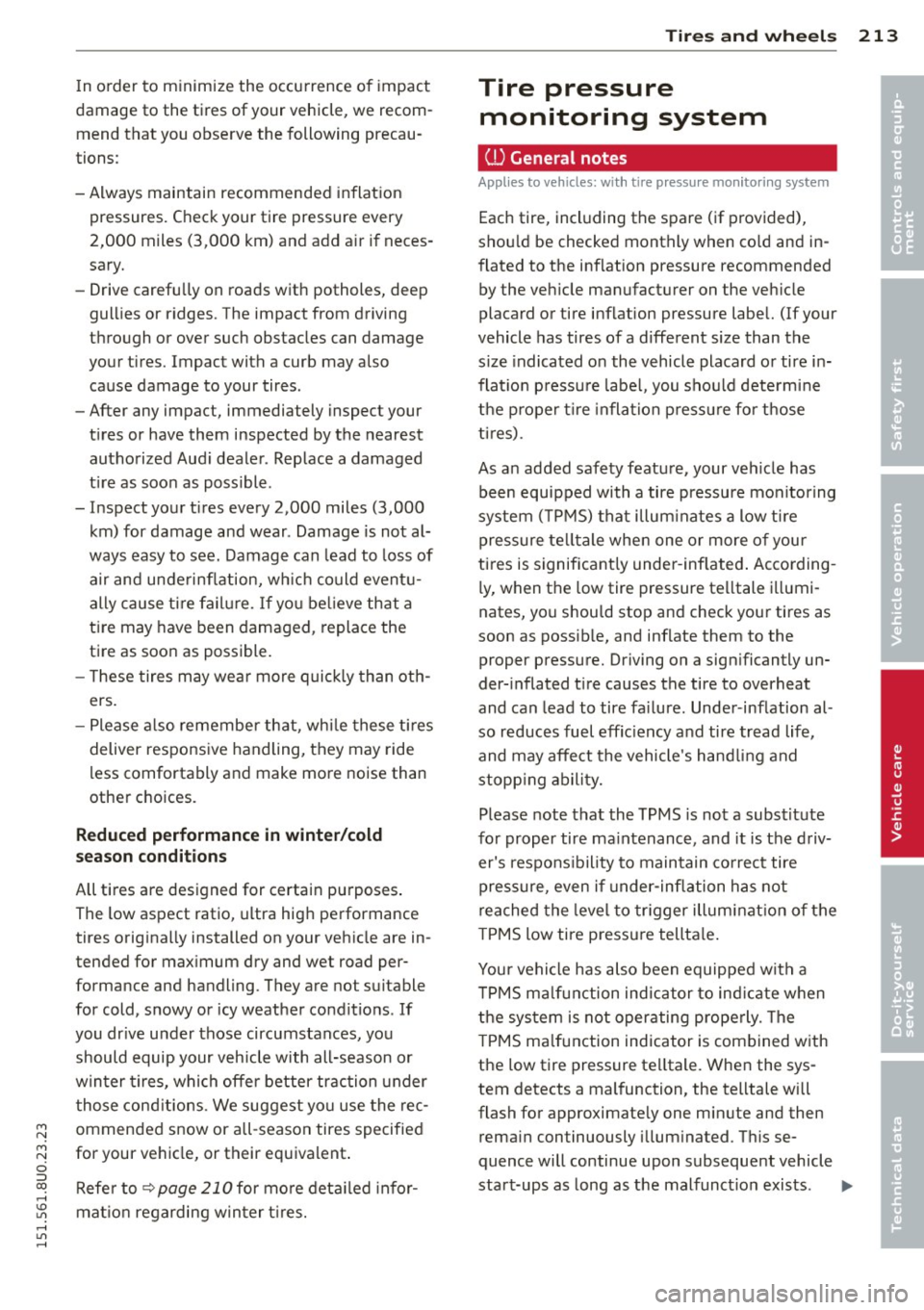
Tire pressure
monitoring system
ill General notes
App lies to vehicles : wi th tire p ress ure mo nito rin g system
Each tire, incl uding the spa re (if provided),
sho uld be checked monthly when co ld and in
flated to the inflation pressure recommended
by the veh icle manufacturer on the veh icle
placard or tire inflation pressure label. (If your
vehicle has tires of a d ifferent size than the
s iz e indicated on the vehicle placa rd o r tire in
flat io n pressu re labe l, you s hou ld dete rm ine
the p roper t ire inflation p ress ure fo r those
ti r es).
As an added safety featu re, your veh icle has
been equipped with a tire p ressure monitoring
system ( TPMS) tha t illum inates a low ti re
pressure te lltale whe n one or more o f you r
ti res is significant ly under -inflated . Acco rding
ly, when the low tire pressure te lltale i llumi
nates, yo u shou ld stop and check you r tires as
soon as possib le, and inf late them to the
proper pressure. Driving on a sign ificantly un
der- inflated t ire causes the tire to overheat
and can lead to tire fa ilure . Under-inflation al
so reduces fuel eff ic iency and tire tread life,
and may affe ct the vehicle 's hand ling and
stopp ing abil ity.
Please note that the TPMS is not a subst itute
fo r proper tire ma intenanc e, and it is the d riv
er's respo nsibility to maintain co rrect tire
pressure, even if under -inflation has not
reached the leve l to tr igger illum inat ion o f the
T PMS low ti re p ressu re tellta le .
You r vehicle has also been equipped with a
T PMS ma lf u nction indicator to ind icate w hen
t he sys tem is not oper ating prope rly . T he
T PMS ma lfunction indicator is combined w ith
the low tire pressure te lltale. When the sys
tem detects a malfunction, the telltale wi ll
flash for approximate ly one min ute and then
rema in con tinuously i llum inated . T hi s se
quence will continue upon subsequent vehicle
start-ups as long as the malfunct ion exists . ..,.
•
•
Page 228 of 258
226 Fuses and bulbs
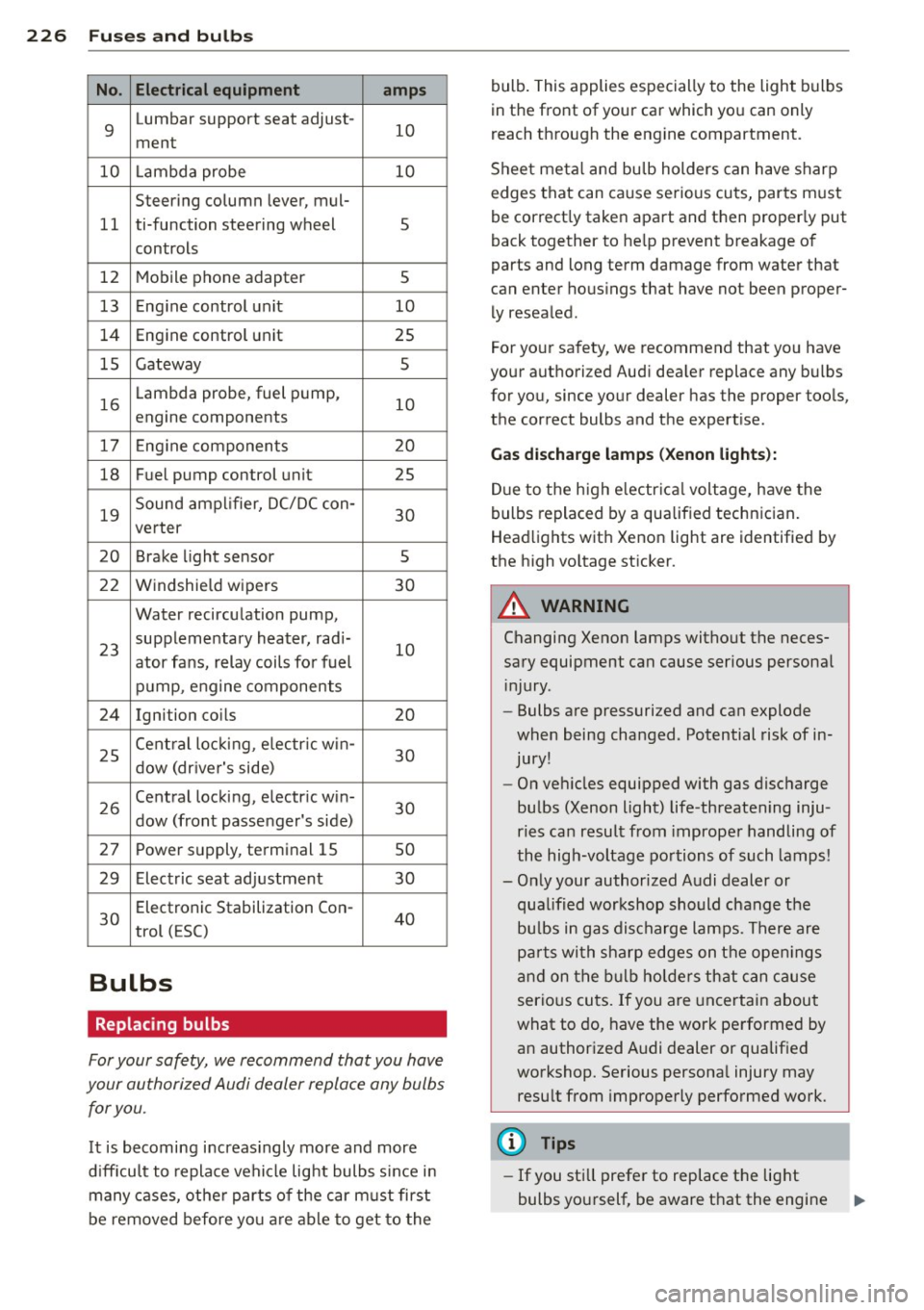
No. Electrical equipment amps
9 Lumbar support seat adjust-
ment
10
10 Lambda probe 10
Steering column lever, mul-
11 ti-function steering wheel
s
controls
12 Mobile phone adapter
s
13 Engine control unit 10
14 Engine control
unit
25
15 Gateway 5
16 Lambda
probe, fuel pump,
10
engine components
17 Eng ine components 20
18 Fuel pump control unit
2S
19 Sound
amplifier, DC/DC con-
verter 30
20 Brake light sensor
s
22 Windshield
wipers
30
Water recirculation pump,
23
supplementary heater, rad i-
10 a tor fans, relay coils for fuel
pump , engine components
24 Ignition coils 20
2S Central locking
, e lectr ic win-
30
dow (driver's side)
26 Central locking, e
lectr ic win-
30
dow (front passenger's side)
27 Power supply, terminal 15
so
29 Electric seat adjustment 30
30 Electronic Stabilization Con-
40
trol (ESC)
Bulbs
Replacing bulbs
For your safety, we recommend that you have
your authorized Audi dealer replace any bulbs for you.
It is becoming increas ingly more and more
difficult to replace vehicle lig ht bulbs s ince in
many cases, other parts of the car must first
be removed before you are able to get to the bulb.
This applies especially to the light bulbs
in the front of your car which you can only
reach through the engine compartment.
Sheet meta l and bulb holders can have sharp
edges that can cause serious cuts, parts must
be correct ly taken apart and then properly put
back together to he lp prevent breakage of
parts and long term damage from water that
can enter housings that have not been proper
ly resealed.
For your safety, we recommend that you have
your authori zed Audi dea ler replace any bulbs
for you, since your dealer has the proper tools,
the correct bulbs and the expertise.
Gas discharge lamps (Xenon lights ):
Due to the high e lectr ica l voltage, have the
bulbs replaced by a qualified technician.
Headlights with Xenon light are identified by
the high voltage st icker.
A WARNING "--
Changing Xenon lamps without the neces-
sary equipment can cause serious persona l
injury.
- Bulbs are pressurized and can explode
when being changed. Potential risk of in
jury!
- On veh icles equipped with gas discharge
bulbs (Xenon light) life-threatening inju
ries can result from improper handling of
the high-voltage portions of such lamps!
- Only your authorized Audi dealer or qualified workshop should change the
bu lbs in gas discharge lamps. There are
pa rts with sharp edges on the openings
and on the bulb holders that can cause
serious cuts. If you are uncertain about
what to do, have the work performed by
an authorized Audi dealer or qualified
workshop. Serious personal injury may
result from improperly performed work.
@ Tips
-If you still prefer to replace the light
bulbs yourself, be aware that the engine ..,.
Page 236 of 258
234 Technical Data
Technical Data
Vehicle identification
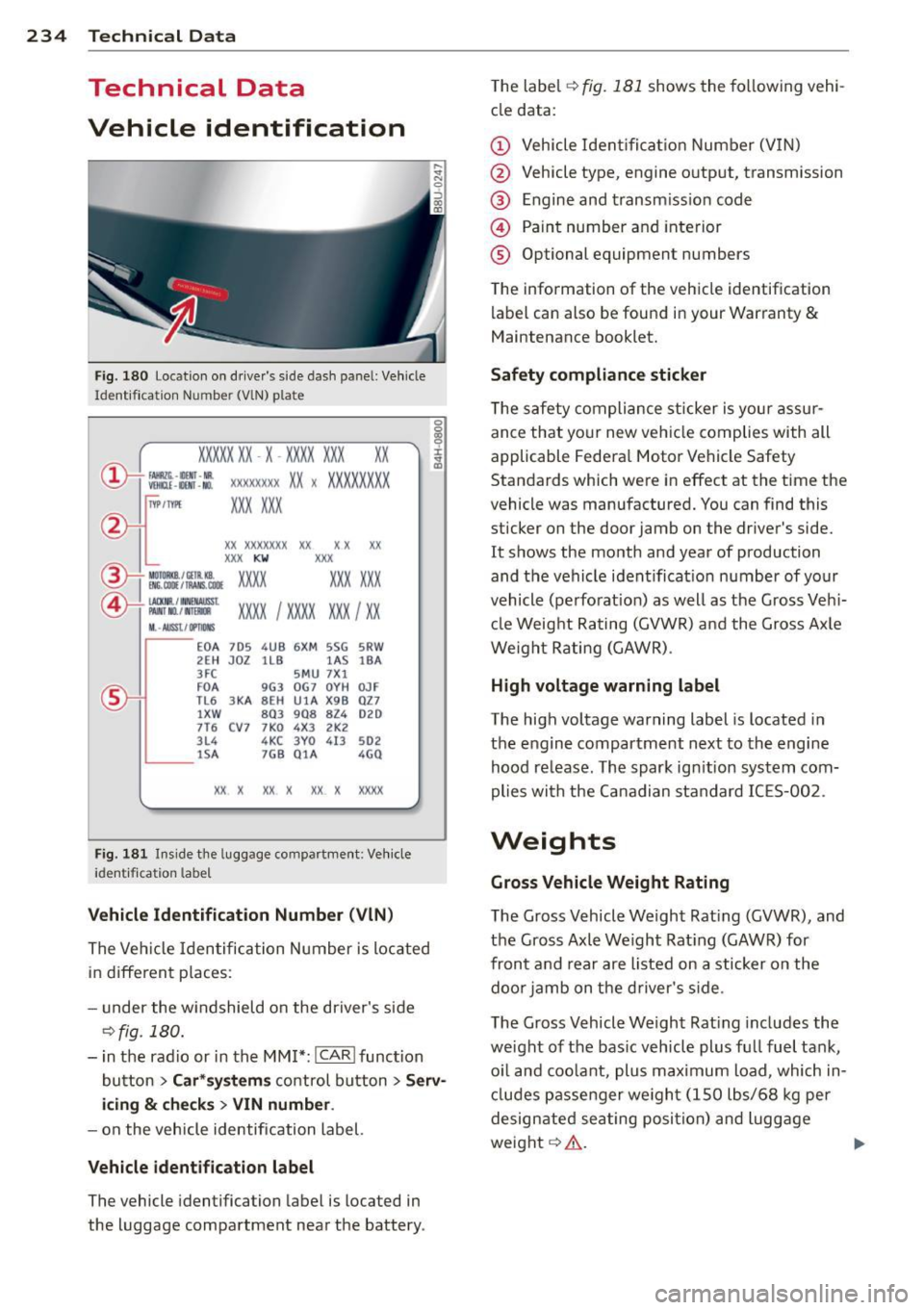
Fig . 180 Location on driver 's s ide dash pane l: Vehicle
Identifica tion Numbe r (V IN) p la te
XXXXX XX · X -XXXX XXX xx
r,'\__l f~ -11!11 1 · Nil ~ V!Hlll -llllll . NO.
IYP IT'fl'E
XXXXXXXX XX X XXXXXXXX
XXX XXX
XX XXXX XXX X X X X XX
XXX
KW XXX
®i ~~: f :l~~ XXXX XXX XXX
@+ ~~r= XXXX I XXXX XXX I XX M,. AIIISl. / lflllllS
EO A 7D5 4 UB 6XM SSG 5RW
2E H JDZ llB l AS lBA
3FC 5MU 7X l
FO A
9G3 OG7 OYH OJF
TL6 3
KA BEH
UlA X9B QZ7
l XW
8Q3 9Q8 82 4 020
7T6 CV 7 7KO 4X3 2K2
3 L4 4 KC 3YO 4I3 502
lSA 7GB Q1 A 4GQ
XX X
XX X XX X XXXX
Fig. 181 Inside the luggage compartme nt: Vehicle
i dentifica tion label
Vehicle Identification Number (VlN)
The Vehicl e Identification Number is located
in different p laces :
- under the w indshield on the driver's side
r=v fig . 180.
-in the radio or in the MM!": !CAR ! function
button
> Car"systems control button > Serv
icing
& checks > VIN number.
- on the vehicle identification label.
Vehicle identification label
The vehicle identification label is located in
the luggage compartment near the battery . T
he label
r=v fig. 181 shows the following vehi
cle data:
(D Vehicle Ident ificat ion Number (VIN)
@ . Vehicle type, engine output, transmission
® Engine and transm ission code
@ Paint number and interior
® Optional equipment numbers
The information of the vehicle identification
label can also be found in your Warranty
&
Maintenance booklet.
Safety compliance sticker
The safety compliance sticker is your assur
ance that your new veh icle complies with all
applicable Federal Motor Vehicle Safety
Standards which were in effect at the time the
vehicle was manufactured. You can find this
sticker on the door jamb on the driver's side.
It shows the month and year of production
and the vehicle ident ificat ion number of your
vehicle (perforat ion) as well as the Gross Veh i
cle Weight Rating (GVWR) and the Gross Axle
Weight Rating (GAWR) .
High voltage warning label
The high voltage warning label is located in
the engine compartment next to the engine
hood re lease . The spark ignition sys tem com
plies with the Canadian standard IC ES-002.
Weights
Gross Vehicle Weight Rating
The Gross Vehicle Weight Rat ing (GVWR), and
the Gross Axle Weight Rat ing (GAWR) for
front and rear are listed on a sticker on the
doo r jamb on the driver's s ide .
The Gross Vehicle Weight Rating includes the
weight of the bas ic vehicle plus fu ll fuel tank,
o il and coolant, plus max imum load, which in
cludes passenger weight (lSO lbs/68 kg per
designated seating position) and luggage
weight ~&, . .,.
Page 238 of 258
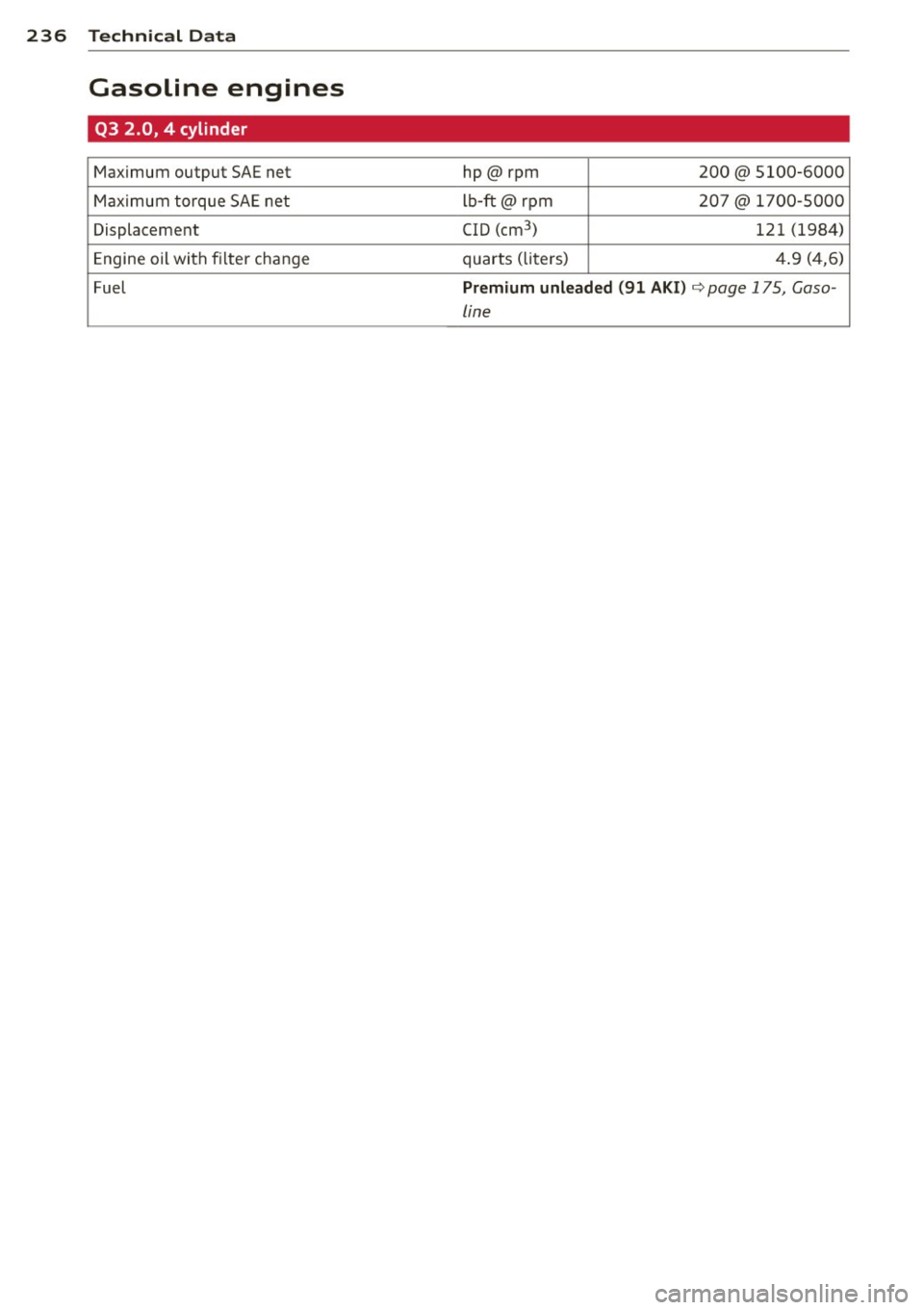
236 Technical Dat a
Gasoline engines
Q3 2.0, 4 cylinder
Maximum output SAE net hp@rpm 200@ 5100-6000
Max imum torque SAE net Lb-ft@ rpm 207 @ 1700-5000
Displacement CID (cm
3
) 121 (1984)
Engine oil with filter change quarts (liters)
4.9 (4,6)
Fuel
Pr em ium un leaded (9 1 A KI) ¢ page 175, Caso-
line