warning light AUDI Q3 2015 Owner's Manual
[x] Cancel search | Manufacturer: AUDI, Model Year: 2015, Model line: Q3, Model: AUDI Q3 2015Pages: 258, PDF Size: 64.9 MB
Page 47 of 258
M N M N
0 ::i co
rl I.O
"' rl
"' rl
to estimate distances of following vehicles
when changing lanes, you could estimate incorrectly and cause an accident.
(D Note
- If the mirror housing is moved uninten
tionally (for example, while parking your
vehicle), then you must first fold the mir ror electrically. Do not readjust the mir
ror housing manually. You could damage
the motor which controls the mirror .
- If you wash the vehicle in an automatic
car wash, you must fold the exterior mir
rors in to reduce the risk of damage to
the mirrors. Never fold power folding ex
terior mirrors* by hand. Only fold them
in and out using the power controls.
@ Tips
If there should be a malfunction in the
electrical system, you can still adjust the
exterior mirrors by pressing the edge of
the mirror ..
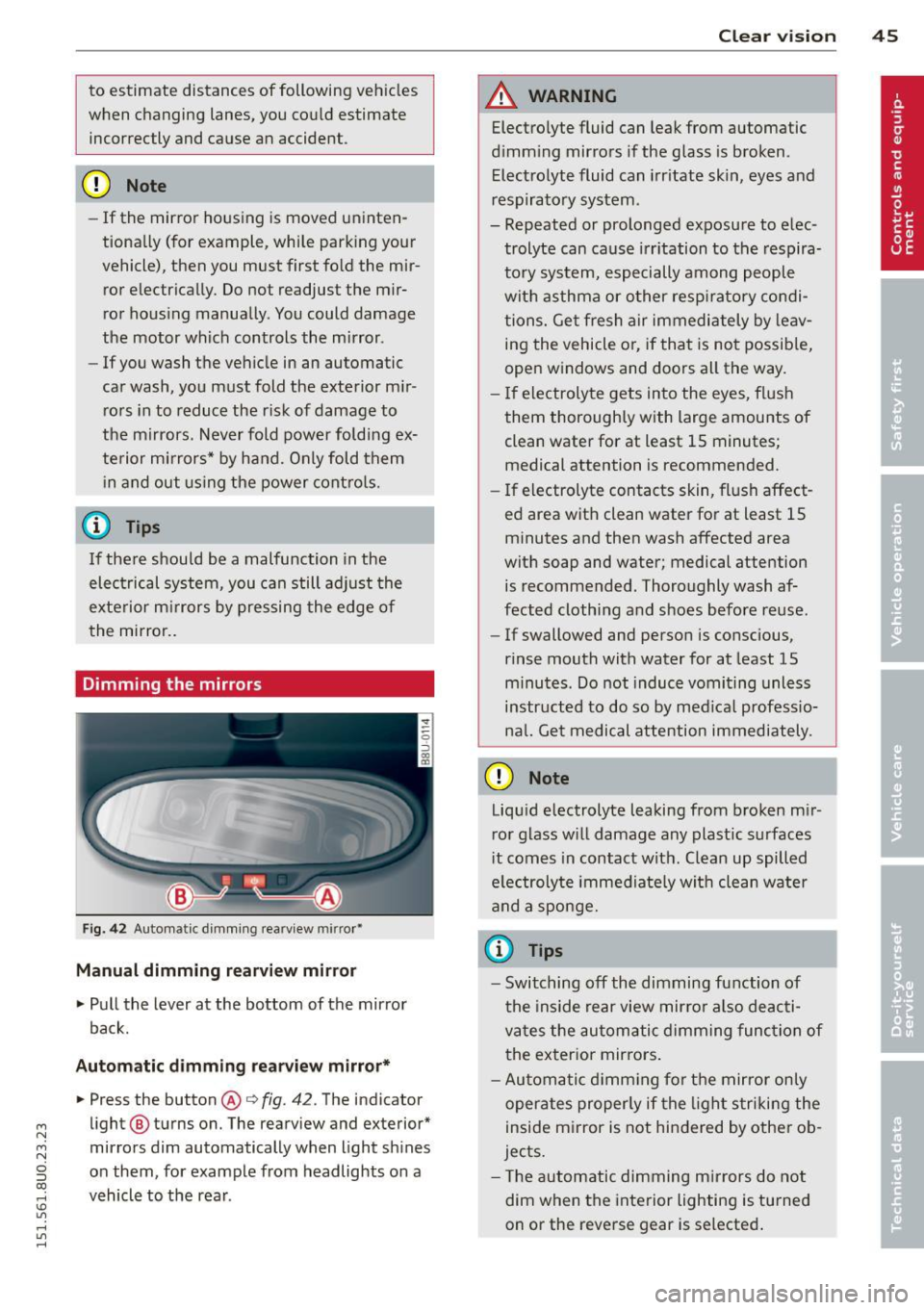
Dimming the mirrors
Fig. 42 Automatic dimming rearview mirror•
Manual dimming rearview mirror
.,. Pull the lever at the bottom of the mirror
back.
Automatic dimming rearview mirror* .,. Press the button
@r::;, fig. 42. The indicator
light @ turns on. The rearview and exterior*
mirrors dim automatically when light shines
on them, for example from headlights on a
vehicle to the rear .
Clear vision 45
A WARNING
Electrolyte fluid can leak from automatic
dimming mirrors if the glass is broken.
Electrolyte fluid can irritate skin, eyes and
respiratory system.
- Repeated or prolonged exposure to elec trolyte can cause irritation to the respira
tory system, especially among people
with asthma or other respiratory condi
tions. Get fresh air immediately by leav
ing the vehicle or, if that is not possible,
open windows and doors all the way.
- If electrolyte gets into the eyes, flush
them thoroughly with large amounts of clean water for at least 15 minutes; medical attention is recommended.
- If electrolyte contacts skin, flush affect
ed area with clean water for at least 15
minutes and then wash affected area
with soap and water; medical attention is recommended. Thoroughly wash af
fected clothing and shoes before reuse.
- If swallowed and person is conscious,
rinse mouth with water for at least 15
minutes. Do not induce vomiting unless
instructed to do so by medical professio
ncil. Get medical attention immediately.
(D Note
Liquid electrolyte leaking from broken mir
ror glass will damage any plastic surfaces
it comes in contact with. Clean up spilled
electrolyte immediately with clean water
and a sponge.
(D Tips
-Switching off the dimming function of
the inside rear view mirror also deacti
vates the automatic dimming function of
the exterior mirrors.
- Automatic dimming for the mirror only
operates properly if the light striking the
inside mirror is not hindered by other ob
jects.
- The automatic dimming mirrors do not
dim when the interior lighting is turned
on or the reverse gear is selected.
.
Page 48 of 258
46 Clear vis ion
Sun visors
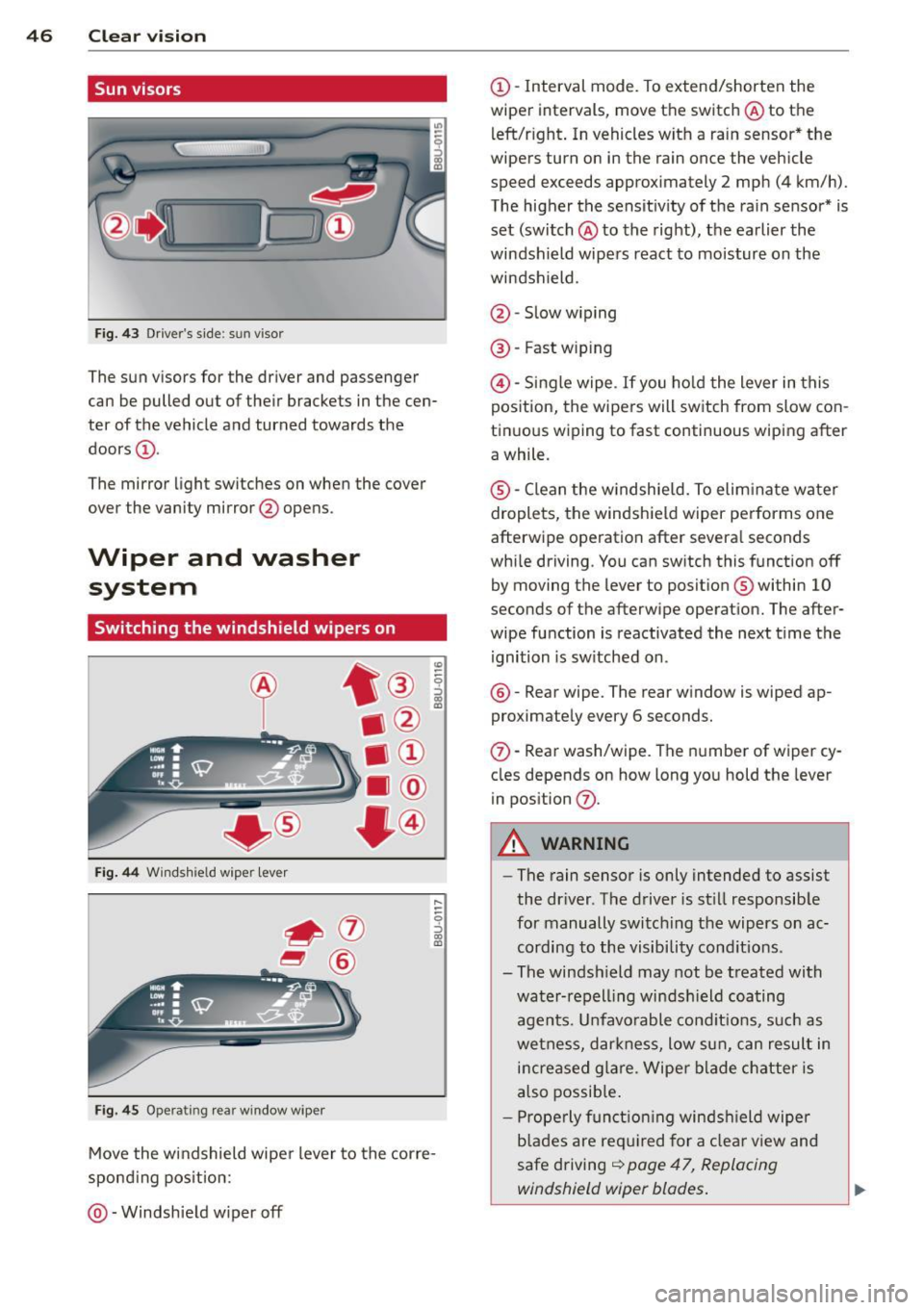
Fig. 43 Drive r's side : sun visor
The sun v isors for the driver and passenger
can be pulled out of the ir brackets in the cen
ter of the vehicle and turned towards the
doors @.
The mirror light switches on when the cover over the vanity mirror @opens .
Wiper and washer
system
Switching the windshield wipers on
Fig. 44 Wind sh ie ld wipe r lever
Fi g. 4 5 O pera ting rear window w ipe r
" -0
='> a, a,
Move the windshield wiper lever to the cor re
spond ing pos ition:
@ -Windsh ie ld wiper off
(D -Interval mode. To extend/shorten the
wipe r intervals, move the switch @to the
l eft/r ight . In vehicles with a ra in sensor* the
wipers turn on in the rain once the vehicle
speed exceeds approximately 2 mph (4 km/h).
The higher the sensit iv ity of the ra in sensor* is
set (switch @to the right), t he earlier the
windshield wipers react to moisture on the
windshield .
@ -Slow w iping
@ -Fast wip ing
@ -Sing le wipe . If you ho ld the lever in this
position, the wipe rs will switch from slow con
tin uous wiping to fast cont inuous wiping after
a while.
® -C lean the w indshie ld. To elim ina te water
droplets, the windshield wiper performs one
afterwipe operation after severa l seconds
whi le driving. You can sw itch this function
off
by moving the lever to posit ion ® within 10
seconds of the afterwipe operat ion. The after
wipe function is reactivated the next t ime the
ignition is sw itched on.
® -Rear wipe. The rear w indow is wiped ap
proximately every 6 seconds.
(j) -Rear wash/wipe . The n umber of wiper cy
cles depends on how long you hold the lever
in position
(J) .
A WARNING
-The rain sensor is only intended to assist
the dr iver. T he d river is st ill responsib le
for manually switching the wipers on ac
cording to the visibility cond itio ns.
- The windsh ield may not be treated with
wate r-repell ing windsh ield coating
agen ts. Un favo rable cond it ions, such as
wetnes s, dark ness, low su n, c an result in
i n creased glare. Wipe r blade cha tter is
also possib le .
- Prope rly fun ct ion ing wi ndsh iel d wiper
b la d es are req uired for a clea r view and
safe driving
c:> page 47, Replacing
windshield wiper blades .
Page 49 of 258
M N
M N
0 ::i co ,...., \!) 1.1"1 ,...., 1.1"1 ,....,
(D Note
-In the case of frost , check whether the
windsh ield wiper b lades are frozen to
the windshie ld. Switching on the wind
s hi eld wipers can damage the wiper
blades!
- Prior to using a car wash, the windshield
wiper system must be switched
off (lever
i n position @). This helps to prevent un
i ntent ional sw itch ing on and damage to
the windshie ld w iper system .
- The wi ndshield wipe rs are switched
off
whe n the ignition is turned off . Activate
t h e w indshie ld w ipers afte r the ig nit ion
i s sw itche d back on by mov ing the w ind
s hi eld wipe r lever to any pos ition.
- Worn or di rty windshie ld wiper b lades
r es ult in strea king. This can affe ct the
r ain senso r* func tion . C heck your wind
s h ield wiper blades r egularly.
- The w asher fluid nozzles of the wi nd
s hi eld washer system are heated a t low
temperatures w hen the ignit ion is on .
- W hen stopp ing tempor arily, (e.g. a t a
traff ic light) the se t speed of the w ind
s hi eld wipers is automatically red uced by
one speed .
Cleaning windshield wiper blades
Clean the windshield wiper blades whe n they
begin to leave streaks . Use a soft cloth and
g lass cleaner to clean the windsh ield wiper
b lades .
Windshield wiper s
.. Place the windshield wipe r arms in the serv
ice position . Refer to ¢ page
47 .
.,. Lift the w iper arm away from the front win
dow .
Rear window wiper
.. Lift the rear wiper arm away from the glass.
Clear vis ion 4 7
A WARNING
Dirty winds hield wiper b lades can impair
your v iew. This can lead to accidents .
Replacing windshield wiper blades
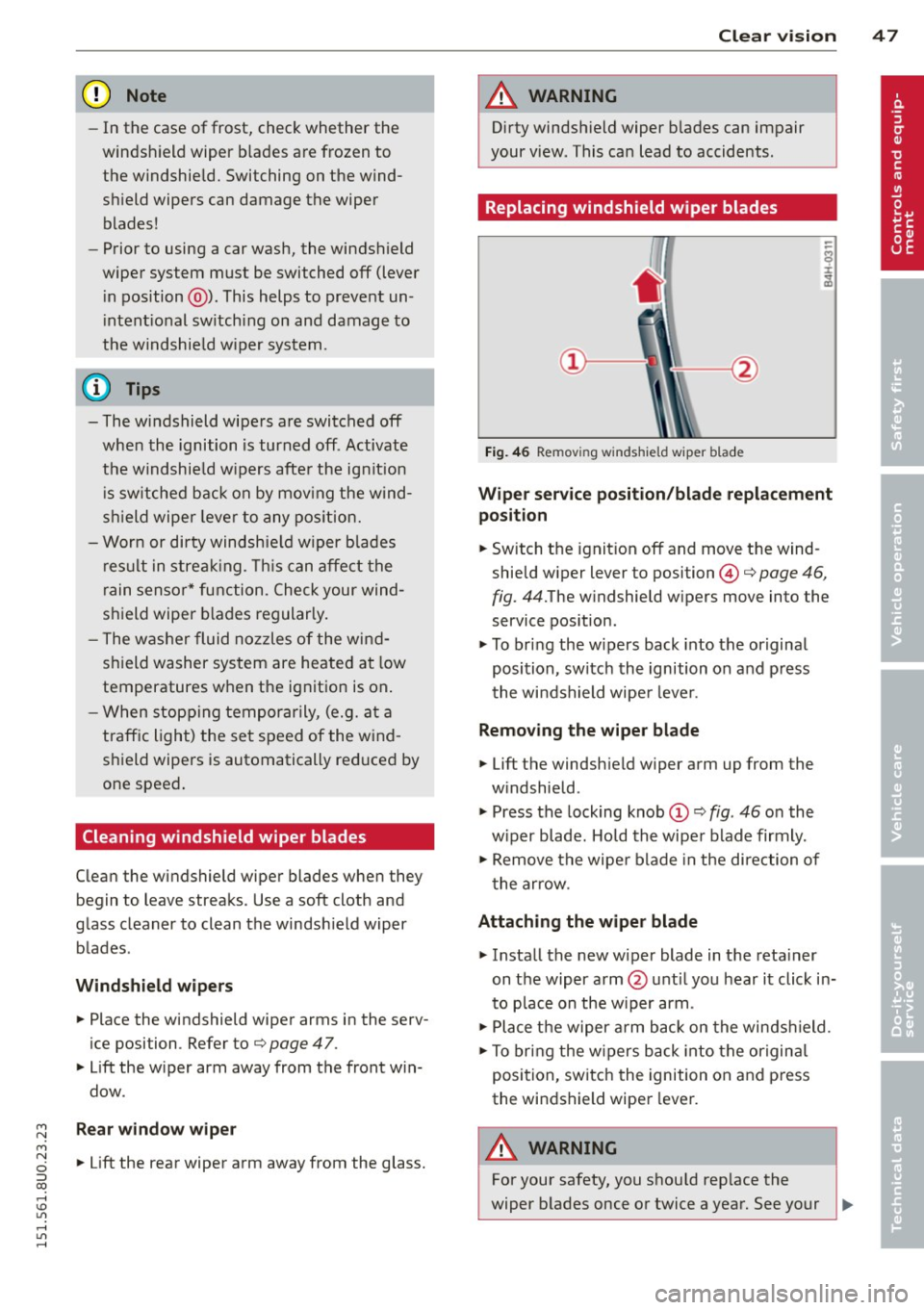
Fig. 46 Remov ing w indsh ield w iper blade
Wiper service position /blade replacement
position
.. Switch the ignit ion off and move the wind
shield w iper lever to position ©¢ page
46,
fig .
44.The w indshie ld w ipers move into the
service pos ition .
.. To br ing the w ipers back into the original
position, sw itc h th e ignition on and p ress
t he winds hield wipe r leve r.
Removing the wiper blade
.. Lift the windsh ield w iper arm up from the
w indshield .
.. Press the lock ing knob
.,. Remove the wipe r blade in the di rec tion of
t he ar row .
Attaching the wiper blade
.. Insta ll the new wiper blade in the reta iner
on t he wiper arm @until you hear i t click in
to p lace on the w iper arm .
.,. Place t he w iper arm back on the winds hield.
.. To bring the w ipers b ack into the or igin al
position, switch the ignition on and press
the windshield wipe r lever.
A WARNING
-
For your safety, y ou shou ld rep lace the
wiper b lades once or twice a year. See your
Page 55 of 258
M N M N
0 ::i co
rl I.O
"' rl
"' rl
Removing the head restraints
• Fold the backrest forward
¢ page 60 .
• Move the head restraint upward as far as it
can go.
• Press the release@¢
fig. 54 with an auxili
ary tool and the button @. Pull the head re
straint out of the backrest at the same time
¢ & .
Install ing the head restraints
• Slide the posts on the head restraint down
into the guides until you feel the posts click
into place .
• Press the button @ and slide the head re
stra int all the way down. You should not be
able to pull the head restraint out of the
back rest.
So that the driver can have a better view to
the rear, the head restraints should be pushed
down completely when the rear seats are not
occupied.
_& WARNING
- Only remove the rear seat head restraints
when necessary in order to install a chi ld
seat . Install the head restraint again im
mediately once the child seat is removed.
Driving without head restraints or with
head restraints that are not properly ad
justed increases the risk of serious or fa
tal neck injury dramatically .
- Read and heed all WARNINGS
¢ page 9 7, Proper adjustment of head
restraints .
(D Tips
Correctly adjusted head restraints and
safety belts are an extremely effective
combinat ion of safety features.
Seats and storage 53
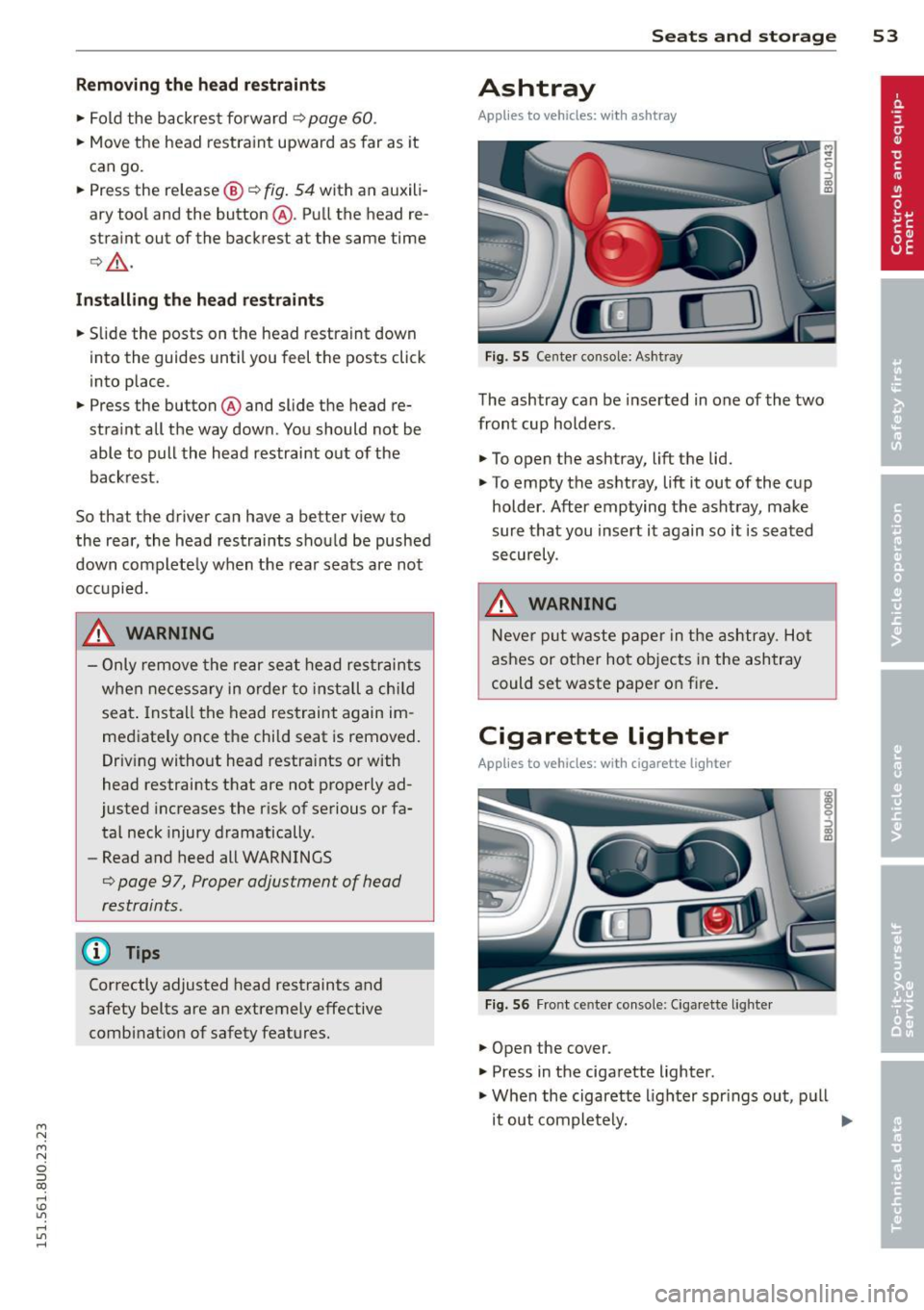
Ashtray
Applies to vehicles: with ashtray
Fig. 55 Center console: Asht ray
The ashtray can be inserted in one of the two
front cup holders .
• To open the ashtray, lift the lid.
.,. To empty the ashtray, lift it out of the cup
holder . After emptying the ashtray , make
sure that you insert it again so it is seated
securely .
_& WARNING
Never put waste paper in the ashtray. Hot
ashes or other hot objects in the ashtray
could set waste paper on fire .
Cigarette lighter
Applies to vehicles: with cigarette lighter
Fig. 56 Front ce nter console: C iga rette l ighte r
.. Open the cover .
.. Press in the cigarette lighter .
.,. When the cigarette lighter spr ings out, p ull
it out completely.
II>
Page 56 of 258
54 Seats and storage
A WARNING
T he ciga rette lighter only works when the
ign ition is on . Improper use can cause seri
ous injury or start a fire. To avo id the r isk
of injury, nev er leave children unsupe r
vised in the vehicle with the key.
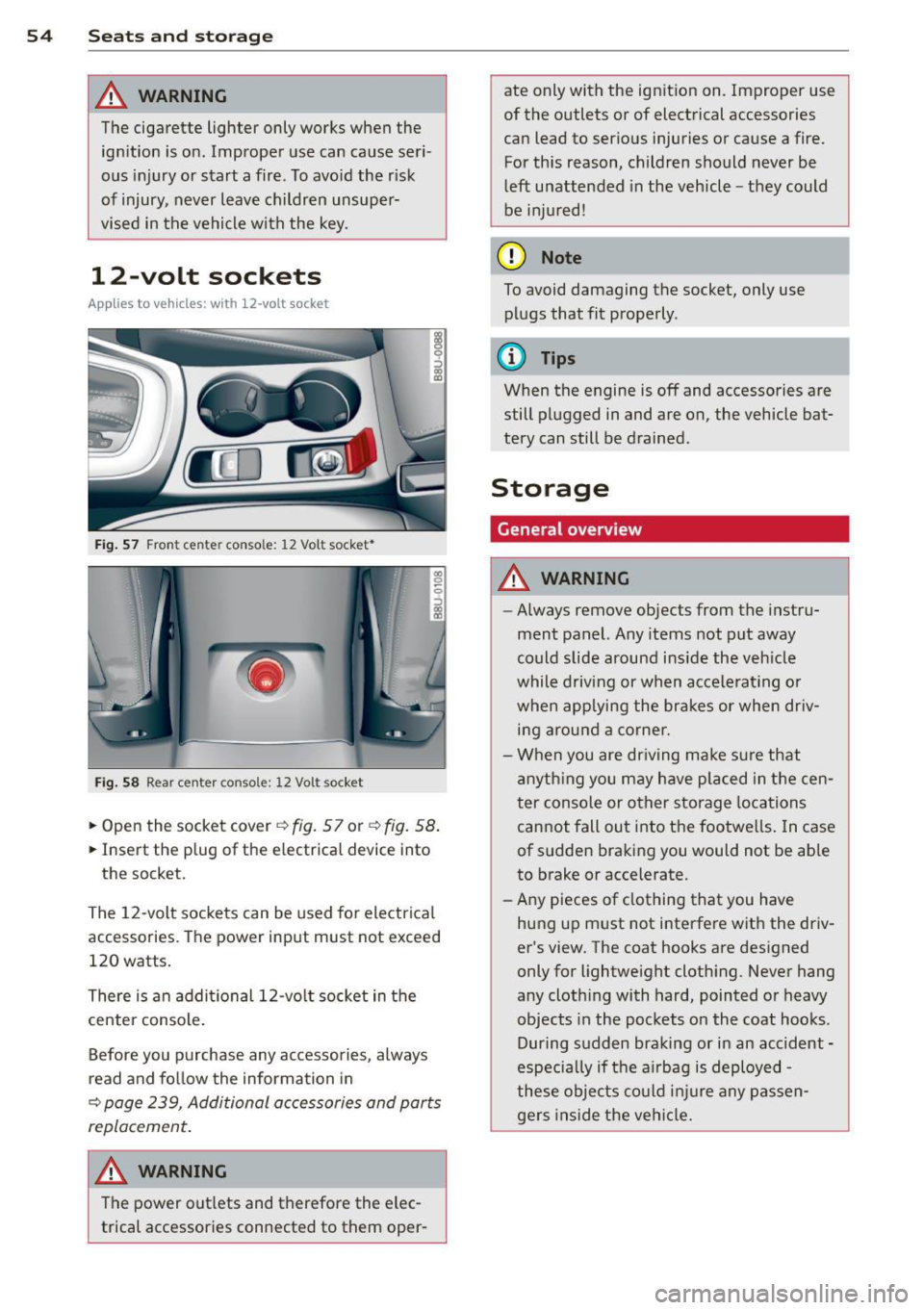
12-volt sockets
Ap plies to vehicles: with 12 -volt socket
Fi g. 57 Fro nt cen ter conso le: 12 Vo lt socket •
Fig. 58 R ear ce nter c onso le: 12 Vo lt socket
.. Open the socket cover ¢ fig. 57 or¢ fig. 58 .
.. Insert the p lug of the e lectrica l device into
the socket.
The 12 -volt sockets can be used fo r electr ical
accessories. The power input must not exceed
120 watts.
There is an addi tional 12-vo lt socket in the
center console .
Before you purchase any accessories, always
read and fo llow the informa tion in
¢ page 239, Additional accessories and parts
r e plac em ent .
A WARNING
The power out lets and therefore the elec
trical accessories connected to them oper- ate only with the ignit
ion on. Improper use
of the outlets or of electrical accessories
can lead to ser ious injuries or cause a fire.
For this reason, children should never be
l eft unattended in the vehicle -they could
be injured!
(D Note
To avoid damaging the socket, only use plugs that fit properly .
(D Tips
When the engine is off and accessories are
still plugged in and are on , the vehicle bat
tery can still be drained .
Storage
General overview
A WARNING
--
-Always remove objects from the instru
ment panel. Any items not put away
could slide around ins ide the veh icle
while driving or when ac cele rat ing o r
when applying the brakes or when dr iv
ing arou nd a corne r.
- When you are dr iving make s ure that
an yth ing you may have pla ced in the cen
ter conso le or other storage loca tions
cannot fall out into the footwe lls . In case
of sudden braking you would not be able
to brake or accelerate.
- Any pieces of clothing that you have
hung up must not i nterfere with the dr iv
er's view. The coat hooks are des igned
only for lightweight cloth ing . Never hang
any cloth ing with hard, pointed o r heavy
objects in the pockets on the coat hoo ks .
During s udden braking or in an accident -
especia lly if t he a irbag is deployed -
these objec ts co uld in ju re any passen
ge rs inside the ve hicl e.
Page 58 of 258
56 Seats and storage
in the vehicle while it is moving. In case
of an accident, sudden braking or other
vehicle movement, hot liquid could spill,
causing scalding burns . Spilled hot liquid
can also cause an accident and personal
injury.
- Use only soft cups in the cupholder. Hard
cups and glasses can cause injury in an
accident .
- Never use the cupholder or adapter as an
ashtray -risk of fire .
CD Note
Only drink containers with lids should be
carried in the cupholder . Liquid could spill
out and damage your vehicle's electronic
equipment or stain the upholstery, etc.
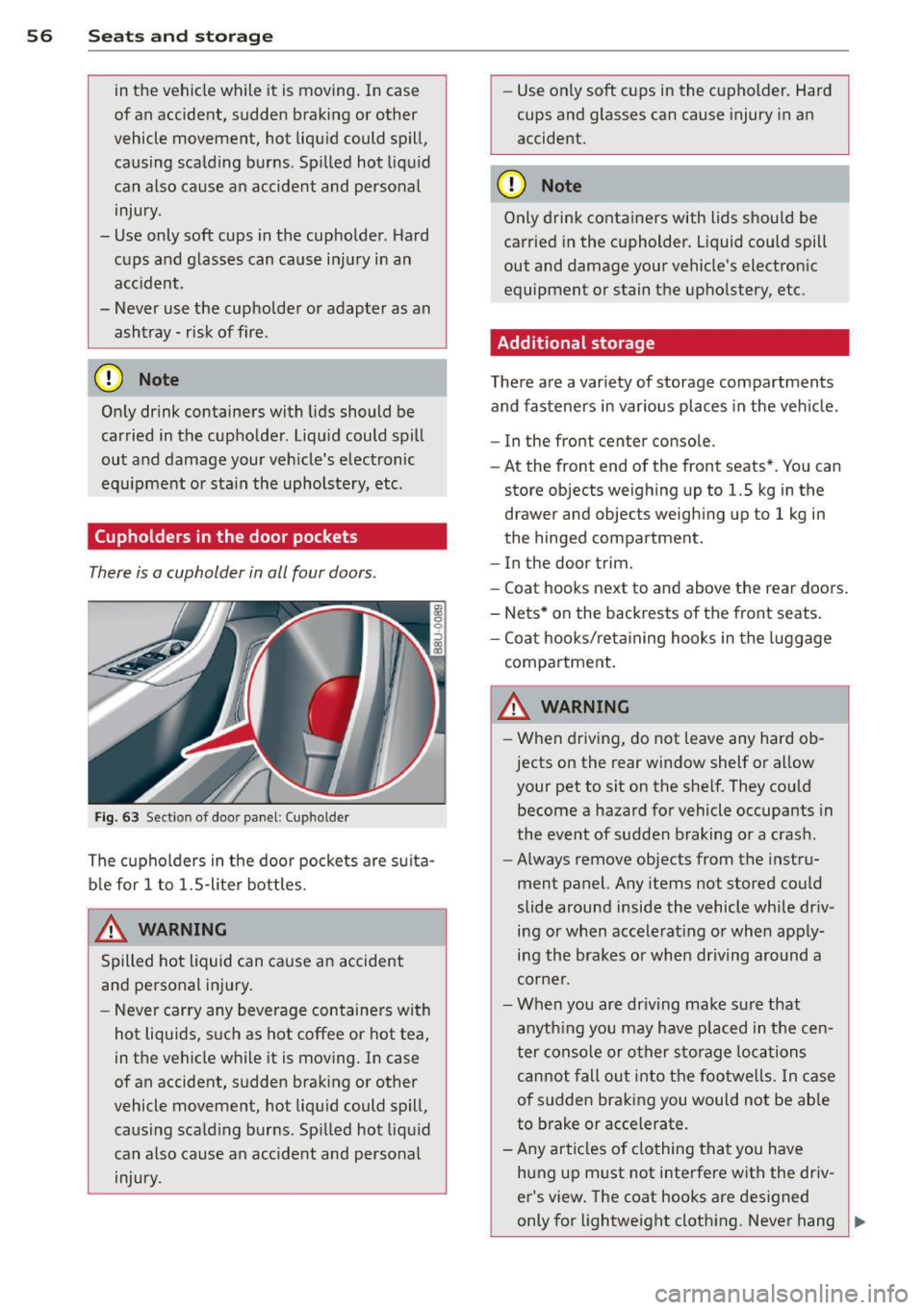
(upholders in the door pockets
There is a cupholder in all four doors .
Fig. 63 Sect ion of doo r panel: Cupho lder
The cupholders in the door pockets are suita
ble for 1 to 1.5-liter bottles.
_& WARNING ,~ ~
Spilled hot liquid can cause an accident
and personal injury.
- Never carry any beverage containers with
hot liquids, such as hot coffee or hot tea,
in the vehicle while it is moving. In case
of an accident, sudden braking or other
vehicle movement, hot liquid could spill,
causing scalding burns. Spilled hot liquid
can also cause an accident and personal injury . -
Use only soft cups in the cupholder. Hard
cups and glasses can cause injury in an
accident.
CD Note
Only drink containers with lids should be
carried in the cupholder. Liquid could spill
out and damage your vehicle's electronic
equipment or stain the upholstery, etc.
Additional storage
There are a variety of storage compartments
and fasteners in various places in the vehicle .
- In the front center console.
- At the front end of the front seats*. You can
store objects weighing up to 1.5 kg in the
drawer and objec ts weighing up to 1 kg in
the hinged compartment .
- In the door trim.
- Coat hooks next to and above the rear doors.
- Nets* on the backrests of the front seats.
- Coat hooks/retaining hooks in the luggage
compartment.
A WARNING
- When driving, do not leave any hard ob
jects on the rear window shelf or allow
your pet to sit on the shelf. They could become a hazard for vehicle occupants in
the event of sudden braking or a crash .
- Always remove objects from the instru
ment panel. Any items not stored could
slide around inside the vehicle while driv
ing or when accelerating or when apply ing the brakes or when driving around a
corner .
- When you are driving make sure that
anything you may have placed in the cen
ter console or other storage locations
cannot fall out into the footwells. In case
of sudden braking you would not be able
to brake or accelerate.
- Any articles of clothing that you have
hung up must not interfere with the driv
er's view. The coat hooks are designed
only for lightweight clothing. Never hang
~
Page 59 of 258
M N M N
0 ::i co
rl I.O
"' rl
"' rl
any clothing with hard, pointed or heavy
objects in the pockets on the coat hooks.
During sudden braking or in an accident -
especially if the airbag is deployed -
these objects could injure any passen
gers inside the vehicle .
- To reduce the r isk of personal injury in an
acc ident or sudden stop, always keep the
glove compartment closed while driving.
- Read and follow all WARNINGS
Q page 129, Important safety instruc
tions on the side airbag system.
- Hang clothes in such a way that they do
not impair the driver's v ision.
- The coat hooks must only be used for
lightwe ight cloth ing . Do not leave any
heavy o r sharp edged objects in the pock
ets which may interfere with the side cur
tain a irbag deployment and can cause
persona l injury in a crash .
- Do not use coat hangers for hanging
clothing on the coat hooks as this can in
terfere with proper dep loyment of the
side curtain airbags in an accident .
- Do not hang heavy objects on the coat
hooks, as they cou ld cause persona l in
jury in a sudden stop.
- Always keep the compartment above the
rearview mirror closed whi le driving to
reduce the risk of injury in the event of
sudden braking maneuvers or a collision.
(D Note
Objects located on the rear shelf that rub
against the rear w indow cou ld damage the
heating wires for the rear window defog
ger.
@ T ips
- A vent slot is located between the shelf
and the rear window. Do not b lock the
vent with any items you may place on the rear window shelf.
- Do not p lace bulky items on the rear w in
dow shelf as they could restrict or b lock
the driver's vis ion in the rear view mirro r.
S ea ts a nd s to rage 57
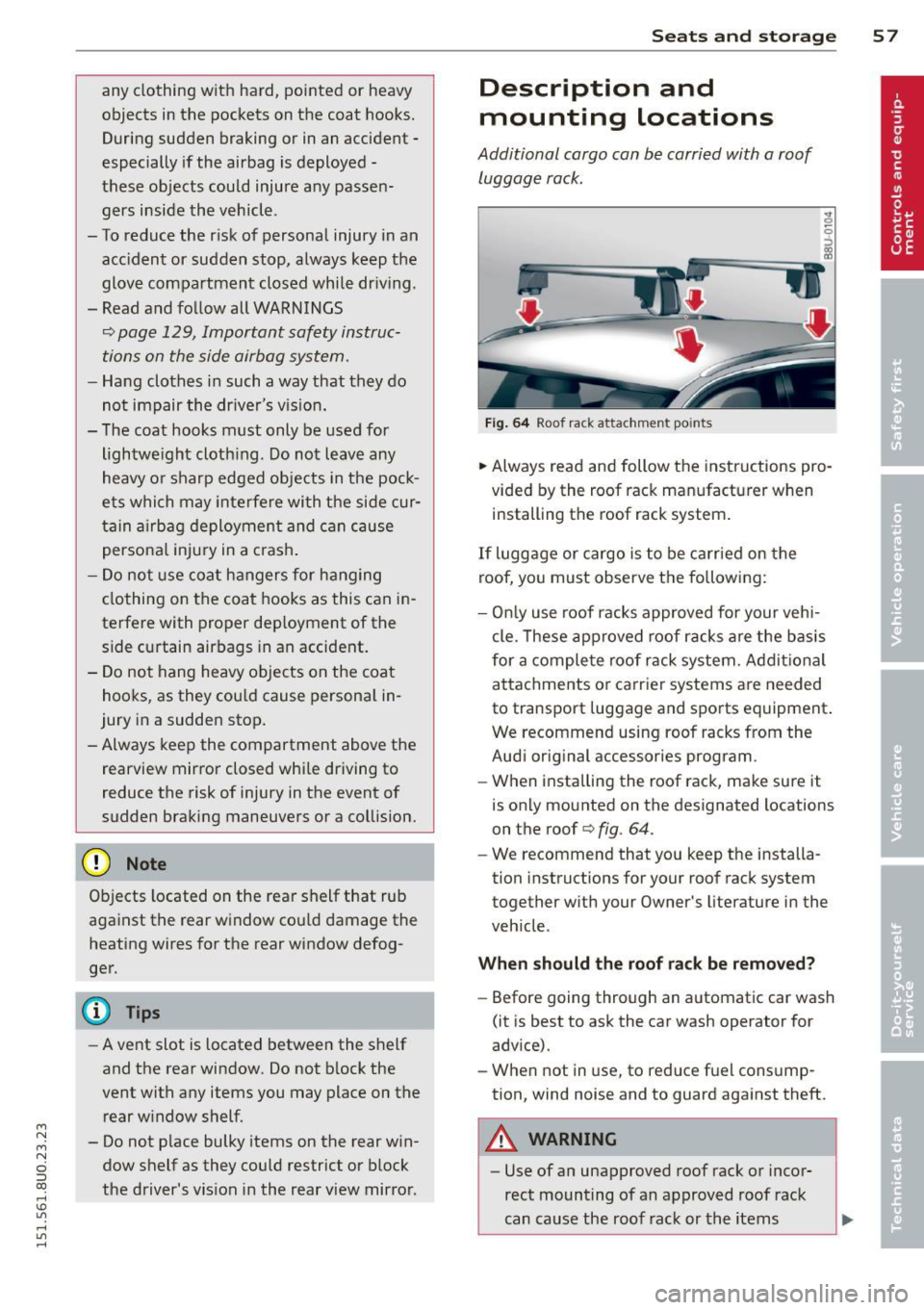
Description and
mounting locations
Additional cargo can be carried with a roof
luggage rack.
Fig . 64 Roof rack attachment points
.,. Always read and follow the instructions pro
vided by the roof rack manufacturer when
installing the roof rack system .
If luggage or cargo is to be carried on the
roof, you must observe the following:
- On ly use roof racks approved for your vehi
cle. These approved roof racks are the basis
for a complete roof rack system. Additional attachments or carr ier systems are needed
to transport luggage and sports equipment .
We recommend using roof racks from the
Audi original accessories program.
- When installing the roof rack, make sure it
is only mounted on the designated locations
on the roof
Q fig. 64.
-We recommend that you keep the installa
tion instructions for your roof rack system
together with your Owner's literature in the
veh icle .
Wh en sh ould th e roo f rack be re mov ed ?
-Before going through an automatic car wash
(it is best to ask the car wash operator for
advice).
- When not in use, to reduce fuel consump
tion, wind noise and to guard against theft.
A WARNING
-
-Use of an unapproved roof rack or incor-
rect mounting of an approved roof rack
can cause the roof rack or the items
Page 63 of 258
M N M N
0 ::i co
rl I.O
"' rl
"' rl
equivalent of about 200 lbs (90 kg). One can
easi ly imagine the injuries that an item of that
weight flying free ly through the passenger
compartment can cause in a collision at a
speed considered relatively low.
A WARNING
Weak, damaged or improper straps used
to secure items to t ie-downs can fail dur
ing hard brak ing o r in a collision and cause
ser ious personal injury.
- Always use suitable retaining straps and
properly secure items to the tie-downs in
the luggage compartment to help pre
vent items from shifting or flying for
ward.
- When the rear seat backrest is folded down, always use su itab le retain ing
st raps and proper ly sec ure items to the
tie-downs in the luggage compartment
to help prevent items from flying for
ward into the passenger compartment.
- Never attach a child safety seat tether
strap to a tie-down.
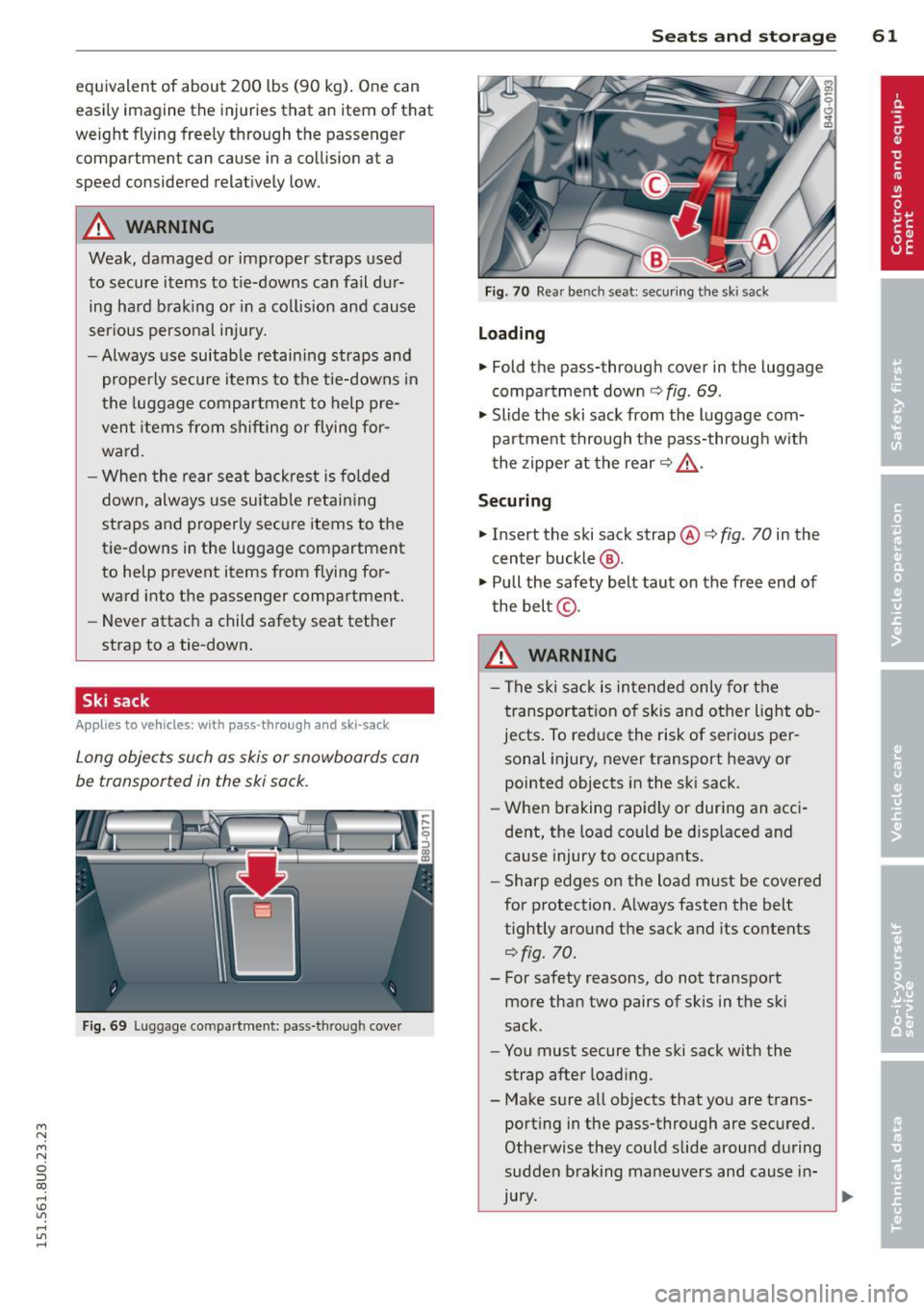
Ski sack
Appl ies to vehicles : wit h pass -t hr oug h and ski -sack
Long objects such as skis or snowboards can
be transported in the ski sack.
F ig. 69 Luggag .e compartment: pass-t hroug h cover
Sea ts a nd s to rage 61
Fig . 70 Rea r be nch seat : secu ring the ski sack
Lo ading
.. Fold the pass-through cover in the luggage
compartment down
¢ fig . 69 .
.. Slide the ski sack from the luggage com
partment through the pass-through with
the zipper at the rear ¢
,&.
Securing
.. Insert the ski sack strap@¢ fig. 70 in the
center buckle @.
.. Pull the safety belt taut on the free end of
the belt @.
8_ WARNING
-
-The s ki sack is intended only for the
transportat ion of sk is and other light ob
jects . To reduce the risk of serious per
sonal injury, never transport heavy or pointed objects in the sk i sack.
- When braking rapid ly or during an acci
dent, the load could be d isp laced and
cause injury to occupants.
- Sharp edges on the load must be covered
for protection. A lways fasten the belt
tightly around the sack and its contents
¢fig. 70.
- For safety reasons, do not transport
more than two pairs of skis in the ski
sack .
- You must secure the ski sack wit h the
strap after load ing.
- Make sure all objects that you are trans port ing in the pass-through are secured .
Otherwise they could slide around during
sudden braking maneuvers and cause in-
jury .
~
Page 70 of 258
68 On th e road
up because of intense sunlight or heat
build-up in the engine compartment.
- Always take the key with you whenever
you leave your vehicle . Otherwise, the
engine could be started or electr ica l
equipment such as the power w indows
could be operated . This can lead to seri
ous inju ry.
- Never leave children or persons requiring
ass istance unattended in the vehicle . The
doors can be locked using th e remote
transmitter, preventing people from es caping from the vehicle on their own in
the event of an eme rgency . Depend ing
on the time of year, people inside the ve
hicle can be exposed to very high or very
low temperatures.
(D Note
If the engine has been under heavy load
for an extended period, heat builds up in
the engine compartment after the engine is switched off- there is a risk of damaging
the engine. Allow the engine to r un at idle
for about two minutes before switching it off.
Convenience key
Starting the engine
Appl ies to vehicles: wit h convenience key
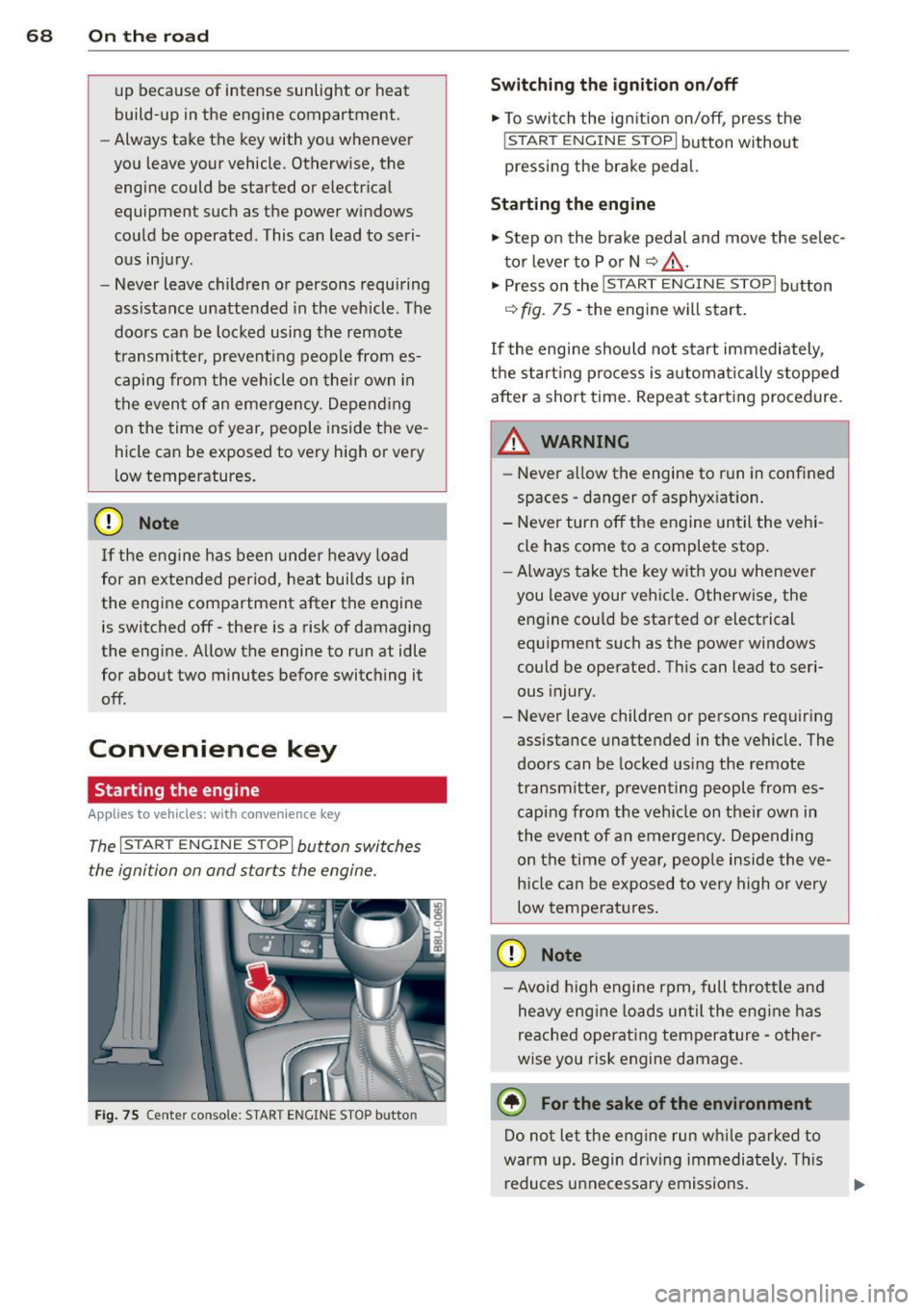
The I STAR T ENG IN E ST OPI button switches
the igni tion on and starts the engine.
Fig . 75 C en te r conso le: STAR T ENGIN E STOP b utto n
Switching the ignition on /off
"' To swi tch the ign ition on/off, press the
! S TART ENGINE STOP I button without
pressing the brake peda l.
Starting the engine
"' Step on the brake pedal and move the se lec
t o r lever to P or N
~ .&_ .
.. Press On the r::1 S::;T ;:-::A -::R :-:;;T :-: E:, N:-7"=: G":'.I N:-:-= E-=s=-= T=-=o =-= p:--i l butt On
~ fig. 75 -the engine will start.
If the engi ne should not start immediately,
t h e start ing process is automat ic all y stopped
after a short time. Repeat starting procedure.
A WARNING
=
- Never a llow the engine to run in confined
spaces -danger of asphy xiat ion .
- Never turn off the engine until the vehi cle has come to a complete stop .
- Always take the key w ith you whenever
you leave your ve hicle . Otherwise, the
engine cou ld be started or electrical
equ ipment such as the power windows
could be operated. This can lead to seri
ous injury.
- Never leave children or persons requiring
assistance unattended in t he vehicle . The
doors can be locked us ing the remote
transmitte r, preventing people from es
caping from the veh icle on their own in
t he event of a n emergency. Depe nding
on the time of yea r, peop le inside the ve
h icle can be exposed to very high or very
low temperatures .
(D Note
-Avo id high engine rpm, full thrott le and
heavy e ng ine lo ads un til the eng ine has
reached operat ing temperature -other
w ise you risk engine damage.
@ For the sake of the environment
Do not let the engine run w hile parked to
warm up. Begin dr iving immediately . Th is
reduces unnecessary emissions .
Page 71 of 258
M N M N
0 ::i co
rl I.O
"' ,....,
"' rl
@ Tips
-After starting a cold engine, there may
be a brief period of increased noise be
cause the oil pressure must first build up
i n the hydraulic valve adjusters . This is
norma l and not a cause for concern .
Switching engine off
Applies to vehicles: with conven ience key
• Bring your veh icle to a complete stop .
• Move the selecto r lever to the P or N posi
t ion.
• Press the
!S TA RT ENGINE S TO PI button
~ pag e 68, fig. 75.
Steering lock
The steering locks when you turn the engine
off us ing the
I START ENGIN E STOP I button
and ope n the dr iver 's door. The locked stee r
i n g helps preven t vehicle theft.
Emergenc y Off functi on
If necessary in an emergency, the engine can
be sw itched off while the vehicle is st ill mov
ing. Press the
I S TAR T ENG IN E ST OPI button
tw ice in quick succession or ho ld it in for lon
ger than two seconds .
_& WARNING
-Never t urn off the engine before the ve
h icle has come to a complete stop . The
full function of the brake booster and the power steering is not guaranteed. You
must use more force to turn or brake if
necessary . Because you cannot steer and
brake as you usually would, this could
lead to crashes and serious injur ies .
- For safety reasons, you should always
park your vehicle with the se lector lever
in P. Otherwise, the ve hicl e co uld inad
vertent ly roll away.
- The rad iator fan can continue to run for
up to 10 min utes even after you have
t urned off the eng ine and removed the
ignition key . The radiator fan can also
turn on again if the engine coolant heats
On th e road 69
up because of intense sunlight or heat
bui ld-up in the engine compartment.
- Always take the key with you whenever
you leave your vehicle. Otherwise, the
engine could be started or electrical
equipment such as the power windows
could be operated . This can lead to seri
ous injury.
(D Note
If the engine has been under heavy load
for an extended period, heat bu ilds up in
the eng ine compartment after the engi ne
i s sw itched off - there is a r isk of damag ing
the engine . A llow the engine to run at idle
for about two minutes before switching it
off .
Starting the engine after a malfunction
Applies to vehicles: wit h convenience key
If the remote control key battery is exhausted
or if radio interference or a system malfunc
tion o ccurs, extra steps may be necessary in
order to start the engine .
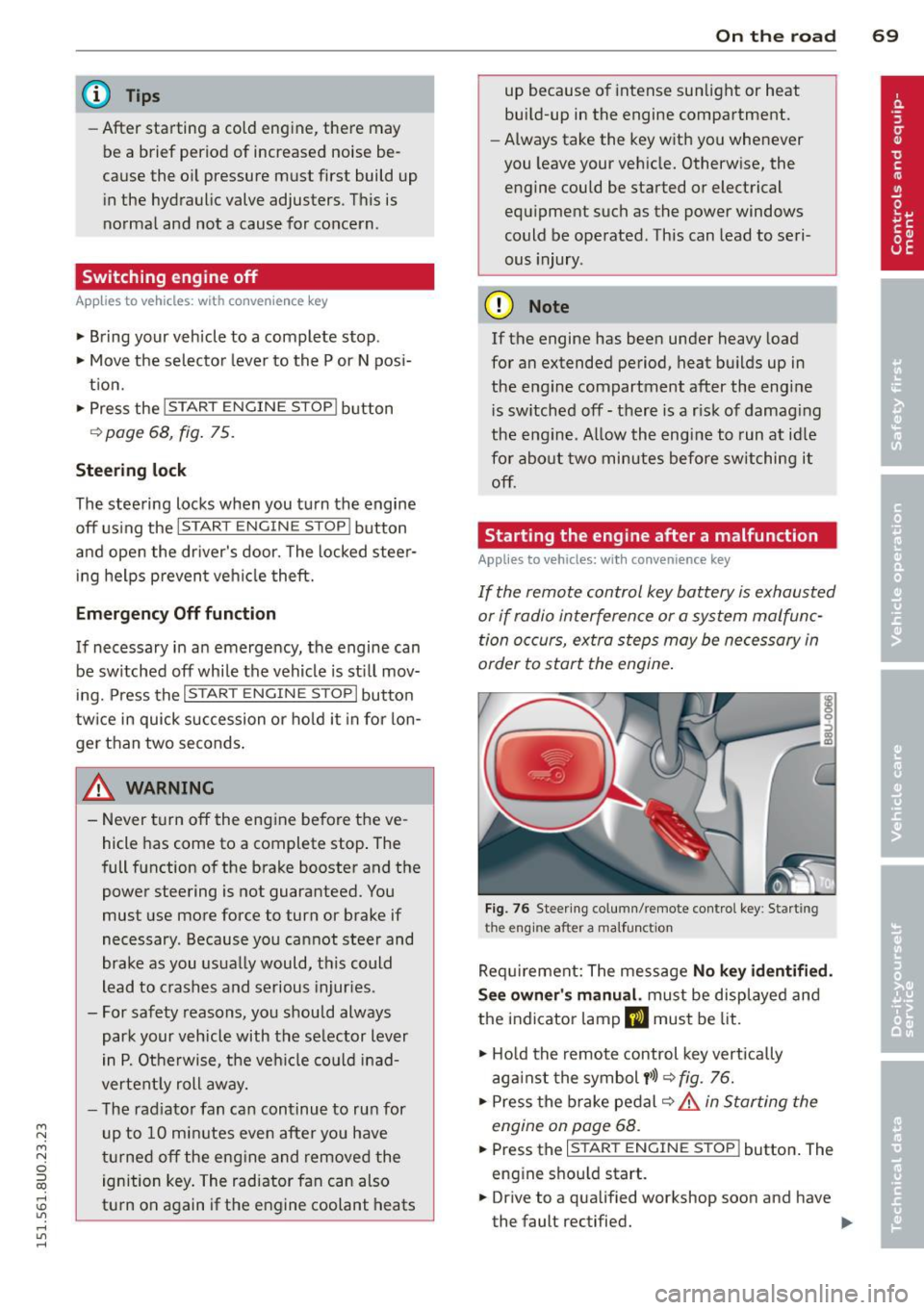
Fig. 76 Steer ing co lumn/remote contro l key : Start ing
t he en gi ne a fter a m alfu ncti on
Requ irement: The message No k ey identifi ed.
S ee owner' s manu al.
must be displayed and
the indicator lamp
m must be lit .
• Ho ld the remote control key vertically
aga inst the symbol
y >l) ~ fig . 76.
• Press the b rake pedal ~.&.
in Starting the
engin e on page 68 .
• Press the ~ I s =T -A -R =T ~ E= N~ G~IN ~ E-s=T -O ~ P~I button. The
eng ine shou ld start.
• Drive to a qualified workshop soon and h ave
the faul t rectified. .-