warning light AUDI Q3 2015 Repair Manual
[x] Cancel search | Manufacturer: AUDI, Model Year: 2015, Model line: Q3, Model: AUDI Q3 2015Pages: 258, PDF Size: 64.9 MB
Page 145 of 258
M N
M N
0 ::i co ,...., \!) ..,.,
,...., ..,., ,....,
-Children on the front seat of any car,
even with Advanced A irbags, can be seri
ous ly injured or even killed when an a ir
bag inflates.
- Never let a child stand or kneel on any
seat, for examp le the front seat.
- Never let a child ride in the cargo area of
your vehicle .
- Always remember that a ch ild lean ing
forward, sitt ing sideways or out of posi
t ion in any way during an acc ident can be
struck by a deploying airbag . This will re
sult in se rious personal injury or death .
- If you must install a booster seat on the
front passenger seat because of excep
t ional circumstances the
PASSENGER
AIR BAG OFF
light must come on and
stay on, whenever the ignition is switch
ed on.
- If the
PASSENGER AIR BAG OFF light
does not come on and stay on, perform
the checks described
¢ page 123, Moni
toring the Advanced Airbag System.
- Ta ke the child restrain t off the front pas
senger seat and install it properly at one
of the rear seat positions if the
PASSEN
GER AIR BAG OFF
light does not stay on
whenever the ignition is switched on.
- Always read and heed all WARNINGS
whenever using a child restrained in ave
hicle is being used
¢page 104, Safety
belts,¢ page 112, Airbag system
and
c:> page 133, Important things to know.
Installing a child safety
seat
Securing a child safety seat using a
safety belt
Safety belts for the rear sea ts and the fron t
passenger can be locked wi th the convertible
locking retractor to properly secure child
safety seats .
The safety belts emergency lock ing retractors
for the rear seats safety belts and for the
front passenger's seat safety belt have a con
ve rtible locking retractor for child restraints.
Child Sa fet y 143
The safety belt must be locked so that be lt
webbing cannot unree l. The retractor can be
activated to lock the safety belt and prevent
the safety belt webbing from loosening up
during normal dr iving . A child safety seat can
only be properly installed when the safety belt
i s locked so that the chi ld and child safety
seat w ill stay in place .
Always remember: Even though your vehicle is equipped with an Advanced Airbag system, all
ch ildren, especially those 12 years and young
er, shou ld always r ide in the back seat proper
ly restrai ned fo r the ir age and size.
A WARNING
Improperly installed chi ld safety seats in
crease the risk of serious personal injury
and death in a collision.
- Always ma ke sure that the safety belt re
tracto r is loc ked when installing a child
safety seat . An unlocked safety belt re
tractor cannot hold the child safety seat
in place during normal dr iving or in a
crash.
- Always buckle the child safety seat firmly
in place even if a ch ild is not sitt ing in it.
A loose child safety seat can fly around during a sudden stop or in a collision .
- Always make sure that the rear seat
backrest to which the center rear safety
be lt is attached is securely latched when
eve r the rea r center safety belt is being
used to secure a ch ild restra int.
- If the backrest is not securely latched,
the child and the child restraint will be
thrown forward together with the back rest and will strike parts of the vehicle
interior. The child can be seriously in
jured or killed.
- Never install rear-fa cing child safety
seats or infant carrie rs on the front pas
senger seat . A child will be serio usly in
jured and can be killed when the passen ger airbag inflates.
- The inflating airbag will h it the ch ild
safety seat or infant carrier with great
force and will smash the child safety seat
~
•
•
Page 146 of 258
144 Child Safety
and child against the backrest, center
armrest, door or roof.
- Always install rear-facing child safety
seats or infant carriers on the rear seat.
- Forward-facing child safety seats or in
fant carriers installed on the front pas
senger's seat may interfere with the de
ployment of the airbag and cause serious
injury to the child.
- It is safer to install a forward-facing
child safety seat on the rear seat.
- Always read and heed all WARNINGS whenever using a child restrained in ave
hicle is being used
c;,page 133. Special
precautions apply when installing a child
safety seat on the front passenger seat
¢ page 114, Child restraints on the front
seat -some important things to know.
A WARNING
Always take special precautions if you
must install a forward or rearward-facing
child restraint on the front passenger's
seat in exceptional situations:
- Whenever a forward or rearward-facing
child restraint is installed on the front
passenger seat, the
PASSENGER AIR
BAG OFF
light must come on and stay on
whenever the ignition is switched on.
- If the
PASSENGER AIR BAG OFF light
does not come on and stay on, perform
the checks described
c;, page 123, Moni
toring the Advanced Airbag System.
- Take the child restraint off the front pas
senger seat and install it properly at one
of the rear seat positions if the
PASSEN
GER AIR BAG OFF
light does not stay on
whenever the ignition is switched on.
- Improper installation of child restraints
can reduce their effectiveness or even
prevent them from providing any protec
tion.
- An improperly installed child restraint
can interfere with the airbag as it de
ploys and seriously injure or even kill the
child. -
Always carefully follow the manufactur
er's instructions provided with the child
safety seat or carrier.
- Never place additional items on the seat
that can increase the total weight regis
tered by the weight-sensing mat and can
cause injury in a crash .
A WARNING
-Forward-facing child restraints:
- Always make sure the forward-facing
seat has been designed and certified by its manufacturer for use on a front seat
with a passenger front and side airbag .
- Never put the forward-facing child re straint up, against or very near the in
strument panel.
- Always move the passenger seat into its
rearmost position in the seat's fore and
aft adjustment range, as far away from
the airbag as possible before installing
the forward-facing child restraint. The
backrest must be adjusted to an upright
position.
- Make sure that the PASSENGER AIR BAG
OFF
light comes on and stays on all the
time whenever the ignition is switched
on .
A WARNING
Rearward-facing child restraints:
- A child in a rearward-facing child safety
seat installed on the front passenger
seat will be seriously injured and can be killed if the front airbag inflates -even
with an Advanced Airbag System .
- The inflating airbag will hit the child
safety seat or infant carrier with great
force and will smash the child safety seat
and child against the backrest, center
armrest, door or roof.
- Always be especially careful if you must
install a rearward facing child safety seat
on the front passenger seat in exception-
al circumstances.
~
Page 147 of 258
M N
M N
0 ::i co ,...., \!) 1.1'1 ,...., 1.1'1 ,....,
-A tight tether strap on a rearward-facing
child restraint attached to the front pas
senger seat can put too much pressure on the weight-mat in the seat and regis
ter a heavier weight in the Advanced Air
bag System . The heavier weight regis
tered can make the system work as
though an adult were on the seat and de
ploy the Advanced Airbag when it must
be suppressed causing serious or even
fatal injury to the child .
- Make sure that the
PASSENGER AIR BAG
OFF
light comes on and stays on all the
time whenever the ignition is switched
on.
- If the
PASSENGER AIR BAG OFF light
does not come on and stay on, immedi
ately install the rear-facing child safety
seat in a rear seating position and have
the airbag system inspected by your Audi dealer.
Activating the convertible locking
retractor
Use the convertible locking retractor to se
cure a child restraint.
Always heed the child safety seat manufactur
er's instructions when installing a child re
straint in your vehicle . To activate the conver
tible locking retractor :
.. Place the child restraint on a seat, prefera
bly on the rear seat.
.. Slowly pull the belt
all the way out .
.. Route it around or through the child re
straint belt path~&_ .
.. Push the child safety seat down with your
full weight to get the safety belt really tight.
.. Insert the belt tongue into the buckle for
that seating position .
.. Guide the safety belt back into the retractor
until the belt lies flat and snug on the child
safety seat .
.. You should hear a "clicking " noise as the
belt winds back into the inertia reel. Test the
convertible locking retractor by pulling on
the belt . You should no longer be able to
Child Safety 145
pull the belt out of the retractor. The con
vertible locking retractor is now activated.
.. Make sure that the red release button is fac
ing away from the child restraint so that it
can be unbuckled quickly.
.. Pull on the belt to make sure the safety belt
is properly tight and fastened so that the
seat cannot move forward or sideways more
than one inch (2.5 cm).
_&. WARNING
Using the wrong child restraint or an im
properly installed child restraint can cause
serious personal injury or death in a crash.
- Always make sure that the safety belt re-
tractor is locked when installing a child
safety seat. An unlocked safety belt re
tractor cannot hold the child safety seat
in place during normal driving or in a
crash.
-Always buckle the child safety seat firmly in place even if a child is not sitting in it.
A loose child safety seat can fly around
during a sudden stop or in a crash.
- Always make sure the seat backrest to
which the child restraint is installed is in
an upright position and securely latched
into place and cannot fold forward . Oth
erwise, the seatback with the child safety
seat attached to it could fly forward in
the event of an accident or other emer
gency situation .
- Always read and heed all WARNINGS
whenever using a child restrained in ave
hicle is being used¢
page 133. Special
precautions apply when installing a child
safety seat on the front passenger seat
¢ page 114, Child restraints on the front
seat -some important things to know .
-
•
•
Page 151 of 258
M N M N
0 ::i co
rl I.O
"' rl
"' rl
Tether anchors and tether straps
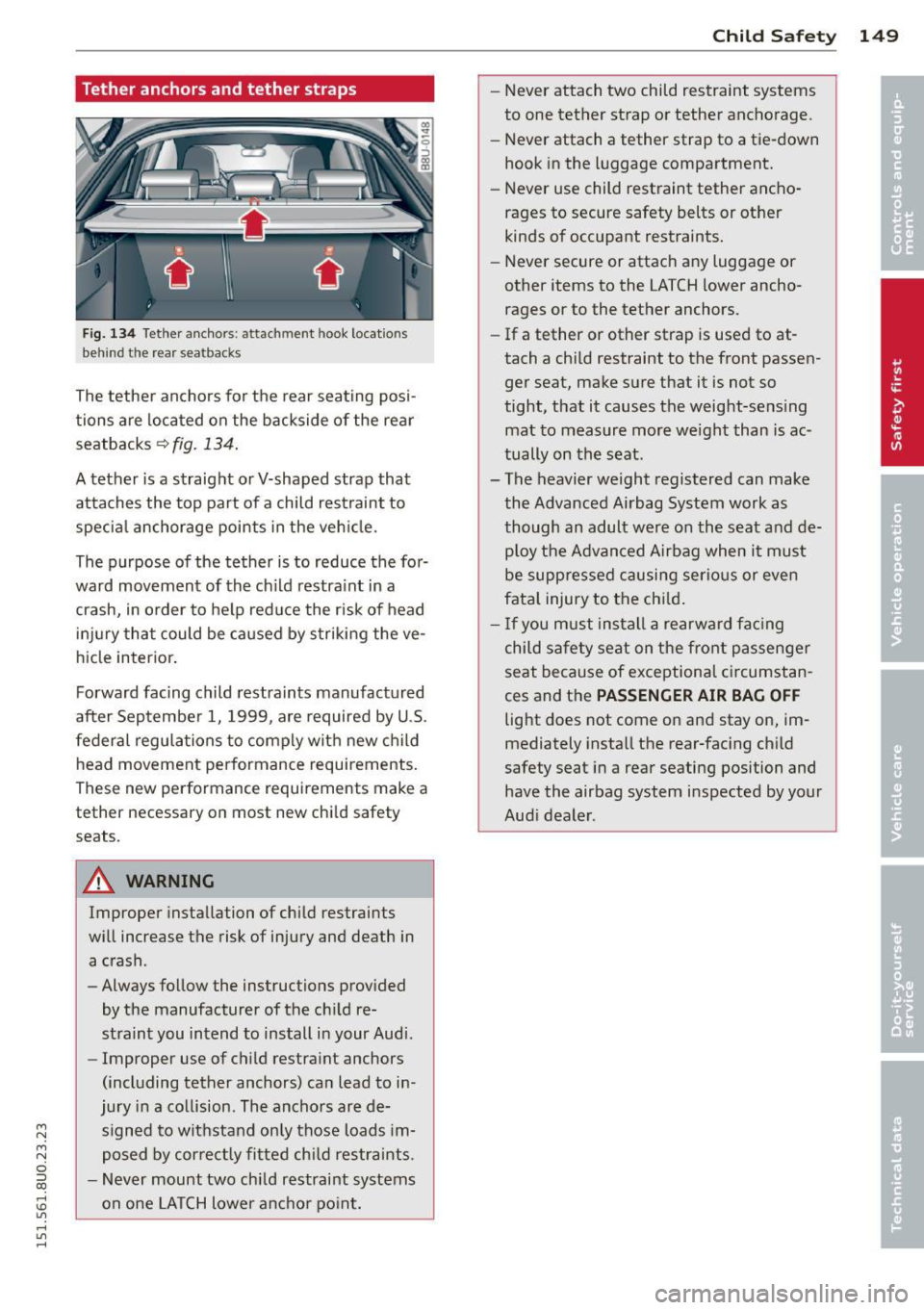
Fig. 134 Tether ancho rs: atta chment hook loc atio ns
behin d the rear s ea tb acks
The tethe r anchors for the rear seating posi
tions are located on the backside of the rear seatbacks
q fig. 134.
A tether is a straight or V-sha ped strap that
attaches the top part of a child restraint to
specia l anchorage points in the veh icle.
The purpose of the tether is to reduce the for
ward movement of the ch ild restra int in a
crash, in o rder to he lp red uce the risk of head
i nj ury that could be ca used by striki ng the ve
hicle interior.
Forward facing child restraints manufactured
after September 1, 1999, a re required by U .S.
federal regulations to comply with new c hild
head movement performance requirements.
Thes e new performance requirements mak e a
tethe r necessary on most new child safety
s eats.
A WARNING
Improper installation of child restraints
will increase the risk of injury and death in a crash .
- Always follow the instructions prov ided
by the manufacturer of the ch ild re
straint you intend to install in your Audi.
- Improper use of ch ild restra int anchors
(including tether anchors) ca n lead to in
jury in a collision. The ancho rs are de
signed to withstand only those loads im posed by correctly fitted ch ild restraints.
- Never mount two chi ld restraint systems
on one LA TCH lower ancho r po int.
Child S afety 149
-Never attach two child restraint systems
to one tether strap or tether anchorage .
- Never attach a tether strap to a tie-down
hook in the luggage compartment.
- Never use child restraint tether a ncho
rages to secure safety belts or other
kinds of occupant restraints.
- Never secure or attach any luggage or
other items to the LATCH lower ancho
rages or to the tether anchors .
- If a tether or oth er strap is used to at
tach a chi ld restraint to the front passen
ger seat, make sure that it is not so
tight, that it causes the weight-sens ing
mat to measure more we ight than is ac
tually on the seat .
- The heavier weight registered can make
the Advanced Airbag System work as
though an adult were on the seat and dep loy the Advanced Airbag when it must
be suppressed causing serious or even
fatal injury to the child .
- I f you must instal l a rearwa rd fa cing
child safety seat on the fro nt passenger
seat because of exceptional circumstan
ces and the
PASSENGER AIR BAG OF F
light does not come on and stay on, im
mediately insta ll the rear -fac ing child
safety seat in a rear seating position and have the airbag system inspected by your
Aud i dealer .
Page 152 of 258
150 Child S afe ty
Installing the upper tether strap on the
anchorage
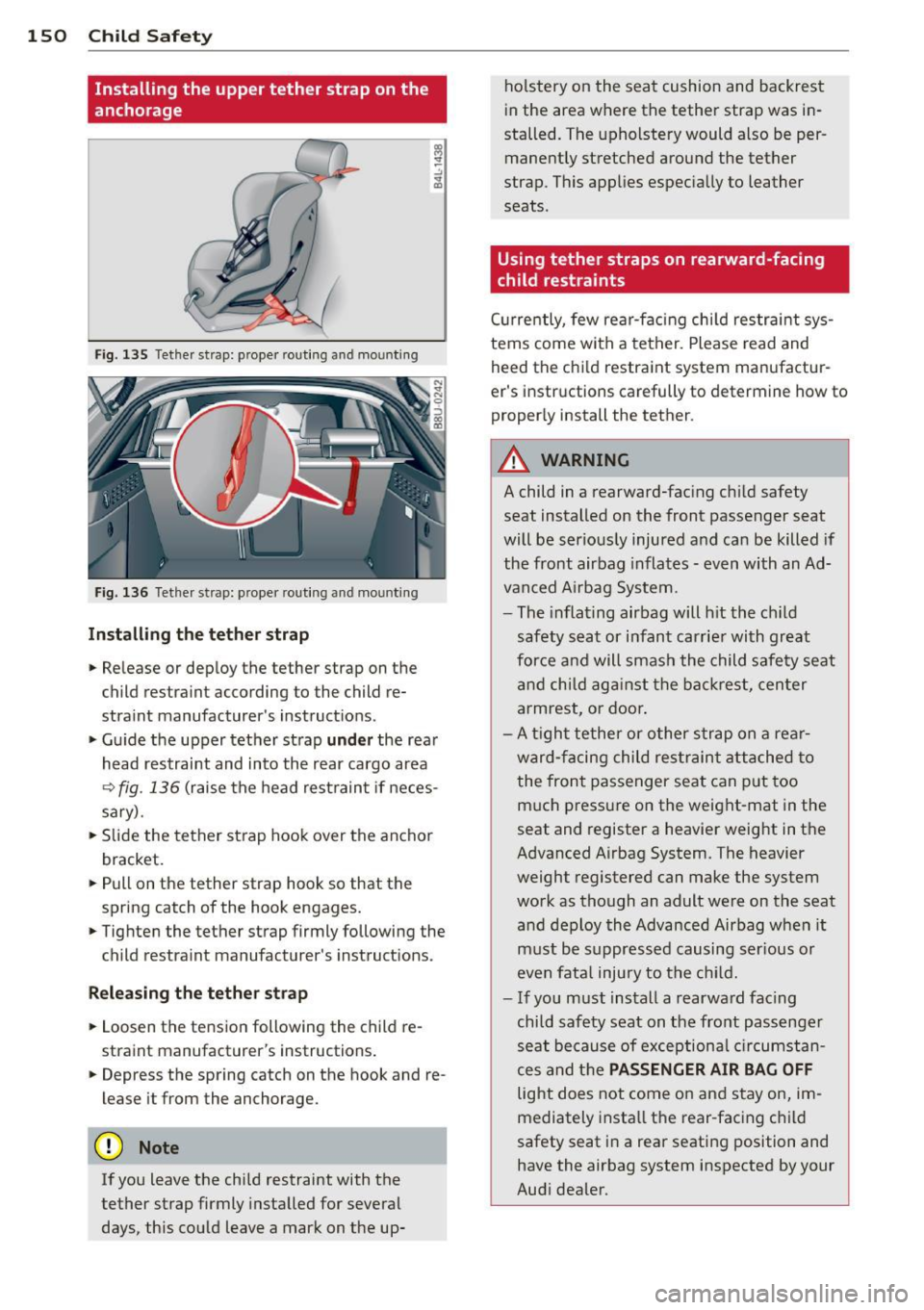
Fig. 135 T ether strap: proper routing and mounting
Fig. 136 Tether strap: proper rou ting and moun ting
In sta ll ing the te th er strap
• Release or deploy the tether strap on the
child restraint according to the child re
stra int manufacturer's instructions .
• Gu ide the upper tether strap
und er the rear
head restraint and into the rear cargo area
Q fig. 136 (raise the head restraint if neces
sary).
• Slide the tether strap hoo k over the anchor
bracket.
• Pull on the tether strap hook so that the
spring catch of the hook engages.
• Tighten the tether strap firmly following the
child restra int manufacturer's instruct ions .
Releasin g the t ethe r stra p
• Loosen the tens ion following the child re
straint manufacturer's instructions .
• Depress the spring catch on the hook and re
lease it from the anchorage.
@ Note
If you leave the child restraint with the
tether strap firmly installed for several
days, this could leave a mark on the up- ho
lstery on the seat cushion and backrest
in the area where the tether strap was in
stalled. The upholstery would also be per
manently stretched around the tether
strap. This applies espec ia lly to leather
seats.
Using tether straps on rearward-facing
, child restraints
Currently, few rear-fac ing ch ild restrai nt sys
tems come with a tether. Please read and
heed the child restraint system manufactur
er 's instructions carefully to determine how to
proper ly install the tether.
A WARNING
= -A child in a rearward-fac ing ch ild safety
seat installed on the front passenger seat
will be seriously injured and can be killed if
the front airbag inflates -even with an Ad
vanced A irbag System.
- The inflating airbag will h it the ch ild
safety seat or infant carrie r with great
force and will smash the child safety seat and child aga inst the ba ckrest, center
armrest, or door .
- A t ight tethe r or other strap on a rear
ward-facing child restraint attached to
the front passenger seat can p ut too
much pressure on the weight-mat in the
seat and register a heavier weight in the
Advanced Airbag System. The heavier
weight registered can make the system
work as though an adult were on the seat
and deploy the Advanced Airbag when it
must be suppressed causing ser ious or
even fata l inju ry to the ch ild.
- If you must install a rearward fac ing
child safety seat on the front passenger
seat because of exceptiona l circumstan
ces and the
PASSENGER AIR BAG OFF
light does not come on and s tay on, im
mediately insta ll the rear-facing c hild
safety seat in a rear seating position and have the airbag system inspected by your
Aud i dealer.
Page 156 of 258
154 Intellig ent technolog y
Anti-slip r egulation (ASR )
ASR reduces engine power when the drive
wheels begin to spin and adapts the force to
the road conditions. This makes it easier to
start, accelerate and drive up hills.
Electronic diffe rential lock (EDL )
The ED L brakes wheels that are spinn ing and
transfers the drive power to the o ther d rive
wheel or whee ls if the vehicle is equipped with
all-wheel drive* . This function is available up
to about 60 mph (100 km/h).
I n extreme cases , ED L automat ica lly switches
off to help keep the brake on the braked whee l
from overheating . EDL wi ll switch on again au
tomatically when conditions have returned to normal.
El ectron ic inte ra xle diff ere ntial lock */
se lec tive wheel t orque contr ol*
The electronic interaxle differential lock (front
wheel drive) or the select ive wheel torque
control (all-wheel drive) operates when driv
ing through curves. The front wheel on the in·
side of the curve or both wheels on the inside
of the curve are braked select ively as needed .
This minimizes s lid ing in the front wheels a nd
allows for more p rec ise driving through
curves. The app licab le system may not acti
vate when driving in wet or snowy conditions .
A WARNING
-ESC, ABS, ASR, EDL, the electronic inter
axle differentia l lock* /selective whee l
torque control* and the hill descent as
sist cannot overcome the laws of physics.
Th is is especially important on slippery
o r wet roads . If the systems begin acting to stabilize your vehicle, you should im
mediately change your speed to match
the road and traffic conditions. Do not let the increased safety provided by
these systems tempt you to take r isks .
Doing so will increase the risk of a loss of
veh icle cont ro l, collision and ser ious per
sonal injur ies.
- Always adapt your speed to road, traffic
and weather conditions. The risk of los
ing control of the vehicle increases when
driving too fast , espec ially through
curves and on slippery or wet roads, and
when driving too close to vehicles up
ahead. ESC, ABS, the brake ass ist sys
tem, ASR, EDL and the electronic inter
axle d ifferential lock*/selective wheel
torque control* cannot prevent colli
sions .
- Always accelerate with special care on
even, smooth surfaces such as those that
are wet or covered with ice and snow .
The drive wheels can spin even w ith
these assistance systems t hat cannot al
ways he lp to reduce the risk of loss of ve
hicle control.
(D Tips
- ABS and ASR only wo rk correct ly when
all four wheels are equipped with identi
cal tires. D ifferent tire sizes can lead to a
reduction in engine power.
- You may hear noises when the systems
described are working .
-If the ind icator light DJ or Ell (USA
mode ls)/ lCO)J
page 16.
Page 157 of 258
M N M N
0 ::i co
rl I.O
"' ,....,
"' rl
Intelligent technolog y 155
Switching on /off
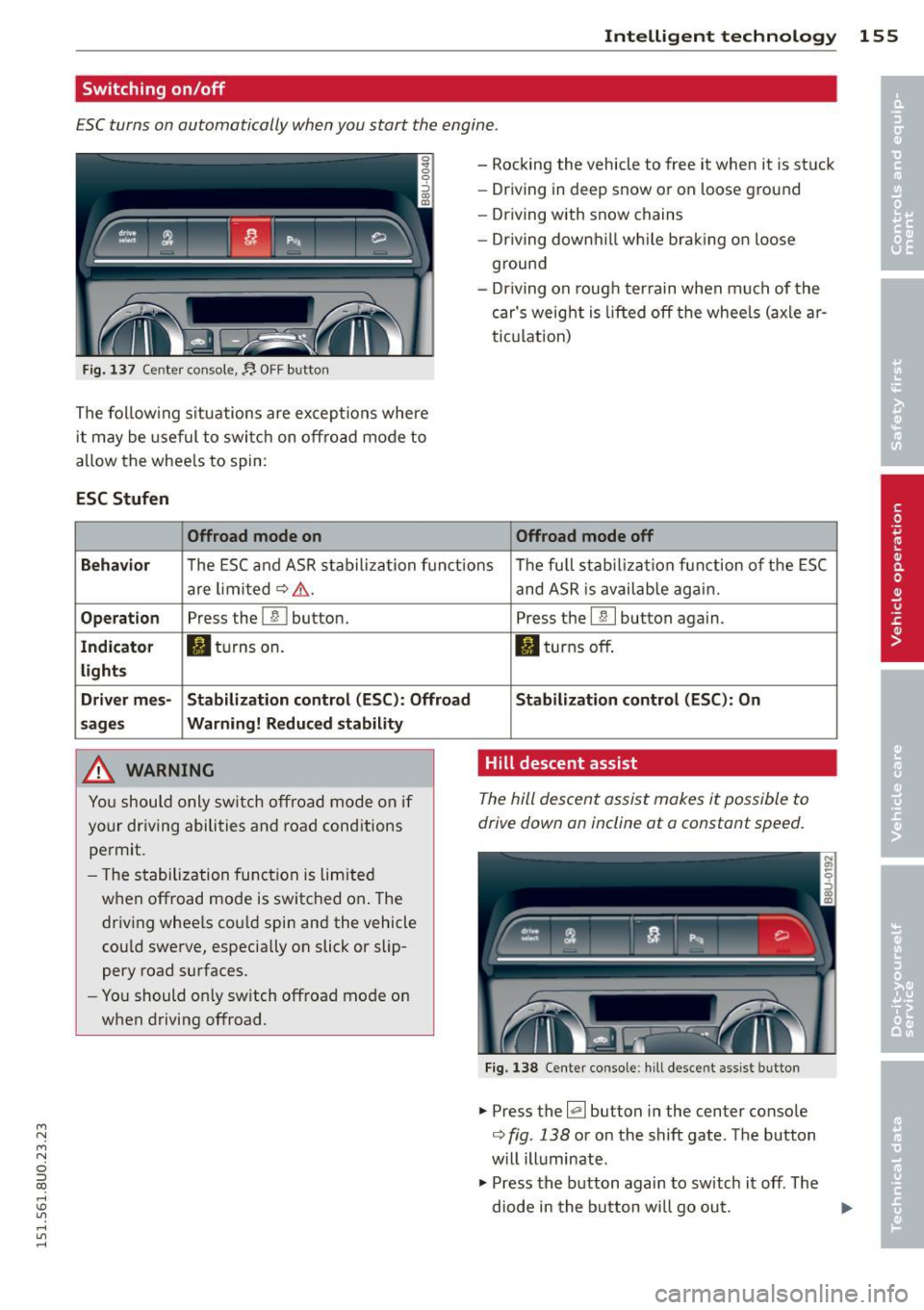
ESC turns on automatically when you start the engine .
Fig. 137 Center console,~ OFF button
The follow ing s ituations are excep tions where
it may be useful to switch on offroad mode to
allow the whee ls to spin:
E SC Stufen
Offroad mode on
-Rocking the vehicle to free it when it is stuck
- Driving in deep snow or on loose ground
- Driving with snow chains
- Dr iving downh il l wh ile brak ing on loose
ground
- Dr iving on rough terrain when much of the
car's weight is lifted off the whee ls (axle ar
tic ulat ion)
Offro ad mode off
Beha vio r
The ESC and ASR stabiliza tion funct ions The fu ll stab iliza tion f unction of the ESC
are limited¢ &..
Op erat ion Press the W button.
Indicat or Bturns on.
light s
Dr ive r m es- Sta biliza tion control (ESC ): Offroad
s age s Warning! Redu ced stab ilit y
_& WARNING
Yo u should only sw itch offroad mode on if
your driving abilities and road conditions
permit.
- T he stabilization function is limited
when offroad mode is switched on . The
driving whee ls cou ld spin and the vehicle
cou ld swerve, especially on slick or slip
pery road surfaces.
- You should on ly sw itch offroad mode on
when driving offroad. and ASR
is available again.
Press the
W button again.
II turns off .
Stabilization contr ol (ESC ): On
Hill descent assist
The hill descent assist makes it possible to
drive down an incline at a constant speed.
Fig. 138 Cente r console : hill desce nt assist button
.,. Press the [el button in the center conso le
¢ fig. 138 or on the shift gate. The button
w ill illuminate.
.,. Press the button again to switch it off. The
diode in the button will go out.
IJi,,-
Page 158 of 258
156 Intellig ent technol ogy
Hill descent assist brakes a ll four wheels auto
matica lly in order to limit speed when driving
e ither forward or reverse on hills with a grade
up to approximately 50%.
When the hi ll descent assist is on, the current
driving speed, when your vehicle entered the incline is maintained . It is only possib le to
switch on the assist when driving slower than
37 mph (60 km/h). The assist works between
approximately 2 and 19 mph (4 and 30 km/ h) . T he driver can increase or decrease the ve
h icle speed w ith in these lim its by depressing
the accelerato r o r brake pedal In addition, ve
h icle steerability is increased d ue to the brak
ing d istribution when driving in reverse .
There must be however sufficient ground ad hes io n. The hill descent assis t can
no t do its
job if the incl ine is icy or if the incline ground
is loose¢ &..
The system does not work at speeds between 19 and 37 mph (30 and 60 km/h) . T he system
i s then in the ready-mode . The diode in the
button will come on. The system automatical
ly switched off when you drive faster than 37
mph (60 km/h). The diode will go out in this
case.
The flashing indicator lamp
-0-in the instru
ment cluster indicates whenever the driving
speed is being actively controlled to a certain
speed up to approximate ly 19 mph (30 km/h) .
The indicator lamp lights up continuously
when the system goes into standby mode.
Hill descent assist is automatically activated
under the fo llow ing cond itions:
- the d iode in the button illuminates,
- vehicle speed is be low approximately
19 mph (30 km/h)
- the in cl in e is 10%.
_&, WARNING
- Always adapt your speed to the weather,
road and traffic conditions . Do not let
the increased safety provided tempt you
into taking risks. -
The hill descent assist system cannot
overcome the laws of physics. Your dr iv
ing style must always be adapted to the
current road and traffic cond itions .
- The hill descent ass ist may not be ab le to
hold your vehicle at a constant speed un
de r all conditions while driv ing on an in
cline (for example if ground under the
veh icle is loose).
Braking
What affects braking efficiency?
New br ake p ad s
During the first 250 miles (400 km), new
brake pads do not possess the ir full brak ing
effect, they have to be "broken in" first ¢&. .
You can compensate for this slightly reduced
braking power by pushing harder on the brake
pedal. Avoid heavy b ra ki ng loads dur ing the
break-in pe riod.
Operating conditions and driving h abits
The brakes on today 's automobiles are still
subjec t to wear, depending largely on operat
i ng condit ions and driving hab its
~ &. -On
vehicles that are either dr iven mos tly in stop
and -go city t ra ffi c or are dr iven hard, the
brake pads should be chec ked by your author
ized Audi dea ler mo re often than specified in
the
Warranty & M aintenan ce booklet. Failure
to have your brake pads inspected can result in reduced brake performance.
On steep slopes, you sho uld use the braking
effect of the eng ine. This way, you prevent un
necessary wear on the brake system. If you
must use your brakes, do not hold the brakes
down cont inuous ly . Pump the brakes at inter
vals .
Oper ating n ois e
Noises may occur when braking depending on
the speed, braking force and outside condi-
tions such as temperature and humidity. .,,.
Page 161 of 258
with all-wheel drive¢ page 211, Snow
chains .
Replacing wheels /tire s
Vehicles w ith all-wheel drive mus t always
h ave tires o f the same size. Also avoid t ires
with different tread depths. For details see
page
c::> page 206, New tires and replacing
tires and wheels.
A WARNING
Always adjust your driving to road and traf
fic condit ions. Do not let the extra safety
afforded by all-wheel drive tempt you into
taking extra risks.
- Although the all-wheel dr ive is very ef
fective, always remember that braking capacity is limited by t ire traction . You
should therefore not dr ive at excess ive
speeds on icy or slippery road surfaces.
- On wet road surfaces, be careful not to
dr ive too fast because the front wheels
c ou ld beg in to s lide on top of the water
(aquaplaning). If this sho uld oc cur, you
will have no warning from a sudden in crease in engine speed as with a front
wheel drive vehicle. A lways drive at
speeds which are suited to the road con
ditions -risk of crash.
Energy management
Starting ability is optimized
Energy management controls the distribution
of electrical energy and thus optimizes the
availability of electrical energy for starting
the engine .
If a vehicle with a conventional energy system
is not driven for a long period of time , the bat
tery is discharged by idling cu rrent consumers
(e.g. immobilizer). In ce rtain c ircumstances it
can result in there being insufficient energy
M avai lab le to start the engine . N
M N
0 ::i co ,...., \!) 1.1'1 ,...., 1.1'1 ,....,
Intelligent energy management in your veh i
cle handles the d istribution of elec trical ener
gy . Starting abi lity is markedly improved and
the life of the battery is extended .
Intellig ent technolog y 159
Basica lly, energy management consists of
b att ery diag nosis , id lin g cur rent man age
ment
and dyn amic en ergy m anag ement.
Batte ry diagnosis
Battery diagnosis continuously determines
the state of the battery . Sensors determine
battery voltage, battery current and battery
temperature . This determines the current
state of charge and the power of the batte ry .
Idlin g current manag ement
Id ling current management reduces energy
consumption while the vehicle is standing.
With the ig nition switched off, it controls the
energy supply to the various electrical compo nents. Data from battery diagnosis is cons id
ered.
Depending on the battery's state of charge ,
individual consumers are gradually turned off
to prevent excessive discharge of the batte ry
and thus maintain starting capability .
Dynamic energy manag ement
While the vehicle is being driven, dynamic en
ergy management distributes the energy gen
erated according to the needs of the individ u
al components . It regulates consumption, so
that more electrical energy is not being used
than is being generated and ensures an opti
mal state of charge for the battery .
(D Tips
-But even energy management cannot
negate the limits of physics. Consider
that the power and life of a battery are
limited.
- If start ing ability is threatened, the indi
cator light (•) ;ippears
c::> page 15.
What you should know
The highest priority is given to maintaining
starting capability .
The battery is severe ly taxed in short-distance
driving , in ci ty traff ic and during the cold time
of year . Abundant electrical energy is .,.
•
•
Page 162 of 258
160 Intelligent technology
required, but on ly a little is generated. It is al
so critical if the engine is not running and
e lectrical components are turned on. In this
instance energy is being consumed but none
is being genera ted.
It is in precisely these situations that you wi ll
notice energy management actively regulat
ing the distrib ution of energy.
Vehicle stands fo r an e xte nded p eriod
If yo u do not drive you r vehicle over a pe riod
of severa l days or weeks, elect rical compo
nents are grad ually cut back or switched off.
This reduces energy consumption and main
tains starting capab ility over a longer period.
Some of the conven ience functions may not
operate, such as the inter ior lig hts or the
power seat adjustment . Th e conven ience
functions w ill be ava ilable again when you
switch on the igni tion and start the engine.
With the engine turned off
If you listen to the radio, for example, with
the eng ine turned off or use other MMI func
tions, the ba tte ry is being d ischarged .
If starting capability is jeopardi zed due to en
ergy consumpt ion, an error message appears
in the MMI display .
The warning message indicates that the sys
tem will be turned off automat ically. If you
wish to continue using the functions , you have
to start the engine .
With the engine running
Altho ugh electrical energy is generated when
the vehicle is being driven, the battery can be
come discharged . T hi s happens most ly when
little energy is be ing generated and a great
deal consumed and the battery 's state of
cha rge is not optimal.
To br ing the energy balance back into equili
brium, consumers which require especia lly
large amounts of energy are tem pora rily cut
back o r switched off . Heati ng sys tems in par
ticular requ ire a g reat dea l of energy. If you
n otice, fo r example , that the heated se ats* or
the heated re ar window are not hea ting, they have been tempora
rily cut back or switched
off. These systems wi ll be available again as
soon as the energy balance has been restored .
You w ill also no tice th at engine id le speed h as
been increased slightly. This is normal and not
a cause for concern . By inc reasing engine id le
speed the additional energy required is gener
ated and the battery is charged.