air condition AUDI Q3 2016 User Guide
[x] Cancel search | Manufacturer: AUDI, Model Year: 2016, Model line: Q3, Model: AUDI Q3 2016Pages: 252, PDF Size: 62.81 MB
Page 118 of 252
Airbag system
Front airbags
Description of front airbags
The airbag system can provide supplemental
protection to properly restrained front seat occu
pants .
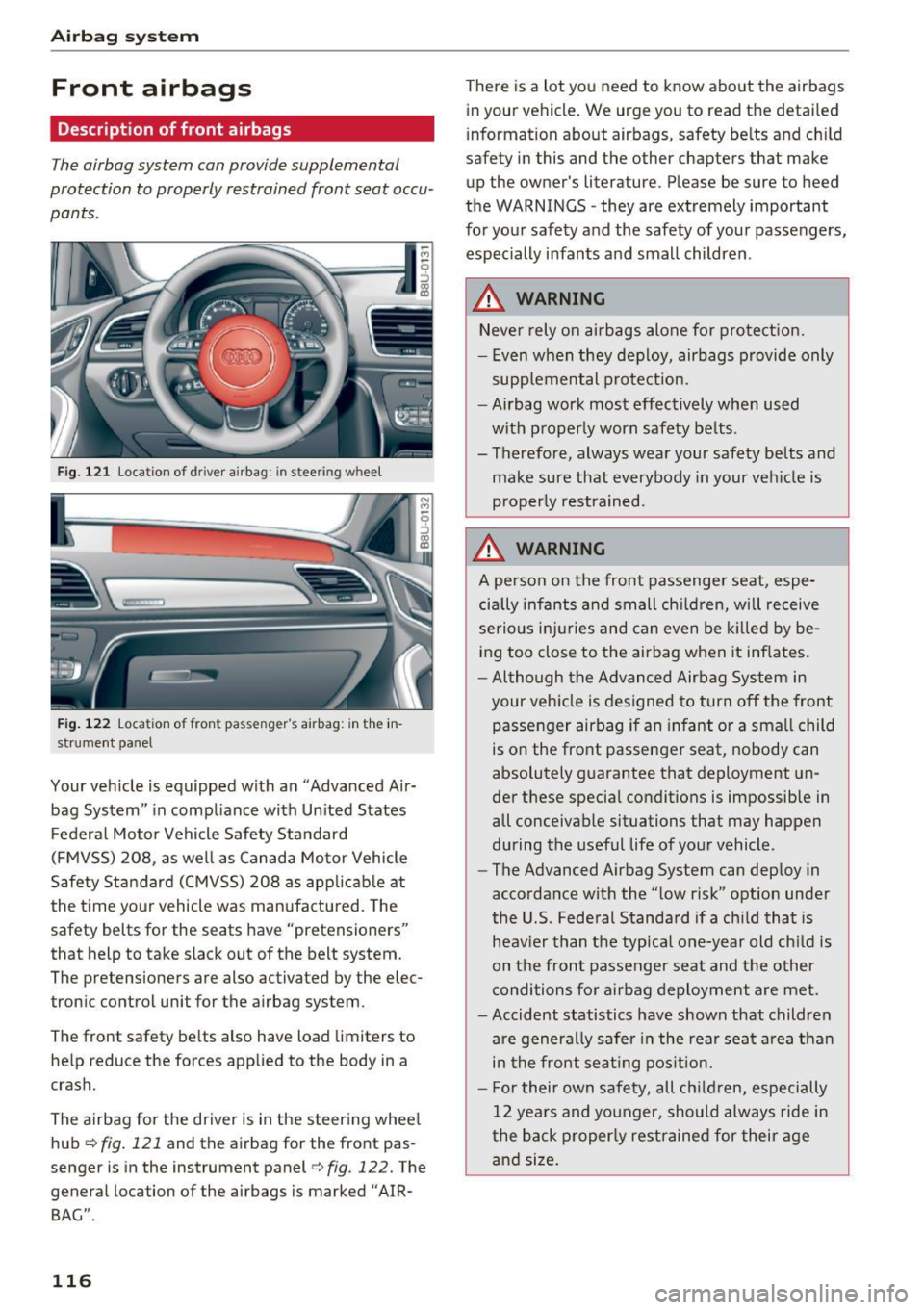
Fig. 121 Location of d river airbag : in steer ing w hee l
Fig. 122 Location of front passenger's airbag: in the in
strument panel
Your veh icle is equipped with an "Advanced Air
bag System" in compliance with Un ited States
Federal Motor Vehicle Safety Standard
(FMVSS) 208, as well as Canada Motor Vehicle
Safety Standard (CMVSS) 208 as applicable at
the time your vehicle was manufactured. The
safety belts for the seats have "pretensioners"
that help to take slack out of the belt system .
The pretensioners are also activated by the elec
tronic control unit for the airbag system.
The front safety be lts also have load limiters to
help reduce the forces applied to the body in a
crash.
The airbag for the driver is in the steering wheel
hub <=>
fig. 121 and the airbag for the front pas
senger is in the instrument panel
<=>fig. 122. The
general location of the airbags is marked "AIR
BAG".
116
There is a lot you need to know about the airbags
in your vehicle . We urge you to read the detai led
i nformation about airbags, safety belts and ch ild
safety in this and the other chapters that make
up the owner's literature. Please be sure to heed
the WARNINGS -they are extremely important
for your safety and the safety of your passengers,
especially infants and small children .
.&_ WARNING -
Never rely on airbags alone for protection.
- Even when they deploy, airbags provide only
supp lemental protection.
- Airbag work most effectively when used
with properly worn safety belts .
- Therefore, always wear your safety belts and make sure that everybody in your vehicle is
properly restrained .
.&_ WARNING
A person on the front passenger seat, espe
cially infants and small ch ildren, wi ll receive
serious injuries and can even be killed by be
ing too close to the airbag when it inf lates.
- Although the Advanced Airbag System in
-
your vehicle is designed to turn off the front
passenger airbag if an infant or a small child
is on the front passenger seat, nobody can
absolutely guarantee that deployment un
der these special conditions is impossible in
all conceivable situations that may happen
during the useful life of your vehicle.
- The Advanced Airbag System can deploy in
accordance with the "low risk" option under
the U.S. Federal Standard if a child that is
heav ier than the typical one-year old ch ild is
on the front passenger seat and the other
conditions for airbag deployment are met.
- Accident statistics have shown that children
are generally safer in the rear seat area than
in the front seating pos ition.
- For their own safety, all children, especially
12 years and younger, should always ride in
the back properly restrained for their age
and size.
Page 125 of 252
The PASSENGER AIR BAG O FF light is located in
the c enter of the instrument panel¢
fig. 124 .
The PASS ENGER AIR BAG OFF light will come on
and stay on to tell you when the front Advanced
Airbag on the passenger side has been turned off
by the el ectronic control unit . Each time you turn
on the ignition, the
P ASSENGER AIR BAG OFF
light will flash for a few seconds and:
- will stay on if the front passenger seat is not
occupied,
- will stay on if the re is a sma ll child or child re
straint on the front passenger seat,
- wi ll go out if the front passenge r seat is occu
pied by an adult as registered by the weight
sensing mat .
The
PA SSENGER AIR BAG O FF light mu st c ome
on and sta y on
if the igni tion is on and
- a car bed has been insta lled on the front seat,
o r
- a rearward-facing child restrai nt has been in
stalled on the front passenger seat , or
- a forward -facing child restra int has been instal
led on the front passenger seat, or
- the weight reg istered on the front passenger
seat is equal to or less than the comb ined
weight of a typical 1 yea r-o ld restrained in one
of the rear-facing or forward-fac ing infant re
strain ts listed in Federal Motor Vehicle Safety
Standard 208 w ith which the Advanced A irbag
System in your vehicle was certified.
I f the front passenger seat is no t occupied, the
fron t air bag w ill not deploy, and the
PASSENGER
AIR BAG OFF
light will stay on . Never install a
rearward -fac ing child restraint on the front pas
senger s eat, the safest p lace for a child in any
kind of child restraint is at one of the seating po
sitions on the rear seat ¢
page 113, Child re
s train ts on the front sea t-some impor tan t
things to know
and ¢ page 132, Child safety .
If the PASSENGER AIR BAG OFF light comes on
when one of the conditions listed above is met,
be sure to check the light regularly to make cer
tain that the
PASSENGER AIR BA G OFF light
stays on cont inuously whenever the ign ition is
on . If the
PASSENGER A IR BAG OFF lig ht does
Airb ag sys tem
not appear and not stay on all the time, stop as
soon as it is safe to do so and
- react ivate the system by tur ning t he ignit ion
off and then t urn ing it on again ;
- remove and re insta ll the chi ld restrain t. M ake
sure that the chi ld restraint is properly ins ta l
led and that the safety belt for the front pas
senger seat has bee n correct ly routed around
the child restraint as desc ribed in the c hild re
straint manufacture r's instruct ions;
- make sure that the convertible locking retrac
tor on the safety belt for the front passenge r
seat has been activated and that the safety belt
has been pulled tight. The belt must not be
loose or have loops of slack so that the sensor
below the safety belt latch on the seat can do
its job ¢
page 141 .
-make sure that th ings that may increase the
weight of the child and ch ild safety seat are not
be ing transported on the front passenger seat ;
- make sure that the safety belt tens ion sensor is
not b locked . Shake the safety belt la tch on the
front passenger seatback and fo rth ;
- If a strap or tether is being used to tie the child
safety seat to the front passenger seat, make
sure that it is not so tight t hat i t causes the
weight-sensing mat to me asu re more weight
than is actua lly on the sea t.
If the PASSENGER AIR BAG OFF light still do es
not come on
and does not stay on co nti nuously
(whe n the ignition is switched on),
- take the child restraint off the front passenge r
seat and install it p roper ly at one of the rear
seat pos itions . Have the airbag system inspect
ed by yo ur au thori zed Audi deale r immedi ately .
- move the child to a rear seat pos ition and ma ke
sure that t he chi ld is proper ly rest rained in a
child restra int that is appropr iate for its s ize
and age .
T he
PASSENGER AIR BAG OFF lig ht should NOT
come on when the ignit io n is on and an adu lt is
s itting in a prope r seat ing pos ition on the front
passenge r seat. If the
PASSENGER AIR BAG OFF
light comes on and stays on or flashes for about
5 seconds whi le dr iv ing, under these c ircumstan-
ces, make sure that :
Ill-
123
Page 134 of 252
Child safety
Child safety
Important information
Introduction
The rear seat is generally the safest place in a
collision .
The physical principles of what happens when
your vehicle is in a crash apply also to children
¢ page 105, What happens to occupants not
wearing safety belts? .
But unlike adults and
teenagers, their muscles and bones are not fully
developed. In many respects children are at
g reater r isk of serious injury in crashes than
adults .
Because children's bodies are not fully devel
oped, they require restraint systems especially
des igned for their size, weight, and body struc
ture. Many countries and all states of the United
States and provinces of Canada have laws requir
ing the use of approved child restraint systems
for infants and small children .
I n a frontal crash at a speed of 20-35 mph
(30-56 km/h) the forces acting on a 13 -pound
(6 kg) infant will be more than 20 times the
weight of the child. This means the weight of the child would suddenly be more than 260 pounds (120 kg) . Under these conditions, only an appro
priate child restraint properly used can reduce
the risk of serious injury . Child restra ints, like
adu lt safety belts, must be used properly to be
effect ive. Used improperly, they can increase the
risk of serious injury in an acc ident.
Consult the child safety seat manufacturer's in
structions in order to be sure the seat is right for
your child's size¢
page 135, Important safety
instructions for using child safety seats .
Please
be sure to read and heed all of the impo rtant in
formation and WARNINGS about child safety,
Advanced Airbags, and the installation of child
restraints in this chapter.
There is a lot you need to know about the Ad
vanced Airbags in your vehicle and how they work
when infants and children in child restraints are
on the front passenger seat . Because of the large
amount of important information, we cannot re-
132
peat it all here. We urge you to read the detailed
information in this owner's manual about airbags
and the Advanced Airbag System in your vehicle and the very important information about trans
porting children on the front passenger seat.
Please be sure to heed the WARNINGS - they are
extremely importa nt for your safety and the safe
ty of your passengers, especia lly infants and
small chi ldren.
.&_ WARNING
- Accident statistics have shown that children
are generally safer in the rear seat area than
in the front seating position. Always restrain
any child age 12 and under in the rear.
- All vehicle occupants and especially children
must be restrained properly whenever riding
in a vehicle. An unrestrained or improperly
restrained child cou ld be injured by striking
the inter ior or by being ejected from the ve
hicle during a sudden maneuver or impact.
An unrestrained or improperly restrained
child is a lso at greater r isk of injury or death
through contact w ith an inf lating airbag.
- A suitable ch ild restraint properly installed
and used at one of the rear seating positions
provides the highest degree of pro tect ion
for infants and small children in most acci
dent sit uations.
.&_ WARNING
Children on the front seat of any car even with
Advanced Airbags can be seriously injured or
even killed when an airbag inflates. A child in
a rearward-facing chi ld safety seat installed
on the front passenger seat will be seriously injured and can be killed if the front airbag in
flates.
- The inflating airbag will hit the child safety
seat or infant carr ier with great force and
w ill smash the child safety seat and child
aga inst the backrest , center armrest, or
door.
- Always install rear-facing child safety seats
on the rear seat.
- If you must install a rearward facing child
safety seat on the front passenger seat in
Page 152 of 252
Intelligent Technology
Intelligent Technology
Notice about data
recorded by the Event
Data Recorder and
vehicle control modules
Event Data Re corder
This vehicle is equipped wi th an Event Data Re
corder (EDR) . The main purpose of an E DR is to
record, in certain crash or near crash -like situa
tions, such as an airbag deploym ent or h itting a
road obstacle, data that will assist in understand
ing how a veh icle 's systems performed . The EDR
is designed to record data related to veh icle dy
namics a nd safety systems for a sho rt period of
time, typically 30 seconds or less . The E DR in this
veh icle is designed to reco rd s uch data as :
- How various systems in your vehicle were oper
at ing;
- Whether or not the driver and passenger safety
belts were buckled/fastened;
- How far ( if at all) the driver was depressing the
acce lerator and/or brake peda l; and,
- How fast the ve hicle was trave ling.
These data can help provide a better understand ing of the ci rc u mstances in which c rashes and in
juries occur. NOT E: EDR data are recorded by yo ur
veh icle only if a non-trivia l crash situat ion occurs;
no data are recorded by the EDR under normal
driving conditions and no personal data (e .g .,
name, gender, age, and crash location) a re re
corded . H owever , other pa rties , such as law en
forcement, cou ld combine the EDR data w it h the
type o f person ally identifyi ng dat a routine ly ac
qu ired dur ing a crash invest igat ion .
To read data reco rded by an EDR, specia l equip
men t is req uire d, and access to the veh icle or the
E DR is needed. In ad dition to the vehicle manu
facturer, other parties, s uch a s law enforcement,
that have t he specia l equipment, can read the in
formation if they have access to the vehicle or the E DR.
Some s tate laws restrict the re trieva l or down
loading of data stored by ED Rs insta lled in a vehi
cle fo r the express purpose of retrieving data af -
150
ter an accident or crash event withou t the own
er 's consent.
Audi will not access the EDR and /or sim ilar data
o r g ive it to others -
- unless t he ve hicle ow ner (o r lessee if the vehi
cle has been leased) ag rees; o r
- upon the offic ial request by the police; or
- upon the order of a court of law or a govern-
ment agency; or
- for the defense of a lawsuit through the jud icia l
discovery process.
- Audi may also use the data for research about
veh icle operation and safety perfo rmance or
prov ide the data to a th ird party for research
purposes w itho ut identify ing t he specific vehi
cle or info rmat ion about the ident ity of its own
er or lessee and only afte r th e re co rded vehicle
d ata has been a ccessed.
Vehicle control modules
You r vehicle is also equ ipped with a number of
e lectronic cont rol modules for va rious vehicle
syste ms, such as engine ma nagement, em iss io n
contro l, air bag s, a nd safety be lts.
These electronic control modules record data
dur ing norma l vehicle operation t hat may be
n eeded by tra ined techn ic ians for d iagnost ic and
r ep air pur poses. The re cording capab ility of these
modules is lim ited to dat a (no sou nd is recor d
ed). Only a sma ll amount of data is actually re
corded over a very limited period of time, or stor
ed when a system fault is detected by a contro l
module . Some of the data stored may relate to
vehicle speed, direction, or braking, as well as re
straint system use and performance in the event
of a crash . Stored data can also only be read a nd
down loaded w it h specia l equipment that is d i
r ec tly connec ted to the vehicle.
(D Tips
Your vehicle may be e quipped w it h Aud i con
n ect . Yo ur use of certain Aud i connect fea
tures requires wire less services that are p ro
v ided by a third party wireless telecomm uni
cations provider. Fo r de tails regarding how in
fo rmation obtained through Aud i connect is
collecte d, processe d, transmitted, use d, an d ..,.
Page 154 of 252
Intelligent Technology
will switch on again automat ically when condi
tions have returned to normal.
Steering recommendation
The ESC helps to stabilize the veh icle by changing
the steering torque.
Selective wheel torque control
Selective wheel torque control is used when driv
i n g on curves . The front wheel on the inside of
the c urve or both wheels on the inside of the
curve are braked selectively as needed. This al
lows more precise driving in curves.
Automatic post-collision braking system
The "Automatic post-collision brak ing system"
can help to reduce the r isk of slid ing and of other
coll is ions after an accident . If the airbag control
module detects a collision above a certain vehicle
speed, the vehicle is braked by the ESC.
The vehicle does not brake automatically if :
- the driver presses the accelerator pedal, or
- the braking force generated by the pressed
brake pedal is greater than the braking force
that would be initiated by the system, or
- the ESC, the brake system or the vehicle electri
cal system are not functioning.
A WARNING
- The ESC and its integrated systems cannot
overcome the limits posed by natural physi-
Switching on and off
cal laws. This is especially important on slip
pery or wet roads. If the systems beg in act
ing to stabilize your vehicle, you should im
mediately alter your speed to match the
road and traffic conditions. Do not let the
increased safety provided tempt you into
taking risks. This could increase your risk of
a collision.
- Please note the risk of a collision increases
when dr iv in g fast, especially through curves
and on slippery or wet roads, and when dr iv
ing too close to objects ahead. The ESC and
its integrated systems cannot always pre
vent collisions -there is still a risk of acci
dents!
- Press the accelerator peda l carefully when
accelerating on even, slippery surfaces such
as ice and snow. The drive wheels can spin
even when these control systems are instal
led and this can affect driving stability and
increase the risk of a collision .
@ Tips
-ABS and ASR only function correctly when
all four wheels are equipped with identical
tires. Different tire sizes can lead to a reduc
tion in engine power.
- You may hear noises when the systems de
scribed are working.
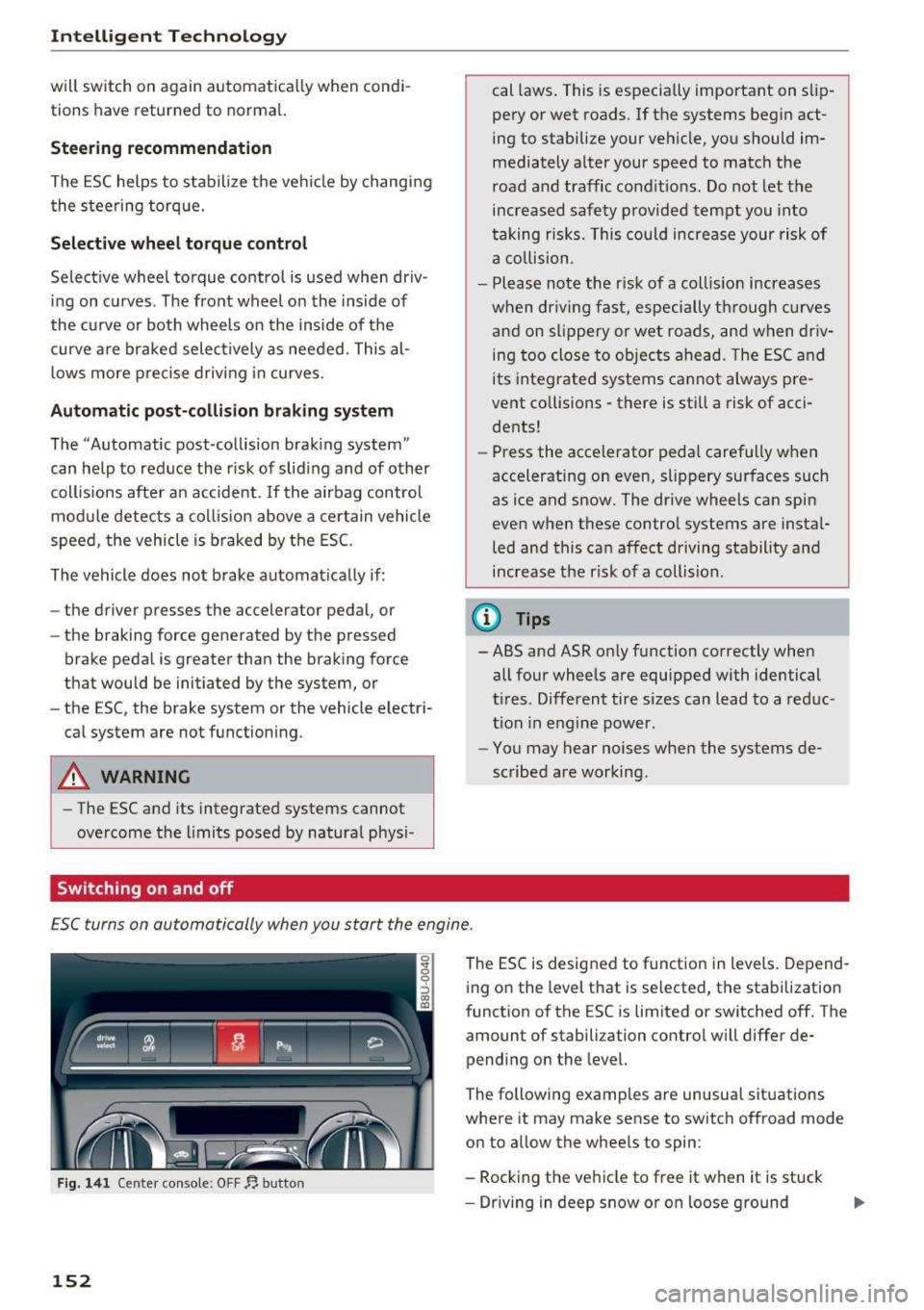
£SC turns on automatically when you start the engine .
Fig. 141 Center console: OFF rJ. button
152
The ESC is designed to function in levels. Depend
i ng on the level that is selected, the stabilization
function of the ESC is limited or switched off. The amount of stabilization control will differ de
pending on the level.
The following examples are unusual situations
where it may make sense to switch offroad mode
on to allow the wheels to spin:
- Rocking the vehicle to free it when it is stuck
- Dr iving in deep snow or on loose ground
Page 162 of 252
Driving and th e en vironm ent
A WARNING
-The temperature of the exhaust system is
high, both when driving and after stopping
the engine.
- Never touch the exha ust tail pipes once they
have become hot . This could result in burns.
- Do no t park or operate the vehi cle in areas
where the hot exha ust system may come in
contact with dry grass, br ush, fue l spill or
other mater ial which can cause a fire.
- Do not apply additional undercoating or
rustproofing on or near the exhaust mani
fold, exhaust p ipes, catalytic converter or
heat sh ields. During dr iv ing, the substance
used for undercoating could ove rheat and
ca use a fire .
(D Note
-Be aware that just one tank filling with
leaded fuel will a lready ser iously degrade
the performance of the catalytic converter .
- Do not exceed the correct eng ine oi l level
¢ page 181.
-Do not drive until the fuel tank becomes
complete ly empty. The engine cou ld mis
fire. Unburned fuel could also get into the
exhaust system and this could cause t he
catalytic converte r to overheat.
- Do not turn off the ignition whi le the vehicle
i s mov ing.
- Do not continue to operate your veh icle un
der these cond itions, as otherwise fue l can
r each the catalytic converte r. This cou ld re
su lt in ove rheating of t he converte r, req uir
i ng its re placement.
- T o assure efficient operation of the Emis
s ion Control System:
- Have your ve hicle maintained properly and
in accordance with the se rvice recommen
dations in your Wa rranty
& Maintenance
book let .
- Lack of proper maintenance as well as im
proper use of the vehicle will impair the
function of the em ission cont rol system
and co uld lead to damage.
160
-
® For the sake of the environment
Even when the Emiss ion Control System is op
e rating properly, the exhaust gas can have a
su lfu r-li ke exhaust gas sme ll under some op
erating states. T his depends on the sulfur
content of the fuel being used. Us ing a d iffer
ent brand of fuel may help, or fi lling the tank
with lead-free super g rade gasoline.
Shutting down vehicle
If you would like your vehicle to remain inopera
tive for a longer pe riod of time, contact an Audi
o r othe r spec ia liz ed dealer. They ca n adv ise you
o n necessa ry p recautions e.g. corros io n preven
tion, m aintenance and storage . Pay attention to
additional in formation concer ning the battery .
Refer to¢
page 187 .
Economical and environ
mentally-friendly driving
General
Your personal style of driving will determine the
economy of your vehicle, a s well as exhau st and
noise levels .
Fu el economy, env ironmenta l impact, and wear
o n your e ngine, brakes and tires large ly depend
o n t hree fa ctors:
- your personal d riving style
- operat ing cond itions
- technical limitat ions
If you anticipate what you need to do next and
drive economically, you can easily cut your f uel
consumption by 10-lS percent. Th is sect ion wi ll
give you some tips on how you can help the envi
ronment and your pocketbook .
{l) Tips
The consumption estimates as published by
ENVIRONMENTAL PROTECTIO N AGENCY
(EPA) and T ransport Canada may not corre
spond to your actual consump tion on the
r oad, which wi ll vary depending upon vehicle
l oad and speed, road a nd wea ther conditions,
tri p l engt h, etc.
Page 163 of 252
Drive smoothly and keep a lookout ahead
Vehicles use the most fuel when they are acceler
ating .
11-Avoid unnecessary accelerating and braking.
Vehicles use the most fuel when they are acceler ating . If you anticipate what is going to happen
next, you will need to brake less and, thus, accel
erate less . Let the vehicle coast whenever possi
ble - for example when you see that the next traf
f ic light is red .
Avoid full throttle
Driving a t modera te speeds saves fuel and im
proves your mileage .
11-Try and keep well be low your car's max imum
speed.
Accelerating gent ly reduces fuel consumption,
engine wear, and does not disturb the environ
ment.
F ue l cons umption, exha ust emissions and engine
noise increase disproportionately at high speeds.
If you drive at approximately three quarters of
top speed, fuel consumpt ion will be reduced by
one half. Never drive faster than the posted
speed limit and weather conditions permit.
Reducing unnecessary idling
Even when your car is just idling i t burns up fuel.
11-S hut the engine off w hen you are not driving
the vehicle.
11-Do not warm up the vehicle by letting the en-
gine ru n at idle .
It makes sense to shut off the eng ine in traffic
jams, when wa iting for trains to pass at rai lroad
crossings, or at traffic lights that have long waits
on red . Turn ing the eng ine off for just 30 -40 sec
onds saves more fue l than is bu rned starting the
engine agai n.
It takes a long t ime for the engine to warm up
fu lly when it is runni ng at idle . However, wear
and noxious emiss ions are especially high when
the eng ine is wa rm ing up . So you should d rive
Driving and the envir onment
away as soon as you start the eng ine and avoid
running at high rpms w hil e the engine is sti ll
warming up .
(D Note
Do not leave eng ine idling una ttended after
starting. If wa rning lights shou ld come on to
i ndicate improper operation, they would go
unheeded. Extended idling also prod uces
heat, which could result in overheating or
other damage to the vehicle or other proper
ty .
Regular maintenance
A badly tuned engine unnecessarily wastes a lot
of fuel .
11-Have your vehicle serviced at regular interva ls.
By having your vehicle regular ly serv iced by an
authorized Audi dea ler helps to ensure that it
runs properly and economically. The cond ition of
your vehicle not only affects its safety and ability
to hold its value, it also affects
fuel con sump
tion .
Chec k your oil each t ime you fill your tank.
T he amount o f oi l used is related to engine load
and speed.
It is normal fo r the oil consump tion of a new en
gine to reach its lowest value after a ce rtain m ile
age has been dr iven.
You m ust dr ive your ve hicle about 3,000 m iles
(5,000 kilometers) befo re yo u can prope rly as
sess oil consumpt io n.
T h is also app lies to fuel consumption and eng ine
output.
(D Note
- Have your vehicle maintained properly and in accordance with the se rvice recommenda
tions i n your Warranty
& M aintenance book-
le t. La ck of prope r maintenan ce as we ll as
imp roper use of the ve hicle will im pair the
function of the em ission cont rol sys tem and
co uld lead to damage . .,.
161
Page 168 of 252
Trailer mod e
Weight d istribution
Towing a loaded trailer with an empty car res ults
in a high ly unstable distribution of weight . If this
cannot be avoided, drive at very low speeds on ly
to avoid the risk of losing steering control.
A "balanced" rig is easie r to operate and con trol.
This means that the tow vehicle should be loaded
to the extent possible and permissible, while
keeping the trai le r as light as possib le under the
circumstances. Whenever possible, transfer
some cargo to the luggage compartment of the
tow vehicle while observ ing tongue load requ ire
ments and vehicle loading considerat ions.
Spee d
The higher the speed, the more difficult it be
comes for the driver to contro l the rig. Do not
drive at the maximum permiss ible speed. Reduce
your speed even more if load, weather or w ind
conditions are unfavorable - part icularly when
goi ng downhill.
Reduce veh icle speed
immediatel y if the tra iler
shows the slightest sign of swaying .
Do not try
to stop the sway ing by acc ele rating .
Observe speed lim its. In some areas, speeds for
veh icles towing trailers are lower than for regular
ve hicles.
A lways app ly brakes early. When driving down
h ill, shift into a lower gear to use the engine
braking effect to slow the veh icle. Use of the
brakes alone can cause them to overheat and fail.
Coolant temp era ture
The coolant temperature gauge¢ page 10 must
be observed carefully. If the needle moves close
to the upper end of the scale, reduce speed im mediately and/or turn off the air conditioner.
If the coo lant temperature warning light in the
instr ument cluster starts flashing., pull off
the road, stop and let the engine
idle for about
two minutes to prevent heat bu ild-up.
A WARNING
Anyone not proper ly restrained in a moving
vehicle is at a much greater risk in an acci-
166
-
dent . Never let anyone ride in your car who is
not properly wear ing the restraints provided
by Audi.
Trailer mode notes
Important to know
You r vehicle handles differently when towing a
trailer because o f th e additiona l weight and dif
ferent weight distribution. Safety, performance
and economy will g reatly depend on how carefu l
l y you load your trai ler and operate your rig.
Before yo u actually tow your trailer, pract ice
turning, stopping and backing up in an area away
from traffic . Keep practicing unti l you have be
come complete ly familiar w ith the way your vehi
cle-tra iler combination behaves and responds.
Backing up is difficult and requires practice .
Backing up with a trailer genera lly requires steer
ing action opposite to that when backing up your
vehicle without a trailer.
Maintain a greater distance between your vehicle
and the one in fro nt of you . You will need more
room to stop. To compensate for the trailer, you
will need a larger than normal turning radius.
When passing, remember that you cannot accel erate as fast as you normally wo uld beca use of
the added load. Make sure you have enough room
to pass. After passing, allow p lenty of room for
your trailer before changing lanes again.
Avoid jerky starts, sharp turns or rapid lane
changes.
@ Tips
- Do not tow a trailer du ring the break-in peri
od of your vehicle.
- If you tow a trai le r, your Au di may requi re
more frequent maintenance due to the ex
t ra load ¢
page 232.
Page 186 of 252
Check ing and F illing
The location of the coolant expansion tank can be
seen in the engine compartment illustration
c::> page 179.
To obtain an accura te reading, the eng ine must
be switched off .
The expans io n tank in your vehicle is equipped
with a n elec tric coolant level sensor.
When the coolant level is too low, the war ning
lig ht in the Auto-Check System
c::> page 14 will
blin k until you add coo la nt and the level has bee n
restored to normal. Even t hou gh the re is an e lec
tr ic coolant level sensor, we still re commend you
check the coo lant level from time to time .
Coolant loss
Coolant loss may indicate a leak in the cooling
system. I n the event of coolant loss, the cooling
system should be inspected immediately by your
author ized Audi dealer. It is not enough me rely
to add coolant.
I n a
se aled system, losses can occur only if the
boi ling point of the coo lant is ex ceeded as a re
sul t of over heat ing.
A WARNING
T he cooling system is unde r pressure and can
get very hot . Red uce the risk of scalding from
hot coolant by following these steps.
- Turn off the eng ine and a llow it to cool
down .
- Protect your face, hands and arms from es
caping fluid and steam by cove ring the ca p
with a la rge, thick rag.
- Turn the cap s lowly and very ca refu lly in a
counter-clockwise direction w hile ap ply ing
light, downwa rd pressure o n the top of the
cap.
- To avo id being burned, do not sp ill anti
freeze or coolant on the exha ust system or
hot eng ine parts. Under certain conditions,
the ethy lene g lycol in e ngine coolant can
catch fire.
(D Note
Do not add any type of radiato r leak sealant
to your veh icle's engine coolant. Adding radia-
184
tor repair fluid may a dverse ly affect the func
tion and performance of your coo ling system
and could result in damage not covered by
your New Vehicle Limited Warranty.
Adding coolant
Be very careful when adding engine coolant.
Befo re yo u check any thing in the engine compart
ment,
always read and heed all WARNINGS
c::>
A in Working in the engine compartment on
page 177.
Requireme nt: The re mus t be a res idual amo unt
of coolant in the expans ion tank
c::> (D .
""Tur n off t he engine .
"" Let the eng ine cool down.
"" Pla ce a thick rag over the coolan t ex pan sio n
tank
c::> page 183, fig. 152 and carefull y turn
the cap counter-clockwise
c::> ,&. .
""Add coolant m ixed in the cor rect rat io
c::>page 183, Coolant up to the MAX ma rking.
"" Make sure that the fluid level remains stab le.
Add more coolant if necessa ry .
"" Twis t the cap o n aga in
tightly.
Replacement eng ine coolant must conform to ex
act specifications
c::> page 183, Coolant.
We recommend using only coo lant ad ditive G 12+
+ , G13 or in an emergency G12+. Do
not use a
different additive. In an emergency use plain wa
te r unt il you can get the cor rect addit ive and ca n
r esto re the cor rect rat io. Thi s should be done as
soon as possib le.
If you have lost a considerable amount of coo l
an t, then you s hou ld add co ld a ntifreeze and cold
water only whe n the engine is co ld.
A lways use
new engine coo lant when ref illing.
Do no t fill c oolant above the "MAX" mark . Excess
coolant will be forced out th rough the pressure
r elief valve in the cap when the engine becomes
hot.
~
Page 187 of 252
A WARNING ,~
- The cooling system is under pressure and
can get very hot. Reduce the risk of scald ing
from hot coolant by following these steps.
- Turn
off the engine and allow it to coo l
down.
- Protect you r face, hands and arms from
escaping fluid and steam by cover ing the
cap with a large, thick rag.
- Turn the cap slowly and very carefully in a
counter-clockwise d irection while applying
light, downward p ressure on the top of
the cap.
- To avoid being burned, do not spill anti
freeze or coolant on the exhaust system or
hot engine parts. Under certa in cond i
tions, the ethylene glycol in eng ine cool
ant can catch fire.
- Antifreeze is poisonous. Always store anti
freeze in its orig inal container and well out
of the reach of children.
- If you dra in the coolant, it must be caught
and safely stored in a proper conta iner
clearly marked "poison".
- Do not add coolant if the expansion tank is
empty. Air cou ld enter the cooling system
and damage the eng ine. If this is the case,
do not continue driving . Seek professional
ass istance.
- Coolant pollutes the env ironment and could
cause an eng ine fire. Excess coolant will be
fo rced o ut through the pressure relief valve
i n the cap when the e ng ine be comes hot.
- If, in an emergency, only wate r can be add
ed, the co rrect r atio betwee n wate r and an
tifree ze
Q page 183 must be res to red as
soon as possib le.
{® For the sake of the environment
Dra ined coolant sho uld not be reused. Always
disp ose of used coolant while obse rving all
....
"' environment al regulat ions. ci ::, co ....
Ch eck ing and Filling
Rad iator fan
The radiator fan switches on automatically by it
self .
The radiator fan is driven by the engine via the V
belt. The viscous clutch regulates th e speed of
the fan accord ing to the temperature of the cool
ant .
An auxiliary e lectr ic radiator fan* switches on and
off depending on coo lant temperature and other
vehicle operating conditions.
After you switch the engine
off, the auxiliary fan
can continue running for up to 10 m inutes -even
with the ignition
off. It can even switch on aga in
later by itself
Q .& , if
- the temperature of the engine coolant rises due
to the heat build-up from the engine in the en
gine compartment, or
- the engine compartment heats up beca use the
veh icle is parked in intense sunlight.
A WARNING
- To reduce the r isk of persona l injury neve r
touch the radia to r fan .
- The auxiliary e lectr ic fan is temperature
controlled and can switch on s uddenly even
when the engine is not ru nning .
- The a uxiliary radiator fan sw itches on auto
mat ically when the eng ine coolant reaches a
certa in temperature a nd will continue to run
until the coolant temperature d rops.
185