brakes AUDI Q3 2016 User Guide
[x] Cancel search | Manufacturer: AUDI, Model Year: 2016, Model line: Q3, Model: AUDI Q3 2016Pages: 252, PDF Size: 62.81 MB
Page 155 of 252
.... N
c:i ::J CX)
.... I.Cl U"I
N I.Cl ......
- Driving on rough terrain when much of the car's weight is lifted off the wheels (axle articu la
t ion)
- Driving downhill whi le brak ing on loose gro und
ESC levels
Intelligent Technology
For yo ur safe ty, switch off the ESC offroad mo de
in advance.
Offroad mode on ESC/ASRoff Offroad mode off or
ESC
/ASRon
Behavior
The ESC and ASR stabiliza -
The stabiliza tion f unction is The f
ull stabiliza tion fu nc-
tion functions are limited not available
Q .&. . ESC and
tion of the ESC and ASR is
~ &. ASR are switched off . available again.
Operation Press the IJJ button briefly. P ress and ho ld the IJJ but- Press the IJJ button aga in.
ton longer than th ree sec-
onds.
Indicato r fl turns on. fil and !;ill•)H turns on. II turns off or II and
lights !;ill•)H turn off .
Driver mes- Stab ilization control (ESC ): Stabil ization control (ESC): Stabilization control (ESC ):
sage s Offroad Warning! Reduced Off Warning! Reduced sta-
On
st ability
bility
A WARNING
You should only switch offroad mode on or
switch ESC/ASR off if your driving ab ilities
and the t raffic conditions perm it. Th ere is a
r is k of sli ding.
- The stabilization function is limited when
offroad mo de is switched on. Th e dr iving
w heels co uld spin and the vehicle cou ld
swe rve, e speci ally on s lick o r slip pery r oad
s u rfaces.
- T here is no veh icle s tabilizat ion whe n ESC/
ASR are swi tched off .
-
Hill descent assist
Applies to vehicles: with hill descent assist
The hill descent assist makes it possible to drive
down an incline at a constant speed .
Fig. 142 Ce nte r console: hill descent ass ist button
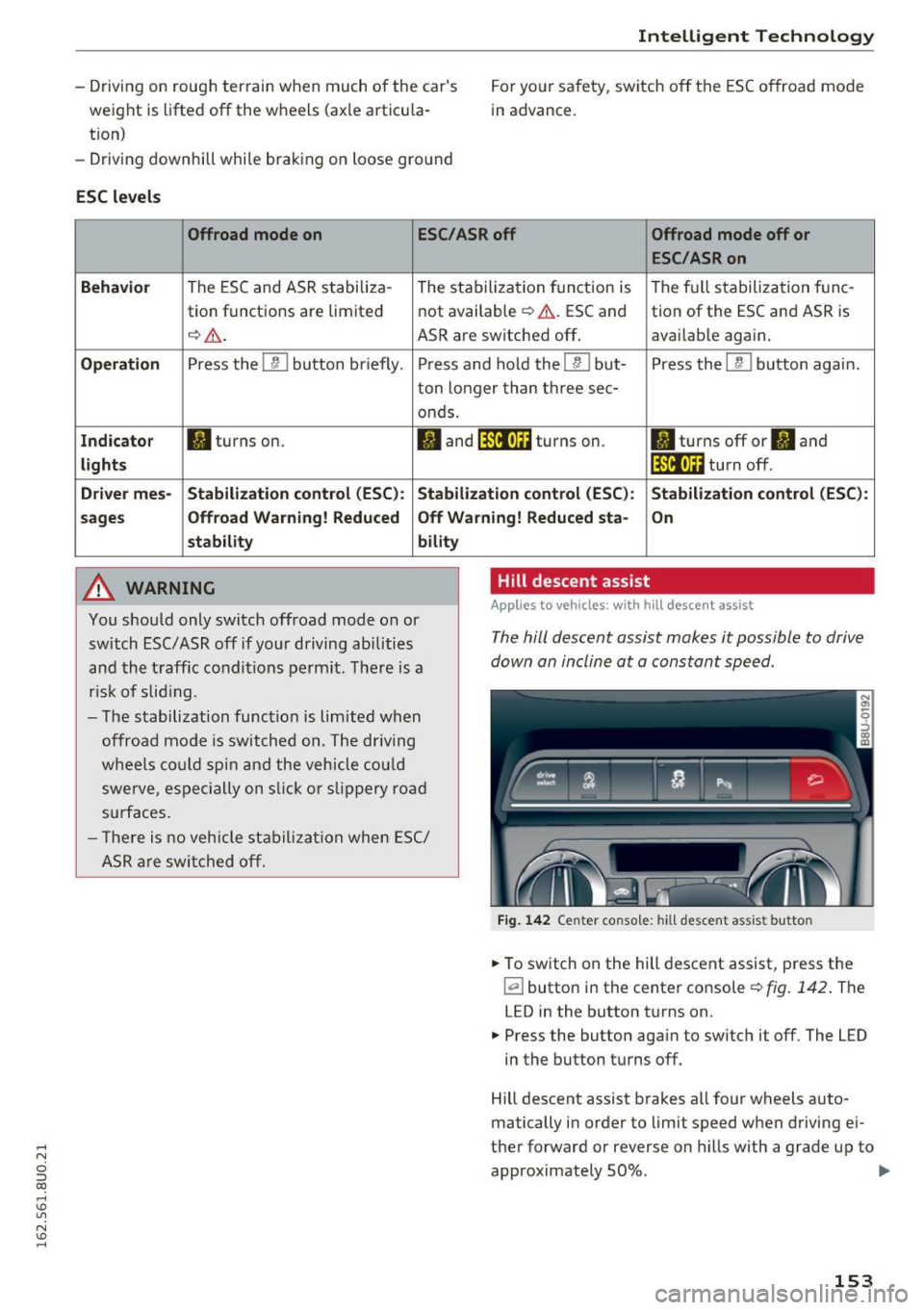
.. To switch on the hill descent assist, p ress the
~ butto n in the center co nsole Q fig. 142 . The
LED in the button turns on .
.. Press the button again to switch it off. The LED
in the button turns off .
Hill descent assist brakes all four wheels auto
matically in order to limit speed when driving ei
ther forward or reverse on hills with a grade up to
approximately 50%. ..,_
153
Page 156 of 252
Intelligent Technology
When the hill descent assist is on, the current
driving speed, when your vehicle entered the in
cline is maintained. It is only possible to switch
on the assist when driving slower than 37 mph (60 km/h). The assist works between approxi
mately 2 and 19 mph (4 and 30 km/h). The driver
can increase or decrease the vehicle speed within
these limits by depressing the accelerator or brake pedal.
There must be however sufficient ground adhe
sion . The hill descent assist
cannot do its job if
the incline is icy or if the incline ground is loose
¢ ,&.
Active assistance at a specific speed up to about 19 mph (30 km/h) is shown in the instrument
cluster through a blinking indicator light •. The
indicator light shines continuously when in the
ready mode.
The system does not work at speeds between 19
and 37 mph (30 and 60 km/h) . The system is
then in the ready-mode. This is shown through
the LED turned on in the button . The system au
tomatically switched off when you drive faster
than 37 mph (60 km/h). The LED will also go out
in this scenario.
Hill descent assist is automatically activated un
der the following conditions:
- The LED in the button turns on ,
- the vehicle speed is lower than 19 mph (30 km/
h) ,
-the incline angle is at least around 10% .
A WARNING
-Always adapt your speed to the weather ,
road and traffic conditions . Do not let the
increased safety provided tempt you into
taking risks, because this increases the risk
of an accident.
- The hill descent assist system cannot over
come the laws of physics. Your driving style
must always be adapted to the current road
and traffic conditions.
- The hill descent assist may not be able to
hold your vehicle at a constant speed under
all conditions while driving on an incline (for
154
example if ground under the vehicle is
loose).
Brakes
New brake pads
New brake pads do not achieve their full braking
effect during the first
250 mi (400 km). They
must be "broken in" first¢& . However, you can
compensate for the slightly reduced braking
force by pressing firmly on the brake pedal. Avoid heavy braking during the break-in period.
Operating conditions and driving habits
The brakes on today's automobiles are still sub
ject to wear, depending largely on operating con
ditions and driving habits¢,& . On vehicles that
are either driven mostly in stop-and-go city traf
fic or are driven hard, the brake pads should be checked by your authorized Audi dealer more of
ten than specified in the
Warranty & Mainte
nance booklet.
Failure to have your brake pads
inspected can result in reduced brake perform
ance.
On steep slopes, you should use the braking ef
fect of the engine. This way, you prevent unnec
essary wear on the brake system. If you must use
your brakes, do not hold the brakes down contin
uously. Pump the brakes at intervals.
Operating noise
Noises may occur when braking depending on the
speed, braking force and outside conditions such
as temperature and humidity.
Effect of water or road salt
In certain situations, for example after driving
through water, in heavy rain, after overnight con densation or after washing your car , the braking
effect can be reduced by moisture or ice on the
brake rotors and brake pads. The brakes must be
"dried" first with a few careful brake applica
tions.
At higher speeds and with the windshield wipers
turned on, the brake pads press against the brake
rotors for a short amount of time. This action
which is not felt by the driver happens at regular .,.
Page 157 of 252
intervals and fac ilitat es a better reaction time for
the brak es in wet weather.
The braki ng effect can also be red uced if you are
driving on salted roads and you do not apply the b rakes for long periods of time . The layer of salt
on th e brake rotors and brake pads must be worn
off first when the brakes are applied~&, .
Cor ro sion
Leaving the vehicle par ked for long periods of
time, low m ileage and avo iding heavy brak ing
can contribute to corros ion on the brake rotors
and dirty brake pads.
If you usually avo id heavy b raking or if there is
cor ros io n present , occasional heavy braking at
high speeds is recommended to clean the brake
rotors and pads~&, .
Brake system malfunct ion
if you notice that the bra ke pedal travel has sud
denly
go tten larger , the n a brake circu it may have
failed ~&. .
Low brake fluid level
When the brake flu id level is low , malfunct ions in
the brake system may occ ur. The brake flu id leve l
i s elect ronically mo nitored .
Brake booster
The brake booster amplifies the pressure you ap
p ly to the brake pedal.
It only works when the en
g ine is running ~&, .
Brak e lining we ar status
Brake lining wea r may be checked by visual in
spection of the condition of the brake pads
through the open ings in the wheel. If necessary,
the wheel may be removed for this inspection
~ page 213, Replacing wheels .
.8, WARNING
-New bra ke pads don 't have the best stop
ping power and must be "bro ken- in" dur ing
the init ial 250 m iles ( 400 km). Yo u can
compensate for this by p ressing the brake
peda l more firm ly . T his also applies later
when new pads are installed .
Intelligent Technology
- You shou ld pe rform braking maneuvers for
the purpose of cleaning the brake system
only if road condit ions permit . Other road
users must not be put at r isk -you may
cause an accident!
- Before descending a steep grade, reduce
speed and sh ift tra nsmission in to a lower
gea r or lower dr iving range . Do not r ide the
b rakes or hold the pedal down too long or
too often. Th is co uld cause t he b rakes to ge t
hot and dim inish b raking effic ien cy.
- D o not " ride the bra kes " by rest ing you r foot
on the ped al when you do no t intend to
brake . T his may ca use the brakes to ove r
heat, premature wear and increased stop
ping distance .
- Under cer tain clima tic and ope rating condi
tions such as passing t hrough water, driving
in heavy rain o r after washing the vehicle,
the effectiveness of the brakes can be re
duced. In winter, ice can accumu late on the
brake pads, lin ings, discs and drums . Care
fully apply brakes for a test . Brakes will d ry
and ice coat ings will be cleaned off after a
few ca refu l bra ke applications .
- Driving for an extended period of t ime on
salt-covered roads without using your b rakes can also affect braking eff icien cy.
Clea n off acc umulated salt coat ing fr om
b rake discs an d pads w ith a few careful
brake applicat ions .
- If you damage the front s poile r, or if you in
s t all a different spoiler, be s ure the a ir flow
to the front brakes is not obstructed. Other
wise the brake system could overheat reduc
ing the effectiveness of the ent ire brake sys
tem.
- Fai lu re of one brake circ uit w ill impa ir the
braking capability resulting in an increased
stopping distance . Avoid driving the vehicle
and have it towed to the nearest authorized
Aud i deale r or qualified worksho p.
- Never let the ve hicle roll to a stop with the
e ngine shut off.
- If the brake booster is not working, the
brake pedal must be pressed cons iderab ly
harder to make up for the lack of booster
assis tance .
155
Page 162 of 252
Driving and th e en vironm ent
A WARNING
-The temperature of the exhaust system is
high, both when driving and after stopping
the engine.
- Never touch the exha ust tail pipes once they
have become hot . This could result in burns.
- Do no t park or operate the vehi cle in areas
where the hot exha ust system may come in
contact with dry grass, br ush, fue l spill or
other mater ial which can cause a fire.
- Do not apply additional undercoating or
rustproofing on or near the exhaust mani
fold, exhaust p ipes, catalytic converter or
heat sh ields. During dr iv ing, the substance
used for undercoating could ove rheat and
ca use a fire .
(D Note
-Be aware that just one tank filling with
leaded fuel will a lready ser iously degrade
the performance of the catalytic converter .
- Do not exceed the correct eng ine oi l level
¢ page 181.
-Do not drive until the fuel tank becomes
complete ly empty. The engine cou ld mis
fire. Unburned fuel could also get into the
exhaust system and this could cause t he
catalytic converte r to overheat.
- Do not turn off the ignition whi le the vehicle
i s mov ing.
- Do not continue to operate your veh icle un
der these cond itions, as otherwise fue l can
r each the catalytic converte r. This cou ld re
su lt in ove rheating of t he converte r, req uir
i ng its re placement.
- T o assure efficient operation of the Emis
s ion Control System:
- Have your ve hicle maintained properly and
in accordance with the se rvice recommen
dations in your Wa rranty
& Maintenance
book let .
- Lack of proper maintenance as well as im
proper use of the vehicle will impair the
function of the em ission cont rol system
and co uld lead to damage.
160
-
® For the sake of the environment
Even when the Emiss ion Control System is op
e rating properly, the exhaust gas can have a
su lfu r-li ke exhaust gas sme ll under some op
erating states. T his depends on the sulfur
content of the fuel being used. Us ing a d iffer
ent brand of fuel may help, or fi lling the tank
with lead-free super g rade gasoline.
Shutting down vehicle
If you would like your vehicle to remain inopera
tive for a longer pe riod of time, contact an Audi
o r othe r spec ia liz ed dealer. They ca n adv ise you
o n necessa ry p recautions e.g. corros io n preven
tion, m aintenance and storage . Pay attention to
additional in formation concer ning the battery .
Refer to¢
page 187 .
Economical and environ
mentally-friendly driving
General
Your personal style of driving will determine the
economy of your vehicle, a s well as exhau st and
noise levels .
Fu el economy, env ironmenta l impact, and wear
o n your e ngine, brakes and tires large ly depend
o n t hree fa ctors:
- your personal d riving style
- operat ing cond itions
- technical limitat ions
If you anticipate what you need to do next and
drive economically, you can easily cut your f uel
consumption by 10-lS percent. Th is sect ion wi ll
give you some tips on how you can help the envi
ronment and your pocketbook .
{l) Tips
The consumption estimates as published by
ENVIRONMENTAL PROTECTIO N AGENCY
(EPA) and T ransport Canada may not corre
spond to your actual consump tion on the
r oad, which wi ll vary depending upon vehicle
l oad and speed, road a nd wea ther conditions,
tri p l engt h, etc.
Page 165 of 252
~ Never drive the vehicle in terrain which is not
suitable for the vehicle, or which exceeds your
driv ing skills. Never take any unnecessary risks!
~ Drive slowly and ca utiously!
~ Pay atten tion to the gro und clearance of your
vehicle! The clearance may vary depending on
the load, ground composition and the environ ment. The driver is therefore responsib le for
deciding whether a vehicle can handle a specific
s ituation.
~ Activate the E SC off ro ad mode as needed
¢ page 152 .
~ Use the hill de scent a ssis t when driving down
steep slopes
¢ page 153.
Difficult t errain
Never drive in areas that are not familiar to you
and drive slowly when
off road and be prepared
and expect the unexpected (e .g . potholes, bou ld
ers, tree stumps, etc .)
To prevent the ve hicle from bottoming and avo id
damage to the unde rbody, you should drive
straight across severe bumps in the gro und with
on ly one side of the vehicle so that only two of
you r wheels cross the bumps.
Drive quick ly throug h sandy or marshy off-road
sections and do not stop, if at all possible.
Driving through water on roads
Note the following to avoid vehicle damage whe n
d riving through wa ter, for example on flooded
r oads:
- The wate r must not be any higher tha n the bot
tom of the vehicle body.
- Do not drive faster than walking speed .
A WARNING
After driving through water o r mud, the brak
ing effect can be reduced due to mo isture on
t he bra ke discs and b rake pads. A few caref ul
brake applications should dry off t he brakes.
Veh icle components such as the engine,
tra nsmission , suspens ion or electr ical system
can be severe ly damaged by dr iv ing t hrough
water.
Driving and the envir onment
{!) Tips
- Determine the depth before driving through
water.
- Do not stop the vehicle, drive in reverse or
switch the engine off when driving through
water.
- Keep in mind that oncoming vehicles may
create waves that raise the water level and
make it too deep for your vehicle to drive
through safe ly.
- Avoid dr iv ing through salt water (corrosion).
163
Page 166 of 252
Trailer mod e
Trailer mode
Driving with a trailer
General information
Your Audi was designed primarily for passenger
transportation.
If you plan to tow a trailer, please remember that
the additional load will affect durability, economy and performance.
Trailer towing not only places more stress on the
vehicle, it also calls for more concentration from
the driver.
F or this reason, always follow the operating and
driving instructions provided and use common
sense.
Technical requirements
Tr aile r hitch
Use a weight-carrying hitch conforming to the
gross trailer weight. The hitch must be suitable
for your veh icle and trailer and must be mounted
securely on the vehicle's chassis at a technically
sound
location . Use only a trailer hitch with a re
movable ball mount . Always check w ith the t rail
er hitch man ufact urer to make su re that you are
using the co rrect hitch .
Do not use a bump er hit ch .
The hitch must be installed in such a way that it
does not interfere with the impact -absorbing
bumper system. No mod ificat ions should be
made to the vehicle exhaust and brake systems .
From t ime to t ime, check that a ll hitch mount ing
bolts rema in securely fastened.
When you are not tow ing a tra iler, remove the
tra iler hitch ba ll mount . This prevents the hitch
from caus ing damage shou ld your veh icle be
s truck from be hind ¢
,&..
Trailer brakes
If your trailer is equipped with a brak ing system,
check to be sure that it conforms to all regula
tions .
164
The trailer hydraulic brake system must not be
directly connected to the vehicle's hydraulic
brake system ¢&. .
Safety chains
Always use safety chains between you r vehicle
and the trailer.
Trailer lights
Traile r lights must meet all regulations . Be sure
to check w ith your author ized Audi dealer for cor
r ec t wiring , switches, and relays.
M irrors
If you are unable to see the traffic behind you us
ing the regular outs ide mirrors, then you
must in
stall extended mirrors . It is important that you
always have clear vision to the rear.
.&_ WARNING
- If a tra ile r has e lectr ica l brakes p lease no te
t hat these brakes are not activated by the
factory-fit ted contro l unit -risk of accident!
- After removing the trai ler hitch, do not
store it in your vehicle. In case of sudden
braking, the hitch co uld fly forward and in
jure you or yo ur passengers.
- Never install a "we ight distribu ting" or
"load eq ualizing" trailer hitch on your vehi
cle. The vehicle was not designed for these
kinds of trailer hitches. The hitch attach ment can fail, caus ing the tra iler to tear
loose from the vehicle.
- The Gross Vehicle Weight Rating for your
veh icle, found on the safety compliance la
be l on the driver's s ide B-pillar, must never
be exceeded under any circumstances . Ex
ceed ing the Gross Vehicle Weight Rat ing of
your veh icle is likely to damage yo ur vehicle,
and such damage will not be covered by
your Limited New Vehicle Warranty . Exceed
ing the Gross Vehicle Weight Rating will al
so change the performance and handling
characteristics of your vehicle, which could
cause a crash result ing in serious injury or
death.
Page 167 of 252
Operating instructions
6" r-2
~·~
1/2"
1·1/2"
ill
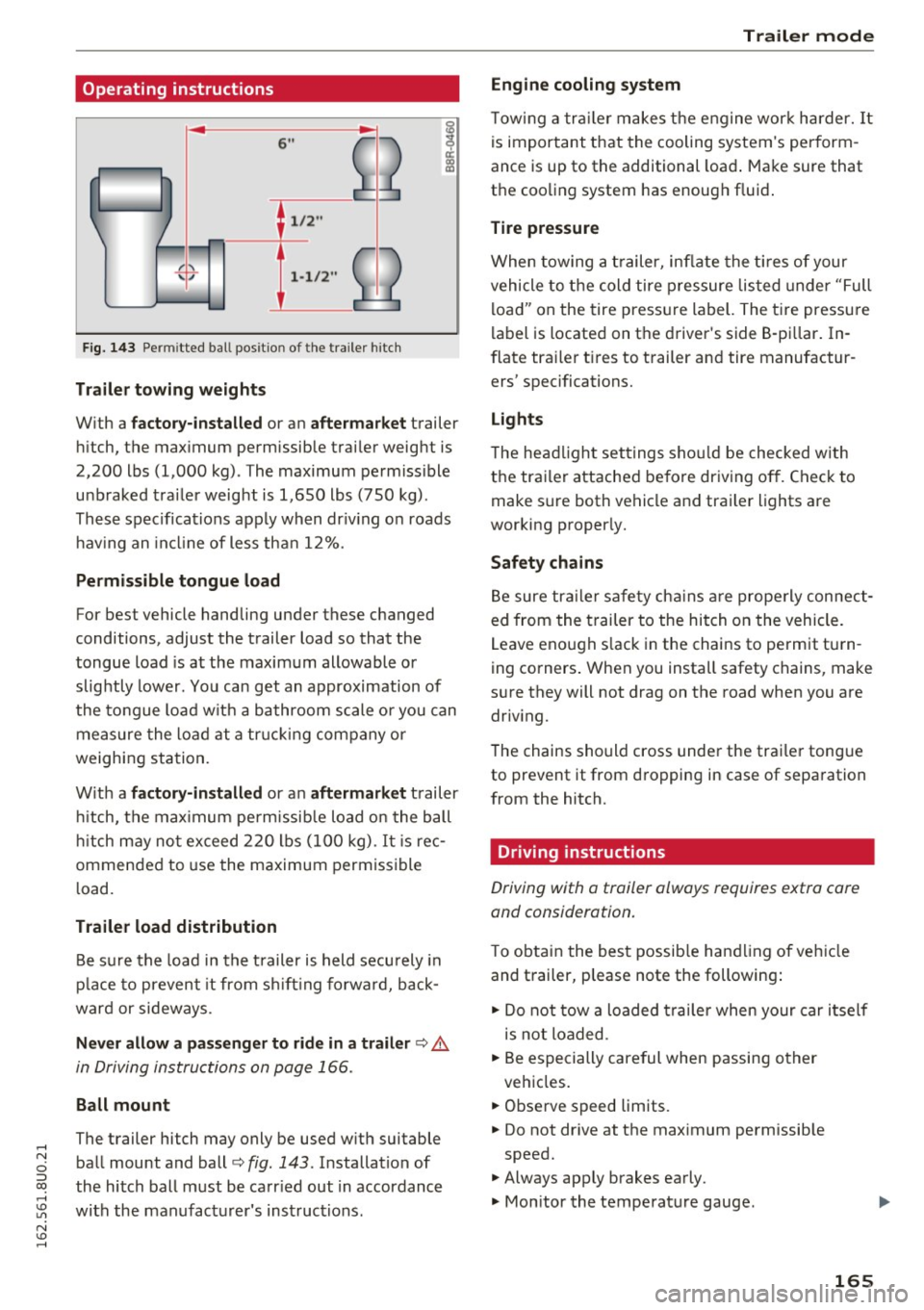
Fig. 143 Permitted ball pos ition of the trailer hitch
Trailer towing weights
With a
factory-installed or an aftermarket trailer
hitch, the maximum permissib le trailer weight is
2,200 lbs (1,000 kg). The maximum permiss ible
unbraked trailer weight is 1,650 lbs (750 kg).
These specifications apply when dr iv ing on roads
h av ing an incl ine of less than 12%.
Permissible tongue load
For best vehicle handling under these changed
conditions, adjust the trailer load so that the
tongue load is at the maximum allowable or
slightly lower. You can get an approximation of
the tongue load w ith a bathroom scale o r you can
measure the load at a trucking company or
weighing station.
With a
factory-installed or an aftermarket trailer
hit ch, the maximum permissib le load on the ball
hitch may not exceed 220 lbs (100 kg).
It is rec
ommended to use the maximum permissible
l oad.
Trailer load distribution Be sure the load in the trailer is held securely in
place to prevent it from s hiftin g forward, back
ward or sideways.
Never allow a passenger to ride in a trailer ¢.&.
in Driving instructions on page 166.
Ball mount
The trailer hitch may only be used w ith suitable
ball mount and ball¢
fig. 143. Installation of
the hitch ball must be carr ied out in accordance
with the manufacturer's instructions.
Trailer mode
Engine cooling system
To wing a trailer makes the engine work harder. It
is important that the cooling system's perform
ance is up to the additional load . Make sure that
the cooling system has enough fluid .
Tire pressure
When towing a trailer, inflate the tires of your
vehicle to th e cold tire pressure lis ted under "Full
load" on the tire pressure label. The tire pressu re
label is located on the driver's side B-pi llar . In
flate trailer t ires to trailer and tire manufactur
ers' specifications.
Lights
T he headlight settings shou ld be checked with
the trai ler attached before driving off. Check to
make s ure both vehicle and trailer lights are
working properly.
Safety chains
Be sure trailer safety chains are properly connect
ed from the trailer to the hitch on the vehicle.
Leave enough s lack in the chains to permit turn
ing corners . When you install safety chains, make
sure they will not drag on the road when you are
driv ing.
The chains should cross under the trai ler tongue
to prevent it from dropping in case of separation
from the hitch.
Driving instructions
Driving with o trailer always requires extra core
and consideration .
To obtain the best possib le handling of vehicle
and trailer, p lease note the following:
.. Do not tow a loaded trailer when your car itself
is not loaded.
.. Be especially care ful when passing other
vehicles .
.. Observe speed limits.
.. Do not drive at the maximum permissib le
speed.
.. Always apply brakes early.
.. Mon itor the temperature gauge .
165
Page 168 of 252
Trailer mod e
Weight d istribution
Towing a loaded trailer with an empty car res ults
in a high ly unstable distribution of weight . If this
cannot be avoided, drive at very low speeds on ly
to avoid the risk of losing steering control.
A "balanced" rig is easie r to operate and con trol.
This means that the tow vehicle should be loaded
to the extent possible and permissible, while
keeping the trai le r as light as possib le under the
circumstances. Whenever possible, transfer
some cargo to the luggage compartment of the
tow vehicle while observ ing tongue load requ ire
ments and vehicle loading considerat ions.
Spee d
The higher the speed, the more difficult it be
comes for the driver to contro l the rig. Do not
drive at the maximum permiss ible speed. Reduce
your speed even more if load, weather or w ind
conditions are unfavorable - part icularly when
goi ng downhill.
Reduce veh icle speed
immediatel y if the tra iler
shows the slightest sign of swaying .
Do not try
to stop the sway ing by acc ele rating .
Observe speed lim its. In some areas, speeds for
veh icles towing trailers are lower than for regular
ve hicles.
A lways app ly brakes early. When driving down
h ill, shift into a lower gear to use the engine
braking effect to slow the veh icle. Use of the
brakes alone can cause them to overheat and fail.
Coolant temp era ture
The coolant temperature gauge¢ page 10 must
be observed carefully. If the needle moves close
to the upper end of the scale, reduce speed im mediately and/or turn off the air conditioner.
If the coo lant temperature warning light in the
instr ument cluster starts flashing., pull off
the road, stop and let the engine
idle for about
two minutes to prevent heat bu ild-up.
A WARNING
Anyone not proper ly restrained in a moving
vehicle is at a much greater risk in an acci-
166
-
dent . Never let anyone ride in your car who is
not properly wear ing the restraints provided
by Audi.
Trailer mode notes
Important to know
You r vehicle handles differently when towing a
trailer because o f th e additiona l weight and dif
ferent weight distribution. Safety, performance
and economy will g reatly depend on how carefu l
l y you load your trai ler and operate your rig.
Before yo u actually tow your trailer, pract ice
turning, stopping and backing up in an area away
from traffic . Keep practicing unti l you have be
come complete ly familiar w ith the way your vehi
cle-tra iler combination behaves and responds.
Backing up is difficult and requires practice .
Backing up with a trailer genera lly requires steer
ing action opposite to that when backing up your
vehicle without a trailer.
Maintain a greater distance between your vehicle
and the one in fro nt of you . You will need more
room to stop. To compensate for the trailer, you
will need a larger than normal turning radius.
When passing, remember that you cannot accel erate as fast as you normally wo uld beca use of
the added load. Make sure you have enough room
to pass. After passing, allow p lenty of room for
your trailer before changing lanes again.
Avoid jerky starts, sharp turns or rapid lane
changes.
@ Tips
- Do not tow a trailer du ring the break-in peri
od of your vehicle.
- If you tow a trai le r, your Au di may requi re
more frequent maintenance due to the ex
t ra load ¢
page 232.
Page 169 of 252
Parking on a slope
Do not pork on a slope with a trailer. If it cannot
be avoided, do so only ofter doing the following:
When parking:
.. Apply the foot brake .
.. Have someone place chocks under both the ve
hicle and the trailer wheels .
.. With chocks in place, slowly release the brakes
until the wheel chocks absorb the load .
.. Turn the wheels towards the curb .
.. Apply the parking brake .
.. Move the selector lever to P.
When restarting after parking:
.. Apply the foot brake .
.. Start the engine .
.. Move the selecto r lever to D/S .
.,. Release the parking brake and slowly pull out
and away from the wheel chocks .
.. Stop and have someone retrieve the wheel
chocks.
(D Tips
If you move the selector lever of the automat
ic transmission to P before applying the park
ing brake and before blocking the wheels, you
may have to use more force later to move the
lever out of the P position.
Trailer mode
167
Page 171 of 252
wash operator to reduce the risk of acc idents.
- To reduce the risk of cuts, protect yourself
from sharp metal components when wash
ing the underbody or the inside of the wheel
housings .
- After washing the vehicle, the brak ing effect
may be delayed due to mo isture on the
brake rotors or ice in the w inter . The brakes
must be dried first w ith a few careful brake
applica tions .
- If you wash the vehicle in an automatic car
wash, yo u m ust fold the exterior m irrors i n
to reduce the risk of damage to the mirrors.
Power folding exte rior m irrors* must on ly
be fo lded in a nd out using the power folding
funct ion.
- To p revent paint damage, do not wash the
vehicle i n direct sunlight.
Ca re and cleaning
- To re duce the risk of damage to the surface,
do not use insect removing sponges, kitchen
sponges or s imilar items .
- Matte finish painted veh icle components:
- To reduce the risk of damage to the sur-
face, do not use po lishing agents or hard
wax.
- Never use protective wax. It can destroy
the matte finish effect .
- Do not place any stickers or magnetic
signs on vehicle parts painted with matte
finish paint. The paint cou ld be damaged
when the stickers or magnets are re
moved .
@ For the sake of the environment
Only wash the vehicle in facili ties s pec ia lly de
s igned for that pu rpose. This will reduce the
r isk of dir ty wate r contam ina ted with o il from
en te ring the sewe r sys tem.
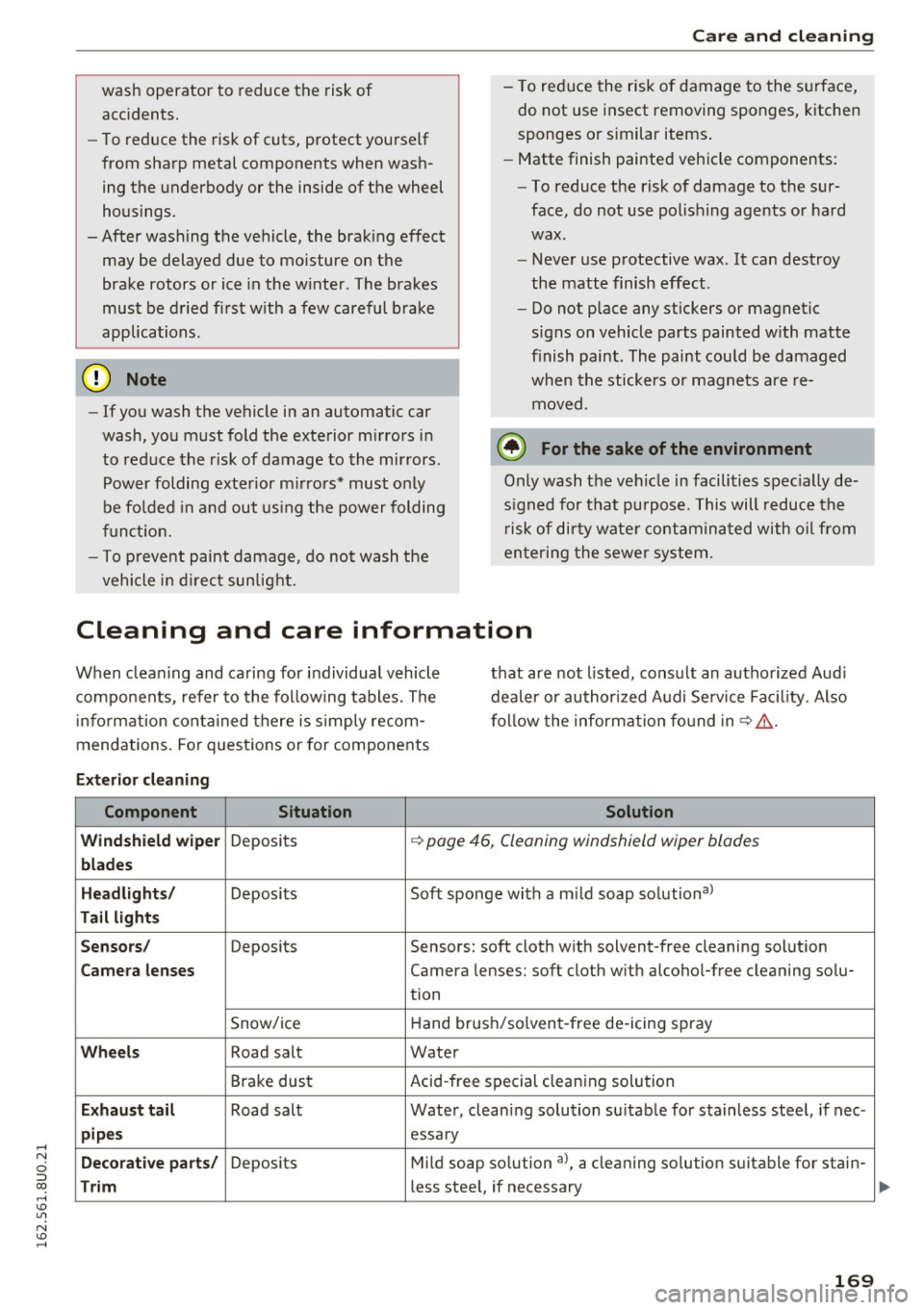
Cleaning and care information
W hen clea ning and ca ring for individua l vehicle
components, refer to the following tables. The
in fo rmation co ntai ned there is s imp ly recom
mend ations. For quest ions or for components that are
not listed, cons ult an autho rized Aud i
dealer or author ized A udi Se rvice Fac il ity. Also
f o llow the information fo und in ~ .&. -
Ext erior cleaning
Component Situation Solution
Windshield wiper
Deposits ~ page 46, Cleaning windshield wiper blades
blades
H eadlights /
Deposits Soft sponge with a mild soap solutiona >
Tail light s
Sensors /
Deposits Sensors: soft cloth with solvent-free cleaning solution
Camera lenses Camera lenses: soft cloth w ith alcoho l-free cleaning solu-
tion
Snow/i ce H
and brus h/solven t-free de-icing spray
Whe els Road salt Water
Brake dust Acid
-free special clean ing solution
Exhaust tail Road salt Water, clean ing solution su itab le for stainless stee l, if nee -
pipes essary
Decorative parts/ Deposits M
ild soap so lution al, a cleaning so lution s uitable for stain-
Trim less stee l, if necessary
169
...