brakes AUDI Q3 2016 Owner's Manual
[x] Cancel search | Manufacturer: AUDI, Model Year: 2016, Model line: Q3, Model: AUDI Q3 2016Pages: 252, PDF Size: 62.81 MB
Page 188 of 252
Checking and Filling
Brake fluid
Checking brake fluid level
The brake fluid level can be checked with a quick
glance.
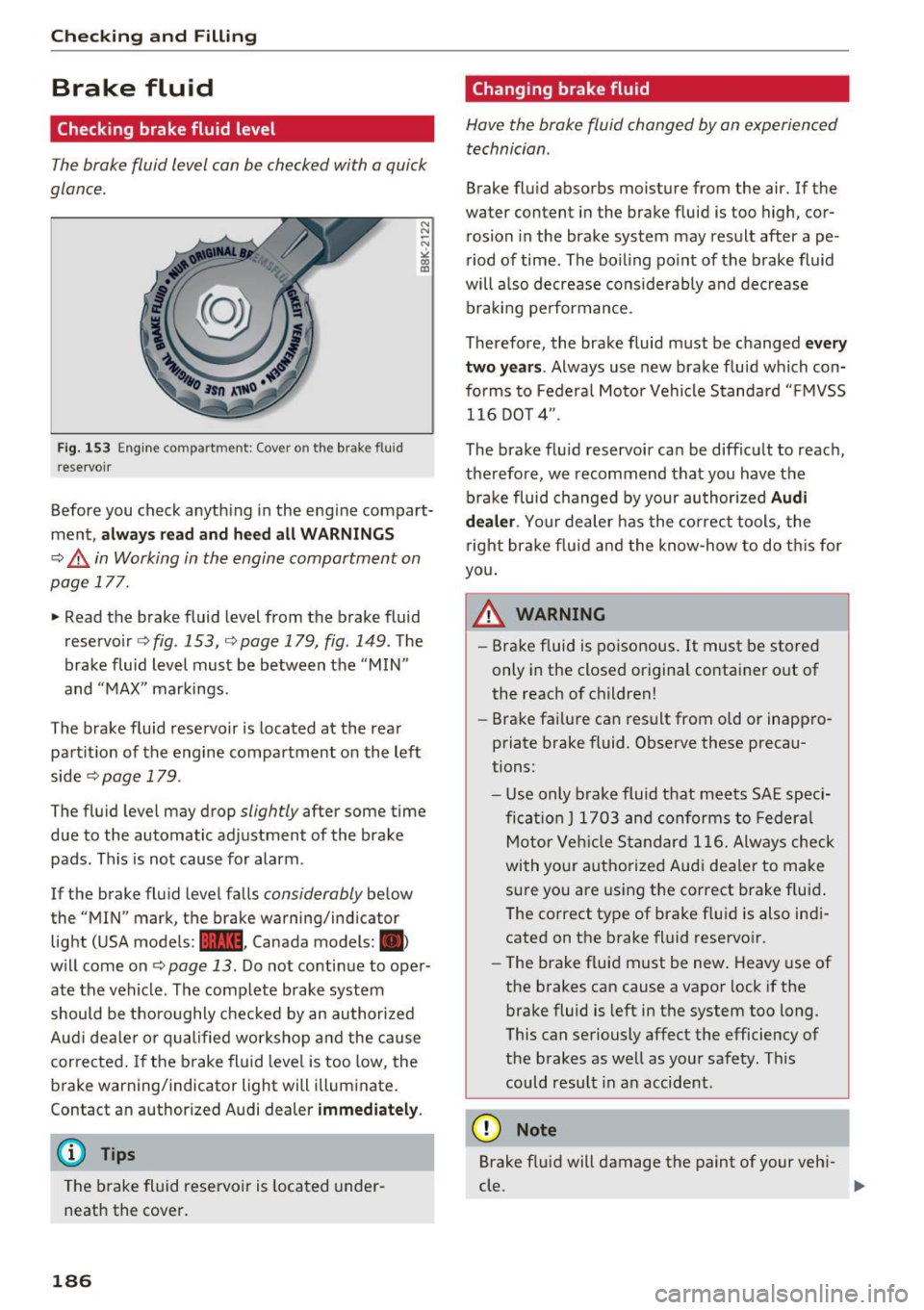
Fig. 153 Eng ine compartment: Cover on the brake fluid
r eservoir
Before you check anything in the engine compart
ment,
always read and heed all WARNINGS
¢ A in Working in the engine compartment on
page 177.
., Read the brake fluid level from the brake fluid
reservoir
<=> fig . 153, ¢page 179, fig . 149 . The
brake fluid level must be between the
" MIN"
and "MAX " markings.
The brake fluid reservoir is located at the rear
partition of the engine compartment on the left
side ¢
page 179 .
The fluid level may drop slightly after some time
due to the automatic adjustment of the brake
pads . This is not cause for alarm .
If the brake fluid level falls
considerably below
the ' 'MIN" mark, the brake warning/indicator
light (USA models:
1111 , Canada models:. )
will come on¢
page 13 . Do not continue to oper
ate the vehicle . The complete brake system
should be thoroughly checked by an authorized
Aud i dealer or qualified workshop and the cause
corrected. If the brake fluid level is too low, the
brake warning/indicator light w ill illuminate.
Contact an author ized Audi dealer
immediately.
(D} Tips
The brake fluid reservoir is located under
neath the cover.
186
Changing brake fluid
Have the brake fluid changed by an experienced
technician .
Brake fluid absorbs moisture from the air. If the
water content in the brake fluid is too high, cor
rosion in the brake system may result after ape
riod of time . The boiling po int of the brake fluid
will a lso decrease considerably and decrease
braking performance.
Therefore , the brake fluid must be changed
every
two years .
Always use new brake fluid which con
forms to Feder-al Motor Vehicle Standard "FMVSS
116 DOT 4 ".
The brake fluid reservoir can be difficult to reach ,
therefore, we recommend that you have the
brake fluid changed by your author ized
Audi
dealer .
Your dealer has the correct tools, the
right brake fluid and the know-how to do this for
you.
A WARNING
- Brake fluid is poisonous. It must be stored
only in the closed original container out of
the reach of children!
- Brake fai lure can result from o ld or inappro
priate brake fluid. Observe these precau
tions:
- Use only brake fluid that meets SAE speci
fi cation
J 1703 and conforms to Federal
Motor Veh icle Standard 116. Always check
with your authorized Audi dealer to make
sure you are using the correct brake fluid .
The correct type of brake f luid is also indi
cated on the brake fluid reservoir.
- The brake fluid must be new . Heavy use of
the brakes can cause a vapor lock if the
brake fluid is left in the system too long .
This can seriously affect the efficiency of
the brakes as well as your safety. This
could result in an accident.
(D Note
Brake fluid will damage the paint of your vehi-
cle .
lilJJ,
Page 195 of 252
be happy to provide more infor
mation.
® Mud and snow capability
"M/5" or "M+S" indicates the tire
has character istics that make it
suitable for driving on mud and
snow .
& indicates a winter tire.
@Composition of the tire cord
and materials
The number of plies indicates the
number of rubberized fabric lay
ers in the tire. In general: the
more layers, the more weight a
tire can carry . Tire manufacturers
must also specify the materials
used in the tire. These inc lude
steel, nylon, polyester and other
materials.
@ Maximum permitted load
This number indicates the max i
mum load in kilograms and
pounds that the tire can carry.
@ Uniform tire quality grade
standards for tread wear,
traction and temperature resistance
Tread wear, traction and temper
ature ranges ¢
page 207.
;:: @ Running direction 0 ::,
~
...
'° V, N
'° ...
The arrows indicate the running
direction of unidirectional tires .
Wheels
You must always follow the speci
fied runn ing d irect ion
¢ page 218 .
@ Maximum permitted
inflation pressure
This number indicates the maxi
mum pressure to which a tire can
be inflated unde r normal operat
ing condit ions.
Glossary of tire and loading
terminology
Accessory weight
means the comb ined weigh t (in
excess of those standard items
which may be replaced) of auto
matic transm ission, power steer
ing , power brakes, power win
dows, power seats, radio, and
heater, to the extent that these
items are available as facto ry-in
stalled equipment (whether in
stalled or not) .
Aspect ratio
means the ratio of the heigh t to
the width of the tire in percent .
Numbers of 55 or lowe r indicate a
low sidewa ll for improved steer
ing response and better overall
handling on dry pavement. .,.
193
Page 197 of 252
... N 0 ::,
~
...
'° V, N
'° ...
(a) Curb weight
(b) Accessory weight
(c) Vehicle capacity weigh t, and
(d) Production options we ight
Ma ximum (permissible)
inflation pressure
means the maximum cold infla
tion pressure to which a t ire may
be inflated. Also called "maxi
mum inflation pressure."
Normal occupant weight
means 150 lbs. (68 kilograms)
times the number of occupants
seated in the veh icle up to the to
tal seating capacity of your vehi c le.
Occupant distribution
means distribution of occupants
in a vehicle.
Outer diameter
means the overall diameter of an
inflated new tire.
Overall width
means the linear distance be
tween the exteriors of the side
walls of an inflated tire, including
elevations due to labeling, deco
rations, or protective bands or
ribs .
Wheels
Ply
means a layer of rubber-coated
parallel cords .
Production options weight
means the combined weight of
those installed regular production
options weighing over 5 lbs. (2.3 kg) in excess of those standard
items which they replace, not pre
viously considered in curb weight
or accessory weight, including
heavy duty brakes, ride levelers,
roof rack, heavy duty battery, and
special trim .
Radial ply tire
means a pneumatic tire in which
the ply cords that extend to the beads are laid at substantially 90
degrees to the centerline of the
tread.
Recommended inflation
pressure
see ~ page 194, Cold tire infla
tion pressure .
Reinforced tire
means a tire designed to operate
at higher loads and at higher in
flation pressures than the corre sponding standard tire. Rein
forced tires may be identified as .,.
195
Page 206 of 252
Wheels
position and the total weight of
any luggage in the vehicle. If you
tow a trailer, the weight of the trailer hitch and the tongue
weight of the loaded trailer must be included as part of the vehicle
load.
The
Gross Axle Weight Rating
("GAWR") is the maximum load
that can be applied at each of the
vehicle's two axles.
The fact that there is an upper
limit to your vehicle's Gross Vehi
cle Weight Rating means that the
total weight of whatever is being
carried in the vehicle (including
the weight of a trailer hitch and
the tongue weight of the loaded
trailer) is limited. The more pas
sengers in the vehicle or passen
gers who are heavier than the
standard weights assumed mean
that less weight can be carried as luggage.
The Gross Vehicle Weight Rating
and the Gross Axle Weight Rating
are listed on the safety compli
ance sticker label located on the
driver's side B-pillar
~ page 201,
fig . 158 .
204
_& WARNING
Overloading a vehicle can cause
loss of vehicle control, a crash
or other accident, serious per
sonal injury, and even death.
-Carrying more weight than
your vehicle was designed to carry will prevent the vehicle
from handling properly and
increase the risk of the loss of
vehicle control.
-The brakes on a vehicle that has been overloaded may not
be able to stop the vehicle
within a safe distance.
-Tires on a vehicle that has
been overloaded can fail sud
denly, including a blowout and
sudden deflation, causing loss of control and a crash.
-Always make sure that the to
tal load being transported -
including the weight of a trail
er hitch and the tongue
weight of a loaded trailer -
does not make the vehicle
heavier than the vehicle's
Gross Vehicle Weight Rating.
Page 239 of 252
Important warnings when working on the
battery . . . . . . . . . . . . . . . . . . . . . . . . . . . .
187
Jump starting . . . . . . . . . . . . . . . . . . . . . . . 223
Replacing the battery . . . . . . . . . . . . . . . . 190
Winter operation . . . . . . . . . . . . . . . . . . . . 187
Working on the battery . . . . . . . . . . . . . . . 187
Before driving . . . . . . . . . . . . . . . . . . . . . . . . . 95
Belt tensioners . . . . . . . . . . . . . . . . . . . . . . . 110
Blended gasoline . . . . . . . . . . . . . . . . . . . . . 173
Blower
Automatic climate control system . . . . . . .
65
Manual climate control system . . . . . . . . . . 63
Booster seats . . . . . . . . . . . . . . . . . . . . . . . . 140
Brake fluid
Changing the brake fluid . . . . . . . . . . . . . .
186
Checking the brake fluid level . . . . . . . . . . 186
Brakes . . . . . . . . . . . . . . . . . . . . . . . . . . . . . . 154
Brake booster . . . . . . . . . . . . . . . . . . . . . . . 154
New brake pads . . . . . . . . . . . . . . . . . . . . . 154
Parking brake . . . . . . . . . . . . . . . . . . . . . . . . 71
Brake system
Brake fluid . . . . . . . . . . . . . . . . . . . . . . . . .
186
Brake fluid specifications for refill and re
placement . . . . . . . . . . . . . . . . . . . . . . . . . 186
Brake light defective . . . . . . . . . . . . . . . . . .
18
Fluid reservoir . . . . . . . . . . . . . . . . . . . . . . 186
Warning/indicator lights . . . . . . . . . . . . . . . 13
Worn brake pads symbol . . . . . . . . . . . . . . . 16
Braking
Brake assist . . . . . . . . . . . . . . . . . . . . . . . .
151
Emergency braking funct ion . . . . . . . . . . . . 73
Starting on inclines . . . . . . . . . . . . . . . . . . . 73
Break-in period
Tires . . . . . . . . . . . . . . . . . . . . . . . . . . . . . .
159
Breaking in . . . . . . . . . . . . . . . . . . . . . . . . . . 159
New tires . . . . . . . . . . . . . . . . . . . . . . . . . . 198
Bulbs . . . . . . . . . . . . . . . . . . . . . . . . . . . . . . . 221
C
California Proposition 65 Warning . . . . . . . 178
Battery specific . . . . . . . . . . . . . . . . . . . . . 188
Capacities . . . . . . . . . . . . . . . . . . . . . . . . . . . 230
Engine oil . . . . . . . . . . . . . . . . . . . . . . . . . . 179
Caps for wheel bolts , removing . . . . . . . . . . 215
Care . . . . . . . . . . . . . . . . . . . . . . . . . . . . . . . . 168
Index
Cargo area
refer to Loading the luggage compart-
ment...... ... .. .. .................
100
Cargo floor . . . . . . . . . . . . . . . . . . . . . . . . . . . 61
Catalytic converter . . . . . . . . . . . . . . . . . . . . 159
Center armrest . . . . . . . . . . . . . . . . . . . . . . . . 51
Centra l locking . . . . . . . . . . . . . . . . . . . . . . . . 27
Central locking sw itch . . . . . . . . . . . . . . . . . 31
Convenience key . . . . . . . . . . . . . . . . . . . . . . 30
Emergency locking . . . . . . . . . . . . . . . . . . . . 32
Luggage compartment lid . . . . . . . . . . . . . . 33
Panorama roof . . . . . . . . . . . . . . . . . . . . . . . 37
Powe r windows . . . . . . . . . . . . . . . . . . . . . . 3 7
Remote control key . . . . . . . . . . . . . . . . . . .
29
Certification . . . . . . . . . . . . . . . . . . . . . . . . . 235
Changing engine oil . . . . . . . . . . . . . . . . . . . 182
Checking
Engine coolant level . . . . . . . . . . . . . . . . . .
183
Child restraints
Danger of using child restraints in the front
seat....... ... .. .. ................ .
113
Where can I get additional information
about child restraints and their use? . . . .
149
Child restraints system anchors. . . . . . . . . . 144
Child safety . . . . . . . . . . . . . . . . . . . . . . . . . .
132
Important safety instructions for using child
safety seats . . . . . . . . . . . . . . . . . . . . . . . .
135
Important th ings to know when driving with
children . . . . . . . . . . . . . . . . . . . . . . . . . . .
132
Installing a child restraint using the LATCH
system . . . . . . . . . . . . . . . . . . . . . . . . . . . .
146
Mounting and re leasing the anchorage
hook . . . . . . . . . . . . . . . . . . . . . . . . . . . . . .
146
Tether anchors . . . . . . . . . . . . . . . . . . . . . . 147
Tether s traps . . . . . . . . . . . . . . . . . . . . . . . 147
Child safety lock
Rear doors . . . . . . . . . . . . . . . . . . . . . . .
35, 36
Child safety seats
Booster seats . . . . . . . . . . . . . . . . . . . . . . .
140
Convertible child seats . . . . . . . . . . . . . . . 138
Convertible locking retractor . . . . . . . . . . 143
Danger of using child restraints in the front
seat...... .... .. .. ............... ..
113
How do I properly install a child safety seat
in my vehicle? . . . . . . . . . . . . . . . . . . . . . . .
135
Infant seats . . . . . . . . . . . . . . . . . . . . . . . . 137
LATCH system . . . . . . . . . . . . . . . . . . . . . . 146
237