change time AUDI Q3 2016 User Guide
[x] Cancel search | Manufacturer: AUDI, Model Year: 2016, Model line: Q3, Model: AUDI Q3 2016Pages: 252, PDF Size: 62.81 MB
Page 90 of 252
Parking systems
Parking systems
General information
Applies to vehicles: with rear parking system/parking system
p lus/rear v iew camera
Depending on your vehicle 's equipment , various
parking aids will help you when parking and ma
neuvering.
The
rear park ing system is an audible parking aid
that warns you of obstacles
behind the vehicle
~ page 88.
The parking system plus assists you when park
ing by audibly and visually indicating objects de
tected
in front of and behind the vehicle
~ page 89.
The rear view camera shows the area behind the
vehicle in the Infotainment display . This display
assists you when you are cross or parallel parking
~ page 90. In addition, you are assisted by the
functions from the park ing system plus
~ page 89.
& WARNING
-Always look for traffic and check the area
around your vehicle by looking at it directly
as well. The parking system cannot replace
the driver's attention. The driver is always
responsible for safety during parking and
for all other maneuvers.
- Please note that some surfaces , such as
clothing, are not detected by the system .
- Sensors and cameras have blind spots in
which people and objects cannot be detect
ed . Be especially cautious of children and
animals.
- The sensors can be displaced by impacts or
damage to the radiator gr ille, bumper,
wheel housing and the underbody . The park
ing systems may become impa ired as a re
sult . Have your authorized Audi dealer or
qualified workshop check their function.
- Make sure the sensors are not covered by
stickers, deposits o r any other obstructions
as
it may impair the sensor function . For in
formation on cleaning, refer to
~ page 168.
88
(D Note
-Some objects are not detected by the sys
tem under certain circumstances:
-Objects such as barrier chains, trailer draw
bars, vertical poles or fences
- Objects above the sensors such as wall ex
tensions
- Objects with specific surfaces or struc
tures such as chain link fences or powder
snow.
- If you continue driving closer to a low-lying
object, it may disappear from the sensor
range. Note that you will no longer be
warned about this obstacle.
(D Tips
-The system may provide a warning even
though there are no obstacles in the cover
age area in some situations, such as:
- certain road surfaces or for long grass.
- external ultrasonic sources e.g. from cleaning vehicles .
- heavy rain, snow or thick vehicle exhaust .
- We recommend that you practice parking in
a traffic-free location or parking lot to be
come familiar with the system . When doing
this, there should be good light and weath
er conditions.
- You can change the volume and pitch of the
signals as well as the display
~ page 93.
- Please refer to the instructions for towing a
trailer ~
page 94 .
-What appears in the infotainment display is
somewhat time-delayed.
Rear parking system
Description
Applies to veh icles : with rear parking system
The rear parking syst em is an audible parking
aid .
There is a sensor in the rear bumpe r cover. If
these detect an obstacle, audible signals warn
you.
Make sure the sensors are not covered by stick -
ers , deposits or any other obstructions as it may ""'
Page 103 of 252
-Always put objects, for example, luggage or
other heavy items in the luggage compart
ment.
- Always secure objects in the luggage com
partment using the tie-down eyelets and
suitable straps.
A WARNING
Heavy loads will influence the way your vehi
cle handles . To help reduce the risk of a loss
of control leading to serious personal injury:
- Always keep in mind when transporting
heavy objects, that a change in the center of
gravity can also cause changes in vehicle
hand ling:
- Always distribute the load as evenly as
possible.
- Place heavy objects as far forward in the
luggage compartment as possible.
- Never exceed the Gross Axle Weight Rating
or the Gross Vehicle Weight Rating specified
on the safety compliance sticker on the left
door jamb. Exceeding permissible weight
standards can cause the vehicle to slide and
handle differently .
- Please observe information on safe driving
¢page 95.
A WARNING
To help prevent poisonous exhaust gas from
being drawn into the vehicle, always keep the
rear lid closed while driving .
- Never transport objects larger than those
fitting completely into the luggage area be
cause the rear lid cannot be fully closed .
- If you absolutely must drive with the rear lid
open, observe the following notes to reduce
the risk of poisoning:
- Close all windows,
- Close the Pano ramic sliding sunroof*,
- Open all air outlets in the instrument pan-
el,
- Switch off the air recirculation,
- Set the fresh air fan to the highest speed .
Driving safety
A WARNING
-
Always make sure that the doors, all win
dows, the Panoramic sliding sunroof* and the
rear lid are securely closed and locked to re
duce the risk of injury when the vehicle is not
being used .
-After closing the rear lid, always make sure
that it is properly closed and locked.
- Never leave your vehicle unattended espe
cially with the rear lid left open. A child
could crawl into the vehicle through the lug
gage compartment and close the rear lid be
coming trapped and unable to get out. Be
ing trapped in a vehicle can lead to serious
personal injury.
- Never let children play in or around the vehi
cle.
- Never let passengers ride in the luggage
compartment. Vehicle occupants must al
ways be properly restrained in one of the ve
hicle's seating positions.
(D Tips
-Air circulation helps to reduce w indow fog
ging . Stale air escapes to the outside
through vents in the trim panel. Be sure to
keep these slots free and open.
- The tire pressure must correspond to the
load. The tire pressure is shown on the tire
pressure label. The tire pressure label is lo
cated on the driver's side B-pillar . The tire
pressure label lists the recommended cold
tire inflation pressures for the vehicle at its
maximum capac ity weight and the tires that
were on your vehicle at the time it was man
ufactured. For recommended t ire pressures
for normal load conditions, please see chap
ter ¢
page 201.
Tie-downs
The luggage compartment is equipped with four
tie-downs to secure luggage and other items.
Use the tie-downs to secure your cargo properly
<=? page 100, Loading the luggage compartment. ..,_
101
Page 128 of 252
Airbag syste m
with these requirements and we recommend
that you have your dealer perform this service
for you.
Other things that can affect Advanced
Airbag performance
Changing the vehicle's suspension system can
change the way that the Advanced Airbag System
performs in a crash. For examp le, using t ire-r im
comb inat ions not approved by Audi, lower ing the
veh icle, changing the stiffness of the suspens ion,
including the springs, suspension struts, shock
absorbers etc . can change the forces that are
measured by the airbag sensors and sent to the
electronic control unit. Some suspension changes
can, for example, increase the force levels meas
ured by the sensors and make the airbag system
deploy in crashes in wh ich it would not deploy if
the changes had not been made. Other kinds of
changes may reduce the force levels meas ured by
the sensors and prevent the airbag from deploy ing when it should.
A WARNING
Changing the vehicle's suspension including
use of unapproved tire-rim combinations can
change Advanced Airbag performance and in
crease the risk of serious personal injury in a
crash.
- Never install suspension components that
do not have the same performance charac
teristics as the components originally instal
led o n your veh icle .
- Never use tire-rim comb inations that have
not been approved by Audi.
A WARNING
Items stored between the safety belt buckle
and the center console can cause the senso rs
in the buckle to send the wrong info rmation
to the electronic control module and prevent
t he Advanced Airbag System from wor king
properly.
- Always make sure tha t noth ing can interfere
with the safety be lt buck les and that they
are not obstructed.
126
Side airbags
Description of side airbags
The airbag system can provide supplemental
protection to properly restrained occupants .
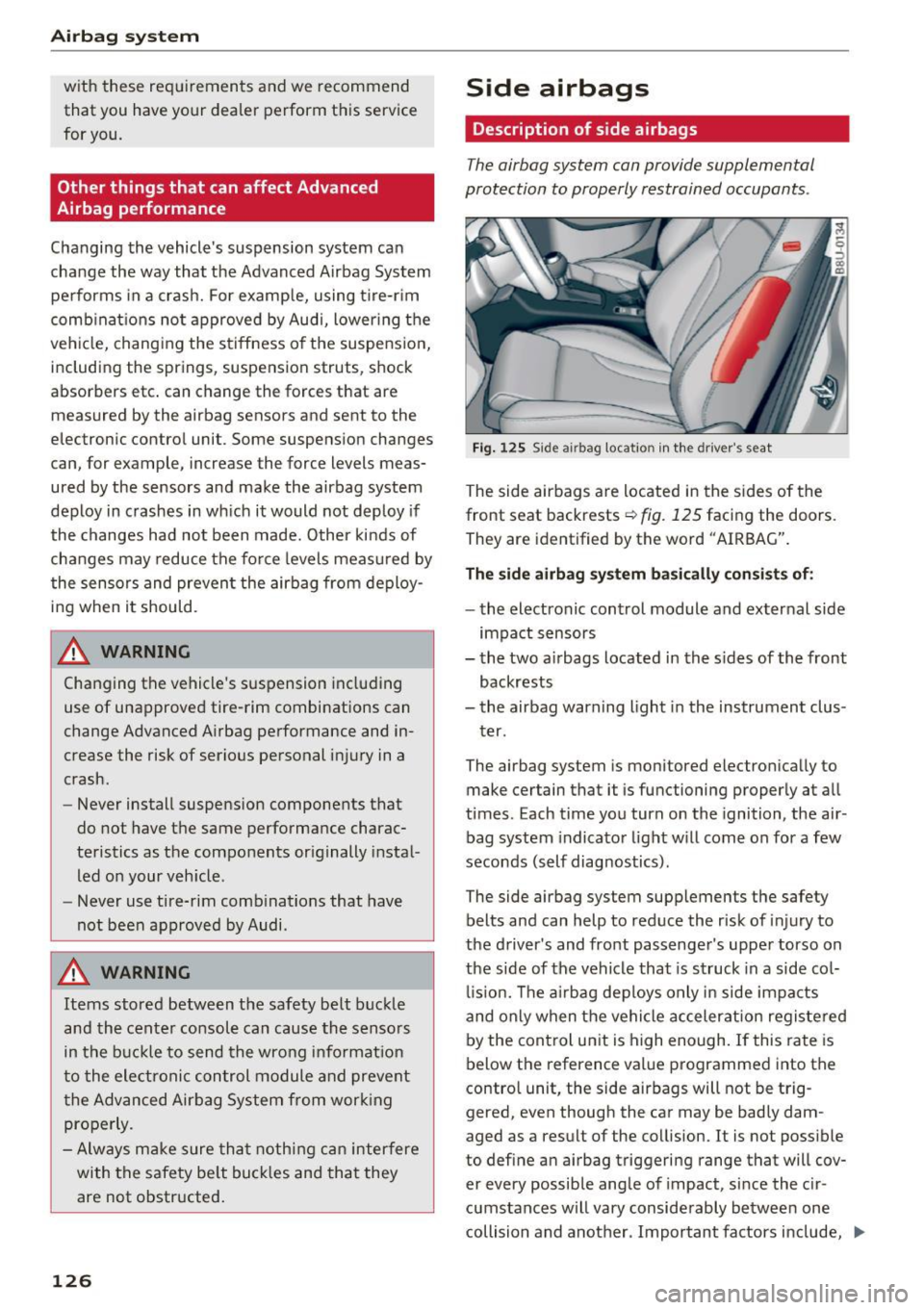
Fig. 125 S ide a irbag locat io n in the driver's seat
The side airbags are located in the sides of the
front seat backrests ¢
fig. 125 facing the doors.
They are identified by the word "AIRBAG".
The sid e airbag system ba sically con sis t s o f:
- the electronic control module and external side
impact sensors
- the two a irbags located in the s ides of the front
backrests
- the airbag warning light in the instrument clus -
ter.
The airbag system is monitored electronica lly to
make certain that it is functioning properly at a ll
t imes. Each time you turn on the ignition, the air
bag system indicator light w ill come on for a few
seconds (self diagnostics) .
The side airbag system supplements the safety belts and can help to reduce the risk of injury to
the driver's and front passenger's upper torso on
the side of the vehicle that is struck in a side co l
li sion. The a irbag deploys only in side impacts
and only when the vehicle acceleration registered by the control unit is high enough. If this rate is
below the reference val ue programmed into the
contro l unit, the side airbags will not be trig-
gered, even though the car may be badly dam-
aged as a result of the collision. It is not possible
to define an airbag triggering range that will cov er every possible angle of impact, si nce the c ir
cumstances w ill vary conside rably between one
collision and another . Important factors include, .,,.
Page 153 of 252
shared, please see your contract with the
wireless telecommunications provider and the
"About Aud i connect" tab in your vehicle's
MMI:
! MENUI button> Audi connect > About
Audi conn ect.
Electronic Stabilization
Control (ESC)
Description
ESC helps to improve road ho ld ing and vehicle
dynamics to help reduce the probability of skid
d ing and loss of vehicle control. It works only
when the engine is runn ing . E SC detects certain
d ifficult dr iving sit uat ions, including when t he
ve hicl e is begin ning to spin (yaw) out of contro l
and helps you to ge t the veh icle back under con
tro l by se lective ly braking the wheels, and/or re
ducing engine powe r and provid ing steering as
sistance to help hold the vehicle on the dr iver's
intended course. The indicator light
GJ in the in
strument cluster blinks when ESC is taking action
to help you co ntrol the vehicle.
ESC has limitations. It is important to remember
that ESC cannot overcome the laws of physics. It
will not a lways be able to help out under all con
d itions you may come up aga inst. For example,
ESC may not always be able to help you master
situations where there is a sudden change in the
coeff icient of friction of the road surface. When
there is a section of dry road that is sudde nly cov
e red with water, slush o r snow, ESC cannot pe r
form the same way it wo uld on the dry s urface . If
the vehicle hydrop lanes (rides on a cushion of wa
ter i nstead of the road su rface), ESC wi ll not be
ab le to he lp you steer the veh icle because contact
with the pavement has been interrupted and the
ve hicle cannot be braked or steered. Dur ing fast
cornering, pa rticula rly on w inding roads, ESC
cannot always deal as effect ively w it h difficult
d riving si tuations tha n at lowe r speeds. When
tow ing a t raile r, ESC is not able to help you re
ga in con trol as it would if you we re not towing a
tra iler .
A lways adjust yo ur speed and driving sty le to
road, traffic and weathe r cond itions. ESC cannot
override the vehicle's physical lim its, increase the
Intellig ent Technology
available t ract ion, or keep a vehicle on the road if
road departure is a resu lt of driver inattention .
Instead, ESC improves the possib ility o f keeping
the vehicle under contro l and on the road d uring
extreme maneuvers by us ing the driver's steer ing
i nputs to help keep the veh icle go ing in the in
tended direction.
If you are traveling at a speed
that causes you to run off the road before ESC c an p rovide any assistance, you may not exper i
en ce the benefi ts of ESC.
ESC is switched o n all the time . In certa in s itua
t ions when you need less tract ion, you can sw itch
off AS R by press ing the button
[fil c:> page 152,
fig. 141. B e sure to switc h ASR on again whe n
you no longer need less tract ion .
T he following systems are integrated in the ESC:
Anti-lock brak ing system (ABS )
ABS prevents the wheels from locking when brak ing . The vehicle can still be steered even dur ing
hard braking. Apply steady pressure to the brake
pedal. Do not pump the pedal. A pulsing in the
brake pedal ind icates that the system is acting to
stab ilize the ve hicle.
Brake assist system
The brake assist system can decrease braking dis
tance. It increases braking powe r when the dr iver
presses the brake peda l quickly in emergency sit
uat io ns. You must press a nd ho ld the bra ke pedal
u nt il the dange rous situation is over.
Anti-slip regulation (ASR)
ASR reduces engine power whe n the dr ive wheels
begin spin ning and adapts the force to the road
co ndit ions. This makes it eas ier to s tart, acce ler
ate and d rive up incl ines.
Electronic differential lock (EDL)
The EDL brakes wheels that are spinning and
transfers the drive power to the other dr ive
wheel or wheels if the vehicle is equ ipped with all
whee l drive*) . This function is not available a t
highe r speeds .
In extreme cases, EDL automat ica lly switches off
to keep t he brake o n the braked wheel from over
hea ting . T he veh icle is still working co rrectly. EDL.,.
151
Page 175 of 252
Fuel and Refueling
Gasoline
Fuel supply
Using the right fuel helps keep the environment
clean and prevents engine damage .
Fuel recommendation
The fuel recommended for your vehicle is unlead
ed premium
grade gasoline. Audi recommends
using TOP TIER Detergent Gasoline with a mini
mum octane rating of 91 AKI (95 RON). For more
in formation on TOP TIER Detergent Gasoline,
p lease go to the offic ial website
(www.toptiergas.com).
The recommended gasoline octane rating for
your engine can also be found on a label located
on the inside of the fuel filler flap. This rating
may be specified as AKI or RON.
Your vehicle may also be operated using unlead
ed regular gasoline with a minimum octane rat
ing of 87 AKI/91 RON. However, using 87 AKI/91
RON octane fuel w ill slightly reduce engine pe r
formance.
Use unleaded gasoline only. Unleaded gasoline
is available throughout the USA, Canada, and in
most European countries . We recommend that
you do not take your vehicle to areas or countries
where un leaded gasoline may not be available.
For more information on refueling your vehicle,
see
r=;, page 17 4.
Octane rating
Octane rating indicates a gasoline's ability to re
sist engine damaging "knock" caused by prema
ture ignit ion and detonation . Therefore, buy ing
the correct grade of gasoline is very important to
help prevent poss ible engine damage and a loss
of eng ine performance.
Gasoline most commonly used in the United
States and Canada has the following octane rat
ings that can usually be found on the filler pump:
- Premium Grade: 91 - 96 AKI
- Regular Grade: 87 - 90 AKI
Fuel and Refueling
Explanation of the abbreviations :
AKI=
Ant i Knock Index= (R+M)/2 = (RON +MON)/
2
RON = Re search Octane Number
MON= Motor Octane Number.
(D Note
- Do not use any fuel with octane ratings low
er than 87 AKI or 91 RON otherwise expen
sive engine damage w ill occur.
- Do
not use leaded gasoline. The use of lead
ed gasoline will severely damage your vehi
cle's catalytic converter and its ability to
control exhaust emissions.
Blended gasoline
Use of gasoline containing alcohol or MTBE
(methyl tertiary butyl ether)
You may use unleaded gasoline b lended with al
cohol or MTBE (commonly referred to as oxygen
ates) if the blended mixt ure meets the follo wing
criteria:
Blend of gasoline methanol (wood alcohol or
methyl alcohol)
- Anti-knock index must be 87 AKI or higher.
- Blend must contain no more than 3% metha-
nol.
- Blend must contain more than 2% co-solvents.
Blend of gasoline and ethanol (grain alcohol or
ethyl alcohol)
- Anti-knock index must be 87 AKI or higher.
- Blend must not conta in more than 15% etha-
nol.
Blend of gasoline and MTBE
- Anti-knock index must be 87 AKI or higher.
- Blend must contain not more than 15% MTBE.
Seasonally adjusted gasoline
Many gasoline grades are blended to perform es
pecially well for winter or summer dr iving . Dur
ing seasonal change-ove r, we suggest that you
fill up at busy gas stations where the seasonal
adjustment is more likely to be made in time. ..,.
173
Page 181 of 252
.... N
c:i ::J CX)
.... I.Cl U"I
N I.Cl ......
Checking and Filling
Engine compartment
Engine compartment overview
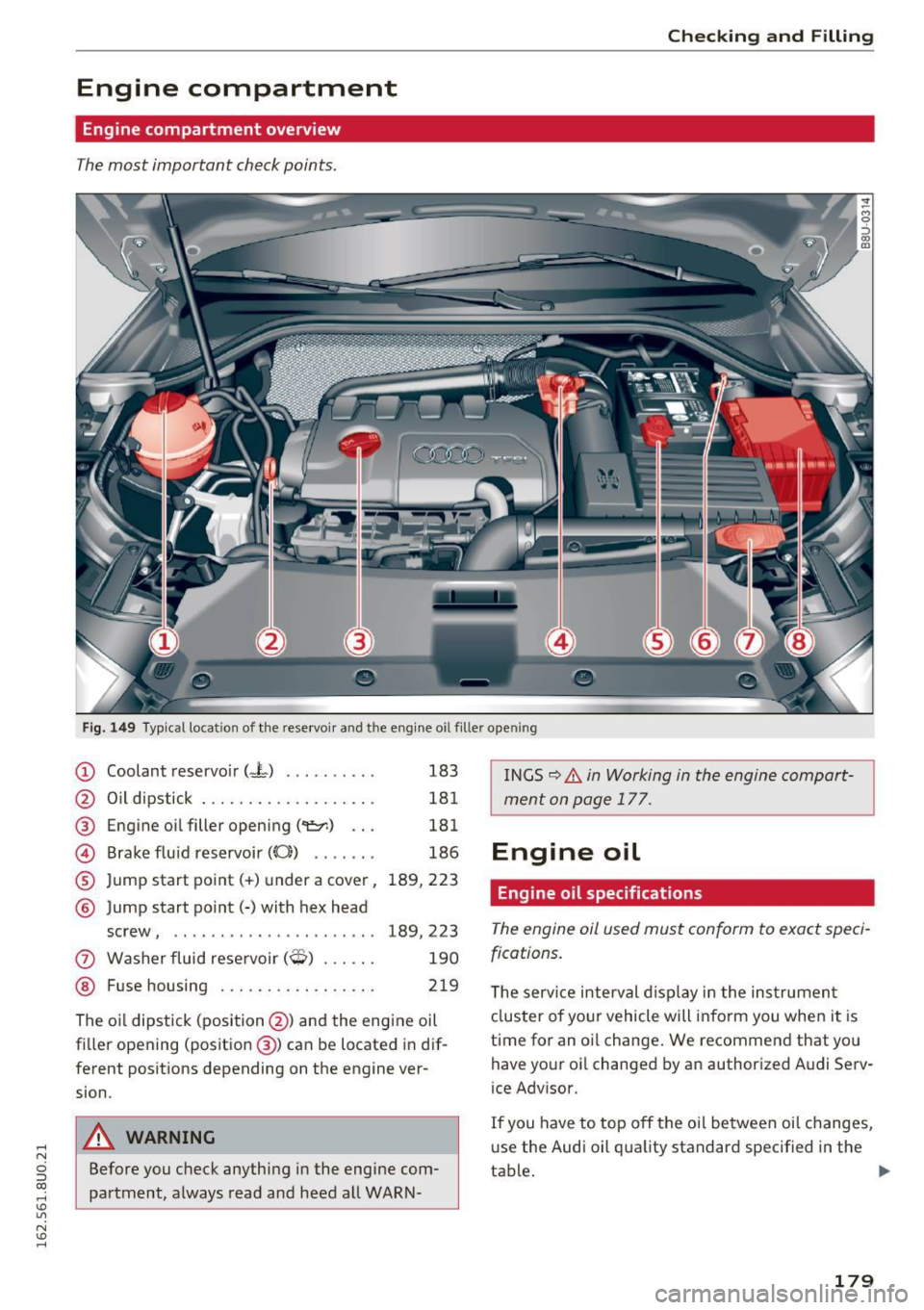
The most important check points.
Fig. 149 Typical location of the reservoir a nd the engine o il fil ler ope ning
(D Coolant reservoir (-L) . . . . . . . . . . 183
@ Oil dipstick . . . . . . . . . . . . . . . . . . . 181
@ Engine oil filler opening ('1!::r.) . . . 181
@ Brake fluid reservoir (0) . . . . . . . 186
® Jump start point(+) under a cover, 189, 223
® Jump start point(-) with hex head
screw, . . . . . . . . . . . . . . . . . . . . . .
189, 223
0 Washer fluid reservoir($) . . . . . . 190
@ Fuse housing . . . . . . . . . . . . . . . . . 219
The oil dipstick (position @) and the engine oil
filler opening (position @) can be located in dif
ferent positions depending on the engine ver
sion.
A WARNING
Before you check anything in the engine com
partment, always read and heed all WARN- INGS
9 .&. in Working in the engine
compart
ment on page 177.
Engine oil
Engine oil specifications
The engine oil used must conform to exact speci
fications.
T he serv ice interval d isplay in the instrument
cluster of your vehicle will inform you when it is
time for an oil change . We recommend that you
have your oil changed by an authorized Audi Serv
ice Advisor.
If you have to top off the oil between oil changes,
us e the Audi oil quality standard specified in the
tab~ .
~
179
Page 182 of 252
Check ing and F illing
Audi oil quality standard
Gas olin e
VW 502 00 or
engi ne vw 50400
Using the proper engine oil is important for the
functionality and service life of the engine. Your
engine was factory-filled with a high-quality oil
which can usually be used throughout the entire
year .
Q) Note
Your Limited New Vehicle Warranty does not
cover damage or malfunctions due to failure
to follow recommended maintenance and use
requirements as set fo rth in the Audi Owner's
Manual and Wa rranty
& Maintenance booklet.
- Use only a high qua lity eng ine oi l th at ex-
pressly complies with the Audi oil qua lity
stan dard specified for your vehi cle's engine.
Using any o ther oil can cause serious engine
damage .
- Do not mix any lubricants o r other addit ives
i nto the engine oil. Doing so can cause en
gine damage.
(D Tips
I f you nee d to add oi l and there is none availa
ble that meets the Audi o il qu ality st andard
your engine requires, you may ad d a total of
no more than 0 .5 quart/liter of a high-quality
"synthet ic"oil that meets the following speci
fications.
- ACEA A3 o r API SM with a viscosity g rade of
SAE OW-30, SAE 5W-30 or SAE 5W-40.
- For more information about engine oi l that
has been approved for your vehicle, please
contact either your authorized Audi dea ler
or Audi Custome r Relat ions at
1 (800) 822-2834 or visit our web site at
www.audiusa.com or www .aud icanada .ca.
Engine oil consumption
The engine in your vehicle depends on an ade
quate amount of oil to lubricate and cool all of
its moving parts .
In order to provide effective lubrication and cool
ing of internal engine components, all internal
180
combust ion engines consume a certa in amo unt
of oil. Oil consumption varies from engine to en
gine and may change significantly over the life of
the engine. Typically, engines w ith a specified
break-in period (see
c:::;, page 159) consume more
o il dur ing the break-in per iod than they consume
af ter o il consumption has stab ilized .
Under normal conditions, the rate of oil con
sumption depends on the quality and viscos ity of
the oil, the RPM (revo lutions per m inute) at
wh ich the engine is operated, the amb ient tem
perature and road condit ions. Further factors a re
the amount of o il di lution from wate r co ndensa
tion or fue l resid ue an d the oxidation level of the
o il. As any engine is sub ject to wear as mileage
builds up, the oi l cons umption may increase over
time unt il replacement of worn components may
become necessary.
With a ll these variab les coming into p lay, no
standard rate of oil consumption can be estab
li shed or specified. The re is no alternative to reg
u lar and frequent checking of the oi l level, see
Note.
If the yellow engine oil level warning symbo l Ell
in the instrument cluster lights up, you sho uld
check the oil level as soon as possible
c:::;, page 181. Top off the oil at your earliest con
venience
c:::;,page 181.
A WARNING
Before you check anyth ing in the e ng ine com
partment, always read and heed all WARN
I NGS
c:::;, .&. in Working in the engin e compart
ment on page 177.
(D Note
Driving w ith an insuffic ient oil level is likely to
cause severe damage to the eng ine.
(D Tips
- The oil pressure warn ing d isplay. is not
an indicator of the oil level. Do not rely on
it. Instead, check the oil level in your en
g ine at regular int ervals , pr eferably each
time you refuel, and alway s before going
on a long trip .
Page 188 of 252
Checking and Filling
Brake fluid
Checking brake fluid level
The brake fluid level can be checked with a quick
glance.
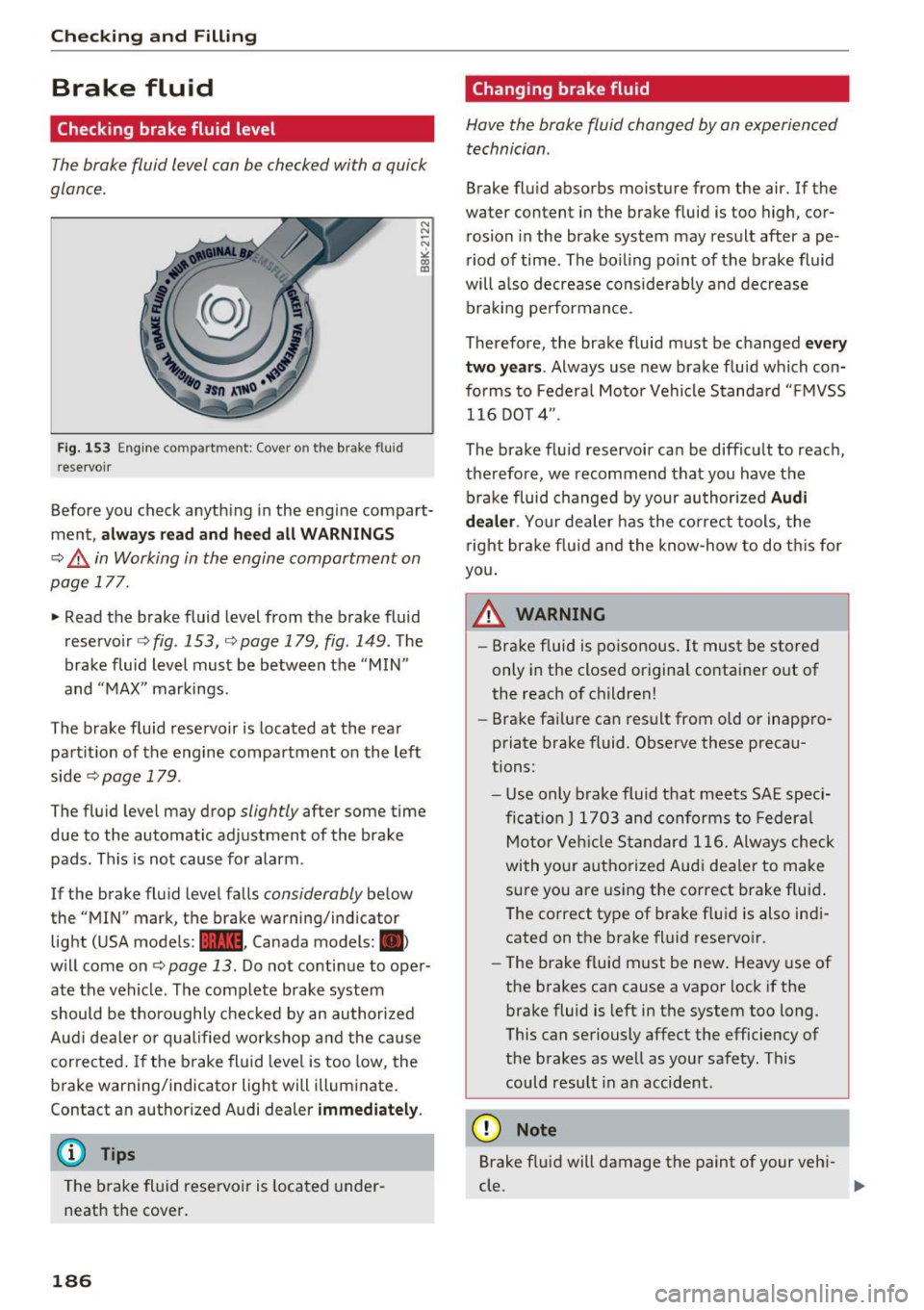
Fig. 153 Eng ine compartment: Cover on the brake fluid
r eservoir
Before you check anything in the engine compart
ment,
always read and heed all WARNINGS
¢ A in Working in the engine compartment on
page 177.
., Read the brake fluid level from the brake fluid
reservoir
<=> fig . 153, ¢page 179, fig . 149 . The
brake fluid level must be between the
" MIN"
and "MAX " markings.
The brake fluid reservoir is located at the rear
partition of the engine compartment on the left
side ¢
page 179 .
The fluid level may drop slightly after some time
due to the automatic adjustment of the brake
pads . This is not cause for alarm .
If the brake fluid level falls
considerably below
the ' 'MIN" mark, the brake warning/indicator
light (USA models:
1111 , Canada models:. )
will come on¢
page 13 . Do not continue to oper
ate the vehicle . The complete brake system
should be thoroughly checked by an authorized
Aud i dealer or qualified workshop and the cause
corrected. If the brake fluid level is too low, the
brake warning/indicator light w ill illuminate.
Contact an author ized Audi dealer
immediately.
(D} Tips
The brake fluid reservoir is located under
neath the cover.
186
Changing brake fluid
Have the brake fluid changed by an experienced
technician .
Brake fluid absorbs moisture from the air. If the
water content in the brake fluid is too high, cor
rosion in the brake system may result after ape
riod of time . The boiling po int of the brake fluid
will a lso decrease considerably and decrease
braking performance.
Therefore , the brake fluid must be changed
every
two years .
Always use new brake fluid which con
forms to Feder-al Motor Vehicle Standard "FMVSS
116 DOT 4 ".
The brake fluid reservoir can be difficult to reach ,
therefore, we recommend that you have the
brake fluid changed by your author ized
Audi
dealer .
Your dealer has the correct tools, the
right brake fluid and the know-how to do this for
you.
A WARNING
- Brake fluid is poisonous. It must be stored
only in the closed original container out of
the reach of children!
- Brake fai lure can result from o ld or inappro
priate brake fluid. Observe these precau
tions:
- Use only brake fluid that meets SAE speci
fi cation
J 1703 and conforms to Federal
Motor Veh icle Standard 116. Always check
with your authorized Audi dealer to make
sure you are using the correct brake fluid .
The correct type of brake f luid is also indi
cated on the brake fluid reservoir.
- The brake fluid must be new . Heavy use of
the brakes can cause a vapor lock if the
brake fluid is left in the system too long .
This can seriously affect the efficiency of
the brakes as well as your safety. This
could result in an accident.
(D Note
Brake fluid will damage the paint of your vehi-
cle .
lilJJ,
Page 189 of 252
@ For the sake of the environment
Because of the problem of proper disposal of
brake fluid as we ll as the special toots re
quired and the necessary expertise, we rec
ommend that you have the brake fluid
changed by your authorized Audi dealer .
Battery
General information
Under normal operating conditions, the battery
in your Audi does not need any maintenance.
With
high outside temperatures or long daily
drives we recommend that you have the electro
lyte level checked by an authorized Audi dealer or
qualified workshop. The electrolyte level should
also be checked each time the battery is charged
c> page 189.
Have the battery checked when you take your ve
hicle in for serv ice. You are well advised to re
place a battery t hat is older than 5 years.
With certain types of airbag deployment, the battery is disconnected from the vehicle electri
cal system for safety reasons
c> & in Repair, care
and disposal of the airbags on page 125 .
Disconnecting the battery terminals
Some vehicle functions (power window regula
tors, for example) are lost if the battery termi nals are disconnected. These functions have to be
relearned after the battery terminals are con
nected again. To prevent th is, the battery should
only be disconnected from the vehicle e lectr ica l
system when abso lutely necessary for repairs.
Vehicles not driven for long periods
If you do not drive your vehicle over a period of
several days or weeks, electrical components are
gradually cut back or sw itched off. This reduces
energy consumption and maintains starting ca
pability over a longer pe riod
c> page 157.
Some of the conven ience functions may not oper
ate, such as the interior lights or the power seat
adjustment. The convenience functions will be
available again when you turn on the ignition and
start the engine.
Checking and Filling
Winter operation
During the winter months, battery capacity tends
to decrease as temperatures drop . This is be
cause more power is also consumed while start
ing, and the headlights, rear window defogger,
etc., are used more often.
Avo id unnecessary power consumption, particu
larly in city traffic or when traveling only short
distances . Let your authorized Audi dealer check
the capacity of the vehicle battery before winter
sets in
c> page 189. A well charged battery will
not only prevent starting problems when the
weather is cold, but will also last longer .
(D Tips
If your vehicle is left standing for several
weeks at extremely low temperatures, the ve
hicle battery should be removed and stored
where it w ill not freeze. This will prevent it
from be ing damaged and having to be re
placed.
Working on the battery
Be especially careful when working on or near
the battery.
The battery is located in the engine compart
ment . Before you check anything in the engine
compartment ,
read and heed all WARNINGS
c>,& ,
Always heed the safety warnings, when working
on the vehicle battery or the veh icle electrical
system to prevent injury.
The following WARNINGS are very important
when working on the battery:
Always heed the following WARNING SYM·
BOLS and safety precautions when working on
the battery.
®
Always wear eye protection.
A
Battery acid contains sulfuric acid. Al-
ways wear gloves and eye protection .
187
Page 190 of 252
Check ing and F illing
@
No
- sp ark s
- flam es
- smoking.
£
When a bat tery is charg ed, it produc es
hydr og en gas which i s ex plo sive and
could c aus e pe rs onal injury .
®
Alwa ys keep the b atter y well out of reach
of chil dren.
A WARNING
Whenever work ing on the battery or on the
elect rical system, there is the risk of injury,
accident and
even fire. Read and heed the fol
lowing WARN INGS :
- Always wea r eye protection. Do not let bat
te ry acid or any lead pa rticles get on your
sk in or cloth ing . Sh ield your eyes. Explosive
gases can cause blindness or other injury .
- Battery acid con tains su lfu ric acid. Sulfur ic
acid c an cause blindness and
severe bu rns.
- Always wear gloves and eye protection. Do
no t tilt the battery because acid could leak
out of the ventilat ion open ings .
- If you get battery ac id in your eyes or on
your skin, immediately rinse with cold wa
ter for several minutes and get medical at tention .
- If you should ingest any battery acid, seek
medical attention immediately .
- Do not expose the battery to an open flame,
electric sparks or an open light .
- Do not smoke.
- Do not interchange the positive and nega-
t ive cables.
- When working on the battery, be sure not to
short-circuit the term inals with tools or oth
er metal objects. Th is wou ld cause the bat
tery to heat up very quickly, which could
lead to damage or explosion and personal
injury .
- When a battery is charged, it produces hy
drogen gas which is explosive and could
ca use personal injury.
- Always keep the battery well out of the reach of ch ildre n.
188
-
-Before wo rk is done on the electrical sys
tem, disconnect the negative gro und cable.
- Before performing any work on the e lectri
cal system, switch off the engine and ign i
tion as well as any electrical equ ipment . The
negat ive cab le on the battery must be dis
connected . If you are just going to replace a
light bulb, then it is enough to switch off
the lights.
- Before d isconnecting the battery, switch off
the an ti-theft alarm system! Otherwise you
will set off the alarm.
- When disconnecting the battery, first dis
connect the negative cab le and then the
positive cable.
- Before reconnect ing the battery, make sure
all electr ica l consume rs a re switched off .
Reconnect the positive cable firs t and then
the negative cable . Never in terch ange t he
cables -this could sta rt a fire!
- Never cha rge a frozen or a thawed-ou t bat
tery . It cou ld explode ! If a ba ttery has fro
zen, then it must be replaced. A discharged
battery can freeze over at 32°F (0°C) .
- Make sure the
vent hose is always attached
to the opening on the side of the battery .
- Never use bat ter ies which are damaged.
There is the danger of an exp losion! Always
replace a damaged battery .
A WARNING
Califo rnia Proposition 65 Warning :
- Ba tte ry posts, te rm inals and related acces
sories contain lead and lead compounds,
chemicals known to the State o f Cali fornia
to cause cancer and reproductive problems.
Wash hands after handling.
(D Note
- Do not disconnect the vehicle battery when
the ignition is switched on or when the en
gine is running, otherwise, you will damage
electronic components in the electrical sys
tem .
- If your veh icle is go ing to stand for a long
period of time w ithout being driven, protect ..,.