trailer AUDI Q3 2016 User Guide
[x] Cancel search | Manufacturer: AUDI, Model Year: 2016, Model line: Q3, Model: AUDI Q3 2016Pages: 252, PDF Size: 62.81 MB
Page 167 of 252
Operating instructions
6" r-2
~·~
1/2"
1·1/2"
ill
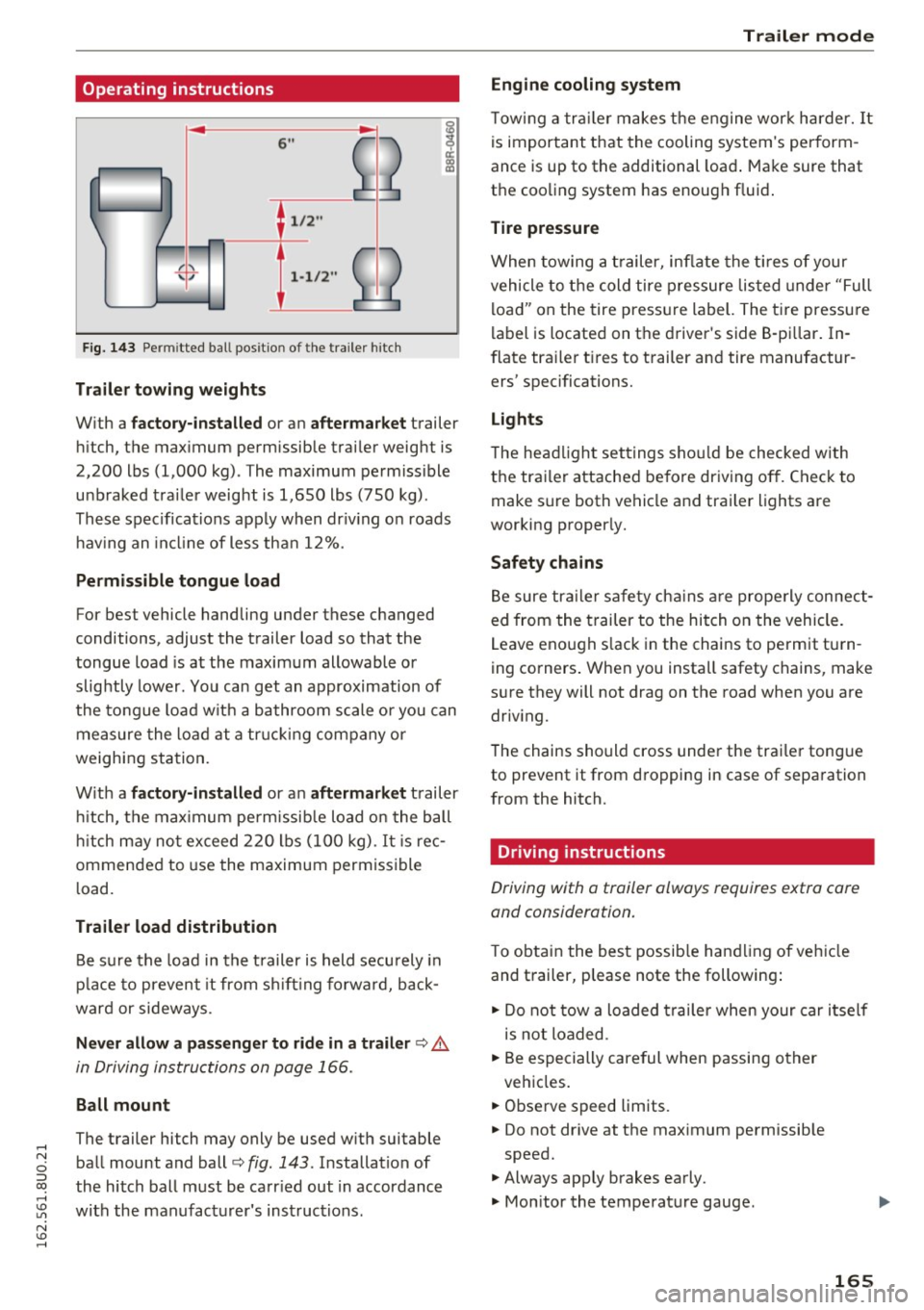
Fig. 143 Permitted ball pos ition of the trailer hitch
Trailer towing weights
With a
factory-installed or an aftermarket trailer
hitch, the maximum permissib le trailer weight is
2,200 lbs (1,000 kg). The maximum permiss ible
unbraked trailer weight is 1,650 lbs (750 kg).
These specifications apply when dr iv ing on roads
h av ing an incl ine of less than 12%.
Permissible tongue load
For best vehicle handling under these changed
conditions, adjust the trailer load so that the
tongue load is at the maximum allowable or
slightly lower. You can get an approximation of
the tongue load w ith a bathroom scale o r you can
measure the load at a trucking company or
weighing station.
With a
factory-installed or an aftermarket trailer
hit ch, the maximum permissib le load on the ball
hitch may not exceed 220 lbs (100 kg).
It is rec
ommended to use the maximum permissible
l oad.
Trailer load distribution Be sure the load in the trailer is held securely in
place to prevent it from s hiftin g forward, back
ward or sideways.
Never allow a passenger to ride in a trailer ¢.&.
in Driving instructions on page 166.
Ball mount
The trailer hitch may only be used w ith suitable
ball mount and ball¢
fig. 143. Installation of
the hitch ball must be carr ied out in accordance
with the manufacturer's instructions.
Trailer mode
Engine cooling system
To wing a trailer makes the engine work harder. It
is important that the cooling system's perform
ance is up to the additional load . Make sure that
the cooling system has enough fluid .
Tire pressure
When towing a trailer, inflate the tires of your
vehicle to th e cold tire pressure lis ted under "Full
load" on the tire pressure label. The tire pressu re
label is located on the driver's side B-pi llar . In
flate trailer t ires to trailer and tire manufactur
ers' specifications.
Lights
T he headlight settings shou ld be checked with
the trai ler attached before driving off. Check to
make s ure both vehicle and trailer lights are
working properly.
Safety chains
Be sure trailer safety chains are properly connect
ed from the trailer to the hitch on the vehicle.
Leave enough s lack in the chains to permit turn
ing corners . When you install safety chains, make
sure they will not drag on the road when you are
driv ing.
The chains should cross under the trai ler tongue
to prevent it from dropping in case of separation
from the hitch.
Driving instructions
Driving with o trailer always requires extra core
and consideration .
To obtain the best possib le handling of vehicle
and trailer, p lease note the following:
.. Do not tow a loaded trailer when your car itself
is not loaded.
.. Be especially care ful when passing other
vehicles .
.. Observe speed limits.
.. Do not drive at the maximum permissib le
speed.
.. Always apply brakes early.
.. Mon itor the temperature gauge .
165
Page 168 of 252
Trailer mod e
Weight d istribution
Towing a loaded trailer with an empty car res ults
in a high ly unstable distribution of weight . If this
cannot be avoided, drive at very low speeds on ly
to avoid the risk of losing steering control.
A "balanced" rig is easie r to operate and con trol.
This means that the tow vehicle should be loaded
to the extent possible and permissible, while
keeping the trai le r as light as possib le under the
circumstances. Whenever possible, transfer
some cargo to the luggage compartment of the
tow vehicle while observ ing tongue load requ ire
ments and vehicle loading considerat ions.
Spee d
The higher the speed, the more difficult it be
comes for the driver to contro l the rig. Do not
drive at the maximum permiss ible speed. Reduce
your speed even more if load, weather or w ind
conditions are unfavorable - part icularly when
goi ng downhill.
Reduce veh icle speed
immediatel y if the tra iler
shows the slightest sign of swaying .
Do not try
to stop the sway ing by acc ele rating .
Observe speed lim its. In some areas, speeds for
veh icles towing trailers are lower than for regular
ve hicles.
A lways app ly brakes early. When driving down
h ill, shift into a lower gear to use the engine
braking effect to slow the veh icle. Use of the
brakes alone can cause them to overheat and fail.
Coolant temp era ture
The coolant temperature gauge¢ page 10 must
be observed carefully. If the needle moves close
to the upper end of the scale, reduce speed im mediately and/or turn off the air conditioner.
If the coo lant temperature warning light in the
instr ument cluster starts flashing., pull off
the road, stop and let the engine
idle for about
two minutes to prevent heat bu ild-up.
A WARNING
Anyone not proper ly restrained in a moving
vehicle is at a much greater risk in an acci-
166
-
dent . Never let anyone ride in your car who is
not properly wear ing the restraints provided
by Audi.
Trailer mode notes
Important to know
You r vehicle handles differently when towing a
trailer because o f th e additiona l weight and dif
ferent weight distribution. Safety, performance
and economy will g reatly depend on how carefu l
l y you load your trai ler and operate your rig.
Before yo u actually tow your trailer, pract ice
turning, stopping and backing up in an area away
from traffic . Keep practicing unti l you have be
come complete ly familiar w ith the way your vehi
cle-tra iler combination behaves and responds.
Backing up is difficult and requires practice .
Backing up with a trailer genera lly requires steer
ing action opposite to that when backing up your
vehicle without a trailer.
Maintain a greater distance between your vehicle
and the one in fro nt of you . You will need more
room to stop. To compensate for the trailer, you
will need a larger than normal turning radius.
When passing, remember that you cannot accel erate as fast as you normally wo uld beca use of
the added load. Make sure you have enough room
to pass. After passing, allow p lenty of room for
your trailer before changing lanes again.
Avoid jerky starts, sharp turns or rapid lane
changes.
@ Tips
- Do not tow a trailer du ring the break-in peri
od of your vehicle.
- If you tow a trai le r, your Au di may requi re
more frequent maintenance due to the ex
t ra load ¢
page 232.
Page 169 of 252
Parking on a slope
Do not pork on a slope with a trailer. If it cannot
be avoided, do so only ofter doing the following:
When parking:
.. Apply the foot brake .
.. Have someone place chocks under both the ve
hicle and the trailer wheels .
.. With chocks in place, slowly release the brakes
until the wheel chocks absorb the load .
.. Turn the wheels towards the curb .
.. Apply the parking brake .
.. Move the selector lever to P.
When restarting after parking:
.. Apply the foot brake .
.. Start the engine .
.. Move the selecto r lever to D/S .
.,. Release the parking brake and slowly pull out
and away from the wheel chocks .
.. Stop and have someone retrieve the wheel
chocks.
(D Tips
If you move the selector lever of the automat
ic transmission to P before applying the park
ing brake and before blocking the wheels, you
may have to use more force later to move the
lever out of the P position.
Trailer mode
167
Page 206 of 252
Wheels
position and the total weight of
any luggage in the vehicle. If you
tow a trailer, the weight of the trailer hitch and the tongue
weight of the loaded trailer must be included as part of the vehicle
load.
The
Gross Axle Weight Rating
("GAWR") is the maximum load
that can be applied at each of the
vehicle's two axles.
The fact that there is an upper
limit to your vehicle's Gross Vehi
cle Weight Rating means that the
total weight of whatever is being
carried in the vehicle (including
the weight of a trailer hitch and
the tongue weight of the loaded
trailer) is limited. The more pas
sengers in the vehicle or passen
gers who are heavier than the
standard weights assumed mean
that less weight can be carried as luggage.
The Gross Vehicle Weight Rating
and the Gross Axle Weight Rating
are listed on the safety compli
ance sticker label located on the
driver's side B-pillar
~ page 201,
fig . 158 .
204
_& WARNING
Overloading a vehicle can cause
loss of vehicle control, a crash
or other accident, serious per
sonal injury, and even death.
-Carrying more weight than
your vehicle was designed to carry will prevent the vehicle
from handling properly and
increase the risk of the loss of
vehicle control.
-The brakes on a vehicle that has been overloaded may not
be able to stop the vehicle
within a safe distance.
-Tires on a vehicle that has
been overloaded can fail sud
denly, including a blowout and
sudden deflation, causing loss of control and a crash.
-Always make sure that the to
tal load being transported -
including the weight of a trail
er hitch and the tongue
weight of a loaded trailer -
does not make the vehicle
heavier than the vehicle's
Gross Vehicle Weight Rating.
Page 207 of 252
Determining correct load
limit
Use the example below to calcu
late the total weight of the pas
sengers and luggage or other
things that you plan to transport
so that you can ma ke sure that
your vehicle will not be overload ed .
Steps for Determining Correct
Load Limit
1 . Locate the statement "THE
COMBINED WEIGHT OF OCCU PANTS AND CARGO SHOULD
NEVER EXCEED XXX KG OR XXX
LBS"on your vehicle 's pla card
(tire inflation pre ssure l abel)
¢ page 201, fig. 158.
2 . Determine the combined
weight of the drive r and pas
s engers that will be riding in
your vehicle.
3 . Subtra ct the combined weight
of the driver and passengers
from
" XXX" kilograms or "XXX"
pounds shown on the sticker
¢ page 201 , fig. 158 .
4. The re sulting figure equals the
available amount of cargo and
luggage load capacity. For ex
ample, if the
" XXX" amount
equals 1400 lbs. and there will
Wheels
be five 1 SO lbs. pa ssengers in
your vehicle, the amount of available cargo and luggage load capacity i s 650 lb s.
(1400-750 (5 X 150) = 650
lbs.)
5. Determin e the combined
weight of luggage and cargo
being loaded on the vehicle.
That weight may not safely ex
ceed the available cargo and luggage load capa city cal culat
ed in Step 4 .
6. If your vehi cle will be towing a
trailer, load from your trailer
will be transferred to your ve
hicle. Con sult thi s manual to
determine how this reduces
the available cargo and lug gage load capacity of your vehi
cle.
..,.Check the tire sidewall
(¢page 191 , fig. 156) to deter
mine the designated load rating
for a specific tire.
Wheel bolts and rims
Wheel bolts
Wheel bolts mus t be clean and loosen/tig hte n
easily .
Rims
Rims with a bo lted r im ring * or with bo lted w heel
cove rs* cons ist of mult iple p ieces. These compo-
nents were bolted togethe r using s pec ial bolts ..,.
205
Page 215 of 252
The spare tire is intended for short-term use on
ly. Have the damaged tire checked and replaced,
if necessary, by an author ized Audi dealer or au
thor ized Audi Service Facility as soon as possib le.
There are some restrictions on the use of the
compact spare tire . The compact spare tire has
been designed specif ically for your type of veh i
cle . Do not replace it with the spare tire from an
other type of vehicle.
R emo ving th e spar e tire
... Remove the cargo floor .
... Remove the wing bolt and then remove the re-
tainer underneath it.
... Remove the subwoofer*
¢ page 212.
... Remove the spare tire.
Snow cha in s
For technical reasons, the use of snow chains on
the compact spare tire is not permitted.
If you have to drive with snow chains and a front
tire fails, mount the spare wheel in place of a
rear tire. Install the snow chains on the rear tire
that you removed, and install that in p lace of the
front tire that failed.
A WARNING
- Never use the spare t ire if it is damaged or if
it is worn down to the tread wear indicators.
- If the spare tire is more than 6 years o ld,
use it only in an emergency and with ex
treme caution and carefu l dr iving.
- The spare tire is intended on ly for tempora
ry and short-term use. It shou ld be replaced
as soon as possible with the normal wheel
and t ire.
- After mounting the compact spare t ire, the
t ire pressure must be checked as soon as
poss ible. The t ire pressure of the compact
spare tire must be 4.2 bar; otherwise, yo u
risk having an accident.
- Do not d rive faster than 50 mph (80 km/h).
Yo u risk hav ing an accident.
- Avoid full-throttle accelerat ion, heavy b rak
ing, and fast cornering. You risk having an
acc ident.
Em ergenc y ass is tanc e
-Never drive using more than one spare
wheel and tire. You r isk having an accident.
- Normal summer or winter tires must not be
mounted on the compact spare wheel rim.
- For technical reasons, the use of tire chains
on the spare tire is not permitted. If it is
necessary to drive w ith tire chains, the spare
wheel must be mounted on the front axle in
the event of a flat in a rear t ire. The newly
ava ilable front wheel must then be installed
in place of the rear wheel with the flat tire.
I nstalling the tire chain befo re mounting
the wheel and tire is recommended .
- Loose items in the passenger compartment
can cause se rious personal injury during
ha rd bra king or i n an accident. Never store
the spare tire or jack and tools in the pas
senger compartment.
Replacing wheels
Before changing a wheel
Observe the following precautions for your own
and your passenger's safety when changing a
wheel.
... After you experience a tire failure, pull the car
well away from moving traffic and try to reach
lev el ground before you stop¢ page 211,
¢ .&_.
... All passengers should le av e the car and move
to a safe location (for instance, behind the
gua rdrail)
c:::> .lll ·
... Engage the parking brake to prevent your veh i
cle from rolling unintentiona lly
c:::> .&_ .
... Move the selector le ver to the P po sit ion .
... If you are towing a trai ler: unhitch the trailer
from your vehicle.
... Take the
jack ¢ page 211 and the spa re ti re
¢page 212 out of the luggage compartment.
A WARNING
You or your passengers could be injured while
changing a whee l if you do not follow these
safety pre caut ions:
- If you have a flat tire, move a safe distance
off the road. Turn off the eng ine, turn the
213
Page 222 of 252
Fuses and bulbs
(D Tips
- The following table does not list fuse loca
tions that are not used.
- Some of the equipment listed in the follow
ing tables applies only to certain model ver
sions or certain optional equipment.
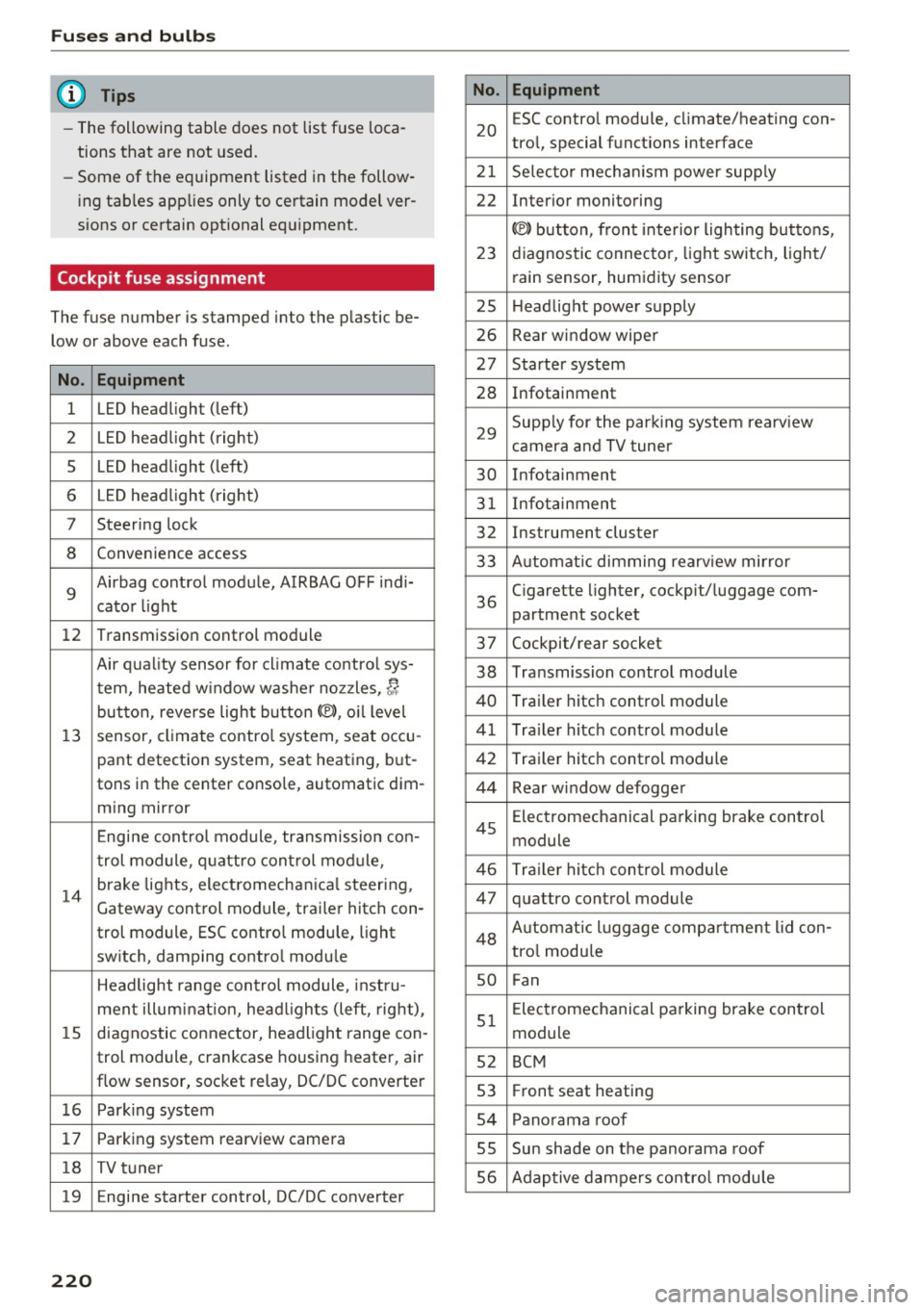
Cockpit fuse assignment
The fuse number is stamped into the plastic be
low or above each fuse.
No. Equipment
1 LED headlight (left)
2 LED headlight ( right)
5 LED headlight (left)
6 LED headlight (right)
7 Steering lock
8 Convenience access
9
Airbag control module, AIRBAG OFF indi-
cator light
12 Transmission control module
Air quality sensor for climate contro l sys-
tern, heated w indow washer nozzles,~
button, reverse light button<®>, oil level
13 sensor, climate control system, seat occu-
pant detection system, seat heating , but-
tons in the center console, automatic dim-
ming mirror
Engine control module, transmission con-
trol module, quattro control module,
14
brake lights, electromechanica l steering,
Gateway cont rol module, trailer hitch con-
trol module, ESC contro l module, light
switch, damping control module
Headlight range control module, instru-
ment illuminat ion, headl ights (left, right),
15 diagnostic connector, headlight range con-
trol module, crankcase housing heater, air
flow sensor, socket relay, DC/DC converter
16 Park ing system
17 Parking system rearview camera
18 TV tuner
19 E ngine starter control, DC/DC converter
220
No . Equipment
20
ESC contro l module, climate/heating con-
tro l, special functions interface
21 Selecto r mechanism power supply
22 Interior monitoring
© button, front interior lighting buttons,
23 diagnostic connector, light switch, light/
rain sensor, humidity sensor
25 Headlight power supply
26 Rear window wiper
27 Starter system
28 Infotainment
29
Supply for the park ing system rearv iew
camera and TV tuner
30 Infotainment
31 Infotainment
32 Instrument cluster
33 A utomat ic dimming rearview mirror
36
Cigarette lighter, cockpit/ luggage com-
partment socket
37 Cockpit/rear socket
38 Transmission control module
40 Trailer hitch control module
41 Trailer hitch control module
42 Trailer hitch control module
44 Rear window defogger
45
Electromechanical parking brake control
module
46 Trailer hitch control module
47 quattro control module
48 Aut omat ic lu ggage compartment lid con-
tro l module
so Fan
51
Electromechanical parking brake control
module
52 BCM
53 Fr ont seat heating
54 Panorama roof
55 Sun shade on the panorama roof
56 Adaptive dampers control module
Page 228 of 252
Emergency situations
bumper. Depending on the version, the cover can
be removed in different ways ¢
fig. 176.
• Version @: Remove the towing loop and the
hook from the veh icle tool kit ¢
page 211. Or
• Version @: Remove the towing loop from the
vehicle tool kit ¢
page 211.
•Version @: Insert the hook into the hole on the
cover and carefully pull off the cover in the di
rection of the arrow ¢
fig. 176. Or
• Ve rsion @: press the cap inward with brief,
forceful pressure
¢fig. 176. The cap w ill loosen
from the bumper.
• Tighten the towing loop in the th readed open
ing until it stops¢
fig. 177 and then tighten it
with a wheel wrench.
• After using, place the towing loop back in the
vehicle tool kit.
A WARNING
If the towing loop is not tightened until it
stops when installing, the threads may be
pulled out when towing the veh icle and that
could cause an accident.
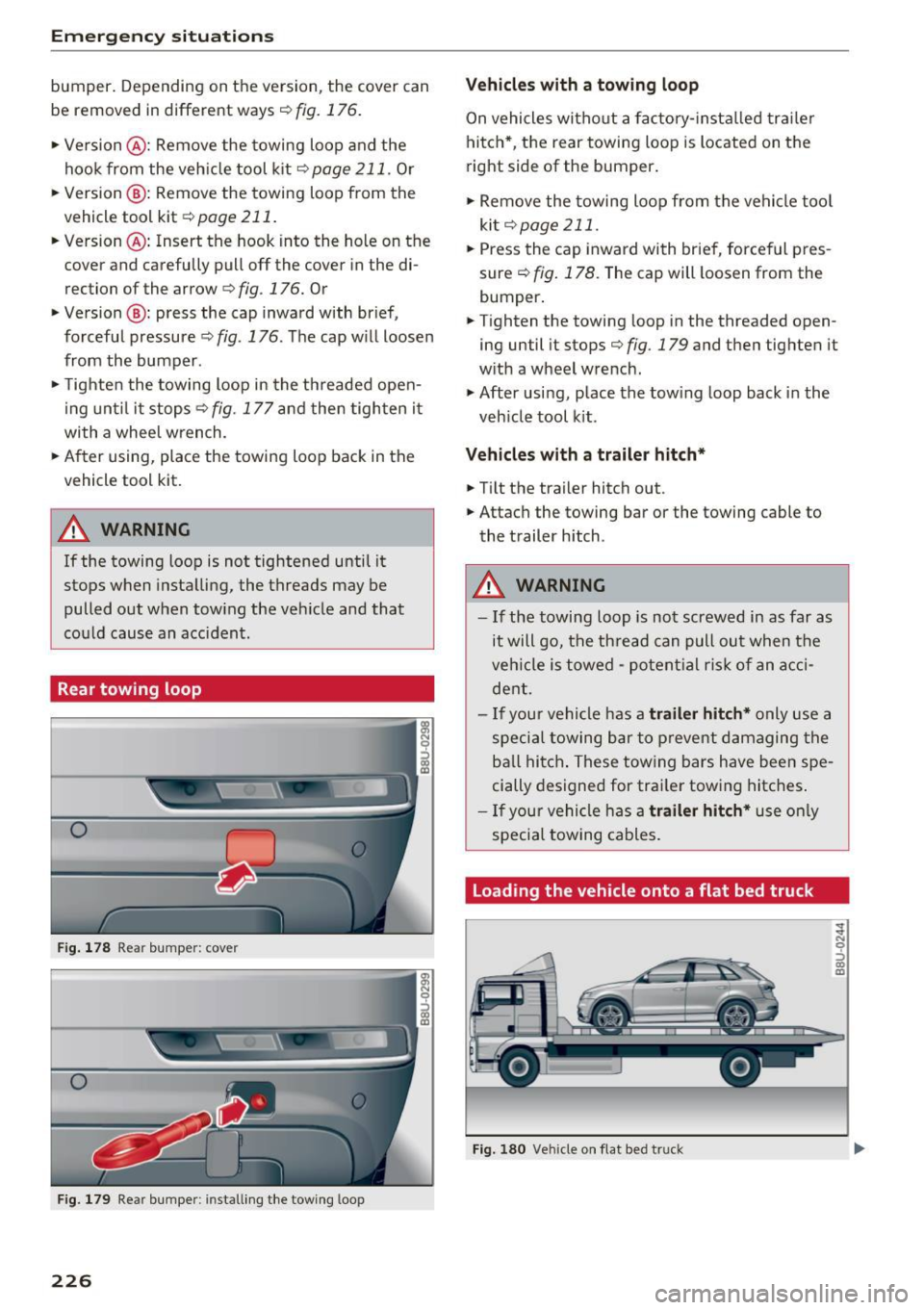
Rear towing loop
Fig. 178 Rear bumper: cover
Fig. 179 Rear bumper: installing the towing loop
226
Vehicles with a towing loop
On vehicles witho ut a factory-installed trailer
hitch*, the rear towing loop is located on the
right side of the bumper .
• Remove the towing loop from the vehicle too l
kit
¢ page 211.
• Press the cap inward with brief, forceful pres
sure¢
fig. 178. The cap will loosen from the
bumper.
• Tighten the towing loop in the threaded open
ing until it stops¢
fig. 179 and then tighten it
w ith a wheel wrench.
• After using, place the tow ing loop back in the
vehicle tool kit.
Vehicles with a trailer hitch*
• Tilt the trailer hitch out.
• Attach the towing bar or the towing cable to
the trailer hitch.
A WARNING
- If the towing loop is not screwed in as far as
it will go, the thread can pull out when the
veh icle is towed - potential risk of an acci
dent.
- If your vehicle has a
trailer hitch* only use a
specia l towing bar to prevent damaging the
ball hitch. These towing bars have been spe
cially designed for trailer towing hitches .
- If your vehicle has a
trailer hitch* use only
special towing cables.
Loading the vehicle onto a flat bed truck
Fig. 180 Vehicle on flat bed truck
~ 0 ::', (IC) m
Page 234 of 252
Consumer information
Consumer information
Warranty coverages
Your Audi is covered by the following warran
ties:
- New Vehicle Limited Warranty
- Limited Warranty Against Corrosion Perfora-
tion
- Emissions Control System Warranty
- Emissions Performance Warranty
- California Emissions Control Warranty (USA
vehicles only)
- California Emissions Performance Warranty
(USA vehicles only)
Detailed information regarding your warranties
can be found in your
Warranty & Maintenance
booklet .
Operating your vehicle
outside the U.S.A. or
Canada
Government regulati ons in the United States and
Canada require that automobi les meet specific
emission regulations and safety standards.
Therefore, vehicles built for the U.S.A. and Cana
da differ from vehicles sold in other countries.
If you plan to take your vehicle outside the conti
nenta l limits of the United States or Canada,
there is the poss ibility that:
- un leaded fue ls for vehicles with catalytic con
verter may not be available;
- fuel may have a considerably lower octane rat
ing . Improper fuel may cause engine damage;
- service may be inadequate due to lack of proper
service facilities, tools or testing equipment;
- r eplacement parts may not be readily available.
- Nav igation systems for veh icles built for the
U.S .A . and Canada will not necessarily work in
Europe, and may not work in other countries
outside of North America.
232
(D Note
Audi cannot be responsib le for mechanical
damage that could result from inadequate
f u el, service or parts ava ilability.
Audi Service Repair
Manuals and Literature
Audi Official Factory Service Manuals and Litera
ture are published as soon as poss ible after mod
el introd uction . Service Manuals and literature
are available to order from the Audi Technical Lit
erature Ordering Center at :
www.audi.techliterature .com
Maintenance
General '
Your vehicle has been designed to help keep
maintenance requirements to a min imum. How
ever, a certain amount of regular maintenance is
still necessary to assure your vehicle's safety,
economy and reliability . For detailed vehicle
maintena nce consult your Warranty & Mainte
nance booklet .
Under difficult operating conditions, for exam
ple at extremely low outside temperatures, in
very dusty regions, whe n towing a trailer very fre
quently, etc., some service work should be per
formed between the intervals specified. This ap
plies particularly to:
- oil changes, and
- cleaning or replac ing the a ir filter .
'
@) For the sake of the environment
By regularly maintain ing your vehicle, you
help make sure that em iss ion standards are
maintained, thus minimizing adverse effects
on the environment .
Important considerations for you and your
vehicle
The increasing use of electronics, sophisticated
fuel injection and emission control systems, and
the genera lly increas ing technica l complexity of ..,_
Page 245 of 252
Opening/closing by remote control . . . . . . . . . . . . . . . . . . . . 29
On the door lock . . . . . . . . . . . . . . . . . . . . . . 32
with the central locking sw itch . . . . . . . . . . 31
with the convenience key. . . . . . . . . . . . . . . 30
Othe r equipmen t (efficiency program) . . . . . 24
Ove rview (Cockpit) . . . . . . . . . . . . . . . . . . . . . . 8
Owner 's l iterature
5
p
P a int damage . .... .. ..... ... .. .. .... . 170
P a int No. . . . . . . . . . . . . . . . . . . . . . . . . . . . . 229
Panorama roof . . . . . . . . . . . . . . . . . . . . . . . . 37
Convenience opening/clos ing . . . . . . . . . . . 37
E mergency clos ing . . . . . . . . . . . . . . . . . . . . 38
Parking aid Cleaning the sensors/camera . . . . . . . . . . 169
Par king bra ke . . . . . . . . . . . . . . . . . . . . . . . . . 7 1
E mergency b rak ing func tion . . . . . . . . . . . . 73
P a rking . . . . . . . . . . . . . . . . . . . . . . . . . . . . . 72
Re leasing/setting . . . . . . . . . . . . . . . . . . . . 71
Starting from a stop . . . . . . . . . . . . . . . . . . 72
Starting to drive with a trailer . . . . . . . . . . . 73
also refer to Parking brake . . . . . . . . . . . . . 71
P a rking ligh ts . . . . . . . . . . . . . . . . . . . . . . . . . 39
P arking system
Ad justi ng the disp lay/wa rning tone . . . . . . 93
C le a ning the rearview came ra . . . . . . . . . . . 90
M alf unct io n . . . . . . . . . . . . . . . . . . . . . . . . . 93
P a rking system pl us . . . . . . . . . . . . . . . . . . . 89
Trai ler hitch . . . . . . . . . . . . . . . . . . . . . . . . . 94
also ref er to Pa rking systems . . . . . . . . 89, 90
Par king systems . . . . . . . . . . . . . . . . . . . . . . . 88
P e riphe ral display . . . . . . . . . . . . . . . . . . . . 89
Rear par king sys tem . . . . . . . . . . . . . . . . . . 88
Rearview camera . . . . . . . . . . . . . . . . . . . . . 90
P a rking (automat ic transmission) . . . . . . . . . 83
Parts replacement . . . . . . . . . . . . . . . . . . . . 234
P ass -through . . . . . . . . . . . . . . . . . . . . . . . . . 60
PASSENG ER AIR BAG OFF light . . . . . . . . . . 122
Pedals . . . . . . . . . . . . . . . . . . . . . . . . . . . . . . . 99
P e riphe ral d isplay . . . . . . . . . . . . . . . . . . . . . . 89
P hys ica l pr inc iples of a frontal collision . . . 105
Polishing . . . . . . . . . . . . . . . . . . . . . . . . . . . . 170
P ollen filter
refer to Pollutant filte r . . . . . . . . . . . . . . . . 6 2
Index
Pollutant filter . . . . . . . . . . . . . . . . . . . . . . . . 62
Power seat ad justment . . . . . . . . . . . . . . . . . . . . . . SO
Windows . .. .. .. ............... .. .. . 36
Power locking system
Selective unlock feature . . . . . . . . . . . . . . . 31
Settings . . . . . . . . . . . . . . . . . . . . . . . . . . . . 31
Powe r windows
Convenience opening/closing . . . . . . . . . . . 37
Malfunction . . . . . . . . . . . . . . . . . . . . . . . . . 37
Pregnant women Special considerations when wearing a safe-
ty belt . . . . . . . . . . . . . . . . . . . . . . . . . . . . . 109
Pressure (tires) . . . . . . . . . . . . . . . . . . . . . . . 209
Proper safety be lt pos ition . . . . . . . . . . . . . . 108
Proper seating position Front passenger . . . . . . . . . . . . . . . . . . . . . . 97
Occ upants. . . . . . . . . . . . . . . . . . . . . . . . . . . 96
Rear passengers . . . . . . . . . . . . . . . . . . . . . . 98
P ro tecting . . . . . . . . . . . . . . . . . . . . . . . . . . . 170
P rotect ive line r . . . . . . . . . . . . . . . . . . . . . . . . 61
Q
quattro (all whee l drive) . . . . . . . . . . . . . . . . 156
Question What happens to unbe lted occupants? 105
R
Radiator fan . . . . . . . . . . . . . . . . . . . . . . . . . 18 5
Rain/light se nsor
Head lights . . . . . . . . . . . . . . . . . . . . . . . . . . 39
I n termitten t (windsh ie ld wipers) . . . . . . . . 45
Senso r defec tive . . . . . . . . . . . . . . . . . . . . . . 18
Raising the vehicle . . . . . . . . . . . . . . . . . . . . 227
Range (fuel level) . . . . . . . . . . . . . . . . . . . . . . 22
Readi ng lig hts . . . . . . . . . . . . . . . . . . . . . . . . . 42
Rear fog lights . . . . . . . . . . . . . . . . . . . . . . . . 39
Rear lid
refer to luggage compartment lid . . . . . . . 33
Rear light
D efective . . . . . . . . . . . . . . . . . . . . . . . . . . . 18
Rearv iew camera
refer to Parking systems . . . . . . . . . . . . 89, 90
Rearview mirror Dimming ............................ 44
243