ECO mode AUDI Q3 2016 Owner's Manual
[x] Cancel search | Manufacturer: AUDI, Model Year: 2016, Model line: Q3, Model: AUDI Q3 2016Pages: 252, PDF Size: 62.81 MB
Page 154 of 252
Intelligent Technology
will switch on again automat ically when condi
tions have returned to normal.
Steering recommendation
The ESC helps to stabilize the veh icle by changing
the steering torque.
Selective wheel torque control
Selective wheel torque control is used when driv
i n g on curves . The front wheel on the inside of
the c urve or both wheels on the inside of the
curve are braked selectively as needed. This al
lows more precise driving in curves.
Automatic post-collision braking system
The "Automatic post-collision brak ing system"
can help to reduce the r isk of slid ing and of other
coll is ions after an accident . If the airbag control
module detects a collision above a certain vehicle
speed, the vehicle is braked by the ESC.
The vehicle does not brake automatically if :
- the driver presses the accelerator pedal, or
- the braking force generated by the pressed
brake pedal is greater than the braking force
that would be initiated by the system, or
- the ESC, the brake system or the vehicle electri
cal system are not functioning.
A WARNING
- The ESC and its integrated systems cannot
overcome the limits posed by natural physi-
Switching on and off
cal laws. This is especially important on slip
pery or wet roads. If the systems beg in act
ing to stabilize your vehicle, you should im
mediately alter your speed to match the
road and traffic conditions. Do not let the
increased safety provided tempt you into
taking risks. This could increase your risk of
a collision.
- Please note the risk of a collision increases
when dr iv in g fast, especially through curves
and on slippery or wet roads, and when dr iv
ing too close to objects ahead. The ESC and
its integrated systems cannot always pre
vent collisions -there is still a risk of acci
dents!
- Press the accelerator peda l carefully when
accelerating on even, slippery surfaces such
as ice and snow. The drive wheels can spin
even when these control systems are instal
led and this can affect driving stability and
increase the risk of a collision .
@ Tips
-ABS and ASR only function correctly when
all four wheels are equipped with identical
tires. Different tire sizes can lead to a reduc
tion in engine power.
- You may hear noises when the systems de
scribed are working.
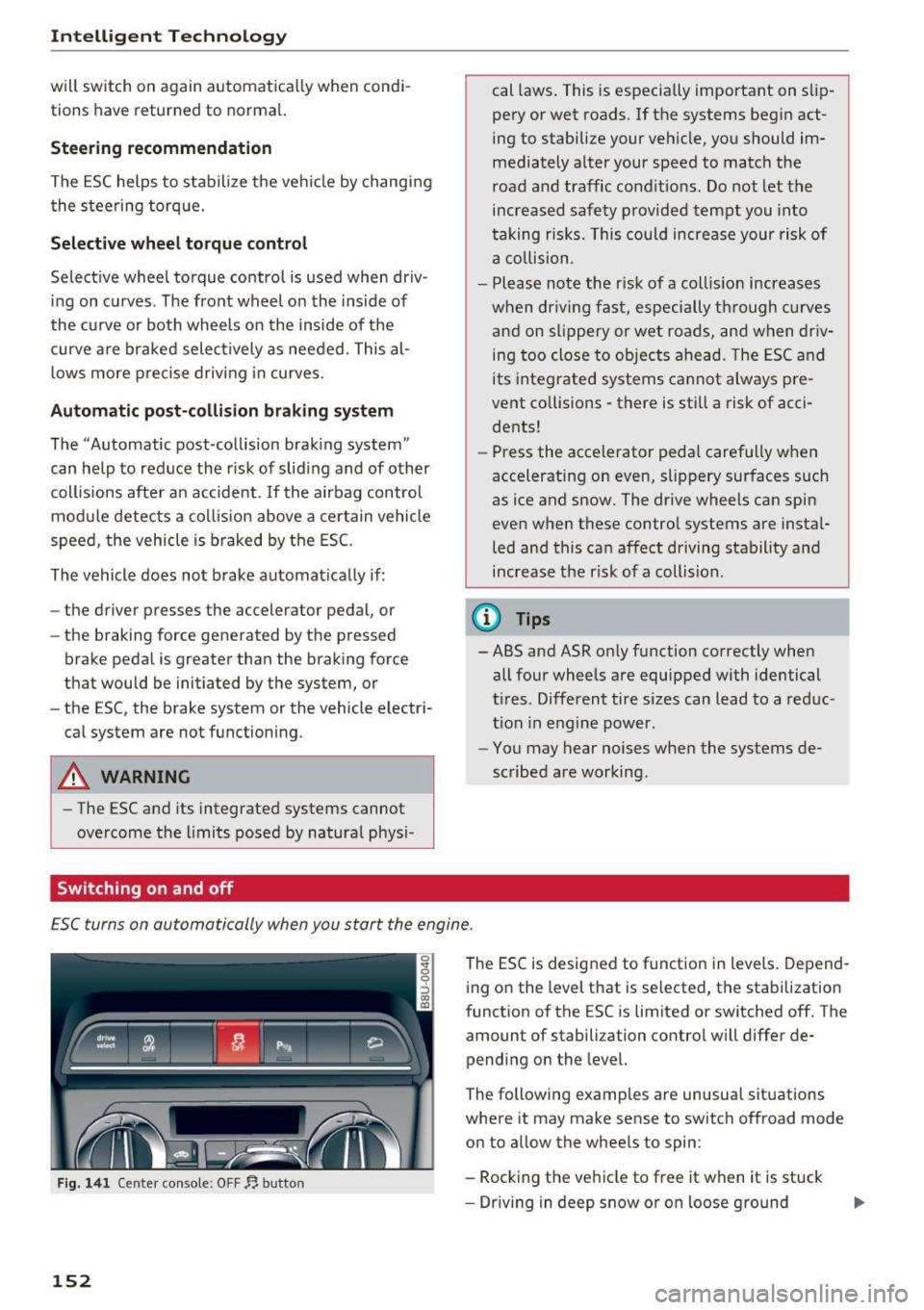
£SC turns on automatically when you start the engine .
Fig. 141 Center console: OFF rJ. button
152
The ESC is designed to function in levels. Depend
i ng on the level that is selected, the stabilization
function of the ESC is limited or switched off. The amount of stabilization control will differ de
pending on the level.
The following examples are unusual situations
where it may make sense to switch offroad mode
on to allow the wheels to spin:
- Rocking the vehicle to free it when it is stuck
- Dr iving in deep snow or on loose ground
Page 163 of 252
Drive smoothly and keep a lookout ahead
Vehicles use the most fuel when they are acceler
ating .
11-Avoid unnecessary accelerating and braking.
Vehicles use the most fuel when they are acceler ating . If you anticipate what is going to happen
next, you will need to brake less and, thus, accel
erate less . Let the vehicle coast whenever possi
ble - for example when you see that the next traf
f ic light is red .
Avoid full throttle
Driving a t modera te speeds saves fuel and im
proves your mileage .
11-Try and keep well be low your car's max imum
speed.
Accelerating gent ly reduces fuel consumption,
engine wear, and does not disturb the environ
ment.
F ue l cons umption, exha ust emissions and engine
noise increase disproportionately at high speeds.
If you drive at approximately three quarters of
top speed, fuel consumpt ion will be reduced by
one half. Never drive faster than the posted
speed limit and weather conditions permit.
Reducing unnecessary idling
Even when your car is just idling i t burns up fuel.
11-S hut the engine off w hen you are not driving
the vehicle.
11-Do not warm up the vehicle by letting the en-
gine ru n at idle .
It makes sense to shut off the eng ine in traffic
jams, when wa iting for trains to pass at rai lroad
crossings, or at traffic lights that have long waits
on red . Turn ing the eng ine off for just 30 -40 sec
onds saves more fue l than is bu rned starting the
engine agai n.
It takes a long t ime for the engine to warm up
fu lly when it is runni ng at idle . However, wear
and noxious emiss ions are especially high when
the eng ine is wa rm ing up . So you should d rive
Driving and the envir onment
away as soon as you start the eng ine and avoid
running at high rpms w hil e the engine is sti ll
warming up .
(D Note
Do not leave eng ine idling una ttended after
starting. If wa rning lights shou ld come on to
i ndicate improper operation, they would go
unheeded. Extended idling also prod uces
heat, which could result in overheating or
other damage to the vehicle or other proper
ty .
Regular maintenance
A badly tuned engine unnecessarily wastes a lot
of fuel .
11-Have your vehicle serviced at regular interva ls.
By having your vehicle regular ly serv iced by an
authorized Audi dea ler helps to ensure that it
runs properly and economically. The cond ition of
your vehicle not only affects its safety and ability
to hold its value, it also affects
fuel con sump
tion .
Chec k your oil each t ime you fill your tank.
T he amount o f oi l used is related to engine load
and speed.
It is normal fo r the oil consump tion of a new en
gine to reach its lowest value after a ce rtain m ile
age has been dr iven.
You m ust dr ive your ve hicle about 3,000 m iles
(5,000 kilometers) befo re yo u can prope rly as
sess oil consumpt io n.
T h is also app lies to fuel consumption and eng ine
output.
(D Note
- Have your vehicle maintained properly and in accordance with the se rvice recommenda
tions i n your Warranty
& M aintenance book-
le t. La ck of prope r maintenan ce as we ll as
imp roper use of the ve hicle will im pair the
function of the em ission cont rol sys tem and
co uld lead to damage . .,.
161
Page 164 of 252
Driving and th e en vironm ent
- Do not alter or remove any component of
the Emission Control System unless ap proved by the manufacturer.
- Do not alter or remove any device, such as
heat shie lds, switches, ignition wires,
valves, which are designed to protect your
vehicle's Em ission Control System and other
i mportant vehicle components.
Fewer short trips
Fuel consumption will always be relatively high
on shor t trips.
... Try to avoid driving short distances with a cold
engine.
The engine and catalyt ic converter have to reach
their optimal
ope rating temperature to reduce
fue l cons umption and nox ious emissions effec
tively .
J ust after starting, a co ld eng ine in a m id -s ize ca r
only achieves a f uel economy of 6-8 miles p er
ga llon (30 -40 l/100 km). After about a half a
mile ; fu e l economy cl imbs to 12 mpg (20 l/100
km). After about
2.5 miles (4 km), the engine is
at its prope r operating temperature and fuel
economy has reached a normal level. So you can
see that you sho uld avoid short t rips whenever
possible.
The
outsid e temperature is also critical in this re
gard . Your car consumes more fuel in the w in ter
than in the summe r.
Driving offroad
General information
When driving offroad, the f unctions for the elec
tron ic stabili zation control (ESC) are expanded.
ESC offroad mode can be activated in dr iving sit
uations in which a whee l lock o r a d ifferent ial
lock fu nction is needed
r=.> page 152.
However, your Audi is not an offroad vehicle.
Never drive the vehicl e in terra in which is not
suitabl e for the vehicle, or which exceeds your
driving skills. Never take any unnecessary ri sks!
162
After driving offroad
- After driving off road, remove branche s and
other deb ris from the rad iator g rille, under
body, and w heels . Look especially fo r objects
(stones) that have been caught in the tire
tread.
- Clean the body and the ve hicle unde rbody and
i nspect the ve hicle for possible damages.
- Clean off the dirty windows, headlights, tail
lights and t he license plate.
- Per form a brake test (especia lly after d riving
throug h water) .
A WARNING
-Be especially aware and attentive when d riv
ing under diff icu lt cond itions. Damages to
the vehicle and injur ies may occur when
driving at an excess ively high speed o r with
incor rect d riving maneuvers .
- Always ad just yo ur speed and handling to
the roads, terra in, traffic and weathe r con
d itions . D rive especially s low if offroad wi th
low visibility.
- Please note that t he wheels can sp in mo re
and the vehicle can swerve when in ESC off
road mode , espe cially when the road is slip
pe ry o r has loose surfa ce m aterial.
- Driv ing stability is reduce d in the ESC
Off
road mode.
@ For the sake of the environment
Avo id harm ing t he env ironmen t and take na
ture into co nsideration .
(D Tips
Only drive where it is allowed and always stay
on the provided roads and paths .
Driving information
There is only one right way to drive in difficult
conditions: slowly and with caution!
Observe the following when driving on unpaved
r oads :
Ill-
Page 166 of 252
Trailer mod e
Trailer mode
Driving with a trailer
General information
Your Audi was designed primarily for passenger
transportation.
If you plan to tow a trailer, please remember that
the additional load will affect durability, economy and performance.
Trailer towing not only places more stress on the
vehicle, it also calls for more concentration from
the driver.
F or this reason, always follow the operating and
driving instructions provided and use common
sense.
Technical requirements
Tr aile r hitch
Use a weight-carrying hitch conforming to the
gross trailer weight. The hitch must be suitable
for your veh icle and trailer and must be mounted
securely on the vehicle's chassis at a technically
sound
location . Use only a trailer hitch with a re
movable ball mount . Always check w ith the t rail
er hitch man ufact urer to make su re that you are
using the co rrect hitch .
Do not use a bump er hit ch .
The hitch must be installed in such a way that it
does not interfere with the impact -absorbing
bumper system. No mod ificat ions should be
made to the vehicle exhaust and brake systems .
From t ime to t ime, check that a ll hitch mount ing
bolts rema in securely fastened.
When you are not tow ing a tra iler, remove the
tra iler hitch ba ll mount . This prevents the hitch
from caus ing damage shou ld your veh icle be
s truck from be hind ¢
,&..
Trailer brakes
If your trailer is equipped with a brak ing system,
check to be sure that it conforms to all regula
tions .
164
The trailer hydraulic brake system must not be
directly connected to the vehicle's hydraulic
brake system ¢&. .
Safety chains
Always use safety chains between you r vehicle
and the trailer.
Trailer lights
Traile r lights must meet all regulations . Be sure
to check w ith your author ized Audi dealer for cor
r ec t wiring , switches, and relays.
M irrors
If you are unable to see the traffic behind you us
ing the regular outs ide mirrors, then you
must in
stall extended mirrors . It is important that you
always have clear vision to the rear.
.&_ WARNING
- If a tra ile r has e lectr ica l brakes p lease no te
t hat these brakes are not activated by the
factory-fit ted contro l unit -risk of accident!
- After removing the trai ler hitch, do not
store it in your vehicle. In case of sudden
braking, the hitch co uld fly forward and in
jure you or yo ur passengers.
- Never install a "we ight distribu ting" or
"load eq ualizing" trailer hitch on your vehi
cle. The vehicle was not designed for these
kinds of trailer hitches. The hitch attach ment can fail, caus ing the tra iler to tear
loose from the vehicle.
- The Gross Vehicle Weight Rating for your
veh icle, found on the safety compliance la
be l on the driver's s ide B-pillar, must never
be exceeded under any circumstances . Ex
ceed ing the Gross Vehicle Weight Rat ing of
your veh icle is likely to damage yo ur vehicle,
and such damage will not be covered by
your Limited New Vehicle Warranty . Exceed
ing the Gross Vehicle Weight Rating will al
so change the performance and handling
characteristics of your vehicle, which could
cause a crash result ing in serious injury or
death.
Page 168 of 252
Trailer mod e
Weight d istribution
Towing a loaded trailer with an empty car res ults
in a high ly unstable distribution of weight . If this
cannot be avoided, drive at very low speeds on ly
to avoid the risk of losing steering control.
A "balanced" rig is easie r to operate and con trol.
This means that the tow vehicle should be loaded
to the extent possible and permissible, while
keeping the trai le r as light as possib le under the
circumstances. Whenever possible, transfer
some cargo to the luggage compartment of the
tow vehicle while observ ing tongue load requ ire
ments and vehicle loading considerat ions.
Spee d
The higher the speed, the more difficult it be
comes for the driver to contro l the rig. Do not
drive at the maximum permiss ible speed. Reduce
your speed even more if load, weather or w ind
conditions are unfavorable - part icularly when
goi ng downhill.
Reduce veh icle speed
immediatel y if the tra iler
shows the slightest sign of swaying .
Do not try
to stop the sway ing by acc ele rating .
Observe speed lim its. In some areas, speeds for
veh icles towing trailers are lower than for regular
ve hicles.
A lways app ly brakes early. When driving down
h ill, shift into a lower gear to use the engine
braking effect to slow the veh icle. Use of the
brakes alone can cause them to overheat and fail.
Coolant temp era ture
The coolant temperature gauge¢ page 10 must
be observed carefully. If the needle moves close
to the upper end of the scale, reduce speed im mediately and/or turn off the air conditioner.
If the coo lant temperature warning light in the
instr ument cluster starts flashing., pull off
the road, stop and let the engine
idle for about
two minutes to prevent heat bu ild-up.
A WARNING
Anyone not proper ly restrained in a moving
vehicle is at a much greater risk in an acci-
166
-
dent . Never let anyone ride in your car who is
not properly wear ing the restraints provided
by Audi.
Trailer mode notes
Important to know
You r vehicle handles differently when towing a
trailer because o f th e additiona l weight and dif
ferent weight distribution. Safety, performance
and economy will g reatly depend on how carefu l
l y you load your trai ler and operate your rig.
Before yo u actually tow your trailer, pract ice
turning, stopping and backing up in an area away
from traffic . Keep practicing unti l you have be
come complete ly familiar w ith the way your vehi
cle-tra iler combination behaves and responds.
Backing up is difficult and requires practice .
Backing up with a trailer genera lly requires steer
ing action opposite to that when backing up your
vehicle without a trailer.
Maintain a greater distance between your vehicle
and the one in fro nt of you . You will need more
room to stop. To compensate for the trailer, you
will need a larger than normal turning radius.
When passing, remember that you cannot accel erate as fast as you normally wo uld beca use of
the added load. Make sure you have enough room
to pass. After passing, allow p lenty of room for
your trailer before changing lanes again.
Avoid jerky starts, sharp turns or rapid lane
changes.
@ Tips
- Do not tow a trailer du ring the break-in peri
od of your vehicle.
- If you tow a trai le r, your Au di may requi re
more frequent maintenance due to the ex
t ra load ¢
page 232.
Page 185 of 252
Cooling system
Coolant
The engine coolant performs two functions: it
keeps the engine from overheating and it pro
tects the engine from freezing in the winter .
The cooling system is sealed and generally re
quires little attention.
T he cooling system has been filled at the factory
with a permanent coolant which does not need to
be changed . The coolant consists of a mixture of
specially condit ioned water and the manufactur
er's glycol-basedcoolant add itive G 13 antifreeze
with anticorrosion additives (SO% for USA mod
e ls; 60% for Canada models) . This mixt ure bot h
assures the necessary frost protec tion and pro
tects meta l components in the engine's cooling
system from corrosion and scaling . It also raises
the boiling point of the coolant.
D o not red uce the concent ration of the coolant in
the summer by add ing p la in water.
The propor
tion of coolant addit ive mu st be at least 50 %
but not more than 60 %
to mainta in antifreeze
protection and cooling efficiency. If the coolant
frost protection is too low, the coolant could
freeze and damage the vehicle heating and en
g ine cooling system .
For year-round driving, antifree ze is added at the
factory for temperatures down to :
- -31° F(- 3S°C)USA
- -4 0 ° F ( - 40 °C) Can ada.
If you must add coolant, use a m ixture of water
and coolant addit ive. M ixing the coolant additive
with d istilled water is recommended .
_& WARNING
Before you check anythi ng i n t he engine com
partment, a lways read and heed a ll WARN
INGS
¢ .&. in Working in the engine compart
ment on page 177 .
(D Note
-Befo re winter se ts in, have the coo lant
checked to see if the coolant additive in you r
vehicle is sufficient to meet the cl imate con -
Check ing and Filling
ditions. This is especially important if you
live in a region where the winter is extreme
ly cold. If necessary, increase the proportion
of coolant additive to 60%.
- When adding coolant additive to your cool
ing system, remember :
- We recommend us ing only coolant add i
tive G12+ + or G13 fo r yo ur vehicle. This
coolant addit ive is avai lab le a t aut horized
A udi dealers . O ther types of antifree ze can
significantly reduce corrosion pro tect ion .
The resulting corrosion can cause a loss of
coolant and serious engine damage.
- Do not add any type of radiator leak sealant
to your vehicle's engine coolant. Adding ra
diator repair fluid may adversely affect the
function and performance of your cooling system and cou ld resu lt in damage not cov
ered by your New Veh icle Limited Warra nty .
Checking the engine coolant level
The engine coolant level can be checked with a
quick glance.
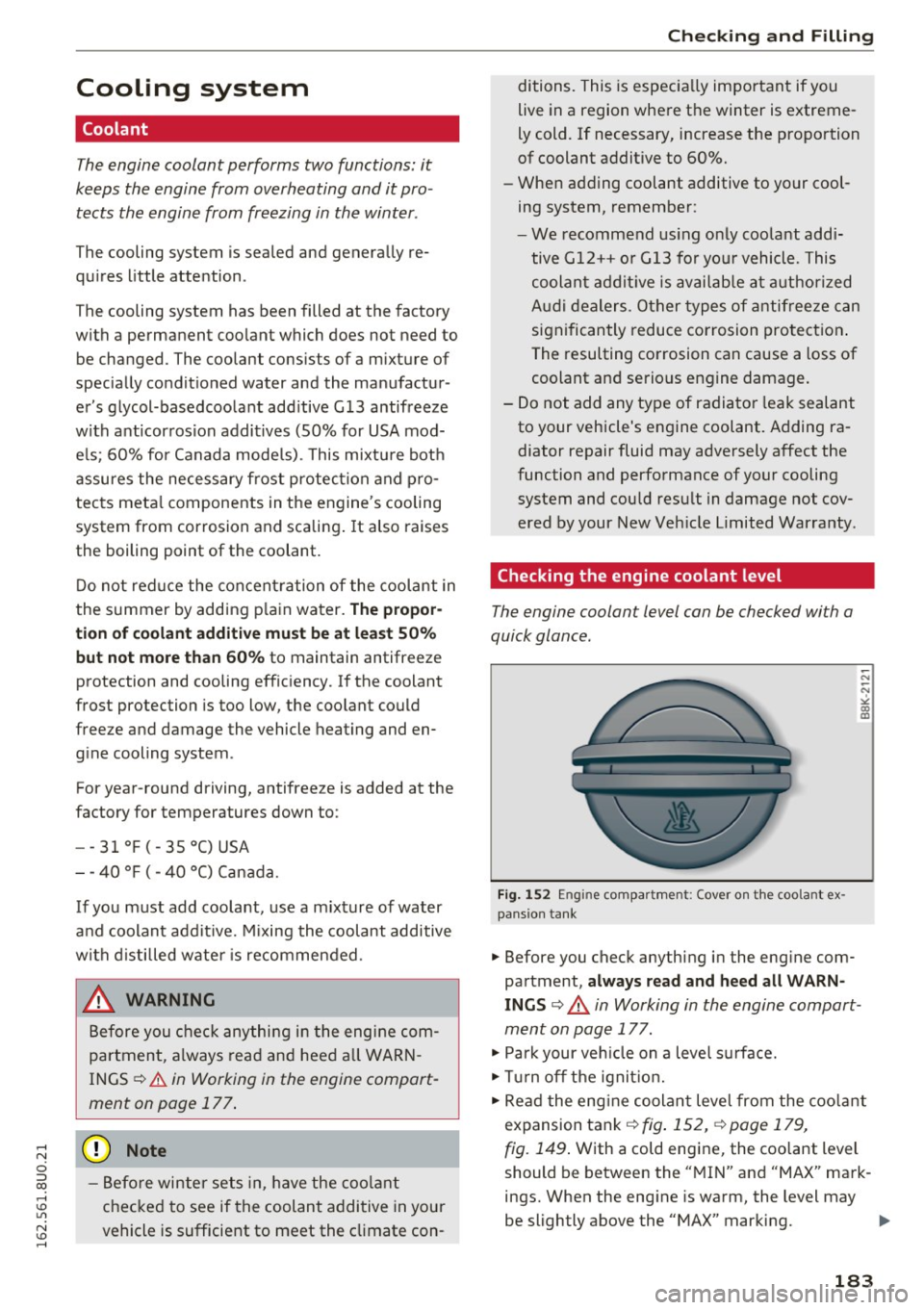
Fi g. 1 52 Engin e compar tmen t: Cover o n the coo la n t ex
pans ion tank
.. Before you check anything in the eng ine com
partment,
always r ead and h eed all WARN
INGS ¢ ,A in Working in the engine compart
ment on page 177 .
.. Par k your veh icle on a leve l sur face.
.. Tur n off t he ignit io n .
.. Read the eng ine coolan t leve l from the coo lant
expansion tank
¢ fig . 15 2, ¢ page 179,
fig. 149 .
With a cold engine, the coo lant level
should be b etween the "MIN" and "MAX" mark
ings. When the eng ine is warm, the level may
be slightly above the "MAX" marking. .,..
183
Page 188 of 252
Checking and Filling
Brake fluid
Checking brake fluid level
The brake fluid level can be checked with a quick
glance.
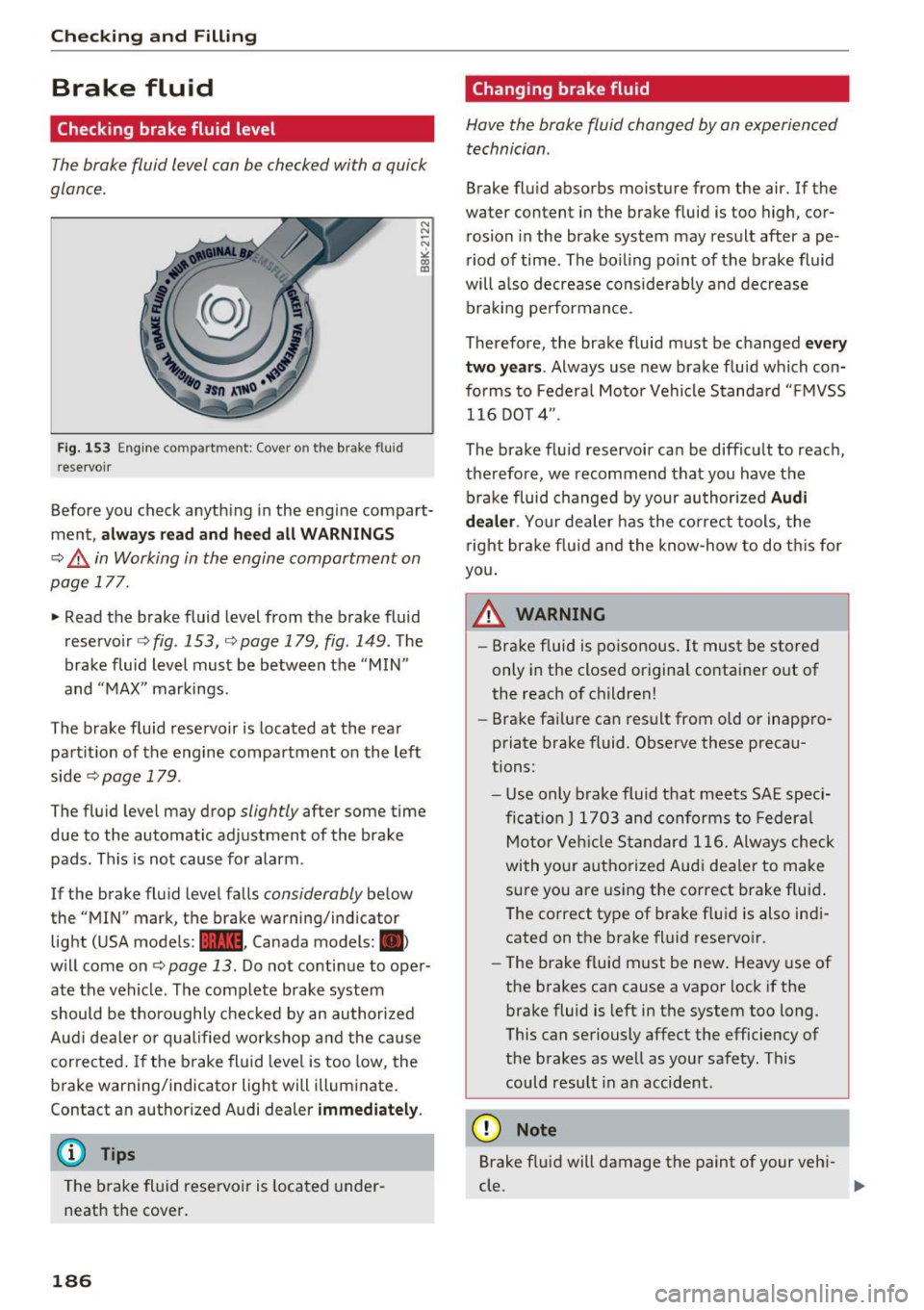
Fig. 153 Eng ine compartment: Cover on the brake fluid
r eservoir
Before you check anything in the engine compart
ment,
always read and heed all WARNINGS
¢ A in Working in the engine compartment on
page 177.
., Read the brake fluid level from the brake fluid
reservoir
<=> fig . 153, ¢page 179, fig . 149 . The
brake fluid level must be between the
" MIN"
and "MAX " markings.
The brake fluid reservoir is located at the rear
partition of the engine compartment on the left
side ¢
page 179 .
The fluid level may drop slightly after some time
due to the automatic adjustment of the brake
pads . This is not cause for alarm .
If the brake fluid level falls
considerably below
the ' 'MIN" mark, the brake warning/indicator
light (USA models:
1111 , Canada models:. )
will come on¢
page 13 . Do not continue to oper
ate the vehicle . The complete brake system
should be thoroughly checked by an authorized
Aud i dealer or qualified workshop and the cause
corrected. If the brake fluid level is too low, the
brake warning/indicator light w ill illuminate.
Contact an author ized Audi dealer
immediately.
(D} Tips
The brake fluid reservoir is located under
neath the cover.
186
Changing brake fluid
Have the brake fluid changed by an experienced
technician .
Brake fluid absorbs moisture from the air. If the
water content in the brake fluid is too high, cor
rosion in the brake system may result after ape
riod of time . The boiling po int of the brake fluid
will a lso decrease considerably and decrease
braking performance.
Therefore , the brake fluid must be changed
every
two years .
Always use new brake fluid which con
forms to Feder-al Motor Vehicle Standard "FMVSS
116 DOT 4 ".
The brake fluid reservoir can be difficult to reach ,
therefore, we recommend that you have the
brake fluid changed by your author ized
Audi
dealer .
Your dealer has the correct tools, the
right brake fluid and the know-how to do this for
you.
A WARNING
- Brake fluid is poisonous. It must be stored
only in the closed original container out of
the reach of children!
- Brake fai lure can result from o ld or inappro
priate brake fluid. Observe these precau
tions:
- Use only brake fluid that meets SAE speci
fi cation
J 1703 and conforms to Federal
Motor Veh icle Standard 116. Always check
with your authorized Audi dealer to make
sure you are using the correct brake fluid .
The correct type of brake f luid is also indi
cated on the brake fluid reservoir.
- The brake fluid must be new . Heavy use of
the brakes can cause a vapor lock if the
brake fluid is left in the system too long .
This can seriously affect the efficiency of
the brakes as well as your safety. This
could result in an accident.
(D Note
Brake fluid will damage the paint of your vehi-
cle .
lilJJ,
Page 200 of 252
Wheels
Occupant loading and distribution for vehicle normal load
for various designated seating
capacities
Refer to the tire inflation pres
sure label ¢
page 201, fig. 159
for the number of seating posi
tions . Refer to the table¢
table
on page 203
for the number of
people that correspond to the ve
hicle normal load.
New tires or wheels
Audi recommends having all work
on tires or wheels performed by
an authorized Audi dealer or au
thorized Audi Service Facility.
These facilities have the proper knowledge and are equipped with
the required tools and replace
ment parts.
.,.New tires do not yet have the
optimum adhesion properties. Drive carefully and at moderate
speeds for the first 350 miles (500 km) with new tires .
.,.Use tires of the same construc
tion, size (rolling circumference)
and as close to the same tread
pattern as possible on all four
wheels .
198
.,.Do not replace tires individually.
At least replace both tires on the
same axle at the same time.
.,.Audi recommends that you use
Audi Original equipment tires. If
you would like to use different
tires, please note that the tires may perform differently even if
they are the same size ¢
,&.
.,. If you would like to equip your
vehicle with a tire/rim combina
tion that is different from what
was installed at the factory, con
sult with an authorized Audi dealer or authorized Audi Service
Facility before making a pur
chase ¢&, .
If the spare tire is different from
the regular tires installed on the
vehicle -for example, if winter
tires or wide tires are installed -
then only use the spare tire tem
porarily in case of emergency and
drive carefully while it is in use. It
should be replaced with a regular
tire as soon as possible.
On
all wheel drive vehicles, all
four wheels must be equipped
with tires that are the same brand and have the same construction
and tread pattern so that the
drive system is not damaged by .,.
Page 209 of 252
of snow, snow chain s can imp air handling and
damage the t ires, and t he chains will quickly be
destroyed.
A WARNING
Using incorrect snow chains or installing snow
chains incorrect ly can result in loss of vehicle
co ntrol, which increases the risk of an acc i
dent .
Snow chains can damage the r ims/wheel cov
ers* if the chains come into d irect contact
w ith them. Remove the wheel covers* first.
Use coated snow chains .
Low aspect ratio tires
Your Audi is facto ry-equipped with low aspect ra
tio ti res. These t ires have been tho rough ly tested
and been se lected specifically for yo ur model fo r
thei r superb per formance, road feel and handling
under a variety of driving conditions. Ask your au
thorized Audi dealer for more details .
The low aspect ratio of these t ires is indica ted by
a numera l of
55 or les s in the tire's size designa
tion. The numeral represents the ratio of the
tire's sidewall height i n relation to its tread width
expressed in percentage. Conventional tires have
a height/w idth ratio of 60 or more.
Th e performance of low-aspect- ratio tire s is par
ticularly sensit ive to improper inflation pre s·
sure . It is therefore important that low aspect
ratio tires are inflated to the specified pressure
and that the inflation pre ssure is regul arly
ch ecked and ma intained . Tire pre ssure s should
be checked at least once a month and a lways
before a long tr ip
c> page 201.
What you can do to avoid tire and rim
damage
L ow aspect rat io tires can be damaged more easi
ly by impact wi th pot holes, c urbs, gull ies or
r idges on the ro ad, p articul arly if the tire is un
de rinflated.
I n o rder to minimize the occurrence of impact
damage to the t ires of your ve hicl e, we recom-
Wh eel s
mend that you observe the following preca u
tions:
- Always ma in tain recommended inflat io n pres
sures. Check yo ur tire pressure every 2,0 00
m iles (3,000 km) and add air if necessary .
- Dr ive c arefully on roads w it h potholes, deep
gullies or ridges . The impac t from dr iving
through or over such obstacles can damage
your tires. Impact with a curb may a lso cause
damage to your tires.
- After any impact, immediate ly inspect your
tires or have them inspected by the nearest au
thorized Audi dealer. Replace a damaged tire as
soon as possible.
- Inspect your tires every 2,000 m iles (3,000 km)
for damage and wear. Damage is not always
easy to see . Damage can lead to loss of air and
underinflation, wh ich could even tually cause
tire fa ilure. If yo u believe that a tire may have
been damaged, replace the tire as soon as pos
sib le.
- These tires may wear more quickly tha n others .
- Please also remember that, while these tires
delive r responsive ha nd ling, they may ride less
comfortably a nd make mo re noise than other
choi ces.
Reduced performance in winter /cold se ason
conditions
All t ires are des igned for certai n purposes. The
low aspect ratio, ultra high performance tires
o rigi na lly installed on your veh icle are intended
f or maximum dry and wet road performance and
handling . They are not suitable for co ld, snowy or
icy weather conditions . If you drive under those
c ircumstances, you should equip yo ur vehicle
with all-season or winter tires, which offer better
tract ion under those conditions. We suggest you
u se the recommended snow or all-season tires
spec ified for your veh icle, or their equiva lent .
Refer to
c> page 206 for more detailed informa
t ion regarding winter tires.
Uniform tire quality grading
- Tread wear
- Traction AA ABC
- Temperature ABC
207
Page 226 of 252
Emergency situations
When jump starting or charging the bat
tery, never connect the negative ground ca
ble to the battery negative post because the
battery manager system must be able to de
tect the battery's state of charge. Always
connect the negative ground cable to the
negative ground post of the battery manag
er contro l unit.
Use of jumper cables
Make sure to connect the jumper cable clamps in
exactly the order described below!
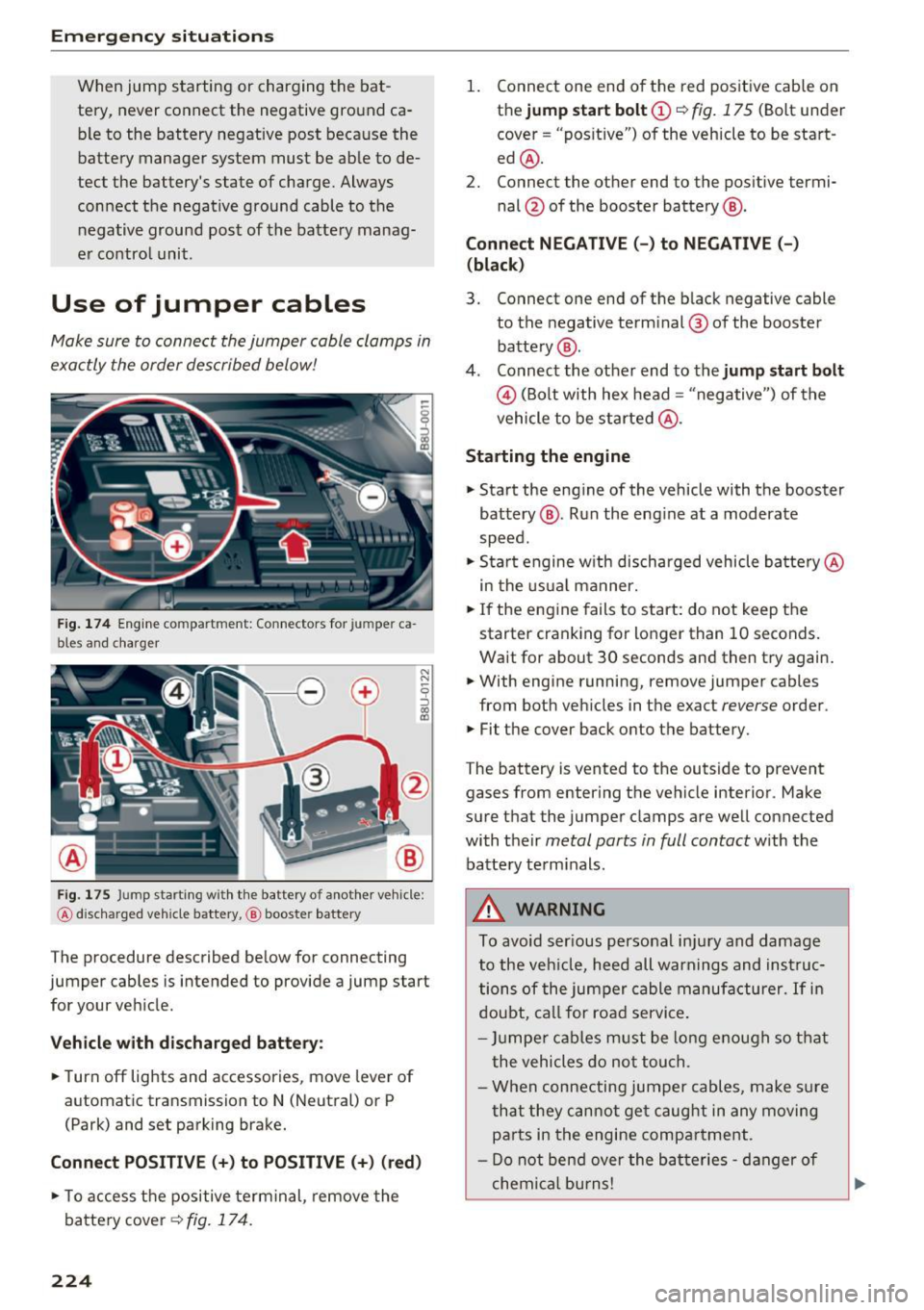
F ig . 1 74 Engine compar tment: Connectors for jumper ca
bles and charger
N N ~ 9 ::, 00 CXl
F ig. 175 Jump starti ng wit h the battery of another veh icle:
@ discharged vehicle battery,@booster battery
The procedure described below for connecting
jumper cables is intended to provide a jump start for your vehicle.
Vehicle with discharged battery:
• Turn off lights and accessories, move lever of
automatic transmission to N (Neutral) or P
(Park) and set parking brake.
Connect POSITIVE (+) to POSITIVE (+) (red)
• To access the positive terminal, remove the
battery cover
c::> fig. 17 4.
224
1. Connect one end of the red pos itive cable on
the
jump start bolt (D c::> fig. 175 (Bolt under
cover= "positive") of the vehicle to be start
ed @.
2. Connect the other end to the positive termi-
nal @ of the booster battery @.
Connect NEGATIVE (- ) to NEGATIVE (-)
(black)
3. Connect one end of the black negative cable
to the negative term inal @ of the booster
battery @.
4. Connect the other end to the
jump start bolt
@ (Bolt with hex head = "negative") of the
vehicle to be started @.
Starting the engine
• Start the eng ine of the vehicle with the booster
battery @. Run the eng ine at a moderate
speed.
• Sta rt engine w ith discharged vehicle ba ttery @
in the usual manner.
• If the engine fails to start: do not keep the
starter cranking for longer than 10 seconds.
Wait for about 30 seconds and then try again.
• With engine running, remove jumper cables
from both vehicles in the exact
reverse order.
• Fit the cover back onto the battery.
The battery is vented to the outside to prevent
gases from entering the vehicle interior . Make
sure that the jumper clamps are well connected
with their
metal parts in full contact with the
battery terminals.
&_ WARNING
To avoid ser ious personal injury and damage
to the vehicle, heed all warnings and instruc
tions of the jumper cable manufacturer. If in
doubt, call for road service.
- Jumper cables must be long enough so that
the vehicles do not touch .
- When connecting jumper cables, make sure
that they cannot get caug ht in any moving
parts in the engine compartment.
- Do not bend over the batteries - danger of
chemical burns!