warning lights AUDI Q3 2016 Owner's Manual
[x] Cancel search | Manufacturer: AUDI, Model Year: 2016, Model line: Q3, Model: AUDI Q3 2016Pages: 252, PDF Size: 62.81 MB
Page 97 of 252
.... N
ci ::, co
Driving safety
Basics
Safe driving habits
Please remember -safety first!
This chapter contains important information,
tips, instructions and warnings that you need to
read and observe for your own safety, the safety
of your passengers and others . We have summar
ized here what you need to know about safety
belts, airbags, child restraints as well as child
safety. Your safety is for us
priority number 1. Al
ways observe the information and warnings in
this section - for your own safety as well as that
of your passengers.
The information in this section applies to all
model versions of your vehicle. Some of the fea
tures descr ibed in this sections may be standard
equipment on some models, or may be optional
equipment on others. If you are not sure, ask
your authorized Audi dealer.
A WARNING
-
- Always make sure that you follow the in
structions and heed the WARNINGS in this
Manual. It is in your interest and in the in
terest of your passengers .
- Always keep the complete Owner's Litera
ture in your Audi when you lend or sell your
vehicle so that this important information
will always be available to the driver and
passengers.
- Always keep the Owner's literature handy so
that you can find it easily if you have ques
tions.
Safety equipment
The safety features are part of the occupant re
straint system and work together to help reduce
the risk of injury in a wide variety of accident sit
uations.
Your safety and the safety of your passengers
should not be left to chance. Advances in tech-
~ nology have made a var iety of features available
~ to help reduce the risk of injury in an accident . ....
Driving safety
The following is a list of just a few of the safety
features in your Audi:
- sophisticated safety belts for driver and all pas-
senger seat ing pos itions,
- be lt force limiters for the front seats,
- belt pretensioners for the seats,
- belt height adjustment for the front seats,
- head restraints for each seating position,
- front airbags,
- side airbags in the front seats,
- side curtain airbags with ejection mitigation
features,
- special LATCH anchorages for child restraints,
- adjustab le steering column.
These individual safety features, can work to gether as a system to help protect you and your
passengers in a wide range of accidents . These
features cannot work as a system if they are not
always correctly adjusted and correctly used.
Safety is everybody's responsibility!
Important things to do before driving
Safety is everybody 's job! Vehicle and occupant
safety always depends on the informed and care
ful driver .
For your safety and the safety of your passen
gers,
before driving always:
.,. Make sure that all lights and signals are operat
ing correctly.
.,. Make sure that the tire pressure is correct .
.,. Make sure that all windows are clean and afford
good visibility to the outside .
.,. Secure all luggage and other items carefully
~page 100, ~page 54 .
.,. Make sure that nothing can interfere with the
pedals.
.,. Adjust front seat, head restraint and mirrors
correctly for your height.
.,. Instruct passengers to adjust the head re
straints according to their height.
.,. Make sure to use the right child restraint cor
rectly to protect children
c:> page 132, Child
safety. ..,.
95
Page 155 of 252
.... N
c:i ::J CX)
.... I.Cl U"I
N I.Cl ......
- Driving on rough terrain when much of the car's weight is lifted off the wheels (axle articu la
t ion)
- Driving downhill whi le brak ing on loose gro und
ESC levels
Intelligent Technology
For yo ur safe ty, switch off the ESC offroad mo de
in advance.
Offroad mode on ESC/ASRoff Offroad mode off or
ESC
/ASRon
Behavior
The ESC and ASR stabiliza -
The stabiliza tion f unction is The f
ull stabiliza tion fu nc-
tion functions are limited not available
Q .&. . ESC and
tion of the ESC and ASR is
~ &. ASR are switched off . available again.
Operation Press the IJJ button briefly. P ress and ho ld the IJJ but- Press the IJJ button aga in.
ton longer than th ree sec-
onds.
Indicato r fl turns on. fil and !;ill•)H turns on. II turns off or II and
lights !;ill•)H turn off .
Driver mes- Stab ilization control (ESC ): Stabil ization control (ESC): Stabilization control (ESC ):
sage s Offroad Warning! Reduced Off Warning! Reduced sta-
On
st ability
bility
A WARNING
You should only switch offroad mode on or
switch ESC/ASR off if your driving ab ilities
and the t raffic conditions perm it. Th ere is a
r is k of sli ding.
- The stabilization function is limited when
offroad mo de is switched on. Th e dr iving
w heels co uld spin and the vehicle cou ld
swe rve, e speci ally on s lick o r slip pery r oad
s u rfaces.
- T here is no veh icle s tabilizat ion whe n ESC/
ASR are swi tched off .
-
Hill descent assist
Applies to vehicles: with hill descent assist
The hill descent assist makes it possible to drive
down an incline at a constant speed .
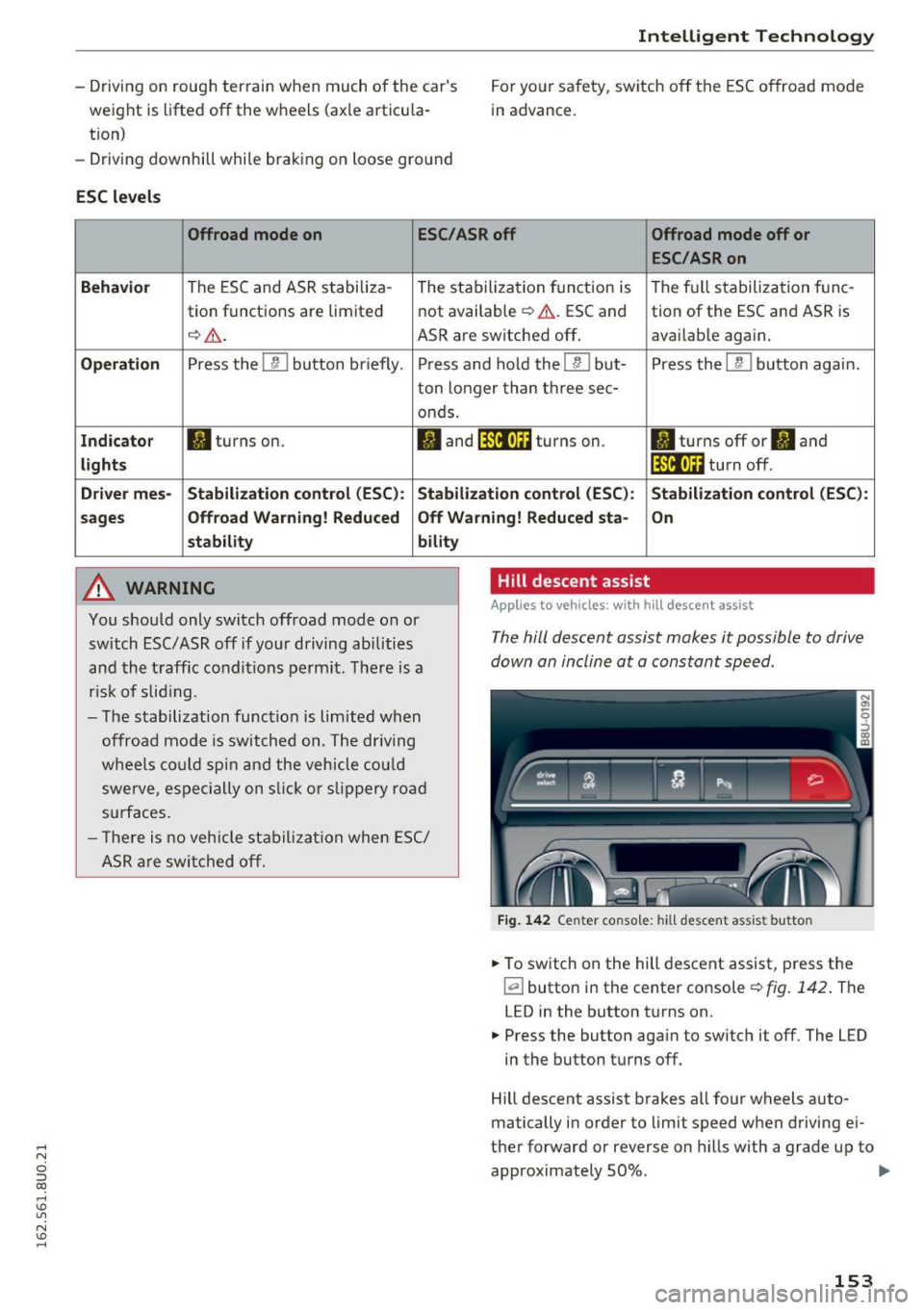
Fig. 142 Ce nte r console: hill descent ass ist button
.. To switch on the hill descent assist, p ress the
~ butto n in the center co nsole Q fig. 142 . The
LED in the button turns on .
.. Press the button again to switch it off. The LED
in the button turns off .
Hill descent assist brakes all four wheels auto
matically in order to limit speed when driving ei
ther forward or reverse on hills with a grade up to
approximately 50%. ..,_
153
Page 158 of 252
Intelligent Technology
Electromechanical
steering
The electromechanical steering sup ports the
driver's steering movements .
Power steering adapts electronically based on
the vehicle speed .
Indicator lights and mess ages
• Steering fault! Do not drive veh icle!
If thi s ind ic a tor light t urns o n and stays o n and
this message appears, the power steering may
have fa iled.
S top the veh icle in a safe lo cat io n as soo n as pos
sib le. Do
not c on tinue driving. See an author ized
Aud i dea ler o r authorized Aud i Serv ice Facility fo r
assistance.
If the ind icator lig ht t urns on, the steer ing wheel
may be mo re diff icu lt to move o r more sensitive
than usual. The stee ring wheel may also be at a n
angle when dr iving straight .
Dr ive s low ly to your author ized A udi dealer or au
thor ized Audi Se rvice Facility to have the ma l
f u nction co rrected.
E£-ij St eering lock: System fault! Plea se contact
deal er.
There is a malfunction in the electronic steering
lock.
D rive to an a uthorized Audi dea le r or a uthorized
Audi Service Facility immediately to have the
malfunct ion corrected.
@ Tips
If the . or Erj indicato r light on ly stays on
for a short time, you may continue driv ing.
All wheel drive (quattro)
Applies to vehicles: with all wheel drive
In oil wheel drive, oil four wheels ore powered .
General information
In a ll w heel d rive, the d rivi ng power is divided be
tween a ll four wheels . This happens au tomatical-
156
ly depending on yo ur driv ing behavior as we ll as
the cur rent road conditions . Refer to
Q page 151.
The all whee l dr ive concep t is designed fo r high
engine power. Yo ur vehicle is except ion ally pow
erf ul and has excellent drivin g charac teristics
both un der normal driving conditions and on
snow and ice . Always read and follow safety pre
cautions
c:> .&, .
Winter tires
By using all whee l dr ive, your ve hicle has goo d
f orward motion wi th standard tires in w inte r con
ditions . However, in winte r we recommend using
winter or all-season tires on all four wheels, be
cause this will improve the brak ing effect
c:> page 206, Winter tires .
Snow chains
If there are snow chain laws, snow chains m ust
also be used o n veh icles with all wheel drive
c:> page 206, Snow chains.
Replacing tires
Fo r vehicles with all wheel drive, on ly wheels with
t h e same ro lli ng circ umfe rence sho uld be used .
Avoid whee ls with different t read depths
Q page 198 , New tires or wheels .
A WARNING
-Also, in vehicles with all wheel drive, adapt
your driving sty le to the current road and
traffic conditions. Do not let t he increased
safety prov ided tempt you in to taking r isks,
because this inc reases t he risk of an acc i
dent.
- The braking ab ility o f your vehicle is limited
t o th e trac tion of th e wh eels. I n this way, it
is no t differe nt from a two wheel drive vehi
cle. Do no t be tempte d to accelerate to a
hi gh speed when the ro ad is slip pery this in
creases the risk of an accident .
- N ote tha t on wet s tree ts, the front wheels
can " hydrop lane" i f driv ing at spee ds tha t
are too high. Unlike front wheel drive
veh icles, t he engine does not
rev higher sud
de nly when t he vehicle begins hydroplan ing.
For this reason, pay attention to the road
Page 164 of 252
Driving and th e en vironm ent
- Do not alter or remove any component of
the Emission Control System unless ap proved by the manufacturer.
- Do not alter or remove any device, such as
heat shie lds, switches, ignition wires,
valves, which are designed to protect your
vehicle's Em ission Control System and other
i mportant vehicle components.
Fewer short trips
Fuel consumption will always be relatively high
on shor t trips.
... Try to avoid driving short distances with a cold
engine.
The engine and catalyt ic converter have to reach
their optimal
ope rating temperature to reduce
fue l cons umption and nox ious emissions effec
tively .
J ust after starting, a co ld eng ine in a m id -s ize ca r
only achieves a f uel economy of 6-8 miles p er
ga llon (30 -40 l/100 km). After about a half a
mile ; fu e l economy cl imbs to 12 mpg (20 l/100
km). After about
2.5 miles (4 km), the engine is
at its prope r operating temperature and fuel
economy has reached a normal level. So you can
see that you sho uld avoid short t rips whenever
possible.
The
outsid e temperature is also critical in this re
gard . Your car consumes more fuel in the w in ter
than in the summe r.
Driving offroad
General information
When driving offroad, the f unctions for the elec
tron ic stabili zation control (ESC) are expanded.
ESC offroad mode can be activated in dr iving sit
uations in which a whee l lock o r a d ifferent ial
lock fu nction is needed
r=.> page 152.
However, your Audi is not an offroad vehicle.
Never drive the vehicl e in terra in which is not
suitabl e for the vehicle, or which exceeds your
driving skills. Never take any unnecessary ri sks!
162
After driving offroad
- After driving off road, remove branche s and
other deb ris from the rad iator g rille, under
body, and w heels . Look especially fo r objects
(stones) that have been caught in the tire
tread.
- Clean the body and the ve hicle unde rbody and
i nspect the ve hicle for possible damages.
- Clean off the dirty windows, headlights, tail
lights and t he license plate.
- Per form a brake test (especia lly after d riving
throug h water) .
A WARNING
-Be especially aware and attentive when d riv
ing under diff icu lt cond itions. Damages to
the vehicle and injur ies may occur when
driving at an excess ively high speed o r with
incor rect d riving maneuvers .
- Always ad just yo ur speed and handling to
the roads, terra in, traffic and weathe r con
d itions . D rive especially s low if offroad wi th
low visibility.
- Please note that t he wheels can sp in mo re
and the vehicle can swerve when in ESC off
road mode , espe cially when the road is slip
pe ry o r has loose surfa ce m aterial.
- Driv ing stability is reduce d in the ESC
Off
road mode.
@ For the sake of the environment
Avo id harm ing t he env ironmen t and take na
ture into co nsideration .
(D Tips
Only drive where it is allowed and always stay
on the provided roads and paths .
Driving information
There is only one right way to drive in difficult
conditions: slowly and with caution!
Observe the following when driving on unpaved
r oads :
Ill-
Page 166 of 252
Trailer mod e
Trailer mode
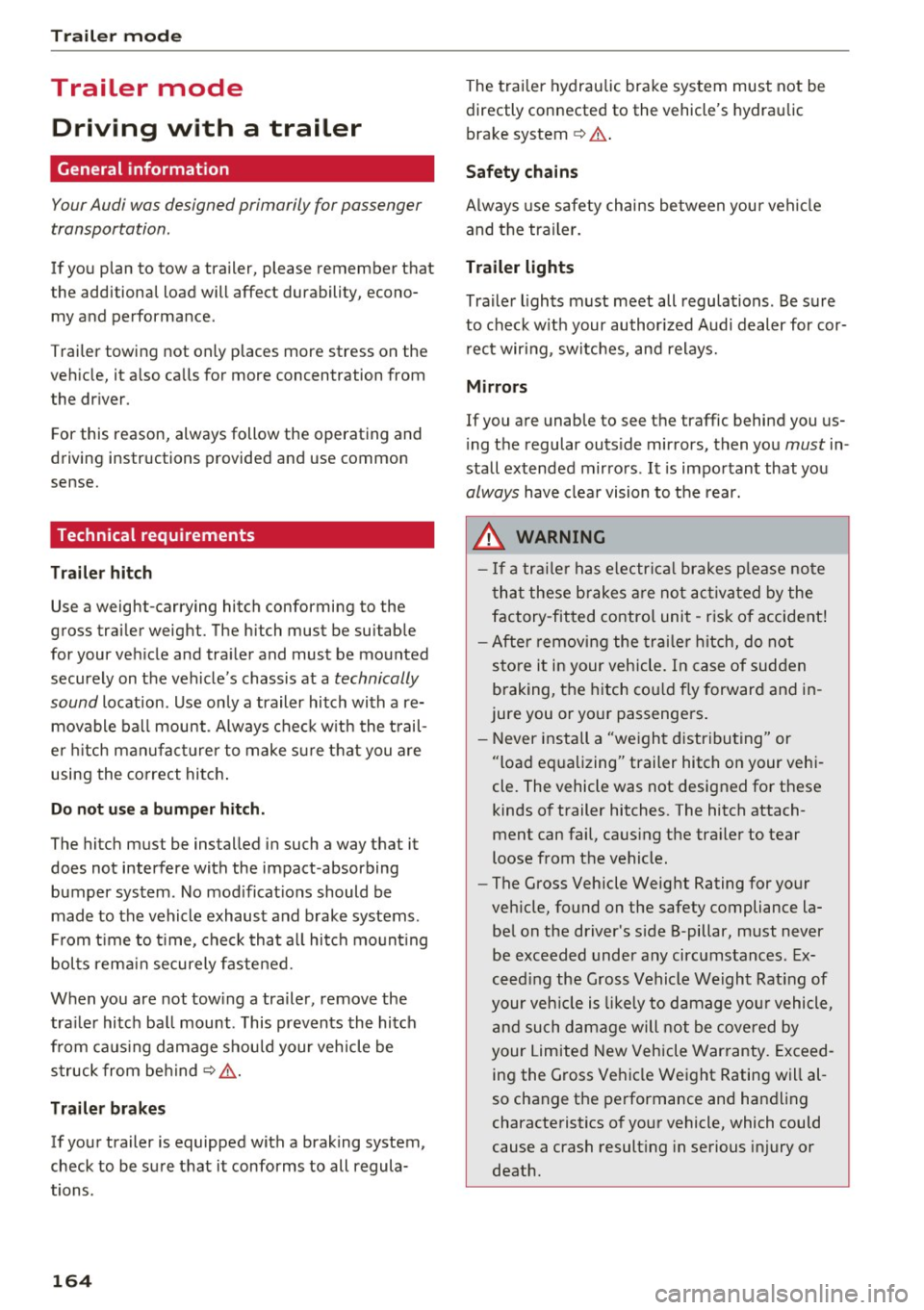
Driving with a trailer
General information
Your Audi was designed primarily for passenger
transportation.
If you plan to tow a trailer, please remember that
the additional load will affect durability, economy and performance.
Trailer towing not only places more stress on the
vehicle, it also calls for more concentration from
the driver.
F or this reason, always follow the operating and
driving instructions provided and use common
sense.
Technical requirements
Tr aile r hitch
Use a weight-carrying hitch conforming to the
gross trailer weight. The hitch must be suitable
for your veh icle and trailer and must be mounted
securely on the vehicle's chassis at a technically
sound
location . Use only a trailer hitch with a re
movable ball mount . Always check w ith the t rail
er hitch man ufact urer to make su re that you are
using the co rrect hitch .
Do not use a bump er hit ch .
The hitch must be installed in such a way that it
does not interfere with the impact -absorbing
bumper system. No mod ificat ions should be
made to the vehicle exhaust and brake systems .
From t ime to t ime, check that a ll hitch mount ing
bolts rema in securely fastened.
When you are not tow ing a tra iler, remove the
tra iler hitch ba ll mount . This prevents the hitch
from caus ing damage shou ld your veh icle be
s truck from be hind ¢
,&..
Trailer brakes
If your trailer is equipped with a brak ing system,
check to be sure that it conforms to all regula
tions .
164
The trailer hydraulic brake system must not be
directly connected to the vehicle's hydraulic
brake system ¢&. .
Safety chains
Always use safety chains between you r vehicle
and the trailer.
Trailer lights
Traile r lights must meet all regulations . Be sure
to check w ith your author ized Audi dealer for cor
r ec t wiring , switches, and relays.
M irrors
If you are unable to see the traffic behind you us
ing the regular outs ide mirrors, then you
must in
stall extended mirrors . It is important that you
always have clear vision to the rear.
.&_ WARNING
- If a tra ile r has e lectr ica l brakes p lease no te
t hat these brakes are not activated by the
factory-fit ted contro l unit -risk of accident!
- After removing the trai ler hitch, do not
store it in your vehicle. In case of sudden
braking, the hitch co uld fly forward and in
jure you or yo ur passengers.
- Never install a "we ight distribu ting" or
"load eq ualizing" trailer hitch on your vehi
cle. The vehicle was not designed for these
kinds of trailer hitches. The hitch attach ment can fail, caus ing the tra iler to tear
loose from the vehicle.
- The Gross Vehicle Weight Rating for your
veh icle, found on the safety compliance la
be l on the driver's s ide B-pillar, must never
be exceeded under any circumstances . Ex
ceed ing the Gross Vehicle Weight Rat ing of
your veh icle is likely to damage yo ur vehicle,
and such damage will not be covered by
your Limited New Vehicle Warranty . Exceed
ing the Gross Vehicle Weight Rating will al
so change the performance and handling
characteristics of your vehicle, which could
cause a crash result ing in serious injury or
death.
Page 173 of 252
Care and cleaning
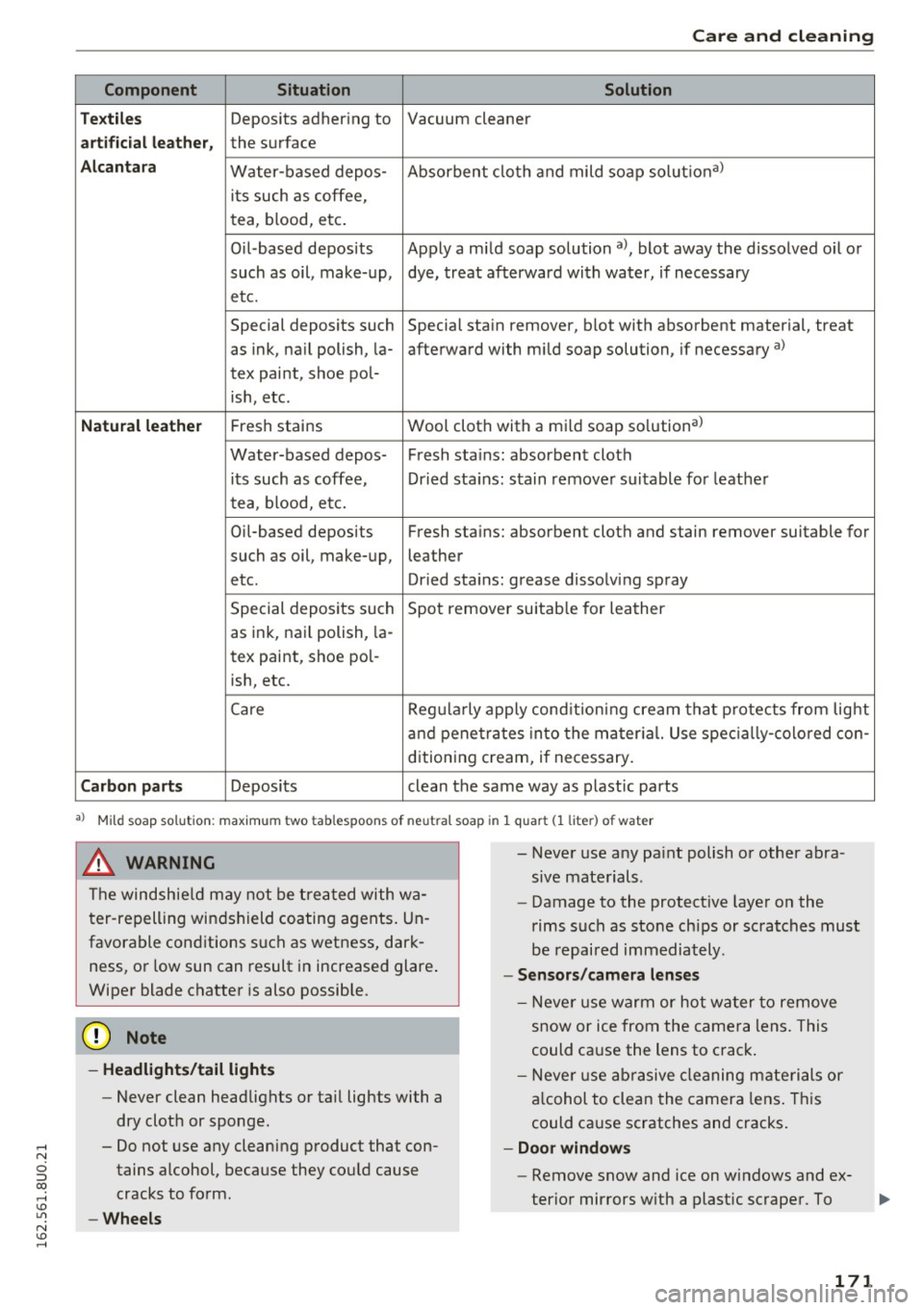
Component Situation Solution
T ex til es
Deposits adhering to Vacuum cleaner
art ifici al leat her, the surface
A lcan tara Water-based depos- Absorbent cloth and mild soap
solutional
its such as coffee,
tea, blood, etc.
Oil-based deposits Apply a mild soap solution al, blot away the dissolved oil or
such as oil, make-up, dye, treat afterward with water, if necessary
etc.
Special deposits such Special stain remover, b lot with absorbent material, treat
as ink, nail polish, la-afterward with mild soap solution, if necessary al
tex paint, shoe pol-
ish, etc.
Natu ral le ath er Fresh stains Wool cloth with a mild soap solution al
Water-based depos-Fresh stains: absorbent cloth
its such as coffee, Dried sta ins: stain remover su itable for leathe r
tea, blood, etc.
Oil-based deposits Fresh stains: absorbent cloth and stain remover suitable for
such as oil, make-up, leather
etc . Dried stains : grease dissolving spray
Special deposits such Spot remover suitable for leather
as ink, nail polish, la-
tex paint, shoe pol-
ish, etc.
Ca re Regularrly apply cond itioning cream that p rotects from light
and penetrates into the ma ter ial. Use spec ially-colored con-
ditionirng cream, if necessary.
Carbon p art s Deposits clean the same way as plastic parts
a) Mild soap solution: maximum two tablespoons of neutral soap in 1 q uart (1 liter) of water
.8, WARNING
The windshield may not be trea ted with wa
ter-repelling windshield coating agents. Un
favorable cond itions such as wetness, dark
ness, or low sun can result in increased glare.
Wiper blade chatter is also possible.
@ Note
- Headlight s/tail li ghts
- Never clean headlights or tail lights with a
dry cloth or sponge.
- Do not use any cleaning product that con
tains alcohol, because they could cause
cracks to form.
- Whe els
-
- Never use a ny pa int polish or other abra
sive materials .
- Damage to the protect ive layer on the
rims such as sto ne ch ips or scratches must
be repaired immediately .
-Sen sor s/camera lenses
-Neve r use warm or hot water to remove
snow or ice from the camera lens . This
could ca use the lens to crack .
- Neve r use ab rasive cleaning materials or
a lcohol to clean the camera lens . This
could cause scratches and cracks .
-Door window s
-Remove snow and ice on windows and ex-
terior mirrors w ith a plast ic scraper. To
171
Page 182 of 252
Check ing and F illing
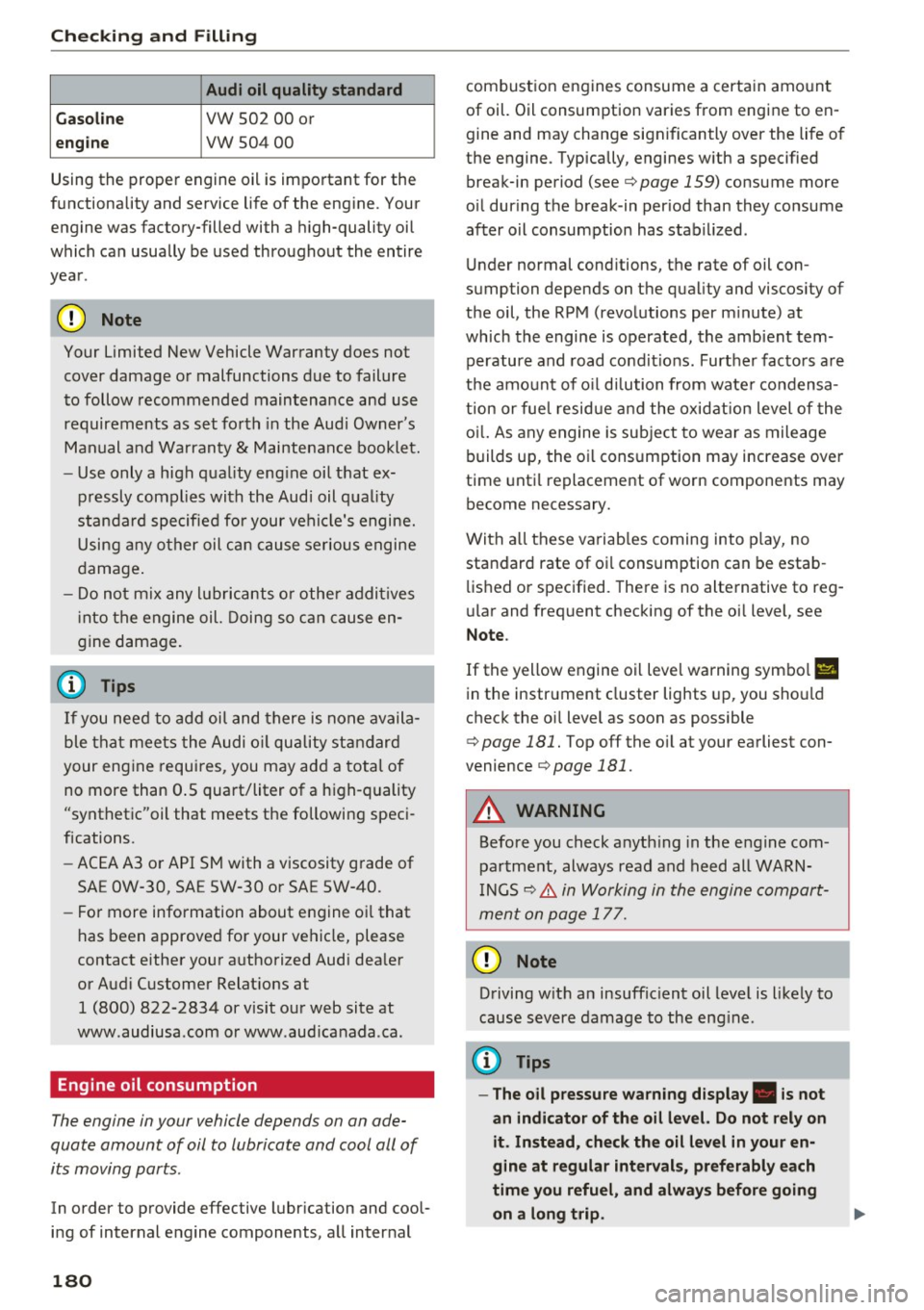
Audi oil quality standard
Gas olin e
VW 502 00 or
engi ne vw 50400
Using the proper engine oil is important for the
functionality and service life of the engine. Your
engine was factory-filled with a high-quality oil
which can usually be used throughout the entire
year .
Q) Note
Your Limited New Vehicle Warranty does not
cover damage or malfunctions due to failure
to follow recommended maintenance and use
requirements as set fo rth in the Audi Owner's
Manual and Wa rranty
& Maintenance booklet.
- Use only a high qua lity eng ine oi l th at ex-
pressly complies with the Audi oil qua lity
stan dard specified for your vehi cle's engine.
Using any o ther oil can cause serious engine
damage .
- Do not mix any lubricants o r other addit ives
i nto the engine oil. Doing so can cause en
gine damage.
(D Tips
I f you nee d to add oi l and there is none availa
ble that meets the Audi o il qu ality st andard
your engine requires, you may ad d a total of
no more than 0 .5 quart/liter of a high-quality
"synthet ic"oil that meets the following speci
fications.
- ACEA A3 o r API SM with a viscosity g rade of
SAE OW-30, SAE 5W-30 or SAE 5W-40.
- For more information about engine oi l that
has been approved for your vehicle, please
contact either your authorized Audi dea ler
or Audi Custome r Relat ions at
1 (800) 822-2834 or visit our web site at
www.audiusa.com or www .aud icanada .ca.
Engine oil consumption
The engine in your vehicle depends on an ade
quate amount of oil to lubricate and cool all of
its moving parts .
In order to provide effective lubrication and cool
ing of internal engine components, all internal
180
combust ion engines consume a certa in amo unt
of oil. Oil consumption varies from engine to en
gine and may change significantly over the life of
the engine. Typically, engines w ith a specified
break-in period (see
c:::;, page 159) consume more
o il dur ing the break-in per iod than they consume
af ter o il consumption has stab ilized .
Under normal conditions, the rate of oil con
sumption depends on the quality and viscos ity of
the oil, the RPM (revo lutions per m inute) at
wh ich the engine is operated, the amb ient tem
perature and road condit ions. Further factors a re
the amount of o il di lution from wate r co ndensa
tion or fue l resid ue an d the oxidation level of the
o il. As any engine is sub ject to wear as mileage
builds up, the oi l cons umption may increase over
time unt il replacement of worn components may
become necessary.
With a ll these variab les coming into p lay, no
standard rate of oil consumption can be estab
li shed or specified. The re is no alternative to reg
u lar and frequent checking of the oi l level, see
Note.
If the yellow engine oil level warning symbo l Ell
in the instrument cluster lights up, you sho uld
check the oil level as soon as possible
c:::;, page 181. Top off the oil at your earliest con
venience
c:::;,page 181.
A WARNING
Before you check anyth ing in the e ng ine com
partment, always read and heed all WARN
I NGS
c:::;, .&. in Working in the engin e compart
ment on page 177.
(D Note
Driving w ith an insuffic ient oil level is likely to
cause severe damage to the eng ine.
(D Tips
- The oil pressure warn ing d isplay. is not
an indicator of the oil level. Do not rely on
it. Instead, check the oil level in your en
g ine at regular int ervals , pr eferably each
time you refuel, and alway s before going
on a long trip .
Page 189 of 252
@ For the sake of the environment
Because of the problem of proper disposal of
brake fluid as we ll as the special toots re
quired and the necessary expertise, we rec
ommend that you have the brake fluid
changed by your authorized Audi dealer .
Battery
General information
Under normal operating conditions, the battery
in your Audi does not need any maintenance.
With
high outside temperatures or long daily
drives we recommend that you have the electro
lyte level checked by an authorized Audi dealer or
qualified workshop. The electrolyte level should
also be checked each time the battery is charged
c> page 189.
Have the battery checked when you take your ve
hicle in for serv ice. You are well advised to re
place a battery t hat is older than 5 years.
With certain types of airbag deployment, the battery is disconnected from the vehicle electri
cal system for safety reasons
c> & in Repair, care
and disposal of the airbags on page 125 .
Disconnecting the battery terminals
Some vehicle functions (power window regula
tors, for example) are lost if the battery termi nals are disconnected. These functions have to be
relearned after the battery terminals are con
nected again. To prevent th is, the battery should
only be disconnected from the vehicle e lectr ica l
system when abso lutely necessary for repairs.
Vehicles not driven for long periods
If you do not drive your vehicle over a period of
several days or weeks, electrical components are
gradually cut back or sw itched off. This reduces
energy consumption and maintains starting ca
pability over a longer pe riod
c> page 157.
Some of the conven ience functions may not oper
ate, such as the interior lights or the power seat
adjustment. The convenience functions will be
available again when you turn on the ignition and
start the engine.
Checking and Filling
Winter operation
During the winter months, battery capacity tends
to decrease as temperatures drop . This is be
cause more power is also consumed while start
ing, and the headlights, rear window defogger,
etc., are used more often.
Avo id unnecessary power consumption, particu
larly in city traffic or when traveling only short
distances . Let your authorized Audi dealer check
the capacity of the vehicle battery before winter
sets in
c> page 189. A well charged battery will
not only prevent starting problems when the
weather is cold, but will also last longer .
(D Tips
If your vehicle is left standing for several
weeks at extremely low temperatures, the ve
hicle battery should be removed and stored
where it w ill not freeze. This will prevent it
from be ing damaged and having to be re
placed.
Working on the battery
Be especially careful when working on or near
the battery.
The battery is located in the engine compart
ment . Before you check anything in the engine
compartment ,
read and heed all WARNINGS
c>,& ,
Always heed the safety warnings, when working
on the vehicle battery or the veh icle electrical
system to prevent injury.
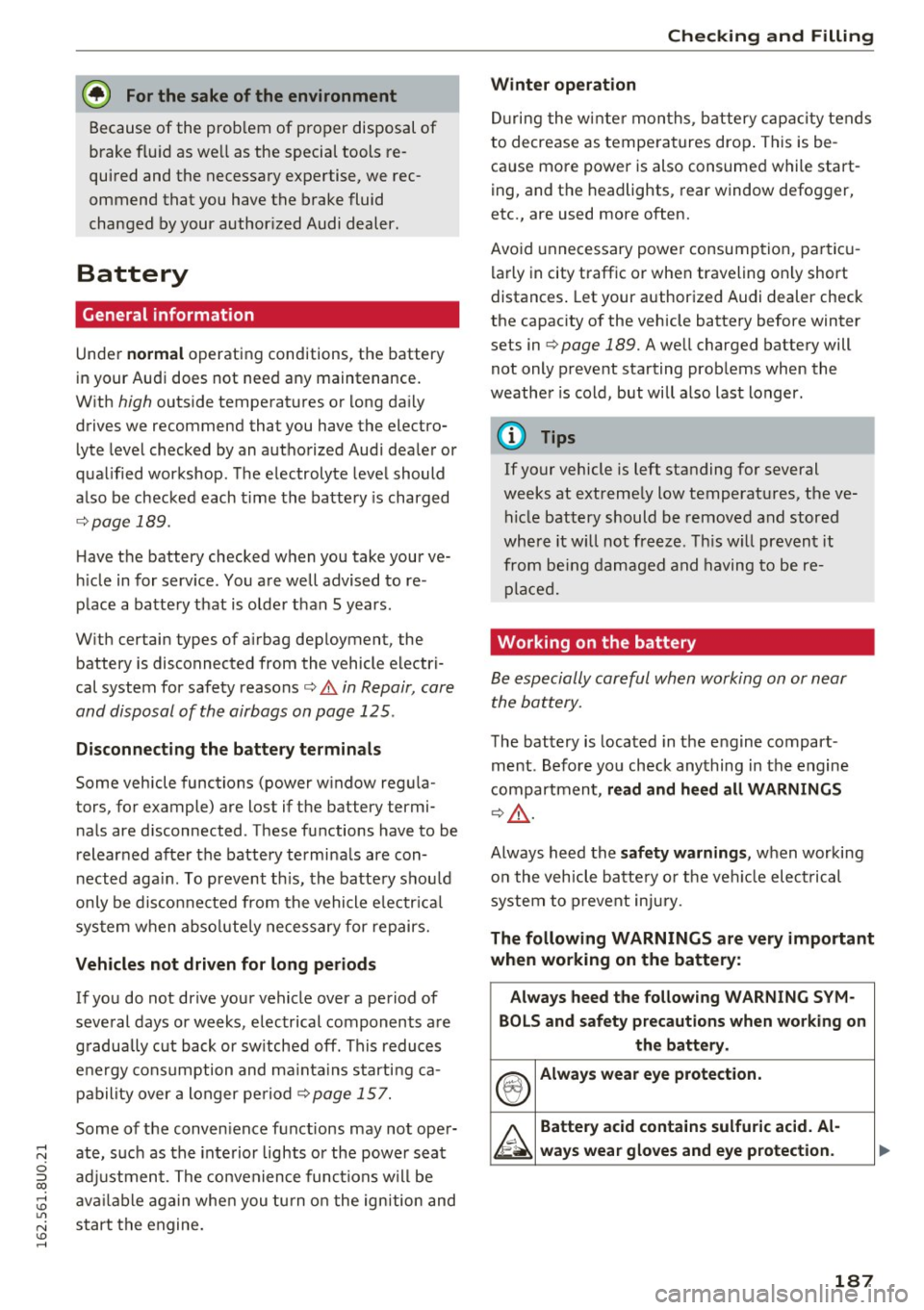
The following WARNINGS are very important
when working on the battery:
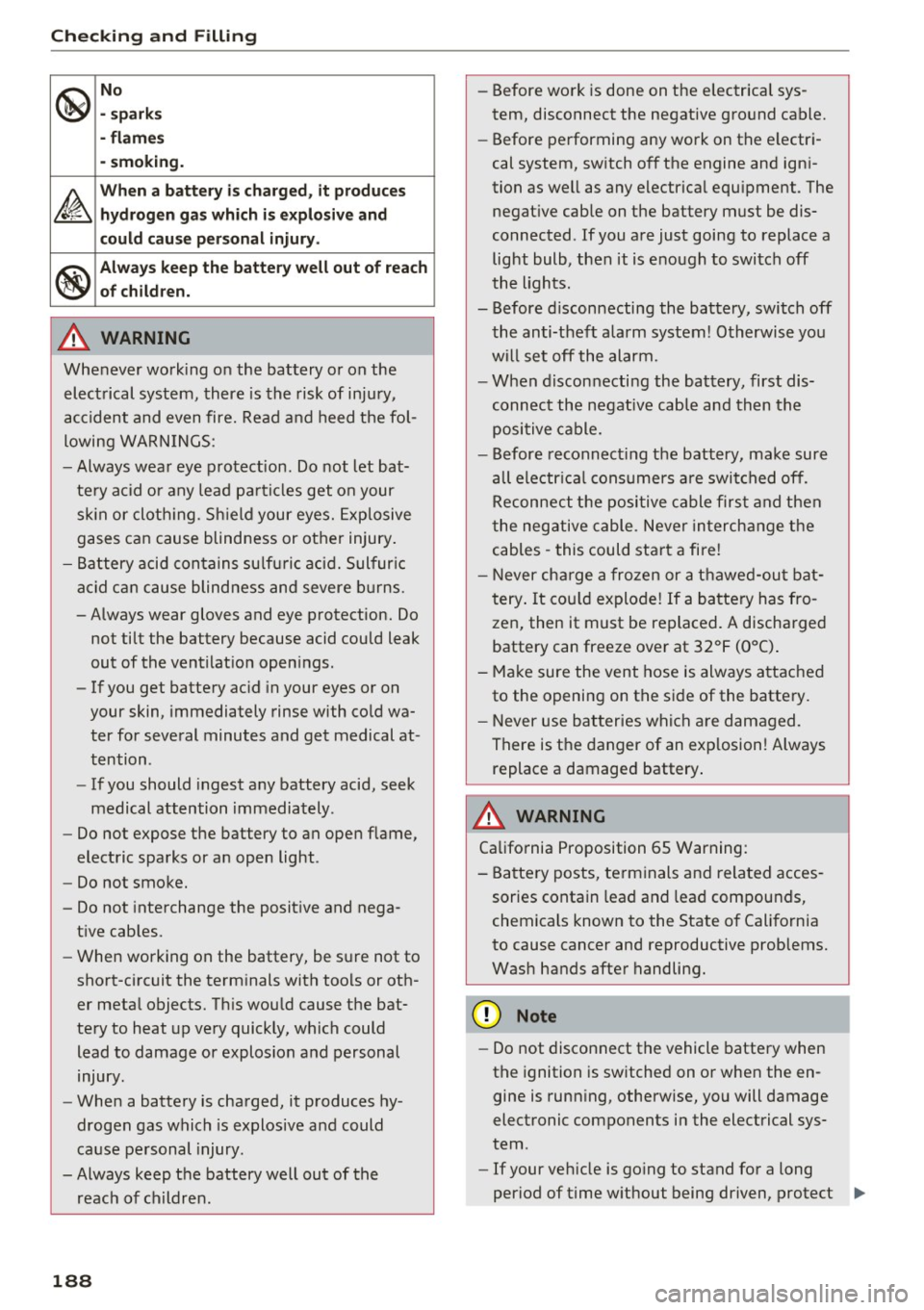
Always heed the following WARNING SYM·
BOLS and safety precautions when working on
the battery.
®
Always wear eye protection.
A
Battery acid contains sulfuric acid. Al-
ways wear gloves and eye protection .
187
Page 190 of 252
Check ing and F illing
@
No
- sp ark s
- flam es
- smoking.
£
When a bat tery is charg ed, it produc es
hydr og en gas which i s ex plo sive and
could c aus e pe rs onal injury .
®
Alwa ys keep the b atter y well out of reach
of chil dren.
A WARNING
Whenever work ing on the battery or on the
elect rical system, there is the risk of injury,
accident and
even fire. Read and heed the fol
lowing WARN INGS :
- Always wea r eye protection. Do not let bat
te ry acid or any lead pa rticles get on your
sk in or cloth ing . Sh ield your eyes. Explosive
gases can cause blindness or other injury .
- Battery acid con tains su lfu ric acid. Sulfur ic
acid c an cause blindness and
severe bu rns.
- Always wear gloves and eye protection. Do
no t tilt the battery because acid could leak
out of the ventilat ion open ings .
- If you get battery ac id in your eyes or on
your skin, immediately rinse with cold wa
ter for several minutes and get medical at tention .
- If you should ingest any battery acid, seek
medical attention immediately .
- Do not expose the battery to an open flame,
electric sparks or an open light .
- Do not smoke.
- Do not interchange the positive and nega-
t ive cables.
- When working on the battery, be sure not to
short-circuit the term inals with tools or oth
er metal objects. Th is wou ld cause the bat
tery to heat up very quickly, which could
lead to damage or explosion and personal
injury .
- When a battery is charged, it produces hy
drogen gas which is explosive and could
ca use personal injury.
- Always keep the battery well out of the reach of ch ildre n.
188
-
-Before wo rk is done on the electrical sys
tem, disconnect the negative gro und cable.
- Before performing any work on the e lectri
cal system, switch off the engine and ign i
tion as well as any electrical equ ipment . The
negat ive cab le on the battery must be dis
connected . If you are just going to replace a
light bulb, then it is enough to switch off
the lights.
- Before d isconnecting the battery, switch off
the an ti-theft alarm system! Otherwise you
will set off the alarm.
- When disconnecting the battery, first dis
connect the negative cab le and then the
positive cable.
- Before reconnect ing the battery, make sure
all electr ica l consume rs a re switched off .
Reconnect the positive cable firs t and then
the negative cable . Never in terch ange t he
cables -this could sta rt a fire!
- Never cha rge a frozen or a thawed-ou t bat
tery . It cou ld explode ! If a ba ttery has fro
zen, then it must be replaced. A discharged
battery can freeze over at 32°F (0°C) .
- Make sure the
vent hose is always attached
to the opening on the side of the battery .
- Never use bat ter ies which are damaged.
There is the danger of an exp losion! Always
replace a damaged battery .
A WARNING
Califo rnia Proposition 65 Warning :
- Ba tte ry posts, te rm inals and related acces
sories contain lead and lead compounds,
chemicals known to the State o f Cali fornia
to cause cancer and reproductive problems.
Wash hands after handling.
(D Note
- Do not disconnect the vehicle battery when
the ignition is switched on or when the en
gine is running, otherwise, you will damage
electronic components in the electrical sys
tem .
- If your veh icle is go ing to stand for a long
period of time w ithout being driven, protect ..,.
Page 223 of 252
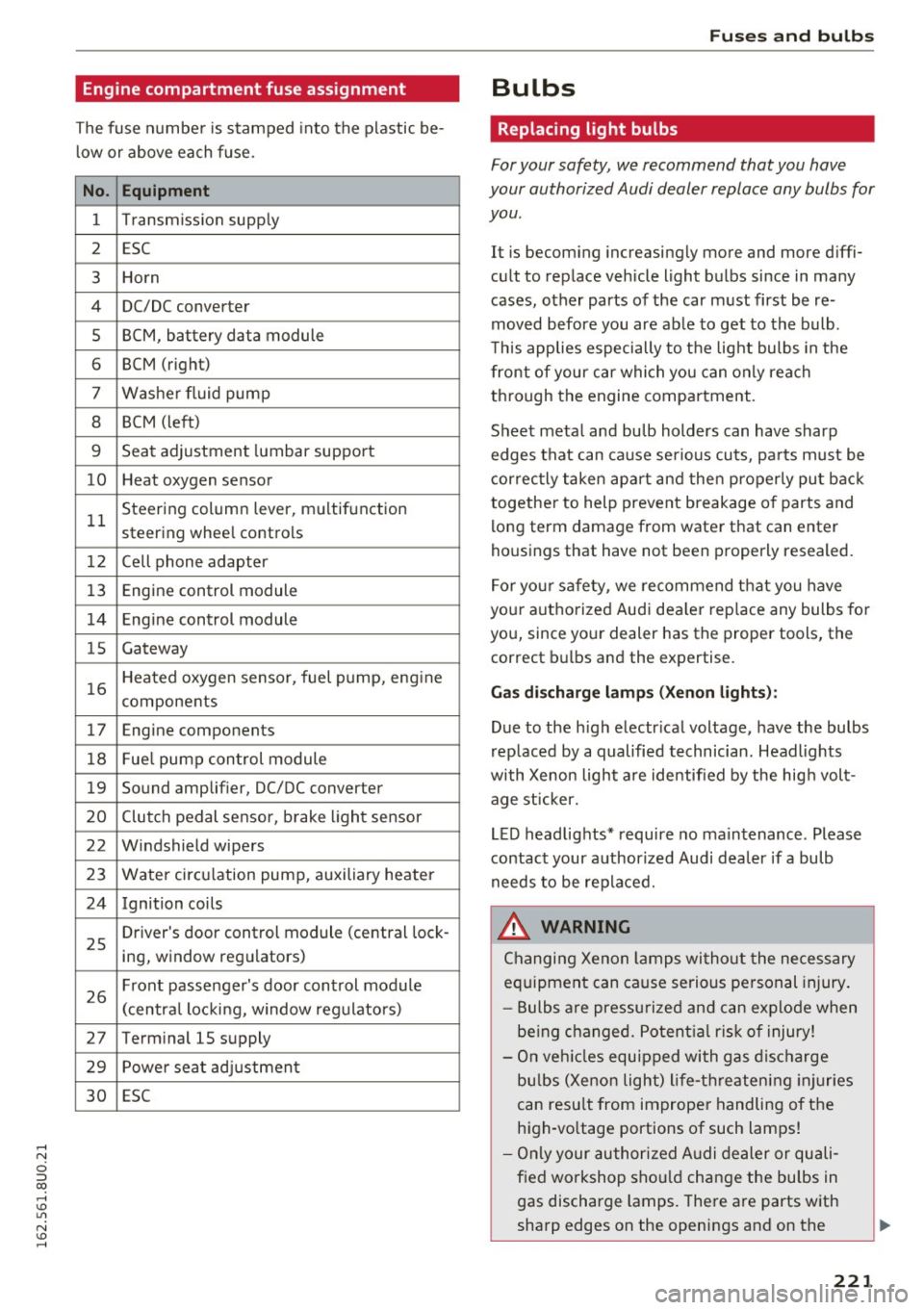
Engine compartment fuse assignment
The fuse number is stamped into the plastic be
low or above each fuse.
No. Equipment
1 Transmiss ion supply
2 ESC
3 Horn
4 DC/DC
converter
5 BCM, battery data module
6 BCM (right)
7 Washer fluid pump
8 BCM (left)
9 Seat adjustment lumbar support
10 Heat oxygen sensor
11 Steering
column lever, multifunction
steering wheel contro ls
1 2 Cell phone adapter
13 Engine control
module
14 Engine control module
15 Gateway
16 Heated oxygen sensor, fuel pump,
engine
components
17 Engine components
18 Fue l pump control module
19 Sound
amplifier, DC/DC converter
20 Clutch pedal sensor, brake light sensor
22 Windshield wipers
23 Water circu
lation pump, auxiliary heater
24 Ignition coils
25 Driver's door
control module (central lock-
ing, window regu lators)
26 Front
passenger's door control module
(centra l locki ng, window reg ulators)
27 Terminal 15 supply
29 Powe r seat adjustment
30 ESC
Fuses an d bulb s
Bulbs
Replacing light bulbs
For your safety, we recommend that you have
your authorized Audi dealer replace any bulbs for
you .
It is becoming increasingly more and more diffi
cult to replace vehicle light bulbs since in many
cases, other parts of the car m ust first be re
moved before you are able to get to the bulb .
T his applies especially to the light bulbs in the
front of your car which you can only reach
through the engine compartment .
Sheet metal and bu lb holders can have sharp
edges that can cause serious cuts, pa rts must be
correctly taken apart and then properly put back
together to help prevent breakage o f parts and
long term damage from water that can enter
housings that have not been properly resealed.
For your safety, we recommend t hat you have
your authorized Aud i dea le r rep lace any bulbs fo r
you, since your dealer has the proper tools, the
correct bulbs and the expertise.
Gas di schar ge la mps (Xe no n light s):
Due to the high electr ical voltage, have the bulbs
rep laced by a qualified technician. Headlights
with Xenon light are identified by the hig h volt
age st icker.
LED headlights* require no maintenance . Please
contact your authorized Audi dea ler if a bulb
needs to be replaced.
_&. WARNING
Changing Xenon lamps wi thout the necessary
equipment can cause serious personal injury .
- Bulbs are pressu rized and can explode when
be ing changed. Potent ial ris k of injury!
- On veh icles equipped with gas disc harge
bu lbs (Xenon light) life-threatening injuries
can resu lt from improper handling of the
high-vo ltage portions of such lamps!
- Only your authorized A udi dealer or quali
fied workshop sho uld change the bulbs in
gas discharge lamps. There are parts with
sharp edges on the openings and on the
221