air condition AUDI Q3 2017 Owner´s Manual
[x] Cancel search | Manufacturer: AUDI, Model Year: 2017, Model line: Q3, Model: AUDI Q3 2017Pages: 236, PDF Size: 58.93 MB
Page 103 of 236
a:,
a:,
...... N r--. N .... 0 0 ::, a:,
.. Sit properly in your seat and make sure that
your passengers do the same
¢page 44, Front
seats .
.. Fasten your safety belt and wear it properly. Al
so instruct your passengers to fasten their safe
ty belts properly
¢page 109.
What impairs driving safety?
Safe driving is directly related to the condition of
the vehicle, the driver as well as the driver's abili
ty to concentrate on the road without being dis
tracted.
The driver is responsible for the safety of the ve
h icle and all of its occupants . If your ability to
drive is impaired, safety risks for everybody in the
veh icle increase and you also become a hazard to
everyone else on the road ¢_& .T herefo re:
.. Do not let yourself be distracted by passengers
or by using a cellular telephone.
.. NEVER dr ive when your dr iv ing ability is im
paired (by medications, alcohol, drugs, etc.).
.. Observe a ll traff ic laws, rules of the road and
speed limits and plain common sense.
.. ALWAYS adjust your speed to road, traffic and
weather conditions.
.. Take frequent breaks on long trips. Do not drive
for more than two hours at a stretch.
.. Do NOT drive when you are tired, under pres
sure or when you are stressed.
A WARNING
Impai red dr iv ing safety increases the risk of
ser ious personal inju ry and death whenever a
vehicle is being used.
Dr iving safety
Correct passenger
seating positions
Proper seating position for the driver
The proper driver seating position is important
for safe, relaxed driving.
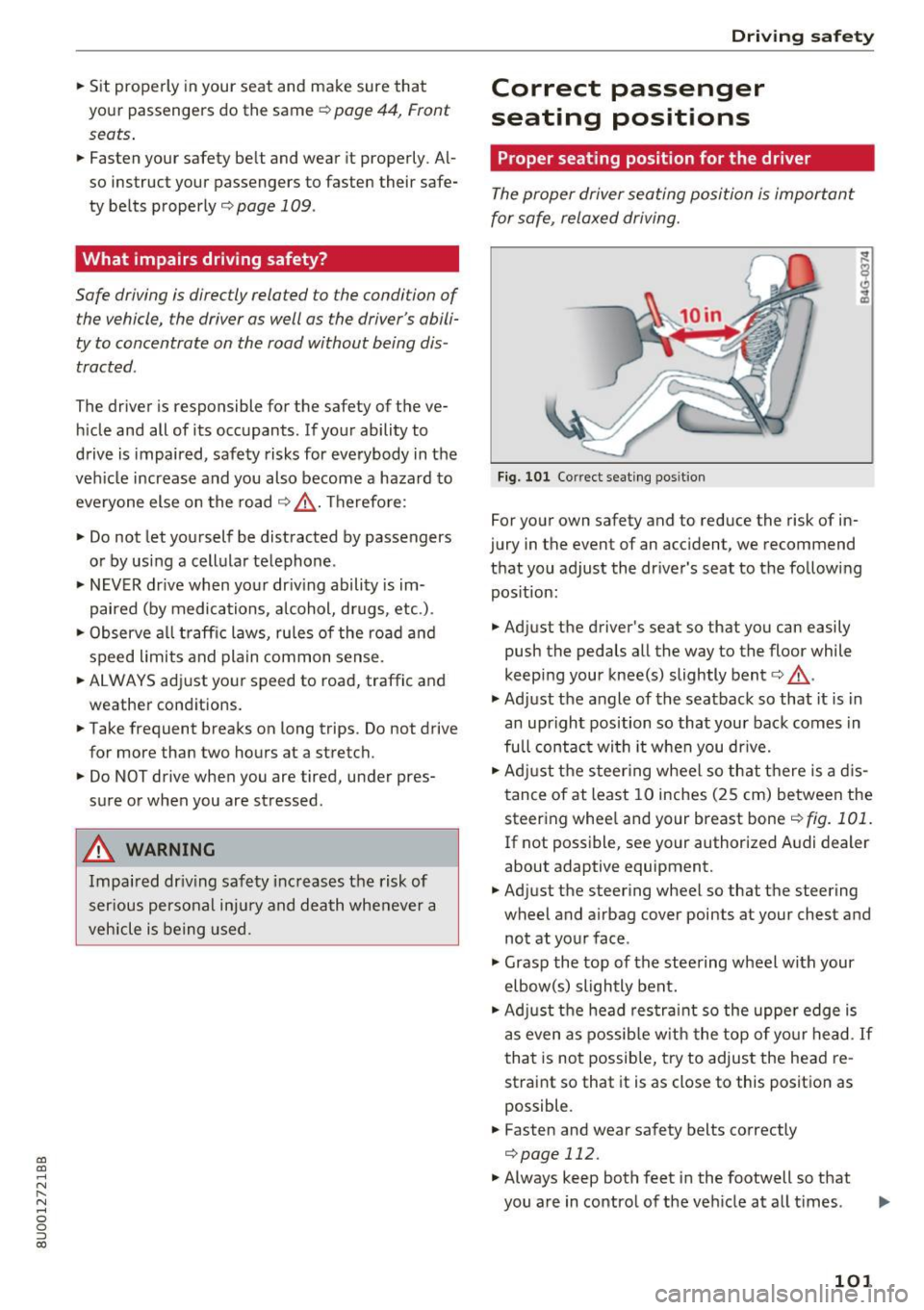
F ig. 101 Cor rect seating position
For your own safety and to reduce the risk of in
jury in the event of an accident, we recommend
that you adjust the driver's seat to the following pos ition:
.. Adjust the driver's seat so that you can easily
push the pedals all the way to the floor while
keep ing your knee(s) slightly bent¢_& .
.,. Adjust the angle of the seatback so that it is in
an upright position so that your back comes in
full contac t wi th it when you dr ive.
.. Adj ust the steer ing wheel so that there is a d is
tance of at least 10 inches (25 cm) between the steering whee l and your breast bone¢
fig. 101.
If not possible, see your author ized A udi dealer
about adaptive equipment.
.. Adjust the steering wheel so that the steering
wheel and airbag cover points at your chest and
not at your face .
.,. Grasp the top of the steering wheel with your
elbow(s) slightly bent .
.. Ad just the head res tra int so the upper edge is
as even as possib le w ith the top of yo ur head.
If
that is no t possib le, try to adjust the head re
straint so that it is as close to this position as
possible .
.. Fasten and wear safety belts correctly
¢page 112.
.. Always keep both feet i n the footwell so that
you are in control of the veh icle at all t imes .
101
Page 108 of 236
Driving safety
-Always put objects, for example, luggage or
other heavy items in the luggage compart
ment.
- Always secure objects in the luggage com
partment using the tie-down eyelets and
suitable straps.
A WARNING
Heavy loads will influence the way your vehi
cle handles. To help reduce the risk of a loss
of control leading to serious personal injury:
- Always keep in mind when transporting
heavy objects, that a change in the center of
gravity can also cause changes in vehicle
handling:
- Always distribute the load as evenly as
possible.
- Place heavy objects as far forward in the
luggage compartment as possible.
- Never exceed the Gross Axle Weight Rating or the Gross Vehicle Weight Rating specified
on the safety compliance sticker on the left
door jamb. Exceeding permissible weight
standards can cause the vehicle to slide and handle differently .
- Please observe information on safe driving
¢page 100.
A WARNING
To help prevent poisonous exhaust gas from
being drawn into the vehicle, always keep the
rear lid closed while driving.
- Never transport objects larger than those fitting completely into the luggage area be
cause the rear lid cannot be fully closed .
- If you absolutely must drive with the rear lid open, observe the following notes to reduce
the risk of poisoning:
- Close all windows,
- Close the Panoramic sliding sunroof*,
- Open all air outlets in the instrument pan-
el,
- Switch off the air recirculation,
- Set the fresh air fan to the highest speed .
106
A WARNING
,--
Always make sure that the doors, all win
dows, the Panoramic sliding sunroof* and the
rear lid are securely closed and locked to re
duce the risk of injury when the vehicle is not
being used .
-After closing the rear lid, always make sure
that it is properly closed and locked.
- Never leave your vehicle unattended espe
cially with the rear lid left open. A child
could crawl into the vehicle through the lug
gage compartment and close the rear lid be
coming trapped and unable to get out. Be
ing trapped in a vehicle can lead to serious
personal injury.
- Never let children play in or around the vehi
cle.
- Never let passengers ride in the luggage
compartment. Vehicle occupants must al
ways be properly restrained in one of the ve
hicle's seating positions.
(D Tips
- Air circulation helps to reduce window fog
ging. Stale air escapes to the outside
through vents in the trim panel. Be sure to keep these slots free and open .
- The tire pressure must correspond to the
load. The tire pressure is shown on the tire
pressure label. The tire pressure label is lo
cated on the driver's side B-pillar . The tire
pressure label lists the recommended cold
tire inflation pressures for the vehicle at its
maximum capacity weight and the tires that
were on your vehicle at the time it was man
ufactured. For recommended tire pressures
for normal load conditions, please see chap
ter
¢ page 181.
Tie-downs
The luggage compartment is equipped with four
tie-downs to secure luggage and other items.
Use the tie-downs to secure your cargo properly
¢page 105, Loading the luggage compartment . ..,_
Page 121 of 236
about children and Advanced Airbags
<=>page 137 .
Even though yo ur vehicle is equipped with an Ad
vanced Airbag System, make certain that all chil
dren, especially those 12 years and younge r, a l
ways ride in the back seat properly restrained for
their age and size. The airbag on the passenger
side makes the front seat a potentially dangerous place for a child to ride. The front seat is not the
safest place for a child in a forward-facing child
safety seat .
It can be a very dangerous place for
a n infant or a child in a rearward-fac ing seat.
The Advanced Airbag System in your veh icle has
been certified to comply with the requirements
of United States Federal Motor Vehicle Safety
Standa rd (FMVSS) 208, as well as Canada Motor
Veh icle Safety Standa rd (CMVSS) 208 as applica
b le a t the time your veh icle was m an ufact ured.
Accord ing to requirements, the front Advanced
Airbag System on the passenger side has been
certified for "suppression" for infants of about
12 month old and younger and for "low risk de
ployment" for children aged
3 to 6 years old (as
defined in the standard) .
The
PASSENGER AIR BAG O FF light in the instru
ment panel tells you when the front Advanced
Airbag on the passenger side has been turned
off
by the electronic control unit.
Each time yo u switch on the ignition, the
PAS ·
S ENGER AIR BAG OFF
light will come on for a
few seconds and:
- will stay on if the front passenger seat is not
occupied,
-will stay on if there is a sma ll chi ld or chi ld re
straint on the front passenge r seat,
- will go
off if the front passenger seat is occu
pied by an adult as reg istered by the weight
sensing mat
c:> page 12 7, Monitoring the Ad
vanced Airbag System.
The PAS SENGER AIR BAG OFF light comes on
when the contro l unit detects a tota l weight on
the front passenger seat that requi res the front
~ airbag to be turned off . ......
"' ~ If the total weight on the front passenge r seat is ......
8 more than that of a typical 1 year-old child but :::, 00
Airb ag sys tem
less than the weight o f a sma ll adult, the front
airbag on the passenger side can dep loy (the
PASSENGER AIR BAG O FF light does not come
on). If the
PA SSENGER AIR BA G OFF light does
not come on, the front airbag on the passenger
s ide has not been turned
off by the electronic
control unit and can deploy if the contro l unit
senses an impact that meets the conditions stor
ed in its memo ry .
For example, the airbag may deploy if:
- a small ch ild that is heav ier than a typ ica l 1
year-o ld child is on the front passenger seat
(regardless of whether the child is in one of the
child safety seats listed
c:> page 139), or
- a child who has outgrown c hild restraints is on
the front passenger seat.
If the front passenger airbag is t urned off, the
PASSENGER AIR BAG O FF light comes on in the
instrument cluster and stays on.
T he front airbag on the passenger side may
not
deploy (the PAS SENGER AIR BAG OFF light does
not illuminate and stay lit) even if a small adu lt
or teenager, or a passenger who is not s itting up
right w ith their back against a non-recl ined back
rest with the ir feet on the vehicle floor i n front of
the seat is on the front passenger seat
c:> page 101, Proper seating position for the driv
er.
If the front passenge r a irbag deploys, the Feder
al Standard requi res the airbag to meet the "low
risk" deployment cri te ria to reduce the r is k of in
j u ry throug h interact ion w it h t he airbag. "Low
risk" deploymen t occurs in t hose crashes tha t
take place at lowe r dece lerations as defined in
the e lectronic control unit
c:> page 128, PASSEN
GER AIR BAG OFF light.
Always remembe r, a ch ild safety sea t or infan t
carr ier installed on the front seat may be s truck
and knocked out of positio n by the rapidly i nflat
ing passenger's airbag in a frontal coll ision . The
airbag could greatly red uce the effectiveness of
the child restraint and even seriously injure the
child during inflation .
IJJ,,
119
Page 123 of 236
-Never place additional items on the seat
that can increase the total weight registered
by the weight-sensing mat and can cause in
jury in a crash .
Front airbags
Description of front airbags
The airbag system can provide supplemental
protection to properly restrained front seat occu
pants.
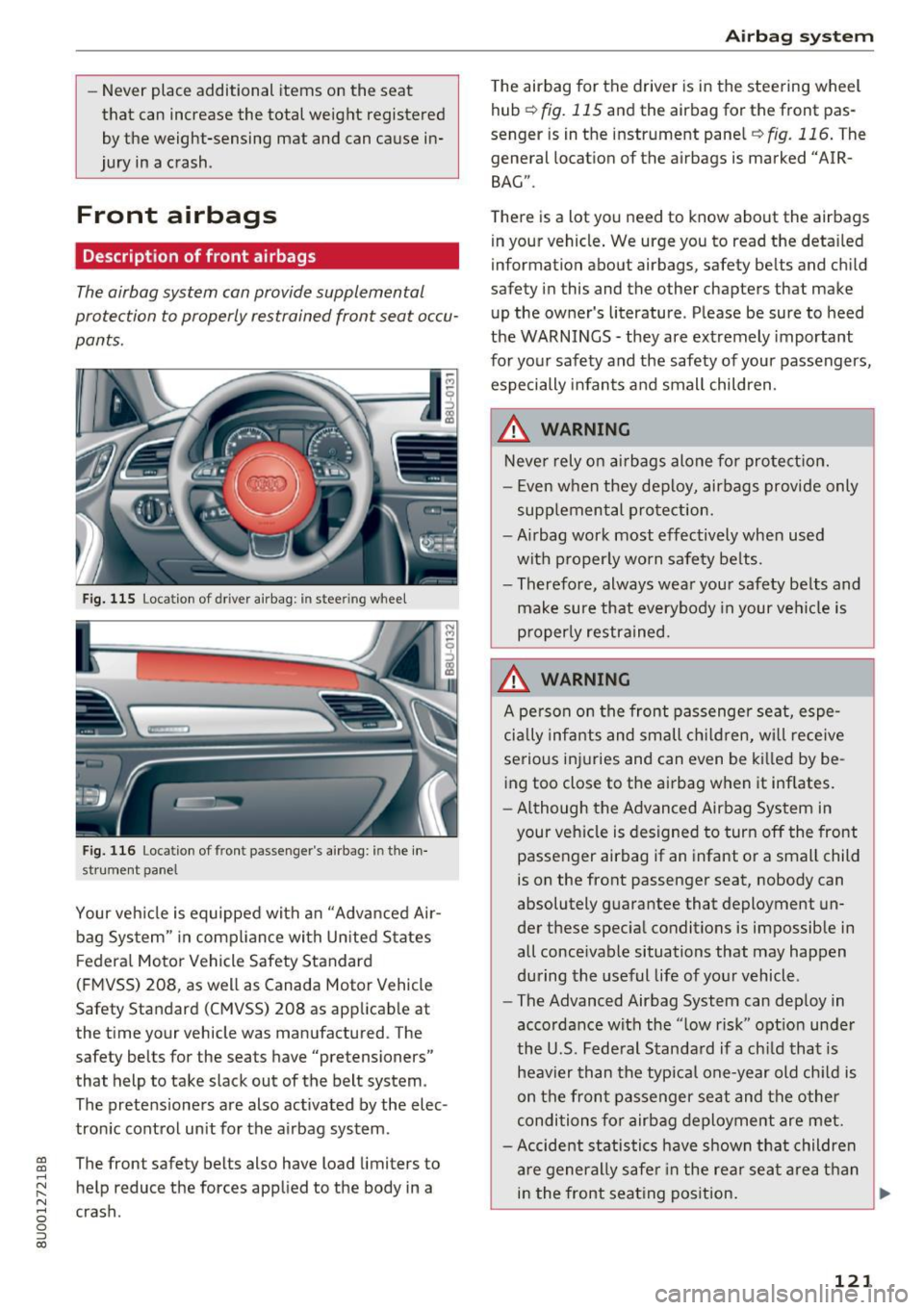
Fig. 1 15 Location of driver airbag: i n stee ring wheel
Fig. 116 Location of front passenger's airbag: in the in
st rument panel
Your veh icle is equipped with an "Advanced Air
bag System" in compliance with United States
F edera l Motor Vehicle Safety Standard
(FMVSS) 208 , as well as Canada Motor Vehicle
Safety Standard (CMVSS) 208 as app licab le at
the time your vehicle was manufactured . The
safety belts for the seats have "pretensioners"
that help to take slack out of the belt system.
The pretensioners are also activated by the elec
tron ic control unit for the airbag system .
~ The front safety belts also have load limiters to ......
~ help reduce the forces applied to the body in a N
8 crash .
0 ::, (X)
Airb ag sys tem
The airbag for the drive r is in the steering wheel
hub ~
fig. 115 and the airbag for the front pas
senger is in the instrument panel
~ fig. 116. The
general locat ion of the airbags is marked "AIR
BAG".
There is a lot you need to know about the airbags
i n your vehicle . We urge you to read the deta iled
information about airbags, safety belts and child
safety in this and the other chapters that make
up the owner's literature . Please be sure to heed
the WARNINGS -they are extremely important
for you r safety and the safety of your passengers,
especially infan ts and small children .
_&. WARNING
-
Never rely on ai rbags alone fo r protect ion.
- E ven w hen they deploy, airbags provide only
supp lemental protection.
- Airbag work most effectively when used
with p roperly worn safety belts .
- Therefore, always wear your safety belts and
make sure that everybody in your ve hicle is
p roperly restrained.
_&. WARNING
A pe rson on the front passenger seat, espe
cia lly infants and small ch ildren, wi ll receive
serious injuries and can even be ki lled by be
ing too close to the airbag when it inf lates.
- Although the Advanced Airbag System in
your veh icle is designed to turn off the front
passenger airbag ifan infant or a small child
is on the front passenger seat, nobody can
absolutely guarantee that deployment un
der these specia l conditions is impossible in
all conceivable situations that may happen
during the useful life of yo ur vehicle .
- The Advanced Airbag System can dep loy in
accordance with the "low risk" option under
the U .S . Fede ral Standa rd if a ch ild that is
heavier than the typica l one-year old ch ild is
on the front passenger seat and the other
conditions fo r airbag deployment are met.
- Accident statistics have shown that children
are generally safe r in the rear sea t area t han
in the front seating pos ition .
Ill-
121
Page 130 of 236
Airbag system
AIR BAG OFF light will come on and stay on
whenever the ignition is on.
A WARNING
An airbag system that is not functioning prop er ly cannot provide supplemental protection
in a frontal crash.
- If the airbag indicator light
c::> page 14
comes when the vehicle is being used, have
the system inspected immediately by your
authorized Audi dealer . It is possible that
the airbag will inf late when it is not sup
posed to, or will not inflate when it should.
PASSENGER AIR BAG OFF light
Fig . 118 Sect ion from the inst rument panel: PASSENGER
AIR BAG O FF light
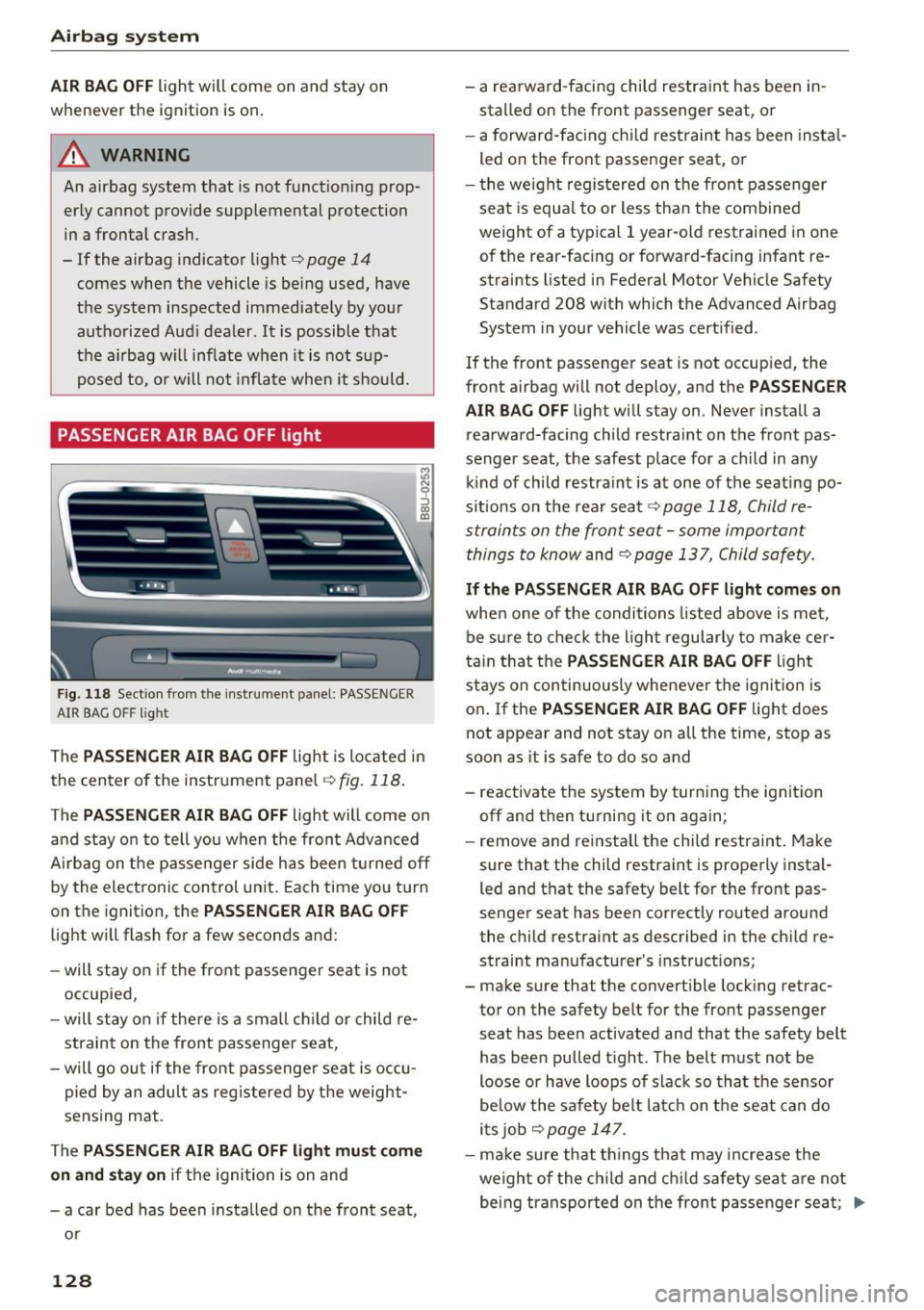
The PASSENGER AIR BAG OFF light is located in
the center of the instrument panel
c::>fig. 118.
The PASSENGER AIR BAG OFF light will come on
and stay on to tell you when the front Advanced
Ai rba g on the passenger side has been turned off
by the electronic control unit. Each time you turn
on the ignition, the
PASSENGER AIR BAG OFF
light will flash for a few seconds and:
- will stay on if the front passenger seat is not
occupied,
-will stay on if there is a small child or child re
straint on the front passenger seat,
- will go out if the front passenger seat is occu
pied by an adult as reg istered by the weight
sensing mat.
The
PASSENGER AIR BAG OFF light must come
on and stay on
if the igni tion is on and
- a car bed has been installed on the front seat,
or
128
- a rearward-facing child restraint has been in
stalled on the front passenger seat, or
- a forward-facing child restraint has been instal
led on the front passenger seat, or
- the weight registered on the front passenger
seat is equal to or less than the combined
weight of a typical 1 year-old restrained in one
of the rear -facing or forward-facing infant re
straints listed in Federal Motor Vehicle Safety
Standard
208 with which the Advanced Airbag
System in your vehicle was cert ified .
If the front passenger seat is not occupied, the
front airbag will not deploy, and the
PASSENGER
AIR BAG OFF
light will stay on. Never install a
rearward-facing child restraint on the front pas
senger seat, the safest place for a ch ild in any
kind of child restraint is at one of the seating po
s itions on the rear seat
c::> page 118, Child re
straints on the front seat -some important
things to know
and c::> page 13 7, Child safety.
If the PASSENGER AIR BAG OFF light comes on
when one of the conditions listed above is met,
be sure to check the light regularly to make cer
tain that the
PASSENGER AIR BAG OFF light
stays on continuously whenever the ignition is
on . If the
PASSENGER AIR BAG OFF light does
not appear and not stay on all the time, stop as
soon as it is safe to do so and
- reactivate the system by turning the ignition
off and then turning it on again;
- remove and reinstall the chi ld restraint. Make
sure that the child restraint is properly instal
led and that the safety belt for the front pas
senger seat has been correctly routed around
the child restraint as described in the child re
straint manufacturer's instructions;
- make sure that the convertible locking retrac
tor on the safety belt for the front passenger
seat has been activated and that the safety belt
has been pulled tight. The belt must not be
loose or have loops of slack so that the sensor
below the safety belt latch on the seat can do
its job
c::> page 147 .
-make sure that things that may increase the
weight of the child and child safety seat are not
be ing transported on the front passenger seat; .,.
Page 139 of 236
00
00
......
"' ,....
"' ...... 0 0 :::,
00
Child safety
Important information
Introduction
The rear seat is generally the safest place in a
collision .
The physical principles of what happens when
your vehicle is in a crash apply also to children
c:> page 110, What happens to occupants not
wearing safety belts? .
But unlike adults and
teenagers, their muscles and bones are not fully
developed. In many respects children are at
greater r isk of serious injury in crashes than
adults .
Because children's bodies are not fu lly devel
oped, they requ ire restraint systems especially
des igned for their size, we ight, and body struc
ture. Many countr ies and all states of the United
States and provinces of Canada have laws requir
ing the use of approved child restraint systems
for infants and small children .
I n a frontal crash at a speed of 20- 3 5 mph
(30-56 km/h) the forces acting on a 13-pound
(6 kg) infant will be more than 20 times the
weight of the child . This means the weight of the
child would suddenly be more than 260 pounds (120 kg) . Under these conditions, only an appro
priate child restraint properly used can reduce
the risk of serious injury . Child restra ints, like
adult safety belts, must be used properly to be
effect ive. Used improperly, they can increase the
risk of serious injury in an accident.
All ch ildren, especially those 12 years and young
er must always ride in the back seat proper ly re
stra ined for their age and size. If you must install
a child restra int on the front passenger seat in
exceptional circumstances, be sure to read and
heed the important information and warnings
c:> page 118. Infants and other children who are
properly restrained in an appropriate child re
straint that is for their size and age can benefit
from the protection that supplemental side air
bags provide in some kinds of crashes.
For more information please see information
provided by the:
Ch ild safety
- National Highway Traffic Safety Administration
(NHTSA), currently at: http:/ /www.safe
rcar.gov (for the USA)
- Transport Canada Information Centre, current-
ly at: http://www.tc .gc.ca (for Canada)
Consult the chi ld safety seat manufacturer's in
structions in order to be sure the seat is right for
yo ur child's size
c:> page 140, Important safety
instructions for using child safety seats .
Please
be sure to read and heed all of the important in
formation and WARNINGS about child safety,
Advanced Airbags, and the installation of child restra ints in this chapter .
There is a lot you need to know about the Ad
vanced Airbags in your vehicle and how they work
when infants and children in child restraints are on the front passenger seat . Because of the large
amount of important informat ion, we cannot re
peat it all he re. We urge you to read the detailed
information in this owner 's ma nual about airbags
and the Advanced Airbag System in your vehicle and the very important information about trans
porting children on the front passenger seat.
P lease be sure to heed the WARNINGS -they are
extremely important for your safety and the safe
ty of your passengers, especially infants and
small children.
A WARNING
-- Accident statistics have shown that children are generally safer in the rear seat area than
in the front seat ing pos ition. Always restrain
any child age 12 and under in the rear.
- All vehicle occupants and especially children must be restrained prope rly whenever r iding
in a vehicle. An unrestra ined or improperly
rest rained child cou ld be inju red by striking
the interior or by being ejected from the ve hicle during a sudden maneuver or impact.
An unrestrained or improperly restrained
child is also at greater risk of injury or death
through contact w ith an inflating a irbag.
-A suitable ch ild restraint properly installed
and used at one of the rear seating positions
provides the h ighest degree of protect ion
for infants and small children in most acci
dent situat ions.
1 37
Page 169 of 236
00
00
......
"' ,....
"' ...... 0 0 :::,
00
~ Add coolant mixed in the correct ratio
¢ page 166 up to the upper marking.
~ Make sure that the fluid level rema ins stable.
Add more coolant if necessary.
~ Close the cap securely.
Coolant loss usually indicates there is a leak. Im
mediately drive your vehicle to an authorized
Audi dealer or authori zed Audi Service Facility
and have the cooling system inspected. If the
cooling system is not leaking, a loss can come
from the coolant boiling through overheating
and be ing pushed out of the cooling system.
.&, WARNING
The cool ing system is pressu rized and can be
come very hot. To reduce the r is k of burns
from hot coolant :
- Do not open the coo lant expansion tank cap
when the engine is hot. This increases the risk of burns.
- Stop the engine and allow it to cool.
- Protect your face, hands and arms from es -
caping coolant and steam by covering the
coolant tank cap with a large, thick cloth .
- T urn the coo lant tank cap co unterclo ckwise
slowly and keep light pressu re on the cap .
- T o reduce the risk of burns , do not allow any
antifreeze o r coolant to drip onto the ex
haust system or hot engine components.
T he ethylene glycol in engine coolant can
catch fire under certain circumstances .
- T he coo lant add itive and the coolant can be
dangerous to your health . For this reason,
keep the coolant in the original container
and away from children. There is a risk of
poisoning.
- When working in the engine compartment,
remember that the radiator fan can switch
on even if the ignition is switched off, which
increases the risk of injury .
Do not add coolant if the expansion tank is
empty. Air could enter the cooling system and
damage the engine. If this is the case, do not
cont inue driv ing . See an authorized Audi deal -
Check ing and Filling
er or authorized Aud i Service Facility for assis
tance .
- Before the start of winter, have your author
ized Aud i dea ler or a uthorized Audi Serv ice
Facility check if the coolant additive in your
vehicle matches the percentage appropriate
for the climate. This is especially important
when driving in colder climates.
- If the appropr iate coo lant add itive is not
availab le in an emergency, do not add any
other additive . You could damage the en
gine. If this happens, only use water and re
store the correct m ixtu re ratio with the
specified coolant add it ive as soo n as poss i
ble .
- Only refill w ith new coolant.
- Radiator sealant must not be mixed with
the coolant .
Radiator fan
T he radiator fan switches on automatically by it
self.
An auxiliary e lectr ic radiator fan switches on and
off depend ing on coolant temperature and other
vehicle operating conditions.
After you switch the engine off, the auxiliary fan c a n continue running for up to 10 m inutes - even
with the ignition off . It can even switch on aga in
later by itself ¢.& , if
- the temperature of the engine coolant rises due
to the heat build-up from the engine in the en
gine compartment, or
- the engine compartment heats up bec ause the
veh icle is parked in in tense sunlight.
.&, WARNING
--
- To reduce the r isk of personal injury never
touch the radiator fan .
- The auxiliary e lectr ic fan is temperature
controlled and can switch on s uddenly even
when the engine is not runn ing .
- The auxiliary radiator fan sw itches on auto
mat ica lly when the eng ine coolant reaches a
certa in temperature and will continue to run
until the coolant temperature d rops .
167
Page 188 of 236

Wheels
and a special procedure. You must not repair or
disassemble them¢&. .
A WARNING
Wheel bolts that are tightened or repaired in
correctly can become loose and result in loss
of vehicle control, which increases the risk of
an accident. For the correct t ightening specifi
cation, see ¢
page 199, After changing a
wheel .
- Always keep the wheel bolts and the
threads in the wheel hub clean and free of grease.
- Only use wheel bolts that fit the rim .
- Always have damaged rims repaired by an
authorized Audi dealer or authorized Audi
Service Facility . Never repair or disassemble
rims yourself, because this increases the risk
of an accident.
Winter tires
Winter tires significantly improve the vehicle's
handling when driving in winter conditions . Be
cause of their construction (width, compound,
tread pattern), summer tires provide l ess trac
tion on ice and snow.
.,. Use winter tires on all four wheels.
.,. Only use winter tires that are approved for your
vehicle.
.,. Please note that the maximum permitted
speed may be lower with winter tires
q .&,. . An
authori zed Audi dealer or authori zed Audi Serv
ice Facility can inform you about the maximum
permitted speed for your tires .
.,. Check the tire pressure after install ing wheels
q page 181.
The effectiveness of winter tires is reduced great
ly when the tread is worn down to a depth of
0 .157 in (4 mm). The characteristics of winter
tires also decrease greatly as the tire ages, re
gardless of the remaining tread.
A WARNING
- Never drive faster than the maximum per
mitted speed for your tires. This could cause
the tires to heat up too much. This increases
186
-
the risk of an accident because it can cause
the tire to burst.
- Always adapt your driving to the road and
traffic conditions . Drive carefully and reduce
your speed on icy or slippery roads . Even
winter tires can lose traction on black ice .
@ For the sake of the environment
Reinstall summer tires at the appropriate
time, because they provide better handling
when roads are free of snow and ice. Summer
tires cause less road noise, tire wear and fuel
consumption .
(D Tips
You can also use all season tires instead of
winter tires. Please note that in some coun
tries where winter tires are required, only
winter tires with the~ symbol may be per
mitted.
Snow chains
Snow chains not only improve the driving in win
ter road conditions, but also the braking.
.,. Only install snow chains on the front wheels .
This applies also to vehicles with a ll wheel
drive* .
.,. Check and correct the seating of the snow
chains after driving a few feet, if necessary. Fol
low the instructions from the manufacturer.
.,. Note the maximum permitted speed when driv
ing with snow chains. Do not exceed 30 mph
(SO km/h) .
Use
fine-mesh snow chains. They must not add
more than 0.53 inch (13 .5 mm) in height, includ
ing the chain lock.
You must remove the snow chains on roads with
out snow. Otherwise , you could impair driving
ability and damage the tires .
Use of snow chains is only permitted with certain
rim/tire combinations due to technical reasons.
Check with an authorized Audi dealer or author i z ed Audi Service Facility to see if you may use
snow chains.
Page 189 of 236
00
00
......
"' ,....
"' ...... 0 0 :::,
00
& WARNING
Using incorrect snow chains or insta lling snow
chains incorrectly can result in loss of vehicle
control, which increases the risk of an acc i
dent.
(D Note
Snow chains can damage the rims/wheel cov
ers * if the chains come into direct contact
wit h them . Remove the wheel covers * first .
Use coated snow chains.
Low aspect ratio tires
Your Aud i is factory-equipped with low aspect ra
tio tires . These t ires have been thoroughly tested
and been se lected specifica lly for you r model for
the ir supe rb performance, road feel and handling
u nder a va riety of d riving conditions. As k yo ur au
thor ized Audi dealer for mo re de tails.
The low aspect ratio of these t ires is indicated by
a numera l of
55 or l ess in the tire's size desig na
tion . The numera l rep resents t he rat io of the
tire's sidewall he ight in rela tion t o its tread w idth
expressed in percen tage. Conventional t ires have
a height/w idth ratio of 60 or more .
The performan ce of low -aspect-r atio tire s is par
ticularly sen sitiv e to impr oper infla tion pre s
s ure . It is therefore important that low a spect
ratio tires are infl ated to the specified pressure
and that the inflation pre ssure is regularl y
checked and ma inta ined . Tire pre ssure s should
be checked at least once a month and alwa ys
before a long trip
c> page 181.
What you can do to avoid tire and rim damage
Low aspect rat io tires can be damaged more easi
ly by impact with potholes, curbs, gul lies or
ridges on the road, pa rticularly if the tire is un
de rinflated .
In order to minimize the occurrence of impact
damage to the t ires of your ve hicle, we recom
mend that you observe the follow ing precau
tions:
Wh eel s
-Always maintain recommended inflat ion pres
sures . Check your tire pressure every 2,000
m iles (3,000 km) and add air if necessary .
- Drive carefully on roads wit h potholes, deep
gu llies or ridges . T he impact from dr iving
through or over such obstacles can damage
your tires. Impact with a curb may a lso cause
damage to your tires.
-After any impact, immed iate ly inspect your
tires or have them inspected by the nearest au
thorized Audi dealer . Replace a damaged tire as
soon as possible .
- Inspect your tires every 2,000 m iles (3,000 km)
for damage and wear. Damage is not a lways
easy to see . Damage can lead to loss of a ir and
unde rinflat ion, wh ic h could eventually cause
t ire fa ilu re . If yo u be lieve th at a t ire may have
been damaged, repla ce the tire as soon as pos
sible.
- These tires may we ar mo re quickly tha n others.
- Please also remember that, while these tires
de live r responsive ha nd ling, they may ride less
comfort ably and make more noise t han other
choices .
Reduced performance in winter/cold season
conditions
All t ires are des igned for certai n pu rposes. The
l ow aspect ratio, ultra h igh performance tires
origina lly installed on your vehicle are intended
for maximum dry and wet road performance and handling. They are not suitable for co ld, snowy or
icy weather conditions. If you drive under those
c ircumstances, you should equip your vehicle
with all-season or winter tires, which offer better
t ract ion under those conditions . We suggest you
u se the recommended s now or a ll-season tires
spe cified for your veh icle, o r the ir equiva lent.
Refer to
c> page 186 for more detailed informa
t ion regard ing winter tires.
Uniform tire quality grad ing
- Tread wear
- Traction AA ABC
- Temperature ABC
187
Page 196 of 236
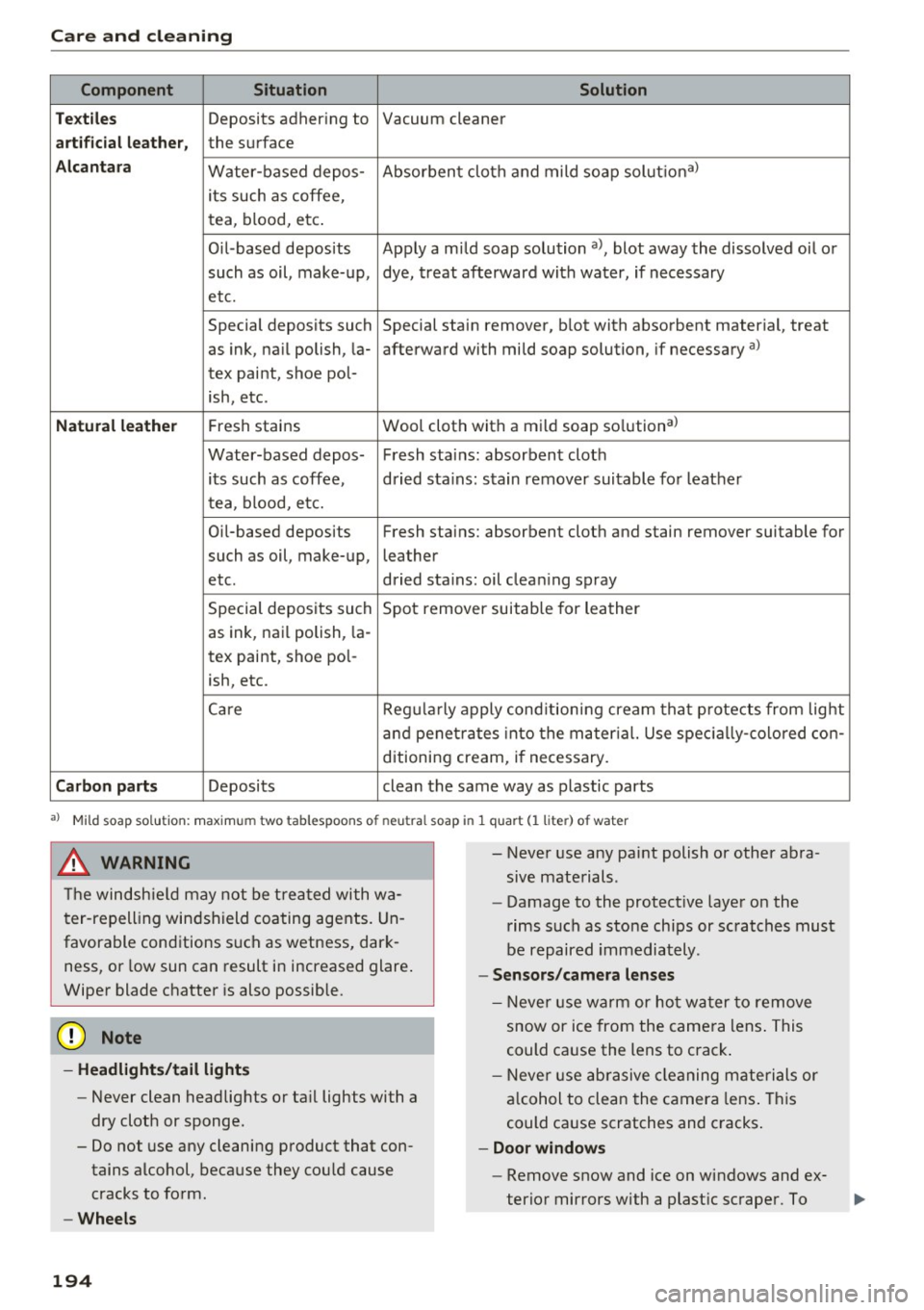
Care and cleaning
Component Situation Solution
Te xtil es
Deposits adhering to Vacuum cleaner
artifi cial le ather , the surface
Alcan tara Water-based depos- Absorbent cloth and mild soap
solutional
its such as coffee,
tea, blood, etc.
O il-based deposits Apply a mild soap solution a), blot away the dissolved oil o r
such as oil, make-up, dye, treat afterward with water, if necessary
etc.
Special deposits such Special sta ,in remover, blot with absorbent material, treat
as ink, na il polish, la- afterward with mild soap solution, if necessary al
tex paint, shoe pol-
ish, etc.
Natural leather Fresh stains Wool cloth with a m
ild soap solutional
Water-based depos- Fresh stains: absorbent cloth its such as coffee, dried sta ins: stain remover suitable fo r leather
tea, blood, etc.
Oil-based deposits Fresh stains: absorbent cloth and stain remover suitable for
such as oil, make-up, leather
etc. dried sta
ins: oil clean ing sp ray
Special deposits such Spot remover suitable for leather
as ink, nai l polish, la -
tex paint, shoe pol-
ish, etc.
Ca re Regularly apply cond itioning cream tha t protects from light
a nd penetr ates into the ma ter ial. Use spec ia lly-co lored con -
ditioning cream, i f necessary.
Carbon parts Deposits clean the same way as plastic parts
a) Mild soap sol ution: maxim um two tablesp oons of neutral soap in 1 quart (l liter) of water
_& WARNING
The windshie ld may not be trea ted with w a
ter-repelling windshield coating agents. Un
favorable conditions s uch as wetness, dark
ness, or low sun can result in increased glare .
Wiper blade chatter is also possib le.
(D Note
- Headlights/tail light s
-Never clean headlights or ta il lights with a
dry cloth or sponge.
- Do not use any cleaning p roduct that con
tains alcohol, because they cou ld cause
cracks to form.
- Wheels
194
-
- Never use any paint polish or other abra
sive materials.
- Damage to the protect ive layer on the
rims such as stone chips or scratches must
be repaired immediately.
- Sensors /camera lenses
- N ever use wa rm or ho t wa ter to remove
snow or ice from the camera lens . This
could ca use the lens to crack .
- N eve r use abrasive cleaning m aterials or
a lcohol to clea n the camera lens . This
could cause scratches and c racks .
-Door windows
- Remove snow and ice on windows and ex-
terior mirrors with a plast ic scraper. To