heating AUDI Q3 2017 Owner´s Manual
[x] Cancel search | Manufacturer: AUDI, Model Year: 2017, Model line: Q3, Model: AUDI Q3 2017Pages: 236, PDF Size: 58.93 MB
Page 161 of 236
00
00
......
"' ,....
"' ...... 0 0 :::,
00
pollutants in the exhaust gas before they are re
leased into the atmosphere.
The exclusive use of unleaded fue l is critically im
portant for the life of the catalytic converter and
proper functioning of the engine .
~ WARNING
-The temperature of the exhaust system is
high, both when driving and after stopping
the engine.
- Never touch the exha ust ta il pipes once they
have become hot. This could result in burns.
- Do not park or operate the vehicle in areas
where the hot exhaust system may come in
contact with dry grass, brush, fuel spill or
other mater ial which can cause a fire.
- Do not apply additional undercoating or
rustproof ing on or near the exhaust mani
fold, exhaust pipes, catalytic converter or
heat shields. During dr iv ing, the substance
used for undercoating could overheat and
cause a fire.
(D Note
- Be aware that just o ne tank filling with
lead ed fue l will already ser iously degrade
the pe rformance of the catalytic co nverter .
- Do not exceed the correct eng ine o il level
c::;, page 164.
- Do not drive until the fuel tank becomes
completely empty. The engine could mis
fire. Unburned fuel could also get into the
exhaust system and th is cou ld cause the
c ata lytic converter to overheat.
- Do not turn off the ignition whi le the vehicle
i s mov ing.
- Do not continue to operate your veh icle un
der these cond it ions, as otherwise fue l can
r each the cataly tic conve rte r. This cou ld re
s ul t in ove rheating of the converter, req uir
i ng its re placement.
- To assure efficient operation of the Em is
s ion Control System:
- Have your vehicle maintained properly and
in accordance with the service recommen
dations in your Warranty
& Maintenance
booklet.
-
Ch eck ing and Filling
-Lack of proper ma intenance as well as im
p roper use of the vehicle w ill impair the
f u nct ion o f the emission control system
and could lead to damage.
® For the sake of the environment
Even when the Emiss ion Control System is op
erating properly, the exhaust gas can have a
su lfur -like exhaust gas sme ll under some op
erating states. This depends on the sulfur
content of the fuel being used. Us ing a d iffer
ent brand of fuel may help, or f illing the tank
wi th lead-free supe r g rade gasoline.
Engine compartment
Working in the engine compartment
Special care is required if you are working in the
engine comportment
For work in th e engine compartm ent su ch as
che cking and filling fluids, there i s a ri sk of in
jury, scalding , accident s, and burn s. For thi s
reason , follow all the warnings and gene ral
s afety p re caution s prov ided in the following in·
formatio n. The engine compartment is a dan
gerous area on the vehicle.
c::;, .&. .
A WARNING
-- T urn the engine off.
- Sw itch the ignition off.
- Set the parking brake .
- Move the selector lever into t he P position .
- Neve r open the hood whe n there is steam o r
coo lant escaping from the engine compart
ment, because there is a risk that you could
be burned. Wait unt il no steam or coolant is
escaping.
- Let the eng ine cool down.
- Keep children away from the eng ine com -
partment.
- Never sp ill fluids on a ho t engine. These flu
ids (such as the anti -freezing agent con
tained in the coolant) can ignite .
- Avoid short c ircui ts in the elect rical sys tem.
- W hen working in the engi ne comp artme nt,
remember that the radiator fan can swi tch
159
Page 169 of 236
00
00
......
"' ,....
"' ...... 0 0 :::,
00
~ Add coolant mixed in the correct ratio
¢ page 166 up to the upper marking.
~ Make sure that the fluid level rema ins stable.
Add more coolant if necessary.
~ Close the cap securely.
Coolant loss usually indicates there is a leak. Im
mediately drive your vehicle to an authorized
Audi dealer or authori zed Audi Service Facility
and have the cooling system inspected. If the
cooling system is not leaking, a loss can come
from the coolant boiling through overheating
and be ing pushed out of the cooling system.
.&, WARNING
The cool ing system is pressu rized and can be
come very hot. To reduce the r is k of burns
from hot coolant :
- Do not open the coo lant expansion tank cap
when the engine is hot. This increases the risk of burns.
- Stop the engine and allow it to cool.
- Protect your face, hands and arms from es -
caping coolant and steam by covering the
coolant tank cap with a large, thick cloth .
- T urn the coo lant tank cap co unterclo ckwise
slowly and keep light pressu re on the cap .
- T o reduce the risk of burns , do not allow any
antifreeze o r coolant to drip onto the ex
haust system or hot engine components.
T he ethylene glycol in engine coolant can
catch fire under certain circumstances .
- T he coo lant add itive and the coolant can be
dangerous to your health . For this reason,
keep the coolant in the original container
and away from children. There is a risk of
poisoning.
- When working in the engine compartment,
remember that the radiator fan can switch
on even if the ignition is switched off, which
increases the risk of injury .
Do not add coolant if the expansion tank is
empty. Air could enter the cooling system and
damage the engine. If this is the case, do not
cont inue driv ing . See an authorized Audi deal -
Check ing and Filling
er or authorized Aud i Service Facility for assis
tance .
- Before the start of winter, have your author
ized Aud i dea ler or a uthorized Audi Serv ice
Facility check if the coolant additive in your
vehicle matches the percentage appropriate
for the climate. This is especially important
when driving in colder climates.
- If the appropr iate coo lant add itive is not
availab le in an emergency, do not add any
other additive . You could damage the en
gine. If this happens, only use water and re
store the correct m ixtu re ratio with the
specified coolant add it ive as soo n as poss i
ble .
- Only refill w ith new coolant.
- Radiator sealant must not be mixed with
the coolant .
Radiator fan
T he radiator fan switches on automatically by it
self.
An auxiliary e lectr ic radiator fan switches on and
off depend ing on coolant temperature and other
vehicle operating conditions.
After you switch the engine off, the auxiliary fan c a n continue running for up to 10 m inutes - even
with the ignition off . It can even switch on aga in
later by itself ¢.& , if
- the temperature of the engine coolant rises due
to the heat build-up from the engine in the en
gine compartment, or
- the engine compartment heats up bec ause the
veh icle is parked in in tense sunlight.
.&, WARNING
--
- To reduce the r isk of personal injury never
touch the radiator fan .
- The auxiliary e lectr ic fan is temperature
controlled and can switch on s uddenly even
when the engine is not runn ing .
- The auxiliary radiator fan sw itches on auto
mat ica lly when the eng ine coolant reaches a
certa in temperature and will continue to run
until the coolant temperature d rops .
167
Page 197 of 236
00
00
......
"' ,....
"' ...... 0 0 :::,
00
avoid scratches, move the scraper only in
one direction and not back and forth.
- Never remove snow or ice from door win
dows and mirrors using warm or hot water
because this could cause cracks to form.
- To avoid damage to the rear window de fogger , do not apply any stickers on the
heating wires on the inside of the window.
- Decorative part .s/trim
- Never use chrome care or cleaning prod-
ucts .
- Paint
- To reduce the risk of scratches, the vehicle
must be free of dirt and dust before pol
ishing or waxing.
- To prevent paint damage, do not polish or
wax the vehicle in direct sunlight .
- To reduce the risk of paint damage, do not
polish away rust spots .
- Remove cosmetics and sunscreen immedi
ately- these could damage the paint.
- Displays/instrument cluster
- The displays/instrument cluster and the
trim su rrounding them must not be
cleaned with dry cleaning methods be
cause they could be scratched.
- Make sure that the instrument cluster is
switched off and has cooled off before
cleaning it.
- Make sure no fluids enter the spaces be
tween the instrument cluster and the
trim, because that could cause damage.
- Controls
- Make sure that no fluids enter the con-
trols, because this could cause damage.
- Safety belts
- Do not remove the safety belts to clean
them.
- Never clean safety belts or their compo
nents chemically or with corrosive fluids
or solvents and never allow sharp objects
to come into contact with the safety belts.
This could cause damage to the belt web bing.
- If there is damage to the webbing, the
connections, the retractors or the buckles,
Care and cleaning
have them replaced by an authorized Audi
dealer or authorized Audi Service Facility.
- Textiles/artificial leather/ Alcantara
- Never treat artificial leather/Alcantara
with leather care products, solvents, floor
polish, shoe polish, spot remove or similar
products.
- Have a specialist remove stubborn stains
to prevent damage.
- Never use steam cleaners, brushes, hard
sponges , etc . when cleaning .
- Do not turn on the seat heating* to dry the
seat .
- Objects with sharp edges, such as zippers
or rivets on clothing or belts, can cause
damage to the surface .
- Open hook and loop fasteners, for exam
ple on clothing, can damage seat covers .
Make sure hook and loop fasteners are
closed .
- Natural leather
- Never treat leather with solvents, floor
polish, shoe polish, spot remover or simi
lar products.
- Objects with sharp edges, such as zippers
or rivets on clothing or belts, can cause
damage to the surface.
- Never use steam cleaners, brushes, hard
sponges, etc. when cleaning.
- Do not turn on the seat heating* to dry the
seat.
- To help prevent the leather from fading,
do not leave the vehicle in direct sunlight
for long periods of time. If leaving the ve
hicle parked for long periods of time, you
should cover the leather to protect it from
direct sunlight.
(D Tips
- Insects are easier to remove from paint that
has been freshly waxed.
- Regular waxing can prevent rust spots from
forming.
195
Page 208 of 236
Fuses and bulbs
(D Tips
- The following table does not list fuse loca
tions that are not used.
- Some of the equipment listed in the follow
ing tables applies only to certain model ver
sions or certain optional equipment.
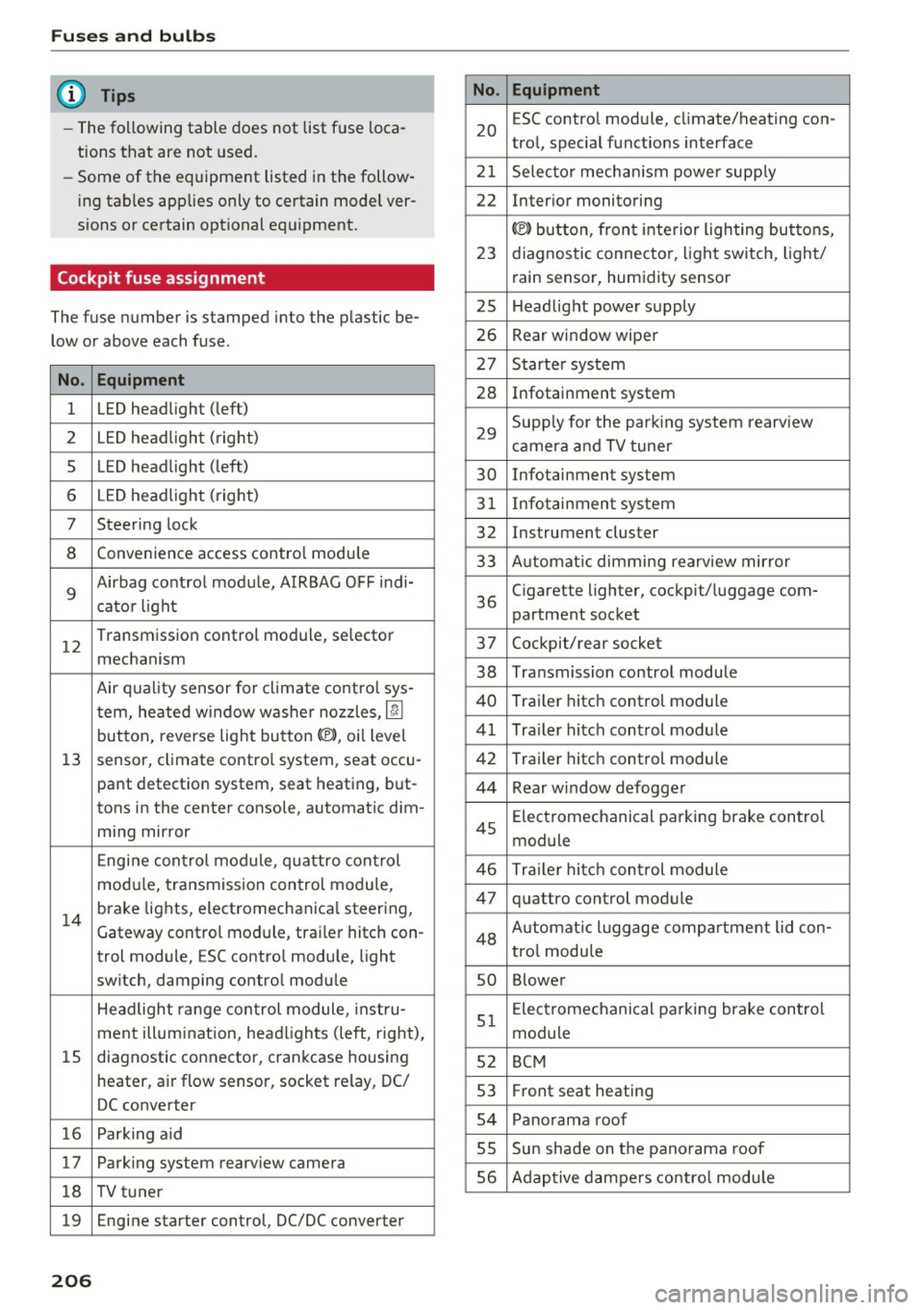
Cockpit fuse assignment
The fuse number is stamped into the plastic be
low or above each fuse.
No. Equipment
1 LED headlight (left)
2 LED headlight ( right)
5 LED headlight (left)
6 LED headlight (right)
7 Steering lock
8 Convenience access contro l module
9
Airbag control module, AIRBAG OFF indi-
cator light
12
Transmission control module, selector
mechanism
Air quality sensor for cl imate control sys-
tern, heated w indow washer nozzles ,
lj]
button, reverse light button<®>, oi l level
13 sensor, climate contro l system, seat occu-
pant detection system, seat heating, but-
tons in the center console, automatic dim-
ming mirror
Engine control module, quattro control
modu le, transmission control module,
14
brake lights, electromechanica l steering,
Gateway control module, trai ler hitch con-
trol module, ESC contro l module, light
switch, damping control module
Headlight range control module , instru-
ment illumination, headlights (left, right),
15 diagnostic connector, crankcase housing
heater, a ir flow sensor, socket relay, DC/
DC converter
16 Park ing aid
17 Parking system rearview camera
18 TV tuner
19 Engine starter control, DC/DC converter
206
No . Equipment
20
ESC contro l module, climate/heating con-
trol, special functions interface
21 Selector mechanism power supply
22 Interior monitoring
© button, front interior lighting buttons,
23 diagnostic connector, light switch, light/
rain sensor, humidity sensor
25 Headlight power supply
26 Rear window wiper
27 Starter system
28 Infotainment system
29
Supply for the parking system rearv iew
camera and TV tuner
30 Infotainment system
31 Infotainment system
32 Instrument cluster
33 A utomat ic dimming rearview mirror
36
Cigarette lighter, cockpit/luggage com-
partment socket
37 Cockpit/rear socket
38 Transmission control module
40 Trailer hitch control module
41 Tra iler hitch control module
42 Trailer hitch control module
44 Rear window defogger
45
Electromechanical parking brake control
module
46 Trailer hitch control module
47 quattro control module
48 Aut omat ic lu ggage compartment lid con-
tro l module
so Blower
51
Electromechanical parking brake control
module
52 BCM
53 Fr ont seat heating
54 Panorama roof
SS Sun shade on the panorama
roof
56 Adaptive dampers control module
Page 232 of 236
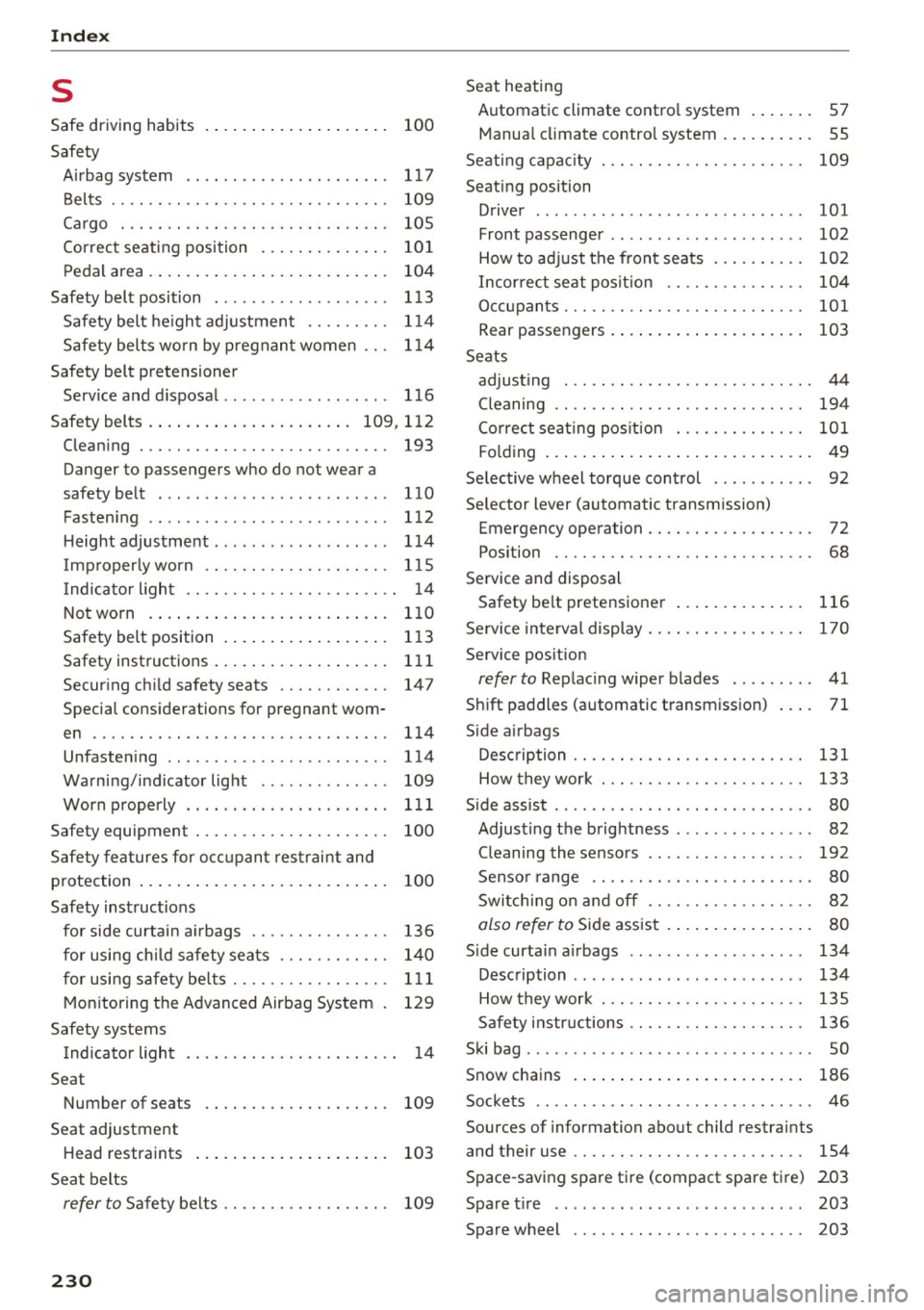
Index
s
Safe driving habits
Safety 100
Airbag system . . . . . . . . . . . . . . . . . . . . . . 117
Belts . . . . . . . . . . . . . . . . . . . . . . . . . . . . . . 109
Cargo . . . . . . . . . . . . . . . . . . . . . . . . . . . . . 105
Correct seating position . . . . . . . . . . . . . . 101
Pedal area . . . . . . . . . . . . . . . . . . . . . . . . . . 104
Safety belt position . . . . . . . . . . . . . . . . . . . 113
Safety belt height adjustment . . . . . . . . . 114
Safety belts worn by pregnant women . . . 114
Safety belt pretensioner Service and disposal ............. .. .. . 116
Safety belts .. .. .. .. .............. 109, 112
Cleaning . . . . . . . . . . . . . . . . . . . . . . . . . . . 193
Danger to passengers who do not wear a
safety belt . . . . . . . . . . . . . . . . . . . . . . . . . 11
O
Fastening . . . . . . . . . . . . . . . . . . . . . . . . . . 112
Height adjustment ............... ... . 114
Improperly worn . . . . . . . . . . . . . . . . . . . . 115
I ndicator l ight . . . . . . . . . . . . . . . . . . . . . . . 14
Not worn .... .. ................ .... 110
Safety belt position . . . . . . . . . . . . . . . . . . 113
Safety instructions . . . . . . . . . . . . . . . . . . . 111
Securing child safety seats . . . . . . . . . . . . 147
Special considerations for pregnant wom-
en . . . . . . . . . . . . . . . . . . . . . . . . . . . . . . . . 114
Unfastening . . . . . . . . . . . . . . . . . . . . . . . . 114
Warning/indicator light . . . . . . . . . . . . . . 109
Worn properly . . . . . . . . . . . . . . . . . . . . . . 111
Safety equipment . . . . . . . . . . . . . . . . . . . . . 100
Safety features for occupant restraint and
protection . . . . . . . . . . . . . . . . . . . . . . . . . . . 100
Safety instructions for side curtain airbags . . . . . . . . . . . . . . . 136
for using child safety seats . . . . . . . . . . . . 140
for using safety belts . . . . . . . . . . . . . . . . . 111
Monitoring the Advanced Airbag System 129
Safety systems Indicator light . . . . . . . . . . . . . . . . . . . . . . . 14
Seat Number of seats
Seat adjustment 109
Head restraints . . . . . . . . . . . . . . . . . . . . . 103
Seat belts
refer to Safety belts . . . . . . . . . . . . . . . . . . 109
230
Seat heating
Automatic climate control system . . . . . . . 57
Manual cl imate control system . . . . . . . . . . 55
Seating capac ity . . . . . . . . . . . . . . . . . . . . . . 109
Seating position Driver . . . . . . . . . . . . . . . . . . . . . . . . . . . . . 101
Front passenger . . . . . . . . . . . . . . . . . . . . . 102
How to adjust the front seats . . . . . . . . . . 102
Incorrect seat position . . . . . . . . . . . . . . . 104
Occupants..... .. .. .. ... .......... .. 101
Rear passengers . . . . . . . . . . . . . . . . . . . . . 103
Seats adjusting . . . . . . . . . . . . . . . . . . . . . . . . . . . 44
Cleaning . . . . . . . . . . . . . . . . . . . . . . . . . . . 194
Correct seating position . . . . . . . . . . . . . . 101
Folding . . . . . . . . . . . . . . . . . . . . . . . . . . . . . 49
Selective wheel torque control . . . . . . . . . . . 92
Selector lever (automatic transmission) Emergency operation . . . . . . . . . . . . . . . . . . 72
Position . . . . . . . . . . . . . . . . . . . . . . . . . . . . 68
Service and disposal Safety belt pretensioner . . . . . . . . . . . . . . 116
Service interval display .. ... .......... .. 170
Service position
refer to Replacing wiper blades . . . . . . . . . 41
Shift paddles (automatic transmission) . . . . 71
Side airbags Description . . . . . . . . . . . . . . . . . . . . . . . . . 131
How they work . . . . . . . . . . . . . . . . . . . . . . 133
Side assist . . . . . . . . . . . . . . . . . . . . . . . . . . . . 80
Adjusting the brightness . . . . . . . . . . . . . . . 82
Cleaning the sensors . . . . . . . . . . . . . . . . . 192
Sensor range . . . . . . . . . . . . . . . . . . . . . . . . 80
Switching on and off . . . . . . . . . . . . . . . . . . 82
also refer to Side assist . . . . . . . . . . . . . . . . 80
Side curtain airbags . . . . . . . . . . . . . . . . . . . 134
Description . . . . . . . . . . . . . . . . . . . . . . . . . 134
How they work . . . . . . . . . . . . . . . . . . . . . . 135
Safety instructions . . . . . . . . . . . . . . . . . . . 136
Ski bag ..... .. .. .. .. .. ........ ..... ... SO
Snow chains . . . . . . . . . . . . . . . . . . . . . . . . . 186
Sockets . . . . . . . . . . . . . . . . . . . . . . . . . . . . . . 46
Sources of information about child restraints
and their use . . . . . . . . . . . . . . . . . . . . . . . . . 154
Space-saving spare tire (compact spare tire) 203
Spare tire . . . . . . . . . . . . . . . . . . . . . . . . . . . 203
Spare wheel . . . . . . . . . . . . . . . . . . . . . . . . . 203