instrument cluster AUDI Q3 2017 Owner´s Manual
[x] Cancel search | Manufacturer: AUDI, Model Year: 2017, Model line: Q3, Model: AUDI Q3 2017Pages: 236, PDF Size: 58.93 MB
Page 121 of 236
about children and Advanced Airbags
<=>page 137 .
Even though yo ur vehicle is equipped with an Ad
vanced Airbag System, make certain that all chil
dren, especially those 12 years and younge r, a l
ways ride in the back seat properly restrained for
their age and size. The airbag on the passenger
side makes the front seat a potentially dangerous place for a child to ride. The front seat is not the
safest place for a child in a forward-facing child
safety seat .
It can be a very dangerous place for
a n infant or a child in a rearward-fac ing seat.
The Advanced Airbag System in your veh icle has
been certified to comply with the requirements
of United States Federal Motor Vehicle Safety
Standa rd (FMVSS) 208, as well as Canada Motor
Veh icle Safety Standa rd (CMVSS) 208 as applica
b le a t the time your veh icle was m an ufact ured.
Accord ing to requirements, the front Advanced
Airbag System on the passenger side has been
certified for "suppression" for infants of about
12 month old and younger and for "low risk de
ployment" for children aged
3 to 6 years old (as
defined in the standard) .
The
PASSENGER AIR BAG O FF light in the instru
ment panel tells you when the front Advanced
Airbag on the passenger side has been turned
off
by the electronic control unit.
Each time yo u switch on the ignition, the
PAS ·
S ENGER AIR BAG OFF
light will come on for a
few seconds and:
- will stay on if the front passenger seat is not
occupied,
-will stay on if there is a sma ll chi ld or chi ld re
straint on the front passenge r seat,
- will go
off if the front passenger seat is occu
pied by an adult as reg istered by the weight
sensing mat
c:> page 12 7, Monitoring the Ad
vanced Airbag System.
The PAS SENGER AIR BAG OFF light comes on
when the contro l unit detects a tota l weight on
the front passenger seat that requi res the front
~ airbag to be turned off . ......
"' ~ If the total weight on the front passenge r seat is ......
8 more than that of a typical 1 year-old child but :::, 00
Airb ag sys tem
less than the weight o f a sma ll adult, the front
airbag on the passenger side can dep loy (the
PASSENGER AIR BAG O FF light does not come
on). If the
PA SSENGER AIR BA G OFF light does
not come on, the front airbag on the passenger
s ide has not been turned
off by the electronic
control unit and can deploy if the contro l unit
senses an impact that meets the conditions stor
ed in its memo ry .
For example, the airbag may deploy if:
- a small ch ild that is heav ier than a typ ica l 1
year-o ld child is on the front passenger seat
(regardless of whether the child is in one of the
child safety seats listed
c:> page 139), or
- a child who has outgrown c hild restraints is on
the front passenger seat.
If the front passenger airbag is t urned off, the
PASSENGER AIR BAG O FF light comes on in the
instrument cluster and stays on.
T he front airbag on the passenger side may
not
deploy (the PAS SENGER AIR BAG OFF light does
not illuminate and stay lit) even if a small adu lt
or teenager, or a passenger who is not s itting up
right w ith their back against a non-recl ined back
rest with the ir feet on the vehicle floor i n front of
the seat is on the front passenger seat
c:> page 101, Proper seating position for the driv
er.
If the front passenge r a irbag deploys, the Feder
al Standard requi res the airbag to meet the "low
risk" deployment cri te ria to reduce the r is k of in
j u ry throug h interact ion w it h t he airbag. "Low
risk" deploymen t occurs in t hose crashes tha t
take place at lowe r dece lerations as defined in
the e lectronic control unit
c:> page 128, PASSEN
GER AIR BAG OFF light.
Always remembe r, a ch ild safety sea t or infan t
carr ier installed on the front seat may be s truck
and knocked out of positio n by the rapidly i nflat
ing passenger's airbag in a frontal coll ision . The
airbag could greatly red uce the effectiveness of
the child restraint and even seriously injure the
child during inflation .
IJJ,,
119
Page 126 of 236
Airbag syste m
adjustment range, as far away from the air
bag as possib le, before insta lling the
forward-facing ch ild restraint. The backrest
must be adjusted to an upright posit ion.
- Make sure that the
PAS SEN GER AIR BA G
OFF
light comes on and stays on all the time
whenever the ignition is switched on.
Advanced Airbag System components
The front passenger seat in your vehicle has a lot
of very important parts of the Advanced Airbag
System in it. These parts include the we ight
sensing mat, sensors, w iring, brac kets, and
mo re. The function of the system in the front
passenger seat is checked by the elec tronic con
trol unit when the ignition is on. The contro l unit
monitors the Advanced Airbag System and turns
the airbag indicator light on when a malfunct ion
in the system components is detected. The func
tion of the airbag indicator light is described in
greater detail below. Because the front passen
ge r seat contains important parts of the Ad
vanced A irbag System, you must take care to p re
vent i t from being damaged. Damage to the seat
may prevent the Advanced Airbag for the fron t
passenger seat from doing its job in a c rash.
The front Advanced Airbag System consists
of th e follow ing :
-Crash sensors in the front of the vehicle that
measure vehicle acceleration/deceleration to
provide information to the Advanced Airbag
System about the severity of the crash.
- An e lectronic control unit, with integrated
crash sensors for front and side impacts. The
contro l unit "decides" whether to fire the front
airbags based on the information received from
the crash sensors . The control unit also "de
c ides" whether the safety belt pretens ioners
sho uld be activated .
- An Advanced Airbag with gas generator and
contro l valve fo r the driver ins ide the steer ing
whee l hub.
-An Advanced Airbag with gas generator and contro l valve inside the instrument pane l for
the front passenger.
124
- A weight -sensing mat under the upholstery
padding of the front passenger seat cushion
that measures the total weight on the seat. The
information reg istered is sent cont inuous ly to
the electronic control unit to regulate deploy
ment of the front Advanced Airbag on the pas
senger s ide .
- An airbag monitoring system and ind icator
light in the instrument cluster
c::;,page 127.
-A sensor in each front seat registers the dis
tance between the respective seat and the
steer ing wheel or instrument panel. The infor
mat ion registered is sent cont inuously to the
elect ronic contro l unit to regu late dep loyment
of the fron t Advanced Airbags.
- The
PASSENGER AIR BAG OFF light comes on
and stays on in the cente r of the ins trument
pa nel
c::;, page 128, fig. 118 and te lls yo u when
the front Advanced Airbag on the passenger
side has been turned
off .
-A sensor below the safety be lt latch for the
front seat passenger to measure the tension on
the safety belt. The tension on the safety belt
and the weight registered by the weight-sens
ing mat help the control unit "decide" whether
the front airbag for the front passenger seat
should be turned off or not
c::;, page 118, Child
restraints on the front seat -some important
things to know.
- A sensor in the safety belt latch for the driver
and for the front seat passenger that senses
whether that safety be lt is latched o r not and
transmits this informa tion to the e lec tronic
cont rol un it.
_&. WARNING
D amage to the front passenger seat can pre
vent the front airbag from working prope rly .
- Improper repair or disassembly of the front
passenger and driver seat will prevent the
Advanced Airbag System from f unctioning
properly.
- Repairs to the front passenger seat must be
performed by qualified and proper ly trained
workshop personnel.
- Never remove the front passenger or driver
seat from the vehicle.
Page 131 of 236
-make sure that the safety belt tension sensor is
not blocked. Shake the safety be lt latch on the
front passenger seatback and forth;
- If a strap or tether is being used to tie the child
safety seat to the front passenger seat, make
sure that it is not so tight that it causes the
weight-sensing mat to measure more weight
than is actually on the seat.
If the PASSENGER AIR BAG OFF li ght still d oes
not come on
and does not stay on continuously
(when the ignition is switched on),
- take the child restraint off the front passenger
seat and install it properly at one of the rear
seat positions. Have the airbag system inspect
ed by your authori zed Audi dealer immediately.
- move the child to a rear seat position and make
sure that the child is properly restra ined in a
child restraint that is appropriate for its size
and age .
The
PAS SENGER AIR BAG O FF light shou ld NOT
come on when the ignition is on and an adult is
sitting in a proper seating position on the front
passenger seat. If the
PASSENGER AIR BAG OFF
light comes on and stays on or flashes for about
5 seconds while driving, under these circ umstan
ces, make su re that:
- the adult on the front passenger seat is proper
ly seated on the center of the seat cushion with
his or her back up aga inst the backrest and the
back rest is not recl ined
<=? page 101, Correct
passenger seating positions,
- the adult is not taking weig ht off the seat by
hold ing on to the passenger assist handle
above the fron t passenger door o r su pporting
their weight on the armres t,
- the safety be lt is be ing p roperly wo rn and that
there is not a lo t of slack in the safe ty be lt web
bing,
- accessory seat cove rs or cushions or othe r
t h ings t hat may cause an inco rrect read ing or
impression on the weight-sensing mat under
the upho lstery of the seat have been removed
from the front passenger seat,
~ - a safety be lt extender has not been left in the ......
~ safety belt latch for the front passenger seat . N ...... 0 0
:::,
00
Airb ag sys tem
In add ition to the PASSENGER AIR BAG OFF
li ght in the center of the instrument panel, the
message
PAS SENGER AIR BAG OF F or PASSEN ·
G ER AIR BAG ON
will briefly appear in the instru
ment cluster d isp lay. This is to inform the driver
of the current front passenger airbag status.
Important safety instructions on
monitoring the Advanced Airbag System
A WARNING
-An a irbag system that is not functioning prop-
erly cannot prov ide supplemental protect ion
i n a fronta l crash.
- If the ai rbag ind icator light
c:> page 14
comes when the veh icle is being used, have
the system inspected immediately by your
author ized Audi dealer.
It is possible that
the airbag will inflate when it is not sup
posed to, or w ill not inflate w hen it should.
A WARNING
If the fron t airbag i nflates, a chi ld without a
chi ld restraint, in a rearward-facing ch ild safe
ty seat or in a forward-facing chi ld restraint
that has not been properly installed will be
seriously in jured and can be ki lled .
- Even tho ugh yo ur vehicle is equipped with
an Advanced A irbag System, make certain
that all children, especia lly 12 years and
younger, always ride on the back seat prop
erly restrained for the ir age and s ize .
- Always install fo rward or rear-facing child
safety seats on the rear seat -even with an
Advanced Airbag System.
- If you must install a rearward-facing child
safety seat on the front passenger seat be
cause of exceptional circumstances and the
PASSENGER AIR BAG OFF light does not
appear and stay on, immediately install the rear-facing chi ld safety seat in a rea r seat ing
position and have the a irbag sys tem in
spected by your autho rized Aud i dea ler.
- A t igh t tether or other strap on a rearward
facing chi ld restraint attached to the front
passenger sea t can put too much pressure
129
Page 165 of 236

00
00
......
"' ,....
"' ...... 0 0 :::,
00
A udi rec ommend s
@;Cilstrot /Jgjgf ~ f'r,w.~7dr,,'1AJ.
A ud i re commends Longlife high p erform ance
e ngi ne oil from A udi Gen uin e P art s
Using the proper engine oil is important for the
functionality and service life of the engine. Your
engine was factory-filled with a high-quality oil
which can usually be used throughout the entire
year .
Note
Your Limited New Vehicle Warranty does not
cover damage or malfunctions due to failure
to follow recommended maintenance and use
requirements as set fo rth in the Aud i Owner's
Manual a nd Warranty & Mai ntenan ce booklet.
- Use only a high quality eng ine oil that ex-
pressly complies with the Aud i oil q ual ity
standard specified for your vehicle's engine. Using any other oil can cause serious engine
damage .
- Do not mix any l ubricants or othe r addi tives
into the engine oil. Doing so can cause en
gine damage.
(D Tips
If you need to add oil and there is none availa
ble that meets the Audi oil quality standard
your engine requires, you may add a total of
no more than 0 .5 quart/liter of a high-quality
"synthet ic"oil that meets the following speci
fications.
- ACEA A3 or API SM with a viscosity grade of
SAE OW-30, SAE SW-30 or SAE SW-40.
- For more information about engine oi l that
has been approved for your vehicle, please
contact e ither your authorized Audi dea ler
or Audi Customer Relat ions at
1 (800) 822-2834 or vis it our web site at
www.audiusa.com or www.aud icanada .ca.
Ch eck ing and Filling
Engine oil consumption
The engine in your vehicle depends on on ade
quate amount of oil to lubricate and
cool oil of
its moving ports.
In order to provide effect ive lubrication and cool
ing of internal engine components, all internal
combust ion eng ines consume a certa in amount
of oil. Oil consumption varies from eng ine to en
gine and may change s ign ificantly over the life of
the engine. Typ ica lly, engines w ith a specified
break-in period (see
q page 58) consume more
oi l during the break -in period than they consume
after oil consumption has stabilized.
Under normal cond itions, the rate of oil con
sumption depends on the q uality and viscosity o f
the oil, the RPM (revol utions per minute) at
which the engine is operated, the ambient tem perature and road condit ions. Further factors are
the amount of oil dilution from water condensa
tion or fuel residue and the oxidation level of the o il. As any engine is subject to wear as mileage
builds up, the oil consumption may increase over
time unt il replacement of worn components may
become necessary.
With all these variables coming into play, no standard rate of o il consumption can be estab
li shed or spec ified . T he re is no alte rnative to reg
u la r and frequent checking of the oi l level , see
Note .
If the yellow engine o il leve l warning symbo l !I
in the instrument cluster lights up, you sho uld
check the o il level as soon as possible
q page 164. Top off the o il at your earlies t con
venience.
A WARNING ~
Before you check anything in the engine com-
partment, always read and heed all WARN
INGS
q .&. in Working in the engine comport
ment on page 159.
(D Note
Driving with an insufficient oil level is likely to
cause severe damage to the eng ine. ..,.
163
Page 172 of 236
Check ing and F illing
To reduce the risk o f lime sca le deposits on the
spray nozzles, use clean water with low amounts
of calcium. A lways add window cleaner to the wa
ter. When the outs ide temperatures are cold, an
anti-freezing agent should be added to the water
so that it does not freeze.
@ Note
-The concentration of anti-freezing agent
must be adjusted to the vehicle operating
cond itions in t he respective climate. A con
centration that is too high can lead to veh i
cle damage.
- Never add rad iator anti-freeze or other add i
tives to the washe r fluid .
- Do not use a glass cleaner that contains
paint solvents, beca use this cou ld damage
the pa int.
Service interval display
The service interval display detects when your ve
hicle is due for service.
The se rvice interva l disp lay works in two stages:
- Inspection o r oil change reminder : after acer-
ta in d istance is driven, a message appears in
the instrument cluster d isp lay every t ime the
ignition is sw itched on . T he remain ing distance
o r time is d isp layed b riefly.
- In spection or oil change due : if you r vehicle
has reached an inspection o r oi l change interval
o r both intervals at the same time, the mes
sage
Inspection due! or Oil change due! or Oil
change and in spection due!
a ppears br iefly a f
ter switching the ignition on .
Checking service intervals
You can check the rema ining distance o r time un
til the next oil change o r next inspection.
- Se lect: the
ICARI function button > (Car ) Sys
tems *
contro l button > Servicing & checks >
Ser vice interval display .
Resetting the indicator
Your author ized Audi dealer or authorized Audi
Serv ice Facility will reset the serv ice interval dis
p lay after pe rforming serv ice.
170
If you have changed the oi l yourself, yo u must re
set the oi l change interval.
Perform the fo llow ing to reset t he d isp lay:
- Select: the
I CARI funct io n button > (Car) Sy s
tem s*
control button > Serv icing & check s >
Service interval di splay . Turn the contro l knob
downwa rd to
Re set oil change int erval and
press the control knob .
(D Note
-On ly reset t he oil change ind icator if the oi l
was changed.
- Following the se rvic e interva ls is cr itica l to
ma inta ining the se rvice life and val ue of
yo ur vehicle, es pecially the eng ine. Even if
the mileage on the ve hicl e is low, do not ex
ceed t he time fo r the next service .
Page 191 of 236
00
00
......
"' ,....
"' ...... 0 0 :::,
00
also reduces fuel e fficiency and tire tread life,
and may affect the vehicle's handling and stop p ing ability .
Pl ease no te that the TPMS is not a substi tute for
p roper tire maintenance, and it is the drive r's re
sponsib ility to maintain cor rect tire pressure,
even if under-inflation has not reached the leve l
to tr igger illum inat ion of the TPMS low tire pres
sure telltale.
Your vehicle has also been eq uipped with a TPMS
mal funct ion indicator to indicate when the sys
tem is not operating properly. The TPMS mal
function indicator is combined w ith the low tire
pressure tellta le. Whe n the system detects a
malfunct ion, the telltale will flash for approx i
mately one min ute and then remai n cont inuo usly
i llum inated. This sequence will continue upon
s ubseq uen t ve hicl e start- ups as long as the m al
f u nction ex ists.
When the malfunct io n in dicator is ill uminated,
the system may not be ab le to detect or signa l
l ow tire press ure as intended . TPM S malfu nctions
may oc cur for a var iety of reasons, incl uding the
installation of replacement or alternate ti res o r
wheels on the vehicle that prevent the TPMS
from functioning properly . Always check the
TPMS malfunction telltale after rep lacing one or
more t ires or whee ls on your ve hicle to ensure
that the replacement or alternate tires and
wheels allow the TPMS to cont inue to funct ion
p roperly.
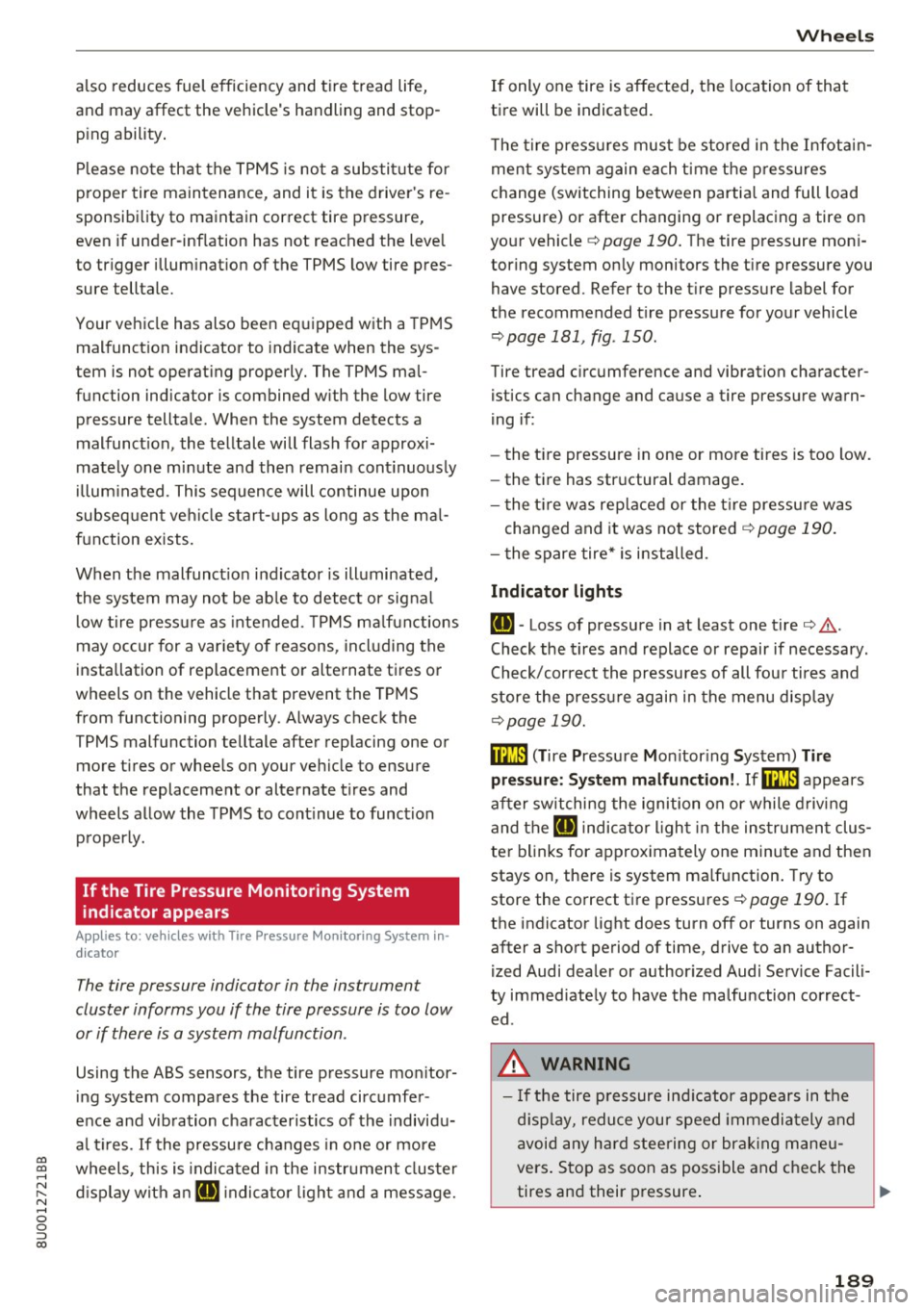
If the Tire Pressure Monitoring System
ind icator appears
A ppl ies to: ve hicles with Tir e Pressure Moni toring System in
di cato r
The tire pressure indicator in the instrument
cluster informs you if the tire pressure is too low
or if th ere is a system malfunction .
Using the ABS sensors, the tire p ressure mo nitor
i ng system compa res the tire tread circumfer
e n ce and vib ra tion characteristics of the individ u
a l tir es .
If the pressure c hanges in o ne or more
wheels , th is is indica ted in the instrument clus ter
d is p la y with a n
[I] indica to r li ght and a message.
Wh eel s
If only one tire is affected, the location of tha t
t ir e will be indicated.
T he tire press ures mus t be store d in the Infot ain
ment system again each t ime the pressures
c h ange (switching between partia l and full load
pressure) or after changing or replacing a tire on
yo ur vehicle
r::!;> page 190 . The tire pressure mon i
toring system on ly monitors the tire pressure you
have stored . Refer to the t ire pressure label for
the recommended t ire press ure fo r yo ur vehicle
r::!;>page 181, fig . 150 .
Tire tread c ircumfe rence and vibration cha racter
istics can change and cause a tire pressu re warn
i ng if :
- the t ire pressure in one or more tires is too low.
- the t ire has str uctural damage .
- t he t ire w as rep lace d or the t ire pressu re was
changed and it was no t store d
r::!;> page 190.
- t he spare tire* is i nstalled.
Indicator lights
[I] -Loss of pressu re in at leas t one tire r::!;> & .
Check the tires and replace or repair if necessary .
Check/correct the pressures of all fou r tires and
store the pressu re again in the menu disp lay
r::!;>page 190.
ffim (T ire Pressure Moni tor ing Sys tem) Tire
pre ssure: Syst em malfunction!. Ifm appears
after sw itching the ignition on or while d riv in g
and the
[I] i ndic ator ligh t in the i nstru men t clus
te r blinks for approx imately one minute and then
stays on, the re is system ma lf u nction . Try to
store the co rrect tire pressures
r::!;> page 190 . If
the indicator light does turn off or turns on again
after a short period of time, drive to an author
ized Audi dealer or author ized Audi Se rvice Facili
ty immediate ly to have the ma lfunction correct
ed.
_&. WARNING
- I f the tire p ressure in dicator appears in the
d isp lay, redu ce you r speed immedi ately and
a void any h ard stee ring or bra king m aneu
vers . S to p as soon as poss ible and check the
tires an d their pressure .
~
189
Page 197 of 236
00
00
......
"' ,....
"' ...... 0 0 :::,
00
avoid scratches, move the scraper only in
one direction and not back and forth.
- Never remove snow or ice from door win
dows and mirrors using warm or hot water
because this could cause cracks to form.
- To avoid damage to the rear window de fogger , do not apply any stickers on the
heating wires on the inside of the window.
- Decorative part .s/trim
- Never use chrome care or cleaning prod-
ucts .
- Paint
- To reduce the risk of scratches, the vehicle
must be free of dirt and dust before pol
ishing or waxing.
- To prevent paint damage, do not polish or
wax the vehicle in direct sunlight .
- To reduce the risk of paint damage, do not
polish away rust spots .
- Remove cosmetics and sunscreen immedi
ately- these could damage the paint.
- Displays/instrument cluster
- The displays/instrument cluster and the
trim su rrounding them must not be
cleaned with dry cleaning methods be
cause they could be scratched.
- Make sure that the instrument cluster is
switched off and has cooled off before
cleaning it.
- Make sure no fluids enter the spaces be
tween the instrument cluster and the
trim, because that could cause damage.
- Controls
- Make sure that no fluids enter the con-
trols, because this could cause damage.
- Safety belts
- Do not remove the safety belts to clean
them.
- Never clean safety belts or their compo
nents chemically or with corrosive fluids
or solvents and never allow sharp objects
to come into contact with the safety belts.
This could cause damage to the belt web bing.
- If there is damage to the webbing, the
connections, the retractors or the buckles,
Care and cleaning
have them replaced by an authorized Audi
dealer or authorized Audi Service Facility.
- Textiles/artificial leather/ Alcantara
- Never treat artificial leather/Alcantara
with leather care products, solvents, floor
polish, shoe polish, spot remove or similar
products.
- Have a specialist remove stubborn stains
to prevent damage.
- Never use steam cleaners, brushes, hard
sponges , etc . when cleaning .
- Do not turn on the seat heating* to dry the
seat .
- Objects with sharp edges, such as zippers
or rivets on clothing or belts, can cause
damage to the surface .
- Open hook and loop fasteners, for exam
ple on clothing, can damage seat covers .
Make sure hook and loop fasteners are
closed .
- Natural leather
- Never treat leather with solvents, floor
polish, shoe polish, spot remover or simi
lar products.
- Objects with sharp edges, such as zippers
or rivets on clothing or belts, can cause
damage to the surface.
- Never use steam cleaners, brushes, hard
sponges, etc. when cleaning.
- Do not turn on the seat heating* to dry the
seat.
- To help prevent the leather from fading,
do not leave the vehicle in direct sunlight
for long periods of time. If leaving the ve
hicle parked for long periods of time, you
should cover the leather to protect it from
direct sunlight.
(D Tips
- Insects are easier to remove from paint that
has been freshly waxed.
- Regular waxing can prevent rust spots from
forming.
195
Page 208 of 236
Fuses and bulbs
(D Tips
- The following table does not list fuse loca
tions that are not used.
- Some of the equipment listed in the follow
ing tables applies only to certain model ver
sions or certain optional equipment.
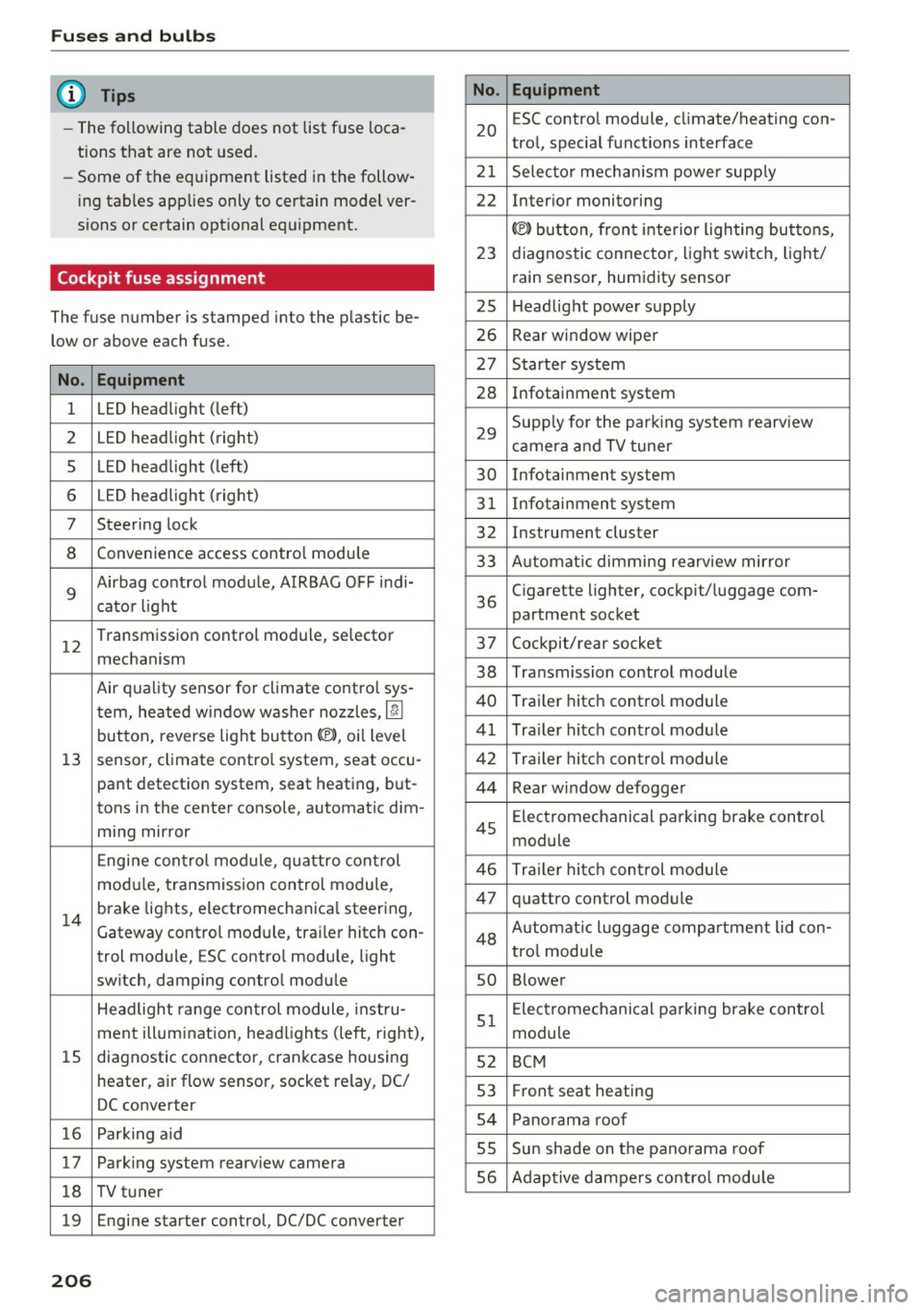
Cockpit fuse assignment
The fuse number is stamped into the plastic be
low or above each fuse.
No. Equipment
1 LED headlight (left)
2 LED headlight ( right)
5 LED headlight (left)
6 LED headlight (right)
7 Steering lock
8 Convenience access contro l module
9
Airbag control module, AIRBAG OFF indi-
cator light
12
Transmission control module, selector
mechanism
Air quality sensor for cl imate control sys-
tern, heated w indow washer nozzles ,
lj]
button, reverse light button<®>, oi l level
13 sensor, climate contro l system, seat occu-
pant detection system, seat heating, but-
tons in the center console, automatic dim-
ming mirror
Engine control module, quattro control
modu le, transmission control module,
14
brake lights, electromechanica l steering,
Gateway control module, trai ler hitch con-
trol module, ESC contro l module, light
switch, damping control module
Headlight range control module , instru-
ment illumination, headlights (left, right),
15 diagnostic connector, crankcase housing
heater, a ir flow sensor, socket relay, DC/
DC converter
16 Park ing aid
17 Parking system rearview camera
18 TV tuner
19 Engine starter control, DC/DC converter
206
No . Equipment
20
ESC contro l module, climate/heating con-
trol, special functions interface
21 Selector mechanism power supply
22 Interior monitoring
© button, front interior lighting buttons,
23 diagnostic connector, light switch, light/
rain sensor, humidity sensor
25 Headlight power supply
26 Rear window wiper
27 Starter system
28 Infotainment system
29
Supply for the parking system rearv iew
camera and TV tuner
30 Infotainment system
31 Infotainment system
32 Instrument cluster
33 A utomat ic dimming rearview mirror
36
Cigarette lighter, cockpit/luggage com-
partment socket
37 Cockpit/rear socket
38 Transmission control module
40 Trailer hitch control module
41 Tra iler hitch control module
42 Trailer hitch control module
44 Rear window defogger
45
Electromechanical parking brake control
module
46 Trailer hitch control module
47 quattro control module
48 Aut omat ic lu ggage compartment lid con-
tro l module
so Blower
51
Electromechanical parking brake control
module
52 BCM
53 Fr ont seat heating
54 Panorama roof
SS Sun shade on the panorama
roof
56 Adaptive dampers control module
Page 227 of 236
00
00
......
"' ,....
"' ...... 0 0 :::,
00
Defrosting (windows)
Manual climate control system . . . . . . . . . . 55
Defrosting (windshield)
Automatic climate control system . . . . . . . 57
DEF (instrument cluster) . . . . . . . . . . . . . . . . 10
Det ermin ing correct load limit . . . . . . . . . . 185
Digital compass . . . . . . . . . . . . . . . . . . . . . . . 42
Dimensions . . . . . . . . . . . . . . . . . . . . . . . . . . 216
Dimming the rearview mirror . . . . . . . . . . . . 38
Display Cleaning . . . . . . . . . . . . . . . . . . . . . . . . . . . 193
Distance . . . . . . . . . . . . . . . . . . . . . . . . . . . . . 20
Doors Child safety lock............... ..... .. 31
Emergency locking . . . . . . . . . . . . . . . . . . . . 28
Driver information system
Driver messages . . . . . . . . . . . . . . . . . . . . . . 20
Efficiency program............ .. .... .. 21
Indicator lights . . . . . . . . . . . . . . . . . . . . . . 10
On-board computer . . . . . . . . . . . . . . . . . . . 20
Operating using the multifunction steering
wheel . . . . . . . . . . . . . . . . . . . . . . . . . . . . . . 20
Operating using windshie ld wiper lever . . . 19
Overview . . . . . . . . . . . . . . . . . . . . . . . . . . . . 19
Service interval display . . . . . . . . . . . . . . . 170
D river seat
refer to Seating position
101
Drive select
Indicator light . . . . . . . . . . . . . . . . . . . . . . . 17
also refer to Audi drive select . . . . . . . . . . . 83
Driving economically . . . . . . . . . . . . . . . . . . . 58
Driving offroad . . . . . . . . . . . . . . . . . . . . . . . . 66
Driving safely . . . . . . . . . . . . . . . . . . . . . . . . 100
Driving through water . . . . . . . . . . . . . . . 58, 67
Dr iving time . . . . . . . . . . . . . . . . . . . . . . . . . . 20
Dust filter
refer to Pollutant filter . . . . . . . . . . . . . . . . 53
E
EDL
refer to Electronic Differentia l Lock . . . . . . 92
Eff iciency program
Fuel economy messages . . . . . . . . . . . . . . . 22
Other equipment . . . . . . . . . . . . . . . . . . . . . 21
Overview . . . . . . . . . . . . . . . . . . . . . . . . . . . . 21
Elect rome chanica l park ing brake . . . . . . . . . 64
Index
El ectromechanical steering . . . . . . . . . . . . . . 96
I ndica tor light . . . . . . . . . . . . . . . . . . . . . . . 96
El ectron ic differentia l lock
Indicator light . . . . . . . . . . . . . . . . . . . . . . . 14
Electron ic Differential Lock . . . . . . . . . . . . . . 92
Electronic immobilizer . . . . . . . . . . . . . . . . . . 24
Electronic stabilization control
Indicator light . . . . . . . . . . . . . . . . . . . . . . . 14
Electronic Stabilization Control . . . . . . . . . . . 92
Hill descent assist . . . . . . . . . . . . . . . . . . . . 94
Offroad mode . . . . . . . . . . . . . . . . . . . . . . . . 93
Emergency assistance . . . . . . . . . . . . . . . . . 197
Emergency braking function . . . . . . . . . . . . . 65
Emergency flashers . . . . . . . . . . . . . . . . . . . . 36
Indicator light . . . . . . . . . . . . . . . . . . . . . . . 17
Emergency locking front passenger's door . . 28
Emergency operation
Front passenger's door . . . . . . . . . . . . . . . . 28
Fuel filler door . . . . . . . . . . . . . . . . . . . . . . 158
Luggag e compartment lid . . . . . . . . . . . . . . 31
Panorama roof . . . . . . . . . . . . . . . . . . . . . . . 34
Sun shade (roof) . . . . . . . . . . . . . . . . . . . . . 34
Emergency release Selector lever . . . . . . . . . . . . . . . . . . . . . . . . 72
Emergency starting . . . . . . . . . . . . . . . . . . . 209
Emissions data . . . . . . . . . . . . . . . . . . . . . . . 215
Energy management . . . . . . . . . . . . . . . . . . . 97
Indicator light . . . . . . . . . . . . . . . . . . . . . . . 13
Engine Coolant . . . . . . . . . . . . . . . . . . . . . . . . . . . . 166
Engine data . . . . . . . . . . . . . . . . . . . . . . . . 217
Start ing with jumper cables ........... 209
Start ing (convenience key) . . . . . . . . . . . . . 62
Starting (ignition lock) . . . . . . . . . . . . . . . . 60
Stopping (convenience key) . . . . . . . . . . . . . 62
Stopping (ignition lock) . . . . . . . . . . . . . . . . 61
Engine compartment Open ing/closing the hood . . . . . . . . . . . . . 161
Ove rview . . . . . . . . . . . . . . . . . . . . . . . . . . . 162
Safety precautions . . . . . . . . . . . . . . . . . . . 159
Engine control (indicator light) . . . . . . . . . . . 15
Engine coolant Radiator fan . . . . . . . . . . . . . . . . . . . . . . . . 167
Eng ine oil . . . . . . . . . . . . . . . . . . . . . . . . . . . 162
Adding . . . . . . . . . . . . . . . . . . . . . . . . . . . . 164
Changing . . . . . . . . . . . . . . . . . . . . . . . . . . 165
Checking the engine oil level . . . . . . . . . . . 164
225