airbag AUDI Q3 2018 User Guide
[x] Cancel search | Manufacturer: AUDI, Model Year: 2018, Model line: Q3, Model: AUDI Q3 2018Pages: 230, PDF Size: 57.03 MB
Page 101 of 230
0 co ......
"' ,....
"' ...... 0 0 :::,
00
- Before driving, always adjust the front seats
and head restraints properly and make sure
that all passengers are properly restrained.
- Never adjust the seats while the vehicle is
moving. Your seat may move unexpectedly
and you could lose control of the vehicle.
- Never drive with the backrest reclined or
tilted far back! The farther the backrests are
tilted back, the greater the risk of injury due
to incorrect positioning of the safety belt
and improper seating position .
- Children must always ride in child safety
seats ¢
page 134 . Special precautions ap
ply when installing a chi ld safety seat on the
front passenger seat¢
page 114.
Proper seating position for the front
passenger
The proper front passenger seating position is
important for safe, relaxed driving.
For your own safety and to reduce the risk of in
jury in the event of an accident, we recommend
that you adjust the seat for the front passenger
to the following position:
• Adjust the ang le of the seatback so that it is in
an upright position and your back comes in full
contact with it whenever the vehicle is moving.
• Adjust the head restraint so the upper edge is
as even as possible with the top of your head. If
that is not possible, try to adjust the head re straint so that it is as close to this position as
possible ¢
page 43.
• Keep both feet flat on the floor in front of the
front passenger seat .
• Fasten and wear safety belts correctly
¢ page 109.
For detailed information on how to adjust the
front passenger's seat, see¢
page 42 .
A WARNING
Front seat passengers who are unbelted, out
of pos ition or too close to the airbag can be
ser iously injured or killed by the airbag as it
unfolds . To help reduce the risk of serious
personal injury:
Driving safety
- Passengers must always sit in an upright po
sition and never lean against or place any part of their body too close to the area
where the airbags are located .
- Passengers who are unbelted, out of posi
tion or too close to the airbag can be seri ously injured by an airbag as it unfolds with
great force in the blink of an eye.
- Always make sure that there are at least
10 inches (25 cm) between the front pas
senger's breastbone and the instrument panel.
- Each passenger must always sit on a seat of
their own and properly fasten and wear the
safety belt belonging to that seat.
- Before driving, always adjust the front pas
senger seat and head restraint properly.
- Always keep your feet on the floor in front
of the seat . Never rest them on the seat, in
strument panel, out of the window, etc. The
airbag system and safety belt will not be
able to protect you properly and can even in
crease the risk of injury in a crash.
- Never drive with the backrest reclined or
tilted far back! The farther the backrests are
tilted back, the greater the risk of injury due
to incorrect positioning of the safety belt
and improper seating position.
- Chi ldren must always ride in child safety
seats ¢
page 134. Special precautions ap
ply when installing a child safety seat on the
front passenger seat¢
page 114.
Proper seating positions for passengers in
rear seats
Rear seat passengers must sit uprigh t wi th both
feet on the floor consistent with their physical
size and be properly restrained whenever the ve
hicle is in use .
To reduce the risk of injury caused by an incorrect
seating position in the event of a sudden braking
maneuver or an accident, your passengers on the
rear bench seat must always observe the follow
ing :
• Make sure that the seatback is securely latched
in the upright position¢
page 47. .,.
99
Page 103 of 230
0 co ......
"' ,....
"' ...... 0 0 :::,
00
critical areas of the body . Improper seating posi
tions also increase the risk of serious injury and
death when an airbag deploys and strikes an oc
cupant who is not in the proper seating position.
A driver is responsible for the safety of all vehicle
occupants and especially for children . Therefore:
~ Never allow anyone to assume an incorrect
seating position when the vehicle is being used
c> &, .
The following bulletins list only some sample po
sitions that will increase the risk of serious injury
and death. Our hope is that these examples will
make you more aware of seating positions that
are dangerous .
Therefore, whenever the vehicle is moving:
-never stand up in the vehicle
- never stand on the seats
- never kneel on the seats
- never ride with the seatback reclined
- never lie down on the seats
- never lean up against the instrument panel
- never sit on the edge of the seat
- never sit sideways
- never lean out the window
- never put your feet out the window
- never put your feet on the instrument panel
- never rest your feet on the seat cush ion or back
of the seat
- never ride in the footwell
- never ride in the cargo area
A WARNING
Improper seating positions increase the risk
of serious personal injury and death whenever
a vehicle is being used.
-Always make sure that all vehicle occupants
stay in a proper seat ing pos ition and are
properly restrained whenever the vehicle is
being used.
Driving safety
Pedal area
Pedals
T he pedals must always be free to move and
must never be interfered with by a floor mat or
any other object.
Make sure that all pedals move freely without in
terference and that nothing prevents them from
returning to their original positions .
Only use floor mats that leave the pedal area free
and can be secured with floor mat fasteners .
If a brake circuit fails, increased brake pedal trav
el is required to bring the vehicle to a full stop.
A WARNING
--Pedals that cannot move freely can cause loss
of vehicle control and increase the risk of seri
ous injury.
- Never place any objects in the driver's foot
well. An object could get into the pedal area
and interfere with pedal function. In case of
sudden braking or an accident, you would
not be able to brake or acce lerate!
-Always make sure that nothing can fall or
move into the driver's footwell.
Floor mats on the driver side
Always use floor mats that can be securely at tached to the floor mat fasteners and do not in
terfere with the free movement of the pedals.
~ Make sure that the floor mats are properly se
cured and cannot move and interfere with the pedals
c> &, .
Use only floor mats that leave the pedal area un
obstructed and that are firmly secured so that
they cannot slip out of position . You can obtain
suitable floor mats from your author ized Audi
dealer.
Floor mat fasteners are installed in your Audi .
Floor mats used in your vehicle must be attached
to these fasteners . Properly securing the floor
101
Page 110 of 230
Safe ty belts
instrument panel, windshield, or whatever else is
in the way
r:!> fig. 104. This impact with the vehi
cle interior has all the energy they had just be
fore the crash.
Never rely on airbags alone for protection . Even
when they deploy, airbags provide only additional
protection. A irbags are not supposed to dep loy in
all kinds of accidents. A lthough your Audi is
equipped w ith airbags, all vehicle occupants, in
cluding the driver, must wear safety belts cor
rectly in order to minimize the risk of severe in
jury or death in a crash .
Remember too, that airbags will deploy only
once and that your safety belts are always there
to offer protect ion in those accidents in wh ic h
airbags are not supposed to deploy or when they
have a lready deployed . Unbel ted occupants can
also be thrown o ut of the veh icle where eve n
mo re severe or fatal injuries can occur .
It is also important for the rear pass engers to
wear safety belts correctly. Unbelted passengers
i n t he re ar seats endanger no t on ly themse lves
but also the drive r and other passengers
~ fig . 1 OS. In a frontal collision they will be
thrown forward violently, where they can hit and
in jure the driver and/or front seat passenger.
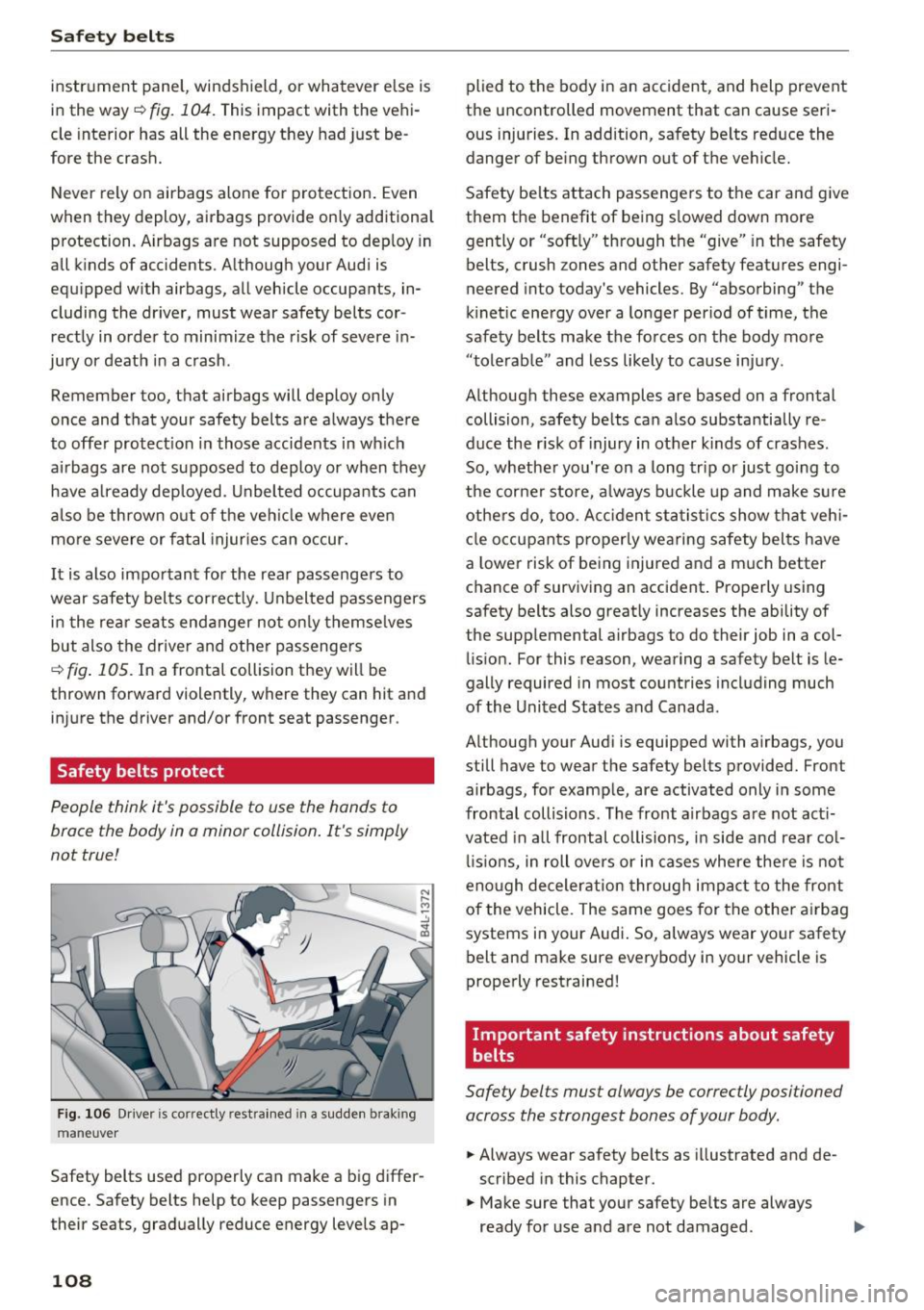
Safety belts protect
People think it's possible to use the hands to
brace the body in a minor collision . It's simply
not true!
F ig . 10 6 Driver is co rrectly restrai ned in a sudde n brak ing
m aneu ver
Safety belts used properly can make a b ig d iffer
ence. Safety belts help to keep passengers in
their seats, gradually reduce energy levels ap-
108
plied to the body in an accident , and help prevent
the uncontrolled movement that can cause seri
ous injuries. In add ition, sa fety belts red uce the
danger of being thrown out of the vehicle.
Safety be lts attach passengers to the car and g ive
them the benefit of being s lowed down more
gently or "soft ly" thro ugh the "give" in the safety
belts, crush zones and other safety feat ures engi
neered into today's vehicles. By "absorbing" the
k inet ic energy over a longer per iod of t ime, the
safety belts make the forces on the body more
"tole rab le" and less likely to cause inju ry .
Although these examples are based on a frontal
collision, safety be lts ca n also substantially re
duce the r isk o f injury in ot her kinds of crashes .
So, whethe r yo u're on a long trip or just goi ng to
the cor ne r store, a lways b uckle up and make s ure
othe rs do, too. Ac ciden t st at ist ics show that veh i
cle o ccupants prope rly wearing safety bel ts have
a lowe r risk of being injured and a m uch better
chance of surviving an acc ident . Properly using
safety be lts also great ly increases the ability of
the supp lemental airbags to do their job in a col
li sion. For this reason, wearing a safety belt is le
gally required in most countries including much
of the United States and Canada .
Although your Aud i is equipped with airbags, you
still have to wear the safety belts provided. Front
airbags, for examp le, are activated only in some
frontal collisions. The front airbags are not act i
vated in all frontal collisions, in side and rear co l
li sions, in roll overs or in cases where the re is not
eno ugh deceler ation throug h impa ct to the front
of the vehicle . The same goes for the other a irbag
systems in your Audi. So, always wear your safety
belt and make sure everybody in your vehicle is
properly rest rained!
Important safety instructions about safety
belts
Safe ty belts must always be correctly positioned
acros s the strongest bones of your body .
.,. Always wear safety belts as illustrated and de
scribed in this chapter.
.,. Make sure that your safety be lts are always
ready fo r use a nd are not damaged .
Page 114 of 230
Safety belts
The shou lder belt should lie as close to the center
of th e collar bone as possib le and should fit well
on the body
c::> A in Safety belt position on
page 110.
"' Push
the loop -a round fittings up c::> fig. 111 @ ,
or
"'squeez e together the (D button, and push the
loop-around fittings down@.
"'Pull the belt to m ake sure that the upper at
tachment is properly engaged .
A WARNING
Always read and heed all WARNINGS and oth er important informat ion
c::> page 108.
(D Tips
With the front seats, the height adjustment of the seat can also be used to adjust the po
sition of the safety belts.
Improperly worn safety belts
Incorrectly positioned safety belts can cause se
vere injuries .
Wearing safety belts improperly can cause seri
ous injury or death . Safety belts can only work
when they are correctly positioned on the body.
Improper seating positions reduce the effect ive
ness of safety belts and will even inc rease the
risk of injury and death by mov ing the safety belt
to cr it ica l areas of the body. Improper seating
positions a lso increase the risk of serious injury
and death when an airbag deploys and strikes an
occupant who is not in the correct seating pos i
tion . A drive r is responsible for the safety of all
veh icle occupants and especially for children.
Therefore :
"' Never permit anyon e to assume an incorrect
sitting position in the vehicle while traveling
c>_& .
A WARNING
Improperly worn safety belts increase the risk
of serious personal injury and death whenever
a vehicle is being used.
112
- Always make sure that all vehicle occupants
are correctly restrained and stay in a correct
seating position whenever the vehicle is be
ing used.
- Always read and heed all WARNINGS and
other important informat ion
c::> page 108 .
Belt tensioners
How safety belt pretensioners work
Seat belts with pyrotechnic safety be lt preten
sioners are tensioned automatically in severe col
lisions, depending on the circumstances . This
helps to reduce the forward motion of the occu
pants.
A WARNING
- It is possible for the pretensioners to deploy
incorrectly .
- Any work on the tensioner system or remov
al and installation of system components
for other repairs must be performed by a qualified workshop .
- The pyrotechnic system can only provide
protection for one collision.
If the pyrotech
nic pretens ioners deploy, the pretensioning
system must be replaced.
(D Note
Never let the belt remain over a rear seatback
that has been folded forward.
(D Tips
- A fine dust is released when the pyrotechnic
safety belt pretensioners deploy . This is nor
mal and is not caused by a fire in the veh i
cle.
- The relevant safety requirements must be
observed when the vehicle or components
of the system are scrapped . A qualified
dealership is familiar with these regulations
and will be pleased to pass on the informa
tion to you.
Page 115 of 230
0 co ......
"' ,....
"' ...... 0 0 :::,
00
Service and disposal of safety belt preten
sioner
The safety belt pretens ioners are parts of the
safety be lts on your Audi. Installing, removing,
servicing or repairing of belt pretensioners can
damage the safety belt system and prevent it
from working correctly in a collision .
There are some important things you have to know to make sure that the effectiveness of the
system w ill not be impaired and that discarded
components do not cause injury or pollute the
environment.
A WARNING
-
Improper care, serv icing and repa ir proce
dures can increase the r isk of personal injury
and death by preven ting a safety be lt preten
sioner from activating when needed or acti
vating it unexpectedly:
- T he be lt pretensione r system can be act ivat
ed only once.
If belt pretensioners have
been ac tiva ted, the system must be re
placed.
- Never repair, adjust, or ch ange any parts of
the safety be lt system .
- Safety belt systems in cl ud ing safety belt
pretens ioners cannot be repaired. Specia l
procedures are req uired for removal, insta l
lation and disposa l of this system.
- For any work on the safety bel t system, we
strongly recommend that you see your au
thorized Aud i dea ler or qualified technician
who has an A udi approved repair manual,
train ing and spec ial equ ipment necessary.
@ For the sake of the environment
Undep loyed airbag modu les and pretension
ers might be classified as Perch lorate Materi
al -spec ia l handling may apply, see
www.dtsc.ca.gov/hazardouswaste/perchlo rate. When the veh icle or parts of the re
straint system including air bag modules safe
ty belts with pretensioners are scrapped, all
app licabl e laws and regula tions must be ob
served. Your authorized Audi dealer is familiar
w it h these req uirements and we recommend
S afet y be lts
that you have your dealer perform this service
for you .
113
Page 116 of 230
Airbag syste m
Airbag system
Important information
Importance of wearing safety belts and
sitting properly
Airbags are only supplemental restraints . For
airbags to do their job, occupants must always
properly wear their safety belts and be in a prop
er seating position.
For your safety and the safety of your passen
ge rs , before driving off, always :
"' Adjust the driver's seat and steering wheel
properly ¢
page 98,
"'Adjust the front passenge r's seat properly
¢ page 99,
"'Wear safety belts p roperly ¢ page 108 ,
"'Always properly use the proper child restraint
to protect children ¢
page 134.
In a coll is io n ai rbags must inflate wi thin the b link
of an eye and with cons iderable force . The sup
p lemental airbags can ca use injuries if the driver
or the front seat passenger is not seated proper·
Ly. T herefore in order to help the airbag to do its
job, it is important, both as a dr iver and as a pas
senger to sit properly at all t imes .
By keeping room between yo ur body and the
steering whee l and the front of the passenger
compartment, the a irbag can inflate fully and
completely and provide supplemental protect ion
in certain frontal collis ions ¢
page 98, Correct
passenger seating positions .
For details on the
operation of the seat adjustment controls
¢ page 42.
It's especially important that children a re proper
ly restra ined
¢ page 134 .
There is a lot that the driver and the passengers
can and must do to help the ind iv idual safety fea
tures installed in your Audi work together as a
system .
Proper seating posit ion is important so that the
front airbag on the drive r side can do its job. If
you have a physical impairment or cond ition that
prevents you from s itting properly on the driver
seat with the safety be lt properly fastened and
114
reaching the peda ls, special modifications to
your vehicle may be necessary.
Contact yo ur autho rized Aud i dea le r, or call A udi
C u stomer Rela tions at 1-800 -82 2-2834.
When the airbag system dep loys, a gas generator
will fill the airbags, b reak open the padded cov
ers, and inflate betwee n the steeri ng wheel and
the driver and between the inst rument panel and
the front passenger . The a irbags w ill deflate im
mediate ly after dep loyment so t hat the front oc
cupants can see through the windsh ie ld again
without interruption.
A ll of th is takes p lace in the blink of an eye, so
fast that many people don't even realize that the
airbags have deployed. The airbags a lso inflate
with a great deal of force and nothing should be i n the ir way when they deploy. Front airbags in
combination with properly worn safety belts slow
down and lim it the occupant's forward move
ment . T ogether they he lp to prevent the driver
a nd front seat passenger from h itti ng pa rts of
t h e inside the veh icle w hile reducing the fo rces
acti ng on the occupant dur ing the cras h. In th is
way they help to reduce the risk of inju ry to the
head and uppe r body i n the crash. Airbags do not
protect the arms or the lower parts of the body.
Both front airbags will not inflate in all frontal
collisions. The trigge ring of the airbag system de
pends on the vehicle deceleration rate caused by
the collis ion and registered by the electronic con
tro l unit . If this rate is below the reference value
programmed into the contro l unit, the airbags
will not be trigge red, even though the car may be
badly damaged as a resu lt of the co llision . Vehi
cle damage, repa ir costs or even the lack of vehi
cl e damage is not necessari ly an indica tion of
whethe r an a irbag should inflate o r not.
It is not possib le to define a range of vehicle
speeds that w ill cove r every possible k ind and an
gle of impa ct that will always tr igger the airbags,
s ince the circumst ances w ill vary cons iderably be
tween one collision and another. Important fac
tors include, for example, the natu re (hard or
soft) of the object which the car hits, the angl e of
i mpact, vehicle speed, etc . The front airbags will ..,_
Page 117 of 230
0 co ......
"' ,....
"' ...... 0 0 :::,
00
also not inflate in side or rear coll isions, or in
ro ll-overs.
A lwa ys rememb er: Airbags will deploy only o nce,
and on ly in certain kinds of coll is ions. Your safety
be lts are always there to offer protection in those
situations in which airbags are not supposed to
deploy, or when they have a lready deployed; for
examp le, when your vehicle str ikes or is struck by
another after the first collis ion.
This is just one of the reasons why an airbag is a
supp lementary restraint and is not a substitute
for a safety belt. The airbag system works most effect ively when used with the safety belts.
Therefore, always properly wear your safety belts
r:::;,page 106.
A WARNING
Sitting too close to the steer ing whee l or in
st rument panel will decrease the effect ive
ness of the airbags and will inc rease the risk
o f persona l injury in a co llision.
- Never sit closer than 10 inches (25 cm) to
the steering wheel or instrument panel.
- If you cannot sit mo re than 10 inches
( 2 5 cm) from the steering wheel, inves ti
gate whethe r adaptive equipment may be
available to help you reach the pedals and
increase your seating distance from the
steering wheel.
- All veh icle occupants and especially children
must be restrained properly whenever riding
in a vehicle. An unrestrained or improperly
restra ined child could be injured by stri king
the inte rior or by being ejected from the ve
hicle d uring a sudden maneuver or impact.
An unrestrained or imp roperly restrained
child is also at greate r risk of inju ry or death
through contact with an inflating airbag .
-If you are unrest rained, leaning fo rwa rd, s it
t ing s ideways or o ut of pos ition in any way,
yo ur risk of in jury is mu ch h igher.
- Yo u will also receive serious injur ies and
c ou ld even be killed if you are up ag ainst the
airbag or too close to it w hen it inf lates -
even with an Advanced Ai rbag.
-
Airb ag sys tem
-To reduce the r is k of injury when an airbag
inflates, always wear sa fety belts prope rly
r:::;, page 109, Safety belts.
-Always make certain that children age 12 or
younger always ride in the rear seat. If chil
dren are not properly restrained, they may be severely injured or killed when an airbag
inflates.
- Never let children r ide unrestrained or im
p roperly restrained in the vehicle. Ad just the
front seats properly.
- Never ride with the back rest recl ined .
- Always sit as far as possible from the steer-
ing wheel or the instrument panel
r:::;, page 98.
-Always sit upright with your back against
the backrest of your seat .
- Never p lace your feet on the instrument
panel or on t he seat. Always keep both feet
on the floor in front of the seat to help pre
vent ser ious injuries to the legs and hips if
the airbag inflates.
- Never recl ine the front passenger's seat to
transpo rt objects , Items can also mo ve in to
the area of the s ide a irbag or the front air
b ag d uring braking o r in a sudden maneu
ver. Obje cts ne ar the airbags can be come
p roject iles and cause injury when an airbag
inflates .
A WARNING ,.___ -
Airbags that have deployed in a crash m ust be
replaced.
- Use on ly original equipment airbags ap
proved by A udi and installed by a t rained
technician who has the necessary tools and
d iagnostic equipment to properly replace
any airbag in yo ur vehicle and assure system
effect iveness in a crash .
- Never permit salvaged or recycled airbags to
be installed in your vehicle.
Child restraints on the front seat - some
important things to know
.,. Be s ure to read the impo rtan t in format ion and
he ad the WARN INGS for impo rtant deta ils
115
Page 118 of 230
Airbag system
about children and Advanced Airbags
c:>page 134.
Even though your vehicle is equipped with an Ad
vanced Airbag System, make certain that all chil
dren, especially those 12 years and younger, al
ways ride in the back seat proper ly restrained for
their age and size. The airbag on the passenger
side makes the front seat a potentially dangerous place for a child to ride. The front seat is not the
safest place for a child in a forward-facing child
safety seat . It can be a very dangerous place for
an infant or a child in a rearward-fac ing seat.
The Advanced Airbag System in your veh icle has
been cert ified to comply with the requirements
of United States Federal Motor Vehicle Safety
Standard (FMVSS) 208, as well as Canada Motor
Veh icle Safety Standard (CMVSS) 208 as applica
b le at the time your vehicle was manufactured.
According to requirements, the front Advanced
Airbag System on the passenger side has been
certified for "suppression" for infants of about
12 month old and younger and for "low risk de
ployment" for children aged 3 to 6 years o ld (as
defined in the standard) .
The
PASSENGER AIR BAG OFF light in the instru
ment panel tells you when the front Advanced
Airbag on the passenger side has been turned off by the electronic control unit.
Each time you switch on the ignition, the
PAS
SENGER AIR BAG OFF
light will come on for a
few seconds and:
- will stay on if the front passenger seat is not
occupied,
-will stay on if there is a small chi ld or child re
straint on the front passenger seat,
- will go off if the front passenger seat is occu
pied by an adult as registered by the weight
sensing mat
c:> page 124, Monitoring the Ad
vanced Airbag System.
The PASSENGER AIR BAG OFF light comes on
when the control unit detects a tota l we ight on
the front passenger seat that requires the front
airbag to be turned off.
If the total weight on the front passenger seat is
more than that of a typical 1 year-old child but
116
less than the weight of a sma ll adult, the front
airbag on the passenger side can dep loy (the
PASSENGER AIR BAG OFF light does not come
on). If the
PASSENGER AIR BAG OFF light does
not come on, the front airbag on the passenger
s ide has not been turned off by the electron ic
control unit and can deploy if the control unit
senses an impact that meets the conditions stor
ed in its memory.
For example, the airbag may deploy if:
-a small ch ild that is heav ier than a typica l 1
year-old child is on the front passenger seat (regardless of whether the child is in one of the
child safety seats listed
c:> page 136), o r
- a child who has outgrown ch ild restraints is on
the front passenger seat.
If the front passenger airbag is turned off, the
PASSENGER AIR BAG OFF light comes on in the
i nstrument cluster and stays on.
The front airbag on the passenger side may
not
deploy (the PASSENGER AIR BAG OFF light does
not illuminate and stay lit) even if a small adult
or teenager, or a passenger who is not sitting up
right with their back against a non-reclined back
rest with the ir feet on the vehicle floor in front of
the seat is on the front passenger seat
c:> page 98, Proper seating position for the driver.
If the front passenger a irbag deploys, the Feder
al Standard requires the airbag to meet the "low
risk" deployment criteria to reduce the r isk of in
jury through interact ion w ith the airbag. "Low
risk" deployment occurs in those crashes that
take place a t lower decelerations as defined in
the e lectronic control unit
c:> page 125, PASSEN
GER AIR BAG OFF light.
Always remember, a child safety seat or infant
carrier installed on the front seat may be struck
and knocked out of position by the rapidly inflat
i ng passenger's airbag in a frontal collision . The
airbag could greatly reduce the effectiveness of
the child restraint and even seriously injure the
ch ild during inflation.
For this reason, and because the back seat is the
safest place for children -when proper ly restrain
ed according to their age and size -we strongly
Ill>
Page 119 of 230
0 co ......
"' ,....
"' ...... 0 0 :::,
00
re commend that children a lway s sit in t he b ack
seat ~
page 134, Child safety .
A WARNING
A child in a rearward-faci ng chi ld safety seat
installed on the front passen ger seat w ill be
seriously injured and can be killed if the front airbag inflates -even w ith an Advanced A irbag
System .
- The inflating a irbag w ill hit the child safety
seat or infant carrier with great force and
will smash the ch ild safety seat and child
against the backrest, center armrest, door
o r roof.
- Always install rear-facing child safety seats
on the rear seat.
- If you must install a rearward fac ing ch ild
safety seat on the front passenger seat be
cause of exceptiona l circumstances and the
PASSENGER AIR BAG OFF light does not
come on and stay on, immed iate ly install
the rear-fac ing ch ild safety seat in a rear
seating posit ion and have the airbag system
inspected by your authorized Audi dea ler.
- Forward-fac ing ch ild safety seats installed
on the front passenger's seat may interfere
with the deployment of the airbag and cause serious personal injury to the child.
A WARNING
If, in except ional circumstances, you must in
stall a forward-facing chi ld restraint on the
front passenger's seat:
- Always make sure the forward-fac ing seat
has been designed and ce rtified by its man
ufacturer fo r use on a fron t seat with a pas
senger front and s ide a irbag.
- Never put the forward-facing child restraint
up against or ve ry near the instrument pan
el.
- Always move the front passenger seat to
the highest position in t he up an d down ad
justment range and move it b ack to the
re ar most position in the se at's fore and a ft
adjustment range, as far away from the air
bag as possib le, before insta llin g the for
ward-facing child restraint .
Airbag sys tem
-Always make sure that the safety be lt upper
anchorage is behind the ch ild restraint and
not next to or in front of the child restraint
so that the safety be lt will be properly posi
tioned .
- Make sure that the
PASSENGER AIR BAG
OFF
li ght comes on and stays on a ll the time
wheneve r the ignit ion is switched on.
A WARNING
-To reduce the risk of serious injury, ma ke sure
that the
PASSENGER AIR BAG OFF ligh t will
be d isplayed whenever a c hild rest raint is i n
st alle d on the front passenger seat and the
i gni tion is switched on.
- I f the
PASSENGER AIR BAG OFF light does
not stay on, perform the checks de scribe d
q page 124, Monitoring the Advanced Air
bag System .
- Take the child restra int off the front passen
ger seat and install it properly at one of the rear seat positions if the
PASSENGER AIR
BAG O FF
light does not stay on.
- Have the ai rbag system inspected by your
author ized Audi dealer immed iate ly .
- Always carefully follow instructions from
child restraint manufacturers when instal
ling child restra ints.
A WARNING
-If, in exceptional c ircumstances, you must in
stall a forward or rearward-facing child re
stra int on the front passenger's seat :
- Improper installat ion of child restraints can
reduce the ir effectiveness or even prevent
them from providing any protect ion.
- An improperly installed child restra int can
interfere with the airbag as it deploys and
serio usly injure or even ki ll the chi ld -even
with an Advanced A irbag Sys tem.
- Always carefully follow the manufacturer's
instr uctions provided with the child safe ty
seat o r ca rr ie r.
- Never p lace add itiona l items on the seat
that can increase t he total weight registered
by the weight-sensing mat and can caus e in
jury in a crash .
117
Page 120 of 230
Airbag system
Front airbags
Description of front airbags
The airbag system can provide supplemental
protection to properly restrained front seat occu
pants.
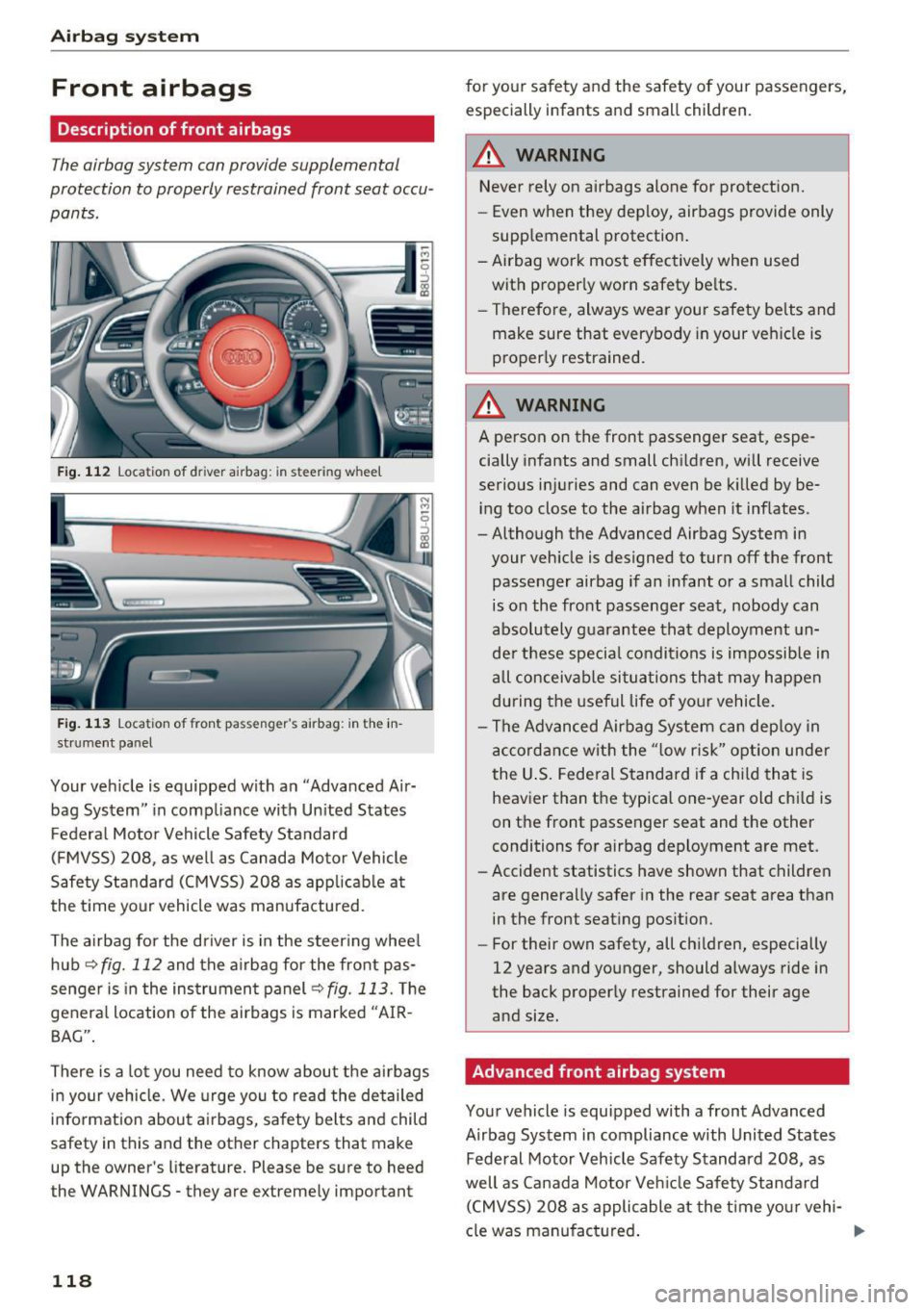
Fig. 112 Location of driver airbag: in steering whee l
Fig. 113 Location of front passenger's airbag: in th e in
strument panel
Your veh icle is equipped with an "Advanced Air
bag System " in compliance with Un ited States
Federal Motor Vehicle Safety Standard
(FMVSS) 208, as well as Canada Motor Vehicle
Safety Standard (CMVSS) 208 as applicable at
the time your vehicle was manufactured.
The airbag for the driver is in the steer ing whee l
hub~
fig. 112 and the airbag for the front pas
senger is in the instrument panel
~fig. 113. Th e
general location of the airbags is marked "AIR
BAG" .
There is a lot you need to know about the airbags
in your vehicle . We urge you to read the detailed
information about airbags, safety belts and child
safety in this and the other chapters that make
up the owner 's literature. Please be sure to heed
the WARNINGS - they are extreme ly important
118
for your safety and the safety of your passengers,
especially infants and small children.
A WARNING -
Never rely on airbags alone for protection.
- Even when they deploy, airbags provide only
supplemental protection.
- Airbag work most effectively when used with proper ly worn safety belts.
- Therefore, always wear your safety be lts and
make sure that everybody in your veh icle is
proper ly restrained.
A WARNING
A person on the front passenger seat, espe
cially infants and small chi ldren, will receive
serious injuries and can even be killed by be ing too close to the airbag when it inflates.
- Although the Advanced Airbag System in
your veh icle is designed to turn off the front
passenger airbag if an infant or a small child
is on the front passenger seat, nobody can
absolutely guarantee that deployment un
der these special conditions is impossible in
all conceivable situations that may happen
during the useful life of your vehicle.
- The Advanced Airbag System can dep loy in
accordance with the "lo w risk" option under
the U.S. Federal Standard if a child that is
heavier than the typical one-year old chi ld is
on the front passenger seat and the other
conditions for airbag deployment are met.
-Accident statistics have shown that children
are generally safer in the rear seat area than
in the front seat ing position.
- For their own safety, all children, especially
12 years and younger, should always ride in
the back properly restrained for their age and size.
Advanced front airbag system -
Your vehicle is equipped with a front Advanced
Airbag System in compliance with United States
Federal Motor Vehicle Safety Standard 208, as
well as Canada Motor Vehicle Safety Standa rd
(CMVSS) 208 as applicable at the time your vehi
cle was manufactured .