roof AUDI Q3 2018 User Guide
[x] Cancel search | Manufacturer: AUDI, Model Year: 2018, Model line: Q3, Model: AUDI Q3 2018Pages: 230, PDF Size: 57.03 MB
Page 125 of 230
0 co ......
"' ,....
"' ...... 0 0 :::,
00
The front airbags are designed to provide addi
tional protection for the chest and face of the
driver and the front seat passenger when:
- sa fety belts are worn prope rly,
- the seats have been positioned so that the oc-
c u pant is properly sea ted as far as possible
from the airbag,
- and the head restra ints have been p roperly ad-
justed.
Because airbags inflate in the blink of an eye w ith
g reat fo rce, things you have on your lap or have
p laced on the seat cou ld become dangerous pro
jectiles, and be p ushed into you if the ai rbag in
flates.
When an a irbag deploys, fine dust is released.
This is normal and is not caused by a fire in the
ve hicl e. Thi s dust is made up mostly of a powder
used to lubricate the airbags as they deploy. It
could irritate skin.
It is important to remember that whi le the sup
p lemental airbag system is designed to reduce
the likel ihood of ser ious injuries, other i nju ries,
for example swelling, bruising and minor abra
sions, can a lso happen when airbags inflate . Air
bags do not protect the arms or the lower parts
of the body. Front airbags only supplement the
three po int safety belts in some frontal collisions
i n which the ve hicle decelerat io n is high enough
to deploy the airbags .
F ront airbag s will not deploy:
- if the ignit ion is switched off when a crash oc-
curs,
- in side collisions,
- in rear-end collisions,
- in rollove rs,
- when the c rash decelerat io n meas ured by the
airbag system is less than the minimum thresh
o ld needed for airbag deployment as registered
by the electronic contro l unit.
The front passenger airbag will also not d eplo y:
- when the front passenger seat is not occ upied,
- when the we igh t on the fron t passenge r seat as
sensed by t he Advanced A irbag System indi-
Airb ag sys tem
cates that the front a irbag on the passenger
side has to be turned off by the e lectronic con
trol unit (the
PASSENGER AIR BAG OFF light
comes on and stays on).
A WARNING
Sitting in the wrong position can increase the r isk of ser ious injury in crashes .
- To reduce the r isk of injury when the airbags
inflate, the driver and passengers must al
ways sit in an upright posit ion, must not
lean aga inst or place any part of their body
too close to the area where the airbags are
lo cated.
- Occupants who are unbelted, out of posit ion
or too close to the airbag can be serio usly
in jur ed by an airbag as it unfolds with g reat
force in the blink of an eye
r=> page 115.
A WARNING
-A child in a rearward-facing child safety seat
insta lled on the front passenger seat will be
seriously injured and can be ki lled if the front
airbag inflates -even with an Advanced Airbag
System.
- The inflating airbag will h it the ch ild safety
seat or in fant carr ier with great force and
will smash the child safety seat and child aga inst the backrest, center armrest, door
or roof.
- Always install rear-fac ing child safety seats
on the rear seat.
- If you must install a rearward facing child
safety seat on the front passenger seat be
cause of exceptional circumstances and the
PASSENGER AIR BAG OFF light does not
come on and stay on, immedia tely insta ll
the rea r-facing child safety se at in a rear
seating posi tion and have the airbag system
inspected by your au thorized Audi dealer.
A WARNING
= -
Objects between you and the airbag will in -
crease the risk of injury in a crash by interfer
i ng with the way the airbag unfolds or by be
i ng p ushed into you as the airbag inflates.
123
Page 140 of 230
Child safety
A WARNING
Not using a child safety seat, using the wrong
child safety seat or improperly installing a
child restraint increases the risk of serious
personal injury and death.
- All vehicle occupants and especially children
must be restrained properly whenever riding
in a vehicle. An unrestrained or improperly
restrained child could be injured by striking
the interior or by being ejected from the ve
hicle during a sudden maneuver or impact.
An unrestrained or improperly restrained
child is also at greater risk of injury or death
through contact with an inflating airbag.
- Commercially available child safety seats
are required to comply with U .S. Federal
Motor Vehicle Safety Standard (FMVSS) 213
(in Canada CMVSS 213).
- When buying a child restraint, select one
that fits your child and the vehicle.
- Only use child restraint systems that fully
contact the flat portion of the seat cush
ion. The child restraint must not tip or
lean to either side. Audi does not recom
mend using child safety seats that rest on
legs or tube-like frames. They do not pro
vide adequate contact with the seat.
-Always heed all legal requirements per
taining to the installation and use of child safety seats and carefully follow the in
structions provided by the manufacturer
of the seat you are using.
- Never allow children under 57 inches
(1.45 meters) to wear a normal safety belt.
They must always be restrained by a proper child restraint system. Otherwise, they
could sustain injuries to the abdomen and
neck areas during sudden braking maneu
vers or accidents .
- Never let more than one child occupy a child
safety seat .
- Never let babies or older children ride in a
vehicle while sitting on the lap of another passenger .
- Holding a child in your arms is never a sub
stitute for a child restraint system.
138
-The strongest person could not hold the
child with the forces that exist in an acci
dent. The child will strike the interior of
the vehicle and can also be struck by the
passenger.
- The child and the passenger can also in
jure each other in an accident.
- Never install rear-facing child safety seats
or infant carriers on the front passenger
seat . A child will be seriously injured and
can be killed when the passenger airbag in
flates -even with an Advanced Airbag Sys
tem.
- Make sure there is enough space in front of
the child in the child seat. If necessary, ad
just the angle and position of the seat in
front of the child seat.
- The inflating airbag will h it the child safety
seat or infant carrier with great force and
will smash the child safety seat and child
against the backrest, center armrest, door
or roof.
-Always install rear-facing child safety seats
or infant carriers on the rear seat.
- Forward-facing child safety seats installed
on the front passenger's seat can interfere
with the airbag when it inflates and cause serious injury to the child. Always install for
ward-facing child safety seats on the rear seat .
- If exceptional circumstances require the use
of a forward-facing child restraint on the
front passenger's seat, the child's safety
and well-being require that the following
special precautions be taken:
- Make sure the forward-facing seat has
been designed and certified by its manu
facturer for use on a front seat with a pas
senger front and side airbag.
- Always carefully follow the manufacturer's
instructions provided with the child safety
seat or carrier.
- Always move the front passenger seat to
the highest position in the up and down
adjustment range and move it back to the
rearmost position in the seat's fore and
aft adjustment range, as far away from
Page 142 of 230
Child safety
Child safety seats
Infant seats
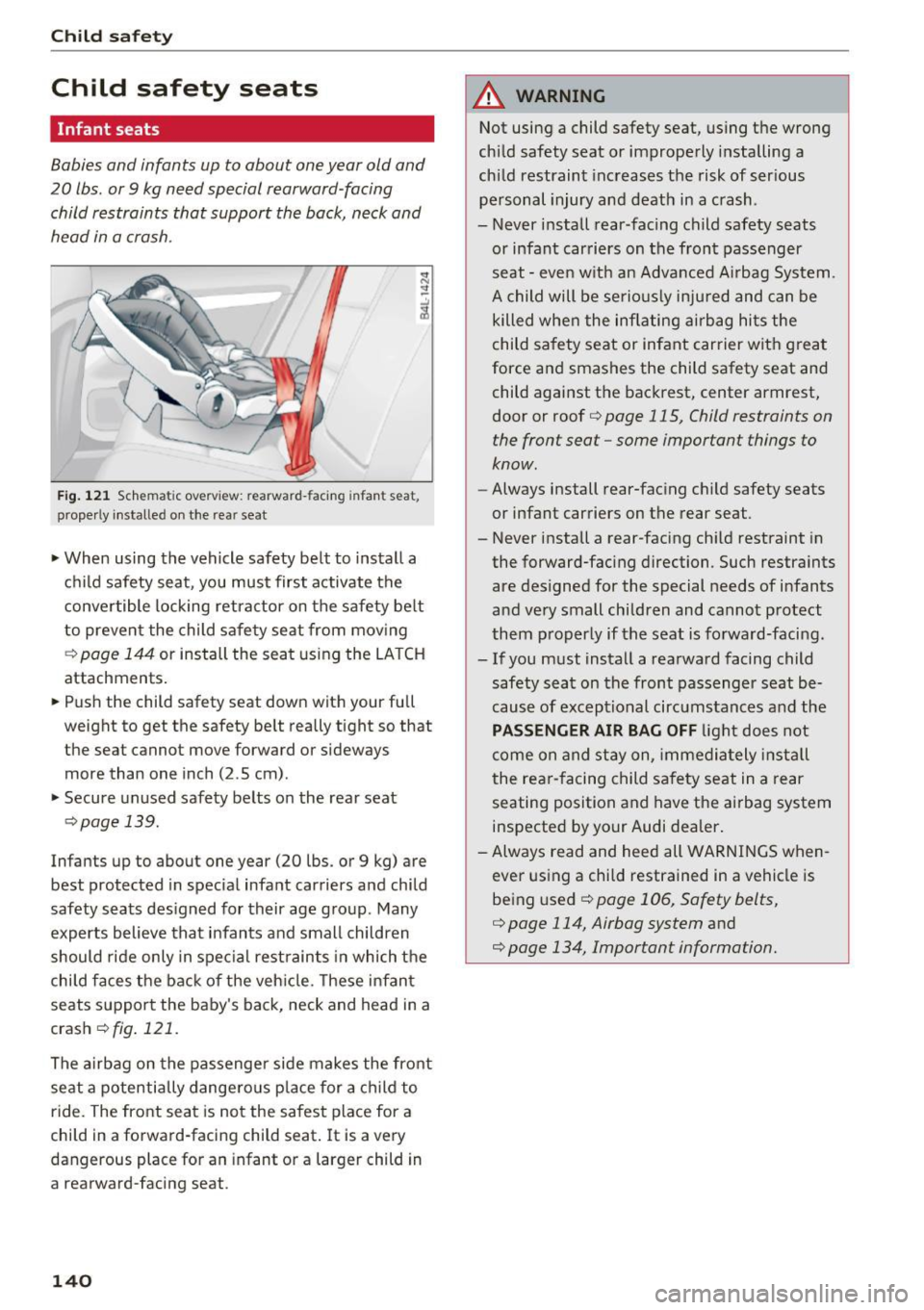
Babies and infants up to about one year old and
20 lbs. or 9 kg need special rearward -facing
child restraints that support the back, neck and
head in a crash.
Fig. 121 Schema tic overv iew: rearwa rd -facing infan t sea t,
properly installe d on the rea r seat
• When using the vehicle safety belt to install a
child safety seat, you must first activate the
convertible locking retractor on the safety belt
to prevent the child safety seat from moving
c::>poge 144 or install the seat using the LA TCH
attachments.
• Push the child safety seat down with your full
weight to get the safety belt really tight so that
the seat cannot move forward or sideways
more than one inch (2 .5 cm) .
• Secure unused safety belts on the rear seat
c::>page 139.
Infants up to about one year (20 lbs. or 9 kg) are
best protected in special infant carriers and child
safety seats des igned for their age group. Many
experts believe that infants and small children
should ride only in spec ial restraints in which the
child faces the back of the veh icle. These infant
seats support the baby 's back, neck and head in a
crash
c::> fig . 121 .
The airbag on the passenger side makes the front
seat a potentially dangerous place for a child to
ride . The front seat is not the safest place for a
child in a forward -facing child seat.
It is a very
dangerous place for an infant or a larger child in
a rearward-facing seat.
140
A WARNING
Not using a child safety seat, using the wrong
child safety seat or improperly installing a
child restraint increases the risk of serious
personal injury and death in a crash .
- Never install rear-facing child safety seats
or infant carriers on the front passenger
seat -even w ith an Advanced A irbag System .
A child will be serio usly injured and can be
killed when the inflating airbag hits the
child safety seat or infant carrier with great
force and smashes the child safety seat and
child against the backrest, center armrest,
door or roof
c::> page 115, Child restraints on
the front seat -some important things to
know .
-Always install rear-facing child safety seats
or infant carriers on the rear seat.
- Never install a rear-facing child restraint in
the forward-facing direction. Such restraints
are designed for the special needs of infants
and very small children and cannot protect
them properly if the seat is forward-facing.
- If you must install a rearward facing child
safety seat on the front passenger seat be
cause of exceptional circumstances and the
PASSENGER AIR BAG OFF light does not
come on and stay on, immediately install
the rear-facing child safety seat in a rear
seating position and have the airbag system
inspected by your Audi dealer.
-Always read and heed all WARNINGS when
ever using a child restrained in a vehicle is
being used
c::> page 106, Safety belts,
c::> page 114, Airbag system and
c::> page 134, Important information.
Page 143 of 230
Convertible child safety seats
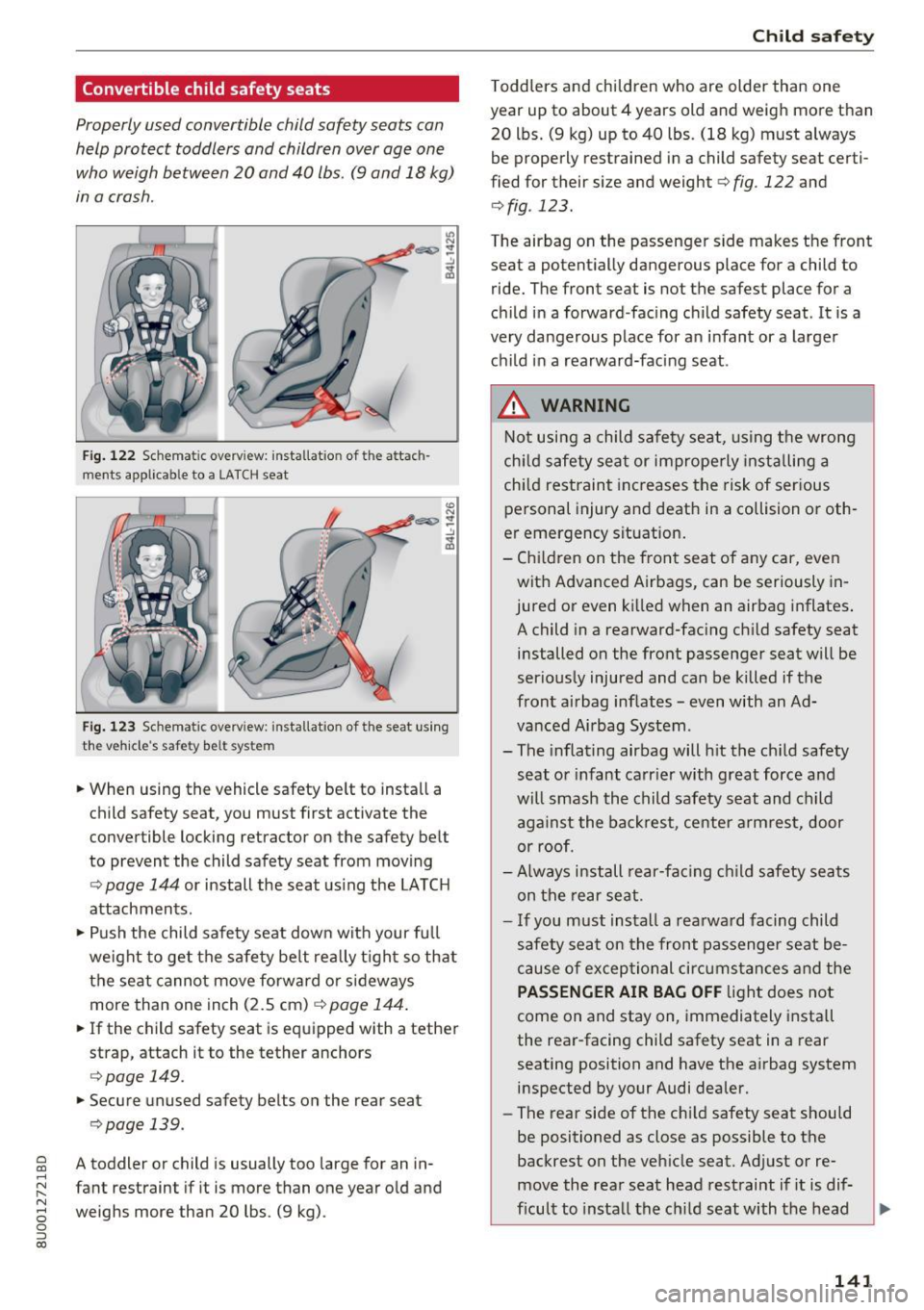
Properly used convertible child safety seats can
help protect toddlers and children over age one
who weigh between
20 and 40 lbs. (9 and 18 kg)
in a crash.
Fig. 122 Schemat ic overv iew: installatio n of the attac h
ments app lica ble to a LA TCH seat
Fig. 123 Schematic overv iew : installat io n of the seat using
the vehicle 's safe ty be lt syste m
.. When using the vehicle safety belt to install a
child safety seat, you must first activate the
convertible locking retractor on the safety belt
to prevent the child safety seat from moving
Q page 144 or install the seat us ing the LATC H
attachments .
.. Push the child safety seat down with your fu ll
weight to get the safety belt really tight so that
the seat cannot move forward o r sideways
more than one inch (2.5 cm)
Q page 144.
.. If the child safety seat is equipped with a tether
strap, attach it to the tether anchors
Q page 149.
.. Secure unused safety belts on the rear seat
Q page 139.
~ A toddler or child is usually too large for an in-
~ fant restraint if it is more than one year old and r--.
;; weighs more than 20 lbs . (9 kg) .
0 ::, (X)
Child safety
Toddlers and children who are older than one
year up to about 4 years old and weigh more than
20 lbs. (9 kg) up to 40 lbs. (18 kg) must always
be properly restrained in a child safety seat certi
fied for their size and weight
Q fig . 122 and
q fig . 123.
The airbag on the passenger side makes the front
seat a potentially dangerous place for a child to
ride. The front seat is not the safest place for a
child in a forward -facing child safety seat. It is a
very dangerous place for an infant or a larger
child in a rearward-facing seat .
_&. WARNING
Not using a child safety seat, us ing the wrong
child safety seat or improperly instal ling a
chi ld restraint increases the risk of serious
personal injury and death in a collision or oth
er emergency situation.
- Children on the front seat of any car, even
with Advanced Airbags, can be seriously in
jured or even killed when an airbag inflates.
A child in a rearward-facing ch ild safety seat
installed on the front passenger seat will be
seriously injured and can be killed if the
front airbag inflates -even with an Ad
vanced Airbag System .
- The inflating airbag will hit the child safety
seat or infant carr ier with great force and
will smash the child safety seat and child
against the backrest, center armrest, door
or roof.
-Al ways install rear-fa cing child safety seats
on the rear seat .
- If you must insta ll a rearward facing child
safety seat on the front passenger seat be
cause of exceptional circumstances and the
PASSENGER AIR BAG OFF light does not
come on and stay on, immediately install
the rea r-facing child safety seat in a rear
seating position and have the a irbag system
inspected by your Audi dealer .
- The rear side of the ch ild safety seat shou ld
be positioned as close as possible to the
backrest on the veh icle seat. Adjust or re
move the rear seat head restraint if it is dif-
ficult to install the child seat with the head
91>
141
Page 146 of 230
Child safety
-Never let a child stand or kneel on any seat,
for example the front seat.
- Never let a child ride in the cargo area of
your vehicle.
- Always remember that a child leaning for
ward, sitting sideways or out of position in
any way during an accident can be struck by
a deploying airbag. This will result in serious
personal injury or death.
- If you must install a booster seat on the
front passenger seat because of exceptional
circumstances the
PASSENGER AIR BAG
OFF
light must come on and stay on, when
ever the ignition is switched on.
- If the
PASSENGER AIR BAG OFF light does
not come on and stay on, perform the
checks described
Q page 124, Monitoring
the Advanced Airbag System.
- Take the child restraint off the front passen
ger seat and install it properly at one of the
rear seat positions if the
PASSENGER AIR
BAG OFF
light does not stay on whenever
the ignition is switched on.
-Always read and heed all WARNINGS when
ever using a child restrained in a vehicle is
being used
Q page 106, Safety belts,
Q page 114, Airbag system
and
Q page 134, Important information.
Securing child safety
seats
Securing a child safety seat using a safety
belt
Safety belts for the rear seats and the front pas
senger can be locked with the convertible locking
retractor to properly secure child safety seats .
The safety belts emergency locking retractors for
the rear seats safety belts and for the front pas
senger's seat safety belt have a convertible lock
ing retractor for child restraints. The safety belt
must be locked so that belt webbing cannot un
reel. The retractor can be activated to lock the
safety belt and prevent the safety belt webbing
from loosening up during normal driving. A child
safety seat can only be properly installed when
144
the safety belt is locked so that the child and
child safety seat will stay in place.
Always remember : Even though your vehicle is
equipped with an Advanced Airbag system, all
children, especially those 12 years and younger,
should always ride in the back seat properly re
strained for their age and size.
A WARNING
Improperly installed child safety seats in
crease the risk of serious personal injury and
death in a collision .
-
-Always make sure that the safety belt re
tractor is locked when installing a child
safety seat. An unlocked safety belt retrac
tor cannot hold the child safety seat in place
during normal driving or in a crash.
- Always buckle the child safety seat firmly in
place even if a child is not sitting in it. A
loose child safety seat can fly around during
a sudden stop or in a collision.
- Always make sure that the rear seat back
rest to which the center rear safety belt is
attached is securely latched whenever the
rear center safety belt is being used to se
cure a child restraint.
-If the backrest is not securely latched, the
child and the child restraint will be thrown
forward together with the backrest and will strike parts of the vehicle interior. The child
can be seriously injured or killed .
- Never install rear-facing child safety seats
or infant carriers on the front passenger
seat. A child will be seriously injured and
can be killed when the passenger airbag in
flates.
- The inflating airbag will hit the child safety
seat or infant carrier with great force and
will smash the child safety seat and child
against the backrest, center armrest, door
or roof.
-Always install rear-facing child safety seats
or infant carriers on the rear seat.
- Forward-facing child safety seats or infant
carriers installed on the front passenger's
seat may interfere with the deployment of
Page 147 of 230
0 co ......
"' ,....
"' ...... 0 0 :::,
00
the airbag and cause serious injury to the
child.
- It is safer to install a forward-facing child
safety seat on the rear seat.
- Always read and heed all WARNINGS when
ever using a child restrained in a vehicle is
being used¢
page 134. Special precautions
apply when installing a child safety seat on
the front passenger seat ¢
page 115, Child
restraints on the front seat- some impor
tant things to know .
A WARNING
Always take special precaut ions if you must
install a forward or rearward-fac ing ch ild re
straint on the front passenger's seat in excep
tional situations:
- Whenever a forward or rearward-facing
child restraint is installed on the front pas
senger seat, the
PA SSENGER AIR BAG OFF
light must come on and stay on whenever
the ignition is switched on.
- If the PASSENGER AIR BAG OFF light does
not come on and stay on, perform the
checks described ¢
page 124, Monitoring
the Advanced Airbag System.
- Take the ch ild restraint off the front passen
ger seat and install it properly at one of the
rear seat positions if the
P AS SEN GER AIR
B AG OFF
light does not stay on whenever
the ignition is switched on .
- Improper installation of ch ild restraints can
reduce their effect iveness or even prevent
them from providing any protection .
- An improperly installed ch ild restraint can
interfere w ith the airbag as it deploys and
seriously injure or even kill the child .
- Always carefully follow the manufacturer's
instructions provided w ith the child safety
seat or carrier.
- Never place additional items on the seat
that can increase the total weight registered by the weight-sensing mat and can cause in
jury in a c rash.
A WARNING
Forward-fac ing child rest raints :
-
Child safety
-Always make sure the forward-facing seat
has been designed and certified by its man
ufacturer for use on a front seat with a pas
senger front and side airbag .
- Never put the forward-facing child restraint
up, against or very near the instrument pan
el.
- Always move the front passenger seat to
the highest posit ion in the up and down ad
justment range and move it back to the
rearmost posit ion in the seat's fore and aft
ad justment range, as far away from the air
bag as possible, before installing the for
ward-facing ch ild restraint.
- Always make sure that the safety be lt upper
anchorage is behind the ch ild rest raint and
not next to or in front of the child restraint
so that the safety be lt will be properly posi
tioned.
- Make sure that the
PASSENGER AIR BAG
OFF
li ght comes on and stays on all the time
wheneve r the ignit ion is switched on .
_& WARNING
-Rearward-facing ch ild restraints:
- A child in a rearward-facing child safety seat
installed on the front passenger seat will be
serious ly injured and can be killed if the
front airbag inflates -even with an Ad
vanced Airbag System.
- The inflating airbag will h it the ch ild safety
seat or infant carr ier with great force and
will smash the child safety seat and child aga inst the backrest, center armrest, door
or roof .
- Always be especia lly careful if you must in
stall a rearward facing child safety seat on
the front passenge r seat in except iona l cir
cumstances.
- A t igh t tether strap on a rearwa rd-facing
child restraint attached to the front passen
ge r seat can put too m uch p ressure on the
weight-m at in the seat and reg ister a heav i
er weight in the Advanced Airbag System .
The heavier weight reg istered can make the
system work as though an ad ult were on the
seat and deploy the Advanced A irbag when
Ill>
145
Page 173 of 230
0 C0
-N ,... N
-0
0
::, a)
Production options weight
means the combined weight of
those installed regular production
options weighing over 5 lbs.
(2 .3 kg) in excess of those stand
ard items which they replace, not
previously considered in curb
weight or accessory we ight, in
cluding heavy duty brakes, ride
levelers, roof rack, heavy duty
battery, and special trim.
Radial ply tire
means a pneumatic tire in which
the ply cords that extend to the beads are laid at substantially
90 degrees to the centerline of
the tread.
Re commended inflation
pressure
see ¢ page 169, Cold tire infla
tion pressure .
Reinforced tire
means a tire designed to operate
at higher loads and at h igher in
flation pressures than the corre
sponding standard tire. Rein
forced tires may be identified as
"XL" "xl" "EXTRA LOAD" or "RF" 1 , ,
on the sidewall.
Wheels
Rim
means a metal support for a tire
or a tire and tube assembly upon
which the tire beads are seated.
Rim diamet er
means nominal d iameter of the
bead seat. If you change your
wheel size, you will have to pur
chase new tires to match the new
rim diameter.
Rim size designat ion
means rim diameter and width .
Rim width
means nominal distance between
r im
flanges .
Sidewall
means that portion of a tire be
tween the tread and bead.
Speed rating (letter code )
means the speed at which a tire is
designed to be driven for extend
ed periods of time . The rat ings
range from
93 mph (150 km/h)
to
186 mph (298 km/h) ¢ table
on page 167.
You may not find
this information on all tires be
cause it is not required by law.
The speed rating letter code,
where applicable, is molded on
the tire sidewall and indicates the ...
17 1
Page 187 of 230

0 co ......
"' ,....
"' ...... 0 0 :::,
00
Care and cleaning
General information
Regular, proper care helps to maintain your vehi
cle's value. It can a lso be a requirement when
submitting warranty claims for corrosion damage
and paint defects on the body.
The necessary care products can be obtained
from an authorized Audi dealer or authorized
Audi Service Facility . Read and follow the instruc
tions for use on the packaging.
A WARNING
- Us ing clean ing and care products incorrectly
can be dangerous to your health.
- Always store clean ing and care products out
of reach of children to reduce the r isk of po i
son ing .
@ For the sake of the environment
- Preferably purchase env ironmenta lly-friend
l y cleaning products.
- Do not d ispose of leftover cleaning and care
products with household trash.
Car washes
T he longer that deposits remain on the vehicle,
the more the surface may be damaged. High
temperatures such as those caused by sunlight increase the damag ing effect.
Befor e washing, rinse
off heavy depos its with
p lenty of water.
S tubborn depos its such as bird droppings or tree
sap are best removed with plenty of water and a
microfiber cloth.
A lso, wash t he un derside of yo ur vehicle once
road sa lt stops being used for the season .
Pressure washers
When washing your ve hicle w ith a pressure wash
e r, a lways fo llow the operating instructions pro
vided wi th the p ressure washer. This is especially
i mportant in rega rd to the pressure and sp raying
d istance . Do not aim the spray directly at seals on
side windows, doors, the hood, the luggage com-
Ca re and cleaning
partment lid or the panorama glass roof* or at
tires, rubber hoses, insulating material, sensors *
o r camera lenses* . Keep a distance of at least 16
in
(40 cm).
Do not remove snow and ice with a pressure
washer.
Never use cone nozz les o r high press ure nozzles .
T he water temperatu re must not be above
140 °F
(60 °().
Automatic car washes
Spray off the vehicle before washing.
Make s ure that the windows and roo f* are closed
and the windshie ld wipers are
off . Follow instruc
tions from the car wash ope rator, especially if
there are accessories attached to your vehicle.
If possible, use car washes that do not have
brushes .
Washing by hand
Clean the ve hicl e starting from the top and wor k
i ng down using a soft sponge o r cleaning br ush.
U se solven t-free cleaning produ cts.
Washing vehicles with matte finish paint by
hand
T o avo id damag ing the pa int w hen washi ng, fi rst
remove dust and large pa rticl es from you r vehi
cle . Insects, grease spots and fingerprints are
best removed w ith a special cleaner for matte
finish paint.
Apply t he product using a microf iber cloth . To
avoid damaging the paint surface, do not use too
much pressure.
Rinse the ve hicl e thoroug hly w ith wate r. Then
cl ean usi ng a neutral shampoo and a soft micro
fiber cloth .
Rinse the ve hicl e thorough ly aga in and let it air
dry. Remove any wate r residue using a chamois.
WARNING
-On ly wash the vehicle when the ign ition is
off and follow the instr uctions from the car
185
Page 202 of 230
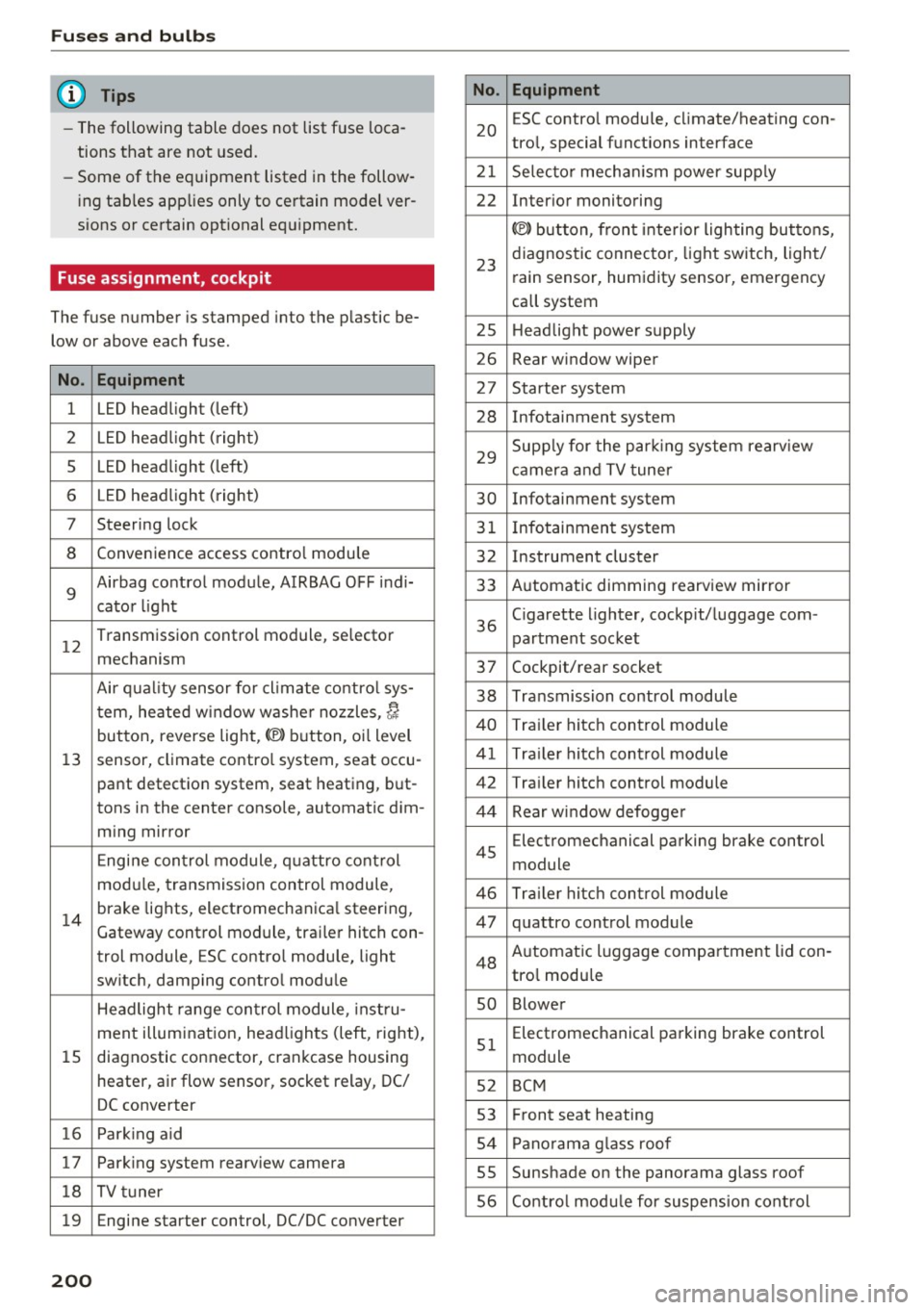
Fuses and bulbs
(D Tips
-The following table does not list fuse loca
tions that are not used.
- Some of the equipment listed in the follow
ing tables applies only to certain model ver
sions or certain optional equipment.
Fuse assignment, cockpit
The fuse number is stamped into the plastic be
low or above each fuse.
No. Equipment
1 LED headlight (left)
2 LED headlight (
right)
5 LED headlight (left)
6 LED headlight (right)
7 Steering lock
8 Convenience access contro
l module
9 Airbag control module, AIRBAG OFF
indi-
cator light
12
Transmission control module, selector
mechanism
Air quality sensor for cl imate control sys-
tern, heated w indow washer nozzles,~
button, reverse light,(®) button, oil level
13 sensor, climate contro
l system, seat occu-
pant detection system, seat heating, but-
tons in the center console, automatic dim-
ming mirror
Engine control module , quattro control
modu le, transmission control module,
14 brake lights, electromechanica
l steering,
Gateway control module, trai ler hitch con-
trol module, ESC control module, light
switch, damping control module
Headlight range control module, instru-
ment illumination, headlights (left, right),
15 diagnostic connector, crankcase housing
heater, a
ir flow sensor, socket relay, DC/
DC converter
16 Parking aid
17 Parking system rearview camera
18 TV tuner
19 Engine starter control, DC/DC converter
200
No
. Equipment
20 E
SC contro l module, climate/heating con-
trol, special functions interface
21 Selector mechanism power supply
22 Interior monitoring
(®) button, front interior lighting buttons,
23 diagnostic connector, light
switch, light/
rain sensor, humidity sensor, emergency
call system
25 Headlight power supply
26 Rear window wiper
27 Starter system
28 Infotainment system
29 Supply for
the park ing system rearview
camera and TV tuner
30 Infotainment system
31 Infotainment system
32 Instrument cluster
33 Automatic dimming rearview mirror
36 Cigarette lighter, cockpit/luggage com
-
partment socket
37 Cockpit/rear socket 38 Transmission contro l module
40 Trailer hitch control module 41 Trailer hitch control module
42 Trai ler hitch control module
44 Rear window defogge r
4S Electromechanical parking brake control
module
46 Trailer hitch control module
47 quattro control module
48 Automatic luggage compartment lid con-
tro
l modu le
so Blowe r
51 Electromechanical parking brake control
module
52 BCM
53 Front seat heating
54 Panorama gla ss roof
55 Sunshade on the panorama glass roof
56 Contro l modu le for suspension control
Page 215 of 230
0 co ......
"' ,....
"' ...... 0 0 :::,
00
today's automobiles, have steadily reduced the
scope of maintenance and repairs which can be
carried out by vehicle owners.
Also, safety and
environmental
concerns place very strict limits
on the nature of repairs and adjustments to en
gine and transmission parts which an owner can perform .
Maintenance, adjustments and repairs usually re
quire special tools, testing devices and other
equipment available to specially trained work
shop personnel in order to assure proper per
formance, reliability and safety of the vehicle and
its many systems.
Improper maintenance, adjustments and repairs
can impair the operation and reliability of your
vehicle and even void your vehicle warranty .
Therefore, proof of servicing in accordance with
the maintenance schedule may be a condition for upholding a possible warranty claim made within
the warranty period.
Above all , operational safety can be adversely af
fected, creating unnecessary risks for you and
your passengers.
If in doubt about any servicing, have it done by
your authorized Audi dealer or any other properly equipped and qualified workshop. We strongly urge you to give your authorized Audi dealer the
opportunity to perform all scheduled mainte nance and necessary repairs. Your dealer has the
facilities, original parts and trained specialists to keep your vehicle running properly .
Performing limited maintenance yourself
The following pages describe a limited number of
procedures which can be performed on your vehi
cle with ordinary tools, should the need arise and
trained personnel be unavailable. Before per
forming any of these procedures, always thor
oughly read all of the applicable text and careful ly follow the instructions given . Always rigorously
observe the
WARNINGS provided .
Before you check anything in the engine com
partment, always read and heed all WARNINGS
c::> .&. and c::> .&. in Working in the engine compart
ment on page 155. Consumer Information
A WARNING
-
Serious personal injury may occur as a result
of improperly performed maintenance, ad
justments or repairs .
- Always be extremely careful when working
on the vehicle. Always follow commonly ac
cepted safety practices and general com
mon sense. Never risk personal injury.
- Do not attempt any of the maintenance,
checks or repairs described on the following
pages if you are not fully familiar with these
or other procedures with respect to the ve
hicle, or are uncertain how to proceed.
- Do not do any work without the proper tools
and equipment. Have the necessary work
done by your authorized Audi dealer or an
other properly equipped and qualified work
shop.
- The engine compartment of any motor vehi cle is a potentially hazardous area. Never
reach into the area around or touch the radi
ator fan.
It is temperature controlled and
can switch on suddenly - even when the en
gine is off and the ignition key has been re
moved. The radiator fan switches on auto
matically when the coolant reaches a certain
temperature and will continue to run until
the coolant temperature drops.
- Always remove the ignition key before any
one gets under the vehicle.
- Always support your vehicle with safety
stands if it is necessary to work underneath
the vehicle . The jack* supplied with the vehi
cle is not adequate for this purpose and
could collapse causing serious personal in
jury.
- If you must work underneath the vehicle
with the wheels on the ground, always make
sure the vehicle is on level ground, that the
wheels are always securely blocked and that the engine cannot be started.
- Always make sure the transmission selector
lever (automatic transmission) is in P (Park
position) and the park brake is applied.
213