tow AUDI Q3 2018 Owner's Manual
[x] Cancel search | Manufacturer: AUDI, Model Year: 2018, Model line: Q3, Model: AUDI Q3 2018Pages: 230, PDF Size: 57.03 MB
Page 100 of 230
Driving sa fety
• ALWAYS adjust your speed to road, traffic and
weather conditions.
• Take frequent breaks on long trips. Do not drive
for more than two hours at a stretch.
• Do NOT drive when you are tired, under pres
sure or whe n you are stressed .
A WARNING
Impaired driv ing safety inc reases t he risk of
ser ious persona l inju ry and death whenever a
vehicle is being used.
Correct passenger
seating positions
Proper seating position for the driver
The proper driver seating position is important
for safe, relaxed driving .
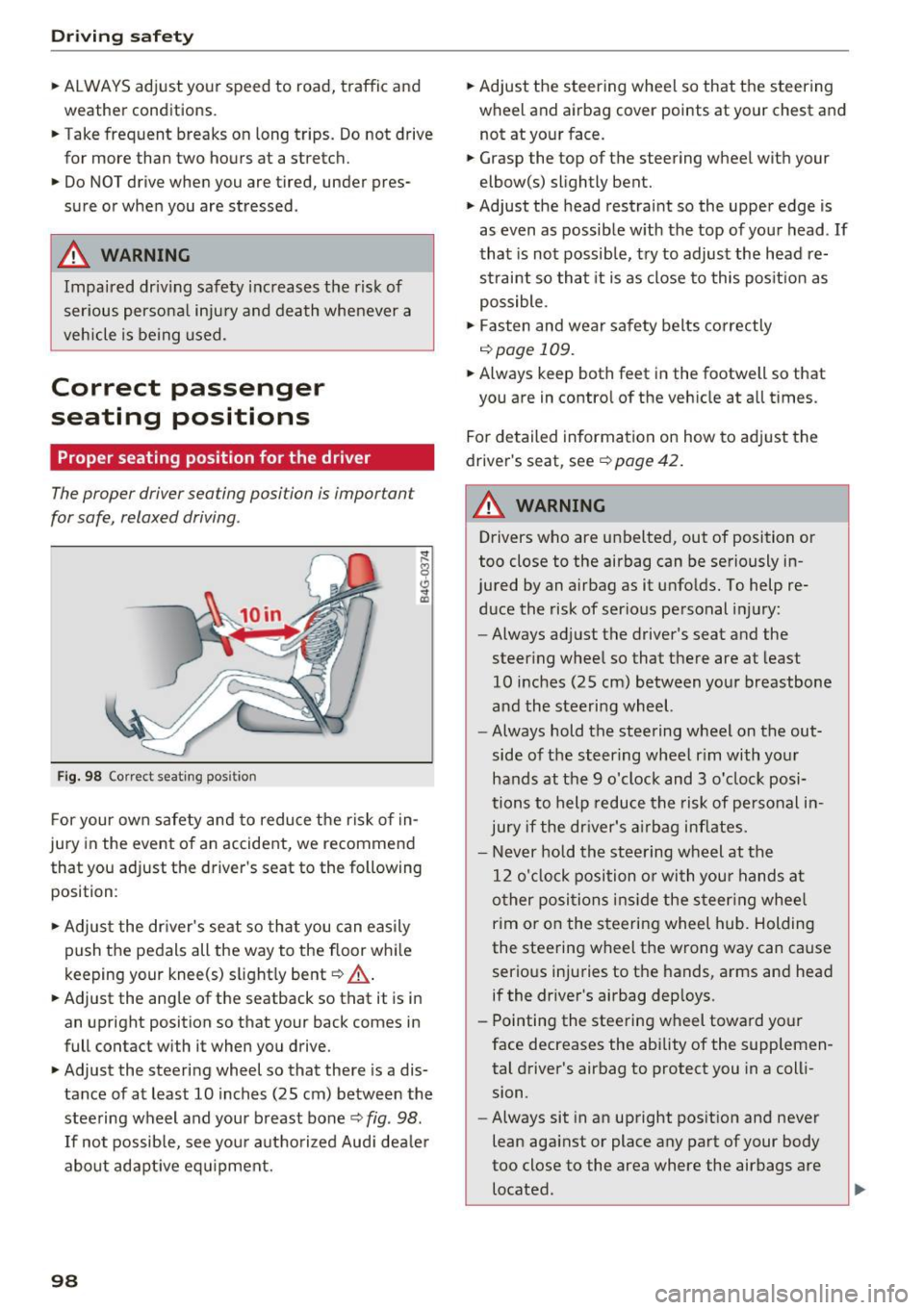
Fig. 9 8 Correct seating pos it io n
For your own safety and to reduce the risk of in
jury in the event of an accident, we recommend
that you adjust the driver 's seat to the following
position :
• Adjus t the dr iver's seat so tha t you can easily
push the pedals all the way to the floor whi le
keeping your knee(s) s light ly bent ~
,A.
• Adjust the angle of the seatback so that it is in
an upright position so that your back comes in
full contact with it when you drive.
• Adjust the steering wheel so that there is a dis
tance of at least 10 inches (25 cm) between the
stee ring wheel and your breast bone~
fig. 98 .
If no t possib le, see you r authorized Aud i dea le r
about adapt ive eq uipment.
98
• Ad just the steering wheel so that the steer ing
wheel and airbag cover points at your chest and
not at yo ur face .
• Grasp the top of the steering wheel with your
elbow(s) slightly bent.
• Adjust the head restraint so the uppe r edge is
as even as possib le w ith the top of your head .
If
that is not possib le, try to adjust the head re
strai nt so that it is as close to this pos it io n as
possible.
• Fasten and wear sa fe ty belts correctly
r=>page 109.
• Always keep both feet in the footwell so that
you are in contro l of the veh icle at all t imes .
Fo r de tailed informa tion on how to ad just the
dr ive r's seat,
see r=!) page 42 .
A WARNING
Drivers who are unbelted, out of position or
too close to the airbag can be seriously in
jured by an airbag as it unfo lds. To help
re
duce the risk of serious personal injury:
- Always ad just the driver 's seat and the
steering whee l so that there are at least
10 inches (25 cm) between yo ur breastbone
and the steering wheel.
- Always hold the steering wheel on the out
side of the steering wheel r im with yo ur
hands at t he 9 o'clock and 3 o'clock posi
tions to help reduce the risk of personal i n
jury if the driver's airbag in flates.
- Never hold the stee ring wheel at the
1 2 o'cl ock position o r wi th you r hands at
o ther posi tion s in side the steer ing whee l
rim o r on the steeri ng wheel hub. Holding
the steering wheel the wrong way can cause serious inju ries to the hands, arms and head
if the drive r's airbag dep loys.
- Pointing the steering wheel towa rd your
face decreases the ability of the supplemen
tal d river 's airbag to protect you in a coll i
sion.
- Always sit in an upright pos ition and never
lean aga inst or place any part of your body
too close to the area where the airbags are
located.
-
Page 104 of 230
Driving safety
mats will prevent them from sliding into posi
tions that could interfere with the pedals or im
pair safe operation of your vehicle in other ways.
A WARNING
Pedals that cannot move freely can result in a
loss of vehicle control and increase the risk of
serious personal injury.
- Always make sure that floor mats are prop
erly secured.
- Never place or install floor mats or other
floor coverings in the vehicle that cannot be
properly secured in place to prevent them
from slipping and interfering with the ped als or the ability to control the vehicle.
- Never place or install floor mats or other
floor coverings on top of already installed
floor mats. Addit ional floor mats and other
coverings will reduce the size of the pedal
area and interfere with the pedals.
- Always properly reinstall and secure floor
mats that have been taken out for cleaning.
- Always make sure that objects cannot fall
into the driver footwell while the veh icle is
moving. Objects can become trapped under
the brake pedal and accelerator pedal caus
ing a loss of vehicle control.
Storing cargo correctly
Loading the luggage compartment
All luggage and other objects must be properly
stowed and secured in the luggage compart
ment.
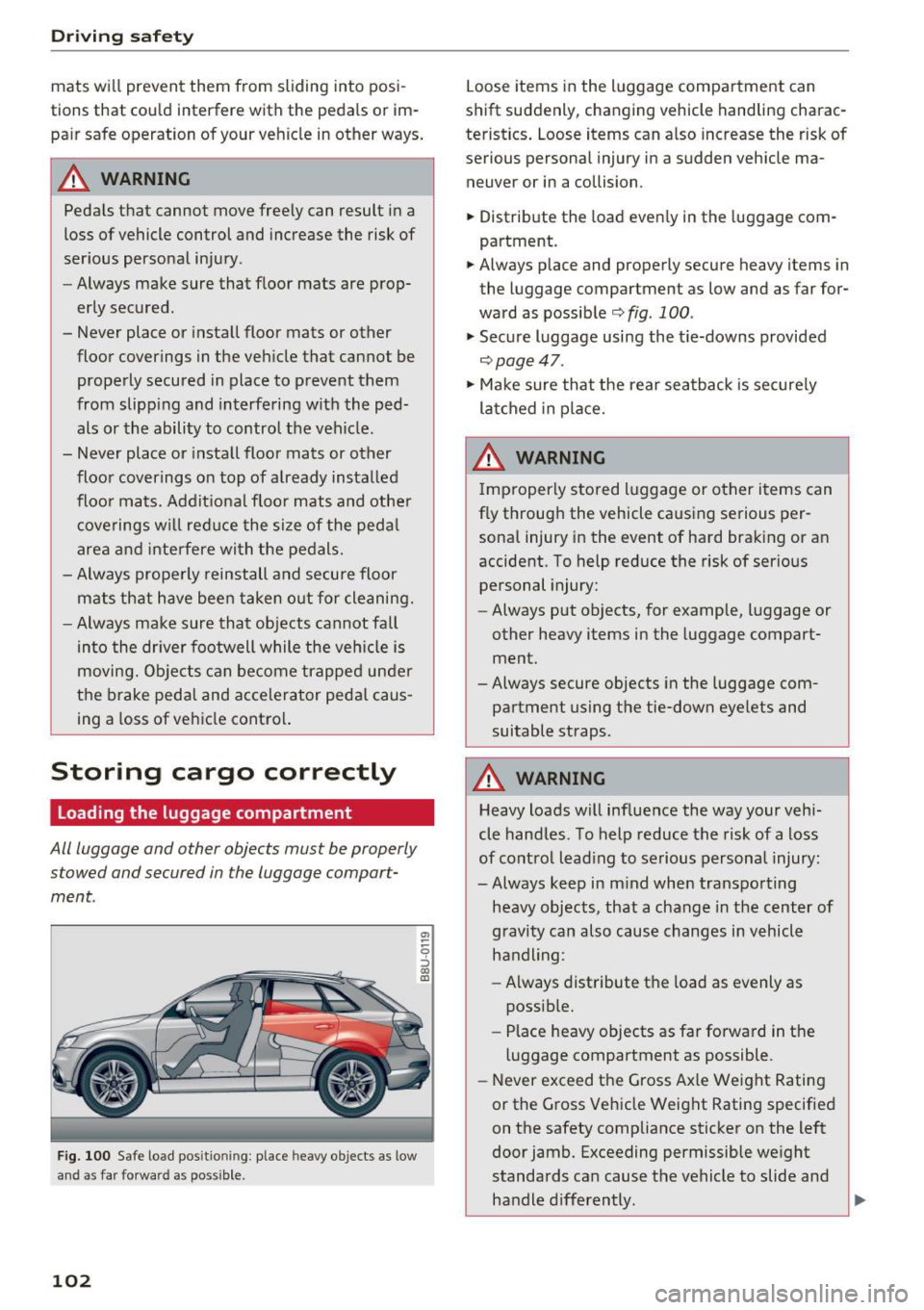
Fig. 100 Safe load pos itio nin g: place heavy objects as low
and as far forward as possible.
102
a, ~ ~ 0
::i 00 OJ
Loose items in the luggage compartment can
shift suddenly, changing vehicle handling charac
teristics. Loose items can also increase the risk of
serious personal injury in a sudden vehicle ma
neuver or in a collision.
.,. Distribute the load evenly in the luggag e com
partment.
.,. Always place and properly secure heavy items in
the luggage compartment as low and as far for
ward as possible
¢fig . 100 .
.,. Secure luggage using the t ie-downs provided
¢ page 47.
.,. Make sure that the rear seatback is securely
latched in place.
A WARNING
Improperly stored luggage or other items can
fly through the vehicle causing serious per sonal injury in the event of hard braking or an
accident. To help reduce the risk of serious personal injury:
- Always put objects, for example, luggage or
other heavy items in the luggage compart
ment.
-Always secure objects in the luggage com
partment using the tie-down eyelets and
suitable straps.
A WARNING
Heavy loads will influence the way your vehi
cle handles. To help reduce the risk of a loss
of control leading to serious personal injury:
-Always keep in mind when transporting heavy objects, that a change in the center of
gravity can also cause changes in vehicle
handling:
- Always distribute the load as evenly as
possible.
- Place heavy objects as far forward in the
luggage compartment as possible.
- Never exceed the Gross Axle Weight Rating
or the Gross Vehicle Weight Rating specified
on the safety compliance sticker on the left
door jamb. Exceeding permissible weight
standards can cause the vehicle to slide and
handle differently.
Ill>-
Page 113 of 230
a
co
...... N r--. N .-< 0 0 ::, co
from the strong bones to more vulnerable,
soft tissue and cause serious injury.
- Always read and heed all WARNINGS and
other important information
9 page 108.
Pregnant women must also be correctly
restrained
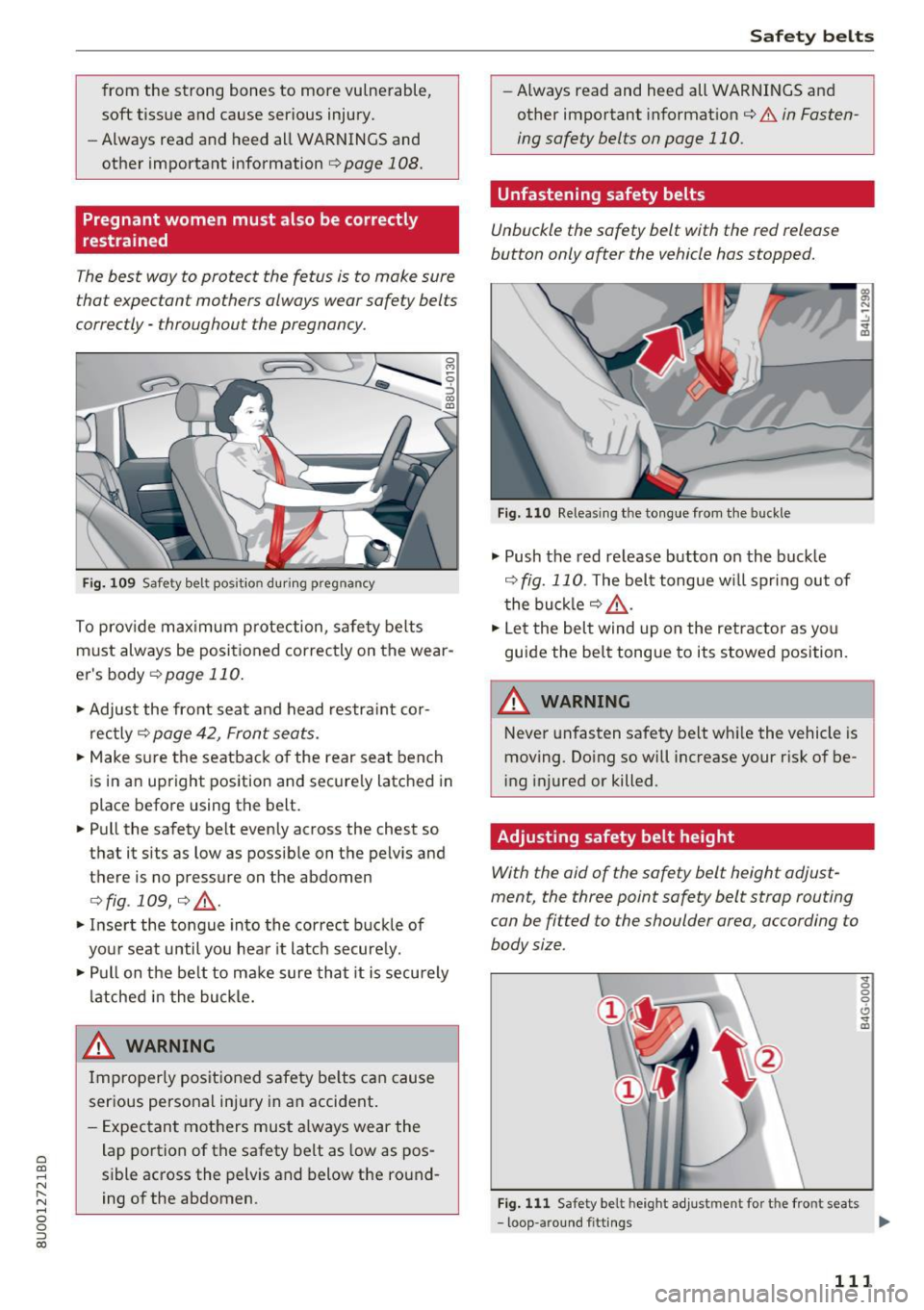
T he best way to protect the fetus is to make sure
tha t expec tan t mothers always wear safe ty bel ts
correctly -throughou t the pregnancy .
Fig. 10 9 Safety be lt pos itio n durin g p reg nancy
To p rov ide max imum p rotection, safety belts
must always be positioned correctly on the wear
e r's body
c::> page 110 .
• Adjus t the front seat and head restra int cor
rec tly
c::> page 42 , Front seats .
• Make s ure the seatback of the rear seat bench
is in a n upright position and secure ly latched in
place before using th e belt.
• Pull the safety belt evenly across the chest so
that it sits a s low as possible on the pelv is and
there is no pressure on the abdomen
c::> fig . 109, c::> .&_ .
• Inse rt the to ngue into the cor rec t buckle of
you r seat until you hea r it latch secure ly .
• Pullon the belt to m ake sure that it is secu rely
latched in the bu ckle.
_& WARNING
Improperly posit ioned safety be lts ca n cause
serious personal inj ury in an accident .
- E xpec tant mot hers mus t always wear the
lap portion of the safety belt as low as pos
sible across the pelvis and below the ro und
ing of the abdomen .
Safety bel ts
-Always read and heed all WARNINGS and
other important informat ion
c::> A in Fasten
ing safety belts on page 110.
Unfastening safety belts
Unbuckle the safety belt with the red release
button only o~er the vehicle has stopped.
Fig. 1 10 Releasi ng t he to ngue from t he bu ckle
.,. Push the red re lease but ton on the buck le
c::> fig. 110 . The belt tongue w ill spr ing out of
t he buck le
c::> _&. .
• Let the belt wind up on the retra ctor as yo u
guide the belt tongue to its stowed posit ion.
_& WARNING
Never unfasten safety belt whi le the vehicle is
moving . Do ing so will increase your r isk of be
i ng injured or killed .
Adjusting safety belt height
With the aid of the safety belt height adjust
ment, the three point safety belt strap rout ing
can be fi tted to the shoulder area, according to
body size .
Fig. 11 1 Safety belt height a dju stm ent fo r th e fro nt seat s
... 0 0
0
6 ... a,
-loop -a ro und fitt ings Ill>
111
Page 124 of 230

Airbag syste m
damaged, preventing them and the airbag
system from working properly.
- Never place seat covers or rep lacement up
holstery that have not been specifically ap
proved by Audi on the front seats .
- Seat covers can prevent the Advanced Air
bag System from recognizing child re
straints or occupants on the front passenger
seat and prevent the side a irbag in the seat
backrest from deploying properly.
- Never use cush ions, pillows, blankets or
similar items on the front passenger seat.
The add it ional padding will prevent the
weight-sens ing mat in the seat from acc u
rately reg istering the ch ild restraint or per
son on the seat and prevent the Advanced
Airbag System from funct ioning properly.
- If you must use a child rest raint on the front
passenge r seat and the child restraint man
ufacturer 's instructions require the use of a
towel, foam cushion or something else to properly position the ch ild restraint, make
certain that the
PA SSENGER AIR BAG OFF
light comes on and stays on whenever the
child restraint is installed on the front pas
senger seat.
- If the
PASSEN GER AIR B AG OFF light does
not come on and stay on, immed iately in
stall child restraint in a rear seating position
and have the airbag system inspected by
yo ur autho rized Aud i deale r.
How the Advanced Airbag System
components work together
The front Advanced Airbag System and the side
airbags supplement the protection offered by the
front three-po int safety belts and the adjustable
head restraints to help reduce the risk of injury in
a w ide range of acc ident and crash s ituations . Be
sure to read the important information about
safety and heed the WARNINGS in th is chapter.
Deployment of the Advanced Airbag System and
the act ivat ion of the safety belt pretensioners de
pend on the deceleration measured by the crash
sensors and registered by the electronic control
un it. Crash severity depends on speed and de cel-
122
eration as well as the mass and stiffness of the
vehicle or object involved in the crash .
On the passenger side, regard less of safety be lt
u se, the airbag will be turned off if the weight on
the passenger seat is less than the amount pro
grammed in the electronic control unit . The front
airbag on the passenger side will also be turned
off if one of the child safety seats that has been
certified under Federal Motor Vehicle Safety
Standard 208 has been recogn ized on the seat .
The
PASSENGER A IR BAG OFF lig ht comes o n
and stays on to te ll you when the front Advanced
Airbag on the passenger side has been turned off
q page 115, Child restraints on the front seat
some important things to know.
A WARNING
To reduce the ris k of injury when an airbag in
f lates, always wea r safety belts properly.
- If you are un restrained, leaning forward, sit
ting sideways or out of position i n any way,
your risk of injury is much higher.
- You will a lso receive serious injuries and
could even be killed if you are up against the
airbag or too close to it when it inflates -
even with an Advanced Airbag
q page 114.
More important things to know about front
airbags
Fig . 114 Inflated front a irbags
Safety be lts are important to help keep front
seat occupants in the proper seated position so
that airbags can unfold properly and prov ide sup-
plemental protection in a fronta l collision . ..,.
Page 148 of 230
Child safety
it must be suppressed causing serious or
even fatal injury to the child.
- Make sure that the
PASSENGER AIR BAG
OFF
light comes on and stays on all the time
whenever the ignition is switched on.
- If the
PASSENGER AIR BAG OFF light does
not come on and stay on, immediately in
stall the rear-facing child safety seat in a
rear seating position and have the airbag
system inspected by your Audi dealer .
Activating the convertible locking retractor
Use the convertible locking retractor to secure a
child restraint.
Always heed the child safety seat manufacturer's
instructions when installing a child restraint in
your vehicle. To activate the convertible locking
retractor:
~ Place the child restraint on a seat, preferably
on the rear seat.
~ Slowly pull the belt all the way out.
~ Route it around or through the child restraint
belt path
~ &_ .
~ Push the child safety seat down with your full
weight to get the safety belt really tight.
~ Insert the belt tongue into the buckle for that
seating position.
~ Guide the safety belt back into the retractor un
til the belt lies flat and snug on the child safety
seat.
~ You should hear a "clicking" noise as the belt
winds back into the inertia reel. Test the con
vertible locking retractor by pulling on the belt .
You should no longer be able to pull the belt
out of the retractor . The convertible locking re
tractor is now activated.
~ Make sure that the red release button is facing
away from the child restraint so that it can
be
unbuckled quickly.
~Pullon the belt to make sure the safety belt is
properly tight and fastened so that the seat
cannot move forward or sideways more than
one inch (2 .5 cm).
146
A WARNING
-
Using the wrong child restraint or an improp-
erly installed child restraint can cause serious
personal injury or death in a crash .
- Always make sure that the safety belt re
tractor is locked when installing a child
safety seat . An unlocked safety belt retrac
tor cannot hold the child safety seat in place
during normal driving or in a crash.
-Always buckle the child safety seat firmly in
place even if a child is not sitting in it. A
loose child safety seat can fly around during
a sudden stop or in a crash.
- Always make sure the seat backrest to which
the child restraint is installed is in an up
right position and securely latched into
place and cannot fold forward. Otherwise,
the seatback with the child safety seat at
tached to it could fly forward in the event of
an accident or other emergency situation.
- Always read and heed all WARNINGS when
ever using a child restrained in a vehicle is
being used
c> page 134. Special precautions
apply when installing a child safety seat on
the front passenger seat
~ page 115, Child
restraints on the front seat -some impor
tant things to know.
· Deactivating the convertible locking
retractor
The convertible locking retractor for child re
straints will be deactivated automatically when
the belt is wound all the way back into the re
tractor.
~ Press the red button on the safety belt buckle.
The belt tongue will pop out of the buckle.
~ Guide the safety belt all the way back into its
stowed position.
Always let the safety belt retract completely into
its stowed position. The safety belt can now be
used as an ordinary safety belt without the con
vertible locking retractor for child restraints.
If the convertible locking retractor should be ac
tivated inadvertently, the safety belt must be un-
fastened and guided completely back into its .,.
Page 149 of 230
0 co ......
"' ,....
"' ...... 0 0 :::,
00
stowed position to deactivate this feature. If the
convertible locking retractor is not deactivated,
the safety belt w ill gradually become tighter and
uncomfortable to wear.
_&. WARNING
Improperly installed child safety seats in
crease the risk of serious personal injury and
death in a collision.
- Never unfasten the safety belt to deactivate
the convert ible locking retractor for child re
straints while the vehicle is moving. You
would not be restrained and could be seri o usly injured in an accident.
- Always read and heed all WARNINGS when
ever using a child restrained in a veh icle is
being used~
page 134. Specia l precautions
apply when installing a child safety seat on
the front passenger seat
~ page 115, Child
restraints on the front seat -some impor
tant things to know.
LATCH system (lower
anchorages and tethers
for children)
Child Restraint System anchors and how
are they related to child safety
To prov ide a simpler and more practicable way to
attach the child restra int on the vehicle seat,
F edera l regulat ions require specia l lower ancho
r ages in vehicles and devices on new child re
straints to attach to the vehicle anchorages.
I n the United States, the combination of the
tether anchorages and the lowe r anchorages is
now genera lly called the LA TC H system for
" L ower Anchorages and Tethers for C hildren" . In
Canada, the terms "top tether" with "lower uni
versal anchorages" (or "lower un iversal anchor
age bars") are used to describe the system.
In other countries the term "ISO FIX" is used to
describe the lower anchorages .
Forward-facing child res tra ints man ufactu red af
ter September 1, 1999, are required by U.S. fed
eral regulations to comply with new child head
movement performance requirements. These
Ch ild safety
new per formance requirements make a tether
necessary on most new chi ld seats.
Installing a ch ild rest raint that requires a top
tether without one can seriously impa ir the per
formance of the child restraint and its ab ility to
protect the child in a co llision. Installing a child
restra int that requires a top tether without the
top tether may be a violat ion of state law.
Child restraint manufacturers offer LATCH lowe r
anchorages on their child seats with hook-on or
push-on connectors attached to adjustable
straps.
In addition to the LATCH lower anchorages, these
child restraint systems usua lly require the use of
tether straps to help keep the child restra int
firmly in p lace.
_&. WARNING
Improper installation of child restra ints w ill
i ncrease the risk of injury and death in a
crash.
- Always follow the instructions prov ided by
the man ufacturer of the ch ild restraint you
inte nd to install in your vehicle.
- Never i nstall a chi ld restraint without a
proper ly attached top tether strap if the
child restraint manufacture r's instructions
require the top tether strap to be used.
-
- Improper use of child restraint LATCH lower
anchorage points can lead to injury in a col li
sion. The LA TC H l ower anchorage points are
des igned to w ithstand only those loads im
posed by correctly fitted child restraints .
- Never mo unt two child res traint systems on
one LA TC H lower anchorage point.
- Never secure or at tach any luggage o r othe r
item to the LA TC H l ower anchorages.
147
Page 181 of 230
fuel, oil, coolant and other fluids plus maximum load. The maxi
mum load includes the number of
passengers that the vehicle is in
tended to carry ("seating capaci
ty") with an assumed weight of
1 50 lbs. (68 kg) for each passen
ger at a designated seating posi
tion and the total weight of any
luggage in the vehicle. If you tow
a trailer, the weight of the trailer
hitch and the tongue weight of
the loaded trailer must be includ
ed as part of the vehicle load.
The
Gr oss Axle Weight R ating
("GAWR") is the maximum load
that can be applied at each of the
veh icle's two axles.
The fact that there is an upper limit to your vehicle's Gross Vehi
cle Weight Rating means that the
total weight of whatever is being
carried in the vehicle (including
the weight of a trai ler hitch and
the tongue weight of the loaded
trailer) is limited. The more pas
sengers in the vehicle or passen
gers who are heavier than the
standard weights assumed mean
that less weight can be carried as
~ luggage.
-N
" N
-0
0
::, a)
Wheels
The Gross Vehicle Weight Rating and the Gross Axle Weight Rating
are listed on the safety compli
ance sticker label located on the
driver's side B-pillar.
_&. WA RNIN G
Overloading a vehicle can cause
loss of vehicle control, a crash
or other accident, serious per
sonal injury, and even death.
- Carrying more weight than
your vehicle was designed to carry will prevent the vehicle
from handling properly and increase the risk of the loss of
vehicle control.
-The brakes on a vehicle that
has been overloaded may not
be able to stop the vehicle
within a safe distance.
- Tires on a vehicle that has
been overloaded can fail sud
denly, including a blowout and
sudden deflation, causing loss
of control and a crash.
- Always make sure that the to
tal load being transported -
including the weight of a trail
er hitch and the tongue
weight of a loaded trailer -
does not make the vehicle heavier than the vehicle's
Gross Veh icle Weight Rating .
179
Page 182 of 230
Wheels
Determining correct load
limit
Use the example below to calcu
late the total weight of the pas
sengers and luggage or other
things that you plan to transport so that you can make sure that
your vehicle will not be overload ed .
Steps for Determining Correct
Load Limit
1 . Locate the statement "THE
COMBINED WEIGHT OF OCCU PANTS AND CARGO SHOULD
NEVER EXCEED XXX KG OR XXX
LBS"on your vehicle 's placard
(tire inflation pre ssure label)
c:::> page 176, fig. 146.
2. Determine the combined
weight of the driver and pas
sengers that will be riding in
your vehicle.
3 . Subtra ct the combined weight
of the driver and passengers
from
"XXX" kilograms or " XXX"
pounds shown on the sticker
c:::> page 176 , fig. 146 .
4. The re sulting figure equals the
available amount of cargo and luggage load capacity. For ex
ample, if the
"XXX" amount
equals 1400 lbs. and there will
180
be five 150 lbs. passengers in
your vehicle, the amount of available cargo and luggage load capacity is 650 lb s.
(1400-750 (5 X 150) = 650
lb s.)
5. Determine the combined weight of luggage and cargo
being loaded on the vehicle.
That weight may not safely ex
ceed the available cargo and luggage load capacity calculat
ed in Step 4 .
6. If your vehicle will be towing a trailer, load from your trailer
will be transferred to your ve
hicle. Con sult this manual to
determine how this reduces
the available cargo and lug gage load capacity of your vehi
cle .
~check the tire sidewall
(c:::> page 167, fig. 144) to deter
mine the designated load rating
for a specific tire.
· Wheel bolts and rims
Wheel bolts
W heel bolts mus t be clean and loose n/tighten
eas ily.
Rims
R ims with a bo lted r im ring * or with bo lted wheel
covers" co nsist of mult ip le p ieces . T h ese compo-
n ents were bolted togethe r usin g s pec ial bolts ..,.
Page 193 of 230
a
co
...... N r--. N
'"' 0 0 ::, co
Emergency assistance
General information
.. Park the vehicle as far as poss ible from moving
traffic in the event of a breakdown. In the event
of a flat tire, park the vehicle on a leve l surface .
It you are on a steep h ill, be especially careful.
.. Set the parking brake.
.. Switch the emergency flashe rs on .
.. Put on a reflective vest .
.. Set up the warn ing triang le, if available .
.. Have the passengers exi t the veh icle. They
sho uld move to a safe place, for example be
hind a guard rail.
_& WARNING
Follow the steps given above. This is for your
protection and the for the safety of other d riv
ers.
Equipment
Vehicle tool kit
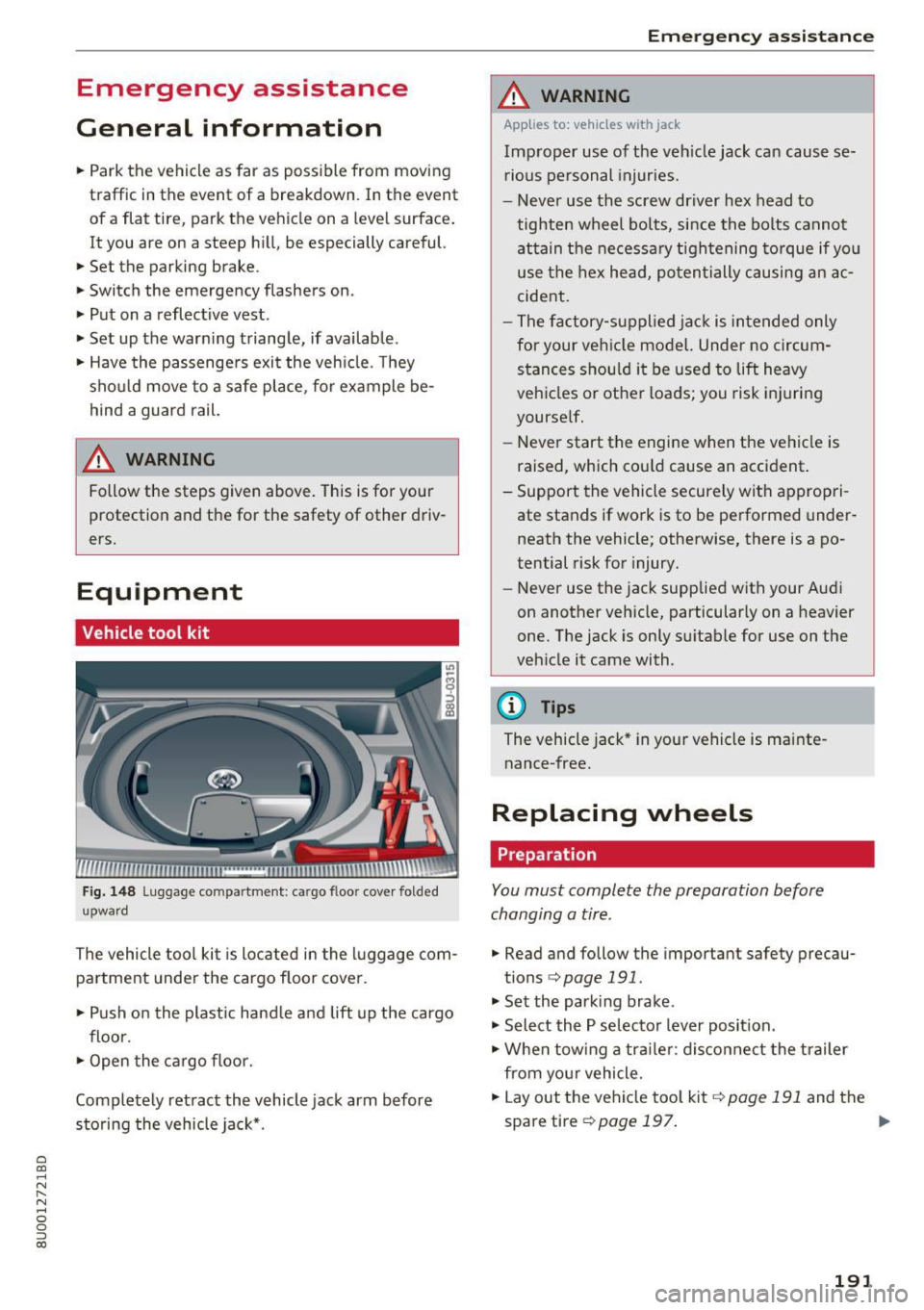
Fig. 1 48 Luggage compartmen t: ca rgo floor cover folded
upward
The vehicle tool kit is located in the luggage com
partment under the cargo floor cover .
.. Push on the plast ic hand le a nd lift up the cargo
floor.
.. Open the cargo floor.
Completely ret ract the vehicle jac k arm before
sto ring the vehicle jack*.
Em ergen cy a ssis tanc e
_& WARNING
-Applies to: ve hicles with jack
Improper use of the veh icle jack can cause se
rious pe rsonal injuries.
- Never use the screw driver hex head to
tighten wheel bolts, since the bolts cannot attain the necessa ry t ightening to rque if yo u
use the hex head, po ten tially causing an ac
cident .
- The factory-supplied jack is intended only
for your ve hicl e mode l. Under no circum
s tances shou ld it be used to lift heavy
vehicles o r other loads; you risk i njuring
yourse lf.
- Never start the engine when the vehicle is
raised, which cou ld cause an accident .
- Support the vehicle securely with appropri
ate stands if work is to be performed under
neath the vehicle; otherwise, there is a po
tential risk for injury.
- Never use the jack supplied with your Audi
on another vehicle, particularly on a heavier
one. The jack is only su itable for use on the
veh icle it came with .
{!) Tips
The vehicle jack * in your vehicle is mainte
nance-free.
Replacing wheels
Preparation
You must complete the preparation before
changing a tire .
.. Read and follow the important safety precau-
tions
<=:> page 191.
.,. Set the park ing brake .
.,. Select the P selector lever posit ion.
.,. W hen tow ing a tra iler: disconnect the trailer
from yo ur vehicle .
.. Lay out the vehi cle too l kit ¢
page 191 and the
spare tire
<=:> page 197.
191
Page 205 of 230
0 co ......
"' ,....
"' ...... 0 0 :::,
00
Emergency situations
General
This chapter is intended for trained emergency
crews and working personnel who have the nec
essary tools and equipment to perform these
operations.
Starting by pushing or
towing
CD Note
Vehicles with an automatic transmission
cannot be started by pushing or towing.
Starting with jumper
cables
If necessary, the engine can be started by con
necting it to the battery of another vehicle.
If the engine should fail to start because of a dis
charged or weak battery, the battery can be con
nected to the battery of
another vehicle, using a
pair of jumper cables to start the engine.
Jumper cables
Use only jumper cables of sufficiently large cross
section
to carry the starter current safely. Refer
to the manufacturer's specifications.
Use only jumper cables with
insulated terminal
clamps which are distinctly marked:
plus(+) cable in most cases colored red
minus(·) cable
in most cases colored black.
A WARNING
Batteries contain electricity, acid, and gas.
Any of these can cause very serious or fatal in
jury. Follow the instructions below for safe
handling of your vehicle's battery.
-Always shield your eyes and avoid leaning
over the battery whenever possible.
-A dead battery can freeze at temperatures
around 32 °F (0 °C). If the vehicle battery is
frozen, you must thaw it before connecting
the jump start cables. If you do not, this in-
Emergency situations
creases the risk of an explosion and chemi
cal burns. After jump starting the vehicle,
drive to an authorized Audi dealer or author
ized Audi Service Facility immediately to
have the vehicle battery checked.
- Do not allow battery acid to contact eyes or
skin . Flush any contacted area with water
immediately.
- Improper use of a booster battery to start a
vehicle may cause an explosion .
- Vehicle batteries generate explosive gases.
Keep sparks, flame and lighted cigarettes
away from batteries.
- Do not try to jump start any vehicle with a
low acid level in the battery .
- The voltage of the booster battery must also
have a 12-Volt rating. The capacity (Ah) of
the booster battery should not be lower
than that of the discharged battery. Use of
batteries of different voltage or substantial
ly different "Ah" rating may cause an explo
sion and personal injury.
- Never charge a frozen battery. Gas trapped
in the ice may cause an explosion.
- Never charge or use a battery that has been
frozen . The battery case may have be weak
ened.
- Use of batteries of different voltage or sub
stantially different capacity (Ah) rating may
cause an explosion and injury. The capacity (Ah) of the booster battery should not be
lower than that of the discharged battery.
- Before you check anything in the engine
compartment, always read and heed all
WARNINGS
qpage 155.
CD Note
-Applying a higher voltage booster battery
will cause expensive damage to sensitive electronic components, such as control
units, relays, radio, etc.
- There must be no electrical contact between
the vehicles as otherwise current could al
ready start to flow as soon as the positive
(+) terminals are connected.
203