warning light AUDI Q3 2018 Service Manual
[x] Cancel search | Manufacturer: AUDI, Model Year: 2018, Model line: Q3, Model: AUDI Q3 2018Pages: 230, PDF Size: 57.03 MB
Page 95 of 230
0 co ......
"' ,....
"' ...... 0 0 :::,
00
Electromechanical
steering
The ele ctromechanical steering supports th e
driver's steering movements.
Power steering adapts electronically based on
the veh icle speed .
Indicat or lights and me ssages
• Steering fault! Do not dr ive vehi cle!
If th is ind icator lig ht tu rns on and stays o n and
this message appears, the power steer ing may
have failed.
Do
not c ont in u e d riving. See an authorized Aud i
dea ler o r autho rized Aud i Serv ice Facility fo r as
sis tance.
If the indicator light turns on, the steering wheel may be more diff icult to move or more sensitive
than usual. The steering wheel may also be at an
angle when dr iving straight .
Drive s low ly to an author ized Audi dealer or au
thor ized Audi Se rvice Fac ility to have the mal
function co rrected.
kr-ij Steering lock: System fault ! Please contact
dealer.
There is a malfunction in the electronic steering
l ock.
Drive to an authorized Aud i dea ler o r aut horized
Audi Service Facility immediately to have the
malfunction corrected.
A WARNING
-
Have the system malfunction corrected as
soon as possible by an author ized Audi dealer
or authorized Aud i Service Fac ility, as this in
creases the risk of a n accident .
(D Tips
If the . or i1:.ij indicator light only stays on
for a short time, you may continue dr iv ing.
Intellig ent Technology
All wheel drive (quattro)
Applies to: vehicles with all wheel drive
In all wheel drive, all four wheels are powered.
General information
In all whee l drive, the dr iving power is div ided be
tween all fou r wheels . This happens automatical
ly depending on yo ur driving behavior as we ll as
the cur rent road conditions . A lso see ¢
page 89 .
The all whee l dr ive concept is des igned for high
engine power. Yo ur vehicle is except iona lly pow
erfu l and has excellent driving characteristics
both under normal driving conditions and on
snow and ice. Always read and follow safety pre cautions
q .&, .
Winter ti res
By using all whee l drive, your veh icle has good
forward motion w ith standard tires in winter con
ditions . However, using winter or all season tires
on
all four wheels in the winter is recommended,
because th is w ill improve the
braking effect.
Snow chains
If there a re snow chain laws, snow cha ins m ust
also be used on ve hicles with all wheel drive
¢ page 181, Snow chains .
Replacing tires
For vehicle s wi th a ll wheel d rive, o nly wheels wi th
the same roll ing ci rcumfe rence sho uld be used.
Avoid using tires with di fferen t tread depths
¢ page 173, New tires or wheels.
A WARNING
- Also, in vehicles with all whee l drive, adapt
your driving style to the current road and traffic cond itions. Do not let the increased
safety prov ided tempt you into taking r isks,
because this increases the risk of an acc i
dent.
- The braking ab ility of your vehicle is limited
to the trac tion of the wheels. I n this way, it
is not different from a two w heel d rive vehi
cle. Do no t be tempte d to accelerate to a
h igh speed when the ro ad is s lippery, be -
cause t his increases t he risk of an acci den t. ...,
93
Page 99 of 230
0 co ......
"' ,....
"' ...... 0 0 :::,
00
Driving safety
Basics
Safe driving habits
Please remember -safety first!
The individual safety features of your vehicle can
work together as a system to help protect you
and your passengers in a wide range of accidents.
T hese features cannot work as a system if they
are not always correctly adjusted and correctly
used.
This chapter contains important information,
tips, instructions and warnings that you need to
read and observe for your own safety, the safety
of your passengers and others . We have summar
ized here what you need to know about safety
belts, airbags, child restraints as well as child
safety. Your safety is for us
priority number 1. Al
ways observe the information and warnings in
this section -for your own safety as well as that
of your passengers.
The information in this section applies to all
model versions of your vehicle. Some of the fea
tures descr ibed in this sections may be standard
equipment on some models, or may be optional
equipment on others. If you are not sure, ask
your authorized Audi dealer.
A WARNING
- Always make sure that you follow the in
structions and heed the WARNINGS in this
Manual. It is in your interest and in the in
terest of your passengers .
-
-Always keep the complete Owner's Litera
ture in your Audi when you lend or sell your
vehicle so that this important information
will always be available to the driver and
passengers.
- Always keep the Owner's literature handy so
that you can find it easily if you have ques
tions.
Driving safety
Important things to do before driving
Safety is everybody's job! Vehicle and occupant
safety always depends on the informed and care
ful driver .
For your safety and the safety of your passen
gers,
before driving always:
.. Make sure that all lights and signals are operat
ing correctly.
.. Make sure that the tire pressure is correct .
.. Make sure that all windows are clean and afford
good visibility to the outside .
.,. Secure all luggage and other items carefully
¢ page 102, ¢page 45.
.,. Make sure that nothing can interfere with the
pedals.
.. Adjust front seat, head restraint and mirrors
correctly for your height.
.. Instruct passengers to adjust the head re
straints according to their height.
.. Make sure to use the right child restraint cor
rectly to protect children
¢ page 134, Child
safety.
.,. Sit properly in your seat and make sure that
your passengers do the same¢
page 42, Front
seats.
.. Fasten your safety belt and wear it properly. Al
so instruct your passengers to fasten their safe
ty belts properly ¢
page 106 .
What impairs driving safety?
Safe driving is directly related to the condition of
the vehicle , the driver as well as the driver's abili
ty to concentrate on the road without being dis
tracted.
The driver is responsible for the safety of the ve
hicle and all of its occupants. If your ability to
drive is impaired, safety risks for everybody in the
vehicle increase and you also become a hazard to
everyone else on the road
¢ _&. . Therefore:
.. Do not let yourself be distracted by passengers
or by using a cellular telephone .
.. NEVER drive when your driving ability is im
paired (by med ications, alcohol, drugs, etc .) .
.. Observe all traffic laws, rules of the road and
speed limits and plain common sense . .,.
97
Page 100 of 230
Driving sa fety
• ALWAYS adjust your speed to road, traffic and
weather conditions.
• Take frequent breaks on long trips. Do not drive
for more than two hours at a stretch.
• Do NOT drive when you are tired, under pres
sure or whe n you are stressed .
A WARNING
Impaired driv ing safety inc reases t he risk of
ser ious persona l inju ry and death whenever a
vehicle is being used.
Correct passenger
seating positions
Proper seating position for the driver
The proper driver seating position is important
for safe, relaxed driving .
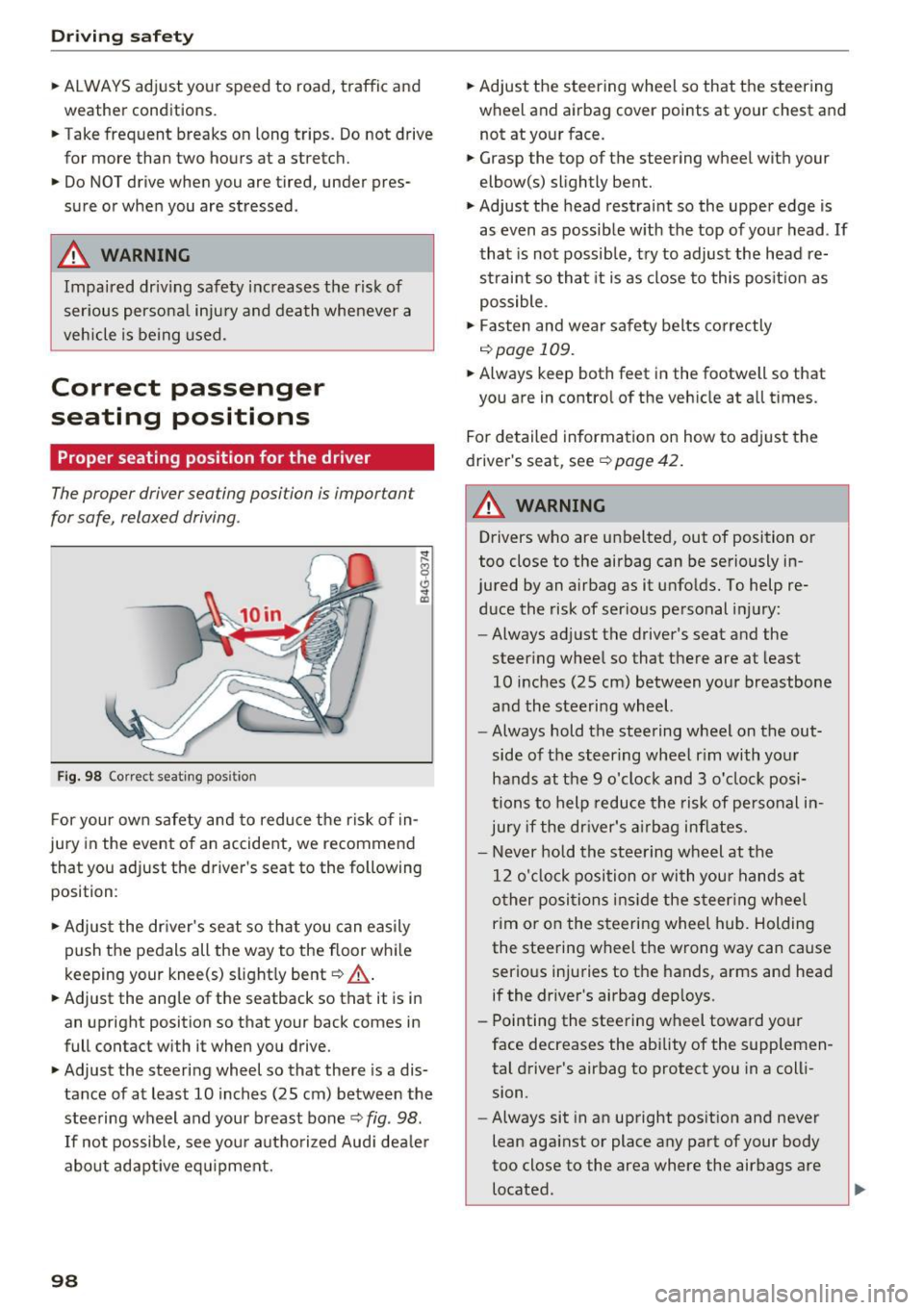
Fig. 9 8 Correct seating pos it io n
For your own safety and to reduce the risk of in
jury in the event of an accident, we recommend
that you adjust the driver 's seat to the following
position :
• Adjus t the dr iver's seat so tha t you can easily
push the pedals all the way to the floor whi le
keeping your knee(s) s light ly bent ~
,A.
• Adjust the angle of the seatback so that it is in
an upright position so that your back comes in
full contact with it when you drive.
• Adjust the steering wheel so that there is a dis
tance of at least 10 inches (25 cm) between the
stee ring wheel and your breast bone~
fig. 98 .
If no t possib le, see you r authorized Aud i dea le r
about adapt ive eq uipment.
98
• Ad just the steering wheel so that the steer ing
wheel and airbag cover points at your chest and
not at yo ur face .
• Grasp the top of the steering wheel with your
elbow(s) slightly bent.
• Adjust the head restraint so the uppe r edge is
as even as possib le w ith the top of your head .
If
that is not possib le, try to adjust the head re
strai nt so that it is as close to this pos it io n as
possible.
• Fasten and wear sa fe ty belts correctly
r=>page 109.
• Always keep both feet in the footwell so that
you are in contro l of the veh icle at all t imes .
Fo r de tailed informa tion on how to ad just the
dr ive r's seat,
see r=!) page 42 .
A WARNING
Drivers who are unbelted, out of position or
too close to the airbag can be seriously in
jured by an airbag as it unfo lds. To help
re
duce the risk of serious personal injury:
- Always ad just the driver 's seat and the
steering whee l so that there are at least
10 inches (25 cm) between yo ur breastbone
and the steering wheel.
- Always hold the steering wheel on the out
side of the steering wheel r im with yo ur
hands at t he 9 o'clock and 3 o'clock posi
tions to help reduce the risk of personal i n
jury if the driver's airbag in flates.
- Never hold the stee ring wheel at the
1 2 o'cl ock position o r wi th you r hands at
o ther posi tion s in side the steer ing whee l
rim o r on the steeri ng wheel hub. Holding
the steering wheel the wrong way can cause serious inju ries to the hands, arms and head
if the drive r's airbag dep loys.
- Pointing the steering wheel towa rd your
face decreases the ability of the supplemen
tal d river 's airbag to protect you in a coll i
sion.
- Always sit in an upright pos ition and never
lean aga inst or place any part of your body
too close to the area where the airbags are
located.
-
Page 108 of 230
Safety belt s
Safety belts
General information
Always wear safety belts!
Wearing safe ty belts correctly saves lives!
This chapte r explains why safety be lts a re neces
sary, how they work and how to adjust and wear
them correct ly.
.. Read all the information that follows and heed
all of the instructions and WARNINGS.
&_ WARNING
Not wea ring safety belts or wearing them im
properly increases the risk of ser ious personal
injury and dea th .
- Safety belts are the s ingle most effective
mea ns ava ilab le to reduce the risk of serious
injury and dea th in automob ile accidents .
For yo ur protect ion and that of your passe n
gers, alw ays co rre ctly wea r sa fety be lt s
when the veh icle is moving .
- Pregnant wom en, in ju re d, o r physically i m
paired persons mus t also use s afety be lts.
L ik e all vehi cle o ccu pants, they are mo re
li kely to be serio usly injure d if th ey do no t
wea r safety be lts. The best way to protect a
fetus is to protect the mothe r -th roughout
the ent ire pregnancy .
Number of seats
Your Audi has a total of five seating positions:
two in the front and three in the rear. Each seat
i n g position has a safety belt.
&_ WARNING
N ot wea ring safety bel ts or weari ng them im
properly increases th e r isk of ser ious personal
inju ry and dea th.
- N ever st rap more tha n one perso n, includ
ing small ch ildren, into a ny be lt .
It is espe
ci ally dan gerous to pla ce a sa fety bel t over a
c hild s itting on you r lap.
- N ever le t mo re people ride in t he vehicle
t h an t he re are saf ety bel ts availab le.
106
-Be sure everyone riding in the vehicle is
properly restrained with a separate safety
be lt or ch ild restraint.
Safety belt warning light
Your vehicle has a warning system for the driver
and front seat passenger to remind you about the importance of buckling-up.
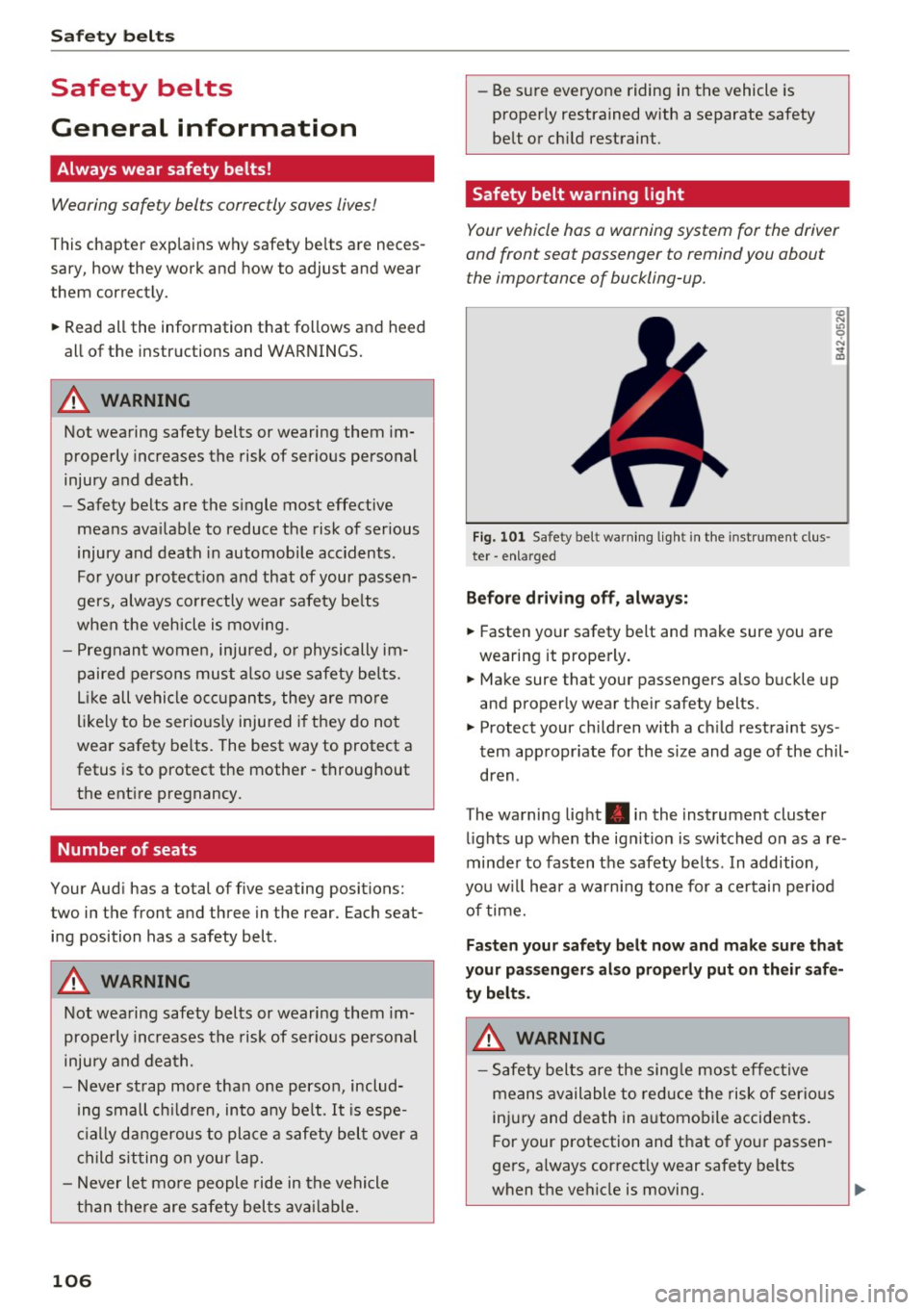
Fig. 101 Safety belt wa rning lig ht in th e in st ru ment clu s·
ter · enl arged
Before driving off , always:
.. Fasten yo ur safety belt and make sure you are
wearing it properly.
.. Ma ke sure that your passengers also b uck le up
and properly wear t heir safety belts.
.. Protect your chi ldren with a ch ild restraint sys
tem app ropr iate for the size and age of the chil
dren .
The wa rning lig ht . in the inst rument cluste r
li ghts up w hen the ig nition is switched on as a re
minde r to fas ten the safety be lts . In addition,
you w ill hear a wa rn in g tone for a ce rtain per iod
of time .
Fasten your safety belt now and make sure that
your passenger s also properly put on their safe
ty belt s.
&_ WARNING -
- Safety bel ts are the sing le mos t eff ec tive
means available to re du ce the risk of serio us
in jur y and dea th in a utomobile accidents.
F or your protection and t hat of yo ur passen
ge rs, a lways cor rect ly wear safety belts
when the vehicle is movin g.
Page 112 of 230
Safe ty belts
Autom ati c s afet y belt retr actors
Every safety belt is equ ipped with an automa tic
be lt retractor on the shoulder belt. This feature
locks the belt when the belt is pulled out fast,
during hard braking and in a n accident . The belt
may a lso lock when you drive up or down a steep
hill or through a sharp curve. Dur ing normal driv
ing the belt lets you
move freely .
Safety belt p ret en sion ers
Safety belts w ith pretensioners he lp to tighten
the safety belt and remove s lack when the pre
tensioners are activated ¢
page 112. The func
tion of the pretensioner is monitored by a warn ing light
¢ page 14.
Con vertib le loc king retract or
Every safety belt except the one on the driver
seat is equipped with a convertible locking retrac
tor that
m ust be used when the safety belt is
used to attach a child safety seat. Be sure to read
the impo rtant information about this feature
¢ page 144.
.&_ WARNING
Improperly pos itioned safety be lts can cause
ser ious injury in an accident
¢page 110,
Safety belt position.
- Safety belts offer optimum protection only
when the seatback is upright and belts are
properly positioned on the body.
- Always make sure that the rear seat bac k
rest to which the center rea r safety belt is
attached is secure ly latched whenever the
rear center safety belt is being used. If the
backrest is not securely latched, the passen
ger will move forward with the backrest dur
ing sudden braking, in a sudden maneuver
and especially in a crash.
- Never attach the safety belt to the buckle for another seat. Attaching the belt to the
wrong buckle wi ll reduce safety belt effec
t iveness and can cause serious persona l in
jury.
- A passenger who is not properly restrained can be seriously in ju red by the safety be lt it
self when it moves from the stronger parts
110
of the body into critical areas like the abdo men.
- Always lock the convertible locking retractor
when you are securing a child safety seat in
the vehicle ¢
page 146.
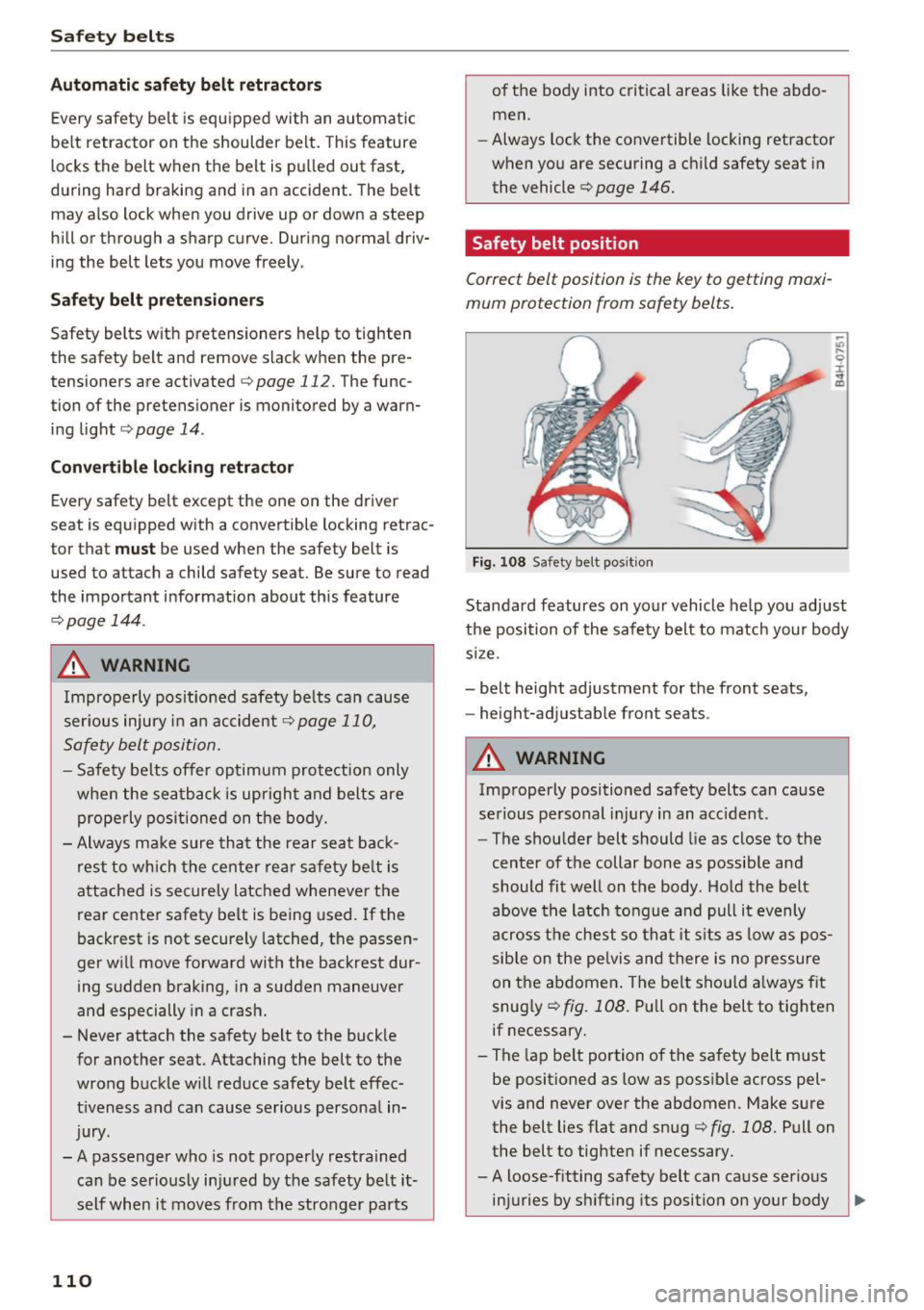
Safety belt position
Correct belt position is the key to getting maxi
mum protection from safety belts .
Fig. 108 Safety belt pos it ion
-"' .... 9 I ... a,
Standard features on your vehicle help you adjust
the position of the safety belt to match your body
s ize.
- belt height adjustment for the front seats,
- height-adjustab le front seats .
.&_ WARNING
Improperly positioned safety belts can cause
serious personal injury in an acc ident .
- The shoulder belt should lie as close to the
center of the collar bone as possib le and
should fit well on the body. Hold the belt
above the latch tongue and pull it evenly
across the chest so that it s its as low as pos
sib le on the pe lvis and there is no p ressure
on the a bdomen . The belt sho uld a lways f it
snug ly ¢
fig. 108. Pull on the belt to tig hten
if necessary .
- The lap be lt portion of the safety belt must
be positioned as low as possible across pel
vis and never
over the abdomen. Make sure
the belt lies flat and snug ¢
fig. 108. Pull on
the belt to tighten if necessary.
- A loose-fitting safety belt can ca use serious
injuries by sh ifting its position on your body ..,_
Page 119 of 230
0 co ......
"' ,....
"' ...... 0 0 :::,
00
re commend that children a lway s sit in t he b ack
seat ~
page 134, Child safety .
A WARNING
A child in a rearward-faci ng chi ld safety seat
installed on the front passen ger seat w ill be
seriously injured and can be killed if the front airbag inflates -even w ith an Advanced A irbag
System .
- The inflating a irbag w ill hit the child safety
seat or infant carrier with great force and
will smash the ch ild safety seat and child
against the backrest, center armrest, door
o r roof.
- Always install rear-facing child safety seats
on the rear seat.
- If you must install a rearward fac ing ch ild
safety seat on the front passenger seat be
cause of exceptiona l circumstances and the
PASSENGER AIR BAG OFF light does not
come on and stay on, immed iate ly install
the rear-fac ing ch ild safety seat in a rear
seating posit ion and have the airbag system
inspected by your authorized Audi dea ler.
- Forward-fac ing ch ild safety seats installed
on the front passenger's seat may interfere
with the deployment of the airbag and cause serious personal injury to the child.
A WARNING
If, in except ional circumstances, you must in
stall a forward-facing chi ld restraint on the
front passenger's seat:
- Always make sure the forward-fac ing seat
has been designed and ce rtified by its man
ufacturer fo r use on a fron t seat with a pas
senger front and s ide a irbag.
- Never put the forward-facing child restraint
up against or ve ry near the instrument pan
el.
- Always move the front passenger seat to
the highest position in t he up an d down ad
justment range and move it b ack to the
re ar most position in the se at's fore and a ft
adjustment range, as far away from the air
bag as possib le, before insta llin g the for
ward-facing child restraint .
Airbag sys tem
-Always make sure that the safety be lt upper
anchorage is behind the ch ild restraint and
not next to or in front of the child restraint
so that the safety be lt will be properly posi
tioned .
- Make sure that the
PASSENGER AIR BAG
OFF
li ght comes on and stays on a ll the time
wheneve r the ignit ion is switched on.
A WARNING
-To reduce the risk of serious injury, ma ke sure
that the
PASSENGER AIR BAG OFF ligh t will
be d isplayed whenever a c hild rest raint is i n
st alle d on the front passenger seat and the
i gni tion is switched on.
- I f the
PASSENGER AIR BAG OFF light does
not stay on, perform the checks de scribe d
q page 124, Monitoring the Advanced Air
bag System .
- Take the child restra int off the front passen
ger seat and install it properly at one of the rear seat positions if the
PASSENGER AIR
BAG O FF
light does not stay on.
- Have the ai rbag system inspected by your
author ized Audi dealer immed iate ly .
- Always carefully follow instructions from
child restraint manufacturers when instal
ling child restra ints.
A WARNING
-If, in exceptional c ircumstances, you must in
stall a forward or rearward-facing child re
stra int on the front passenger's seat :
- Improper installat ion of child restraints can
reduce the ir effectiveness or even prevent
them from providing any protect ion.
- An improperly installed child restra int can
interfere with the airbag as it deploys and
serio usly injure or even ki ll the chi ld -even
with an Advanced A irbag Sys tem.
- Always carefully follow the manufacturer's
instr uctions provided with the child safe ty
seat o r ca rr ie r.
- Never p lace add itiona l items on the seat
that can increase t he total weight registered
by the weight-sensing mat and can caus e in
jury in a crash .
117
Page 122 of 230
Airbag syste m
If the front passenger airbag deploys , the Feder
al Standard requires the airbag to meet the "low risk" deployment criteria to help reduce the risk
of injury through interaction with the airbag.
"Low risk" deployment occurs in those crashes
that take place at lower decelerations as defined in the electronic control unit . ~
page 124
Alway s rem ember: Even though you r veh icle is
equipped with Advanced Airbags, the safest place
for children is properly restrained on the back
seat. Please be sure to read the important infor
mat io n in the sections that follow and be sure to
heed a ll of the WARN INGS .
_& WARNING
To reduce the risk of inj ury when an airbag in
flates, a lways wear safety belts properly .
-If you are unrestrained, leaning forwa rd, s it
t ing s ideways or o ut of pos ition in any way,
yo ur risk of injury is much higher .
- Yo u will also receive serious injur ies and
could even be killed if you are up aga inst the
airbag or too close to it when it inflates -
even with an Advanced Airbag r:!> page 114.
_& WARNING
A child in a rearward-facing child safety seat
installed on the front passenger seat wi ll be
ser iously injured and can be killed if the front
airbag inflates -even w ith an Advanced Airbag
System .
- Although the Advanced A irbag System in
your vehicle is designed to turn off the front
airbag when a rea rward-facing child re
straint has been insta lled on the front pas
senger seat, nobody can absolutely guaran
tee that deployment is impossible in all con
ceivable s ituations that may happen during
the useful life o f you r vehicle .
- T he inflating a irbag w ill hit the child safety
seat or infant carrier with great force and
will smash the chi ld safety seat and child
against the backrest, center armrest, door,
or roof.
- Always install rearward-facing chi ld re
straints in the back seat.
120
- If you must install a rearwa rd facing child
safety seat on the front passenger seat be
cause of exceptional circumstances and the
PA SS EN GER AIR BAG OFF light does not
come on and stay on, immediately install
the rea r-facing child safety seat in a rear
seating position and have the ai rbag system
inspected by your authori zed Aud i dealer.
_& WARNING
If, in exceptional ci rcums tances , you must in
stall a forward-facing child restraint on the
front passenger's seat :
- Always make sure the forward-facing sea t
has been des igned and certified by its man
ufacturer for use on a front seat with a pas
senger front and side airbag.
- Never put the forward -facing child restraint
up against or very near the instrument pan
el.
- Always move the front passenger seat to
the highest posit ion in the up and down ad
justment range and move it back to the
rearmost posit ion in the seat's fore and aft
adjustment range, as far away from the a ir
bag as poss ible, before installing the for
ward-facing chi ld restrain t.
- Always make sure that the safety be lt upper
anchorage is behind the ch ild restraint and
not next to o r in front of the child rest raint
so that the safety be lt will be p roperly posi
tioned.
- Always move the passenge r seat into its
rearmost posit ion i n the seat's fo re and aft
ad justmen t range, as far away from the a ir
bag as poss ible, before install ing the for
ward-facing chi ld restraint. The backrest
must be adjusted to an upright position.
- Ma ke sure that the
PASSENGER AIR BAG
OFF
li ght comes on and stays on all the time
whenever the ign it ion is switched on.
' Advanced Airbag System components
The front passenger seat in your veh icle has a lot
of very impo rtant parts of the Advanced A irbag
System in it . These parts include the weight-
sensing mat, sensors , wir ing, brackets, and .,.
Page 123 of 230

more. The function of the system in the front
passenger seat is checked by the electronic con
trol unit when the ignition is on . The control unit
monitors the Advanced Airbag System and turns
the airbag indicator light on when a malfunct ion
i n the system components is detected . The func
tion of the airbag indicator light is descr ibed in
greater detail below . Because the front passen
ge r seat contains important parts of the Ad
vanced A irbag System, you m ust take care to p re
vent it from being damage d. Damage to the seat
may prevent the Advanced Airbag for the front
passenger seat from doing its job in a crash.
The front Advanced Airbag System consists
of the following :
-Crash sensors in the front of the vehicle t hat
measure vehicle acceleration/deceleration to
provide information to the Advanced Airbag
System a bout the severity of the crash.
- An electronic control un it, with integrated
crash sensors for front and side impacts. The
contro l unit "decides" whether to fire the front
airbags based on the information received from
the crash sensors. The control unit a lso "de
c ides " whether the safety be lt pretens ione rs
sho uld be activated .
- An Advanced Airbag with gas generator and
contro l valve for the d river ins ide the s teer ing
whee l hub.
- An Advanced Airbag with gas generator and
contro l valve inside the instrument pa ne l for
the fron t passenger.
- A weig ht-sensing mat unde r the upho lstery
padding of the front passenge r seat c ushion
that meas ures the to tal weight on the sea t. The
informa tion registered is sen t continuously to
the e lectronic cont ro l unit to reg ulate dep loy
ment of the front Adv a need Ai rbag on the pas
senger side.
- An airbag monitoring system and indicator
light in the instrument cluster
¢ page 124.
-A sensor in each front seat reg isters the dis
tance between the respective seat and the
steering wheel or instrument pane l. The infor
o co mation reg istered is sent continuously to the ......
~ electronic control unit to regulate deployment N
8 of the fro nt Advanced A irbags . 0
:::,
00
Airb ag sys tem
-The PASSENGER AIR BAG OFF light comes on
and stays on in the center of the instrument
pane l¢
page 125, fig . 115 and te lls yo u when
the front Advanced Airbag on the passenger side has been turned off.
- A sensor below the safety be lt latch for the
front seat passenger to measure the tension on the safety belt. The tension on the safety belt
and the we igh t registered by the weight -sens
ing mat help the contro l unit "decide" whethe r
the front airbag fo r th e fron t passe nger seat
should be tu rned off o r not ¢
page 115, Child
restrain ts on the front seat -some impor tant
things to know.
- A sensor in the s afety be lt latch for the drive r
an d for the front seat passenger that senses
whether tha t safety be lt is la tched o r not and
transmits this information to the e lectronic
control un it.
A WARNING ,-
Damage to the front passenge r seat can pre-
vent the front airbag from working properly.
- Improper repair or disassembly of the front
passenger and driver seat will prevent the
Advanced Airbag System from f unct ion ing
properly .
- Repairs to the front passenger seat must be
performed by qualified and p roper ly trained
wo rkshop personne l.
- Never remove the front passenger or d river
seat from the vehicle.
- Never remove the upholstery from the front
passenger seat.
- Never d isassemble or remove parts from the
seat or disconnect w ires from it.
- Never carry sharp objects in your pockets or
p lace them on the seat . If the weight-sens
ing mat in the passenger seat is punctu red
it cannot work p roper ly .
- Never carry things on your lap or carry ob
jects on the passenge r seat . S uch items can
increase the weight reg istered by the
weight-sensing mat and s end the wrong in
formation to the a irbag control unit.
- Never store i tems unde r the front passenger
seat. Parts of the Advanced Airbag System
un der t he passenger se at could be
~
121
Page 124 of 230

Airbag syste m
damaged, preventing them and the airbag
system from working properly.
- Never place seat covers or rep lacement up
holstery that have not been specifically ap
proved by Audi on the front seats .
- Seat covers can prevent the Advanced Air
bag System from recognizing child re
straints or occupants on the front passenger
seat and prevent the side a irbag in the seat
backrest from deploying properly.
- Never use cush ions, pillows, blankets or
similar items on the front passenger seat.
The add it ional padding will prevent the
weight-sens ing mat in the seat from acc u
rately reg istering the ch ild restraint or per
son on the seat and prevent the Advanced
Airbag System from funct ioning properly.
- If you must use a child rest raint on the front
passenge r seat and the child restraint man
ufacturer 's instructions require the use of a
towel, foam cushion or something else to properly position the ch ild restraint, make
certain that the
PA SSENGER AIR BAG OFF
light comes on and stays on whenever the
child restraint is installed on the front pas
senger seat.
- If the
PASSEN GER AIR B AG OFF light does
not come on and stay on, immed iately in
stall child restraint in a rear seating position
and have the airbag system inspected by
yo ur autho rized Aud i deale r.
How the Advanced Airbag System
components work together
The front Advanced Airbag System and the side
airbags supplement the protection offered by the
front three-po int safety belts and the adjustable
head restraints to help reduce the risk of injury in
a w ide range of acc ident and crash s ituations . Be
sure to read the important information about
safety and heed the WARNINGS in th is chapter.
Deployment of the Advanced Airbag System and
the act ivat ion of the safety belt pretensioners de
pend on the deceleration measured by the crash
sensors and registered by the electronic control
un it. Crash severity depends on speed and de cel-
122
eration as well as the mass and stiffness of the
vehicle or object involved in the crash .
On the passenger side, regard less of safety be lt
u se, the airbag will be turned off if the weight on
the passenger seat is less than the amount pro
grammed in the electronic control unit . The front
airbag on the passenger side will also be turned
off if one of the child safety seats that has been
certified under Federal Motor Vehicle Safety
Standard 208 has been recogn ized on the seat .
The
PASSENGER A IR BAG OFF lig ht comes o n
and stays on to te ll you when the front Advanced
Airbag on the passenger side has been turned off
q page 115, Child restraints on the front seat
some important things to know.
A WARNING
To reduce the ris k of injury when an airbag in
f lates, always wea r safety belts properly.
- If you are un restrained, leaning forward, sit
ting sideways or out of position i n any way,
your risk of injury is much higher.
- You will a lso receive serious injuries and
could even be killed if you are up against the
airbag or too close to it when it inflates -
even with an Advanced Airbag
q page 114.
More important things to know about front
airbags
Fig . 114 Inflated front a irbags
Safety be lts are important to help keep front
seat occupants in the proper seated position so
that airbags can unfold properly and prov ide sup-
plemental protection in a fronta l collision . ..,.
Page 125 of 230
0 co ......
"' ,....
"' ...... 0 0 :::,
00
The front airbags are designed to provide addi
tional protection for the chest and face of the
driver and the front seat passenger when:
- sa fety belts are worn prope rly,
- the seats have been positioned so that the oc-
c u pant is properly sea ted as far as possible
from the airbag,
- and the head restra ints have been p roperly ad-
justed.
Because airbags inflate in the blink of an eye w ith
g reat fo rce, things you have on your lap or have
p laced on the seat cou ld become dangerous pro
jectiles, and be p ushed into you if the ai rbag in
flates.
When an a irbag deploys, fine dust is released.
This is normal and is not caused by a fire in the
ve hicl e. Thi s dust is made up mostly of a powder
used to lubricate the airbags as they deploy. It
could irritate skin.
It is important to remember that whi le the sup
p lemental airbag system is designed to reduce
the likel ihood of ser ious injuries, other i nju ries,
for example swelling, bruising and minor abra
sions, can a lso happen when airbags inflate . Air
bags do not protect the arms or the lower parts
of the body. Front airbags only supplement the
three po int safety belts in some frontal collisions
i n which the ve hicle decelerat io n is high enough
to deploy the airbags .
F ront airbag s will not deploy:
- if the ignit ion is switched off when a crash oc-
curs,
- in side collisions,
- in rear-end collisions,
- in rollove rs,
- when the c rash decelerat io n meas ured by the
airbag system is less than the minimum thresh
o ld needed for airbag deployment as registered
by the electronic contro l unit.
The front passenger airbag will also not d eplo y:
- when the front passenger seat is not occ upied,
- when the we igh t on the fron t passenge r seat as
sensed by t he Advanced A irbag System indi-
Airb ag sys tem
cates that the front a irbag on the passenger
side has to be turned off by the e lectronic con
trol unit (the
PASSENGER AIR BAG OFF light
comes on and stays on).
A WARNING
Sitting in the wrong position can increase the r isk of ser ious injury in crashes .
- To reduce the r isk of injury when the airbags
inflate, the driver and passengers must al
ways sit in an upright posit ion, must not
lean aga inst or place any part of their body
too close to the area where the airbags are
lo cated.
- Occupants who are unbelted, out of posit ion
or too close to the airbag can be serio usly
in jur ed by an airbag as it unfolds with g reat
force in the blink of an eye
r=> page 115.
A WARNING
-A child in a rearward-facing child safety seat
insta lled on the front passenger seat will be
seriously injured and can be ki lled if the front
airbag inflates -even with an Advanced Airbag
System.
- The inflating airbag will h it the ch ild safety
seat or in fant carr ier with great force and
will smash the child safety seat and child aga inst the backrest, center armrest, door
or roof.
- Always install rear-fac ing child safety seats
on the rear seat.
- If you must install a rearward facing child
safety seat on the front passenger seat be
cause of exceptional circumstances and the
PASSENGER AIR BAG OFF light does not
come on and stay on, immedia tely insta ll
the rea r-facing child safety se at in a rear
seating posi tion and have the airbag system
inspected by your au thorized Audi dealer.
A WARNING
= -
Objects between you and the airbag will in -
crease the risk of injury in a crash by interfer
i ng with the way the airbag unfolds or by be
i ng p ushed into you as the airbag inflates.
123