warning light AUDI Q5 2013 Owners Manual
[x] Cancel search | Manufacturer: AUDI, Model Year: 2013, Model line: Q5, Model: AUDI Q5 2013Pages: 316, PDF Size: 78.89 MB
Page 222 of 316
220 Cleaning and protec tio n
- do not clean the camera lenses and the
area around them with the pressure
washer.
- Never use warm or hot water to remove
snow or ice from the camera lens. T his
could cause the lens to crack.
- Never clean the camera lens with abra
sive prod ucts .
Waxing and Polishing
Wa xing
A good wax coating protects the vehicle paint
to a large extent against the environmental
factors listed under
qpage 216, Washing and
even against slight scratches .
You can use a liquid car wax to protect your pa int as soon as one week after your veh icle
has been delivered.
Even if you regularly use a
w axi ng process in
automatic car washes, we recommend that
you manua lly app ly a coat of wax to give the
pa int extra protection, particularly if water no
longer beads on the clean paint .
Protect p lastic body parts with car wax in the
same way as the vehicle body.
During wa rm weather dead insects tend to
collect on the front bumper and on the for
ward area of the hood . They are much easier
to remove from paint that is waxed
often.
P oli shing
Polish your vehicle on ly if the paint has lost its
shine and the g loss cannot be brought back
with wax .
I f the polish used does not contain preserva
tive compounds, the paint must be waxed af
terwards .
_&. WARNING
Always read and heed a ll WARNINGS and
other information
9 page 216.
@ Note
Donotusecarwaxon -
matte o r anodized meta l trim
- rubber or rubber- like t rim.
Trim strips
Metal trim needs special care.
For environmental reasons, Audi fabricates
the bright trim strips and trim p ieces from
pure chromium-free aluminum .
Dirt and marks on the trim strips should be
removed with a
pH-b alan ced cleaning agent
(do not use a chrome cleaner) . Authorized
Audi dealers carry cleaning products which have been tested for use on you r vehicle and
are not ha rmfu l to the environment.
To avoid corrosion on the exter ior trim strips ,
only a pH-ba lanced solution shou ld be used
for the windsh ield washer.
_&. WARNING
A lways read and heed all WARNINGS and
other information
q page 216.
Plastic and vinyl
Plastic needs special care.
Use a clean, damp cloth or sponge to remove
dust and light surface dirt . For othe r soil, use
a lukewa rm all-pu rpose cleaning solution or a
mild saddle soap for v inyl tr im . Remove wate r
spots and traces of soap wi th a clean, damp
cloth or sponge. Use a clean, soft cloth to rub
dry.
G rease , tar or oil sta ins can be removed with a
cle an cloth or sponge soaked wi th a ll-purpose
cleaner or with a solvent designed especia lly
to clean vinyl.
O ccas ional ly app ly a colorless v inyl or leather
preservative to re tain the materia l's luster
and pliability.
_&. WARNING
A lways read and heed all WAR NINGS and
other information
q page 216.
Page 224 of 316
222 Cleaning and protec tio n
-To h elp prevent dirt fr om scratch ing the
win dow, always scrape in a f orward di
rection -pu shing the scraper away from
you -never back and fo rth.
- Water leaking from the inside of the rear
windows may damage sensitive electrical
components located either under the
rear parcel shelf or in the rear trunk area.
Always ensure that water
never leaks
through the body sect ion of the vehicle.
You can do this by using waterp roof pro
tection
over the vehi cle's electr ical com
ponen ts (e.g., when ins tall ing window
tinting) .
- Damage or malf unct ion of electrical
componen ts due to wa ter damage or any
other outside influence is not covered by
the Audi New Vehicle Limited Warranty .
See your Warranty
& Maintenance book
l et for add itiona l details about your war
ranty.
Cast (light ) alloy wheels
Cast (light) alloy wheels require special care.
... Wash the whee ls w ith a sponge or hose
brush
every other week .
... For deep cleaning afterwards, use only a
dedicated
acid-free cast alloy wheel cleaner.
., Rub a coat of
liquid wa x onto the r ims every
three month . Be sure to reach and treat a ll
parts of the rim .
To preserve the decorat ive appearance of the
cast a lloy whee ls, some specia l care is neces
sary. In add it io n to road dirt and sa lt, b rake
dust is a lso cor ros ive . If left o n for too long,
b rake dust ca n cause pitting.
Use on ly special
acid-free cleaners formulated
for a lloy rims . Safe products are available at
your author ized Audi dealer. Never leave the
cleane r on the r ims longe r than spec ified o n
the label.
If no t rinsed off p romp tly, the a cid
con tained in some cleaners can attack the
threads on the whee l bolts.
Never use ab ras ive or metal polishing clean
i ng agen ts.
If the pro te ct ive coa ting has been chipped, e.g
. by kicked up road dirt, to uch it
u p as soon as possible.
A WARNING
--
- Moisture and ice on b rakes may affect
brak ing eff ic iency
c::> page 200, Brake sys
tem.
Test the brakes carefully each t ime
you wash the vehicle .
- Always read and heed all WARNINGS and
other information
c::> page 216.
Body cavity sealing
The body cavity sealing does not need to be
checked.
All body cavit ies which could be affected by
corros ion have been thorough ly protected at
the factory.
T his sealing does not require any inspection or
additional treatment. If any wax shou ld seep
o ut of the cavity when the ambient tempera
ture is high, it can be
removed with a p lastic
scraper and a suitable solvent .
A WARNING
-Solvents can be dangerous.
- Benz ine is flammab le and toxic. If you
use benz ine for removing the wax, keep
sparks , flame and lighted cigarettes
away . Never dump benz ine on the
g round, into open streams or down sew
age d rains.
- Be s ure to
observe all safety and environ
men tal regulat ions. Follow all instruc
tions on the container.
- Always read and heed all WAR NINGS and
other info rmation
c::> page 216.
Chassis
Have the undercoating checked for damage
from time to time .
The lower body shell of your Aud i is also thor
oughly protected against corros io n.
Any damage to the undercoat ing ca used by
road hazards should be repaired prompt ly.
Page 225 of 316
& WARNING
Too much undercoating in the wrong pla
ces can cause a fire.
- Do not apply additional undercoating or
rustproofing on or near the exha ust
manifold, exhaust pipes, cata lytic con
verter or heat shie lds . Wh ile driving, the
substance used for undercoating could overheat and cause a f ire.
- Always read and heed all WARNINGS and other information
c:> page 216.
Exhaust tail pipes
-
Road sa lt and other corros ive materia ls will
damage the mater ial in the exhaust tail p ipes
if they are not cleaned regula rly . Do not clean
the ta il p ipes with whee l cleaner, paint polis h,
chrome polish or othe r abrasive cleane rs.
C lean the tail p ipes wi th car care prod ucts
that are s uitab le for stain less stee l.
Your authori zed Audi dealer can provide clean
in g p roducts t hat have been tested and ap
p roved for you r vehi cle.
Care of interior
Radio and MMI* display
.,. Clean the d isp lay w ith a soft clea n cloth and
an LCD cleane r.
The display can be cleaned w ith a professio
na lly available "LCD cleaner". The cloth shou ld
be slightly dampened with the clean ing flu id
to clean the display .
(D Note
To avoid scratching the display, you should
never clean it dry .
MMI control console
Applies to vehicles: with MMI
.. First clean the MMI control console with a
brus h to remove dust from the hous ing .
.,. The n w ipe the MMI con tro l c onso le w ith a
cl ean, soft, s ligh tly damp cloth .
Cleaning and protec tion 223
The M MI contro l console sho uld be cleaned
with a brush first so that no dirt is t rapped be
tween the buttons and the housing . We rec
ommend giving the MMI control conso le a fi
nal wipe with a cloth moistened with water
and dish washing detergent .
(D Note
To prevent damage, make s ure that no flu
i d ever gets into t he MMI contro l conso le.
Aluminum trim
Use only neutral-pH products to remove spots
and deposits from aluminum surfaces .
Chrome care products a nd a lkaline cleaners
will attack a luminum surfa ces and ca n dam
age them over t ime .
& WARNING ~
Always read and heed all WARN INGS and
other info rmation
c:> page 216.
Fabrics and fabric coverings
Fabrics and fab ric coverings (e.g . seats, door
trim pane ls, etc .) sho uld be cleaned at regular
intervals w ith a vacuum cle aner. This removes
su rface dirt particles which could become em
bedded in the fabric through use . Steam
cleaners sho uld not be used , because the
steam te nds to p ush the dirt deeper into the
fabric and lo ck it the re.
Normal cleaning
Generally, we recommend us ing a soft sponge
o r a lint -free microfibe r clo th to t he clean fab
r ic. B rushes s hou ld only be used for carpets
and floo r mats, since othe r fabr ic surfa ces
cou ld be harmed by br ushes.
Normal su rface stains can be cleaned using a
comme rc ially availab le foam cleaner . Spread
the foam o n the su rface of t he fabric with a
soft sponge and wo rk it in gently . D o no t satu
ra te the f abric. Then pat the foam dry using
absorbent, dry cloths (e .g . m icrofi ber cloth)
and vac uum it after it has dried compl etely .
Ill>
•
•
Page 228 of 316
226 Cleaning and protec tio n
• Remove specific kinds of spots (ballpoint
pen, felt marker, fingernai l polish, water
based paint, shoe polish, etc .) with a spot
remover specifically formulated for leather .
Leath er care
• Every ha lf year use an approved leather care
product (available from your authorized
Audi dealer) to care for the leather.
• Apply the product very sparing ly.
• Wipe it off with a damp cloth.
If you have any questions about cleaning and
caring for the leather in your vehicle, it is best
to contact your author ized Audi dealer, who
will be glad to help you and tell you about our
full range of leather care products, such as:
- Leather cleaning and care
kit
- Creams to care for colored leather
- Spot removers fo r ballpo int pens, shoe po l-
ish , etc.
- Oil/grease dissolving spray
- New and upcoming products.
_& WARNING
Always read and heed a ll WARNINGS and
other information
r::!v page 216.
(D Note
- Neve r use chemical solvents (e.g . lighter
fluid, turpentine), waxes, shoe polish or
s imilar products on the leather surfaces
i n you r A ud i.
- To avoid damage, have stubborn stains
r emoved by a commer cial cleani ng spe
cia list .
Safety belts
Only well-maintained safety belts work relia
bly when needed.
• Keep be lts clean .
• Fo r cl eaning, use a m ild soap and wate r sol
u tio n. Let be lts dry thoro ughly and away
from direct sunlight .
• Do not a llow inertia reel safety be lts to re
tract before they are completely dry . •
Check the condition of your safety be lts
reg
ularly .
Heavi ly so iled s afety bel ts may not ret ract
proper ly .
A WARNING
Damaged safety belts can break in a crash .
- Anyth ing that might damage your sa fety
be lts could mean that you and your pas
sengers would not be adequate ly pro
tected in an accident.
- Safety belt performance depends on cor
rect insta llation. Never remove be lts
from the veh icle to clean them.
- Do not use chemical cleaning agents,
bleach or dyes. They have corrosive prop
erties which weaken the webb ing.
- When cleaning you r safety be lts, inspect
them for damage. If you discover dam
age, see your authorized Audi dealer .
- Always read and heed a ll WARNINGS and
other information
r::!v page 216.
Engine compartment
Be especially careful when cleaning the en
gine compartment.
Alway s swit ch off th e ignition before cle an
ing the engine
r::!v .&. .
Plenum panel
Remove leaves from the plenum panel in front
of the w indshield under the eng ine hood. This
preve nts the wa ter dr ain holes from becomi ng
blocked, and it prevents debris from entering
the ve hicle interior t hrough the heating and
ventilat ion ducts .
Corrosion protection
T he eng ine compartmen t and transmission
have been co rrosion-protected a t the f actory.
Good anti-corrosion treatment is very impor
tant, particu larly in the w inte r.
If the vehicle
is frequently d riven on salt t rea ted roads, the
en tire engine compar tment and p lenum panel
shou ld be thoroughly cleaned at the end of
winter and retreated to prevent salt damage. ...
Page 235 of 316
Checking and filling Engine hood
Releasing the engine hood
The engine hood is released from inside the
vehicle .
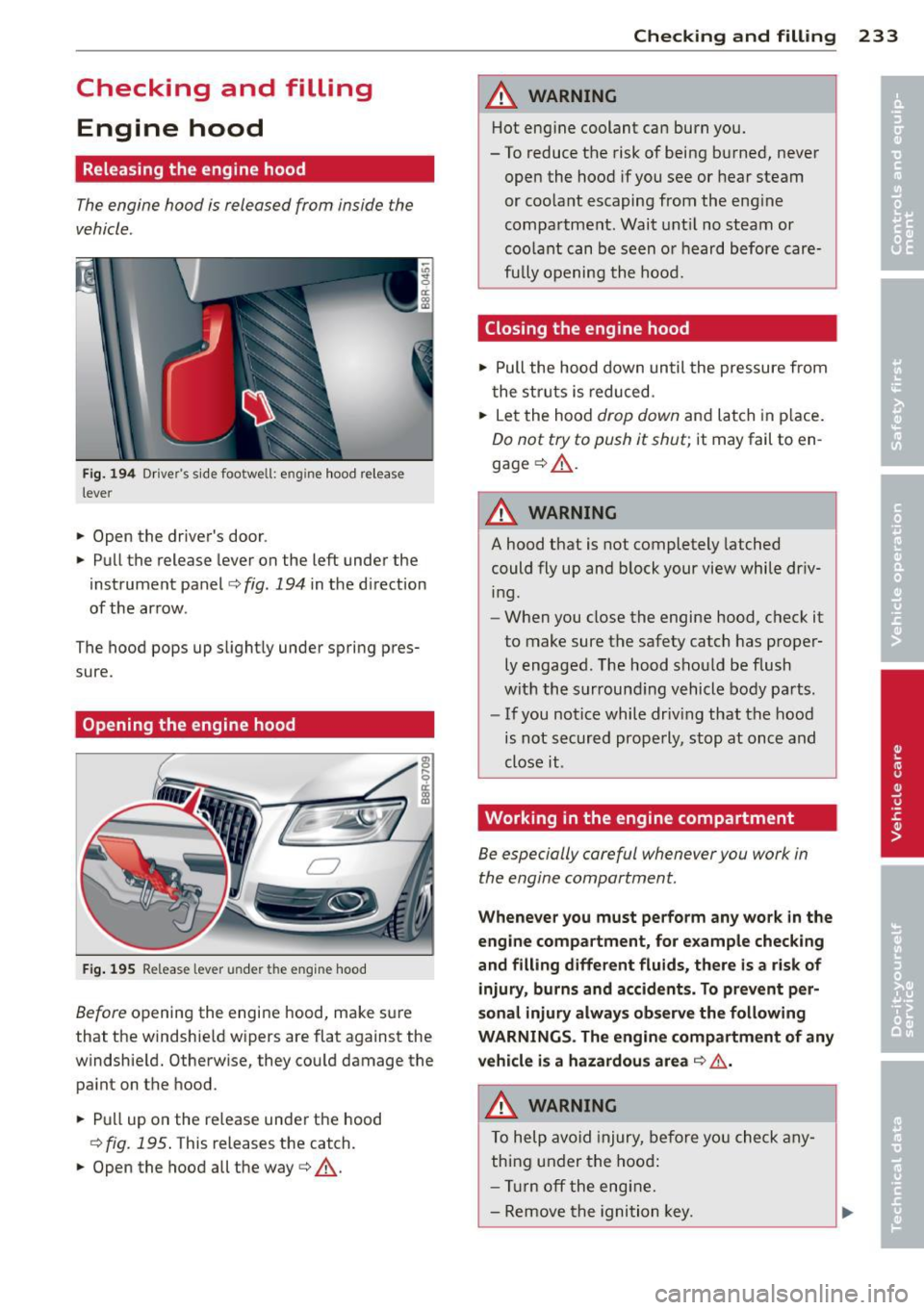
Fig. 19 4 Driver's s ide footwell: engine hood release
lever
"' Open the driver's door .
"' Pull the release lever on the left under the
instrument panel
i=:> fig. 194 in the d irection
of the arrow.
The hood pops up slightly under spring pres
sure.
Opening the engine hood
F ig . 195 Re lease lever under the engine hood
Before opening the engine hood, make sure
that the windshield wipers are flat against the
windshie ld. Otherwise, they could damage the
paint on the hood.
"' Pull up on the release under the hood
c;, fig. 195 . This releases the catch.
"' Open the hood all the way
c::> &,.
Checkin g and fillin g 233
A WARNING
Hot engine coolant can burn you.
- To reduce the risk of being burned, never
open the hood if you see or hear steam
or coolant escaping from the eng ine
compartment. Wait unt il no steam or
coolant can be seen or heard before care
fu lly opening the hood.
Closing the engine hood
"' Pull the hood down un til the pressure from
the struts is reduced.
"' Let the hood
drop down and latch in p lace.
Do not try to push it shut; it may fail to en
gage
c;, &, .
A WARNING
--
A hood that is not completely latched
could fly up and block your view while dr iv
ing.
- When you close the engine hood, check it
to make sure the safety catch has proper
ly engaged. The hood should be flush
with the surround ing vehicle body parts.
- If you notice while driv ing that the hood
is not secured properly, stop at once and
close it .
Working in the engine compartment
Be especially careful whenever you work in
the engine compartment.
Whenever yo u must pe rform any w ork in the
e n g ine com pa rt ment, for e xample ch e cki ng
and filling differ ent fluids, th ere is a risk of
injury , burn s and accid ent s. T o pr eve nt per
so nal injury alwa ys obs erve the foll owing
WARNINGS . Th e en gine co mpa rtm ent of an y
v e hicl e is a hazardou s ar ea
c;, Lh, .
A WARNING ~
To help avoid injury, be fo re you check any
thing under the hood:
- Turn off the engine.
- Remove the ignition key.
Page 237 of 316
Checking and filling 235
Engine compartment
Engine compartment
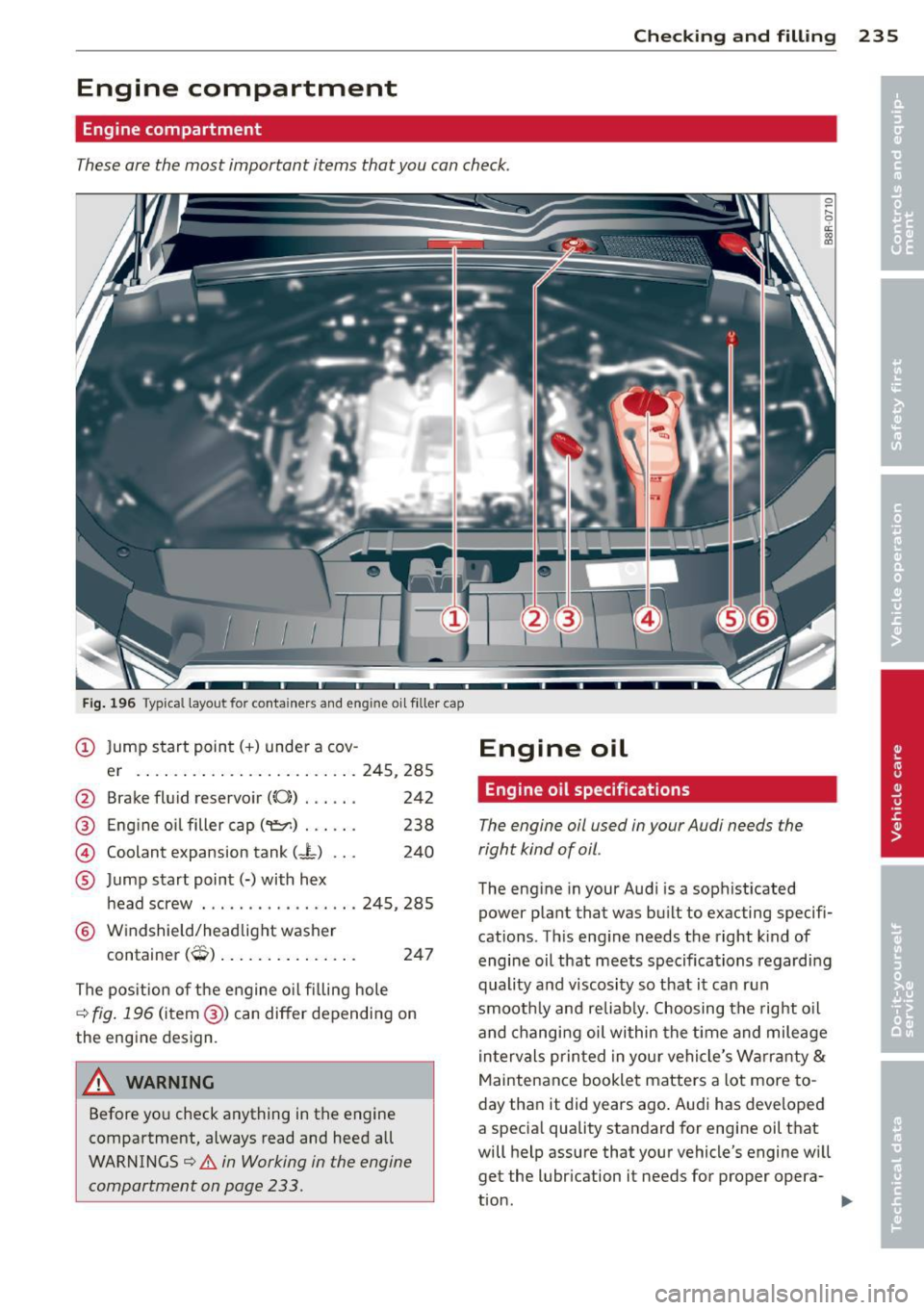
These are the most important items that you can check.
Fig. 196 Typical layout for contain ers and engine oil filler cap
(D Jump start point( +) under a cov -
er .. .. .. .. .............. .. 245, 285
@ Brake fluid reservoir ((0)) . . . . . . 242
@ Eng ine oil filler cap
("t=:?1) . . . . . . 238
@ Coolant expansion tank (J-) . . . 240
® Jump start point(-) with hex
head screw ........... .... .. 245, 285
® Windshield/headlight washer
container
(0) . . . . . . . . . . . . . . . 247
The pos ition of the engine o il filling hole
¢ fig. 196 (item@) can differ depending on
the engine design.
A WARNING
-
Before you check anything in the engine
compartment, always read and heed all
WARNINGS ¢&. in Working in the engine
compartment on page 233.
Engine oil
Engine oil specifications
The engine oil used in your Audi needs the
right kind of oil .
The engine in your Audi is a sophisticated
power plant that was bu ilt to exacting specifi
cations. This eng ine needs the right k ind of
engine oil that meets specifications regarding
quality and viscosity so that it can run
smooth ly and reliab ly. Choosing the right oil
and changing oil within the time and mileage
intervals printed in your vehicle's Warranty
&
Maintenance booklet matters a lot more to
day than it did years ago . Audi has developed
a specia l quality standard for engine oil that
will help assure that your vehicle's engine will
get the lubrication it needs for proper opera-
tion. .,..
Page 243 of 316
engine is warm, the level may be slightly
above the "MAX" marking .
The location of the coolant expansion tank
can be seen in the engine compartment illus
tration ¢
page 235.
To obtain an accurate reading, the engine
must be switched
off.
The expansion tank in your vehicle is equipped
with an electric coolant level sensor.
When the coolant level is too low, the warning
light in the Auto-Check System¢
page 30 will
blink until you add coolant and the level has
been restored to normal. Even though there is
an electric coolant level sensor, we still rec
ommend you check the coolant level from
time to time.
Coolant loss
Coolant loss may indicate a leak in the cooling
system. In the event of coolant loss, the cool
ing system should be inspected immediately
by your authorized Audi dealer.
It is not
enough merely to add coolant.
In a
sealed system, losses can occur only if
the boiling point of the coolant is exceeded as
a result of overheating.
(D Note
Do not add any type of radiator leak seal
ant to your vehicle's engine coolant. Add
ing radiator repair fluid may adversely af
fect the function and performance of your
cooling system and could result in damage
not covered by your New Vehicle Limited
Warranty.
Adding coolant
Be very careful when adding engine coolant.
Before you check anything in the engine com
partment,
always read and heed all WARN
INGS ¢ A in Working in the engine compart
ment on page 233.
... Turn off the engine .
... Let the engine cool down.
Checking and filling 241
... Place a thick rag over the coolant expansion
tank ¢
page 240, fig. 199 and carefully turn
the cap counter-clockwise ¢
A.
... Add coolant.
... Twist the cap on again
tightly.
Replacement engine coolant must conform to
exact specifications ¢
page 240, Coolant. We
recommend using only coolant additive
Gl2+
+, Gl3
or in an emergency Gl2 +. Do not use a
different additive . In an emergency use plain
water until you can get the correct additive and can restore the correct ratio. This should
be done as soon as possible .
If you have lost a considerable amount of
coolant, then you should add cold antifreeze
and cold water only when the engine is cold.
Always use
new engine coolant when refilling.
Do not fill coolant above the "MAX" mark. Ex
cess coolant will be forced out through the
pressure relief valve in the cap when the en
gine becomes hot.
A WARNING
- The cooling system is under pressure and
can get very hot. Reduce the risk of
scalding from hot coolant by following
these steps.
- Turn
off the engine and allow it to cool
down.
- Protect your face, hands and arms from
escaping fluid and steam by covering
the cap with a large, thick rag.
- Turn the cap slowly and very carefully
in a counter-clockwise direction while
applying light, downward pressure on
the top of the cap .
- To avoid being burned, do not spill an
tifreeze or coolant on the exhaust sys
tem or hot engine parts. Under certain
conditions, the ethylene glycol in en
gine coolant can catch fire.
-Antifreeze is poisonous. Always store an
tifreeze in its original container and well
out of the reach of children.
~
•
•
Page 244 of 316
24 2 Ch ecking and filling
-If you drain the coolant, it must be
caught and safely stored in a p roper
conta iner clearly marked "poison".
(D Note
- Coolant pollutes the env ironment and
could cause an engine fire . Excess coo l-
ant will be forced out through the pres
sure relief valve in the cap when the en
gine becomes hot.
- If, in an emergency, only water can be
added , the correct ratio between water
and antifreeze¢
page 240 must be re
stored as soon as possible .
@ For the sake of the environment
Drained coolant should not be reused. Al
ways dispose of used coolant while observ ing all environmental regulations.
Radiator fan
The radiator fan switches on automatically by
itself
The radiator fan is driven by the engine via the
V-be lt . The viscous clutch regulates the speed
of the fan accord ing to t he temperature of the
coolant.
An auxiliary electric radiator fan* switches on
a nd off depending on coolant temperature
and other ve hicle operating conditions.
After you switch the engine off, the auxiliary
fan can cont inue running for up to 10 minutes
- even with the ignition off. It can even switch
on again later by itself¢&. , if
- the temperature of the engine coolant rises
due to the heat build-up from the engine in
the engine compartment, or
- the engine compartment heats up because
the veh icle is parked in intense sunlight.
_&. WARNING
- To reduce the r isk of personal injury nev
er to uch the radiator fa n. -
The a uxiliary electric fan is temperat ure
controlled and can switch on suddenly
even when the engine is not running.
- The auxiliary radiator fan switches on a u
tomatically when the engine coolant reaches a certai n temperature and will
continue to ru n until the coolant temper
ature drops.
Brake fluid
Checking brake fluid level
The brake fluid level can be checked with a
quick glance.
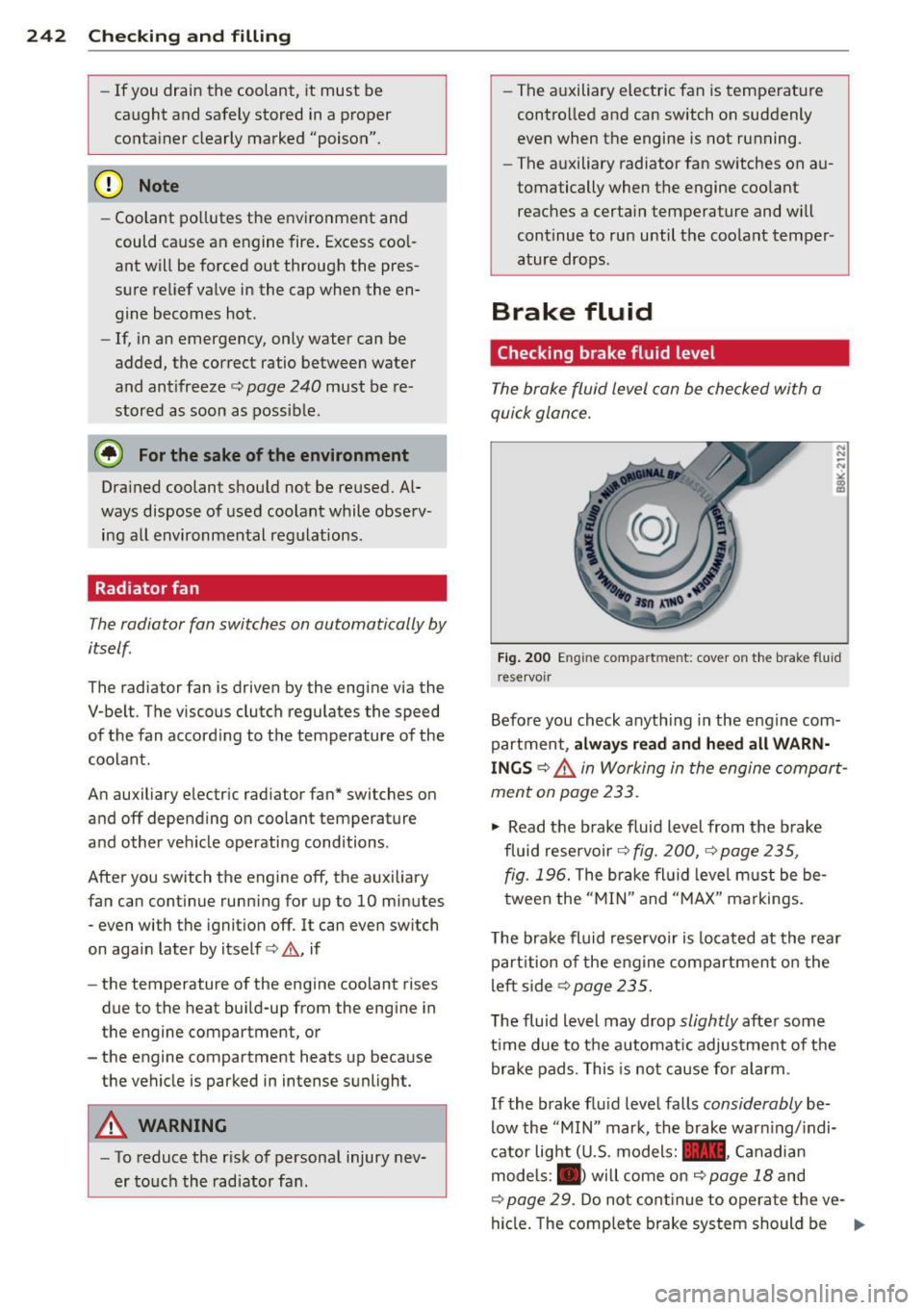
F ig. 2 00 Engine compart men t: cover on t he brake fluid
reservoir
Befo re you check anyth ing in the engine com
partment,
alway s read and he ed all WARN
INGS c::> ,&. in Working in the engine compart
ment on page 233.
.,. Read the brake fluid level from the b rake
fluid reservoir
c::> fig. 200, c::> page 235,
fig. 196.
The brake fl uid level m ust be be
tween the "MIN" and "MAX" markings.
T he bra ke fluid reservo ir is located at the rear
part ition o f the e ngine compartment on the
left s ide
c::> page 235.
The fluid level may drop slightly afte r some
t ime due to the a utomatic adjustment of the
brake pads. This is not cause for a larm .
If the brake fl uid level falls
considerably be
low the
"MIN" mar k, the brake war ning/ indi
cator light ( U.S. models:
1111 , Canadian
models :. will come on
c::> page 18 and
c::>page 29. Do not con tinue to operate the ve-
hicle . The comp lete brake system should be ..,.
Page 245 of 316

thoroughly checked by an authorized Audi
dealer or qualified workshop and the cause
corrected .
If the brake fluid level is too low ,
the brake warning/indicator light will i llum i
nate. Con tact an au thori zed Aud i dealer
im ·
mediately .
Changing brake fluid
Have the brake fluid changed by an experi
enced technician .
Brake fluid absorbs moist ure from the a ir. If
the water con tent in the brake fluid is too
h igh, corrosion in the brake system may resul t
after a per iod of t ime . The bo iling po int of the
brake fluid w ill also decrease considerably and
decrease b raking performance .
There fore, the brake flu id must be changed
e very two years . Always use new brake fluid
which conforms to Fede ral Motor Vehicle
Standard "FMVSS 116 DOT 4 ".
The brake flu id reservoir can be difficult to
reac h, therefore , we recommend that you
h ave the brake flu id changed by your author
iz ed
Audi dealer . Your deale r has the co rrect
too ls, the right b rake fluid and the know-how
to do this fo r you.
_& WARNING ,~
- Brake fluid is po isonous. I t must be s to r
ed only in the closed orig inal container
o ut o f the reac h of c hildren!
- Brake fa ilure can resu lt from old o r inap
propriate b rake fluid. Observe these pre
cautions :
- Use o nly bra ke fluid t hat meets SAE
specification
J 1703 and confo rms to
Federal Motor Vehicle Sta ndard 116 .
Always check wi th you r auth orized Audi
deale r to make s ure you are using the
correct brake f luid . The co rrec t type of
brake fluid is a lso indicated on the
brake fluid reservoir .
- The brake f lui d m ust be new. Heavy use
of the b rakes can ca use a vapor lock if
the brake fl uid is left in the system too
long . This can ser io usly affect the effi-
Checkin g and fillin g 243
ciency of the brakes as well as your
safety. Th is co uld resu lt in an accident.
(D Note
B ra ke fluid will damage the pa int o f you r
vehicle .
@ For the sake of the environment
Because o f the p rob lem of proper disposal
of bra ke fluid as well as the spec ia l t oo ls
r equire d an d the necessary expe rtise, we
recommend that yo u have the brake f luid
changed by yo ur authorized Aud i dea ler.
Battery
General information
Under n o rmal ope ra ti ng cond itions , the b at
te ry in yo ur Audi does not need any ma inte
nance . With
high outside temperat ures or
l ong daily drives we recommend that you have
the e lectrolyte leve l checked by an authorized
Audi dealer or qualified workshop. The elec
troly te level should also be checked each t ime
the battery is charged
c:> page 245 .
Have the battery checked when yo u take you r
vehicle in for service. You are well advised to
replace a battery that is older than 5 years .
With certain types of airbag deployment, the battery is disconnected from the veh icle elec
trical system for safety reasons
c:> .&. in Re
pair, care and disposal of the airbags on
page 171 .
Hybrid drive* : you can find important informa
tion about the high voltage battery under
c:> page 97.
Di sconnecting the battery terminals
Some vehicle functions (power window reg u
lators, for example) are lost if t he battery te r
mina ls are disconnected. These f unctions have
to be relearned after the ba ttery termina ls are
con nected aga in . To prevent th is, the battery
shou ld only be d isconnected from the veh icle
electrica l system when abso lutely necessary
fo r repa irs. ..,_
•
•
Page 246 of 316
244 Checking and filling
Vehicles not driven for long periods
If you do not drive you r vehicle over a pe riod
of severa l days or weeks, electrical compo
nents are gradually cut back or switched off.
This reduces energy consumption and main
tains starting capability over a longer period
¢page 203.
Take into consideration that when yo u un lock
your vehicle, some convenience functions, such as the interior lights or the power seat
adjustment, may not be available. The con
venience funct ions w ill be available again
when you turn on the ignition and start the
engine .
Winter operation
During the winter months, battery capacity
tends to decrease as temperatures drop . This
is because more power is also consumed while
start ing, and the headl ights, rear window de
fogger, etc., are used more often .
Avoid unnecessary power consumption, par
ticularly in city traffic or when traveling only
short distances . Let your authorized Audi
dealer check the capacity of the vehicle bat
tery before winter sets in¢
page 245. A well
cha rged battery w ill not only prevent starting
prob lems when the weather is cold , but will
a lso last longer .
Working on the battery
Be especially careful when working on or near
the battery.
The battery is located in the luggage compart
ment under the floor. Before you check any
thing in the luggage compartment,
read and
heed all WARNINGS
¢ _&..
Hybr id drive*: you can find impo rtant informa
tion about the high voltage battery under
¢page 97 .
Always heed the safety warnings , when work
ing on the vehicle battery or the vehicle elec
trical system to prevent injury.
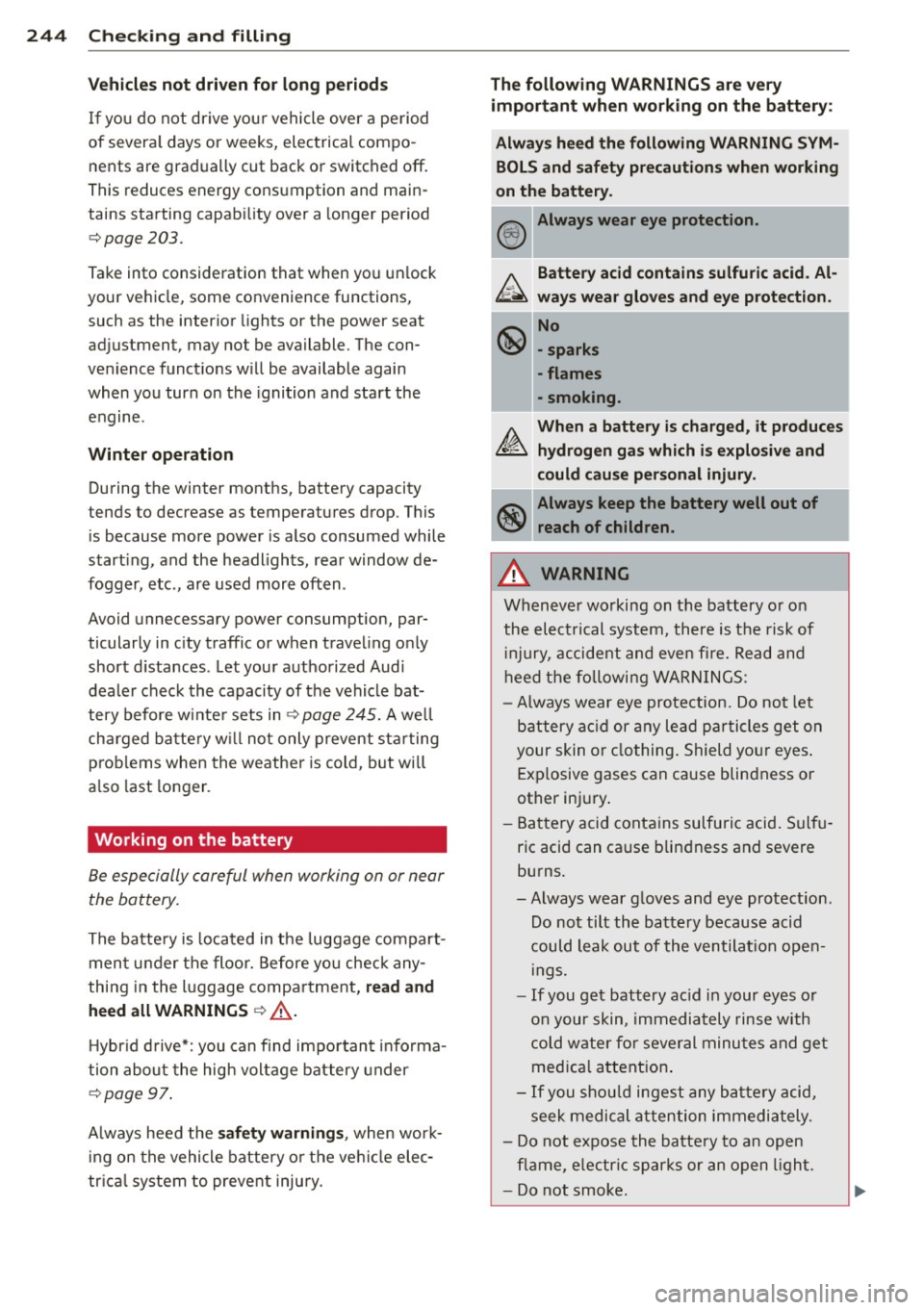
The following WARNINGS are very
important when working on the battery:
Always heed the following WARNING SYM BOLS and safety precaution s when working
on the battery.
@) Always wear eye protection .
I>. Battery acid contains sulfuric acid_-Al
~ ways wear gloves and eye protection.
~ No
\!=51 -sparks
-flames
-smoking.
A When a battery is charged, it produces
~ hydrogen gas which is explosive and
could cause personal injury.
/G Always keep the battery well out of
V!!JI reach of children.
A WARNING "--
Whenever working on the battery or on
the electrical system, there is the risk of
in jury, accident and even fi re. Read and
heed the following WARNINGS :
- Always wear eye protection. Do not let
battery ac id or any lead particles get on
your skin or clothing. Shield your eyes .
Exp losive gases can cause blindness or
other injury .
- Ba ttery acid contains sulfuric acid. Sulfu
ric acid can ca use blindness and severe
burns .
- Always wear gloves and eye protection .
Do not tilt the battery because acid
could leak out of the ventilat ion open
i ngs.
- If you get battery ac id in your eyes or
on your skin, immediately rinse with
cold water fo r several minutes and get
med ical attention .
-If you should ingest any battery acid,
seek medical attention immediately.
- Do not expose the battery to an open
flame, electr ic sparks or an open light.
- Do not smoke.
-
1
I