hood open AUDI Q5 2013 User Guide
[x] Cancel search | Manufacturer: AUDI, Model Year: 2013, Model line: Q5, Model: AUDI Q5 2013Pages: 316, PDF Size: 78.89 MB
Page 240 of 316
238 Checking and filling
Checking the engine oil level
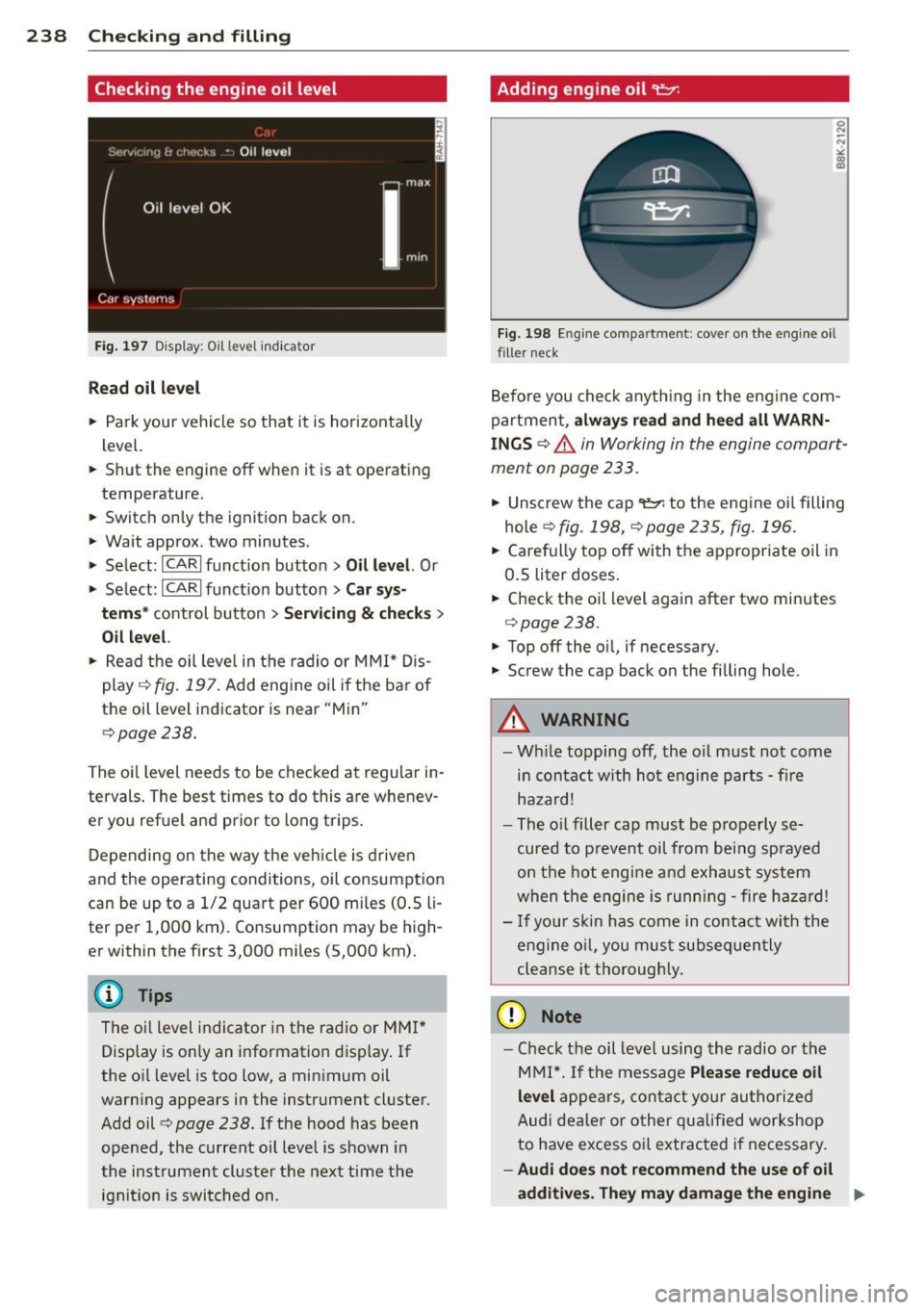
Fig. 197 Disp lay: Oi l level indicator
Read oil level
• Park your vehicle so that it is horizontally
level.
.. Shut the engine off when it is at operating
temperature.
.. Switch only the ignition back on.
• Wait approx. two minutes.
> Select: ICARI function button> Oil level. Or
> Select: ICARI function button> Car sys-
tems *
control button > Servicing & checks >
Oil level.
• Read the oil leve l in the radio or MMI* Dis
play
r::;:, fig. 197. Add engine oil if the bar of
the oil level indicator is near "Min"
r::;:,page 238.
The oil level needs to be checked at regular in
tervals . The best times to do this are whenev
er you refuel and prior to long trips .
Depending on the way the vehicle is driven
and the operating conditions, oil consumption
can be up to a 1/2 quart per 600 miles (0.5
li
ter per 1,000 km). Consumption may be high
er within the first 3,000 miles (5,000 km).
@ Tips
The oil level indicator in the radio or MMI*
Display is only an information display. If
the oil level is too low, a minimum oil
warning appears in the instrument cluster.
Add oil
r::;:, page 238. If the hood has been
opened, the current oil level is shown in
the instrument cluster the next time the
ignition is switched on.
Adding engin e oil 't:::r.
Fig. 198 En gine compart men t: cover on the engine oil
fille r neck
Before you check anything in the engine com
partment,
always read and heed all WARN
INGS
r::;:, .&. in Working in the engine compart
ment on page 233.
"' Unscrew the cap 't=1'l to the engine oil filling
hole ¢
fig. 198, r::;:, page 235, fig. 196 .
• Carefully top off with the appropriate oil in
0.5 liter doses.
.. Check the oil level again after two minutes
r::;:,page238 .
"'Top off the oil, if necessary.
"' Screw the cap back on the filling hole.
A WARNING
=
-While topping off, the oil must not come
in contact with hot engine parts - fire
hazard!
- The oil filler cap must be properly se
cured to prevent oil from being sprayed
on the hot engine and exhaust system
when the engine is running -fire hazard!
- If your skin has come in contact with the
engine oil, you must subsequently
cleanse it thoroughly.
(D Note
- Check the oil level using the radio or the
MMI*. If the message
Please reduce oil
level
appears, contact your authorized
Audi dealer or other qualified workshop
to have excess oil extrac ted if necessary.
-Audi does not recommend the use of oil
additives. They may damage the engine ..,..
Page 248 of 316
246 Checking and filling
• Open the engine hood ¢ page 233.
• Remov e the cover (!) by pressing on the ar
row ¢
fig. 201.
• Open the cover @on the positive term inal.
• Connect the charger connectors according
to the instruct ions to the
jump start bolts.
(Bolts under the cover = "positive ", Bolts
with hex head= "negative").
• Only now plug the mains lead for the charg
i ng equipment into the wall outlet and turn
iton ¢,&. .
• Make sure the charging rate is not over
30 amps/14.8 Volt.
• When the battery is fully charged: Turn the
charging equ ipment off and remove the
mains lead from the wall outlet.
• Now remove the clamps for the charging
equipment.
• Close the cover @on the positive term inal
and re-install the cover (!).
• Close the hood ¢
page 233.
A discharged battery can freeze at tempera
tures of on ly 32 °F (0 °C). A llow a frozen bat
tery to thaw completely befo re attempt ing to
cha rge it~ &. . H owever, we recommend not
using a thawed battery again because the bat
tery casing can be cracked due to ice forma
tion and can leak battery acid.
Battery charging (Maximum charging rate
of
30 amps/14.8 Volt)
When charging at low voltages (e.g . with a
trickle charger ), the battery cables do not
have to be d isconnected first. The battery
caps should
not be opened when charging a
battery .
It is not necessary to remove the battery from
the luggage compartment.
Fast charging the battery (charging rate
above 14.8 Volts )
For technical reasons do not use a battery
charger that uses voltage greater than 14.8
Volts to charge your vehicle's battery.
.&_ WARNING
Charging a battery can be dangerous. -
Always follow the operating instructions
provided by the battery charger manu
facturer when charging your battery.
- Never charge a frozen battery. It may ex
plode because of gas trapped in the ice.
Allow a frozen battery to thaw out first.
- Do not reuse batteries wh ich were fro
zen. The battery housing may have
cracked and weakened when the battery
froze.
- Charge the battery in a well ventilated
area. Keep away from open flame or elec
tr ica l spark. Do not smoke. Hydrogen gas
generated by the battery is explosive.
- To reduce the danger of explosion, never
connect or disconnect charger cab les
while the charger is ope rat ing.
- Fast charging a battery is dangerous and
should only be attempted by a compe
tent technician with the proper equip
ment.
- Battery acid that may spill dur ing charg
ing should be washed off with a solution
of warm wat er and baking soda to neu
tralize the acid.
(I) Note
Never use a fast charger as a booster to
start the engine. This will seriously dam
age sensitive electronic components, such
as contro l units, re lays, radio, etc., as well
as the battery charger.
Battery replacement
The new battery must have the same specifi
cations and dimensions as the original equip
ment battery.
Intelligent energy management in your vehi
cle is responsible for distributing the electri
ca l energy throughout your vehicle
¢
page 203 . The intelligent energy manage
ment system will keep the engine battery
charged better then vehicles without this sys
tem . To make sure the additional electrical en
ergy is ava ilable once again after you have
changed the battery, we recommend that you ..,.