oil AUDI Q5 2013 Owner's Manual
[x] Cancel search | Manufacturer: AUDI, Model Year: 2013, Model line: Q5, Model: AUDI Q5 2013Pages: 316, PDF Size: 78.89 MB
Page 231 of 316
-Anti-knock index must be 87 AKI or higher.
- Blend must contain not more than 15%
MTBE.
Seasonally adjusted gasoline
Many gasoline grades are blended to perform
especially well for winter or summer driving. During seasonal change-over, we suggest that
you fill up at busy gas stat ions where the sea
sonal adjustment is more likely to be made in
time.
(D Note
- Fuels containing a high percentage of
ethanol such as ESO and E85 may only
be used in veh icles with flex ible fuel* en
gines. Using high ethano l fuel in vehicles
not equipped with flexib le fue l* engines
can cause severe engine damage .
- Methanol fuels which do not meet these
requirements may cause corrosion and
damage to plastic and rubber compo
nents in the fuel system.
- Do not use fuels that fail to meet the
specified criteria in this chapter.
- If you are unable to determine whether
or not a particular fuel blend meets the
specifications, ask your service station or
its fuel supplier.
- Do not use fuel for which the contents
cannot be identified.
- Fuel system damage and performance
problems resulting from the use of fuels
different from those specified are not
the respons ibility of Audi and are not
covered under the New Veh icle or the
Emission Control System Warranties.
- If you experience a loss of fuel economy
or driveability and performance prob
l ems due to the use of one of these fuel
blends, we recommend that you switch
to unblended fuel.
Fuel supply and filling your fuel tank 229
Ethanol fuel (Bio-ethanol)
Applies to veh icles: w it h flex ible fue l en gin e
You can recognize vehicles with a flexible fuel
engine by looking at the label on the inside of
the fuel filler flap .
Vehicles with flexible fuel engines may be op
erated with bio -ethanol fuels such as E85
(85% ethanol and 15% gasoline) or with un
leaded gasoline (91 AKI/ROZ 95) . T he vehicle
may also be operated with a mixture of these
fuels.
Your fuel consumption will increase when us
ing bio-ethanol fue ls due to the lower amount
of energy contained per unit volume in etha
nol.
Warming up the flexible fuel engine in
low temperatures
Due to the chemical composition of b io-etha
nol, a certain amount of fuel ends up in the
engine oil when driving short distances in ve ry
low temperatures. This fuel evaporates again
when the engine is warmed up.
D Please warm up engine.
If the driver message appears in the instru
ment cluster disp lay, drive with a warm en
gine to reduce the oil level.
(D Note
- Never fill with methanol or with a higher
percentage of b io-ethanol than 85%
(E85). A h igher percentage of bio-etha
nol in the fuel can cause damage to the
engine or to the fue l system.
- If you use only E85, it is recommended
to fill the fue l tank complete ly w ith un
leaded premium grade gaso line every
5,000 miles.
- If you experience starting, rough id le or
hesitation driveability problems, fill the
fuel tank comp letely with unleaded pre
mium grade gasoline and dr ive it nor
mally until the gasoline is used. See your
authorized Audi dealer if the problem
pers ists.
•
•
Page 236 of 316
234 Checking and filling
-Apply the parking brake.
- Move selector lever of automatic trans- mission to P (Park).
- Always let the engine cool down. Hot components will burn skin on contact.
- To reduce the risk of being burned, never
open the hood if you see or hear steam
or coolant escaping from the engine
compartment. Wait until no steam or
coolant can be seen or heard before care
fully opening the hood.
- Keep children away from the engine com partment.
- Never spill fluids on hot engine compo
nents. They can cause a fire.
- Never touch the radiator fan. The auxili
ary electric fan is temperature controlled
and can switch on suddenly.
- Never open the coolant reservoir cap
when the engine is still warm. The cool
ant system is pressurized and hot cool ant could spray out .
- Protect your face, hands and arm from
steam or hot engine coolant by placing a
thick rag over the cap when you open the
coolant reservoir .
- Do not remove the engine cover under
any circumstances. This increases the
risk of burns.
- If work on the fuel system or the electri
cal system is necessary:
- Always disconnect the battery.
- Never smoke or work near heaters or
open flames. Fluids in the engine com
partment could start a fire.
- Keep an approved fire extinguisher im
mediately available.
- To avoid electrical shock and personal in
jury while the engine is running or being
started, never touch:
- Ignition cables
- Other components of the high voltage
electronic ignition system.
- If you must perform a check or repair
with the engine running: -
First, fully apply the parking brake,
move selector lever of automatic trans
mission to P (Park).
- Always use extreme caution to prevent
clothing, jewelry, or long hair from get
ting caught in the radiator fan, V-belts
or other moving parts, or from contact ing hot parts. Tie back hair before
starting, and do not wear clothing that
will hang or droop into the engine.
- Minimize exposure to emission and
chemical hazards
c:> &, .
&_ WARNING
California Proposition 65 Warning:
- Engine exhaust, some of its constituents,
and certain vehicle components contain
or emit chemicals known to the State of
California to cause cancer and birth de
fects and reproductive harm. In addition,
certain fluids contained in vehicles and
certain products of component wear con
tain or emit chemicals known to the
State of California to cause cancer and
birth defects or other reproductive harm.
- Battery posts, terminals and related ac
cessories contain lead and lead com
pounds, chemicals known to the State of
California to cause cancer and reproduc
tive harms. Wash hands after handling.
(D Note
When adding fluids, always make sure that
they are poured into the proper container
or filler opening, otherwise serious dam
age to vehicle systems will occur.
@ For the sake of the environment
To detect leaks in time, inspect the vehicle
floor pan from underneath regularly. If
you see spots from oil or other vehicle flu
ids, have your vehicle inspected by an au
thorized Audi dealer.
Page 237 of 316
Checking and filling 235
Engine compartment
Engine compartment
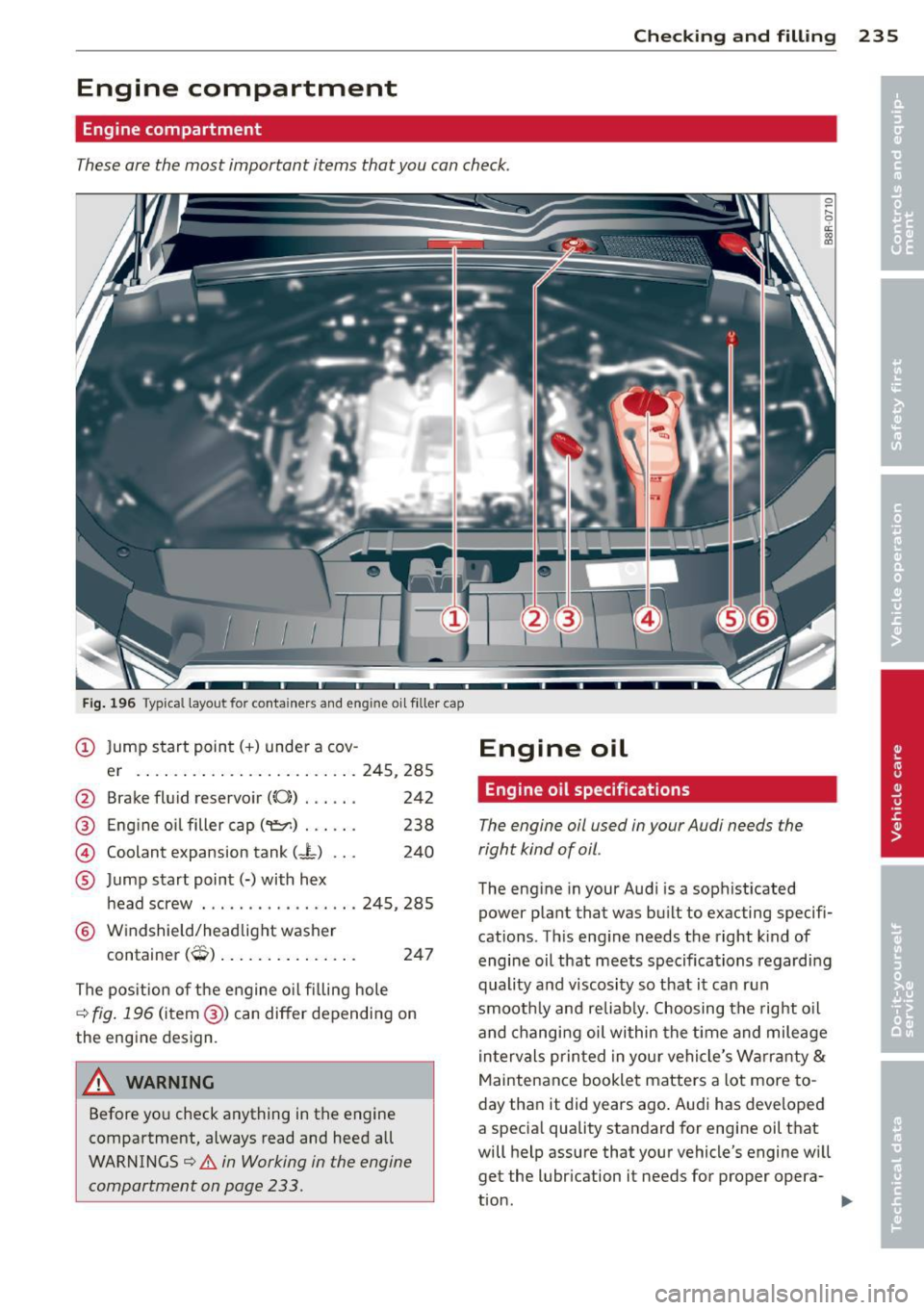
These are the most important items that you can check.
Fig. 196 Typical layout for contain ers and engine oil filler cap
(D Jump start point( +) under a cov -
er .. .. .. .. .............. .. 245, 285
@ Brake fluid reservoir ((0)) . . . . . . 242
@ Eng ine oil filler cap
("t=:?1) . . . . . . 238
@ Coolant expansion tank (J-) . . . 240
® Jump start point(-) with hex
head screw ........... .... .. 245, 285
® Windshield/headlight washer
container
(0) . . . . . . . . . . . . . . . 247
The pos ition of the engine o il filling hole
¢ fig. 196 (item@) can differ depending on
the engine design.
A WARNING
-
Before you check anything in the engine
compartment, always read and heed all
WARNINGS ¢&. in Working in the engine
compartment on page 233.
Engine oil
Engine oil specifications
The engine oil used in your Audi needs the
right kind of oil .
The engine in your Audi is a sophisticated
power plant that was bu ilt to exacting specifi
cations. This eng ine needs the right k ind of
engine oil that meets specifications regarding
quality and viscosity so that it can run
smooth ly and reliab ly. Choosing the right oil
and changing oil within the time and mileage
intervals printed in your vehicle's Warranty
&
Maintenance booklet matters a lot more to
day than it did years ago . Audi has developed
a specia l quality standard for engine oil that
will help assure that your vehicle's engine will
get the lubrication it needs for proper opera-
tion. .,..
Page 238 of 316
236 Check ing and filling
Modern engine lubrication has taken a quan
tum leap in the last few years. Many synthetic
oils ava ilable today provide better engine lu
brication that can outlast traditional petrole
um-based oils, making them a smart choice
for use throughout the life of your Audi .
Whether you use synthetic or petroleum
based engine oil, the oil that you use must
conform to Audi 's oil quality standard
VW 502 00 to he lp keep your vehicle's engine
running smoothly and help prevent the for
mat ion of harmfu l deposits, sometimes called
"sludge ", that ove r time can lead to expensive
repairs .
At the time of pr int ing , engine o ils available in
the U .S . and Canada that meet the exacting
specifi cations of Audi oi l standard VW 502 00
a re synthetic engine oils. This does not mean,
however, that every syn thetic engine oil will
meet Audi oil standard VW 502 00. So always
be sure that you use an approved oil.
To help prevent the format ion of harmful de
posits use only oi l with the fo llowing specifi
cations printed on the oil container :
Audi oil standard VW 502 00
O il container labe ls may carry the specif ica
tion s ingly or in comb inat ion with other des ig
nations and oil qua lity standards .
Viscosity
Engine oi ls are graded according to their vis
cosity. The proper viscosity grade oil for your
engine depends on cl imactic or seasonal con
d itions where you drive. You can use oil with a
viscosity grade of SA E SW40 across all tem
pe ratu re ranges for normal driving conditions .
However, if eng ine o il viscos ity grade SA E
SW40 is not avai lab le, you can also use viscos
ity grade SAE SW -30 or SAE OW-40 as long as
it meets Audi o il quality standard VW 502 00
specif ications .
Because engine oil that meets the Audi oil
standard may not be available everywhere
when you need it, we strongly recommend
that you always carry with you an ext ra quart (
li te r) of oil that exp ress ly con forms to the
VW 502 00 spec ification, in case you have to
top
off the oil while on the road.
Only if the ba r of the o il level indica tor is near
" Mi n" - and no oil that express ly conforms to
Audi o il standard VW 502 00 specifications is
available - may you top
off w ith a high quality
engine oil, preferably synthetic-based, that
meets ACEA A3 or API SM spec ificat ions, but
even then, on ly in viscosity grades SAE
SW-40, SAE SW-30, or SAE OW-40 . Howeve r,
during the entire time between o il change in
te rva ls , never top
off with more than a total
of 0 .5 qt/liter engine oil t hat does not con
f orm to Audi oil specification VW 502 00 .
For more information about eng ine oi l that
has been approved for your ve hicle, please
contac t either yo ur autho riz ed Aud i deale r or
Audi C ustome r Re lations at 1 (800) 822-2834
or v isit our web site at www .audiusa.com or
www.audicanada.ca . Here you wi ll also find a
c u rrent list of oils (manufacturers, brand
names etc.) that conform to Audi oil standard
vw 502 00.
Changing the engine oil
T he eng ine o il and o il fil ter m ust be changed
accord ing to the mileage (k ilometers) and
time intervals specified in your ve hicle's War
ranty
& Maintenance booklet . Do not exceed
these interva ls - harmful deposits from old
engine oil can reduce eng ine performance and
can lead to expensive engine repairs.
Changing the oil at the recommended inter
vals is so very important because the lubricat
ing propert ies of oil decrease gradually d uring
normal veh icle use. If you are not sure when
you have your oil changed, ask your author
ized Audi Se rv ice Adv isor.
Under some circumstances the engine oil
shou ld even be changed more frequent ly.
Change oil more often if you drive most ly
sho rt distances, operate the ve hicle in dusty
areas o r most ly unde r stop-and-go traff ic con
ditions, o r when you use your vehi cle where
temperatu res s tay be low freezing point for
l ong periods .
Page 239 of 316
Detergent additives in the oil will make fresh
oil look dark after the engine has been run
n ing for a short time . This is norma l and is not
a reason to change the o il more often than
recommended.
D amage o r m alfu nctions due to lac k of
m ainten ance
It is essen tial that yo u change your oil at the
recommended inte rva ls using only engine oil
that complies with A udi oil standard
VW 502 00 . Your Lim ited New Vehicle War
ranty does not cover damage or malfunctions
due to failure to follow recommended mainte nance and use requ ireme nts as set forth in
the Audi Owner 's Manual and Warranty
&
M aintenance book let . Your dea ler will have to
deny warranty coverage u nless you p resent to
the dea ler proof in the form of Serv ice or Re
pa ir Orde rs that all scheduled maintenance
was performed in a timely manner.
Engine oil consumption
The engine in your vehicle depends on an ade
quate amount of oil to lubricate and cool all
of its moving ports.
I n o rder to prov ide effective l ubr ication and
cooling of internal engine components, a ll in
ternal comb ustion engines consume a certain
amo unt of oi l. Oi l cons umption varies from
engine to engine and may change significantly
over the life of the eng ine . Typ ically, eng ines
with a specified break-in per iod (see
c:> page 205) consume more o il during the
break-in per iod than they consume after oil
consumption has stab ilized .
Under normal conditions, the rate of oil con
sumpt io n depends on the quality and viscosity
of the oil, the RPM (revolutions per m inute) at
which the engine is ope rated, the ambient
temperature and road condi tions. Furt her fac
tors are the amo unt of oil d ilution from wate r
condensation or fuel residue and the oxida
tion level of the oi l. As any engine is subject to
wear as mileage bui lds up, the oil consump
tion may increase over time until rep lacement
of worn components may become necessary.
Checkin g and fillin g 237
With a ll these variab les coming into p lay, no
standard rate of oil consumption can be es
tab lished or spec ified . There is no alte rnative
to regular and frequent check ing of the o il lev
el, see
Note .
If the yellow engine oil leve l warning symbo l
in the instrument cluster
Ill li ghts up, you
sho uld check the oil leve l as soon as possib le
c:> page 238. Top off the oil at your earliest
convenience
c:> poge 238.
A WARNING
Before you check anything in the eng ine
compartment, always read and heed all
WAR NINGS
c:> & in Working in the engine
compor tment on page 233.
(D Note
D riving w it h an insufficient o il level is like
l y to cause severe damage to the engine.
© Tips
- The oil pr essur e warn ing display. i s
not an indicator of th e oil level. Do not
rely on it. Instead, check the oil level in
your engine at regu lar int erval s, pr ef
erably e ach time you refu el, and alway s
before going on a long trip .
-If you have the impression yo ur engi ne
c ons umes excess ive amoun ts of oil , we
recommend that you consu lt an author
ized Audi dea ler to have the cause of
your conce rn properly d iagnosed. Keep in
mind that the accurate measurement of
oil consumption requ ires great care and
may take some t ime . An authorized Aud i
deale r has instructions about how to
measu re oi l consumption accurate ly .
-
•
•
Page 240 of 316
238 Checking and filling
Checking the engine oil level
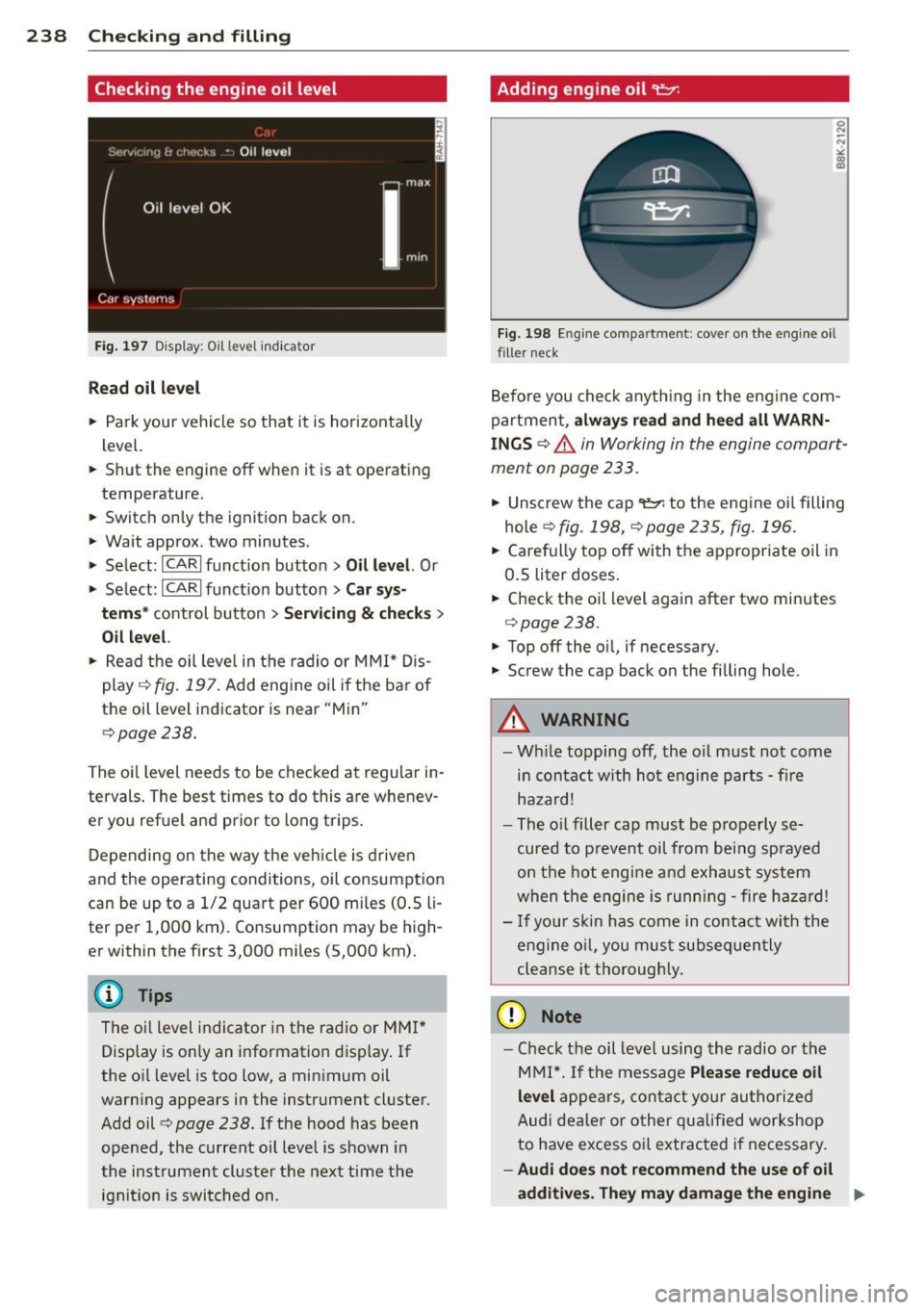
Fig. 197 Disp lay: Oi l level indicator
Read oil level
• Park your vehicle so that it is horizontally
level.
.. Shut the engine off when it is at operating
temperature.
.. Switch only the ignition back on.
• Wait approx. two minutes.
> Select: ICARI function button> Oil level. Or
> Select: ICARI function button> Car sys-
tems *
control button > Servicing & checks >
Oil level.
• Read the oil leve l in the radio or MMI* Dis
play
r::;:, fig. 197. Add engine oil if the bar of
the oil level indicator is near "Min"
r::;:,page 238.
The oil level needs to be checked at regular in
tervals . The best times to do this are whenev
er you refuel and prior to long trips .
Depending on the way the vehicle is driven
and the operating conditions, oil consumption
can be up to a 1/2 quart per 600 miles (0.5
li
ter per 1,000 km). Consumption may be high
er within the first 3,000 miles (5,000 km).
@ Tips
The oil level indicator in the radio or MMI*
Display is only an information display. If
the oil level is too low, a minimum oil
warning appears in the instrument cluster.
Add oil
r::;:, page 238. If the hood has been
opened, the current oil level is shown in
the instrument cluster the next time the
ignition is switched on.
Adding engin e oil 't:::r.
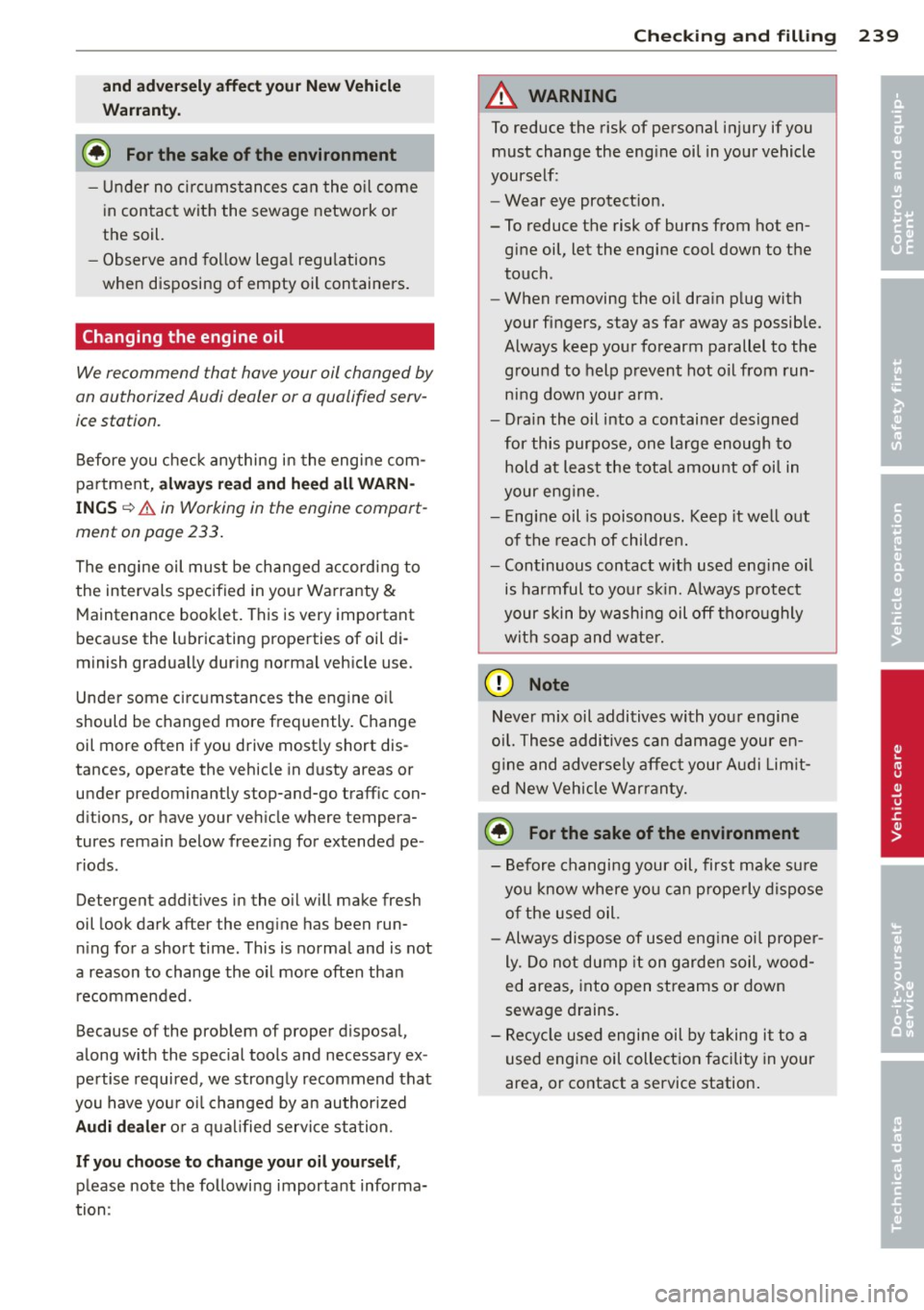
Fig. 198 En gine compart men t: cover on the engine oil
fille r neck
Before you check anything in the engine com
partment,
always read and heed all WARN
INGS
r::;:, .&. in Working in the engine compart
ment on page 233.
"' Unscrew the cap 't=1'l to the engine oil filling
hole ¢
fig. 198, r::;:, page 235, fig. 196 .
• Carefully top off with the appropriate oil in
0.5 liter doses.
.. Check the oil level again after two minutes
r::;:,page238 .
"'Top off the oil, if necessary.
"' Screw the cap back on the filling hole.
A WARNING
=
-While topping off, the oil must not come
in contact with hot engine parts - fire
hazard!
- The oil filler cap must be properly se
cured to prevent oil from being sprayed
on the hot engine and exhaust system
when the engine is running -fire hazard!
- If your skin has come in contact with the
engine oil, you must subsequently
cleanse it thoroughly.
(D Note
- Check the oil level using the radio or the
MMI*. If the message
Please reduce oil
level
appears, contact your authorized
Audi dealer or other qualified workshop
to have excess oil extrac ted if necessary.
-Audi does not recommend the use of oil
additives. They may damage the engine ..,..
Page 241 of 316
and adve rsely affect you r New Vehicle
Wa rrant y.
@) For the sake of the environment
-Un der no ci rc u mstances can the o il come
in contact with the sewage network or
the soil.
- Observe and follow lega l regu lations
when disposing of empty oil containers .
Changing the engine oil
We recommend that have your oil changed by
an authorized Audi dealer or a qualified serv
ice station.
Before you check anything in the engine com
partment,
a lways rea d and he ed all WARN
INGS
~ &. in Working in the engine compart
ment on page 233.
The engine oil must be changed according to
the intervals specified in your Warranty
&
Maintenance book let. This is very important
because the lubricating properties of oil di
minish gradua lly during normal vehicle use.
Under some circumstances the engine oi l
should be changed more frequently. Change
oil more often if you drive most ly short dis
tances, operate the vehicle in dusty areas or under predominantly stop-and-go traff ic con
d itions, or have your veh icle where tempera
tures remain below freezing for extended pe
riods.
Detergent additives in the o il w ill make fresh
oil look dark after the engine has been run n ing for a short time. This is normal and is not
a reason to change the oil more often than recommended.
Because of the problem of proper disposa l,
along w ith the special tools and necessary ex
pertise required, we strongly recommend that
you have you r oi l changed by an authorized
Au di de ale r o r a qual ified servi ce station.
If y ou c hoose to c ha ng e y our o il yo urse lf,
please note the following important informa
tion :
Checkin g and fillin g 239
A WARNING
To reduce the risk of personal injury if you
must change the eng ine oil in your vehicle
yourself:
- Wear eye protect ion.
- To reduce the risk of burns from hot en- gine oil, let the engine cool down to the
touch.
- When removing the o il dra in p lug with
your fingers, stay as far away as possible. Always keep your forearm parallel to the
ground to help p revent hot oil from run
ning down you r arm.
- Dra in the oil into a container designed
for this purpose, one la rge enough to
hold at least the tota l amount of oi l in
your eng ine .
- Engine oil is poisonous. Keep it well out
of the reach of children.
- Continuous contact wit h used eng ine o il
is harmful to your s kin. A lways protect
your skin by washing oil off tho ro ughly
with soap and water.
@ Note
Neve r mix oil additives with your engine
oil. These additives can damage your en
g ine and adversely affec t you r Aud i Lim it
ed New Vehicle Warranty.
@ For the sake of the environment
- Before changing your oil, first make su re
you know where you c an properly dispose
o f the used oil.
- Always dispose of used eng ine oi l proper
ly. Do not dump it on garden soil, wood
ed areas, into open streams or down
sewage drains .
- Recycle used engine oil by taking it to a
used engine oil collect ion facility in your
area, or contact a service station.
•
•
Page 242 of 316
240 Checking and filling
Engine cooling system
Coolant
The engine coolant performs two functions: it
keeps the engine from overheating and it pro
tects the engine from freezing in the winter .
The cooling system is sealed and generally re
quires little attention.
The cooling system has been filled at the fac
tory with a permanent coolant which does not need to be changed. The coolant consists of a
mixture of water and the manufacturer's gly
col-based coolant additive Gl3 ant ifreeze
with anticorros ion add itives (SO% for USA
models; 60% for Canadian models). This mix
ture both assures the necessary frost protec
tion and protects metal components in the
engine's cooling system from corrosion and
scaling. It also raises the boiling point of the
coolant.
Do not reduce the concentration of the coo l
ant in the summer by adding plain water .
The
proportion of coolant additive must be at
least 50% but not more than 60%
to main
tain antifreeze protection and cooling efficien
cy. If the coolant frost protection is too low,
the coolant could freeze and damage the veh i
cle heating and engine cooling system .
For year-round driving, antifreeze is added at
the factory for temperatures down to:
- - 31 °F ( - 35°() USA
- - 40°F ( - 40°() Canada .
A WARNING
Before you check anything in the engine
compartment, always read and heed all
WARNINGS
c:> &. in Working in the engine
compartment on page 233.
- Before winter sets in, have the coolant
checked to see if the coolant addit ive in
your vehicle is sufficient to meet the cli
mate cond itions. This is especially impor
tant if you live in a region where the w in- ter
is extreme ly cold . If necessary, in
crease the proportion of coolant additive
to 60%.
- When adding coolant additive to your
cooling system, remember:
- We recommend using only coolant ad
ditive Gl2++ or Gl3 for your vehicle.
This coolant additive is available at au
thorized Audi dealers. Other types of
antifreeze can significantly reduce cor
rosion protection. The resulting corro
sion can ca use a loss of coolant and se
rious engine damage.
- Do not add any type of radiator leak seal
ant to your vehicle's engine coolant .
Add ing radiator repair fluid may adverse
ly affect the function and performance of
your cooling system and could result in
damage not covered by your New Vehicle
Limited Warranty.
Checking the engine coolant level
The engine coolant level can be checked with
a quick glance .
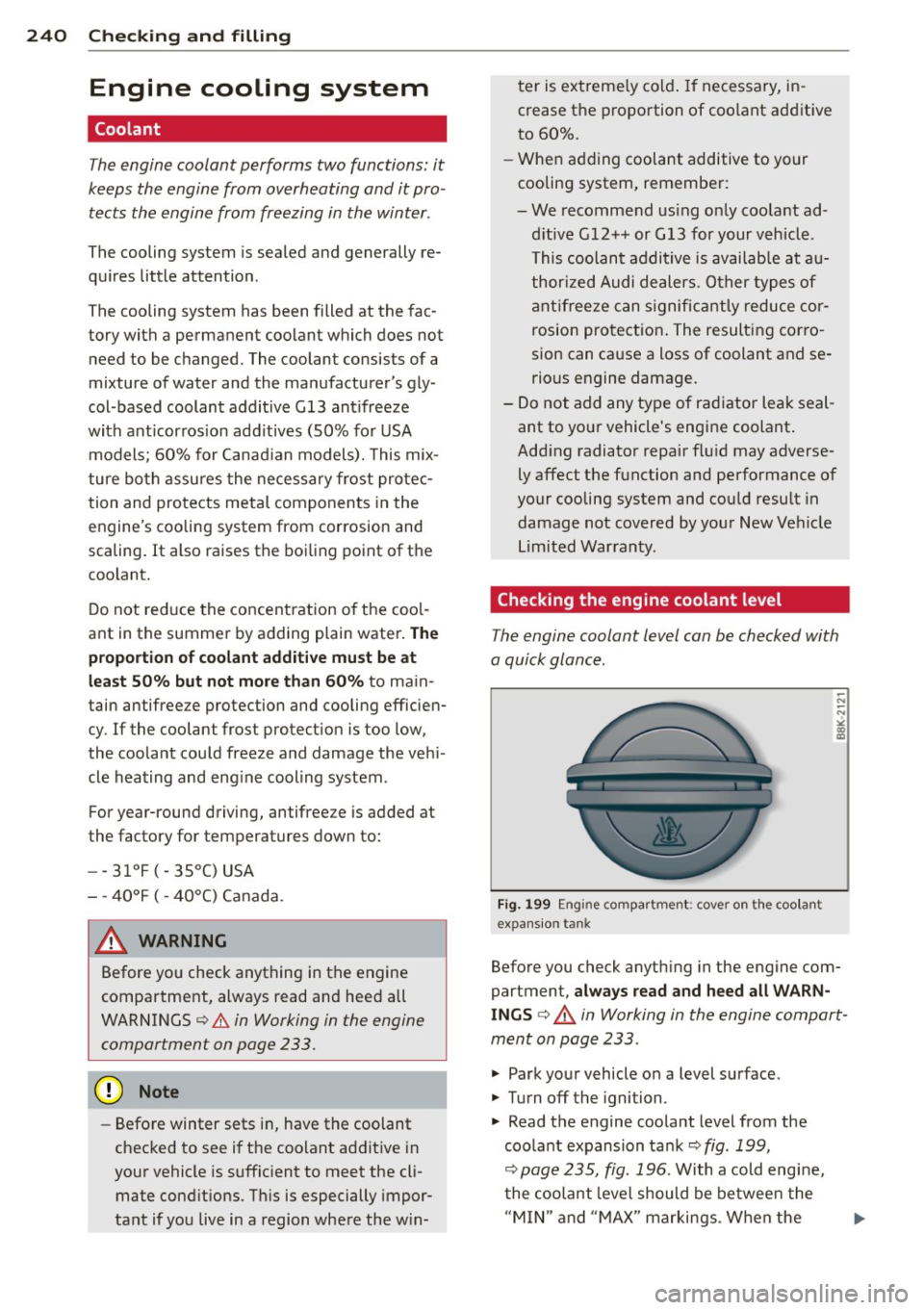
Fig. 199 Engine compartment : cover on t he coolant
expansion tank
Before you check anyth ing in the engine com
partment,
always read and heed all WARN
INGS c:> &. in Working in the engine compart
ment on page 233 .
.. Park your vehicle on a level surface .
.. Turn off the ignition .
.. Read the engine coolant level from the
coolant expansion tank
c:> fig. 199,
c:> page 235, fig. 196 . With a cold engine,
the coolant level should be between the
"MIN" and "MAX" markings. When the
Page 243 of 316
engine is warm, the level may be slightly
above the "MAX" marking .
The location of the coolant expansion tank
can be seen in the engine compartment illus
tration ¢
page 235.
To obtain an accurate reading, the engine
must be switched
off.
The expansion tank in your vehicle is equipped
with an electric coolant level sensor.
When the coolant level is too low, the warning
light in the Auto-Check System¢
page 30 will
blink until you add coolant and the level has
been restored to normal. Even though there is
an electric coolant level sensor, we still rec
ommend you check the coolant level from
time to time.
Coolant loss
Coolant loss may indicate a leak in the cooling
system. In the event of coolant loss, the cool
ing system should be inspected immediately
by your authorized Audi dealer.
It is not
enough merely to add coolant.
In a
sealed system, losses can occur only if
the boiling point of the coolant is exceeded as
a result of overheating.
(D Note
Do not add any type of radiator leak seal
ant to your vehicle's engine coolant. Add
ing radiator repair fluid may adversely af
fect the function and performance of your
cooling system and could result in damage
not covered by your New Vehicle Limited
Warranty.
Adding coolant
Be very careful when adding engine coolant.
Before you check anything in the engine com
partment,
always read and heed all WARN
INGS ¢ A in Working in the engine compart
ment on page 233.
... Turn off the engine .
... Let the engine cool down.
Checking and filling 241
... Place a thick rag over the coolant expansion
tank ¢
page 240, fig. 199 and carefully turn
the cap counter-clockwise ¢
A.
... Add coolant.
... Twist the cap on again
tightly.
Replacement engine coolant must conform to
exact specifications ¢
page 240, Coolant. We
recommend using only coolant additive
Gl2+
+, Gl3
or in an emergency Gl2 +. Do not use a
different additive . In an emergency use plain
water until you can get the correct additive and can restore the correct ratio. This should
be done as soon as possible .
If you have lost a considerable amount of
coolant, then you should add cold antifreeze
and cold water only when the engine is cold.
Always use
new engine coolant when refilling.
Do not fill coolant above the "MAX" mark. Ex
cess coolant will be forced out through the
pressure relief valve in the cap when the en
gine becomes hot.
A WARNING
- The cooling system is under pressure and
can get very hot. Reduce the risk of
scalding from hot coolant by following
these steps.
- Turn
off the engine and allow it to cool
down.
- Protect your face, hands and arms from
escaping fluid and steam by covering
the cap with a large, thick rag.
- Turn the cap slowly and very carefully
in a counter-clockwise direction while
applying light, downward pressure on
the top of the cap .
- To avoid being burned, do not spill an
tifreeze or coolant on the exhaust sys
tem or hot engine parts. Under certain
conditions, the ethylene glycol in en
gine coolant can catch fire.
-Antifreeze is poisonous. Always store an
tifreeze in its original container and well
out of the reach of children.
~
•
•
Page 250 of 316
248 Tire s and whee ls
Tires and wheels
Tires
General notes
Tires may be the least appreciated and most
abused parts of a motor vehicle .
Tires may be the least appreciated and most
abused parts of a motor vehicle. Tires are,
however, one of the most important parts of a
vehicle, particularly considering the compara
tive ly small patch of rubber on each tire that
assures that all -important contact between
you, your vehicle and the road.
Maintaining the correct tire pressure, making
sure that your vehicle and its tires do not have
to carry more weight than they can safe ly han
d le, avoiding damage from road hazards and
reg ularly inspecting t ires for damage includ
ing cuts, slashes irregu la r wear and overall
condition are the most important things that
you can do to he lp avoid sudden tire failure in
cluding tread separation and blowouts.
A vo idin g dama ge
I f you have to drive over a curb or similar ob
stacle, drive very slow ly and as close as possi
ble at a right angle to the curb.
A lways keep chem icals including grease, oil,
gasoline and b rake fluid off the tires.
Inspect the tires regularly for damage (cuts,
cracks or bl isters, etc.). Remove any foreign
bod ies embedded in the treads.
St orin g tire s
Mark tires when you remove them to indicate
the direction of rotation . Th is ensures you to
be ab le to mount them correctly when you re
install them.
When removed, the wheels or tires should be
stored in a cool, dry and preferably dark place .
Store tires in a vertical position if they are not mounted on rims, in a horizontal position if
they are mounted on rims. N
ew tir es
New t ires have to be broken in¢&,. .
The tread depth of new t ires may vary, accord
ing to the type and make of t ire and the tread
pattern .
Hidden damag e
Damage to tires and r ims is often not readily
vis ible . If you notice unusual vibrat ion or the
vehicle pulls to one s ide, th is may ind icate
that one of the t ires has been damaged . T he
t ir es must be checked immed iate ly by an au
tho rized Aud i dea le r or q ualified wor kshop.
Unidirecti onal t ires
A un idirectional tire can be identified by ar
rows on the sidewall, that po int in the direc
t ion the t ire is designed to rotate. You must
fol low the specified direction of rotation . This
is necessary so that these tires can develop
their optimum characteristics regarding grip, road noise, wear and hydrop laning resistance.
For more information ¢
page 2 78.
A WARNING
-New tires or tires that are old, worn or
damaged cannot provide maximum con
trol and braking ability .
-
-New tires tend to be slippery and must
also be broken-in. To reduce the risk of losing control, a collision and serious
pe rsonal injuries, drive w ith specia l care
for the first 350 miles (560 km).
- Driving with worn or damaged tires can lead to loss of control, sudden tire fail
ure, including a blowou t and sudden de
flation, c rashes and serious personal in
juries . Have worn or damaged tires re
p laced immediate ly.
- Tires age even if they are not being used
and can fai l sudden ly, especially at high
speeds. Tires that are more than 6 years
old can only be used in an emergency
and then w ith special care and at low
speed.