service AUDI Q5 2013 Owner's Manual
[x] Cancel search | Manufacturer: AUDI, Model Year: 2013, Model line: Q5, Model: AUDI Q5 2013Pages: 316, PDF Size: 78.89 MB
Page 231 of 316
-Anti-knock index must be 87 AKI or higher.
- Blend must contain not more than 15%
MTBE.
Seasonally adjusted gasoline
Many gasoline grades are blended to perform
especially well for winter or summer driving. During seasonal change-over, we suggest that
you fill up at busy gas stat ions where the sea
sonal adjustment is more likely to be made in
time.
(D Note
- Fuels containing a high percentage of
ethanol such as ESO and E85 may only
be used in veh icles with flex ible fuel* en
gines. Using high ethano l fuel in vehicles
not equipped with flexib le fue l* engines
can cause severe engine damage .
- Methanol fuels which do not meet these
requirements may cause corrosion and
damage to plastic and rubber compo
nents in the fuel system.
- Do not use fuels that fail to meet the
specified criteria in this chapter.
- If you are unable to determine whether
or not a particular fuel blend meets the
specifications, ask your service station or
its fuel supplier.
- Do not use fuel for which the contents
cannot be identified.
- Fuel system damage and performance
problems resulting from the use of fuels
different from those specified are not
the respons ibility of Audi and are not
covered under the New Veh icle or the
Emission Control System Warranties.
- If you experience a loss of fuel economy
or driveability and performance prob
l ems due to the use of one of these fuel
blends, we recommend that you switch
to unblended fuel.
Fuel supply and filling your fuel tank 229
Ethanol fuel (Bio-ethanol)
Applies to veh icles: w it h flex ible fue l en gin e
You can recognize vehicles with a flexible fuel
engine by looking at the label on the inside of
the fuel filler flap .
Vehicles with flexible fuel engines may be op
erated with bio -ethanol fuels such as E85
(85% ethanol and 15% gasoline) or with un
leaded gasoline (91 AKI/ROZ 95) . T he vehicle
may also be operated with a mixture of these
fuels.
Your fuel consumption will increase when us
ing bio-ethanol fue ls due to the lower amount
of energy contained per unit volume in etha
nol.
Warming up the flexible fuel engine in
low temperatures
Due to the chemical composition of b io-etha
nol, a certain amount of fuel ends up in the
engine oil when driving short distances in ve ry
low temperatures. This fuel evaporates again
when the engine is warmed up.
D Please warm up engine.
If the driver message appears in the instru
ment cluster disp lay, drive with a warm en
gine to reduce the oil level.
(D Note
- Never fill with methanol or with a higher
percentage of b io-ethanol than 85%
(E85). A h igher percentage of bio-etha
nol in the fuel can cause damage to the
engine or to the fue l system.
- If you use only E85, it is recommended
to fill the fue l tank complete ly w ith un
leaded premium grade gaso line every
5,000 miles.
- If you experience starting, rough id le or
hesitation driveability problems, fill the
fuel tank comp letely with unleaded pre
mium grade gasoline and dr ive it nor
mally until the gasoline is used. See your
authorized Audi dealer if the problem
pers ists.
•
•
Page 241 of 316
and adve rsely affect you r New Vehicle
Wa rrant y.
@) For the sake of the environment
-Un der no ci rc u mstances can the o il come
in contact with the sewage network or
the soil.
- Observe and follow lega l regu lations
when disposing of empty oil containers .
Changing the engine oil
We recommend that have your oil changed by
an authorized Audi dealer or a qualified serv
ice station.
Before you check anything in the engine com
partment,
a lways rea d and he ed all WARN
INGS
~ &. in Working in the engine compart
ment on page 233.
The engine oil must be changed according to
the intervals specified in your Warranty
&
Maintenance book let. This is very important
because the lubricating properties of oil di
minish gradua lly during normal vehicle use.
Under some circumstances the engine oi l
should be changed more frequently. Change
oil more often if you drive most ly short dis
tances, operate the vehicle in dusty areas or under predominantly stop-and-go traff ic con
d itions, or have your veh icle where tempera
tures remain below freezing for extended pe
riods.
Detergent additives in the o il w ill make fresh
oil look dark after the engine has been run n ing for a short time. This is normal and is not
a reason to change the oil more often than recommended.
Because of the problem of proper disposa l,
along w ith the special tools and necessary ex
pertise required, we strongly recommend that
you have you r oi l changed by an authorized
Au di de ale r o r a qual ified servi ce station.
If y ou c hoose to c ha ng e y our o il yo urse lf,
please note the following important informa
tion :
Checkin g and fillin g 239
A WARNING
To reduce the risk of personal injury if you
must change the eng ine oil in your vehicle
yourself:
- Wear eye protect ion.
- To reduce the risk of burns from hot en- gine oil, let the engine cool down to the
touch.
- When removing the o il dra in p lug with
your fingers, stay as far away as possible. Always keep your forearm parallel to the
ground to help p revent hot oil from run
ning down you r arm.
- Dra in the oil into a container designed
for this purpose, one la rge enough to
hold at least the tota l amount of oi l in
your eng ine .
- Engine oil is poisonous. Keep it well out
of the reach of children.
- Continuous contact wit h used eng ine o il
is harmful to your s kin. A lways protect
your skin by washing oil off tho ro ughly
with soap and water.
@ Note
Neve r mix oil additives with your engine
oil. These additives can damage your en
g ine and adversely affec t you r Aud i Lim it
ed New Vehicle Warranty.
@ For the sake of the environment
- Before changing your oil, first make su re
you know where you c an properly dispose
o f the used oil.
- Always dispose of used eng ine oi l proper
ly. Do not dump it on garden soil, wood
ed areas, into open streams or down
sewage drains .
- Recycle used engine oil by taking it to a
used engine oil collect ion facility in your
area, or contact a service station.
•
•
Page 245 of 316

thoroughly checked by an authorized Audi
dealer or qualified workshop and the cause
corrected .
If the brake fluid level is too low ,
the brake warning/indicator light will i llum i
nate. Con tact an au thori zed Aud i dealer
im ·
mediately .
Changing brake fluid
Have the brake fluid changed by an experi
enced technician .
Brake fluid absorbs moist ure from the a ir. If
the water con tent in the brake fluid is too
h igh, corrosion in the brake system may resul t
after a per iod of t ime . The bo iling po int of the
brake fluid w ill also decrease considerably and
decrease b raking performance .
There fore, the brake flu id must be changed
e very two years . Always use new brake fluid
which conforms to Fede ral Motor Vehicle
Standard "FMVSS 116 DOT 4 ".
The brake flu id reservoir can be difficult to
reac h, therefore , we recommend that you
h ave the brake flu id changed by your author
iz ed
Audi dealer . Your deale r has the co rrect
too ls, the right b rake fluid and the know-how
to do this fo r you.
_& WARNING ,~
- Brake fluid is po isonous. I t must be s to r
ed only in the closed orig inal container
o ut o f the reac h of c hildren!
- Brake fa ilure can resu lt from old o r inap
propriate b rake fluid. Observe these pre
cautions :
- Use o nly bra ke fluid t hat meets SAE
specification
J 1703 and confo rms to
Federal Motor Vehicle Sta ndard 116 .
Always check wi th you r auth orized Audi
deale r to make s ure you are using the
correct brake f luid . The co rrec t type of
brake fluid is a lso indicated on the
brake fluid reservoir .
- The brake f lui d m ust be new. Heavy use
of the b rakes can ca use a vapor lock if
the brake fl uid is left in the system too
long . This can ser io usly affect the effi-
Checkin g and fillin g 243
ciency of the brakes as well as your
safety. Th is co uld resu lt in an accident.
(D Note
B ra ke fluid will damage the pa int o f you r
vehicle .
@ For the sake of the environment
Because o f the p rob lem of proper disposal
of bra ke fluid as well as the spec ia l t oo ls
r equire d an d the necessary expe rtise, we
recommend that yo u have the brake f luid
changed by yo ur authorized Aud i dea ler.
Battery
General information
Under n o rmal ope ra ti ng cond itions , the b at
te ry in yo ur Audi does not need any ma inte
nance . With
high outside temperat ures or
l ong daily drives we recommend that you have
the e lectrolyte leve l checked by an authorized
Audi dealer or qualified workshop. The elec
troly te level should also be checked each t ime
the battery is charged
c:> page 245 .
Have the battery checked when yo u take you r
vehicle in for service. You are well advised to
replace a battery that is older than 5 years .
With certain types of airbag deployment, the battery is disconnected from the veh icle elec
trical system for safety reasons
c:> .&. in Re
pair, care and disposal of the airbags on
page 171 .
Hybrid drive* : you can find important informa
tion about the high voltage battery under
c:> page 97.
Di sconnecting the battery terminals
Some vehicle functions (power window reg u
lators, for example) are lost if t he battery te r
mina ls are disconnected. These f unctions have
to be relearned after the ba ttery termina ls are
con nected aga in . To prevent th is, the battery
shou ld only be d isconnected from the veh icle
electrica l system when abso lutely necessary
fo r repa irs. ..,_
•
•
Page 258 of 316
256 Tire s and wheel s
-If the tire is not flat and you do not have
to change a wheel immed iately, drive at
reduced speed to the nearest service sta
t ion to check the tire pressure and add
air as required .
(D Note
Driving without va lve stem caps can cause
damage to the t ire valves . To prevent this,
always make sure that factory installed
valve stem caps on all wheels are securely mounted on the
valve .
@) For the sake of the environment
Underinf lated tires will a lso increase the
fue l consumption .
Tires and vehicle load limits
There are limits to the amount of load or
weight that any veh icle and any t ire ca n car ry.
A vehicle that is overloaded w ill not ha ndle
well a nd is more difficult to stop. Over load ing
can not on ly lead to loss of vehicle contro l,
but can a lso damage important parts of the
ve hicle and can lead to sudden tire failure , in
cluding a blowout and sudden deflation that
can cause the veh icle to crash .
Your safety and that of yo ur passenge rs a lso
depends on making sure that load limits are not exceeded. Vehicle load includes everybody
a nd everyth ing in and on the vehicle . T hese
load limits are tech nica lly refe rred to as the
ve hicle 's
Gross V ehicle Weight Rating
("GVWR").
The "GVWR" includes the we ight of the basic
vehicle, all factory insta lled accesso ries, a full
tank of fuel, oi l, coo la nt and othe r fluids pl us
maximum load. The maxim um load includes
the number of passengers that t he vehi cle is
intended to carry ("seating capacity") w ith an
assumed weight o f 150 lbs (6 8 kg) for each
passenger at a designated seating pos ition
and the tota l weight of any l uggage in th e
ve
hicle. If you tow a trailer, the weight of the
trailer hitch and the tongue weig ht of the loaded tra
ile r must be included as part of the
vehicle load .
T he
Gro ss Axle Weight Rating (" GAWR") is
the max imum load th at can be applied at e ach
of the vehicle's two axles .
T he Gross Vehicle Weight Rat ing and the
G ross Ax le Weight Ra ting are listed on the
sa fety comp liance s ticke r label lo cated on the
driver's side B-pillar. Your Audi has 5 seat ing
positions, 2 in the front and 3 in the rear fo r
total seat ing capac ity of 5. Each seating posi
t ion has a seat be lt
c:> page 149, Safety bel ts.
The fact that there is an upper limit to yo ur
vehicle's G ross Vehicle Weight Rating means
that the total weight of whatever is being car
ried in the vehicle ( includ ing the weight of a
tra iler hitch and the tongue weight of the
loaded tra iler) is lim ited . The more passen
gers in the vehicle or passenge rs w ho are
heavier than th e standard we ights assumed
mea n tha t less we ight can be carried as lug
gage .
T he t ire pressure label on your Aud i also lis ts
the max imum combi ned weig ht of a ll of the
occupants and luggage or other cargo that
the vehi cle can carry . For t he lo ca tion of the
label <=>page 252, fig. 203.
A WARNING
Overloading a vehicle can cause loss of ve
hi cle cont ro l, a c rash or other accident, se
rious personal injury, and even death.
- Ca rrying more we ight than your veh icle
was des igned to carry wi ll prevent the
veh icle from handling pr operly and in
crease the risk of the loss of vehicle con
trol.
- The brakes on a vehicle that has been
overloaded may not be able to stop the
veh icle w ith in a safe distance.
- Tires on a vehicle that has been overload
ed can fail s uddenly, including a blowout
a nd sudden defla tion, causing loss of
contro l and a c rash .
~
Page 260 of 316
258 Tires and wheels
Tire service life
The service life of tires depends on a lot of
different things including proper installation
and balancing, correct tire pressure and driv
ing style.
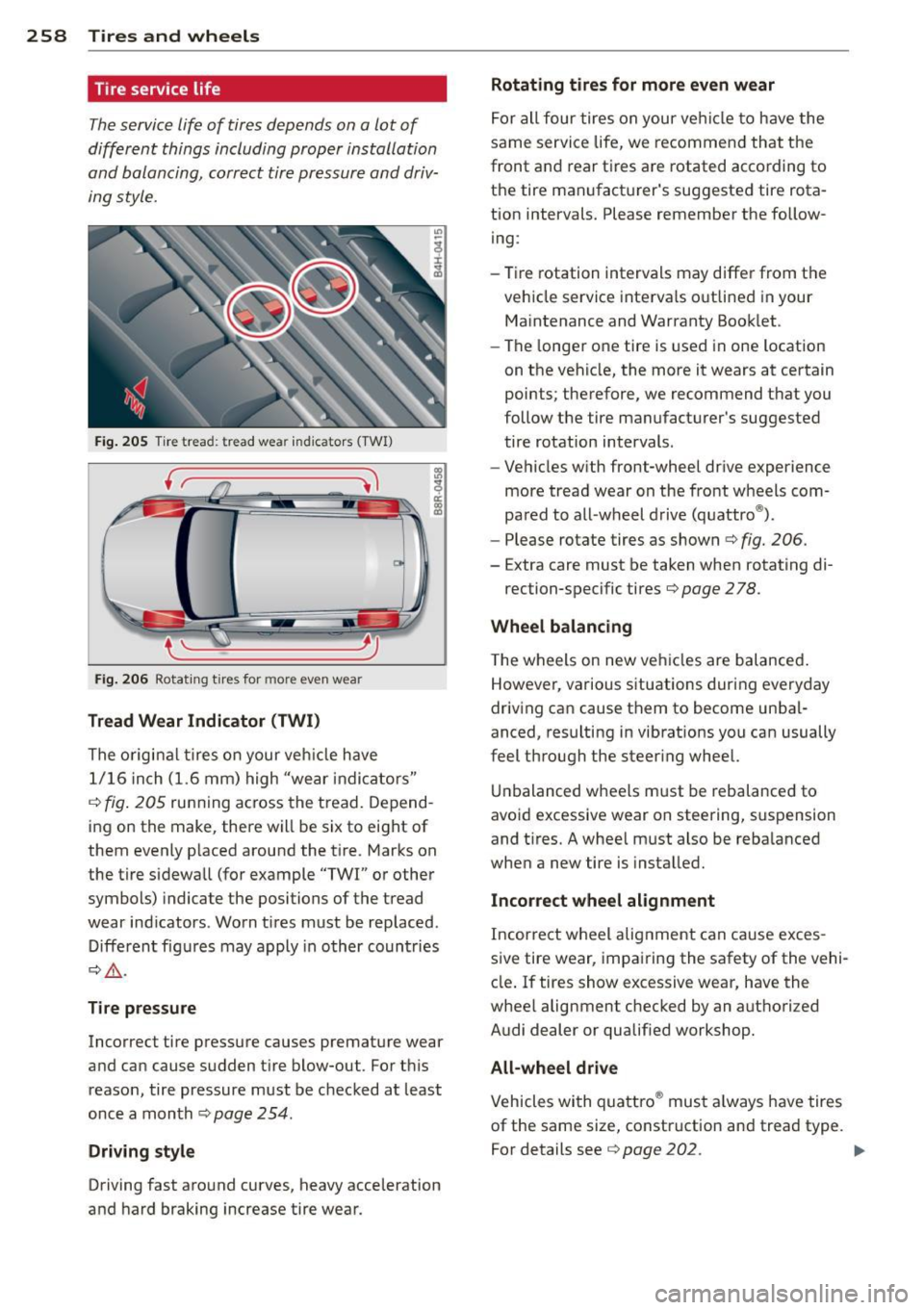
F ig. 20 5 Tire tread: tre ad wea r ind icators (TWI)
F ig. 206 Rotat ing t ires for more ev en wea r
Tread Wear Indicator (TWI)
The o rigi na l tires on your veh icle have
1/16 inch (1.6 mm) high "wear indicators"
c::> fig . 205 running across the tread. Depend
i ng on the make, there will be six to eight of
them evenly p laced around the t ire. Marks on
the tire sidewa ll (for example "TWI" or other
symbols) indicate the positions of the tread
wear ind icators . Worn t ires must be replaced .
Different fig ures may apply in o ther countries
c::> & .
Tire p ressure
Incorrect tire pressure causes premature wear
a nd can cause sudden t ire blow-out. For th is
reason, tire pressure must be checked at least
once a month
c::> page 254.
Driving style
Driving fast aro und curves, heavy acce leration
and hard braking increase tire wear.
Rotating tires for more even wear
F or all four tires on your ve hicl e to h ave the
same service life, we recommend that the
front and rear t ires are rotated according to
the tire manufacturer's suggested tire rota
tion intervals. Please remember the follow
ing :
- Tire rotation intervals may differ from the
vehicle service inte rva ls o utlined in your
Ma intenance and Warranty Book let .
- The longer one tire is used in one location
on the vehicle, the more it wears at certain
points; therefore, we recommend that you
follow the tire manufact urer's suggested
tire rotation intervals .
- Vehi cles w ith front-wheel dr ive experience
more tread wear on the front wheels com
pa red to all-wheel drive (quattro ®).
- Please rotate tires as shown
c::> fig. 206.
-Extra care must be taken when rotating di-
rection-specific tires
c::> page 278 .
Wheel balancing
The wheels on new ve hicles are balanced .
However, various situations during everyday
driving can cause them to become unbal
anced, re sulting in vibrat ions you can usually
feel through the steer ing wheel.
Un balanced whee ls must be rebalanced to
avoid excessive wear on steering, suspension
and t ires. A whee l m ust also be reba lanced
when a new tire is insta lled.
Incorrect wheel alignment
Incor rect wheel alig nment can cause exces
sive tire wear, impairing the safety of the veh i
cle . If tires show excessive wear, have the
whee l alignment checked by an authori zed
Audi dealer or qualif ied workshop .
All-wheel driv e
Vehicles with q uattro ® mus t always have tires
of the same size, construction and tread type .
For details see
c::> page 202 . ..,.
Page 297 of 316
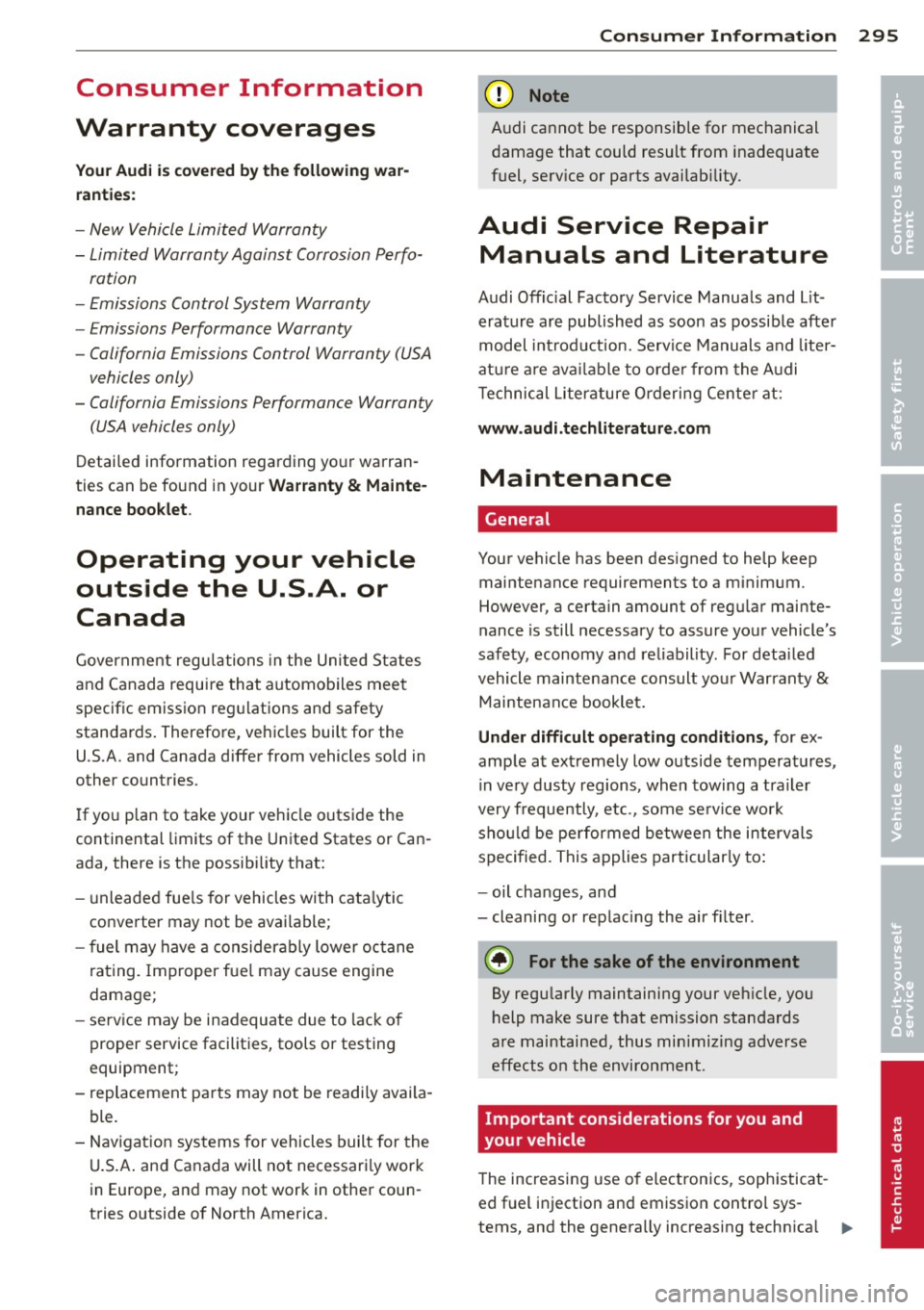
Consumer Information
Warranty coverages
Your Audi is covered by the following war
ranties :
- New Vehicle Limited Warranty
- Limited Warranty Against Corrosion Perfo-
ration
- Emissions Control System Warranty
- Emissions Performance Warranty
- California Emissions Con trol Warranty (USA
vehicles only)
- California Emissions Performance Warranty
(USA vehicles only)
Detailed information regarding your warran
ties can be found in your
Warranty & Mainte
nance booklet .
Operating your vehicle
outside the U.S.A. or
Canada
Government regulations in the United States
and Canada require that automobiles meet
specific emission regulations and safety
standards. Therefore, veh icles built for the
U.S.A. and Canada differ from vehicles sold in
other countries .
If you p lan to take your vehicle outside the
continental limits of the United States or Can
ada, there is the possibility that:
- unleaded fuels for vehicles with cata lytic
converter may not be available;
- fuel may have a considerably lower octane
rating . Improper fuel may cause engine
damage ;
- service may be inadequate due to lack of
proper service facilities, tools or testing
equipment ;
- replacement parts may not be readily availa
ble.
- Navigation systems for vehicles built for the
U.S.A. and Canada will not necessari ly work
in Europe, and may not work in other coun
tries outside of North America.
Consumer Information 295
@ Note
Audi cannot be responsible for mechanical
damage that could result from inadequate
fuel, service or parts availab ility.
Audi Service Repair
Manuals and Literature
Audi Offic ial Factory Service Manuals and Lit
erature are published as soon as possible after
model introduction. Service Manuals and liter
atu re are availabl e to order from the Audi
T echnical Literature Ordering Center at:
www.audi.techliterature.com
Maintenance
' General
Your vehicle has been designed to help keep
maintenance requirements to a minimum.
However, a certain amount of regular mainte
nance is still necessary to assure your vehicle's
safety, economy and reliability . For detailed
vehicle maintenance consult your Warranty
&
Maintenance booklet.
Under difficult operating conditions , for ex
ample at extremely low outside temperatures ,
in very dusty regions, when towing a tra iler
very frequently, etc., some serv ice work
shou ld be pe rformed between the intervals
specified. This applies particularly to:
- oil changes, and
- cleaning or replacing the air filter .
® For the sake of the environment
By regularly maintaining your vehicle, you
help make sure that emission standards
are maintained, thus min imizi ng adverse
effects on the environment .
Important considerations for you and
your vehicle
The increasing use of electronics , sophisticat
ed fuel injection and emission contro l sys-
tems, and the genera lly increasing technica l ..,_
•
•
Page 311 of 316
-----------------------------~I~ n~ d~ e~x 309
Red symbols . . . . . . . . . . . . . . . . . . . . . . . . 28
Refill engine oil ...................... 31
Refuelling . .. ............. .... .. .. . 231
Release lever for hood ............... 233
Remote control
H omelink ...................... .. 135
Remote control key
Unlock ing and locking ............... 40
Remote rear lid release ... .. .. .. .. .. 43
Repair manuals ................... .. 295
Repairs Airbag system
Replacing A fuse
... .. .. .... .. .... ... .. .. ...
Light bulbs ... ... ..... ... .. .. .. .. . 170
280
283
Tires and whee ls . ..... ... .. .. .. .. . 260
Report ing Safety Defects . . . . . . . . 146, 1 47
Reset button . ............. .... .. .... 13
Retractor
' . .. .... ...... ... .. .. .. .. .
Right hand d rive
Rims Cast alloy 1
5 2
5 1
222
Roof rack .... .... ...... ... .. .. .. .... 70
Attac hment points ..... ... .. .. .. .. .. 71
Instal ling the attachments ... .. .. .. .. 72
Instal ling the roof rack .............. 71
Roof load .. ............. .... .. .... 72
Rule of behavior offroad .. ... .. .. .. .. . 209
s
Safe d riving hab its .................. 139
Safety belt position . . . . . . . . . . . . . . . . . 153
Safety belt he ight adjustment ....... 155
Safety belts worn by pregnant women . 154
Safety belt pretensioner . . . . . . . . . . . . . . 155
Service and disposal ............... 156
Safety belts .. ............. .... .. .. . 152
C leaning ... .. .... .... ... .. .. .. ... 226
Danger to passengers who do not wear a
safety belt . . . . . . . . . . . . . . . . . . . . . . . 150
Fastening .. ............. .... .. ... 152
H eight adjustment .......... .. .. .. . 155
Improperly worn ... ..... ... .. .. .. . 155
Not wo rn ........................ 150
Safety belt position . . . . . . . . . . . . . . . . 153
S afety instructions ........ .. .. .. .. . 152 Securing child safety seats . . .
. . . . . . . 188
Specia l considerations for pregnant
women ... .. .. .. .. . .. ... .... ... .. 154
Unfastening . .. .. ................. 154
Warning/ind icator light . . . . . . . . . 16, 149
Why YOU MUST wear them .......... 149
Wor n properly ... .. . .. .. ..... ... .. 151
Safety compliance sticker ..... ... .. .. 290
Safety eq uipment ...... ............. 139
Safety features for occupant restraint and
protection ......................... 139
Safety gu idelines
Seat adjustment .. .................. 61
Safe ty i nstr uct ions
E ngine compartment . ... .... ... .. .. 233
f or side c urtain airbags . ..... ... .. .. 177
for using child safety seats ... ... .. .. 181
for using safety belts ............... 152
Monitoring the Advanced Airbag Sys-
tem ............................. 170
Safety sys tems
Warning/indicator lights ..... ... .. .. . 15
Seat Heating . .... .. .... ... .......... .. . 81
N umber of sea ts . ............. .... 1 49
Ventila tion .. .... .. . .. .. ..... ... .. . 81
Seat adjustment . . . . . . . . . . . . . . . . . . . . . 62
Drive r's seat . . . . . . . . . . . . . . . . . . . . . . . 61
Fron t passenger's seat . . . . . . . . . . . . . . . 62
F ron t seats .. .. .. .... ............. . 61
Head restraints .. .. . ... .... ... .. .. 142
Memory .. .. .... .. . .. .. ..... ... .. . 63
Seat be lts
refer to Safety belts . . . . . . . . . . . . . . . . 149
Seating capac ity .................... 149
Seati ng position
Driver
. . .. .. . ' .. .. . .. .. ..... ... . .
Front passenger .. .. ........... ... .
How to adj ust the front seats ....... .
Incorrect seat position ............. .
Occupants ....................... .
Rea r passengers .. .. . .. .. ..... ... . .
Sea transport 140
141
141
143
140
142
106
Se lective unlock feature . . . . . . . . . . . . . . . 39
Se lective wheel torque control (all-wheel
drive) ......... ... .. ............... 197
•
•
Page 312 of 316
310 Index
Selector lever ..... ..... ... .. .. .... . 123
Emergency release . . . . . . . . . . . . . . . . . 128
Service and disposal
Safety belt p retens ioner . .. .. .. .. .. .
156
Service interval d isp lay ....... ... .. .. .. 22
Service pos ition for windshield wipers .. . 55
SET button . . . . . . . . . . . . . . . . . . . . . . . . . 1 1
Shift buttons .............. .. .. .... . 127
Ship transport ...................... 106
Side airbags
Descr ipt ion . .............. ... .. ...
172
H owtheywork .................... 174
Side assist
Ac tiva ting and deactivating . .. .. .. .. .
118
Adjusting the brightness ............ 118
C leaning sensors .............. .... 2 19
D escr ipt ion ... ........... .. .. .... . 116
Sensor range . . . . . . . . . . . . . . . . . . . . . 117
Side curta in airbags ........ .. .. .. .. . 175
Descr ipt ion . .............. ... .. ... 175
H owtheywo rk .................... 176
Safety instructions ......... ... .. .. . 177
Side marker lights ................... 49
Snow chains .... ... .... ... .. .. .... . 264
Socket .. ... ................... ... .. 75
Sound system display
Driver information display . . . . . . . . . . . .
20
Sources o f informat io n about c hild re-
straints and their use .. ... .. .. .. .... .
19 6
Speedometer ... .... ...... .. .. .. .. .. 13
Speed rating letter code ..... .. .. .. .. . 260
Speed warn ing system ................ 93
Start-Stop-System . . . . . . . . . . . . . . . . . . . 91
Eng ine does not switched off ... ...... 92
E ng ine starts automatically .......... 92
Ind icator lights . . . . . . . . . . . . . . . . . . . . 92
M essages . . . . . . . . . . . . . . . . . . . . . . . . . 93
S tarting/stopping the eng ine . .. .... .. 92
Sw itching off/on . ..... ... .. .. .... .. 93
START ENGINE STOP button (Conven ience
key) . . . . . . . . . . . . . . . . . . . . . . . . . . .
86, 87
Starting from rest .......... .. .. .... .. 90
Starting off with a tra ile r .. .. .. .. .. .. . . 90
Starting the eng ine . . . . . . . . . . . . . . 83, 86
Start ing (engine) . . . . . . . . . . . . . . . . . . . . 98
Stee ring
E lectromechanical power assist . . .
201, 0
Indicator light ... ... .. ..... ... .. .. 201
Locking the steering ............... . 83
Malfunction . . . . . . . . . . . . . . . . . . . . . . . 31
Manually adjusting the steering wheel . . 83
also refer to Electromechanical power as-
s ist ......... ....................
201
Steering wheel column
Adjusting manually .............. .. .
83
Steps for determin ing correct load limit . 257
Stopping the eng ine . . . . . . . . . . . . . . 85, 87
Stopping (engine) ... .............. .. . 98
Storage ............................ 76
Cu pholder door pockets . . . . . . . . . . . . . . 7 4
G love compartment . . . . . . . . . . . . . . . . .
76
Sun shade ........ .. .............. .. 54
Sun visors .. .. .. .. .. ........... .... . 54
Supplementa ry (climate contro l) ... .... . 82
Switches
Emergency flashe rs . . . . . . . . . . . . . . . . .
52
Symbols
Red ..............................
28
Yellow .... .... .. ............. .... . 31
T
Tachometer ..... .. ............. .... . 11
Technical modifications .......... .... 298
Tether anchors .. .................. . 194
Tether strap . ..... ... .. ..... ... .. .. 194
T he first 1,000 miles (1,500 km) and after -
wa rds .............................
205
Tie-down rings . . . . . . . . . . . . . . . . . 68, 146
tiptronic ... .... .. .. ... ..... ... .. .. 123
Automatic Shift Lock (ASL) ... .... . .. 124
Driving . .. .. .. .. ............. .. .. 125
Emergency mode .... .......... .. .. 128
Hill descent control .............. .. 126
K ick -down ........................ 127
Manual shift prog ram .. ....... ... .. 127
Se lector lever .. .. ............. .. .. 123
Tire Mobility System . . . . . . . . . . . . 104, 272
T ire pressure . ... .. .. .... .... ... .. .. 254
T ire pressure mon itoring system ....... 266
Loss of ai r pressure . . . . . . . . . . . . 16, 267
Page 313 of 316
Malfunction ...... .... ... .. .. .. ... 267
Resetting tire pressures . ... .. .. .. .. . 268
Tires .............................. 24 8
Repa ir kit .. ............. .. .. .. ... 272
Repai r set .. .. ........... .. .. .. ... 104
Service life ..... .. .... ... .. .. .. ... 2S8
Speed rating letter code ... .. .. .. .. . 260
T ire manufacturing date ... .. .. .. .. . 260
Tire specifications .......... .. .. .. . 260
Tread depth ............. .... .. ... 258
Uniform tire quality grading .. ....... 262
W inte r tires ..... .. ... ... .. .. .. .. . 263
Tires and vehicle load limits . ... .. .. .. . 256
Tires and whee ls
Chec king tire pressure .............. 254
Cold ti re inflat ion pressu re ... .. .. .. . 2 52
Dimensions .... .. ..... ... .. .. .. ... 259
General notes ... .. .... ... .. .. .. ... 248
Glossary of t ire and load ing term ino lo-
gy .. .. ... . .... ............. .. .. . 249
Low aspect ratio tires ..... .... ... .. . 265
New tires and wheels ............... 259
Replacing ............ ............ 260
S now chai ns ............. .... .. ... 264
Tire pressure monitor ing system . 16, 266
Tires and vehicle load lim its .. .. .. .. . 256
Wheel bolts .... .. .... ... .. .. .. ... 265
W inter tires . .. .. ..... ... .. .. .. ... 263
Tool kit ... .. ................. .. ... 269
Tools ..... .. ................. .. ... 104
Torn or frayed sa fety belts ... .. .. .. .. . 152
Touch-up paint ............. ...... .. 22 1
T ow ing
Front eyelet ............. .... .. ... 287
Rear eye let . ............. .... .. .. . 287
Tow truck procedures ...... .. .. .. .. . 286
Towing a trai ler
Park ing system . ... .... ... .. .. .. ... 134
TPMS Tire pressure monitori ng sys tem .. .. . 26 7
Trailer towing ...................... 212
Operating instructions ......... .. .. . 213
Tec hnical req uirements ...... .. 212,213
Tong ue load ............. .. .. .. .. . 213
Trailer towing tips ........ .. .. .. .. . 214
T railer turn signa l assembly
War ning/ indicato r lights ....... ... ... 16
Inde x 311
Transmission
Malfunction (indicator light) .. ... .. .. 128
t iptron ic . ... .. .. .. . .. ... .... ... .. 123
T ranspo rt Canada .. .... ........... .. 14 7
Travel mode .. .. .. .. ..... ........... 51
T read Wear Ind icator (TWI)
Tr ip compute r 258
Fuel consumpt io n ............. .... . 23
Mileage . .. .. .. .. .... ........... .. . 23
S ingle -trip memo ry .. .. ..... ... .. .. . 23
Tota l-trip memory . .. .. ..... ... .. .. . 23
T rip odomete r ............ ........... 13
Trunk
refer to Rear lid . . . . . . . . . . . . . . . . . . . . 44
T urn signals ... .... .. . .. .. ..... ... .. . 52
Warning/ind icator lights ..... ... .. .. . 16
u
Undercoa ting . .. .. .. . .............. 222
Un fastening safety belts ............. 154
U nidirectional tires ... . .. ..... ... .. .. 248
U ni form tire quality gradi ng .......... 262
U nlocking
Power locking switch ................ 42
Rea r lid/tru nk lid ... . .. .. ... ..... .. . 43
Remote cont ro l key ............... .. 40
U sin g the mec hanical key ............ 41
Use of jumper cables ............ .... 285
V
Vanity mirror . . . . . . . . . . . . . . . . . . . . . . . . 54
Vehicle Transpo rt ... .... .. . .. ... .... ... .. 106
Vehicle-care products . ............... 216
Vehicle Identification Number (VIN) . ... 290
Vehicle jac k . . . . . . . . . . . . . . . . . . . 269, 276
Vehicle literature .. ................. .. 5
Vehicle tool kit .. .. .. . ... ...... ... .. 104
Ventilation . . . . . . . . . . . . . . . . . . . . . . . . . 79
w
Warning/indicator lights . . . . . . . . . . . . . . 10
Airbag system .... ................. 15
Anti- lock b rake system (ABS) . . . . . . . . . 17
Br ake system .. .. ................. . 18
•
•
Page 314 of 316
312 Index
Cruise control . . . . . . . . . . . . . . . . . . . . . . 17
Electromechanica l parking brake .. .. .. 18
Electronic power control ..... .. .... .. 15
Electronic Stabili zation Control (ESC) ... 15
High beam ................ .. .... .. 17
Malfunction Indicator Lamp (MIL) . .... 16
Safety belt .... .... ...... .. .. .. .. .. 16
Tire pressure monitoring system .. .. .. 16
Trailer turn signal assembly .... .. .... 16
Turn signals ............. .. .. .... .. 16
Warning lights ............. ... .. .. .. 14
Warranty coverages ............ .... . 295
Washer reservoir .......... .. .. .... . 247
Washing ...... ........... .. .. .... . 216
Automatic car wash ....... .. .. .. .. . 217
By hand .. .. ................ ... ... 217
General information ....... ..... .. . 216
Matte finish paint . ....... .. .. .. .. . 219
with a power washer ...... .. .. .... . 218
Waxing . .. .... ........... ........ . 220
Wear indicator .. ........ .. .. .. .... . 258
Weights ... .. ................ ... ... 290
What happens if you wear your safety belt
too loo se? ... ............. .. .. .. ... 153
What happens to unbelted occupants? .. 150
What impairs driving safety? ... .. .. .. . 140
What should I do after changing a
wheel? .. .. .. .. . .......... .. .. .... .
255
What should I do after replacing wheels? 255
Wheel bolts
Torque . .. .. ................ ... .. .
265
Wheels ... .. ..................... . 248
Cast alloy ............... .. .. .... . 222
Check ing tire pressure . .... .. .. .. .. . 254
Cold t ire inflation pressure ..... .. ... 252
General notes ... ...... .... ... .. .. . 248
Glossary of tire and load ing te rmin olo-
gy .. .. .. .... ........... .. .. .. .. .
249
New tires and wheels ...... .. .. .. .. . 259
Tires and vehicle load limits . ....... . 256
When must a safety belt be rep laced? .. 152
When must the airbag system be inspect-
ed? ... .. .. .. .. . .......... .. .. .... .
168
When should I adjust the tire pressures? 255
When should I check the tire pressures? . 255
Where are lower anchorages located? . .. 192 Where
can I find the tire pressures for my
car? ..... .. .... .. .. ... ........ .. ..
254
Why safety belts? . . . . . . . . . . . . . . 149, 150
Window regulators
Malfunctions .. .. .. .. ...... ... .. .. .
47
Power locks . . . . . . . . . . . . . . . . . . . . . . . 4 7
Windows Cleaning .. .... .. ............. .... 221
Defrost ing . . . . . . . . . . . . . . . . . . . . . . . .
81
Windshield
Defrosting .... .. .. ......... .. .. .. .
81
Windsh ie ld washer fluid
Low leve l .. .. .. . .............. .. .. .
33
Windsh ie ld wipers .. .............. .. . 54
Faulty ........ .. .. ........ ...... .. 35
Installing new wiper blades . . . . . . . . . . 56
Replac ing the rear wiper blade ........ 56
Service position . . . . . . . . . . . . . . . . . . . . 55
Washer reservoir . ............. .. .. 247
Winter operation
Battery . . . . . . . . . . . . . . . . . . . . . . . . . .
243
Coolant system .. ................ . 240
Defrosting windows ............ .. .. . 81
Seat heating . .. .. ............. .. ... 81
T ires . .... .... ................... 202
Windows ..... .. .. ... ... ..... .. .. 221
Winter tires ..... .. .. ........ ...... .
263
All-wheel drive ... ... .......... .. .. 263
Wiper b lades
Installing new wiper b lades . . . . . . . . . .
56
X
Xenon-L ights . . . . . . . . . . . . . . . . . . . 51, 283
y
Ye llow symbo ls . . . . . . . . . . . . . . . . . . . . . . 31